



Ultrasound Needle Guides Market
Ultrasound Needle Guides Market Size, Share, Insights, Competitive Landscape, and Forecast 2026 to 2033
Ultrasound Needle Guides Market Size and Trend Analysis
How Fast Is the Ultrasound Needle Guides Market Growing?
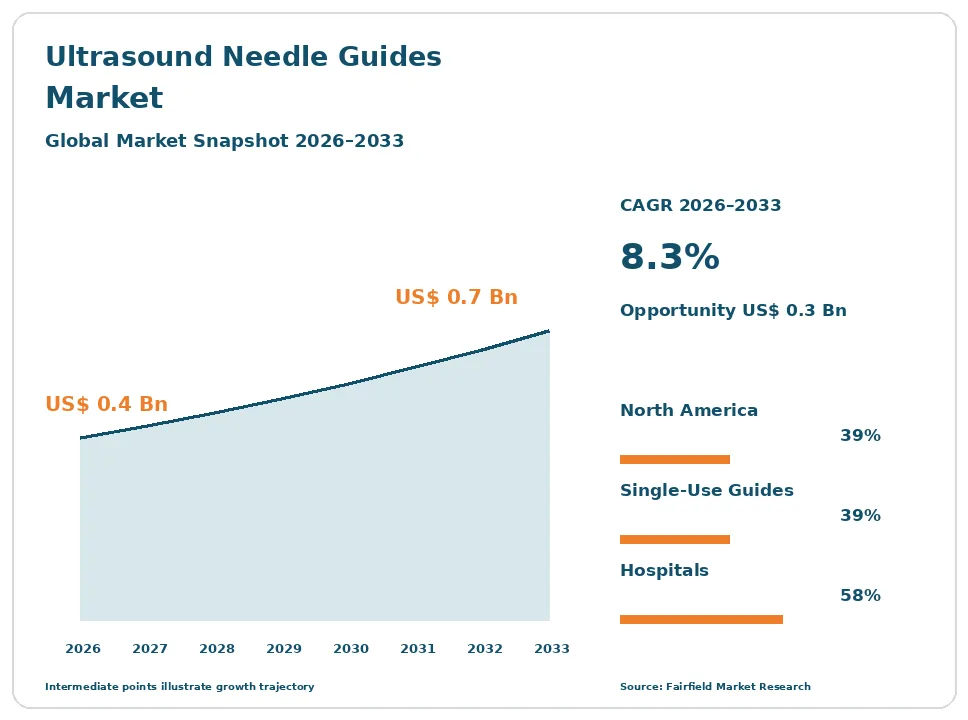
The global ultrasound needle guides market size is expected to be valued at US$ 0.4 billion in 2026 and projected to reach US$ 0.7 billion by 2033, growing at a CAGR of 8.3% between 2026 and 2033. This is an accessory and consumable market. It counts brackets, kits, disposable guides and bundled sterile packs, and excludes ultrasound systems and transducers themselves. Between 2020 and 2025 the category compounded at roughly 6.9% a year, held back during the period by deferred elective procedures. Two forces carry the forecast. Hospitals are converting from reusable brackets to single-use guides because reprocessing carries documented labour, tracking and audit cost. Procedure volumes in regional anaesthesia, vascular access and biopsy continue to rise. Unit prices stay low, so growth comes from volume and from bundling rather than from price.
Key Report Takeaways
- By Product Type: Single-Use Disposable Guides held 39.0% share in 2026, while Needle Guide Kits with Sterile Probe Covers and Gel are projected to expand at a 10.4% CAGR through 2033, as hospitals buy complete procedure packs instead of separate items.
- By Transducer Type: Linear Array Transducer Guides held 41.0% share in 2026, while Endocavity Transducer Guides are projected to expand at a 9.1% CAGR through 2033, driven by transperineal prostate sampling workflows and gynaecological procedure volumes.
- By Application: Biopsy held 31.0% share in 2026, while Regional Anaesthesia is projected to expand at a 10.1% CAGR through 2033, as block techniques spread from specialist centres into routine surgical lists.
- By End User: Hospitals held 58.0% share in 2026, while Ambulatory Surgical Centres and Office-Based Clinics are projected to expand at a 10.6% CAGR through 2033, following the migration of day-case procedures out of inpatient settings.
- By Geography: North America held 39.0% share in 2026, while Asia Pacific is projected to expand at an 11.0% CAGR through 2033, as transducer installed bases widen across China, India and Japan.
Global Ultrasound Needle Guides Market Trends and Insights
Drivers Impact Analysis
| Driver | Impact on CAGR Forecast | Geographic Relevance | Impact Timeline |
| Reprocessing cost and audit burden pushing conversion to single-use guides | High | North America, Europe, Asia Pacific | Long term ≥4 years |
| Rising ultrasound-guided regional anaesthesia and vascular access volumes | High | Global | Medium term 2–4 years |
Two forces, one economic and one procedural, account for most growth in this accessory category.
Reprocessing Economics, Not Clinical Preference, Drive the Shift to Single-Use Needle Guides
The move to disposable guides is a cost and compliance decision taken by sterile processing departments. A reusable bracket and the transducer it attaches to must be cleaned, disinfected and documented between uses, with each step recorded and auditable. Hospitals count the labour minutes, the reprocessing chemistry, the tracking system and the cost of a failed audit, and increasingly conclude that a single-use component removes an entire workflow.
The mechanism is regulatory and operational. Under the Spaulding classification, transducers used in semi-critical applications are subject to high-level disinfection requirements set out in professional society guidance, and manufacturers must supply validated reprocessing instructions in line with ISO 17664. The EU Medical Device Regulation and US Food and Drug Administration reprocessing guidance both place validation obligations on the manufacturer and responsibility for conformance on the facility. Removing a reusable part removes that obligation.
Expanding Ultrasound-Guided Regional Anaesthesia and Vascular Access Lift Guide Consumption
Procedure volume is the second engine, and it is largely outside supplier control. Ultrasound guidance has moved from specialist practice into routine use for peripheral nerve blocks, central and peripheral venous access, drainage and pain management injections. Each of those procedures is a potential unit of consumption for a guide, a sterile cover or a bundled kit, and volumes scale with surgical and emergency activity rather than with capital budgets.
The underlying change is where ultrasound sits. Portable and handheld systems have placed transducers in operating theatres, emergency departments, intensive care units and office-based clinics that previously had none, and professional bodies including AIUM and national anaesthesia and radiology societies publish guidance on ultrasound-guided procedures and probe hygiene. A wider installed base of transducers in procedural settings expands the population of procedures where a guide can be specified at all.
Restraints Impact Analysis
| Restraint | Impact on CAGR Forecast | Geographic Relevance | Impact Timeline |
| Tendered consumable pricing and commoditisation | High | Global | Short term ≤2 years |
| Transducer model fragmentation and continued freehand technique | Medium | Global | Long term ≥4 years |
Two structural limits keep this from becoming a high-value market.
Tendered Consumable Pricing Compresses Margins Across Ultrasound Needle Guide Supply
Needle guides are bought the way gloves and gel are bought, through group purchasing contracts and national tenders, and that process steadily erodes price. A disposable guide carries a low unit price to begin with, and hospitals consolidate accessory spend into multi-line contracts where the lowest compliant quote wins. Suppliers therefore face annual price reviews on products whose specification changes little between cycles.
The cost source is the moulded plastic and packaging rather than the design. Once a guide is validated for a transducer model, manufacturing is inexpensive and easily replicated, so differentiation rests on compatibility coverage, sterilisation validation under ISO 11137 or ISO 11135, and supply reliability. Procedure volumes also sit entirely outside supplier control, so a weak elective surgery year translates directly into lower consumption with no pricing lever available to offset it.
Transducer Model Fragmentation and Freehand Practice Limit Needle Guide Attachment Rates
Guides are transducer-model specific, and that fragmentation is a genuine commercial burden. A hospital group may operate transducers from four or five manufacturers across several generations, each requiring a different bracket geometry. Suppliers must tool, validate and stock dozens of variants to be specified at all, which inflates inventory, raises obsolescence risk and makes small-volume models unprofitable to support.
The second limit is behavioural and technical. Freehand needle technique remains common among experienced operators, who prefer the freedom to angle the needle independently of the transducer, and in many settings no guide is used at all. Electromagnetically tracked needle navigation offers a further alternative approach built into some ultrasound platforms. Together these mean that attachment rate, not procedure count, determines the addressable volume, and that rate varies widely between specialties and countries.
Market Opportunities
Bundled Sterile Procedure Packs Raise Revenue per Ultrasound-Guided Procedure
Selling a complete sterile procedure pack rather than a bare bracket is the clearest route to higher revenue per procedure in this category. A kit combining a single-use guide, a sterile transducer cover, sterile gel and securing bands replaces several separately ordered line items with one catalogue number. Hospitals value the simplified ordering and the removal of assembly steps at the point of use, and the bundle carries a materially higher price than its components alone.
Accessory specialists and probe-cover manufacturers are best placed to capture this pool, because they already hold the cover and gel business. Demand comes from operating theatre and procedural suite managers responsible for stock accuracy and turnover time. Sterilisation validation under ISO 11137 or ISO 11135 is the entry requirement, and suppliers able to configure packs per customer gain contract stickiness that a commodity bracket cannot.
Single-Use Conversion in Endocavity and Vascular Procedures Opens a Replacement Revenue Pool
Converting installed reusable brackets to disposable equivalents is a defined, quantifiable replacement pool rather than a speculative one. Every reusable guide in service represents a procedure stream that currently generates no recurring accessory revenue. When a facility switches, that stream converts into per-procedure consumption, which is why suppliers treat conversion rate as the key commercial metric in this market.
Manufacturers with broad transducer compatibility libraries can capture it, since conversion requires matching the exact fleet a hospital already owns. Demand is led by sterile processing and infection prevention committees rather than by clinicians, and it is strongest in endocavity and vascular access work where reprocessing documentation is most demanding. Ultrasound system manufacturers hold an advantage on their own transducers, while third parties compete by covering mixed fleets that no single original equipment supplier serves.
Segment Analysis
By Product Type: Disposable Guides Lead While Bundled Sterile Kits Grow Fastest
Single-use disposable guides held 39.0% of 2026 revenue, the largest product type, because recurring consumption produces more annual revenue than a durable bracket sold once. Reusable stainless steel guides retained 18.0% and reusable plastic guides 15.0%, both concentrated in facilities with established reprocessing capacity and in cost-constrained markets where capital reuse is preferred.
Needle guide kits bundled with sterile probe covers and gel are the fastest-growing product type at a 10.4% CAGR to 2033, from 28.0% share. Growth comes from procurement simplification rather than from any change in the guide itself: one catalogue number replaces three, and stock control improves. Suppliers are responding by configuring customer-specific packs and validating them under recognised sterilisation standards. The business implication is that value is migrating from the component to the pack, which favours manufacturers holding the cover and gel lines as well as the bracket.
By Transducer Type: Linear Array Guides Dominate While Endocavity Guides Accelerate
Linear array transducer guides accounted for 41.0% of 2026 revenue. Linear probes are the workhorse for vascular access, superficial biopsy and most peripheral nerve block work, so they carry the highest procedure count and the widest range of compatible accessories. Curved array guides follow, used for deeper abdominal targets and drainage work.
Endocavity transducer guides are the fastest-growing type at a 9.1% CAGR. Transrectal and transvaginal procedures involve transducers subject to the most demanding reprocessing requirements, which makes single-use guides and covers commercially attractive, and transperineal prostate sampling workflows have added a distinct accessory set. Intraoperative transducer guides remain a small specialist pool. The practical implication for suppliers is that compatibility libraries must be maintained probe model by probe model, because a hospital specifies against its own fleet and will not accept a near match.
By Application: Biopsy Holds the Largest Share While Regional Anaesthesia Expands Quickest
Biopsy applications represented 31.0% of 2026 ultrasound needle guide revenue, the leading application. Prostate, breast, thyroid, liver and lymph node sampling are high-volume, protocol-driven procedures in which a guide is routinely specified, and many biopsy workflows already use kitted accessories. Vascular access follows at 26.0%, supported by central line and difficult peripheral access volumes.
Regional anaesthesia is the fastest-growing application at a 10.1% CAGR. Nerve block techniques have spread from specialist centres into routine orthopaedic, day-surgery and emergency practice, and each block adds a potential accessory unit. Drainage and pain management injections contribute steady smaller pools. The implication is that growth depends on procedural specialties the supplier cannot influence, so commercial planning in this market tracks surgical and emergency activity statistics more closely than it tracks ultrasound equipment sales.
By End User: Hospitals Anchor Volume While Ambulatory Settings Scale Fastest
Hospitals held 58.0% of 2026 end-user revenue. They perform the broadest range of image-guided procedures, operate the largest and most varied transducer fleets, and maintain the sterile processing departments whose cost calculations drive single-use conversion. Hospital group purchasing contracts also set the reference price for the whole category.
Ambulatory surgical centres and office-based clinics are the fastest-growing end user at a 10.6% CAGR. Day-case migration has moved substantial procedural volume into settings with no sterile processing department, which makes disposable guides and bundled kits the practical default rather than a cost choice. Diagnostic imaging centres and specialty oncology and urology centres complete the mix. For suppliers the change is commercial: thousands of small accounts order in low volumes through distributors, which demands different packaging sizes and a distribution model built for breadth rather than depth.
Geography Analysis
Which Region Is Leading the Ultrasound Needle Guides Market?
North America leads the ultrasound needle guides market with 39.0% share in 2026, driven by the highest per-capita volume of image-guided procedures and the most advanced single-use conversion. The United States accounts for most of it, with Canada contributing a smaller provincially funded base. These accessories are regulated as class II devices cleared through the US Food and Drug Administration premarket notification pathway, and reusable variants must carry validated reprocessing instructions consistent with agency guidance on reprocessing medical devices in health care settings. Accreditation bodies audit transducer disinfection practice, which strengthens the cost case for disposables. Group purchasing organisations concentrate buying power and compress unit prices. The defining regional change is the continued migration of procedures into ambulatory surgical centres and office-based clinics, which lack reprocessing facilities and therefore buy kits by default.
Europe Converts to Single-Use Under Tighter Device and Reprocessing Obligations
Europe held 29.0% of 2026 revenue, the second-largest pool, with Germany, France, the United Kingdom, Italy and the Nordic countries driving demand. The EU Medical Device Regulation sets explicit obligations for reusable devices, including validated cleaning and disinfection information and conformity assessment involvement for the reprocessing aspects, which raises the administrative cost of keeping reusable brackets in service. National infection prevention bodies publish transducer disinfection requirements aligned to the Spaulding classification, and hospital audits increasingly test documentary conformance. Procurement is heavily tendered, often at national or regional level, so prices are tightly controlled. The notable change is that compliance workload rather than unit price is now the decisive argument in conversion business cases, which has shifted supplier selling effort toward infection prevention committees and away from clinical users.
Which Region Is Growing Fastest in the Ultrasound Needle Guides Market?
Asia Pacific is growing fastest in the ultrasound needle guides market at an 11.0% CAGR between 2026 and 2033, from 22.0% share in 2026. China supplies the largest absolute increase, as domestic ultrasound manufacturers expand installed transducer bases through county-level hospital procurement programmes and accessory demand follows the fleet. India adds rapid growth in private hospital chains and diagnostic networks, where ultrasound-guided biopsy and vascular access volumes are rising quickly. Japan and South Korea contribute mature, high-specification demand with strong single-use adoption, while Australia applies stringent transducer reprocessing guidance. Price sensitivity is acute across much of the region, which sustains reusable guides longer than elsewhere. The defining change is local manufacture of compatible disposables, which lowers landed cost and accelerates conversion in public hospital tenders.
Latin America Grows From a Small Base Against Import Cost and Reprocessing Gaps
Latin America accounted for 6.0% of 2026 ultrasound needle guide revenue, with Brazil and Mexico contributing most and Argentina, Chile and Colombia adding private hospital demand. Image-guided procedure volumes are rising in metropolitan private networks, and distributors are extending accessory ranges alongside ultrasound system sales. Barriers are real: imported disposables carry currency-exposed pricing that makes reuse economically attractive, public hospital budgets prioritise capital equipment over consumables, and national registration adds delay for each transducer-specific variant a supplier wishes to list. Sterile processing capacity varies widely between institutions. The clearest regional change is the extension of accreditation programmes into private hospital groups, which brings documented transducer disinfection practice into routine audit and gradually strengthens the commercial case for single-use kits.
Middle East & Africa Demand Concentrates in Gulf Hospital Networks
Middle East & Africa represented 4.0% of 2026 revenue, the smallest regional pool. Demand concentrates in the United Arab Emirates, Saudi Arabia, Qatar and Israel, where new hospital construction installs modern transducer fleets and procurement specifications frequently mandate single-use accessories from the outset. South Africa anchors demand on the continent, with Egypt and Nigeria growing from low bases. Barriers are substantial: import dependence for every component, fragmented registration across many national authorities, limited sterile processing infrastructure outside tertiary centres, and procedural volumes constrained by specialist workforce availability. Distribution is thin, so stock availability is a recurring problem. The notable change is the inclusion of consumable supply within multi-year ultrasound equipment tenders in Gulf states, which locks accessory revenue to system contracts and favours original equipment manufacturers.
Competitive Landscape
The ultrasound needle guides market is moderately concentrated, and its structure is dictated by transducer compatibility rather than by scale. One accessory specialist has long held the widest compatibility library and supplies guides under its own brand and under original equipment agreements. Alongside it, the major ultrasound system manufacturers each supply branded guides for their own transducers, which gives them a structural advantage wherever a hospital standardises on one fleet. Beneath both groups sits a long tail of regional moulders and probe-cover manufacturers competing on price for high-volume disposable lines. Consolidation has been limited, because the category is small and the assets are specialised tooling rather than platforms.
Competition rests on compatibility coverage first. A supplier that cannot match the exact transducer models a hospital owns is simply not specified, regardless of price or quality. The remaining factors are sterilisation validation and regulatory documentation, breadth of bundled kit configurations, supply reliability into tendered contracts, and unit price, which dominates once compatibility is established. New approaches entering the field include ultrasound platforms with integrated electromagnetic needle tracking, which bypass the bracket entirely, and low-cost disposable manufacturers in China and India competing in public tenders.
Strategic activity concentrates on compatibility libraries and kit configuration rather than on product innovation. Accessory specialists invest in tooling for newly launched transducer models so they are ready when fleets refresh, and they pursue original equipment supply agreements that place their guides inside system manufacturers’ catalogues. Probe-cover and gel manufacturers extend upward into complete procedure packs, while system manufacturers bundle accessory supply into multi-year equipment contracts to protect the attached consumable stream.
The shared strategic direction is to convert a commodity component into a contracted procedure pack, because the pack is where pricing power and customer retention now sit.
Ultrasound Needle Guides Industry Leaders
- CIVCO Medical Solutions
- GE HealthCare Technologies Inc.
- Koninklijke Philips N.V.
- Siemens Healthineers AG
- Canon Medical Systems Corporation
Recent Industry Developments
- March 2024: The US Environmental Protection Agency finalised tighter emission standards for commercial ethylene oxide sterilisation facilities – raising compliance cost and capacity risk for the contract sterilisation of single-use ultrasound accessory kits.
- July 2024: An amending regulation introduced a phased roll-out of the European Database on Medical Devices and a duty to notify interruptions of supply under the EU Medical Device Regulation – adding registration and reporting obligations for accessory manufacturers selling into the European Union.
- June 2025: New United Kingdom post-market surveillance requirements for medical devices came into force – extending vigilance, trend reporting and periodic review duties to suppliers of ultrasound accessories placed on the British market.
Companies Covered in the Report
- CIVCO Medical Solutions
- GE HealthCare Technologies Inc.
- Siemens Healthineers AG
- Koninklijke Philips N.V.
- Canon Medical Systems Corporation
- FUJIFILM Sonosite, Inc.
- Esaote S.p.A.
- Mindray Bio-Medical Electronics Co., Ltd.
- SonoScape Medical Corp.
- Protek Medical Products, Inc.
- Parker Laboratories, Inc.
- Ecolab Inc.
- Argon Medical Devices, Inc.
- Medline Industries, LP
Ultrasound Needle Guides Market Report Scope
This study covers brackets, kits and accessories that fix and align a needle to an ultrasound transducer, including reusable metal and plastic guides, single-use disposables and bundled sterile kits. Ultrasound systems, transducers and needles themselves are excluded, and freehand and electromagnetically tracked approaches are treated only as competing alternatives. The base year is 2025, with a forecast period of 2026 to 2033, reported in US$ Billion.
Product Type
- Reusable Stainless Steel Guides
- Reusable Plastic Guides
- Single-Use Disposable Guides
- Needle Guide Kits with Sterile Probe Covers and Gel
Transducer Type
- Linear Array Transducer Guides
- Curved Array Transducer Guides
- Endocavity Transducer Guides
- Intraoperative Transducer Guides
Application
- Biopsy
- Vascular Access
- Regional Anaesthesia
- Drainage
- Pain Management
End User
- Hospitals
- Ambulatory Surgical Centres and Office-Based Clinics
- Diagnostic Imaging Centres
- Specialty Oncology and Urology Centres
Regions
- North America
- Europe
- Asia Pacific
- Latin America
- Middle East & Africa
Key Questions Answered in the Report
How large is the ultrasound needle guides market in 2026?
The ultrasound needle guides market is valued at US$ 0.4 billion in 2026, counting accessories and consumables only and excluding ultrasound systems and transducers.
What is the ultrasound needle guides forecast and CAGR to 2033?
The market is projected to reach US$ 0.7 billion by 2033 at an 8.3% CAGR, adding US$ 0.3 billion in absolute dollar opportunity.
Which product type holds the largest share?
Single-use disposable guides lead with 39.0% share in 2026, because recurring per-procedure consumption generates more annual revenue than a durable reusable bracket.
Which ultrasound needle guides segment is growing fastest?
Bundled kits with sterile probe covers and gel grow fastest at a 10.4% CAGR, because one catalogue number replaces several separately ordered items.
Which region leads the ultrasound needle guides market?
North America leads with 39.0% share in 2026, supported by high image-guided procedure volumes and the most advanced conversion to single-use accessories.
1. Executive Summary
1.1. Global Ultrasound Needle Guides Market Snapshot
1.2. Future Projections
1.3. Key Report Takeaways
1.4. Regional Snapshot
2. Market Overview
2.1. Market Definition and Report Scope
2.2. Historical Trends 2020–2025
2.3. Market Dynamics
2.3.1. Drivers
2.3.1.1. Reprocessing Economics, Not Clinical Preference, Drive the Shift to Single-Use Needle Guides
2.3.1.2. Expanding Ultrasound-Guided Regional Anaesthesia and Vascular Access Lift Guide Consumption
2.3.2. Restraints
2.3.2.1. Tendered Consumable Pricing Compresses Margins Across Ultrasound Needle Guide Supply
2.3.2.2. Transducer Model Fragmentation and Freehand Practice Limit Needle Guide Attachment Rates
2.3.3. Market Opportunities
2.3.3.1. Bundled Sterile Procedure Packs Raise Revenue per Ultrasound-Guided Procedure
2.3.3.2. Single-Use Conversion in Endocavity and Vascular Procedures Opens a Replacement Revenue Pool
3. Global Ultrasound Needle Guides Market Outlook, 2020–2033
3.1. Global Ultrasound Needle Guides Market Outlook, by Product Type, Value (US$ Billion), 2020–2033
3.1.1. Reusable Stainless Steel Guides
3.1.2. Reusable Plastic Guides
3.1.3. Single-Use Disposable Guides
3.1.4. Needle Guide Kits with Sterile Probe Covers and Gel
3.2. Global Ultrasound Needle Guides Market Outlook, by Transducer Type, Value (US$ Billion), 2020–2033
3.2.1. Linear Array Transducer Guides
3.2.2. Curved Array Transducer Guides
3.2.3. Endocavity Transducer Guides
3.2.4. Intraoperative Transducer Guides
3.3. Global Ultrasound Needle Guides Market Outlook, by Application, Value (US$ Billion), 2020–2033
3.3.1. Biopsy
3.3.2. Vascular Access
3.3.3. Regional Anaesthesia
3.3.4. Drainage
3.3.5. Pain Management
3.4. Global Ultrasound Needle Guides Market Outlook, by End User, Value (US$ Billion), 2020–2033
3.4.1. Hospitals
3.4.2. Ambulatory Surgical Centres and Office-Based Clinics
3.4.3. Diagnostic Imaging Centres
3.4.4. Specialty Oncology and Urology Centres
3.5. Global Ultrasound Needle Guides Market Outlook, by Region, Value (US$ Billion), 2020–2033
3.5.1. North America
3.5.2. Europe
3.5.3. Asia Pacific
3.5.4. Latin America
3.5.5. Middle East & Africa
4. North America Ultrasound Needle Guides Market Outlook, 2020–2033
4.1. North America Ultrasound Needle Guides Market Outlook, by Product Type, Value (US$ Billion), 2020–2033
4.1.1. Reusable Stainless Steel Guides
4.1.2. Reusable Plastic Guides
4.1.3. Single-Use Disposable Guides
4.1.4. Needle Guide Kits with Sterile Probe Covers and Gel
4.2. North America Ultrasound Needle Guides Market Outlook, by Transducer Type, Value (US$ Billion), 2020–2033
4.2.1. Linear Array Transducer Guides
4.2.2. Curved Array Transducer Guides
4.2.3. Endocavity Transducer Guides
4.2.4. Intraoperative Transducer Guides
4.3. North America Ultrasound Needle Guides Market Outlook, by Application, Value (US$ Billion), 2020–2033
4.3.1. Biopsy
4.3.2. Vascular Access
4.3.3. Regional Anaesthesia
4.3.4. Drainage
4.3.5. Pain Management
4.4. North America Ultrasound Needle Guides Market Outlook, by End User, Value (US$ Billion), 2020–2033
4.4.1. Hospitals
4.4.2. Ambulatory Surgical Centres and Office-Based Clinics
4.4.3. Diagnostic Imaging Centres
4.4.4. Specialty Oncology and Urology Centres
4.5. North America Ultrasound Needle Guides Market Outlook, by Country, Value (US$ Billion), 2020–2033
4.5.1. United States Ultrasound Needle Guides Market Outlook, by Product Type, 2020–2033
4.5.2. United States Ultrasound Needle Guides Market Outlook, by Transducer Type, 2020–2033
4.5.3. United States Ultrasound Needle Guides Market Outlook, by Application, 2020–2033
4.5.4. United States Ultrasound Needle Guides Market Outlook, by End User, 2020–2033
4.5.5. Canada Ultrasound Needle Guides Market Outlook, by Product Type, 2020–2033
4.5.6. Canada Ultrasound Needle Guides Market Outlook, by Transducer Type, 2020–2033
4.5.7. Canada Ultrasound Needle Guides Market Outlook, by Application, 2020–2033
4.5.8. Canada Ultrasound Needle Guides Market Outlook, by End User, 2020–2033
5. Europe Ultrasound Needle Guides Market Outlook, 2020–2033
5.1. Europe Ultrasound Needle Guides Market Outlook, by Product Type, Value (US$ Billion), 2020–2033
5.1.1. Reusable Stainless Steel Guides
5.1.2. Reusable Plastic Guides
5.1.3. Single-Use Disposable Guides
5.1.4. Needle Guide Kits with Sterile Probe Covers and Gel
5.2. Europe Ultrasound Needle Guides Market Outlook, by Transducer Type, Value (US$ Billion), 2020–2033
5.2.1. Linear Array Transducer Guides
5.2.2. Curved Array Transducer Guides
5.2.3. Endocavity Transducer Guides
5.2.4. Intraoperative Transducer Guides
5.3. Europe Ultrasound Needle Guides Market Outlook, by Application, Value (US$ Billion), 2020–2033
5.3.1. Biopsy
5.3.2. Vascular Access
5.3.3. Regional Anaesthesia
5.3.4. Drainage
5.3.5. Pain Management
5.4. Europe Ultrasound Needle Guides Market Outlook, by End User, Value (US$ Billion), 2020–2033
5.4.1. Hospitals
5.4.2. Ambulatory Surgical Centres and Office-Based Clinics
5.4.3. Diagnostic Imaging Centres
5.4.4. Specialty Oncology and Urology Centres
5.5. Europe Ultrasound Needle Guides Market Outlook, by Country, Value (US$ Billion), 2020–2033
5.5.1. Germany Ultrasound Needle Guides Market Outlook, by Product Type, 2020–2033
5.5.2. Germany Ultrasound Needle Guides Market Outlook, by Transducer Type, 2020–2033
5.5.3. Germany Ultrasound Needle Guides Market Outlook, by Application, 2020–2033
5.5.4. Germany Ultrasound Needle Guides Market Outlook, by End User, 2020–2033
5.5.5. France Ultrasound Needle Guides Market Outlook, by Product Type, 2020–2033
5.5.6. France Ultrasound Needle Guides Market Outlook, by Transducer Type, 2020–2033
5.5.7. France Ultrasound Needle Guides Market Outlook, by Application, 2020–2033
5.5.8. France Ultrasound Needle Guides Market Outlook, by End User, 2020–2033
5.5.9. United Kingdom Ultrasound Needle Guides Market Outlook, by Product Type, 2020–2033
5.5.10. United Kingdom Ultrasound Needle Guides Market Outlook, by Transducer Type, 2020–2033
5.5.11. United Kingdom Ultrasound Needle Guides Market Outlook, by Application, 2020–2033
5.5.12. United Kingdom Ultrasound Needle Guides Market Outlook, by End User, 2020–2033
5.5.13. Italy Ultrasound Needle Guides Market Outlook, by Product Type, 2020–2033
5.5.14. Italy Ultrasound Needle Guides Market Outlook, by Transducer Type, 2020–2033
5.5.15. Italy Ultrasound Needle Guides Market Outlook, by Application, 2020–2033
5.5.16. Italy Ultrasound Needle Guides Market Outlook, by End User, 2020–2033
5.5.17. Nordic countries Ultrasound Needle Guides Market Outlook, by Product Type, 2020–2033
5.5.18. Nordic countries Ultrasound Needle Guides Market Outlook, by Transducer Type, 2020–2033
5.5.19. Nordic countries Ultrasound Needle Guides Market Outlook, by Application, 2020–2033
5.5.20. Nordic countries Ultrasound Needle Guides Market Outlook, by End User, 2020–2033
6. Asia Pacific Ultrasound Needle Guides Market Outlook, 2020–2033
6.1. Asia Pacific Ultrasound Needle Guides Market Outlook, by Product Type, Value (US$ Billion), 2020–2033
6.1.1. Reusable Stainless Steel Guides
6.1.2. Reusable Plastic Guides
6.1.3. Single-Use Disposable Guides
6.1.4. Needle Guide Kits with Sterile Probe Covers and Gel
6.2. Asia Pacific Ultrasound Needle Guides Market Outlook, by Transducer Type, Value (US$ Billion), 2020–2033
6.2.1. Linear Array Transducer Guides
6.2.2. Curved Array Transducer Guides
6.2.3. Endocavity Transducer Guides
6.2.4. Intraoperative Transducer Guides
6.3. Asia Pacific Ultrasound Needle Guides Market Outlook, by Application, Value (US$ Billion), 2020–2033
6.3.1. Biopsy
6.3.2. Vascular Access
6.3.3. Regional Anaesthesia
6.3.4. Drainage
6.3.5. Pain Management
6.4. Asia Pacific Ultrasound Needle Guides Market Outlook, by End User, Value (US$ Billion), 2020–2033
6.4.1. Hospitals
6.4.2. Ambulatory Surgical Centres and Office-Based Clinics
6.4.3. Diagnostic Imaging Centres
6.4.4. Specialty Oncology and Urology Centres
6.5. Asia Pacific Ultrasound Needle Guides Market Outlook, by Country, Value (US$ Billion), 2020–2033
6.5.1. China Ultrasound Needle Guides Market Outlook, by Product Type, 2020–2033
6.5.2. China Ultrasound Needle Guides Market Outlook, by Transducer Type, 2020–2033
6.5.3. China Ultrasound Needle Guides Market Outlook, by Application, 2020–2033
6.5.4. China Ultrasound Needle Guides Market Outlook, by End User, 2020–2033
6.5.5. India Ultrasound Needle Guides Market Outlook, by Product Type, 2020–2033
6.5.6. India Ultrasound Needle Guides Market Outlook, by Transducer Type, 2020–2033
6.5.7. India Ultrasound Needle Guides Market Outlook, by Application, 2020–2033
6.5.8. India Ultrasound Needle Guides Market Outlook, by End User, 2020–2033
6.5.9. Japan Ultrasound Needle Guides Market Outlook, by Product Type, 2020–2033
6.5.10. Japan Ultrasound Needle Guides Market Outlook, by Transducer Type, 2020–2033
6.5.11. Japan Ultrasound Needle Guides Market Outlook, by Application, 2020–2033
6.5.12. Japan Ultrasound Needle Guides Market Outlook, by End User, 2020–2033
6.5.13. South Korea Ultrasound Needle Guides Market Outlook, by Product Type, 2020–2033
6.5.14. South Korea Ultrasound Needle Guides Market Outlook, by Transducer Type, 2020–2033
6.5.15. South Korea Ultrasound Needle Guides Market Outlook, by Application, 2020–2033
6.5.16. South Korea Ultrasound Needle Guides Market Outlook, by End User, 2020–2033
6.5.17. Australia Ultrasound Needle Guides Market Outlook, by Product Type, 2020–2033
6.5.18. Australia Ultrasound Needle Guides Market Outlook, by Transducer Type, 2020–2033
6.5.19. Australia Ultrasound Needle Guides Market Outlook, by Application, 2020–2033
6.5.20. Australia Ultrasound Needle Guides Market Outlook, by End User, 2020–2033
7. Latin America Ultrasound Needle Guides Market Outlook, 2020–2033
7.1. Latin America Ultrasound Needle Guides Market Outlook, by Product Type, Value (US$ Billion), 2020–2033
7.1.1. Reusable Stainless Steel Guides
7.1.2. Reusable Plastic Guides
7.1.3. Single-Use Disposable Guides
7.1.4. Needle Guide Kits with Sterile Probe Covers and Gel
7.2. Latin America Ultrasound Needle Guides Market Outlook, by Transducer Type, Value (US$ Billion), 2020–2033
7.2.1. Linear Array Transducer Guides
7.2.2. Curved Array Transducer Guides
7.2.3. Endocavity Transducer Guides
7.2.4. Intraoperative Transducer Guides
7.3. Latin America Ultrasound Needle Guides Market Outlook, by Application, Value (US$ Billion), 2020–2033
7.3.1. Biopsy
7.3.2. Vascular Access
7.3.3. Regional Anaesthesia
7.3.4. Drainage
7.3.5. Pain Management
7.4. Latin America Ultrasound Needle Guides Market Outlook, by End User, Value (US$ Billion), 2020–2033
7.4.1. Hospitals
7.4.2. Ambulatory Surgical Centres and Office-Based Clinics
7.4.3. Diagnostic Imaging Centres
7.4.4. Specialty Oncology and Urology Centres
7.5. Latin America Ultrasound Needle Guides Market Outlook, by Country, Value (US$ Billion), 2020–2033
7.5.1. Brazil Ultrasound Needle Guides Market Outlook, by Product Type, 2020–2033
7.5.2. Brazil Ultrasound Needle Guides Market Outlook, by Transducer Type, 2020–2033
7.5.3. Brazil Ultrasound Needle Guides Market Outlook, by Application, 2020–2033
7.5.4. Brazil Ultrasound Needle Guides Market Outlook, by End User, 2020–2033
7.5.5. Mexico Ultrasound Needle Guides Market Outlook, by Product Type, 2020–2033
7.5.6. Mexico Ultrasound Needle Guides Market Outlook, by Transducer Type, 2020–2033
7.5.7. Mexico Ultrasound Needle Guides Market Outlook, by Application, 2020–2033
7.5.8. Mexico Ultrasound Needle Guides Market Outlook, by End User, 2020–2033
7.5.9. Argentina Ultrasound Needle Guides Market Outlook, by Product Type, 2020–2033
7.5.10. Argentina Ultrasound Needle Guides Market Outlook, by Transducer Type, 2020–2033
7.5.11. Argentina Ultrasound Needle Guides Market Outlook, by Application, 2020–2033
7.5.12. Argentina Ultrasound Needle Guides Market Outlook, by End User, 2020–2033
7.5.13. Chile Ultrasound Needle Guides Market Outlook, by Product Type, 2020–2033
7.5.14. Chile Ultrasound Needle Guides Market Outlook, by Transducer Type, 2020–2033
7.5.15. Chile Ultrasound Needle Guides Market Outlook, by Application, 2020–2033
7.5.16. Chile Ultrasound Needle Guides Market Outlook, by End User, 2020–2033
7.5.17. Colombia Ultrasound Needle Guides Market Outlook, by Product Type, 2020–2033
7.5.18. Colombia Ultrasound Needle Guides Market Outlook, by Transducer Type, 2020–2033
7.5.19. Colombia Ultrasound Needle Guides Market Outlook, by Application, 2020–2033
7.5.20. Colombia Ultrasound Needle Guides Market Outlook, by End User, 2020–2033
8. Middle East & Africa Ultrasound Needle Guides Market Outlook, 2020–2033
8.1. Middle East & Africa Ultrasound Needle Guides Market Outlook, by Product Type, Value (US$ Billion), 2020–2033
8.1.1. Reusable Stainless Steel Guides
8.1.2. Reusable Plastic Guides
8.1.3. Single-Use Disposable Guides
8.1.4. Needle Guide Kits with Sterile Probe Covers and Gel
8.2. Middle East & Africa Ultrasound Needle Guides Market Outlook, by Transducer Type, Value (US$ Billion), 2020–2033
8.2.1. Linear Array Transducer Guides
8.2.2. Curved Array Transducer Guides
8.2.3. Endocavity Transducer Guides
8.2.4. Intraoperative Transducer Guides
8.3. Middle East & Africa Ultrasound Needle Guides Market Outlook, by Application, Value (US$ Billion), 2020–2033
8.3.1. Biopsy
8.3.2. Vascular Access
8.3.3. Regional Anaesthesia
8.3.4. Drainage
8.3.5. Pain Management
8.4. Middle East & Africa Ultrasound Needle Guides Market Outlook, by End User, Value (US$ Billion), 2020–2033
8.4.1. Hospitals
8.4.2. Ambulatory Surgical Centres and Office-Based Clinics
8.4.3. Diagnostic Imaging Centres
8.4.4. Specialty Oncology and Urology Centres
8.5. Middle East & Africa Ultrasound Needle Guides Market Outlook, by Country, Value (US$ Billion), 2020–2033
8.5.1. United Arab Emirates Ultrasound Needle Guides Market Outlook, by Product Type, 2020–2033
8.5.2. United Arab Emirates Ultrasound Needle Guides Market Outlook, by Transducer Type, 2020–2033
8.5.3. United Arab Emirates Ultrasound Needle Guides Market Outlook, by Application, 2020–2033
8.5.4. United Arab Emirates Ultrasound Needle Guides Market Outlook, by End User, 2020–2033
8.5.5. Saudi Arabia Ultrasound Needle Guides Market Outlook, by Product Type, 2020–2033
8.5.6. Saudi Arabia Ultrasound Needle Guides Market Outlook, by Transducer Type, 2020–2033
8.5.7. Saudi Arabia Ultrasound Needle Guides Market Outlook, by Application, 2020–2033
8.5.8. Saudi Arabia Ultrasound Needle Guides Market Outlook, by End User, 2020–2033
8.5.9. Qatar Ultrasound Needle Guides Market Outlook, by Product Type, 2020–2033
8.5.10. Qatar Ultrasound Needle Guides Market Outlook, by Transducer Type, 2020–2033
8.5.11. Qatar Ultrasound Needle Guides Market Outlook, by Application, 2020–2033
8.5.12. Qatar Ultrasound Needle Guides Market Outlook, by End User, 2020–2033
8.5.13. Israel Ultrasound Needle Guides Market Outlook, by Product Type, 2020–2033
8.5.14. Israel Ultrasound Needle Guides Market Outlook, by Transducer Type, 2020–2033
8.5.15. Israel Ultrasound Needle Guides Market Outlook, by Application, 2020–2033
8.5.16. Israel Ultrasound Needle Guides Market Outlook, by End User, 2020–2033
8.5.17. South Africa Ultrasound Needle Guides Market Outlook, by Product Type, 2020–2033
8.5.18. South Africa Ultrasound Needle Guides Market Outlook, by Transducer Type, 2020–2033
8.5.19. South Africa Ultrasound Needle Guides Market Outlook, by Application, 2020–2033
8.5.20. South Africa Ultrasound Needle Guides Market Outlook, by End User, 2020–2033
8.5.21. Egypt Ultrasound Needle Guides Market Outlook, by Product Type, 2020–2033
8.5.22. Egypt Ultrasound Needle Guides Market Outlook, by Transducer Type, 2020–2033
8.5.23. Egypt Ultrasound Needle Guides Market Outlook, by Application, 2020–2033
8.5.24. Egypt Ultrasound Needle Guides Market Outlook, by End User, 2020–2033
8.5.25. Nigeria Ultrasound Needle Guides Market Outlook, by Product Type, 2020–2033
8.5.26. Nigeria Ultrasound Needle Guides Market Outlook, by Transducer Type, 2020–2033
8.5.27. Nigeria Ultrasound Needle Guides Market Outlook, by Application, 2020–2033
8.5.28. Nigeria Ultrasound Needle Guides Market Outlook, by End User, 2020–2033
9. Competitive Landscape
9.1. Market Concentration and Industry Leaders
9.2. Competitive Differentiation
9.3. Strategic Moves and Market Direction
9.4. Recent Industry Developments
9.5. Company Profiles
9.5.1. CIVCO Medical Solutions
9.5.2. GE HealthCare Technologies Inc.
9.5.3. Siemens Healthineers AG
9.5.4. Koninklijke Philips N.V.
9.5.5. Canon Medical Systems Corporation
9.5.6. FUJIFILM Sonosite, Inc.
9.5.7. Esaote S.p.A.
9.5.8. Mindray Bio-Medical Electronics Co., Ltd.
9.5.9. SonoScape Medical Corp.
9.5.10. Protek Medical Products, Inc.
9.5.11. Parker Laboratories, Inc.
9.5.12. Ecolab Inc.
9.5.13. Argon Medical Devices, Inc.
9.5.14. Medline Industries, LP
10. Appendix
10.1. Research Methodology
10.2. Report Assumptions
10.3. Acronyms and Abbreviations
| Product Type | Reusable Stainless Steel Guides, Reusable Plastic Guides, Single-Use Disposable Guides, Needle Guide Kits with Sterile Probe Covers and Gel |
| Transducer Type | Linear Array Transducer Guides, Curved Array Transducer Guides, Endocavity Transducer Guides, Intraoperative Transducer Guides |
| Application | Biopsy, Vascular Access, Regional Anaesthesia, Drainage, Pain Management |
| End User | Hospitals, Ambulatory Surgical Centres and Office-Based Clinics, Diagnostic Imaging Centres, Specialty Oncology and Urology Centres |
| Regions | North America, Europe, Asia Pacific, Latin America, Middle East & Africa |
Our Research Methodology
Considering the volatility of business today, traditional approaches to strategizing a game plan can be unfruitful if not detrimental. True ambiguity is no way to determine a forecast. A myriad of predetermined factors must be accounted for such as the degree of risk involved, the magnitude of circumstances, as well as conditions or consequences that are not known or unpredictable. To circumvent binary views that cast uncertainty, the application of market research intelligence to strategically posture, move, and enable actionable outcomes is necessary.
View Methodology
Quality Assured
Rigorous Validation Process

Confidentiality Assured
End-to-end Data Security

Custom Research Services
Tailored To Your Objectives
FAQs
The ultrasound needle guides market is valued at US$ 0.4 billion in 2026, counting accessories and consumables only and excluding ultrasound systems and transducers.
The market is projected to reach US$ 0.7 billion by 2033 at an 8.3% CAGR, adding US$ 0.3 billion in absolute dollar opportunity.
Single-use disposable guides lead with 39.0% share in 2026, because recurring per-procedure consumption generates more annual revenue than a durable reusable bracket.
Bundled kits with sterile probe covers and gel grow fastest at a 10.4% CAGR, because one catalogue number replaces several separately ordered items.
North America leads with 39.0% share in 2026, supported by high image-guided procedure volumes and the most advanced conversion to single-use accessories.
Related Reports
Oncology Molecular Diagnostic Market Size, Share, Insights, Competitive Landscape, and Forecast 2026 to 2033
The oncology molecular diagnostic market is projected to grow from US$12.4 billion in 2026 to US$24.6 billion by 2033, at a 10.3% CAGR. Explore trends.
Mechanical Ventilators Market Size, Share, Insights, Competitive Landscape, and Forecast 2026 to 2033
The global mechanical ventilators market is valued at US$4.80 billion in 2026, reaching US$6.58 billion by 2033, growing at a 4.6% CAGR
Drugs of Abuse Testing Market Size, Share, Insights, Competitive Landscape, and Forecast 2026 to 2033
The global drugs of abuse testing market is valued at US$6.80 billion in 2026, reaching US$14.60 billion by 2033, growing at an 11.5% CAGR
Brain Health Devices Market Size, Share, Insights, Competitive Landscape, and Forecast 2026 to 2033
The global brain health devices market is valued at US$8.60 billion in 2026, reaching US$13.10 billion by 2033, growing at a 6.2% CAGR
Biohazard Bags Market Size, Share, Insights, Competitive Landscape, and Forecast 2026 to 2033
The global biohazard bags market is valued at US$380.4 million in 2026, reaching US$660.4 million by 2033, growing at an 8.2% CAGR
Biohacking Market Size, Share, Insights, Competitive Landscape, and Forecast 2026 to 2033
The global biohacking market is valued at US$27.50 billion in 2026, reaching US$84.53 billion by 2033, growing at a 17.4% CAGR