



Partner Relationship Management Market
Partner Relationship Management Market Size, Share, Insights, Competitive Landscape, and Forecast 2026 to 2033
Partner Relationship Management Market Size and Trend Analysis
How Fast Is the Partner Relationship Management Market Growing?
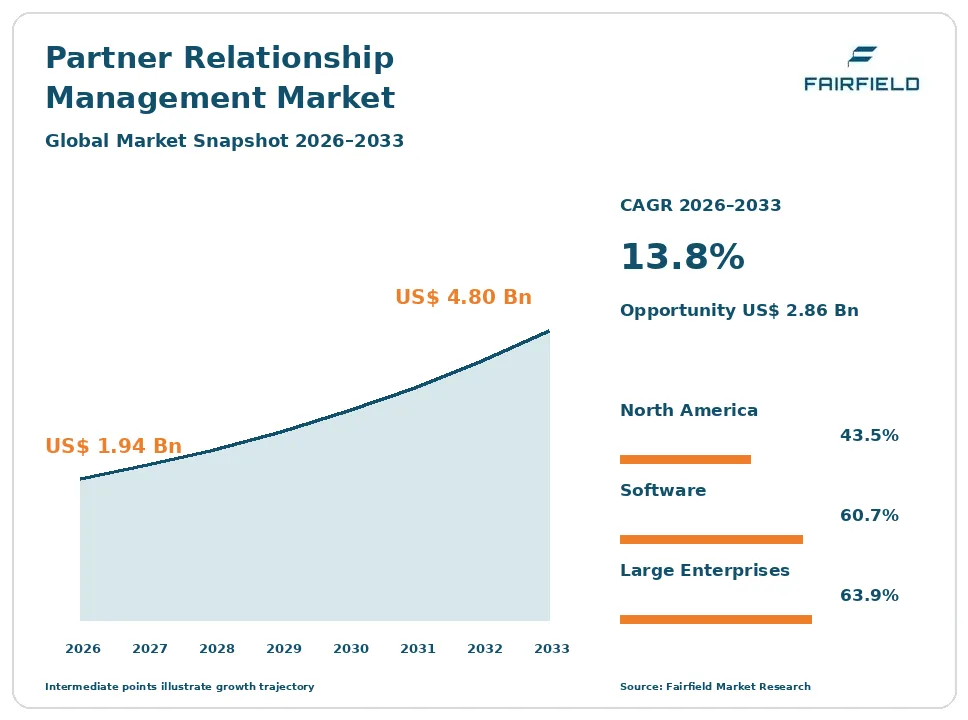
The global partner relationship management market size is expected to be valued at US$ 1.94 billion in 2026 and projected to reach US$ 4.80 billion by 2033, growing at a CAGR of 13.8% between 2026 and 2033.
Between 2020 and 2025, the market grew at a CAGR of about 12.5%, as remote selling pushed vendors to manage channel partners through digital portals. Three factors drive growth: a larger share of software, hardware, and services revenue flowing through resellers, distributors, and alliances, the rise of cloud marketplaces from Amazon Web Services, Microsoft, and Google Cloud, and AI tools that automate partner work. The market is shifting from simple partner portals toward platforms covering partner onboarding, training, deal registration, market development funds, incentives, and co-selling. Ecosystem-led growth strategies use shared account data to find joint opportunities with partners, and AI assistants now create content, register deals, and score partner performance automatically.
Key Report Takeaways
- By Component: Software held 60.7% share in 2026, while Services is projected to expand at a 15.6% CAGR through 2033, driven by demand for implementation, program design, and managed partner programs.
- By Organization Size: Large Enterprises held 63.9% share in 2026, while Small & Medium Enterprises are projected to expand at a 16.1% CAGR through 2033, driven by affordable cloud platforms and growing partner programs.
- By Industry: IT & Telecom held 28.8% share in 2026, while Healthcare is projected to expand at a 16.4% CAGR through 2033, driven by medical device and health technology companies selling through distributors.
- By Region: North America held 43.5% share in 2026, while Asia Pacific is projected to expand at a 15.0% CAGR through 2033, driven by technology channel growth in India, Japan, and Australia.
Global Partner Relationship Management Market Trends and Insights
Drivers Impact Analysis
| Driver | Impact on CAGR Forecast | Geographic Relevance | Impact Timeline |
| Growth of indirect sales and partner ecosystems | High | Global | Long term (≥4 years) |
| Cloud marketplaces and AI automation | High | North America, Europe, Asia Pacific | Medium term (2-4 years) |
Two drivers carry the strongest influence on partner relationship management demand during the forecast period.
Indirect Sales Growth Is Driving the Partner Relationship Management Market
The growth of indirect sales and partner ecosystems is the strongest driver of the partner relationship management market. Companies increasingly sell through partners rather than only through their own sales teams.
The mechanism is the high cost of direct sales and the reach that partners provide. Technology companies such as Microsoft, Cisco, Salesforce, and HubSpot earn a large share of revenue through resellers, systems integrators, managed service providers, and consultants. Manufacturers of industrial equipment, medical devices, and consumer electronics rely on distributors and dealers to reach local markets. Managing thousands of partners across countries needs software for recruitment, partner onboarding, training, certification, lead sharing, and incentive payments. Without PRM tools, companies struggle with channel conflict, poor visibility, and slow payments. DocuSign revamped its partner program in 2024 with more advanced PRM capabilities. These factors drive steady software adoption.
Cloud Marketplaces and AI Are Expanding the Partner Relationship Management Market
Cloud marketplaces and AI automation are expanding the partner relationship management market. New buying routes and tools are changing how partners sell.
The cause is the rise of hyperscaler marketplaces and generative AI. Enterprise buyers increasingly purchase software through Amazon Web Services Marketplace, Microsoft Marketplace, and Google Cloud Marketplace to use committed cloud spend, often with resellers involved in the deal. PRM platforms now track marketplace co-sell opportunities and partner attribution. AI assistants generate partner content, translate materials, complete deal registration forms from voice or text, and recommend next steps. Impartner launched its Aimi AI engine in 2025, and ZINFI released an AI-native co-selling application in 2026. Account mapping tools reveal shared customers between partners. These trends raise the value of modern PRM platforms.
Restraints Impact Analysis
| Restraint | Impact on CAGR Forecast | Geographic Relevance | Impact Timeline |
| Integration complexity with CRM and ERP systems | High | Global | Medium term (2-4 years) |
| Low partner adoption and data privacy concerns | Medium | Europe, North America | Short term (≤2 years) |
Two restraints limit how quickly the partner relationship management market grows.
Integration Complexity Slows the Partner Relationship Management Market
Integration complexity with CRM and ERP systems slows the partner relationship management market. PRM platforms must connect with many other business systems.
The specific causes are fragmented software environments and custom processes. PRM tools need two-way links with customer relationship management systems such as Salesforce and HubSpot, enterprise resource planning systems for orders and payments, marketing automation, learning platforms, and cloud marketplaces. Each partner program has unique tiers, incentives, and rules that require configuration. Data mismatches can cause errors in deal registration and payouts. Large companies may run several partner portals after acquisitions. Implementation projects can take months and require consultants. Switching from one PRM vendor to another is costly, so buyers take time to choose. Security reviews by IT teams add further delay. These factors raise costs and delay benefits, slowing adoption among mid-sized firms.
Low Partner Adoption Restricts the Partner Relationship Management Market
Low partner adoption and data privacy concerns restrict the partner relationship management market. A PRM system only works if partners actually use it.
The underlying causes are partner fatigue and data sharing worries. Resellers often work with many vendors, each with its own portal and login, so they ignore portals that are hard to use. Small partners lack time for training and reporting. Some partners worry that sharing customer and pipeline data with vendors could lead to direct sales competition. Data protection laws such as the European Union General Data Protection Regulation limit how customer data is shared between companies. Poor user experience on mobile devices reduces engagement. Low engagement makes it hard to prove the value of PRM spending to company leaders. Vendors respond with simpler interfaces, single sign-on, and rewards for partner activity. These factors reduce the return on PRM investments.
Market Opportunities
AI-Driven Co-Selling and Ecosystem Intelligence Open a Premium Revenue Pool
AI-driven co-selling and ecosystem intelligence open a premium revenue pool in the partner relationship management market. Companies want to know which partners can help close which deals.
Vendors that combine PRM with account mapping and AI can capture this opportunity. Ecosystem-led growth platforms such as Crossbeam, which merged with Reveal in 2024, let companies securely compare customer lists with partners to find overlaps. AI match scoring suggests the best partner for each deal, and privacy-first opt-in controls protect data. Automated marketplace listings and private offers speed cloud sales. Predictive analytics show which partners will grow. Premium AI modules can be sold as add-ons. These features help vendors raise contract values, and integrations with sales tools such as Salesforce and HubSpot put partner insights directly into sellers’ daily workflows. Measuring partner influence on revenue also helps companies justify bigger partner budgets.
Asia Pacific and SME Partner Programs Create a Volume Revenue Pool
Partner program growth in Asia Pacific and among small and medium enterprises creates a volume revenue pool in the partner relationship management market. Many companies are building channels for the first time.
Cloud PRM vendors with simple, affordable products can capture this opportunity. India has a fast-growing software-as-a-service sector that sells globally through partners and marketplaces. Japan, Australia, Singapore, and South Korea have large technology distribution networks. China has strong local channel ecosystems. Small software companies use affiliate, referral, and reseller programs to grow without large sales teams. Platforms such as PartnerStack and Allbound offer quick setup. Localized languages, local currency payouts, and tax handling help adoption. Distributors in Asia Pacific are also adopting PRM tools to manage their own resellers, and government digital programs support software exports.
Segment Analysis
By Component: Software Leads While Services Grow Fastest
Software held 60.7% share in 2026. PRM software includes partner portals, deal registration, lead distribution, content libraries, learning management, incentives, market development funds, and analytics. Cloud deployment accounts for most new software sales and supports partner onboarding at scale, because it is faster to launch and easier to update. Salesforce, Impartner, ZINFI, Zift Solutions, Oracle, and Magentrix are major software providers.
Services are the fastest-growing component, expanding at a 15.6% CAGR through 2033. Services include implementation, integration, partner program design, training, and partner marketing as a service, where providers run campaigns on behalf of partners. Impartner introduced partner management as a service offerings. Many companies lack in-house channel operations skills. Companies outsource partner recruitment and enablement to specialist agencies that use PRM platforms. For the market, services growth raises customer value.
By Organization Size: Large Enterprises Lead While SMEs Grow Fastest
Large Enterprises held 63.9% share in 2026. Global technology, telecom, manufacturing, and financial companies run complex programs with thousands of channel partners, multiple tiers, and regional rules. They need enterprise-grade security, integrations, and analytics. Large contracts and long-term subscriptions provide stable revenue for vendors. These companies often manage separate programs for resellers, alliances, and marketplaces in one platform.
Small & Medium Enterprises are the fastest-growing organization size, expanding at a 16.1% CAGR through 2033. Growing software-as-a-service firms, device makers, and service companies are launching referral and reseller programs. Affordable cloud tools with templates and quick setup reduce barriers. Affiliate and referral programs help small firms grow without large sales teams. For the market, SME growth broadens the customer base.
By Industry: IT & Telecom Lead While Healthcare Grows Fastest
IT & Telecom held 28.8% share in 2026. Software vendors, hardware makers, cloud providers, and telecom operators depend heavily on resellers, systems integrators, managed service providers, and marketplaces. They were early adopters of PRM and run some of the largest partner programs. Manufacturing, banking and financial services, and retail form other major industries, with manufacturers using PRM to manage dealer networks and spare parts sales.
Healthcare is the fastest-growing industry, expanding at a 16.4% CAGR through 2033. Medical device, diagnostics, and health technology companies sell through distributors and need to manage training, compliance, and certifications. Regulated industries value audit trails and controlled access to product information. Hospital purchasing groups and digital health resellers add further partner types. For the market, healthcare growth adds new demand.
Geography Analysis
Which Region Is Leading the Partner Relationship Management Market?
North America is leading the partner relationship management market with a 43.5% share in 2026. The United States is home to the largest technology vendors, cloud marketplaces, and partner ecosystems, as well as most PRM providers, including Salesforce, Impartner, ZINFI, Zift Solutions, Allbound, and Crossbeam. Companies such as Microsoft, Cisco, and Dell Technologies run vast partner programs. Cloud marketplace co-selling is most advanced in the region. Canada has a growing software sector with partner programs, especially in Toronto and Vancouver. One change shaping the region is AI-assisted partner management.
Europe Advances the Partner Relationship Management Market Through Channel Programs
Europe is the second-largest partner relationship management market. The United Kingdom, Germany, France, and the Netherlands have large technology distribution and reseller sectors, and many companies rely on local partners to sell across language and regulatory borders. SAP in Germany runs one of the world’s largest partner ecosystems, with thousands of resellers and consultants. Data privacy rules shape how partner data is shared, so vendors offer data hosting inside the European Union. Sweden, Denmark, and Ireland host many software companies building partner programs. Key barriers include data protection compliance. One opportunity is multilingual partner portals.
Which Region Is Growing Fastest in the Partner Relationship Management Market?
Asia Pacific is growing fastest in the partner relationship management market at a 15.0% CAGR through 2033. India has a fast-growing software and IT services sector that sells globally through partners. Japan relies heavily on distributors and systems integrators for technology sales, creating demand for structured partner programs. Australia and Singapore are regional hubs for cloud and software companies. China has large local channel ecosystems, mostly served by local software providers. Cloud marketplace adoption is rising across the region as hyperscalers open new local data centers. Vendors are adding local partners and languages. One opportunity is cloud PRM for fast-growing software firms.
Latin America Grows the Partner Relationship Management Market Through Technology Distribution
Latin America is a growing partner relationship management market. Brazil and Mexico have large technology distribution networks and many resellers that serve local businesses. Global vendors depend on partners to handle local languages, complex taxes, and payments. Colombia, Chile, and Argentina add demand, and cloud marketplace sales are growing in the region. Regional distributors manage thousands of small resellers that need training and incentives. Software companies in Brazil are building partner programs to grow across the region. Key barriers include tight budgets, currency swings, and limited partner digital skills. One opportunity is partner programs for cloud software vendors.
Middle East & Africa Builds the Partner Relationship Management Market
Middle East & Africa is an emerging partner relationship management market. The United Arab Emirates and Saudi Arabia are regional hubs for technology distribution, with Dubai hosting regional offices of many global vendors. South Africa has a mature reseller sector serving the wider region, and Morocco is a growing hub for French-speaking markets. Nigeria, Kenya, and Egypt have growing technology channels serving banks, telecom operators, and governments. Global vendors use regional distributors to reach dozens of countries, which requires strong partner management. Key barriers include limited budgets and fragmented partner networks. One opportunity is digital transformation projects led by governments.
Competitive Landscape
The partner relationship management market is fragmented. Salesforce leads through its Experience Cloud partner portals, while specialists such as Impartner, ZINFI Technologies, Zift Solutions, Magentrix, Channeltivity, Allbound, PartnerStack, and Mindmatrix compete strongly. Oracle, Microsoft, and SAP offer partner management within their broader platforms, and ecosystem data companies such as Crossbeam add account mapping.
Companies compete on ease of use, partner engagement, CRM integration, AI features, marketplace support, analytics, security, and price. Specialists compete on depth of channel features, while platform vendors compete on integration with their CRM and enterprise suites. Smaller vendors target affiliate and referral programs for software-as-a-service companies, while enterprise vendors focus on complex multi-tier channels. Pricing is usually by partner count, user, or module, and many vendors now bundle AI features into higher tiers. Integrations with cloud marketplaces and account mapping tools are becoming standard requirements in buyer evaluations.
Strategic moves show how competition is changing. In June 2024, Crossbeam and Reveal merged to build a larger ecosystem data network, and DocuSign revamped its partner program with advanced PRM capabilities. In December 2025, Impartner launched its Aimi AI engine. In May 2026, ZINFI released an AI-native co-selling application. These moves show competition shifting toward AI and ecosystem data.
Three themes shape vendor strategy. First, vendors are embedding AI assistants across workflows. Second, they are adding marketplace and co-selling tools. Third, they are offering managed services for partner programs.
Partner Relationship Management Market Industry Leaders
- Salesforce
- Impartner
- ZINFI Technologies
- Oracle
- Zift Solutions
Recent Industry Developments
- May 2026: ZINFI Technologies made its AI-native Partner Co-Selling Management application generally available - automates co-selling with privacy-first partner matching.
- December 2025: Impartner launched Aimi, an AI engine for content, deal registration, and partner support - raises partner productivity.
- June 2024: Crossbeam and Reveal merged in an all-stock deal - creates a larger ecosystem data network for co-selling.
- June 2024: DocuSign revamped its Partner Network Program with more advanced PRM capabilities - shows enterprise demand for modern partner management.
Companies Covered in the Report
- Salesforce
- Impartner
- ZINFI Technologies
- Oracle
- Zift Solutions
- Microsoft
- SAP
- Magentrix
- Channeltivity
- Allbound
- PartnerStack
- Crossbeam
Partner Relationship Management Market Report Scope
This report covers partner relationship management software and services, including partner portals, onboarding, training, deal registration, incentives, market development funds, co-selling, and analytics, deployed in the cloud or on-premise for large enterprises and SMEs in IT and telecom, manufacturing, banking, healthcare, retail, and other industries. It excludes general CRM software. The base year is 2025, and the forecast period runs from 2026 to 2033. All values are expressed in US$ Billion.
Component
- Software
- Services
Organization Size
- Large Enterprises
- Small & Medium Enterprises
Industry
- IT & Telecom
- Manufacturing
- Banking & Financial Services
- Healthcare
- Retail
- Others
Regions
- North America
- Europe
- Asia Pacific
- Latin America
- Middle East & Africa
Key Questions Answered in the Report
How big is the partner relationship management market in 2026?
The partner relationship management market is valued at US$ 1.94 billion in 2026, led by cloud software used by large enterprises.
What is the partner relationship management market forecast to 2033?
The market is projected to reach US$ 4.80 billion by 2033, growing at a 13.8% CAGR and adding US$ 2.86 billion.
Which industry is growing fastest in partner relationship management?
Healthcare is growing fastest at a 16.4% CAGR through 2033, driven by medical device and health technology companies selling through distributors.
Which region is growing fastest in the partner relationship management market?
Asia Pacific is growing fastest at a 15.0% CAGR through 2033, driven by technology channel growth in India, Japan, and Australia.
Which region holds the largest partner relationship management market share?
North America holds the largest share at 43.5% in 2026, supported by large technology vendors and most leading PRM providers.
1. Executive Summary
1.1. Global Partner Relationship Management Market Snapshot
1.2. Future Projections
1.3. Key Report Takeaways
1.4. Regional Snapshot
2. Market Overview
2.1. Market Definition and Report Scope
2.2. Historical Trends 2020–2025
2.3. Market Dynamics
2.3.1. Drivers
2.3.1.1. Indirect Sales Growth Is Driving the Partner Relationship Management Market
2.3.1.2. Cloud Marketplaces and AI Are Expanding the Partner Relationship Management Market
2.3.2. Restraints
2.3.2.1. Integration Complexity Slows the Partner Relationship Management Market
2.3.2.2. Low Partner Adoption Restricts the Partner Relationship Management Market
2.3.3. Market Opportunities
2.3.3.1. AI-Driven Co-Selling and Ecosystem Intelligence Open a Premium Revenue Pool
2.3.3.2. Asia Pacific and SME Partner Programs Create a Volume Revenue Pool
3. Global Partner Relationship Management Market Outlook, 2020-2033
3.1. Global Partner Relationship Management Market Outlook, by Component, Value (US$ Billion), 2020-2033
3.1.1. Software
3.1.2. Services
3.2. Global Partner Relationship Management Market Outlook, by Organization Size, Value (US$ Billion), 2020-2033
3.2.1. Large Enterprises
3.2.2. Small & Medium Enterprises
3.3. Global Partner Relationship Management Market Outlook, by Industry, Value (US$ Billion), 2020-2033
3.3.1. IT & Telecom
3.3.2. Manufacturing
3.3.3. Banking & Financial Services
3.3.4. Healthcare
3.3.5. Retail
3.3.6. Others
3.4. Global Partner Relationship Management Market Outlook, by Region, Value (US$ Billion), 2020-2033
3.4.1. North America
3.4.2. Europe
3.4.3. Asia Pacific
3.4.4. Latin America
3.4.5. Middle East & Africa
4. North America Partner Relationship Management Market Outlook, 2020-2033
4.1. North America Partner Relationship Management Market Outlook, by Component, Value (US$ Billion), 2020-2033
4.1.1. Software
4.1.2. Services
4.2. North America Partner Relationship Management Market Outlook, by Organization Size, Value (US$ Billion), 2020-2033
4.2.1. Large Enterprises
4.2.2. Small & Medium Enterprises
4.3. North America Partner Relationship Management Market Outlook, by Industry, Value (US$ Billion), 2020-2033
4.3.1. IT & Telecom
4.3.2. Manufacturing
4.3.3. Banking & Financial Services
4.3.4. Healthcare
4.3.5. Retail
4.3.6. Others
4.4. North America Partner Relationship Management Market Outlook, by Country, Value (US$ Billion), 2020-2033
4.4.1. United States Partner Relationship Management Market Outlook, by Component, 2020-2033
4.4.2. United States Partner Relationship Management Market Outlook, by Organization Size, 2020-2033
4.4.3. United States Partner Relationship Management Market Outlook, by Industry, 2020-2033
4.4.4. Canada Partner Relationship Management Market Outlook, by Component, 2020-2033
4.4.5. Canada Partner Relationship Management Market Outlook, by Organization Size, 2020-2033
4.4.6. Canada Partner Relationship Management Market Outlook, by Industry, 2020-2033
5. Europe Partner Relationship Management Market Outlook, 2020-2033
5.1. Europe Partner Relationship Management Market Outlook, by Component, Value (US$ Billion), 2020-2033
5.1.1. Software
5.1.2. Services
5.2. Europe Partner Relationship Management Market Outlook, by Organization Size, Value (US$ Billion), 2020-2033
5.2.1. Large Enterprises
5.2.2. Small & Medium Enterprises
5.3. Europe Partner Relationship Management Market Outlook, by Industry, Value (US$ Billion), 2020-2033
5.3.1. IT & Telecom
5.3.2. Manufacturing
5.3.3. Banking & Financial Services
5.3.4. Healthcare
5.3.5. Retail
5.3.6. Others
5.4. Europe Partner Relationship Management Market Outlook, by Country, Value (US$ Billion), 2020-2033
5.4.1. United Kingdom Partner Relationship Management Market Outlook, by Component, 2020-2033
5.4.2. United Kingdom Partner Relationship Management Market Outlook, by Organization Size, 2020-2033
5.4.3. United Kingdom Partner Relationship Management Market Outlook, by Industry, 2020-2033
5.4.4. Germany Partner Relationship Management Market Outlook, by Component, 2020-2033
5.4.5. Germany Partner Relationship Management Market Outlook, by Organization Size, 2020-2033
5.4.6. Germany Partner Relationship Management Market Outlook, by Industry, 2020-2033
5.4.7. France Partner Relationship Management Market Outlook, by Component, 2020-2033
5.4.8. France Partner Relationship Management Market Outlook, by Organization Size, 2020-2033
5.4.9. France Partner Relationship Management Market Outlook, by Industry, 2020-2033
5.4.10. Netherlands Partner Relationship Management Market Outlook, by Component, 2020-2033
5.4.11. Netherlands Partner Relationship Management Market Outlook, by Organization Size, 2020-2033
5.4.12. Netherlands Partner Relationship Management Market Outlook, by Industry, 2020-2033
5.4.13. Sweden Partner Relationship Management Market Outlook, by Component, 2020-2033
5.4.14. Sweden Partner Relationship Management Market Outlook, by Organization Size, 2020-2033
5.4.15. Sweden Partner Relationship Management Market Outlook, by Industry, 2020-2033
5.4.16. Denmark Partner Relationship Management Market Outlook, by Component, 2020-2033
5.4.17. Denmark Partner Relationship Management Market Outlook, by Organization Size, 2020-2033
5.4.18. Denmark Partner Relationship Management Market Outlook, by Industry, 2020-2033
5.4.19. Ireland Partner Relationship Management Market Outlook, by Component, 2020-2033
5.4.20. Ireland Partner Relationship Management Market Outlook, by Organization Size, 2020-2033
5.4.21. Ireland Partner Relationship Management Market Outlook, by Industry, 2020-2033
6. Asia Pacific Partner Relationship Management Market Outlook, 2020-2033
6.1. Asia Pacific Partner Relationship Management Market Outlook, by Component, Value (US$ Billion), 2020-2033
6.1.1. Software
6.1.2. Services
6.2. Asia Pacific Partner Relationship Management Market Outlook, by Organization Size, Value (US$ Billion), 2020-2033
6.2.1. Large Enterprises
6.2.2. Small & Medium Enterprises
6.3. Asia Pacific Partner Relationship Management Market Outlook, by Industry, Value (US$ Billion), 2020-2033
6.3.1. IT & Telecom
6.3.2. Manufacturing
6.3.3. Banking & Financial Services
6.3.4. Healthcare
6.3.5. Retail
6.3.6. Others
6.4. Asia Pacific Partner Relationship Management Market Outlook, by Country, Value (US$ Billion), 2020-2033
6.4.1. India Partner Relationship Management Market Outlook, by Component, 2020-2033
6.4.2. India Partner Relationship Management Market Outlook, by Organization Size, 2020-2033
6.4.3. India Partner Relationship Management Market Outlook, by Industry, 2020-2033
6.4.4. Japan Partner Relationship Management Market Outlook, by Component, 2020-2033
6.4.5. Japan Partner Relationship Management Market Outlook, by Organization Size, 2020-2033
6.4.6. Japan Partner Relationship Management Market Outlook, by Industry, 2020-2033
6.4.7. Australia Partner Relationship Management Market Outlook, by Component, 2020-2033
6.4.8. Australia Partner Relationship Management Market Outlook, by Organization Size, 2020-2033
6.4.9. Australia Partner Relationship Management Market Outlook, by Industry, 2020-2033
6.4.10. Singapore Partner Relationship Management Market Outlook, by Component, 2020-2033
6.4.11. Singapore Partner Relationship Management Market Outlook, by Organization Size, 2020-2033
6.4.12. Singapore Partner Relationship Management Market Outlook, by Industry, 2020-2033
6.4.13. China Partner Relationship Management Market Outlook, by Component, 2020-2033
6.4.14. China Partner Relationship Management Market Outlook, by Organization Size, 2020-2033
6.4.15. China Partner Relationship Management Market Outlook, by Industry, 2020-2033
7. Latin America Partner Relationship Management Market Outlook, 2020-2033
7.1. Latin America Partner Relationship Management Market Outlook, by Component, Value (US$ Billion), 2020-2033
7.1.1. Software
7.1.2. Services
7.2. Latin America Partner Relationship Management Market Outlook, by Organization Size, Value (US$ Billion), 2020-2033
7.2.1. Large Enterprises
7.2.2. Small & Medium Enterprises
7.3. Latin America Partner Relationship Management Market Outlook, by Industry, Value (US$ Billion), 2020-2033
7.3.1. IT & Telecom
7.3.2. Manufacturing
7.3.3. Banking & Financial Services
7.3.4. Healthcare
7.3.5. Retail
7.3.6. Others
7.4. Latin America Partner Relationship Management Market Outlook, by Country, Value (US$ Billion), 2020-2033
7.4.1. Brazil Partner Relationship Management Market Outlook, by Component, 2020-2033
7.4.2. Brazil Partner Relationship Management Market Outlook, by Organization Size, 2020-2033
7.4.3. Brazil Partner Relationship Management Market Outlook, by Industry, 2020-2033
7.4.4. Mexico Partner Relationship Management Market Outlook, by Component, 2020-2033
7.4.5. Mexico Partner Relationship Management Market Outlook, by Organization Size, 2020-2033
7.4.6. Mexico Partner Relationship Management Market Outlook, by Industry, 2020-2033
7.4.7. Colombia Partner Relationship Management Market Outlook, by Component, 2020-2033
7.4.8. Colombia Partner Relationship Management Market Outlook, by Organization Size, 2020-2033
7.4.9. Colombia Partner Relationship Management Market Outlook, by Industry, 2020-2033
7.4.10. Chile Partner Relationship Management Market Outlook, by Component, 2020-2033
7.4.11. Chile Partner Relationship Management Market Outlook, by Organization Size, 2020-2033
7.4.12. Chile Partner Relationship Management Market Outlook, by Industry, 2020-2033
7.4.13. Argentina Partner Relationship Management Market Outlook, by Component, 2020-2033
7.4.14. Argentina Partner Relationship Management Market Outlook, by Organization Size, 2020-2033
7.4.15. Argentina Partner Relationship Management Market Outlook, by Industry, 2020-2033
8. Middle East & Africa Partner Relationship Management Market Outlook, 2020-2033
8.1. Middle East & Africa Partner Relationship Management Market Outlook, by Component, Value (US$ Billion), 2020-2033
8.1.1. Software
8.1.2. Services
8.2. Middle East & Africa Partner Relationship Management Market Outlook, by Organization Size, Value (US$ Billion), 2020-2033
8.2.1. Large Enterprises
8.2.2. Small & Medium Enterprises
8.3. Middle East & Africa Partner Relationship Management Market Outlook, by Industry, Value (US$ Billion), 2020-2033
8.3.1. IT & Telecom
8.3.2. Manufacturing
8.3.3. Banking & Financial Services
8.3.4. Healthcare
8.3.5. Retail
8.3.6. Others
8.4. Middle East & Africa Partner Relationship Management Market Outlook, by Country, Value (US$ Billion), 2020-2033
8.4.1. United Arab Emirates Partner Relationship Management Market Outlook, by Component, 2020-2033
8.4.2. United Arab Emirates Partner Relationship Management Market Outlook, by Organization Size, 2020-2033
8.4.3. United Arab Emirates Partner Relationship Management Market Outlook, by Industry, 2020-2033
8.4.4. Saudi Arabia Partner Relationship Management Market Outlook, by Component, 2020-2033
8.4.5. Saudi Arabia Partner Relationship Management Market Outlook, by Organization Size, 2020-2033
8.4.6. Saudi Arabia Partner Relationship Management Market Outlook, by Industry, 2020-2033
8.4.7. South Africa Partner Relationship Management Market Outlook, by Component, 2020-2033
8.4.8. South Africa Partner Relationship Management Market Outlook, by Organization Size, 2020-2033
8.4.9. South Africa Partner Relationship Management Market Outlook, by Industry, 2020-2033
8.4.10. Morocco Partner Relationship Management Market Outlook, by Component, 2020-2033
8.4.11. Morocco Partner Relationship Management Market Outlook, by Organization Size, 2020-2033
8.4.12. Morocco Partner Relationship Management Market Outlook, by Industry, 2020-2033
8.4.13. Nigeria Partner Relationship Management Market Outlook, by Component, 2020-2033
8.4.14. Nigeria Partner Relationship Management Market Outlook, by Organization Size, 2020-2033
8.4.15. Nigeria Partner Relationship Management Market Outlook, by Industry, 2020-2033
8.4.16. Kenya Partner Relationship Management Market Outlook, by Component, 2020-2033
8.4.17. Kenya Partner Relationship Management Market Outlook, by Organization Size, 2020-2033
8.4.18. Kenya Partner Relationship Management Market Outlook, by Industry, 2020-2033
8.4.19. Egypt Partner Relationship Management Market Outlook, by Component, 2020-2033
8.4.20. Egypt Partner Relationship Management Market Outlook, by Organization Size, 2020-2033
8.4.21. Egypt Partner Relationship Management Market Outlook, by Industry, 2020-2033
9. Competitive Landscape
9.1. Market Concentration and Industry Leaders
9.2. Competitive Differentiation
9.3. Strategic Moves and Market Direction
9.4. Recent Industry Developments
9.5. Company Profiles
9.5.1. Salesforce
9.5.2. Impartner
9.5.3. ZINFI Technologies
9.5.4. Oracle
9.5.5. Zift Solutions
9.5.6. Microsoft
9.5.7. SAP
9.5.8. Magentrix
9.5.9. Channeltivity
9.5.10. Allbound
9.5.11. PartnerStack
9.5.12. Crossbeam
10. Appendix
10.1. Research Methodology
10.2. Report Assumptions
10.3. Acronyms and Abbreviations
| Component | Software, Services |
| Organization Size | Large Enterprises, Small & Medium Enterprises |
| Industry | IT & Telecom, Manufacturing, Banking & Financial Services, Healthcare, Retail, Others |
| Regions | North America, Europe, Asia Pacific, Latin America, Middle East & Africa |
Our Research Methodology
Considering the volatility of business today, traditional approaches to strategizing a game plan can be unfruitful if not detrimental. True ambiguity is no way to determine a forecast. A myriad of predetermined factors must be accounted for such as the degree of risk involved, the magnitude of circumstances, as well as conditions or consequences that are not known or unpredictable. To circumvent binary views that cast uncertainty, the application of market research intelligence to strategically posture, move, and enable actionable outcomes is necessary.
View Methodology
Quality Assured
Rigorous Validation Process

Confidentiality Assured
End-to-end Data Security

Custom Research Services
Tailored To Your Objectives
FAQs
The partner relationship management market is valued at US$ 1.94 billion in 2026, led by cloud software used by large enterprises.
The market is projected to reach US$ 4.80 billion by 2033, growing at a 13.8% CAGR and adding US$ 2.86 billion.
Healthcare is growing fastest at a 16.4% CAGR through 2033, driven by medical device and health technology companies selling through distributors.
Asia Pacific is growing fastest at a 15.0% CAGR through 2033, driven by technology channel growth in India, Japan, and Australia.
North America holds the largest share at 43.5% in 2026, supported by large technology vendors and most leading PRM providers.
Related Reports
Observability Tools and Platforms Market Size, Share, Insights, Competitive Landscape, and Forecast 2026 to 2033
Observability tools and platforms market to reach US$ 30.08 billion by 2033 at a 14.1% CAGR. Explore telemetry, end uses, companies and regional trends.
Radiation Hardened Electronics Market Size, Share, Insights, Competitive Landscape, and Forecast 2026 to 2033
Radiation hardened electronics market to reach US$ 3.09 billion by 2033 at a 6.1% CAGR. Explore components, materials and regional trends.
Multi-Layer Ceramic Capacitor Market Size, Share, Insights, Competitive Landscape, and Forecast 2026 to 2033
Explore the multi-layer ceramic capacitor market, reaching US$ 28.65 billion by 2033 at 7.2% CAGR, with segments and regional insights.
Multi-factor Authentication Market Size, Share, Insights, Competitive Landscape, and Forecast 2026 to 2033
Explore the multi-factor authentication market, reaching US$ 54.00 billion by 2033 at 13.0% CAGR, with segments and regional insights.
Multi-Cloud Computing Market Size, Share, Insights, Competitive Landscape, and Forecast 2026 to 2033
Explore the multi-cloud computing market, reaching US$ 34.38 billion by 2033 at 14.4% CAGR, with segments, trends and regional insights.
Malware Analysis Market Size, Share, Insights, Competitive Landscape, and Forecast 2026 to 2033
Explore the malware analysis market, reaching US$ 21.0 billion by 2033 at 14.0% CAGR, with component, deployment and regional insights.