



Radiation Hardened Electronics Market
Radiation Hardened Electronics Market Size, Share, Insights, Competitive Landscape, and Forecast 2026 to 2033
Radiation Hardened Electronics Market Analysis, 2026–2033
Radiation Hardened Electronics Market
Radiation Hardened Electronics Market Size, Share, Insights, Competitive Landscape, and Forecast 2026 to 2033
Radiation Hardened Electronics Market Size and Trend Analysis
How Fast Is the Radiation Hardened Electronics Market Growing?
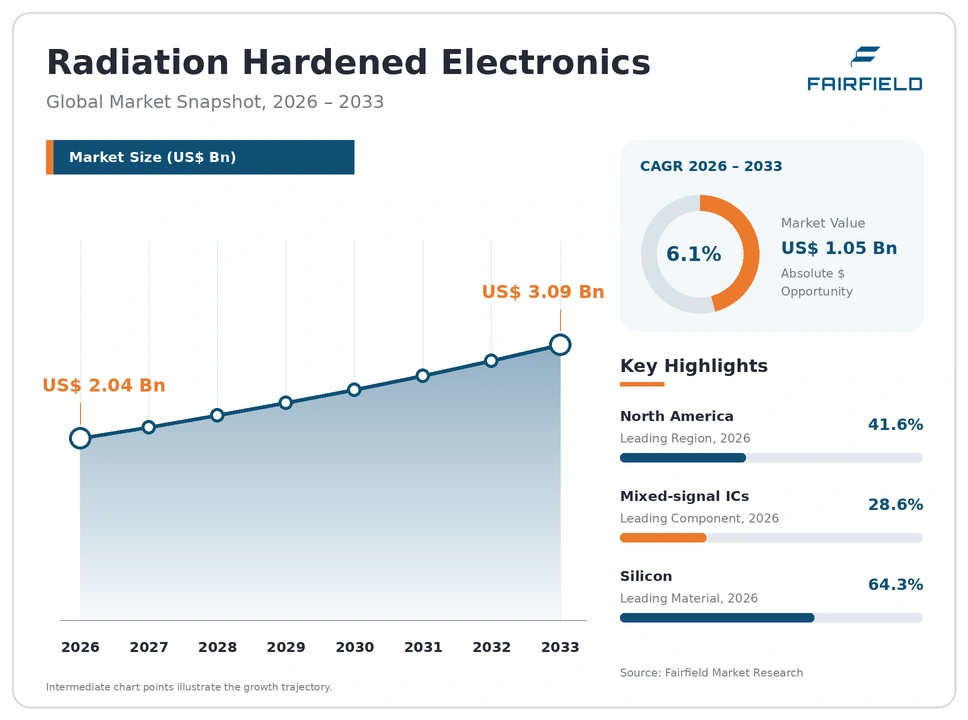
The global radiation hardened electronics market size is expected to be valued at US$ 2.04 billion in 2026 and projected to reach US$ 3.09 billion by 2033, growing at a CAGR of 6.1% between 2026 and 2033.
Between 2020 and 2025, the market grew at a CAGR of about 4.8%, as satellite launches surged and defense budgets rose, while chip shortages and long qualification times limited supply. Three factors now drive growth: rapid deployment of low Earth orbit satellites for communications and Earth observation, rising defense and missile programs, and new deep-space and lunar missions. The market is shifting from expensive, fully space-grade parts toward radiation-tolerant commercial components for shorter missions, and toward advanced processes that deliver higher computing power while resisting total ionizing dose and single event effects.
Key Report Takeaways
- By Component: Mixed-signal ICs held 28.6% share in 2026, while Processors & FPGAs are projected to expand at a 7.6% CAGR through 2033, driven by onboard data processing and AI on satellites.
- By Product Type: Custom-made held 46.4% share in 2026, while Radiation-tolerant COTS is projected to expand at a 8.6% CAGR through 2033, driven by low-cost satellite constellations with shorter mission lives.
- By Material: Silicon held 64.3% share in 2026, while Gallium Nitride is projected to expand at a 9.1% CAGR through 2033, driven by power and radio frequency needs in satellites and radar.
- By Region: North America held 41.6% share in 2026, while Asia Pacific is projected to expand at a 7.8% CAGR through 2033, driven by space programs in China, India, and Japan.
Global Radiation Hardened Electronics Market Trends and Insights
Drivers Impact Analysis
Two drivers carry the strongest influence on radiation hardened electronics demand during the forecast period.
| Driver | Impact on CAGR Forecast | Geographic Relevance | Impact Timeline |
| Growth of satellite constellations and space exploration | High | North America, Asia Pacific, Europe | Long term (≥4 years) |
| Rising defense spending and strategic systems | High | North America, Europe, Asia Pacific | Medium term (2-4 years) |
Satellite Constellations and Space Exploration Are Driving the Radiation Hardened Electronics Market
The growth of satellite constellations and space exploration is the strongest driver of the radiation hardened electronics market. Electronics in space face radiation that can damage chips or cause errors.
The mechanism is a sharp increase in satellites and missions. Thousands of low Earth orbit satellites have been launched for broadband internet by companies such as SpaceX’s Starlink and Amazon’s Project Kuiper, and governments are building constellations for defense and Earth observation. Lunar programs such as NASA’s Artemis and missions to Mars and beyond need highly reliable electronics. Satellites increasingly process data onboard using powerful processors and FPGAs. Microchip Technology expanded its space-qualified RT PolarFire FPGA portfolio in 2025. Each spacecraft needs power management, processors, memory, and data converters that resist radiation, creating steady demand for space-grade and radiation-tolerant parts.
Defense Spending Is Expanding the Radiation Hardened Electronics Market
Rising defense spending and strategic systems are expanding the radiation hardened electronics market. Military systems must work in nuclear and space environments.
The cause is geopolitical tension and modernization programs. The United States, Europe, China, and India are increasing defense budgets, funding missiles, satellites, and nuclear deterrent systems that require hardened electronics. The United States Space Development Agency is building large defense satellite constellations. Strategic systems must survive intense radiation from nuclear events. Governments also want trusted domestic chip supply; BAE Systems received US$ 16 million in Defense Production Act funding in September 2026 to qualify its RH45 technology. Hypersonic weapons and missile defense programs add demand. Allies in Europe and Asia Pacific are also building military satellite networks. These factors support long-term government spending on radiation hardened components.
Restraints Impact Analysis
Two restraints limit how quickly the radiation hardened electronics market grows.
| Restraint | Impact on CAGR Forecast | Geographic Relevance | Impact Timeline |
| High costs and long development cycles | High | Global | Medium term (2-4 years) |
| Export controls and limited foundry capacity | Medium | North America, Europe, Asia Pacific | Short term (≤2 years) |
High Costs and Long Development Cycles Slow the Radiation Hardened Electronics Market
High costs and long development cycles slow the radiation hardened electronics market. Radiation hardened chips cost far more than commercial chips and take years to develop.
The specific causes are special design, testing, and small volumes. Hardened chips need special design techniques or processes, extensive radiation testing at particle accelerators, and qualification to standards such as QML Class V. Small production volumes spread fixed costs over few units, so prices can be hundreds of times higher than commercial parts. Development and qualification can take five years or more, leaving hardened chips several generations behind commercial technology in performance. Satellite makers building large constellations want lower costs and use commercial or radiation-tolerant parts instead. Testing capacity at radiation facilities is limited, causing scheduling delays. These factors limit growth in traditional fully hardened products.
Export Controls and Foundry Limits Restrict the Radiation Hardened Electronics Market
Export controls and limited foundry capacity restrict the radiation hardened electronics market. Radiation hardened chips are considered strategic technology.
The underlying causes are national security rules and a shrinking supplier base. United States ITAR and export administration rules limit sales of many hardened chips to foreign buyers, pushing Europe, China, and India to develop their own supply. Few foundries offer radiation-hardened processes, and some older lines have closed. Trusted foundry requirements for defense programs further limit options. Supply disruptions can delay satellite and defense programs for months. Small suppliers struggle to fund new process development and qualification. Rising demand from constellations can strain capacity at qualified suppliers, extending lead times to a year or more. These factors restrict supply and slow the adoption of advanced technology nodes.
Market Opportunities
Radiation-tolerant COTS for New Space Opens a Volume Revenue Pool
Radiation-tolerant commercial-off-the-shelf parts for new space companies open a volume revenue pool in the radiation hardened electronics market. Constellation operators need many affordable parts.
Chipmakers with screened and tested commercial products can capture this opportunity. Low Earth orbit satellites face lower radiation and have shorter missions, so upscreened plastic-packaged parts can meet needs at much lower cost. Texas Instruments, Microchip Technology, Renesas Electronics, Analog Devices, and STMicroelectronics offer space-enhanced product lines. Satellite makers buy thousands of identical parts, creating volume demand. Standard radiation test data and reference designs speed adoption. Suppliers that balance cost and reliability can win large constellation contracts and recurring orders. Testing services that measure single event effects and total ionizing dose for commercial parts also grow with this trend.
High-performance Space Computing Creates a Technology Revenue Pool
High-performance space computing creates a technology revenue pool in the radiation hardened electronics market. Satellites and spacecraft need more onboard processing for AI and data handling.
Processor and FPGA makers can capture this opportunity. Onboard AI processes images and signals in orbit, reducing data sent to Earth. BAE Systems demonstrated its Endura system-on-chip processor using 45 nm technology for strategic and space missions in June 2026. NASA and Microchip Technology are developing the High-Performance Spaceflight Computing processor. Advanced packaging, error correction, and redundancy techniques improve reliability at lower cost. Deep-space and lunar missions need autonomous operation. Space-based data centers and in-orbit servicing missions are emerging uses that need powerful, reliable computers. These high-value products command premium prices and long program commitments.
Segment Analysis
By Component: Mixed-signal ICs Lead While Processors & FPGAs Grow Fastest
Mixed-signal ICs held 28.6% share in 2026. Mixed-signal ICs, such as analog-to-digital and digital-to-analog converters, combine analog and digital functions to process signals from sensors, antennas, and instruments. Every satellite and defense system needs these parts. Texas Instruments, Analog Devices, and Renesas Electronics are major suppliers, and power management ICs and memory form other key components.
Processors & FPGAs are the fastest-growing component, expanding at a 7.6% CAGR through 2033. Satellites increasingly process data onboard, run AI models, and reconfigure functions in orbit. Microchip Technology’s RT PolarFire FPGAs, AMD’s space-grade FPGAs, and BAE Systems’ processors serve this demand. FPGAs allow designers to update functions after launch. For the market, processor growth raises value per spacecraft.
By Product Type: Custom-made Leads While Radiation-tolerant COTS Grows Fastest
Custom-made held 46.4% share in 2026. Custom application-specific integrated circuits and hardened designs are built for critical defense, strategic, and deep-space missions that require the highest reliability. BAE Systems, Honeywell, and Frontgrade Technologies offer custom design and foundry services. These products are expensive but essential for long missions, such as geostationary satellites designed to work for 15 years or more.
Radiation-tolerant COTS is the fastest-growing product type, expanding at a 8.6% CAGR through 2033. Commercial parts that are screened and tested for radiation offer lower cost and newer technology. They suit low Earth orbit satellites, small satellites, and shorter missions. Constellation builders favor these products to control costs. Fully hardened standard products form a third segment. For the market, COTS growth expands volume demand.
By Material: Silicon Leads While Gallium Nitride Grows Fastest
Silicon held 64.3% share in 2026. Silicon and silicon-on-insulator technologies are used for processors, memory, mixed-signal ICs, and power management chips. Silicon-on-insulator reduces radiation effects, and BAE Systems’ RH45 uses a 45 nm silicon-on-insulator platform from GlobalFoundries. Silicon carbide and gallium arsenide form other material segments.
Gallium Nitride is the fastest-growing material, expanding at a 9.1% CAGR through 2033. Gallium nitride transistors handle high power and frequency and naturally resist radiation, making them ideal for satellite communications, radar, and power conversion. EPC Space, Infineon Technologies, and Renesas Electronics offer radiation-hardened gallium nitride devices. Electric propulsion systems also use gallium nitride power devices. For the market, gallium nitride growth improves power efficiency in spacecraft.
Geography Analysis
Which Region Is Leading the Radiation Hardened Electronics Market?
North America is leading the radiation hardened electronics market with a 41.6% share in 2026. The United States has the largest space and defense budgets, with programs led by NASA, the Space Force, the Space Development Agency, and the Missile Defense Agency. Leading suppliers including Microchip Technology, BAE Systems, Frontgrade Technologies, Texas Instruments, Honeywell, and Teledyne are based in the region. Commercial operators such as SpaceX and Amazon launch large constellations. Government funding supports domestic trusted foundries. Canada has satellite and space robotics programs. One change shaping the region is the growing use of radiation-tolerant commercial parts in constellations.
Europe Advances the Radiation Hardened Electronics Market Through Sovereign Space Programs
Europe is an important radiation hardened electronics market driven by the European Space Agency and national defense programs. France, Germany, Italy, and the United Kingdom have major space companies such as Airbus Defence and Space and Thales Alenia Space. STMicroelectronics and Infineon Technologies supply radiation-hardened parts, and Europe seeks independence from United States export-controlled components. The IRIS² secure satellite constellation will add demand. Spain, Belgium, and the Netherlands have specialist space electronics firms. European defense spending has risen sharply, adding demand for hardened parts in missiles and satellites. One opportunity is European-made hardened processors and FPGAs that avoid export restrictions.
Which Region Is Growing Fastest in the Radiation Hardened Electronics Market?
Asia Pacific is growing fastest in the radiation hardened electronics market at a 7.8% CAGR through 2033. China is building large satellite constellations and lunar missions and develops its own hardened chips due to export controls. India’s ISRO and private launch companies are expanding missions, supported by policies opening space to private firms. Japan has active lunar and satellite programs. South Korea and Australia are growing space sectors. China’s Guowang and Qianfan constellations plan thousands of satellites. One challenge is access to advanced technology due to export controls. One opportunity is local supply of radiation-tolerant parts for regional satellite makers.
Latin America Develops the Radiation Hardened Electronics Market Through Satellite Programs
Latin America is a developing radiation hardened electronics market. Brazil has a national space agency and satellite programs, including joint Earth observation satellites with China. Argentina builds communications and Earth observation satellites through INVAP. Mexico operates communications satellites. Chile, Peru, and Colombia have launched small satellites for Earth observation and research, often built with university partners. Satellite ground stations and astronomy observatories in Chile use specialized electronics. Key barriers include small budgets, limited local design capacity, and reliance on imported parts subject to export rules. One opportunity is small satellites for Earth observation and agricultural monitoring.
Middle East & Africa Builds the Radiation Hardened Electronics Market Through Space Investment
Middle East & Africa is an emerging radiation hardened electronics market. The United Arab Emirates has sent a probe to Mars and is building satellites, while Saudi Arabia is investing in space programs. Israel has advanced defense and satellite industries. South Africa builds small satellites. Egypt, Nigeria, and Kenya have national space agencies that launch small satellites. Saudi Arabia and the United Arab Emirates are building satellite manufacturing facilities and defense electronics capabilities, and Qatar and Oman are expanding satellite communications. Nuclear power programs in the United Arab Emirates and Egypt need radiation-resistant instruments. Key barriers include limited local chip production and dependence on export licenses. One opportunity is small satellite programs.
Competitive Landscape
The radiation hardened electronics market is moderately concentrated. Microchip Technology, BAE Systems, Renesas Electronics, Frontgrade Technologies, and Texas Instruments are leading players, while Honeywell, STMicroelectronics, Infineon Technologies, AMD, Analog Devices, Teledyne, and EPC Space compete in specific segments.
Companies compete on radiation performance, reliability, qualification level, product range, delivery time, pricing, and trusted supply. Access to qualified foundry capacity is a major advantage, since few fabs offer hardened processes. Suppliers also provide radiation test reports and design support to help customers qualify parts faster. Long qualification processes and heritage on past missions create strong customer loyalty, since program managers prefer parts with proven flight records. Large chipmakers offer broad catalogs of space-enhanced parts, while specialists such as Frontgrade Technologies and EPC Space focus on hardened products and services. Defense primes and satellite makers sometimes develop custom chips with foundry partners.
Strategic moves show how competition is changing. In July 2025, Microchip Technology expanded its space-qualified RT PolarFire FPGA portfolio. In June 2026, BAE Systems demonstrated its Endura system-on-chip processor. In September 2026, BAE Systems received US$ 16 million to qualify RH45 technology. These moves show competition shifting toward higher-performance processing and secure domestic supply.
Three themes shape vendor strategy. First, companies are developing advanced-node hardened processes for computing. Second, they are offering lower-cost radiation-tolerant product lines. Third, they are securing government funding for trusted foundries and new process qualification.
Radiation Hardened Electronics Market Industry Leaders
- Microchip Technology
- BAE Systems
- Renesas Electronics
- Frontgrade Technologies
- Texas Instruments
Recent Industry Developments
- September 2026: BAE Systems received US$ 16 million in Defense Production Act Title III funding to qualify its RH45 technology - strengthens domestic supply of hardened chips.
- June 2026: BAE Systems demonstrated its Endura system-on-chip space processor in strategic radiation environments - brings smaller, lower-power processors to space missions.
- July 2025: Microchip Technology expanded its space-qualified RT PolarFire FPGA portfolio with new qualifications and SoC availability - supports onboard processing in satellites.
Companies Covered in the Report
- Microchip Technology
- BAE Systems
- Renesas Electronics
- Frontgrade Technologies
- Texas Instruments
- Honeywell International
- STMicroelectronics
- Infineon Technologies
- AMD
- Analog Devices
- Teledyne Technologies
- EPC Space
Radiation Hardened Electronics Market Report Scope
This report covers radiation hardened and radiation-tolerant electronics, including mixed-signal ICs, processors and FPGAs, memory, power management devices, and discrete components, in custom, standard, and COTS forms, made from silicon, gallium nitride, silicon carbide, and other materials, for space, defense, nuclear power, and medical uses. It excludes standard commercial chips. The base year is 2025, and the forecast period runs from 2026 to 2033. All values are expressed in US$ Billion.
Component
- Mixed-signal ICs
- Processors & FPGAs
- Memory
- Power Management
- Discrete Components
Product Type
- Custom-made
- Radiation-hardened Standard Products
- Radiation-tolerant COTS
Material
- Silicon
- Gallium Nitride
- Silicon Carbide
- Others
Regions
- North America
- Europe
- Asia Pacific
- Latin America
- Middle East & Africa
Key Questions Answered in the Report
How big is the radiation hardened electronics market in 2026?
The radiation hardened electronics market is valued at US$ 2.04 billion in 2026, led by mixed-signal ICs for satellites and defense.
What is the radiation hardened electronics market forecast to 2033?
The market is projected to reach US$ 3.09 billion by 2033, growing at a 6.1% CAGR and adding US$ 1.05 billion.
Which product type is growing fastest in radiation hardened electronics?
Radiation-tolerant COTS is growing fastest at a 8.6% CAGR through 2033, driven by low-cost satellite constellations with shorter missions.
Which region is growing fastest in the radiation hardened electronics market?
Asia Pacific is growing fastest at a 7.8% CAGR through 2033, driven by space programs in China, India, and Japan.
Which region holds the largest radiation hardened electronics market share?
North America holds the largest share at 41.6% in 2026, supported by the largest space and defense budgets in the United States.
1. Executive Summary
1.1. Global Radiation Hardened Electronics Market Snapshot
1.2. Future Projections
1.3. Key Report Takeaways
1.4. Regional Snapshot
2. Market Overview
2.1. Market Definition and Report Scope
2.2. Historical Trends 2020–2025
2.3. Market Dynamics
2.3.1. Drivers
2.3.1.1. Satellite Constellations and Space Exploration Are Driving the Radiation Hardened Electronics Market
2.3.1.2. Defense Spending Is Expanding the Radiation Hardened Electronics Market
2.3.2. Restraints
2.3.2.1. High Costs and Long Development Cycles Slow the Radiation Hardened Electronics Market
2.3.2.2. Export Controls and Foundry Limits Restrict the Radiation Hardened Electronics Market
2.3.3. Market Opportunities
2.3.3.1. Radiation-tolerant COTS for New Space Opens a Volume Revenue Pool
2.3.3.2. High-performance Space Computing Creates a Technology Revenue Pool
3. Global Radiation Hardened Electronics Market Outlook, 2020-2033
3.1. Global Radiation Hardened Electronics Market Outlook, by Component, Value (US$ Billion), 2020-2033
3.1.1. Mixed-signal ICs
3.1.2. Processors & FPGAs
3.1.3. Memory
3.1.4. Power Management
3.1.5. Discrete Components
3.2. Global Radiation Hardened Electronics Market Outlook, by Product Type, Value (US$ Billion), 2020-2033
3.2.1. Custom-made
3.2.2. Radiation-hardened Standard Products
3.2.3. Radiation-tolerant COTS
3.3. Global Radiation Hardened Electronics Market Outlook, by Material, Value (US$ Billion), 2020-2033
3.3.1. Silicon
3.3.2. Gallium Nitride
3.3.3. Silicon Carbide
3.3.4. Others
3.4. Global Radiation Hardened Electronics Market Outlook, by Region, Value (US$ Billion), 2020-2033
3.4.1. North America
3.4.2. Europe
3.4.3. Asia Pacific
3.4.4. Latin America
3.4.5. Middle East & Africa
4. North America Radiation Hardened Electronics Market Outlook, 2020-2033
4.1. North America Radiation Hardened Electronics Market Outlook, by Component, Value (US$ Billion), 2020-2033
4.1.1. Mixed-signal ICs
4.1.2. Processors & FPGAs
4.1.3. Memory
4.1.4. Power Management
4.1.5. Discrete Components
4.2. North America Radiation Hardened Electronics Market Outlook, by Product Type, Value (US$ Billion), 2020-2033
4.2.1. Custom-made
4.2.2. Radiation-hardened Standard Products
4.2.3. Radiation-tolerant COTS
4.3. North America Radiation Hardened Electronics Market Outlook, by Material, Value (US$ Billion), 2020-2033
4.3.1. Silicon
4.3.2. Gallium Nitride
4.3.3. Silicon Carbide
4.3.4. Others
4.4. North America Radiation Hardened Electronics Market Outlook, by Country, Value (US$ Billion), 2020-2033
4.4.1. United States Radiation Hardened Electronics Market Outlook, by Component, 2020-2033
4.4.2. United States Radiation Hardened Electronics Market Outlook, by Product Type, 2020-2033
4.4.3. United States Radiation Hardened Electronics Market Outlook, by Material, 2020-2033
4.4.4. Canada Radiation Hardened Electronics Market Outlook, by Component, 2020-2033
4.4.5. Canada Radiation Hardened Electronics Market Outlook, by Product Type, 2020-2033
4.4.6. Canada Radiation Hardened Electronics Market Outlook, by Material, 2020-2033
5. Europe Radiation Hardened Electronics Market Outlook, 2020-2033
5.1. Europe Radiation Hardened Electronics Market Outlook, by Component, Value (US$ Billion), 2020-2033
5.1.1. Mixed-signal ICs
5.1.2. Processors & FPGAs
5.1.3. Memory
5.1.4. Power Management
5.1.5. Discrete Components
5.2. Europe Radiation Hardened Electronics Market Outlook, by Product Type, Value (US$ Billion), 2020-2033
5.2.1. Custom-made
5.2.2. Radiation-hardened Standard Products
5.2.3. Radiation-tolerant COTS
5.3. Europe Radiation Hardened Electronics Market Outlook, by Material, Value (US$ Billion), 2020-2033
5.3.1. Silicon
5.3.2. Gallium Nitride
5.3.3. Silicon Carbide
5.3.4. Others
5.4. Europe Radiation Hardened Electronics Market Outlook, by Country, Value (US$ Billion), 2020-2033
5.4.1. France Radiation Hardened Electronics Market Outlook, by Component, 2020-2033
5.4.2. France Radiation Hardened Electronics Market Outlook, by Product Type, 2020-2033
5.4.3. France Radiation Hardened Electronics Market Outlook, by Material, 2020-2033
5.4.4. Germany Radiation Hardened Electronics Market Outlook, by Component, 2020-2033
5.4.5. Germany Radiation Hardened Electronics Market Outlook, by Product Type, 2020-2033
5.4.6. Germany Radiation Hardened Electronics Market Outlook, by Material, 2020-2033
5.4.7. Italy Radiation Hardened Electronics Market Outlook, by Component, 2020-2033
5.4.8. Italy Radiation Hardened Electronics Market Outlook, by Product Type, 2020-2033
5.4.9. Italy Radiation Hardened Electronics Market Outlook, by Material, 2020-2033
5.4.10. United Kingdom Radiation Hardened Electronics Market Outlook, by Component, 2020-2033
5.4.11. United Kingdom Radiation Hardened Electronics Market Outlook, by Product Type, 2020-2033
5.4.12. United Kingdom Radiation Hardened Electronics Market Outlook, by Material, 2020-2033
5.4.13. Spain Radiation Hardened Electronics Market Outlook, by Component, 2020-2033
5.4.14. Spain Radiation Hardened Electronics Market Outlook, by Product Type, 2020-2033
5.4.15. Spain Radiation Hardened Electronics Market Outlook, by Material, 2020-2033
5.4.16. Belgium Radiation Hardened Electronics Market Outlook, by Component, 2020-2033
5.4.17. Belgium Radiation Hardened Electronics Market Outlook, by Product Type, 2020-2033
5.4.18. Belgium Radiation Hardened Electronics Market Outlook, by Material, 2020-2033
5.4.19. Netherlands Radiation Hardened Electronics Market Outlook, by Component, 2020-2033
5.4.20. Netherlands Radiation Hardened Electronics Market Outlook, by Product Type, 2020-2033
5.4.21. Netherlands Radiation Hardened Electronics Market Outlook, by Material, 2020-2033
6. Asia Pacific Radiation Hardened Electronics Market Outlook, 2020-2033
6.1. Asia Pacific Radiation Hardened Electronics Market Outlook, by Component, Value (US$ Billion), 2020-2033
6.1.1. Mixed-signal ICs
6.1.2. Processors & FPGAs
6.1.3. Memory
6.1.4. Power Management
6.1.5. Discrete Components
6.2. Asia Pacific Radiation Hardened Electronics Market Outlook, by Product Type, Value (US$ Billion), 2020-2033
6.2.1. Custom-made
6.2.2. Radiation-hardened Standard Products
6.2.3. Radiation-tolerant COTS
6.3. Asia Pacific Radiation Hardened Electronics Market Outlook, by Material, Value (US$ Billion), 2020-2033
6.3.1. Silicon
6.3.2. Gallium Nitride
6.3.3. Silicon Carbide
6.3.4. Others
6.4. Asia Pacific Radiation Hardened Electronics Market Outlook, by Country, Value (US$ Billion), 2020-2033
6.4.1. China Radiation Hardened Electronics Market Outlook, by Component, 2020-2033
6.4.2. China Radiation Hardened Electronics Market Outlook, by Product Type, 2020-2033
6.4.3. China Radiation Hardened Electronics Market Outlook, by Material, 2020-2033
6.4.4. India Radiation Hardened Electronics Market Outlook, by Component, 2020-2033
6.4.5. India Radiation Hardened Electronics Market Outlook, by Product Type, 2020-2033
6.4.6. India Radiation Hardened Electronics Market Outlook, by Material, 2020-2033
6.4.7. Japan Radiation Hardened Electronics Market Outlook, by Component, 2020-2033
6.4.8. Japan Radiation Hardened Electronics Market Outlook, by Product Type, 2020-2033
6.4.9. Japan Radiation Hardened Electronics Market Outlook, by Material, 2020-2033
6.4.10. South Korea Radiation Hardened Electronics Market Outlook, by Component, 2020-2033
6.4.11. South Korea Radiation Hardened Electronics Market Outlook, by Product Type, 2020-2033
6.4.12. South Korea Radiation Hardened Electronics Market Outlook, by Material, 2020-2033
6.4.13. Australia Radiation Hardened Electronics Market Outlook, by Component, 2020-2033
6.4.14. Australia Radiation Hardened Electronics Market Outlook, by Product Type, 2020-2033
6.4.15. Australia Radiation Hardened Electronics Market Outlook, by Material, 2020-2033
7. Latin America Radiation Hardened Electronics Market Outlook, 2020-2033
7.1. Latin America Radiation Hardened Electronics Market Outlook, by Component, Value (US$ Billion), 2020-2033
7.1.1. Mixed-signal ICs
7.1.2. Processors & FPGAs
7.1.3. Memory
7.1.4. Power Management
7.1.5. Discrete Components
7.2. Latin America Radiation Hardened Electronics Market Outlook, by Product Type, Value (US$ Billion), 2020-2033
7.2.1. Custom-made
7.2.2. Radiation-hardened Standard Products
7.2.3. Radiation-tolerant COTS
7.3. Latin America Radiation Hardened Electronics Market Outlook, by Material, Value (US$ Billion), 2020-2033
7.3.1. Silicon
7.3.2. Gallium Nitride
7.3.3. Silicon Carbide
7.3.4. Others
7.4. Latin America Radiation Hardened Electronics Market Outlook, by Country, Value (US$ Billion), 2020-2033
7.4.1. Brazil Radiation Hardened Electronics Market Outlook, by Component, 2020-2033
7.4.2. Brazil Radiation Hardened Electronics Market Outlook, by Product Type, 2020-2033
7.4.3. Brazil Radiation Hardened Electronics Market Outlook, by Material, 2020-2033
7.4.4. Argentina Radiation Hardened Electronics Market Outlook, by Component, 2020-2033
7.4.5. Argentina Radiation Hardened Electronics Market Outlook, by Product Type, 2020-2033
7.4.6. Argentina Radiation Hardened Electronics Market Outlook, by Material, 2020-2033
7.4.7. Mexico Radiation Hardened Electronics Market Outlook, by Component, 2020-2033
7.4.8. Mexico Radiation Hardened Electronics Market Outlook, by Product Type, 2020-2033
7.4.9. Mexico Radiation Hardened Electronics Market Outlook, by Material, 2020-2033
7.4.10. Chile Radiation Hardened Electronics Market Outlook, by Component, 2020-2033
7.4.11. Chile Radiation Hardened Electronics Market Outlook, by Product Type, 2020-2033
7.4.12. Chile Radiation Hardened Electronics Market Outlook, by Material, 2020-2033
7.4.13. Peru Radiation Hardened Electronics Market Outlook, by Component, 2020-2033
7.4.14. Peru Radiation Hardened Electronics Market Outlook, by Product Type, 2020-2033
7.4.15. Peru Radiation Hardened Electronics Market Outlook, by Material, 2020-2033
7.4.16. Colombia Radiation Hardened Electronics Market Outlook, by Component, 2020-2033
7.4.17. Colombia Radiation Hardened Electronics Market Outlook, by Product Type, 2020-2033
7.4.18. Colombia Radiation Hardened Electronics Market Outlook, by Material, 2020-2033
8. Middle East & Africa Radiation Hardened Electronics Market Outlook, 2020-2033
8.1. Middle East & Africa Radiation Hardened Electronics Market Outlook, by Component, Value (US$ Billion), 2020-2033
8.1.1. Mixed-signal ICs
8.1.2. Processors & FPGAs
8.1.3. Memory
8.1.4. Power Management
8.1.5. Discrete Components
8.2. Middle East & Africa Radiation Hardened Electronics Market Outlook, by Product Type, Value (US$ Billion), 2020-2033
8.2.1. Custom-made
8.2.2. Radiation-hardened Standard Products
8.2.3. Radiation-tolerant COTS
8.3. Middle East & Africa Radiation Hardened Electronics Market Outlook, by Material, Value (US$ Billion), 2020-2033
8.3.1. Silicon
8.3.2. Gallium Nitride
8.3.3. Silicon Carbide
8.3.4. Others
8.4. Middle East & Africa Radiation Hardened Electronics Market Outlook, by Country, Value (US$ Billion), 2020-2033
8.4.1. United Arab Emirates Radiation Hardened Electronics Market Outlook, by Component, 2020-2033
8.4.2. United Arab Emirates Radiation Hardened Electronics Market Outlook, by Product Type, 2020-2033
8.4.3. United Arab Emirates Radiation Hardened Electronics Market Outlook, by Material, 2020-2033
8.4.4. Saudi Arabia Radiation Hardened Electronics Market Outlook, by Component, 2020-2033
8.4.5. Saudi Arabia Radiation Hardened Electronics Market Outlook, by Product Type, 2020-2033
8.4.6. Saudi Arabia Radiation Hardened Electronics Market Outlook, by Material, 2020-2033
8.4.7. Israel Radiation Hardened Electronics Market Outlook, by Component, 2020-2033
8.4.8. Israel Radiation Hardened Electronics Market Outlook, by Product Type, 2020-2033
8.4.9. Israel Radiation Hardened Electronics Market Outlook, by Material, 2020-2033
8.4.10. South Africa Radiation Hardened Electronics Market Outlook, by Component, 2020-2033
8.4.11. South Africa Radiation Hardened Electronics Market Outlook, by Product Type, 2020-2033
8.4.12. South Africa Radiation Hardened Electronics Market Outlook, by Material, 2020-2033
8.4.13. Egypt Radiation Hardened Electronics Market Outlook, by Component, 2020-2033
8.4.14. Egypt Radiation Hardened Electronics Market Outlook, by Product Type, 2020-2033
8.4.15. Egypt Radiation Hardened Electronics Market Outlook, by Material, 2020-2033
8.4.16. Nigeria Radiation Hardened Electronics Market Outlook, by Component, 2020-2033
8.4.17. Nigeria Radiation Hardened Electronics Market Outlook, by Product Type, 2020-2033
8.4.18. Nigeria Radiation Hardened Electronics Market Outlook, by Material, 2020-2033
8.4.19. Kenya Radiation Hardened Electronics Market Outlook, by Component, 2020-2033
8.4.20. Kenya Radiation Hardened Electronics Market Outlook, by Product Type, 2020-2033
8.4.21. Kenya Radiation Hardened Electronics Market Outlook, by Material, 2020-2033
8.4.22. Qatar Radiation Hardened Electronics Market Outlook, by Component, 2020-2033
8.4.23. Qatar Radiation Hardened Electronics Market Outlook, by Product Type, 2020-2033
8.4.24. Qatar Radiation Hardened Electronics Market Outlook, by Material, 2020-2033
8.4.25. Oman Radiation Hardened Electronics Market Outlook, by Component, 2020-2033
8.4.26. Oman Radiation Hardened Electronics Market Outlook, by Product Type, 2020-2033
8.4.27. Oman Radiation Hardened Electronics Market Outlook, by Material, 2020-2033
9. Competitive Landscape
9.1. Market Concentration and Industry Leaders
9.2. Competitive Differentiation
9.3. Strategic Moves and Market Direction
9.4. Recent Industry Developments
9.5. Company Profiles
9.5.1. Microchip Technology
9.5.2. BAE Systems
9.5.3. Renesas Electronics
9.5.4. Frontgrade Technologies
9.5.5. Texas Instruments
9.5.6. Honeywell International
9.5.7. STMicroelectronics
9.5.8. Infineon Technologies
9.5.9. AMD
9.5.10. Analog Devices
9.5.11. Teledyne Technologies
9.5.12. EPC Space
10. Appendix
10.1. Research Methodology
10.2. Report Assumptions
10.3. Acronyms and Abbreviations
| Segment | Categories |
|---|---|
| Component | Mixed-signal ICs, Processors & FPGAs, Memory, Power Management, Discrete Components |
| Product Type | Custom-made, Radiation-hardened Standard Products, Radiation-tolerant COTS |
| Material | Silicon, Gallium Nitride, Silicon Carbide, Others |
| Regions | North America, Europe, Asia Pacific, Latin America, Middle East & Africa |
Our Research Methodology
Considering the volatility of business today, traditional approaches to strategizing a game plan can be unfruitful if not detrimental. True ambiguity is no way to determine a forecast. A myriad of predetermined factors must be accounted for such as the degree of risk involved, the magnitude of circumstances, as well as conditions or consequences that are not known or unpredictable. To circumvent binary views that cast uncertainty, the application of market research intelligence to strategically posture, move, and enable actionable outcomes is necessary.
View Methodology
Quality Assured
Rigorous Validation Process

Confidentiality Assured
End-to-end Data Security

Custom Research Services
Tailored To Your Objectives
FAQs
The radiation hardened electronics market is valued at US$ 2.04 billion in 2026, led by mixed-signal ICs for satellites and defense.
The market is projected to reach US$ 3.09 billion by 2033, growing at a 6.1% CAGR and adding US$ 1.05 billion.
Radiation-tolerant COTS is growing fastest at a 8.6% CAGR through 2033, driven by low-cost satellite constellations with shorter missions.
Asia Pacific is growing fastest at a 7.8% CAGR through 2033, driven by space programs in China, India, and Japan.
North America holds the largest share at 41.6% in 2026, supported by the largest space and defense budgets in the United States.
Related Reports
Multi-Layer Ceramic Capacitor Market Size, Share, Insights, Competitive Landscape, and Forecast 2026 to 2033
Explore the multi-layer ceramic capacitor market, reaching US$ 28.65 billion by 2033 at 7.2% CAGR, with segments and regional insights.
Multi-factor Authentication Market Size, Share, Insights, Competitive Landscape, and Forecast 2026 to 2033
Explore the multi-factor authentication market, reaching US$ 54.00 billion by 2033 at 13.0% CAGR, with segments and regional insights.
Multi-Cloud Computing Market Size, Share, Insights, Competitive Landscape, and Forecast 2026 to 2033
Explore the multi-cloud computing market, reaching US$ 34.38 billion by 2033 at 14.4% CAGR, with segments, trends and regional insights.
Malware Analysis Market Size, Share, Insights, Competitive Landscape, and Forecast 2026 to 2033
Explore the malware analysis market, reaching US$ 21.0 billion by 2033 at 14.0% CAGR, with component, deployment and regional insights.
Language Translation Device Market Size, Share, Insights, Competitive Landscape, and Forecast 2026 to 2033
Explore the language translation device market, reaching US$ 3.43 billion by 2033 at 11.9% CAGR, with product, application and regional insights.
Smart Water Management Market Size, Share, Insights, Competitive Landscape, and Forecast 2026 to 2033
Explore the smart water management market, reaching US$ 45.2 billion by 2033 at 11.0% CAGR, with solution, regional and competitive insights.