



Language Translation Device Market
Language Translation Device Market Size, Share, Insights, Competitive Landscape, and Forecast 2026 to 2033
Language Translation Device Market Size and Trend Analysis
How Fast Is the Language Translation Device Market Growing?
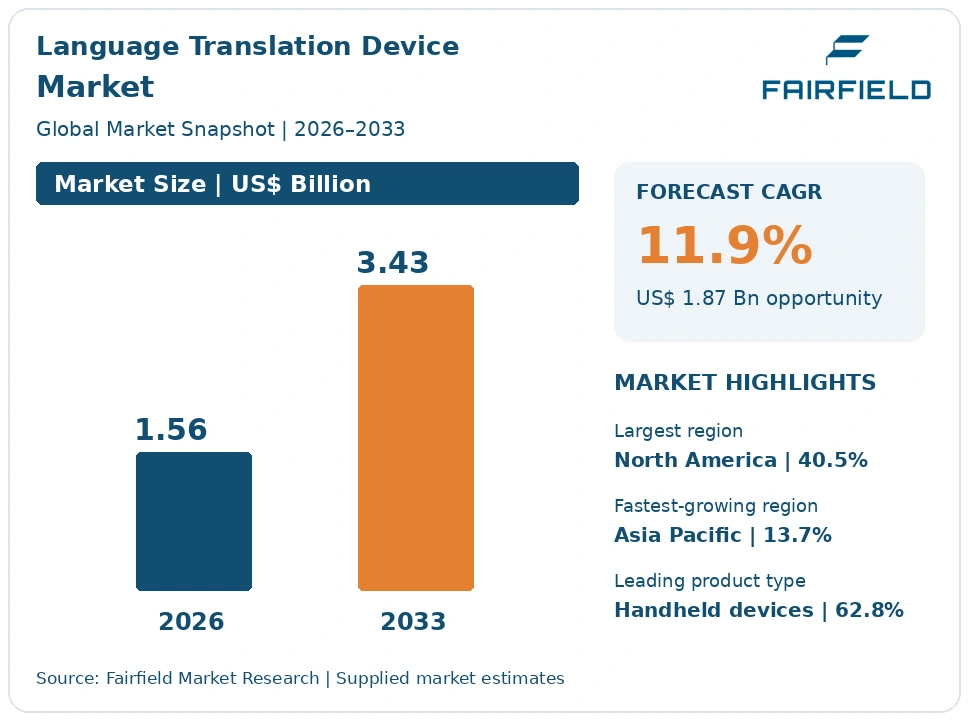
The global language translation device market size is expected to be valued at US$ 1.56 billion in 2026 and projected to reach US$ 3.43 billion by 2033, growing at a CAGR of 11.9% between 2026 and 2033.
Between 2020 and 2025, the market grew at a CAGR of about 9.8%, recovering from the collapse in international travel in 2020 and then accelerating as tourism, business travel, and migration returned. Three factors now drive growth: rising cross-border travel, demand for multilingual communication in healthcare and public services, and rapid gains in AI speech recognition and translation quality. The market is moving from basic handheld translators toward AI translation earbuds, smart glasses, and meeting devices that translate conversations in real time. Hybrid devices that work both online and offline are gaining ground with travelers and professionals.
Key Report Takeaways
- By Product Type: Handheld Devices held 62.8% share in 2026, while Wearables are projected to expand at a 16.9% CAGR through 2033, driven by hands-free translation in earbuds and smart glasses.
- By Connectivity: Online Devices held 54.3% share in 2026, while Hybrid Devices are projected to expand at a 17.4% CAGR through 2033, driven by travelers needing translation without reliable mobile data.
- By Application: Travel & Tourism held 28.0% share in 2026, while Healthcare Communication is projected to expand at a 14.7% CAGR through 2033, driven by patient safety needs and language access rules in hospitals.
- By Region: North America held 40.5% share in 2026, while Asia Pacific is projected to expand at a 13.7% CAGR through 2033, driven by outbound tourism from China and strong AI device makers.
Global Language Translation Device Market Trends and Insights
Drivers Impact Analysis
Two drivers carry the strongest influence on language translation device demand during the forecast period.
| Driver | Impact on CAGR Forecast | Geographic Relevance | Impact Timeline |
| Recovery and growth in international travel and migration | High | Global, strongest in Asia Pacific and Europe | Medium term (2-4 years) |
| AI speech recognition and neural translation improvements | High | North America, Asia Pacific, Europe | Long term (≥4 years) |
International Travel Growth Is Driving Language Translation Device Demand
International travel growth is the strongest driver of language translation device demand. Tourists, business travelers, students, and migrants need quick, reliable ways to talk with people who speak other languages.
The mechanism is the return and expansion of cross-border movement. UN Tourism reported that international tourist arrivals in 2024 reached about 1.4 billion, almost fully recovering to pre-pandemic levels. Travelers from China, India, Indonesia, and Thailand increasingly visit destinations where they do not speak the local language. Major events, such as the 2026 FIFA World Cup across the United States, Canada, and Mexico, attract millions of international visitors. Migration and refugee flows also create daily communication needs in schools, offices, and public services. A dedicated handheld translator offers clear audio, long battery life, and simple operation that many travelers prefer over phone apps.
AI Speech Recognition Advances Are Expanding Real-Time Translation Device Use
Advances in AI speech recognition and neural machine translation are expanding the use of language translation devices. Translation is now fast and accurate enough for natural conversations in many common languages.
The cause is the rapid improvement of large language models and on-device AI processors. Modern devices use noise-canceling microphones to capture speech, cloud or on-device engines to translate, and natural voice output. Real-time speech translation now handles accents, idioms, and specialized vocabulary better than earlier systems. In September 2025, Apple introduced Live Translation for AirPods Pro 3, bringing conversation translation to mainstream earbuds. Google expanded its Live Translate feature with headphones to more devices. Specialist makers such as Timekettle and iFLYTEK use multiple translation engines to improve accuracy. These advances make translation devices useful for business meetings, healthcare, and education, not only tourism.
Restraints Impact Analysis
Two restraints limit how quickly language translation devices gain adoption.
| Restraint | Impact on CAGR Forecast | Geographic Relevance | Impact Timeline |
| Competition from free smartphone apps and built-in features | High | Global | Short term (≤2 years) |
| Accuracy limits, privacy concerns, and connectivity dependence | Medium | Global | Medium term (2-4 years) |
Free Smartphone Apps Limit Dedicated Language Translation Device Sales
Free smartphone translation apps limit sales of dedicated language translation devices. Many consumers already carry phones with capable translation tools and see little reason to buy separate hardware.
The underlying cause is the reach of major technology platforms. Google Translate, Microsoft Translator, and Apple’s Translate app offer text, voice, and camera translation at no extra cost. Phone makers now build translation into operating systems, keyboards, calls, and messaging. Samsung’s Galaxy AI includes live call translation, and Apple has added translation to earbuds. Each improvement in phone-based tools reduces the reason for occasional travelers to buy a dedicated device. Device makers must therefore justify prices through better microphones, offline capability, hands-free use, industry certifications, or specialized features. Price pressure from low-cost devices sold online further compresses margins for established brands.
Accuracy and Privacy Concerns Slow Professional Translation Device Adoption
Accuracy limits and privacy concerns slow adoption of language translation devices in professional settings. Errors in healthcare, legal, or police conversations can have serious consequences, so organizations remain cautious.
The specific causes are language coverage gaps, noisy environments, and data handling. Translation quality is strong for widely spoken languages but weaker for less common languages, dialects, and specialized terms. Background noise and overlapping speech reduce accuracy. Many devices send audio to cloud servers, which raises concerns under privacy laws such as the European Union General Data Protection Regulation and health privacy rules like HIPAA in the United States. Online devices also fail when mobile data or Wi-Fi is unavailable. Hospitals and courts often still require certified human interpreters for critical conversations. These limits restrict devices to supporting roles in some professional uses.
Market Opportunities
Healthcare and Public Service Language Access Opens an Institutional Revenue Pool
Healthcare and public service language access opens an institutional revenue pool for language translation device makers. Hospitals, government agencies, police, and schools must communicate with growing numbers of people who speak limited local languages.
Device makers offering secure, certified solutions can capture this demand. In the United States, federal civil rights rules require many healthcare providers that receive federal funds to provide language assistance. Pocketalk has expanded deployments with public agencies; the New Jersey Motor Vehicle Commission completed a statewide rollout of its devices in February 2026. In Europe, healthcare and welfare institutions are adopting translation devices to support patients and migrants. Organizations buy devices in volume with management software, security features, and service contracts. These institutional sales provide steadier, higher-margin revenue than seasonal consumer travel purchases and support recurring subscription income.
Meeting Interpreters and AI Smart Glasses Create an Enterprise Revenue Pool
Meeting interpreters and AI smart glasses create an enterprise revenue pool for language translation devices. Global companies need affordable ways to run multilingual meetings, training, and customer conversations without hiring interpreters for every event.
Companies combining hardware, software, and AI translation can capture this opportunity. In June 2026, Timekettle launched the X1 Meeting Interpreter Hub, which supports up to 50 participants and five languages at once. In March 2026, iFLYTEK introduced AI Glasses and an AI Interpret Mic at MWC Barcelona. Smart glasses can show translated subtitles in the user’s field of view, enabling natural face-to-face conversations. Multinational companies, conference organizers, universities, hotels, and retailers are the main customers. Subscription plans for translation minutes, languages, and enterprise management add steady recurring revenue beyond hardware sales.
Segment Analysis
By Product Type: Handheld Devices Lead While Wearables Gain Momentum
Handheld Devices held 62.8% share in 2026. Pocket-sized translators with screens, microphones, and speakers are simple to use, support many languages, and offer camera translation for signs and menus. Brands such as Pocketalk, Vasco Electronics, and iFLYTEK sell them to travelers, businesses, and public agencies.
Wearables are the fastest-growing product type, expanding at a 16.9% CAGR through 2033. AI translation earbuds let users hear translations privately and speak naturally without passing a device back and forth. Timekettle launched its W4 AI interpreter earbuds in September 2025 and its LiveTalk open-ear earbuds in October 2026. Apple, Google, and Samsung add translation to mainstream earbuds, raising awareness. Smart glasses with subtitles are emerging. For the market, wearable growth shifts demand toward hands-free, conversation-focused devices and expands use in meetings and daily life.
By Connectivity: Online Devices Lead While Hybrid Devices Grow Fastest
Online Devices held 54.3% share in 2026. Cloud connections give access to the most accurate translation engines and large language libraries. Many devices include built-in eSIM data plans so travelers can translate without local SIM cards or Wi-Fi.
Hybrid Devices are the fastest-growing connectivity type, expanding at a 17.4% CAGR through 2033. These devices use cloud translation when connected and switch to offline translation for downloaded language pairs when signal is weak. Travelers in remote areas, airplanes, cruise ships, and underground transport benefit from continuous service. Hospitals and government agencies also value offline modes for privacy-sensitive conversations. More powerful on-device AI chips make offline quality better each year. For the market, hybrid growth reduces a key barrier to adoption and supports premium pricing.
By Application: Travel & Tourism Leads While Healthcare Communication Grows Fastest
Travel & Tourism held 28.0% share in 2026. Tourists use translation devices to ask directions, order food, shop, and handle emergencies abroad. Rising outbound travel from China, India, Indonesia, and Thailand sustains demand in this segment, and airports and hotels also buy devices for staff.
Healthcare Communication is the fastest-growing application, expanding at a 14.7% CAGR through 2033. Hospitals and clinics serve growing numbers of patients with limited proficiency in local languages, and clear communication is essential for safe care. Devices help with admissions, triage, and routine conversations when human interpreters are unavailable. Language access rules and patient safety goals drive adoption. Business communication, education, and government services remain important applications, with schools using devices to support newly arrived students and their parents. For the market, healthcare growth supports multilingual communication solutions with security, certification, and enterprise management features.
Geography Analysis
Which Region Is Leading the Language Translation Device Market?
North America is leading the language translation device market with a 40.5% share in 2026. The United States has large immigrant communities, high outbound travel, and federal language access requirements in healthcare and public services. Agencies, police departments, and hospitals deploy devices from Pocketalk and other brands. Technology companies such as Apple and Google add translation to consumer earbuds and phones, raising awareness. The 2026 FIFA World Cup increased demand among cities and public agencies hosting international visitors. Canada adds demand from bilingual services and immigration. One change shaping the region is the spread of translation in mainstream earbuds.
Europe Adopts Language Translation Devices for Tourism and Public Services
Europe is a major market where tourism, migration, and multilingual public services drive language translation device demand. France, Spain, and Italy are among the world’s most visited countries, attracting travelers who need translation support. Germany and the United Kingdom have large migrant communities, and healthcare and welfare institutions are adopting devices for patient and client communication. Poland hosts Vasco Electronics, a major device maker. Strict privacy rules under the General Data Protection Regulation favor devices with secure data handling and offline modes, giving established brands an advantage over low-cost imports. One opportunity is certified translation devices for healthcare providers.
Which Region Is Growing Fastest in the Language Translation Device Market?
Asia Pacific is growing fastest in the language translation device market at a 13.7% CAGR through 2033. China has a large population of outbound travelers and leading device makers and AI companies such as iFLYTEK, Timekettle, and Youdao. Japan hosts Pocketalk and is receiving record numbers of international visitors. India has enormous linguistic diversity, with many languages used across states, creating domestic demand. South Korea, Thailand, and Vietnam add tourism and business demand. Low-cost competition from online brands is intense, keeping retail prices under pressure. One opportunity is translation for less widely spoken Asian languages.
Latin America Grows Language Translation Device Use Through Tourism
Latin America is an emerging market where tourism and international business drive language translation device demand. Mexico received many international visitors during the 2026 FIFA World Cup and has a large tourism sector. Brazil, where Portuguese is spoken, needs translation for trade with Spanish- and English-speaking partners. Argentina, Colombia, Costa Rica, and Peru attract growing numbers of foreign tourists from North America, Europe, and Asia Pacific. Key barriers include high device prices relative to incomes, import duties, and reliance on free phone apps. One opportunity is devices for hotels, tour operators, and tourist police in popular destinations.
Middle East & Africa Uses Language Translation Devices for Tourism and Expatriate Workforces
Middle East & Africa is a developing market where tourism, religious travel, and expatriate workforces drive language translation device demand. Saudi Arabia welcomes millions of pilgrims for Hajj and Umrah and is expanding tourism under Vision 2030. The United Arab Emirates has a highly diverse expatriate population, with workers from India, Pakistan, the Philippines, and Europe, and hosts major events in Dubai. In Africa, many countries use multiple local languages alongside English, French, or Portuguese. Key barriers include limited retail availability, weak coverage of local African languages, and price sensitivity. One opportunity is translation devices for pilgrimage services, airports, and hospitality staff.
Competitive Landscape
The language translation device market is moderately concentrated. Specialist device brands such as Pocketalk, Timekettle, Vasco Electronics, and iFLYTEK lead dedicated devices, while large technology companies such as Apple, Google, and Samsung add translation features to earbuds and phones. Many smaller Chinese brands, including Wooask, Langogo, and VORMOR, sell low-cost devices online, creating strong price competition.
Companies compete on translation accuracy, number of languages, offline capability, microphone quality, battery life, ease of use, and price. Built-in data plans, subscription services, and enterprise management software increasingly differentiate offerings. Certifications for healthcare and government use matter in institutional sales. Large technology companies benefit from huge user bases, pushing specialists toward premium, professional, and enterprise products.
Strategic moves show how competition is changing. In September 2025, Apple introduced Live Translation on AirPods Pro 3, bringing translation to mass-market earbuds. Timekettle launched its W4 earbuds in September 2025, its X1 Meeting Interpreter Hub in June 2026, and its LiveTalk open-ear earbuds in October 2026. iFLYTEK introduced AI Glasses and an AI Interpret Mic in March 2026. Pocketalk expanded public sector deployments, including a statewide rollout with the New Jersey Motor Vehicle Commission. These moves show competition shifting toward wearables, meetings, and institutional customers.
Three themes shape vendor strategy. First, companies are adding generative AI and multiple translation engines. Second, they are developing wearable and meeting devices. Third, they are targeting healthcare, government, and enterprise customers.
Language Translation Device Market Industry Leaders
- Pocketalk
- Timekettle
- Vasco Electronics
- iFLYTEK
- Apple
Recent Industry Developments
October 2026: Timekettle launched LiveTalk open-ear AI interpreter earbuds supporting 54 languages - expands affordable wearable translation.
June 2026: Timekettle launched the X1 Meeting Interpreter Hub for up to 50 participants - targets enterprise meetings.
March 2026: iFLYTEK introduced AI Glasses and an AI Interpret Mic at MWC Barcelona - enters smart glasses translation.
February 2026: The New Jersey Motor Vehicle Commission completed a statewide rollout of Pocketalk devices - shows public sector demand.
September 2025: Apple introduced Live Translation on AirPods Pro 3 - brings translation to mainstream earbuds.
Language Translation Device Market Report Scope
| Metric | Value |
| Study Period | 2020-2033 |
| Market Size 2026 | US$ 1.56 Billion |
| Market Size 2033 | US$ 3.43 Billion |
| CAGR 2026-2033 | 11.9% |
| Absolute Dollar Opportunity | US$ 1.87 Billion |
| Largest Market | North America |
| Fastest-Growing Market | Asia Pacific |
| Market Concentration | Medium |
| Major Players | Pocketalk, Timekettle, Vasco Electronics, iFLYTEK, Apple |
This report covers dedicated electronic devices that translate spoken or written language, including handheld translators, wearable translation earbuds and smart glasses, and meeting interpreter devices, across online, offline, and hybrid connectivity. It excludes standalone translation apps, software-only services, and human interpretation. The base year is 2025, and the forecast period runs from 2026 to 2033. All values are expressed in US$ Billion.
Language Translation Device Market Segmentation
Product Type
- Handheld Devices
- Wearables
- Others
Connectivity
- Online Devices
- Offline Devices
- Hybrid Devices
Application
- Travel & Tourism
- Business Communication
- Healthcare Communication
- Education
- Government & Public Services
- Others
Regions
- North America
- Europe
- Asia Pacific
- Latin America
- Middle East & Africa
- Executive Summary
- Global Language Translation Device Market Snapshot
- Future Projections
- Key Report Takeaways
- Regional Snapshot
- Market Overview
- Market Definition and Report Scope
- Historical Trends 2020–2025
- Market Dynamics
- Drivers
- International Travel Growth Is Driving Language Translation Device Demand
- AI Speech Recognition Advances Are Expanding Real-Time Translation Device Use
- Restraints
- Free Smartphone Apps Limit Dedicated Language Translation Device Sales
- Accuracy and Privacy Concerns Slow Professional Translation Device Adoption
- Market Opportunities
- Healthcare and Public Service Language Access Opens an Institutional Revenue Pool
- Meeting Interpreters and AI Smart Glasses Create an Enterprise Revenue Pool
- Drivers
- Global Language Translation Device Market Outlook, 2020-2033
- Global Language Translation Device Market Outlook, by Product Type, Value (US$ Billion), 2020-2033
- Handheld Devices
- Wearables
- Others
- Global Language Translation Device Market Outlook, by Connectivity, Value (US$ Billion), 2020-2033
- Online Devices
- Offline Devices
- Hybrid Devices
- Global Language Translation Device Market Outlook, by Application, Value (US$ Billion), 2020-2033
- Travel & Tourism
- Business Communication
- Healthcare Communication
- Education
- Government & Public Services
- Others
- Global Language Translation Device Market Outlook, by Region, Value (US$ Billion), 2020-2033
- North America
- Europe
- Asia Pacific
- Latin America
- Middle East & Africa
- Global Language Translation Device Market Outlook, by Product Type, Value (US$ Billion), 2020-2033
- North America Language Translation Device Market Outlook, 2020-2033
- North America Language Translation Device Market Outlook, by Product Type, Value (US$ Billion), 2020-2033
- Handheld Devices
- Wearables
- Others
- North America Language Translation Device Market Outlook, by Connectivity, Value (US$ Billion), 2020-2033
- Online Devices
- Offline Devices
- Hybrid Devices
- North America Language Translation Device Market Outlook, by Application, Value (US$ Billion), 2020-2033
- Travel & Tourism
- Business Communication
- Healthcare Communication
- Education
- Government & Public Services
- Others
- North America Language Translation Device Market Outlook, by Country, Value (US$ Billion), 2020-2033
- United States Language Translation Device Market Outlook, by Product Type, 2020-2033
- United States Language Translation Device Market Outlook, by Connectivity, 2020-2033
- United States Language Translation Device Market Outlook, by Application, 2020-2033
- Canada Language Translation Device Market Outlook, by Product Type, 2020-2033
- Canada Language Translation Device Market Outlook, by Connectivity, 2020-2033
- Canada Language Translation Device Market Outlook, by Application, 2020-2033
- North America Language Translation Device Market Outlook, by Product Type, Value (US$ Billion), 2020-2033
- Europe Language Translation Device Market Outlook, 2020-2033
- Europe Language Translation Device Market Outlook, by Product Type, Value (US$ Billion), 2020-2033
- Handheld Devices
- Wearables
- Others
- Europe Language Translation Device Market Outlook, by Connectivity, Value (US$ Billion), 2020-2033
- Online Devices
- Offline Devices
- Hybrid Devices
- Europe Language Translation Device Market Outlook, by Application, Value (US$ Billion), 2020-2033
- Travel & Tourism
- Business Communication
- Healthcare Communication
- Education
- Government & Public Services
- Others
- Europe Language Translation Device Market Outlook, by Country, Value (US$ Billion), 2020-2033
- France Language Translation Device Market Outlook, by Product Type, 2020-2033
- France Language Translation Device Market Outlook, by Connectivity, 2020-2033
- France Language Translation Device Market Outlook, by Application, 2020-2033
- Spain Language Translation Device Market Outlook, by Product Type, 2020-2033
- Spain Language Translation Device Market Outlook, by Connectivity, 2020-2033
- Spain Language Translation Device Market Outlook, by Application, 2020-2033
- Italy Language Translation Device Market Outlook, by Product Type, 2020-2033
- Italy Language Translation Device Market Outlook, by Connectivity, 2020-2033
- Italy Language Translation Device Market Outlook, by Application, 2020-2033
- Germany Language Translation Device Market Outlook, by Product Type, 2020-2033
- Germany Language Translation Device Market Outlook, by Connectivity, 2020-2033
- Germany Language Translation Device Market Outlook, by Application, 2020-2033
- United Kingdom Language Translation Device Market Outlook, by Product Type, 2020-2033
- United Kingdom Language Translation Device Market Outlook, by Connectivity, 2020-2033
- United Kingdom Language Translation Device Market Outlook, by Application, 2020-2033
- Poland Language Translation Device Market Outlook, by Product Type, 2020-2033
- Poland Language Translation Device Market Outlook, by Connectivity, 2020-2033
- Poland Language Translation Device Market Outlook, by Application, 2020-2033
- Europe Language Translation Device Market Outlook, by Product Type, Value (US$ Billion), 2020-2033
- Asia Pacific Language Translation Device Market Outlook, 2020-2033
- Asia Pacific Language Translation Device Market Outlook, by Product Type, Value (US$ Billion), 2020-2033
- Handheld Devices
- Wearables
- Others
- Asia Pacific Language Translation Device Market Outlook, by Connectivity, Value (US$ Billion), 2020-2033
- Online Devices
- Offline Devices
- Hybrid Devices
- Asia Pacific Language Translation Device Market Outlook, by Application, Value (US$ Billion), 2020-2033
- Travel & Tourism
- Business Communication
- Healthcare Communication
- Education
- Government & Public Services
- Others
- Asia Pacific Language Translation Device Market Outlook, by Country, Value (US$ Billion), 2020-2033
- China Language Translation Device Market Outlook, by Product Type, 2020-2033
- China Language Translation Device Market Outlook, by Connectivity, 2020-2033
- China Language Translation Device Market Outlook, by Application, 2020-2033
- Japan Language Translation Device Market Outlook, by Product Type, 2020-2033
- Japan Language Translation Device Market Outlook, by Connectivity, 2020-2033
- Japan Language Translation Device Market Outlook, by Application, 2020-2033
- India Language Translation Device Market Outlook, by Product Type, 2020-2033
- India Language Translation Device Market Outlook, by Connectivity, 2020-2033
- India Language Translation Device Market Outlook, by Application, 2020-2033
- South Korea Language Translation Device Market Outlook, by Product Type, 2020-2033
- South Korea Language Translation Device Market Outlook, by Connectivity, 2020-2033
- South Korea Language Translation Device Market Outlook, by Application, 2020-2033
- Thailand Language Translation Device Market Outlook, by Product Type, 2020-2033
- Thailand Language Translation Device Market Outlook, by Connectivity, 2020-2033
- Thailand Language Translation Device Market Outlook, by Application, 2020-2033
- Vietnam Language Translation Device Market Outlook, by Product Type, 2020-2033
- Vietnam Language Translation Device Market Outlook, by Connectivity, 2020-2033
- Vietnam Language Translation Device Market Outlook, by Application, 2020-2033
- Indonesia Language Translation Device Market Outlook, by Product Type, 2020-2033
- Indonesia Language Translation Device Market Outlook, by Connectivity, 2020-2033
- Indonesia Language Translation Device Market Outlook, by Application, 2020-2033
- Asia Pacific Language Translation Device Market Outlook, by Product Type, Value (US$ Billion), 2020-2033
- Latin America Language Translation Device Market Outlook, 2020-2033
- Latin America Language Translation Device Market Outlook, by Product Type, Value (US$ Billion), 2020-2033
- Handheld Devices
- Wearables
- Others
- Latin America Language Translation Device Market Outlook, by Connectivity, Value (US$ Billion), 2020-2033
- Online Devices
- Offline Devices
- Hybrid Devices
- Latin America Language Translation Device Market Outlook, by Application, Value (US$ Billion), 2020-2033
- Travel & Tourism
- Business Communication
- Healthcare Communication
- Education
- Government & Public Services
- Others
- Latin America Language Translation Device Market Outlook, by Country, Value (US$ Billion), 2020-2033
- Mexico Language Translation Device Market Outlook, by Product Type, 2020-2033
- Mexico Language Translation Device Market Outlook, by Connectivity, 2020-2033
- Mexico Language Translation Device Market Outlook, by Application, 2020-2033
- Brazil Language Translation Device Market Outlook, by Product Type, 2020-2033
- Brazil Language Translation Device Market Outlook, by Connectivity, 2020-2033
- Brazil Language Translation Device Market Outlook, by Application, 2020-2033
- Argentina Language Translation Device Market Outlook, by Product Type, 2020-2033
- Argentina Language Translation Device Market Outlook, by Connectivity, 2020-2033
- Argentina Language Translation Device Market Outlook, by Application, 2020-2033
- Colombia Language Translation Device Market Outlook, by Product Type, 2020-2033
- Colombia Language Translation Device Market Outlook, by Connectivity, 2020-2033
- Colombia Language Translation Device Market Outlook, by Application, 2020-2033
- Costa Rica Language Translation Device Market Outlook, by Product Type, 2020-2033
- Costa Rica Language Translation Device Market Outlook, by Connectivity, 2020-2033
- Costa Rica Language Translation Device Market Outlook, by Application, 2020-2033
- Peru Language Translation Device Market Outlook, by Product Type, 2020-2033
- Peru Language Translation Device Market Outlook, by Connectivity, 2020-2033
- Peru Language Translation Device Market Outlook, by Application, 2020-2033
- Latin America Language Translation Device Market Outlook, by Product Type, Value (US$ Billion), 2020-2033
- Middle East & Africa Language Translation Device Market Outlook, 2020-2033
- Middle East & Africa Language Translation Device Market Outlook, by Product Type, Value (US$ Billion), 2020-2033
- Handheld Devices
- Wearables
- Others
- Middle East & Africa Language Translation Device Market Outlook, by Connectivity, Value (US$ Billion), 2020-2033
- Online Devices
- Offline Devices
- Hybrid Devices
- Middle East & Africa Language Translation Device Market Outlook, by Application, Value (US$ Billion), 2020-2033
- Travel & Tourism
- Business Communication
- Healthcare Communication
- Education
- Government & Public Services
- Others
- Middle East & Africa Language Translation Device Market Outlook, by Country, Value (US$ Billion), 2020-2033
- Saudi Arabia Language Translation Device Market Outlook, by Product Type, 2020-2033
- Saudi Arabia Language Translation Device Market Outlook, by Connectivity, 2020-2033
- Saudi Arabia Language Translation Device Market Outlook, by Application, 2020-2033
- United Arab Emirates Language Translation Device Market Outlook, by Product Type, 2020-2033
- United Arab Emirates Language Translation Device Market Outlook, by Connectivity, 2020-2033
- United Arab Emirates Language Translation Device Market Outlook, by Application, 2020-2033
- Middle East & Africa Language Translation Device Market Outlook, by Product Type, Value (US$ Billion), 2020-2033
- Competitive Landscape
- Market Concentration and Industry Leaders
- Competitive Differentiation
- Strategic Moves and Market Direction
- Recent Industry Developments
- Company Profiles
- Pocketalk
- Timekettle
- Vasco Electronics
- iFLYTEK
- Apple
- Samsung Electronics
- Youdao
- Langogo
- Shenzhen Wooask Technology
- Waverly Labs
- Travis
- Appendix
- Research Methodology
- Report Assumptions
- Acronyms and Abbreviations
Product Type
- Handheld Devices
- Wearables
- Others
Connectivity
- Online Devices
- Offline Devices
- Hybrid Devices
Application
- Travel & Tourism
- Business Communication
- Healthcare Communication
- Education
- Government & Public Services
- Others
Regions
- North America
- Europe
- Asia Pacific
- Latin America
- Middle East & Africa
Our Research Methodology
Considering the volatility of business today, traditional approaches to strategizing a game plan can be unfruitful if not detrimental. True ambiguity is no way to determine a forecast. A myriad of predetermined factors must be accounted for such as the degree of risk involved, the magnitude of circumstances, as well as conditions or consequences that are not known or unpredictable. To circumvent binary views that cast uncertainty, the application of market research intelligence to strategically posture, move, and enable actionable outcomes is necessary.
View Methodology
Quality Assured
Rigorous Validation Process

Confidentiality Assured
End-to-end Data Security

Custom Research Services
Tailored To Your Objectives
FAQs
The language translation device market is valued at US$ 1.56 billion in 2026, led by handheld translators used for travel and tourism.
The market is projected to reach US$ 3.43 billion by 2033, growing at an 11.9% CAGR and adding US$ 1.87 billion.
Wearables are growing fastest at a 16.9% CAGR through 2033, driven by hands-free translation in earbuds and smart glasses.
Asia Pacific is growing fastest at a 13.7% CAGR through 2033, driven by outbound tourism from China and strong AI device makers.
North America holds the largest share at 40.5% in 2026, supported by immigrant communities, outbound travel, and language access requirements.
Related Reports
Smart Water Management Market Size, Share, Insights, Competitive Landscape, and Forecast 2026 to 2033
Explore the smart water management market, reaching US$ 45.2 billion by 2033 at 11.0% CAGR, with solution, regional and competitive insights.
Infusion Pump Software Market Size, Share, Insights, Competitive Landscape, and Forecast 2026 to 2033
Explore the infusion pump software market, reaching US$ 2.4 billion by 2033 at 10.4% CAGR, with software, regional and competitive insights.
Database Security Market Size, Share, Insights, Competitive Landscape, and Forecast 2026 to 2033
Explore the database security market, reaching US$ 28.5 billion by 2033 at 14.3% CAGR, with offering, regional and competitive insights.
Smart Home Appliances Market Size, Share, Insights, Competitive Landscape, and Forecast 2026 to 2033
Explore the smart home appliances market, reaching US$ 113.0 billion by 2033 at 13.0% CAGR, with product, regional and competitive insights.
Smart Cities Market Size, Share, Insights, Competitive Landscape, and Forecast 2026 to 2033
Explore the smart cities market, reaching US$ 420.0 billion by 2033 at 12.7% CAGR, with solution, regional and competitive insights.
Industrial Robotics Market Size, Share, Insights, Competitive Landscape, and Forecast 2026 to 2033
Explore the industrial robotics market, reaching US$ 95.0 billion by 2033 at 8.4% CAGR, with robot types, regional and competitive insights.