



Persulfates Market
Global Persulfates Industry Analysis, Size, Share, Growth, Trends, and Forecast 2026-2033 – (By Form, By End-use Industry, By Geographic Coverage and By Company)
Global Persulfates Market: Comprehensive Strategic Analysis
Executive Summary & Key Highlights
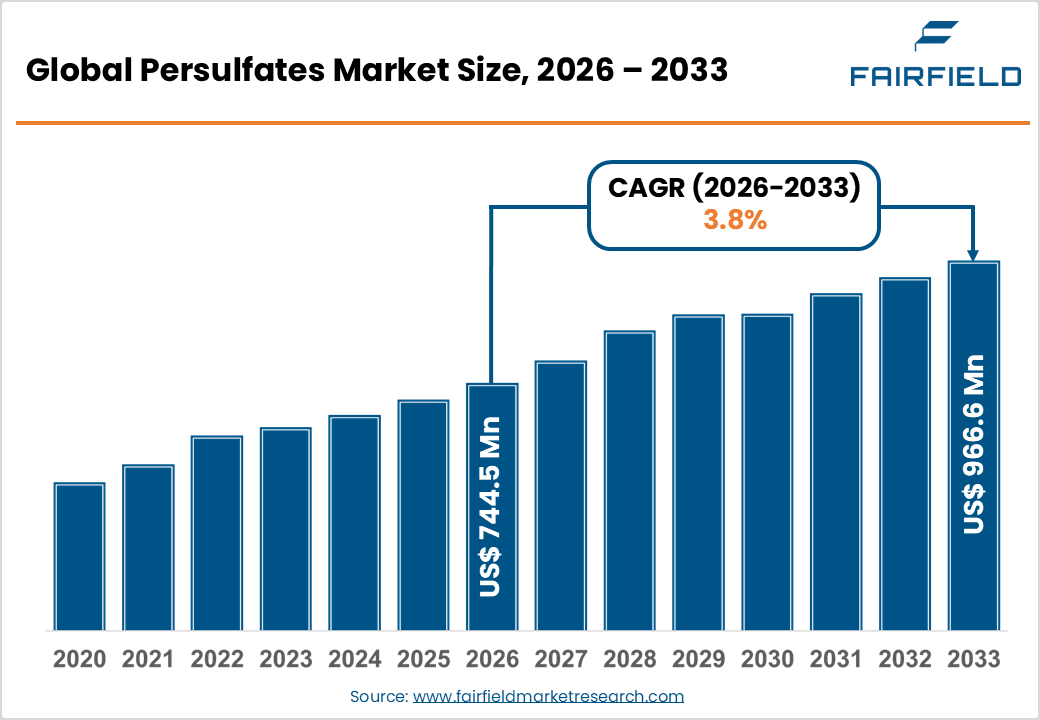
- Persulfates Market valued approximately at US$744.5 million in 2026, and is projected to reach US$966.6 million by 2033 at 3.8% CAGR, reflecting polymer and electronics demand amid regulatory shifts in water treatment.
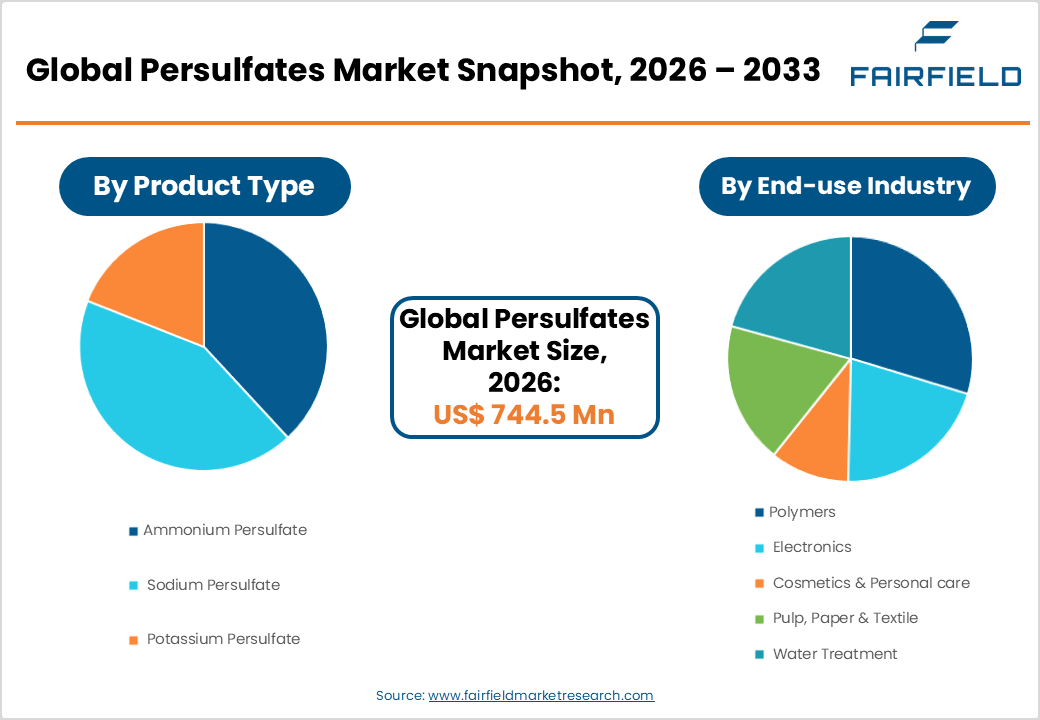
- Sodium Persulfate leads with 56.2% share in 2026 , driven by cost advantages in polymerization; Ammonium Persulfate grows fastest, supporting electronics etching.
- Polymers holds 28.7% share, fueled by adhesives/coatings production; while Water Treatment emerges as fastest grower, tied to wastewater compliance needs.
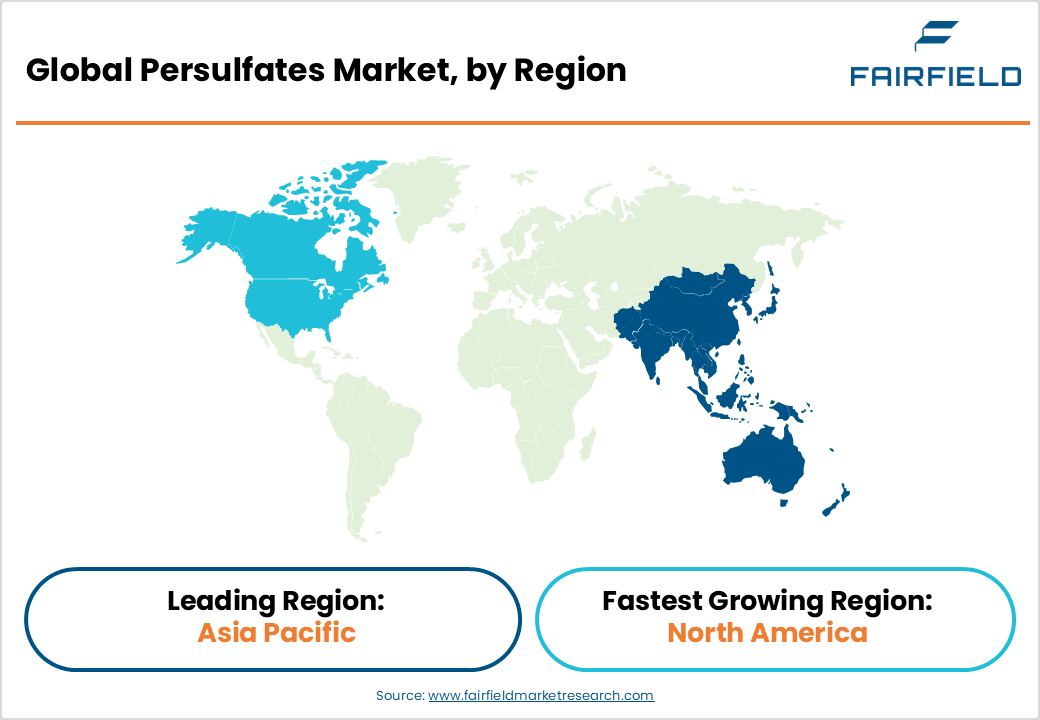
- Asia Pacific commands 50.6% global share in 2026, led by China; North America (22%) anchored by U.S. (~85% regional).
- Capacity expansions by Mitsubishi Gas Chemical (2024) and United Initiators partnerships enhance supply for polymers; regulatory tightening boosts remediation applications.
- Participants prioritize vertical integration in Asia Pacific while navigating EU sustainability mandates, positioning for 3.8% growth amid supply chain risks.
Market Overview: Strategic Context Assessment
The global persulfates market reached US$744.5 million in 2026 and is anticipated to expand to US$966.6 million by 2033, representing a CAGR of 3.8%. This trajectory reflects rising demand for polymerization initiators in plastics and stringent wastewater regulations, with market participants evaluating expansion amid REACH/EPA frameworks and electronics supply chain consolidation influencing strategy across product and end-use segments. Context centers on three factors: (1) electronics manufacturing growth, consuming 15-20% persulfates for PCB etching; (2) polymer production expansion, with global capacity up 4% annually ; (3) environmental remediation needs, driven by 20% rise in industrial effluent standards . Constraints include raw material volatility capping upside, while projections employ bottom-up sizing from company disclosures and top-down validation.
Market Dynamics: Drivers, Restraints, and Opportunities Analysis
Market Drivers
- Polymerization Demand and Electronics Etching
Polymer initiator needs drive the Polymers segment to 28.7% market share, with GMI reporting a 3.7% CAGR tied to adhesives and coatings growth, contributing 1.5 percentage points to overall expansion. Asia Pacific experiences amplified impact through China’s capacity expansions , where firms leveraging scale achieve cost advantages, though sulfur input volatility moderates sustainability efforts. Complementing this, electronics etching relies on persulfates for PCB desmear processes, supported by EPA data showing 15% U.S. semiconductor output growth boosting demand. This driver adds 0.8 points to CAGR, favoring sodium persulfate types, while trade policy monitoring remains critical as tariffs impact imports.
- Water Treatment Compliance
Oxidizing agents in water treatment address industrial effluents, with the World Bank noting a 25% rise in global wastewater investments, projecting a 1.2-point CAGR contribution through 2033. Regional variations are pronounced, as EU REACH regulations accelerate adoption compared to other markets. Supply chain resilience will determine realization of this potential, particularly amid raw material constraints affecting production scalability.
Market Restraints
- Raw Material Volatility
Sulfur and ammonium costs fluctuate 15-20% yearly according to OECD statistics, suppressing overall market growth by approximately 0.5 percentage points through the forecast period. Asia Pacific producers, reliant on imports, face heightened exposure, amplifying cost pressures in high-volume segments like polymers and electronics. This volatility disrupts pricing stability and margins, particularly for sodium persulfate production. Mitigation strategies center on hedging mechanisms and securing long-term supplier contracts to stabilize input costs, enabling firms to maintain competitive pricing amid global supply chain uncertainties. Larger players with diversified sourcing demonstrate greater resilience, while smaller entities risk margin erosion without proactive risk management.
- Regulatory Stringency
REACH and EPA toxicity regulations elevate compliance costs by 10-15%, disproportionately affecting the cosmetics and personal care segment through formulation restrictions and testing mandates. European firms adapt via product reformulations to meet stringent residue limits, yet these requirements delay market entry for smaller players lacking R&D scale. This creates barriers in high-value applications like hair bleaching products, where alternative oxidizers face similar scrutiny. Strategic responses include investing in low-toxicity grades and regulatory expertise, positioning compliant manufacturers for premium pricing. Non-compliance risks compound with evolving EU sustainability directives, underscoring the need for proactive adaptation across end-use industries.
Market Opportunities
- Soil Remediation Expansion and Sustainable Polymers
Soil remediation via in-situ oxidation targets persistent contaminants in oil/gas sites, with U.S. EPA Superfund data indicating a 30% rise in projects, creating a US$50 million opportunity by 2030. This focuses on the Oil & Gas end-use segment, where partnerships with EPC firms overcome technical barriers like oxidant delivery efficiency. Complementarily, sustainable polymers integrate bio-based initiators with persulfates, supported by EU Green Deal incentives projecting a 20% segment shift valued at USD 100 million. Early technology adopters secure premium pricing through certified low-carbon formulations, though IP protection remains critical amid elevated R&D investments required for scalability and performance equivalence with conventional grades.
- Electronics in APAC
Investments in semiconductor fabrication facilities across India and Japan, growing at 10% CAGR, generate new persulfates demand for PCB etching and cleaning applications. IMARC analysis sizes this addressable opportunity at USD 80 million through the decade, driven by capacity expansions targeting consumer electronics and automotive semiconductors. Localization strategies become essential to counter China’s regional dominance (70% of Asia Pacific demand), enabling multinational suppliers to establish compliant production footprints. Success factors include securing high-purity grades meeting JEDEC standards and navigating export controls, positioning firms to capture value in high-margin electronics applications despite infrastructure development timelines.
Regional Market Assessment: Strategic Geography Analysis
- North America Persulfates Market
The U.S. market, valued over US$155 million in 2026 and comprising ~85% of the North American regional total, exhibits maturity characterized by consolidated supply chains dominated by PeroxyChem and Evonik. This structure supports a 3.3% CAGR projection through 2031, driven by stable demand in polymers and electronics etching. EPA standards establish stringent compliance requirements for wastewater and remediation applications, shaping production and handling protocols. Innovation hubs concentrated in semiconductor regions accelerate adoption of high-purity grades for PCB manufacturing. Market participants must navigate tariff considerations and trade policy fluctuations when formulating supply chain strategies in this competitive, regulated environment.
- Europe: Regulatory Harmonization and Differentiated Market Dynamics
The European persulfates market is projected to surpass US$500 million by 2033. Germany leads with 25% regional share, equating to approximately US$58.8 million by 2031, while the United Kingdom holds equivalent 25% positioning supported by a 2.8% CAGR trajectory. REACH regulations harmonize toxicity classification and handling requirements across member states, placing increased emphasis on sustainability metrics and residue management that reshape formulation strategies. This regulatory convergence coexists with persistent fragmented competition featuring both multinational producers and regional specialists. Effective expansion necessitates granular country-level analysis accounting for differentiated industrial structures, compliance cost profiles, and end-use adoption patterns particular to each market.
- Asia-Pacific: Differential Growth and Competitive Positioning
The Asia-Pacific persulfates market is projected to reach approximately US$370 million by 2033, maintaining a 39-50% share of global demand. China dominates with 70% of regional consumption, driven by electronics manufacturing and polymer production capacity expansions that solidify its supply chain centrality. India emerges as the fastest-growing market at 6.2% CAGR , fueled by textile processing and water treatment infrastructure development. Manufacturing hubs across the region accelerate supplier consolidation, while government policy incentives promote localization of high-purity grades to reduce import dependence. Strategic planning requires country-specific competitive intensity assessments, balancing China's scale advantages against India's growth potential and Japan's technology leadership in semiconductor applications.
Segmentation Analysis: Category-Wise Strategic Assessment
- Product Type Segmentation
Sodium Persulfate represents 56.2% of the market (US$418.7 million in 2026), valued for cost-effectiveness in high-volume polymerization, with leadership stemming from 64% share in electronics etching. Demand centers on PCB/desmear applications, where leading producers emphasize high-purity grades to meet semiconductor specifications. Ammonium Persulfate holds ~30% share and expands faster at 4%+ CAGR, driven by specialty applications in hair bleaching and emulsion polymers that outpace overall market growth through targeted formulation demand. Resource allocation decisions should account for elevated entry barriers, including specialized formulation expertise and regulatory approvals for personal care applications.
- End-Use Industry Segmentation
Polymers commands 28.7% market share (US$213.7 million in 2026), driven by demand for initiators in adhesives and plastics production, with Research noting 25% volume reliance that underscores competitive emphasis on supply reliability. Water Treatment grows quickest at projected 4.5% CAGR amid EPA and REACH effluent regulations, holding ~15% share boosted by disinfection applications in industrial wastewater management. Strategic positioning requires evaluating infrastructure dependencies and compliance linkages, as regulatory enforcement accelerates adoption while supply chain integration determines capture of this high-growth segment.
Competitive Landscape: Market Structure and Strategic Positioning
The persulfates market exhibits moderate concentration, with the top-5 players PeroxyChem/Evonik, United Initiators, Mitsubishi Gas Chemical, Adeka, and Fujian Zhanhua collectively holding approximately 50% market share. Competitive differentiation centers on product purity specifications for electronics applications and production scale advantages in commodity grades for polymers. Entry barriers remain substantial, encompassing capital expenditures of US$50-100 million for greenfield plants and comprehensive REACH compliance validation processes that extend timelines by 18-24 months. Ongoing M&A activity, exemplified by the PeroxyChem acquisition, signals market maturation as incumbents pursue vertical integration and geographic expansion to consolidate regional supply positions amid stabilizing demand patterns.
Key Players
- Evonik Industries AG
- United Initiators
- PeroxyChem LLC
- Mitsubishi Gas Chemical Company, Inc.
- Ak-Kim Kimya
- Fujian Zhanhua Chemical Co., Ltd.
- Merck KGaA
- LANXESS AG
- Hebei Yatai Electrochemistry Co., Ltd.
- Hebei Jiheng Group
- Powder Pack Chem
- Aldon Corporation
- RheinPerChemie GmbH
- San Yuan Chemical Co., Ltd.
- VR Persulfates Private Limited
Key Industry Developments
- In November 2025, Evonik launched high-purity ammonium persulfate grades optimized for electronics etching applications, meeting JEDEC semiconductor purity standards. This development targets PCB desmear processes amid 15% U.S. semiconductor capacity growth, enhancing supply reliability for high-volume electronics manufacturers.
- In January 2024, Mitsubishi Gas Chemical expanded Japan production capacity by 20% specifically for polymer initiator grades, responding to adhesives and coatings demand . The investment strengthens Asia Pacific supply chains, supporting regional electronics and plastics sectors with improved delivery timelines and cost stability.
Market Segmentation
By Product Type
- Ammonium Persulfate
- Sodium Persulfate
- Potassium Persulfate
By End-Use Industry
- Polymers
- Electronics
- Cosmetics & Personal care
- Pulp, Paper & Textile
- Water Treatment
- Oil & Gas
- Soil Remediation
- Others
By Application
- Polymer initiator
- Oxidation, Bleaching & Sizing Agent
- Down-hole
- Others
By Region
- North America
- Europe
- Asia Pacific
- Latin America
- Middle East and Africa
- Executive Summary
- Global Persulfates Market Snapshot
- Future Projections
- Key Market Trends
- Regional Snapshot, by Value, 2026
- Analyst Recommendations
- Market Overview
- Market Definitions and Segmentations
- Market Dynamics
- Drivers
- Restraints
- Market Opportunities
- Value Chain Analysis
- COVID-19 Impact Analysis
- Porter's Five Forces Analysis
- Impact of Russia-Ukraine Conflict
- PESTLE Analysis
- Regulatory Analysis
- Price Trend Analysis
- Current Prices and Future Projections, 2025-2033
- Price Impact Factors
- Global Persulfates Market Outlook, 2020 - 2033
- Global Persulfates Market Outlook, by Product Type, Value (US$ Mn), 2020-2033
- Ammonium Persulfate
- Sodium Persulfate
- Potassium Persulfate
- Global Persulfates Market Outlook, by End-Use Industry, Value (US$ Mn), 2020-2033
- Polymers
- Electronics
- Cosmetics & Personal care
- Pulp, Paper & Textile
- Water Treatment
- Oil & Gas
- Soil Remediation
- Others
- Global Persulfates Market Outlook, by Application, Value (US$ Mn), 2020-2033
- Polymer initiator
- Oxidation, Bleaching & Sizing Agent
- Down-hole
- Others
- Global Persulfates Market Outlook, by Region, Value (US$ Mn), 2020-2033
- North America
- Europe
- Asia Pacific
- Latin America
- Middle East & Africa
- Global Persulfates Market Outlook, by Product Type, Value (US$ Mn), 2020-2033
- North America Persulfates Market Outlook, 2020 - 2033
- North America Persulfates Market Outlook, by Product Type, Value (US$ Mn), 2020-2033
- Ammonium Persulfate
- Sodium Persulfate
- Potassium Persulfate
- North America Persulfates Market Outlook, by End-Use Industry, Value (US$ Mn), 2020-2033
- Polymers
- Electronics
- Cosmetics & Personal care
- Pulp, Paper & Textile
- Water Treatment
- Oil & Gas
- Soil Remediation
- Others
- North America Persulfates Market Outlook, by Application, Value (US$ Mn), 2020-2033
- Polymer initiator
- Oxidation, Bleaching & Sizing Agent
- Down-hole
- Others
- North America Persulfates Market Outlook, by Country, Value (US$ Mn), 2020-2033
- U.S. Persulfates Market Outlook, by Product Type, 2020-2033
- U.S. Persulfates Market Outlook, by End-Use Industry, 2020-2033
- U.S. Persulfates Market Outlook, by Application, 2020-2033
- Canada Persulfates Market Outlook, by Product Type, 2020-2033
- Canada Persulfates Market Outlook, by End-Use Industry, 2020-2033
- Canada Persulfates Market Outlook, by Application, 2020-2033
- BPS Analysis/Market Attractiveness Analysis
- North America Persulfates Market Outlook, by Product Type, Value (US$ Mn), 2020-2033
- Europe Persulfates Market Outlook, 2020 - 2033
- Europe Persulfates Market Outlook, by Product Type, Value (US$ Mn), 2020-2033
- Ammonium Persulfate
- Sodium Persulfate
- Potassium Persulfate
- Europe Persulfates Market Outlook, by End-Use Industry, Value (US$ Mn), 2020-2033
- Polymers
- Electronics
- Cosmetics & Personal care
- Pulp, Paper & Textile
- Water Treatment
- Oil & Gas
- Soil Remediation
- Others
- Europe Persulfates Market Outlook, by Application, Value (US$ Mn), 2020-2033
- Polymer initiator
- Oxidation, Bleaching & Sizing Agent
- Down-hole
- Others
- Europe Persulfates Market Outlook, by Country, Value (US$ Mn), 2020-2033
- Germany Persulfates Market Outlook, by Product Type, 2020-2033
- Germany Persulfates Market Outlook, by End-Use Industry, 2020-2033
- Germany Persulfates Market Outlook, by Application, 2020-2033
- Italy Persulfates Market Outlook, by Product Type, 2020-2033
- Italy Persulfates Market Outlook, by End-Use Industry, 2020-2033
- Italy Persulfates Market Outlook, by Application, 2020-2033
- France Persulfates Market Outlook, by Product Type, 2020-2033
- France Persulfates Market Outlook, by End-Use Industry, 2020-2033
- France Persulfates Market Outlook, by Application, 2020-2033
- U.K. Persulfates Market Outlook, by Product Type, 2020-2033
- U.K. Persulfates Market Outlook, by End-Use Industry, 2020-2033
- U.K. Persulfates Market Outlook, by Application, 2020-2033
- Spain Persulfates Market Outlook, by Product Type, 2020-2033
- Spain Persulfates Market Outlook, by End-Use Industry, 2020-2033
- Spain Persulfates Market Outlook, by Application, 2020-2033
- Russia Persulfates Market Outlook, by Product Type, 2020-2033
- Russia Persulfates Market Outlook, by End-Use Industry, 2020-2033
- Russia Persulfates Market Outlook, by Application, 2020-2033
- Rest of Europe Persulfates Market Outlook, by Product Type, 2020-2033
- Rest of Europe Persulfates Market Outlook, by End-Use Industry, 2020-2033
- Rest of Europe Persulfates Market Outlook, by Application, 2020-2033
- BPS Analysis/Market Attractiveness Analysis
- Europe Persulfates Market Outlook, by Product Type, Value (US$ Mn), 2020-2033
- Asia Pacific Persulfates Market Outlook, 2020 - 2033
- Asia Pacific Persulfates Market Outlook, by Product Type, Value (US$ Mn), 2020-2033
- Ammonium Persulfate
- Sodium Persulfate
- Potassium Persulfate
- Asia Pacific Persulfates Market Outlook, by End-Use Industry, Value (US$ Mn), 2020-2033
- Polymers
- Electronics
- Cosmetics & Personal care
- Pulp, Paper & Textile
- Water Treatment
- Oil & Gas
- Soil Remediation
- Others
- Asia Pacific Persulfates Market Outlook, by Application, Value (US$ Mn), 2020-2033
- Polymer initiator
- Oxidation, Bleaching & Sizing Agent
- Down-hole
- Others
- Asia Pacific Persulfates Market Outlook, by Country, Value (US$ Mn), 2020-2033
- China Persulfates Market Outlook, by Product Type, 2020-2033
- China Persulfates Market Outlook, by End-Use Industry, 2020-2033
- China Persulfates Market Outlook, by Application, 2020-2033
- Japan Persulfates Market Outlook, by Product Type, 2020-2033
- Japan Persulfates Market Outlook, by End-Use Industry, 2020-2033
- Japan Persulfates Market Outlook, by Application, 2020-2033
- South Korea Persulfates Market Outlook, by Product Type, 2020-2033
- South Korea Persulfates Market Outlook, by End-Use Industry, 2020-2033
- South Korea Persulfates Market Outlook, by Application, 2020-2033
- India Persulfates Market Outlook, by Product Type, 2020-2033
- India Persulfates Market Outlook, by End-Use Industry, 2020-2033
- India Persulfates Market Outlook, by Application, 2020-2033
- Southeast Asia Persulfates Market Outlook, by Product Type, 2020-2033
- Southeast Asia Persulfates Market Outlook, by End-Use Industry, 2020-2033
- Southeast Asia Persulfates Market Outlook, by Application, 2020-2033
- Rest of SAO Persulfates Market Outlook, by Product Type, 2020-2033
- Rest of SAO Persulfates Market Outlook, by End-Use Industry, 2020-2033
- Rest of SAO Persulfates Market Outlook, by Application, 2020-2033
- BPS Analysis/Market Attractiveness Analysis
- Asia Pacific Persulfates Market Outlook, by Product Type, Value (US$ Mn), 2020-2033
- Latin America Persulfates Market Outlook, 2020 - 2033
- Latin America Persulfates Market Outlook, by Product Type, Value (US$ Mn), 2020-2033
- Ammonium Persulfate
- Sodium Persulfate
- Potassium Persulfate
- Latin America Persulfates Market Outlook, by End-Use Industry, Value (US$ Mn), 2020-2033
- Polymers
- Electronics
- Cosmetics & Personal care
- Pulp, Paper & Textile
- Water Treatment
- Oil & Gas
- Soil Remediation
- Others
- Latin America Persulfates Market Outlook, by Application, Value (US$ Mn), 2020-2033
- Polymer initiator
- Oxidation, Bleaching & Sizing Agent
- Down-hole
- Others
- Latin America Persulfates Market Outlook, by Country, Value (US$ Mn), 2020-2033
- Brazil Persulfates Market Outlook, by Product Type, 2020-2033
- Brazil Persulfates Market Outlook, by End-Use Industry, 2020-2033
- Brazil Persulfates Market Outlook, by Application, 2020-2033
- Mexico Persulfates Market Outlook, by Product Type, 2020-2033
- Mexico Persulfates Market Outlook, by End-Use Industry, 2020-2033
- Mexico Persulfates Market Outlook, by Application, 2020-2033
- Argentina Persulfates Market Outlook, by Product Type, 2020-2033
- Argentina Persulfates Market Outlook, by End-Use Industry, 2020-2033
- Argentina Persulfates Market Outlook, by Application, 2020-2033
- Rest of LATAM Persulfates Market Outlook, by Product Type, 2020-2033
- Rest of LATAM Persulfates Market Outlook, by End-Use Industry, 2020-2033
- Rest of LATAM Persulfates Market Outlook, by Application, 2020-2033
- BPS Analysis/Market Attractiveness Analysis
- Latin America Persulfates Market Outlook, by Product Type, Value (US$ Mn), 2020-2033
- Middle East & Africa Persulfates Market Outlook, 2020 - 2033
- Middle East & Africa Persulfates Market Outlook, by Product Type, Value (US$ Mn), 2020-2033
- Ammonium Persulfate
- Sodium Persulfate
- Potassium Persulfate
- Middle East & Africa Persulfates Market Outlook, by End-Use Industry, Value (US$ Mn), 2020-2033
- Polymers
- Electronics
- Cosmetics & Personal care
- Pulp, Paper & Textile
- Water Treatment
- Oil & Gas
- Soil Remediation
- Others
- Middle East & Africa Persulfates Market Outlook, by Application, Value (US$ Mn), 2020-2033
- Polymer initiator
- Oxidation, Bleaching & Sizing Agent
- Down-hole
- Others
- Middle East & Africa Persulfates Market Outlook, by Country, Value (US$ Mn), 2020-2033
- GCC Persulfates Market Outlook, by Product Type, 2020-2033
- GCC Persulfates Market Outlook, by End-Use Industry, 2020-2033
- GCC Persulfates Market Outlook, by Application, 2020-2033
- South Africa Persulfates Market Outlook, by Product Type, 2020-2033
- South Africa Persulfates Market Outlook, by End-Use Industry, 2020-2033
- South Africa Persulfates Market Outlook, by Application, 2020-2033
- Egypt Persulfates Market Outlook, by Product Type, 2020-2033
- Egypt Persulfates Market Outlook, by End-Use Industry, 2020-2033
- Egypt Persulfates Market Outlook, by Application, 2020-2033
- Nigeria Persulfates Market Outlook, by Product Type, 2020-2033
- Nigeria Persulfates Market Outlook, by End-Use Industry, 2020-2033
- Nigeria Persulfates Market Outlook, by Application, 2020-2033
- Rest of Middle East Persulfates Market Outlook, by Product Type, 2020-2033
- Rest of Middle East Persulfates Market Outlook, by End-Use Industry, 2020-2033
- Rest of Middle East Persulfates Market Outlook, by Application, 2020-2033
- BPS Analysis/Market Attractiveness Analysis
- Middle East & Africa Persulfates Market Outlook, by Product Type, Value (US$ Mn), 2020-2033
- Competitive Landscape
- Company Vs Segment Heatmap
- Company Market Share Analysis, 2025
- Competitive Dashboard
- Company Profiles
- Evonik Industries AG
- Company Overview
- Product Portfolio
- Financial Overview
- Business Strategies and Developments
- United Initiators
- PeroxyChem LLC
- Mitsubishi Gas Chemical Company, Inc.
- Ak-Kim Kimya
- Fujian Zhanhua Chemical Co., Ltd.
- Merck KGaA
- LANXESS AG
- Hebei Yatai Electrochemistry Co., Ltd.
- Hebei Jiheng Group
- Powder Pack Chem
- Aldon Corporation
- RheinPerChemie GmbH
- San Yuan Chemical Co., Ltd.
- VR Persulfates Private Limited
- Evonik Industries AG
- Appendix
- Research Methodology
- Report Assumptions
- Acronyms and Abbreviations
|
BASE YEAR |
HISTORICAL DATA |
FORECAST PERIOD |
UNITS |
|||
 |
2025 |
 |
2019 - 2024 |
 |
2026 - 2033 |
Value: US$ Million |
|
REPORT FEATURES |
DETAILS |
|
By Product Type Coverage |
|
|
By Isotope Coverage |
|
|
Geographical Coverage |
|
|
Leading Companies |
|
|
Report Highlights |
Key Market Indicators, Macro-micro economic impact analysis, Technological Roadmap, Key Trends, Driver, Restraints, and Future Opportunities & Revenue Pockets, Porter’s 5 Forces Analysis, Historical Trend (2019-2024), Market Estimates and Forecast, Market Dynamics, Industry Trends, Competition Landscape, Category, Region, Country-wise Trends & Analysis, COVID-19 Impact Analysis (Demand and Supply Chain) |
Our Research Methodology
Considering the volatility of business today, traditional approaches to strategizing a game plan can be unfruitful if not detrimental. True ambiguity is no way to determine a forecast. A myriad of predetermined factors must be accounted for such as the degree of risk involved, the magnitude of circumstances, as well as conditions or consequences that are not known or unpredictable. To circumvent binary views that cast uncertainty, the application of market research intelligence to strategically posture, move, and enable actionable outcomes is necessary.
View Methodology
Quality Assured
Rigorous Validation Process

Confidentiality Assured
End-to-end Data Security

Custom Research Services
Tailored To Your Objectives
FAQs
The Persulfates Market size is US$744.5 million in 2026.
The Persulfates Market is projected 3.8% CAGR by 2033.
The Persulfates Market growth drivers include polymerization demand, electronics etching, and water treatment compliance.
Asia Pacific is the dominating region for Persulfates Market.
PeroxyChem/Evonik, United Initiators, Mitsubishi Gas Chemical, Adeka, and Fujian Zhanhua are some leading industry players in the Persulfates Market.
Related Reports
Hydrogen Cyanide Market
Hydrogen Cyanide Market reaches USD 3.98 Billion by 2033 from USD 2.85 Billion in 2026, growing at 4.9% CAGR, with Chemicals & Plastics leading at 57%.
Seed Treatment Fungicides Market Insights, Competitive Landscape, and Market Forecast 2033
Seed Treatment Fungicides Market to reach USD 5.74 Bn by 2033, growing at 6.9% CAGR, driven by crop protection, disease control, and sustainable farming.
SDHI Fungicide Market Insights, Competitive Landscape, and Market Forecast 2033
SDHI Fungicide Market to reach USD 3.89 Bn by 2033, growing at 7.8% CAGR, driven by crop protection, disease control, and resistance management.
Lithium Manganese Iron Phosphate (LMFP) Battery Market Forecast - 2033
The global lithium manganese iron phosphate (LMFP) battery market is set to reach US$ 7.24 billion by 2033, growing at a 22.0% CAGR from 2026-2033
Ball Clay Market Insights, Competitive Landscape, and Market Forecast - 2033
Ball clay market is valued at USD 1.65 Billion in 2026 and projected to reach USD 2.26 Billion by 2033, expanding at a CAGR of 4.6%.
N-Vinylformamide Market Insights, Competitive Landscape, and Market Forecast - 2033
N-vinylformamide market is valued at USD 420.00 Million in 2026 and projected to reach USD 683.30 Million by 2033, expanding at a CAGR of 7.2%.