



Precision Guided Munition Market
Global Precision Guided Munition Industry Analysis, Size, Share, Growth, Trends, and Forecast 2026-2033 – (By Speed, By Product, By Technology,By Mode of Operation, By Launch Platforms, By Geographic Coverage and By Company)
Global Precision Guided Munition Market: Comprehensive Strategic Analysis
Executive Summary & Key Highlights
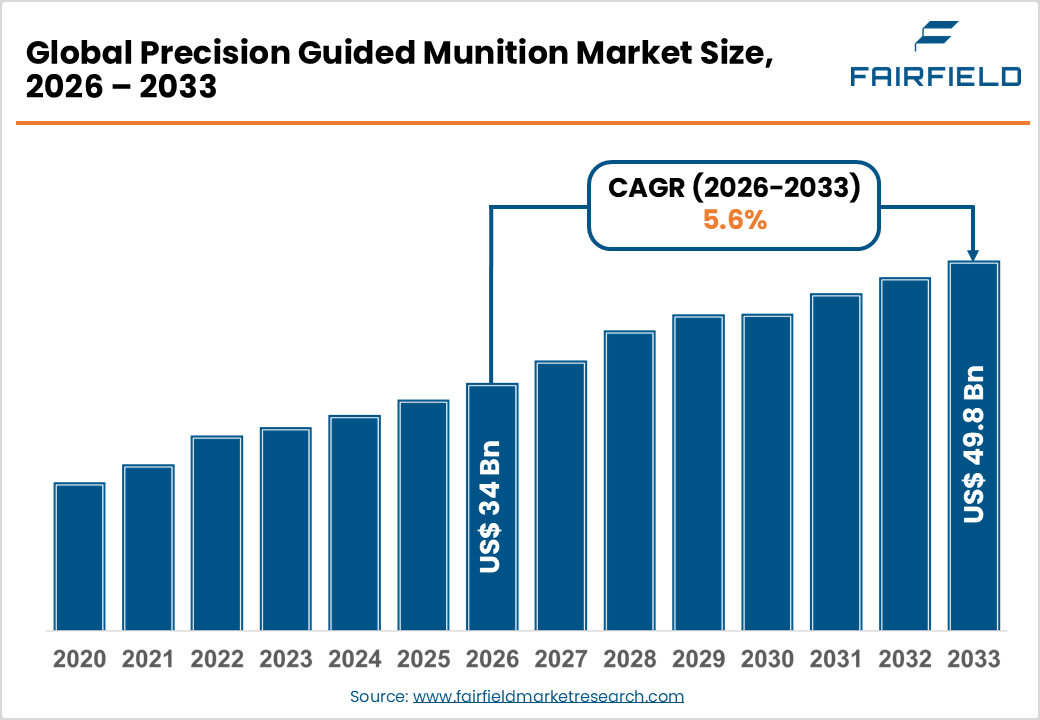
- Precision Guided Munition Market reached US$34 billion in 2026, projected to expand to US$49.8 billion by 2033 at 5.6% CAGR, reflecting sustained defense modernization amid geopolitical tensions.
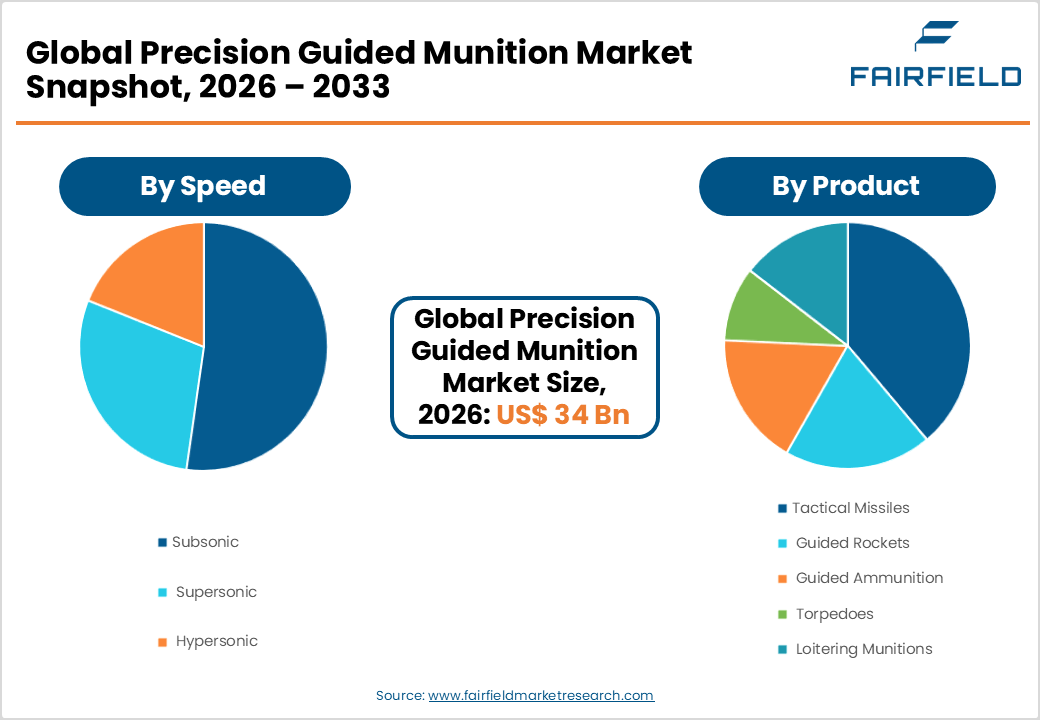
- Subsonic segment leads by speed (58% share), while tactical missiles dominate products (40% share); hypersonic and loitering munitions show accelerated growth.
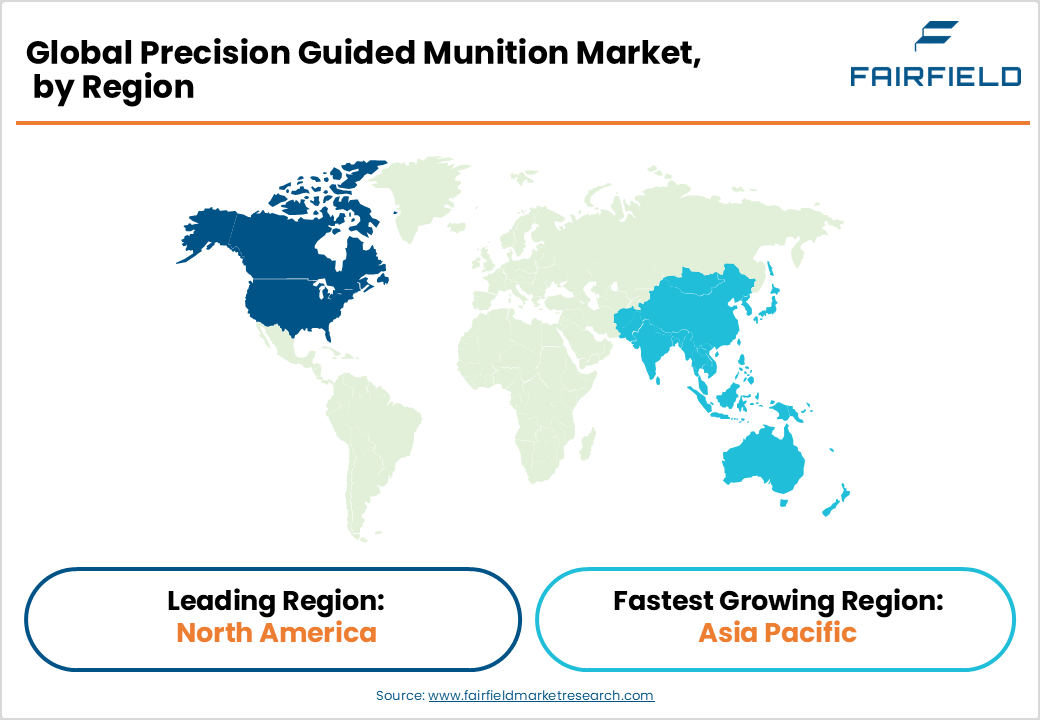
- North America commands largest regional share (~38%), with U.S. at 91% within region; Asia Pacific emerges as fastest-growing due to China and India investments.
- Key drivers include rising defense budgets and precision strike demand, tempered by high development costs; opportunities in loitering systems for asymmetric warfare.
- U.S. holds widest deployment , supported by DoD procurement; Europe and Asia Pacific follow with NATO and territorial focus.
- Leading players like Lockheed Martin and RTX drive consolidation via AI-guided innovations, with post-2023 developments emphasizing hypersonic capabilities.
Market Dynamics: Drivers, Restraints, and Opportunities Analysis
Market Drivers
- Geopolitical Tensions and Precision Demand
Heightened conflicts in Ukraine and the South China Sea elevate demand for low-collateral precision guided munitions. U.S. DoD data indicates a 40% procurement rise from 2023-2025, primarily influencing subsonic and tactical missile segments. Straits Research estimates this driver contributes approximately 2 percentage points to the global CAGR through 2033. Companies integrating AI guidance systems secure advantages in export markets, though escalating geopolitical risks heighten market volatility and require adaptive supply chain strategies.
- Rising Defense Budgets and Technological Advancements in Guidance
Global defense allocations reached USD 2.4 trillion in 2025 per SIPRI, with North America maintaining 38% market share. This fuels tactical missile growth at 6% segment CAGR, where domestic production mitigates sanction exposure amid budget cyclicality. GPS/INS seeker integrations achieve sub-1 meter miss rates , delivering 5.9% market uplift accelerating hypersonic adoption. RTX-like innovators benefit, though semiconductor dependencies pose supply chain moderation risks.
Market Restraints
- High Development Costs
Precision guided munition R&D exceeds USD 500 million per system according to GAO reports from 2025, creating substantial barriers that suppress small and medium enterprise entry while moderating overall market growth by approximately 1-2 percentage points. This cost structure favors established primes with scale economies, limiting innovation diversity. Public-private partnerships, exemplified by the EU Defense Fund allocations, demonstrate mitigation potential through cost-sharing mechanisms that distribute financial risks. However, these arrangements typically extend development timelines by 18-24 months, requiring patient capital and sustained government commitments to realize efficiency gains across hypersonic and loitering segments.
- Export Controls and Ethical Constraints
ITAR and MTCR regimes restrict technology transfers, capping approximately 20% of potential international sales according to U.S. State Department data. These controls preserve strategic advantages but constrain revenue diversification for Western manufacturers. Geopolitical realignments, including selective waivers for NATO allies, gradually ease certain barriers, enabling limited proliferation of subsonic systems. However, ethical concerns surrounding collateral damage and autonomous targeting continue to impede hypersonic deployment, particularly in contested theaters where precision verification remains technically challenging despite GPS/INS advancements.
Market Opportunities
- Loitering Munitions Expansion and Hypersonic Proliferation
Ukraine conflict validations have driven USD 2 billion in loitering munitions orders from 2024-2026, establishing this underserved segment with 10%+ CAGR potential through ISR-strike integration against asymmetric threats. Success depends on scalable swarm technologies that enable persistent surveillance and precision engagement, positioning early adopters for dominance in urban and hybrid warfare scenarios. Complementing this, Mach 5+ hypersonic systems address critical defense gaps, with Asia Pacific investments from China and India signaling a USD 10 billion addressable market by 2033. Strategic partnerships between governments and primes become essential to overcome thermal materials and propulsion barriers, enabling proliferation beyond current U.S./Russian prototypes while navigating export controls.
- Regional Modernization in Asia Pacific
India's BrahMos supersonic missile expansions and Japan's Type 12 upgrades create compelling market entry points within Asia Pacific's 6.7% regional CAGR trajectory. These indigenous programs leverage cost advantages from regional supply chain hubs, reducing production expenses by 15-20% compared to Western equivalents and accelerating fielding timelines. However, intellectual property protection remains a pivotal risk factor, particularly for technology transfers involving seeker and navigation systems, where inadequate safeguards could deter multinational participation and compromise competitive positioning in this high-growth theater.
Regional Market Assessment: Strategic Geography Analysis
- North America PGM Market
The North American market, led by the United States, represents the global Precision Guided Munition Market's largest concentration at ~38%, with U.S. market size exceeding US$16.65 billion in 2026 accounting for 91% of the regional total. This maturity reflects advanced platform integration and growth anchored in DoD budgets reaching USD 850 billion in 2026, which prioritize modernization programs. Regulatory frameworks established by DoD and FAA enforce stringent compliance for guidance systems and airspace integration, shaping competitive entry requirements. Innovation hubs concentrated in California and Florida accelerate AI-guided developments, enhancing precision capabilities amid FMS export dependencies. Market participants should evaluate these FMS dynamics alongside domestic procurement priorities when formulating strategies in this highly competitive, technology-driven arena.
- Europe: Regulatory Harmonization and Differentiated Market Dynamics
The European Precision Guided Munition Market exhibits significant geographic variation, with the UK commanding 55% and Germany 20% of regional value; overall size projected to reach US$14.78 billion by 2033. The EU Defense Directive establishes harmonized standards that impose interoperability costs on multinational programs, influencing procurement decisions across member states. Sustainability mandates enforced through the European Defence Agency (EDA) reshape competitive bids by prioritizing green propulsion and lifecycle management requirements. The UK maintains leadership through Tempest program integration of advanced seekers, while Germany advances via Taurus missile upgrades for deep-strike capabilities. These dynamics, alongside country-specific NATO spending pledges, necessitate tailored regulatory and partnership strategies for effective market positioning.
- Asia-Pacific: Differential Growth and Competitive Positioning
The Asia-Pacific Precision Guided Munition Market holds ~30% of global share and is projected to reach US$26.14 billion by 2033 at a 6.7% CAGR, driven by defense modernization across key economies. China dominates with 42% of regional value through hypersonic and anti-ship advancements, while India demonstrates rapid 21% growth via indigenous programs like BrahMos supersonic missiles. Japan's mature market contrasts with emerging ASEAN dynamics, creating diverse competitive profiles. Regional supply chains concentrated in China and India reduce production costs by 20% relative to Western benchmarks, accelerating deployment timelines. However, these indigenous initiatives intensify rivalry and underscore intellectual property risks, requiring strategic alliances and robust IP safeguards for market entry and sustained positioning.
Segmentation Analysis: Category-Wise Strategic Assessment
- Speed Segmentation
The subsonic segment represents 58% of the global Precision Guided Munition Market, valued at approximately US$19.7 billion in 2026, demonstrating stable leadership through cost-effectiveness and broad platform compatibility in cruise missiles and guided bombs. This dominance stems from proven reliability, evidenced by 99% hit rates in U.S. military tests, alongside high-volume procurement supporting existing inventories. Competition within this mature category features oligopolistic structure dominated by RTX and Lockheed Martin, with strategic emphasis on advanced seeker technologies for GPS/INS augmentation. Conversely, the hypersonic segment holds 10% market share but expands at the highest CAGR, propelled by DoD hypersonic budgets reaching USD 4.7 billion in 2025 that prioritize evasion superiority against advanced air defenses. Companies targeting hypersonic growth must evaluate substantial thermal materials and propulsion barriers before committing resources to this high-risk, high-reward category.
- Product Segmentation
Tactical Missiles command 40% market share, valued at approximately US$13.6 billion in 2026, driven by versatility across air, ground, and sea platforms that support multi-role operations with extended standoff ranges exceeding 370 km, as exemplified by the AGM-158 JASSM system. This leadership reflects market structure consolidation, where industry leaders like Lockheed Martin and MBDA pursue modularity enhancements to improve interoperability and reduce logistics footprints across allied inventories. Conversely, Loitering Munitions hold 12% share but exhibit the highest growth trajectory through ISR-strike fusion capabilities, with Ukraine operational data demonstrating 15% efficacy gains over conventional artillery in dynamic environments. Strategic positioning in this segment requires careful evaluation of evolving autonomy regulations, including U.S. DoD Loitering Munition Systems Phase 2 standards and EU AI Act provisions, which will govern scalable deployment across NATO and Indo-Pacific theaters.
Competitive Landscape: Market Structure and Strategic Positioning
The Precision Guided Munition Market exhibits medium concentration, with the top five players Lockheed Martin, RTX, Boeing, MBDA, and Northrop Grumman collectively holding approximately 60% market share, reflecting oligopolistic dynamics dominated by established defense primes. Competitive differentiation centers on technology leadership in AI guidance and sensor fusion, complemented by vertical integration strategies that secure critical supply chains for seekers and propulsion systems. Substantial entry barriers persist, including R&D investments exceeding USD 1 billion per platform family alongside stringent ITAR compliance requirements that limit new competitor participation. Recent M&A activity, exemplified by RTX's 2023 acquisition of Aerojet Rocketdyne, signals market maturation through capability consolidation and portfolio diversification, enabling survivors to address multi-domain precision strike requirements across subsonic, hypersonic, and loitering segments while smaller players face marginalization.
Key Players
- Lockheed Martin Corporation
- RTX Corporation
- Northrop Grumman Corporation
- The Boeing Company
- General Dynamics Corporation
- BAE Systems plc
- MBDA
- Rheinmetall AG
- Thales Group
- Leonardo S.p.A.
- Saab AB
- Elbit Systems Ltd.
- Israel Aerospace Industries
- Kongsberg Gruppen
- L3Harris Technologies, Inc.
Key Industry Developments
- In February 2026, Boeing secures India BrahMos co-production deal. This marks Boeing's deepest Asia Pacific market penetration, leveraging "Make in India" incentives while securing USD 2.5 billion in long-term contracts.
- In January 2026, MBDA/Thales expand Storm Shadow production for Ukraine aid . This addresses European stockpile depletion from sustained conflict support while qualifying for EU Defense Fund reimbursements.
- In December 2024, Lockheed Martin delivers LRASM Lot 4 to U.S. Navy, enhancing anti-ship precision .
Market Segmentation
By Speed
- Subsonic
- Supersonic
- Hypersonic
By Product
- Tactical Missiles
- Guided Rockets
- Guided Ammunition
- Torpedoes
- Loitering Munitions
By Technology
- Infrared
- Laser
- Inertial Navigation System (INS)
- Global Positioning System (GPS)
- Rader Homing
- Anti-radiation
By Mode of Operation
- Autonomous
- Semi-autonomous
By Launch Platforms
- Land
- Airbone
- Naval
By Region
- North America
- Europe
- Asia Pacific
- Latin America
- Middle East and Africa
- Executive Summary
- Global Precision Guided Munition Market Snapshot
- Future Projections
- Key Market Trends
- Regional Snapshot, by Value, 2026
- Analyst Recommendations
- Market Overview
- Market Definitions and Segmentations
- Market Dynamics
- Drivers
- Restraints
- Market Opportunities
- Value Chain Analysis
- COVID-19 Impact Analysis
- Porter's Five Forces Analysis
- Impact of Russia-Ukraine Conflict
- PESTLE Analysis
- Regulatory Analysis
- Price Trend Analysis
- Current Prices and Future Projections, 2025-2033
- Price Impact Factors
- Global Precision Guided Munition Market Outlook, 2020 - 2033
- Global Precision Guided Munition Market Outlook, by Speed, Value (US$ Bn), 2020-2033
- Subsonic
- Supersonic
- Hypersonic
- Global Precision Guided Munition Market Outlook, by Product, Value (US$ Bn), 2020-2033
- Tactical Missiles
- Guided Rockets
- Guided Ammunition
- Torpedoes
- Loitering Munitions
- Global Precision Guided Munition Market Outlook, by Technology, Value (US$ Bn), 2020-2033
- Infrared
- Laser
- Inertial Navigation System (INS)
- Global Positioning System (GPS)
- Rader Homing
- Anti-radiation
- Global Precision Guided Munition Market Outlook, by Mode of Operation, Value (US$ Bn), 2020-2033
- Autonomous
- Semi-autonomous
- Global Precision Guided Munition Market Outlook, by Launch Platforms, Value (US$ Bn), 2020-2033
- Land
- Airbone
- Naval
- Global Precision Guided Munition Market Outlook, by Region, Value (US$ Bn), 2020-2033
- North America
- Europe
- Asia Pacific
- Latin America
- Middle East & Africa
- Global Precision Guided Munition Market Outlook, by Speed, Value (US$ Bn), 2020-2033
- North America Precision Guided Munition Market Outlook, 2020 - 2033
- North America Precision Guided Munition Market Outlook, by Speed, Value (US$ Bn), 2020-2033
- Subsonic
- Supersonic
- Hypersonic
- North America Precision Guided Munition Market Outlook, by Product, Value (US$ Bn), 2020-2033
- Tactical Missiles
- Guided Rockets
- Guided Ammunition
- Torpedoes
- Loitering Munitions
- North America Precision Guided Munition Market Outlook, by Technology, Value (US$ Bn), 2020-2033
- Infrared
- Laser
- Inertial Navigation System (INS)
- Global Positioning System (GPS)
- Rader Homing
- Anti-radiation
- North America Precision Guided Munition Market Outlook, by Mode of Operation, Value (US$ Bn), 2020-2033
- Autonomous
- Semi-autonomous
- North America Precision Guided Munition Market Outlook, by Launch Platforms, Value (US$ Bn), 2020-2033
- Land
- Airbone
- Naval
- North America Precision Guided Munition Market Outlook, by Country, Value (US$ Bn), 2020-2033
- S. Precision Guided Munition Market Outlook, by Speed, 2020-2033
- S. Precision Guided Munition Market Outlook, by Product, 2020-2033
- S. Precision Guided Munition Market Outlook, by Technology, 2020-2033
- S. Precision Guided Munition Market Outlook, by Mode of Operation, 2020-2033
- S. Precision Guided Munition Market Outlook, by Launch Platforms, 2020-2033
- Canada Precision Guided Munition Market Outlook, by Speed, 2020-2033
- Canada Precision Guided Munition Market Outlook, by Product, 2020-2033
- Canada Precision Guided Munition Market Outlook, by Technology, 2020-2033
- Canada Precision Guided Munition Market Outlook, by Mode of Operation, 2020-2033
- Canada Precision Guided Munition Market Outlook, by Launch Platforms, 2020-2033
- BPS Analysis/Market Attractiveness Analysis
- North America Precision Guided Munition Market Outlook, by Speed, Value (US$ Bn), 2020-2033
- Europe Precision Guided Munition Market Outlook, 2020 - 2033
- Europe Precision Guided Munition Market Outlook, by Speed, Value (US$ Bn), 2020-2033
- Subsonic
- Supersonic
- Hypersonic
- Europe Precision Guided Munition Market Outlook, by Product, Value (US$ Bn), 2020-2033
- Tactical Missiles
- Guided Rockets
- Guided Ammunition
- Torpedoes
- Loitering Munitions
- Europe Precision Guided Munition Market Outlook, by Technology, Value (US$ Bn), 2020-2033
- Infrared
- Laser
- Inertial Navigation System (INS)
- Global Positioning System (GPS)
- Rader Homing
- Anti-radiation
- Europe Precision Guided Munition Market Outlook, by Mode of Operation, Value (US$ Bn), 2020-2033
- Autonomous
- Semi-autonomous
- Europe Precision Guided Munition Market Outlook, by Launch Platforms, Value (US$ Bn), 2020-2033
- Land
- Airbone
- Naval
- Europe Precision Guided Munition Market Outlook, by Country, Value (US$ Bn), 2020-2033
- Germany Precision Guided Munition Market Outlook, by Speed, 2020-2033
- Germany Precision Guided Munition Market Outlook, by Product, 2020-2033
- Germany Precision Guided Munition Market Outlook, by Technology, 2020-2033
- Germany Precision Guided Munition Market Outlook, by Mode of Operation, 2020-2033
- Germany Precision Guided Munition Market Outlook, by Launch Platforms, 2020-2033
- Italy Precision Guided Munition Market Outlook, by Speed, 2020-2033
- Italy Precision Guided Munition Market Outlook, by Product, 2020-2033
- Italy Precision Guided Munition Market Outlook, by Technology, 2020-2033
- Italy Precision Guided Munition Market Outlook, by Mode of Operation, 2020-2033
- Italy Precision Guided Munition Market Outlook, by Launch Platforms, 2020-2033
- France Precision Guided Munition Market Outlook, by Speed, 2020-2033
- France Precision Guided Munition Market Outlook, by Product, 2020-2033
- France Precision Guided Munition Market Outlook, by Technology, 2020-2033
- France Precision Guided Munition Market Outlook, by Mode of Operation, 2020-2033
- France Precision Guided Munition Market Outlook, by Launch Platforms, 2020-2033
- K. Precision Guided Munition Market Outlook, by Speed, 2020-2033
- K. Precision Guided Munition Market Outlook, by Product, 2020-2033
- K. Precision Guided Munition Market Outlook, by Technology, 2020-2033
- K. Precision Guided Munition Market Outlook, by Mode of Operation, 2020-2033
- K. Precision Guided Munition Market Outlook, by Launch Platforms, 2020-2033
- Spain Precision Guided Munition Market Outlook, by Speed, 2020-2033
- Spain Precision Guided Munition Market Outlook, by Product, 2020-2033
- Spain Precision Guided Munition Market Outlook, by Technology, 2020-2033
- Spain Precision Guided Munition Market Outlook, by Mode of Operation, 2020-2033
- Spain Precision Guided Munition Market Outlook, by Launch Platforms, 2020-2033
- Russia Precision Guided Munition Market Outlook, by Speed, 2020-2033
- Russia Precision Guided Munition Market Outlook, by Product, 2020-2033
- Russia Precision Guided Munition Market Outlook, by Technology, 2020-2033
- Russia Precision Guided Munition Market Outlook, by Mode of Operation, 2020-2033
- Russia Precision Guided Munition Market Outlook, by Launch Platforms, 2020-2033
- Rest of Europe Precision Guided Munition Market Outlook, by Speed, 2020-2033
- Rest of Europe Precision Guided Munition Market Outlook, by Product, 2020-2033
- Rest of Europe Precision Guided Munition Market Outlook, by Technology, 2020-2033
- Rest of Europe Precision Guided Munition Market Outlook, by Mode of Operation, 2020-2033
- Rest of Europe Precision Guided Munition Market Outlook, by Launch Platforms, 2020-2033
- BPS Analysis/Market Attractiveness Analysis
- Europe Precision Guided Munition Market Outlook, by Speed, Value (US$ Bn), 2020-2033
- Asia Pacific Precision Guided Munition Market Outlook, 2020 - 2033
- Asia Pacific Precision Guided Munition Market Outlook, by Speed, Value (US$ Bn), 2020-2033
- Subsonic
- Supersonic
- Hypersonic
- Asia Pacific Precision Guided Munition Market Outlook, by Product, Value (US$ Bn), 2020-2033
- Tactical Missiles
- Guided Rockets
- Guided Ammunition
- Torpedoes
- Loitering Munitions
- Asia Pacific Precision Guided Munition Market Outlook, by Technology, Value (US$ Bn), 2020-2033
- Infrared
- Laser
- Inertial Navigation System (INS)
- Global Positioning System (GPS)
- Rader Homing
- Anti-radiation
- Asia Pacific Precision Guided Munition Market Outlook, by Mode of Operation, Value (US$ Bn), 2020-2033
- Autonomous
- Semi-autonomous
- Asia Pacific Precision Guided Munition Market Outlook, by Launch Platforms, Value (US$ Bn), 2020-2033
- Land
- Airbone
- Naval
- Asia Pacific Precision Guided Munition Market Outlook, by Country, Value (US$ Bn), 2020-2033
- China Precision Guided Munition Market Outlook, by Speed, 2020-2033
- China Precision Guided Munition Market Outlook, by Product, 2020-2033
- China Precision Guided Munition Market Outlook, by Technology, 2020-2033
- China Precision Guided Munition Market Outlook, by Mode of Operation, 2020-2033
- China Precision Guided Munition Market Outlook, by Launch Platforms, 2020-2033
- Japan Precision Guided Munition Market Outlook, by Speed, 2020-2033
- Japan Precision Guided Munition Market Outlook, by Product, 2020-2033
- Japan Precision Guided Munition Market Outlook, by Technology, 2020-2033
- Japan Precision Guided Munition Market Outlook, by Mode of Operation, 2020-2033
- Japan Precision Guided Munition Market Outlook, by Launch Platforms, 2020-2033
- South Korea Precision Guided Munition Market Outlook, by Speed, 2020-2033
- South Korea Precision Guided Munition Market Outlook, by Product, 2020-2033
- South Korea Precision Guided Munition Market Outlook, by Technology, 2020-2033
- South Korea Precision Guided Munition Market Outlook, by Mode of Operation, 2020-2033
- South Korea Precision Guided Munition Market Outlook, by Launch Platforms, 2020-2033
- India Precision Guided Munition Market Outlook, by Speed, 2020-2033
- India Precision Guided Munition Market Outlook, by Product, 2020-2033
- India Precision Guided Munition Market Outlook, by Technology, 2020-2033
- India Precision Guided Munition Market Outlook, by Mode of Operation, 2020-2033
- India Precision Guided Munition Market Outlook, by Launch Platforms, 2020-2033
- Southeast Asia Precision Guided Munition Market Outlook, by Speed, 2020-2033
- Southeast Asia Precision Guided Munition Market Outlook, by Product, 2020-2033
- Southeast Asia Precision Guided Munition Market Outlook, by Technology, 2020-2033
- Southeast Asia Precision Guided Munition Market Outlook, by Mode of Operation, 2020-2033
- Southeast Asia Precision Guided Munition Market Outlook, by Launch Platforms, 2020-2033
- Rest of SAO Precision Guided Munition Market Outlook, by Speed, 2020-2033
- Rest of SAO Precision Guided Munition Market Outlook, by Product, 2020-2033
- Rest of SAO Precision Guided Munition Market Outlook, by Technology, 2020-2033
- Rest of SAO Precision Guided Munition Market Outlook, by Mode of Operation, 2020-2033
- Rest of SAO Precision Guided Munition Market Outlook, by Launch Platforms, 2020-2033
- BPS Analysis/Market Attractiveness Analysis
- Asia Pacific Precision Guided Munition Market Outlook, by Speed, Value (US$ Bn), 2020-2033
- Latin America Precision Guided Munition Market Outlook, 2020 - 2033
- Latin America Precision Guided Munition Market Outlook, by Speed, Value (US$ Bn), 2020-2033
- Subsonic
- Supersonic
- Hypersonic
- Latin America Precision Guided Munition Market Outlook, by Product, Value (US$ Bn), 2020-2033
- Tactical Missiles
- Guided Rockets
- Guided Ammunition
- Torpedoes
- Loitering Munitions
- Latin America Precision Guided Munition Market Outlook, by Technology, Value (US$ Bn), 2020-2033
- Infrared
- Laser
- Inertial Navigation System (INS)
- Global Positioning System (GPS)
- Rader Homing
- Anti-radiation
- Latin America Precision Guided Munition Market Outlook, by Mode of Operation, Value (US$ Bn), 2020-2033
- Autonomous
- Semi-autonomous
- Latin America Precision Guided Munition Market Outlook, by Launch Platforms, Value (US$ Bn), 2020-2033
- Land
- Airbone
- Naval
- Latin America Precision Guided Munition Market Outlook, by Country, Value (US$ Bn), 2020-2033
- Brazil Precision Guided Munition Market Outlook, by Speed, 2020-2033
- Brazil Precision Guided Munition Market Outlook, by Product, 2020-2033
- Brazil Precision Guided Munition Market Outlook, by Technology, 2020-2033
- Brazil Precision Guided Munition Market Outlook, by Mode of Operation, 2020-2033
- Brazil Precision Guided Munition Market Outlook, by Launch Platforms, 2020-2033
- Mexico Precision Guided Munition Market Outlook, by Speed, 2020-2033
- Mexico Precision Guided Munition Market Outlook, by Product, 2020-2033
- Mexico Precision Guided Munition Market Outlook, by Technology, 2020-2033
- Mexico Precision Guided Munition Market Outlook, by Mode of Operation, 2020-2033
- Mexico Precision Guided Munition Market Outlook, by Launch Platforms, 2020-2033
- Argentina Precision Guided Munition Market Outlook, by Speed, 2020-2033
- Argentina Precision Guided Munition Market Outlook, by Product, 2020-2033
- Argentina Precision Guided Munition Market Outlook, by Technology, 2020-2033
- Argentina Precision Guided Munition Market Outlook, by Mode of Operation, 2020-2033
- Argentina Precision Guided Munition Market Outlook, by Launch Platforms, 2020-2033
- Rest of LATAM Precision Guided Munition Market Outlook, by Speed, 2020-2033
- Rest of LATAM Precision Guided Munition Market Outlook, by Product, 2020-2033
- Rest of LATAM Precision Guided Munition Market Outlook, by Technology, 2020-2033
- Rest of LATAM Precision Guided Munition Market Outlook, by Mode of Operation, 2020-2033
- Rest of LATAM Precision Guided Munition Market Outlook, by Launch Platforms, 2020-2033
- BPS Analysis/Market Attractiveness Analysis
- Latin America Precision Guided Munition Market Outlook, by Speed, Value (US$ Bn), 2020-2033
- Middle East & Africa Precision Guided Munition Market Outlook, 2020 - 2033
- Middle East & Africa Precision Guided Munition Market Outlook, by Speed, Value (US$ Bn), 2020-2033
- Subsonic
- Supersonic
- Hypersonic
- Middle East & Africa Precision Guided Munition Market Outlook, by Product, Value (US$ Bn), 2020-2033
- Tactical Missiles
- Guided Rockets
- Guided Ammunition
- Torpedoes
- Loitering Munitions
- Middle East & Africa Precision Guided Munition Market Outlook, by Technology, Value (US$ Bn), 2020-2033
- Infrared
- Laser
- Inertial Navigation System (INS)
- Global Positioning System (GPS)
- Rader Homing
- Anti-radiation
- Middle East & Africa Precision Guided Munition Market Outlook, by Mode of Operation, Value (US$ Bn), 2020-2033
- Autonomous
- Semi-autonomous
- Middle East & Africa Precision Guided Munition Market Outlook, by Launch Platforms, Value (US$ Bn), 2020-2033
- Land
- Airbone
- Naval
- Middle East & Africa Precision Guided Munition Market Outlook, by Country, Value (US$ Bn), 2020-2033
- GCC Precision Guided Munition Market Outlook, by Speed, 2020-2033
- GCC Precision Guided Munition Market Outlook, by Product, 2020-2033
- GCC Precision Guided Munition Market Outlook, by Technology, 2020-2033
- GCC Precision Guided Munition Market Outlook, by Mode of Operation, 2020-2033
- GCC Precision Guided Munition Market Outlook, by Launch Platforms, 2020-2033
- South Africa Precision Guided Munition Market Outlook, by Speed, 2020-2033
- South Africa Precision Guided Munition Market Outlook, by Product, 2020-2033
- South Africa Precision Guided Munition Market Outlook, by Technology, 2020-2033
- South Africa Precision Guided Munition Market Outlook, by Mode of Operation, 2020-2033
- South Africa Precision Guided Munition Market Outlook, by Launch Platforms, 2020-2033
- Egypt Precision Guided Munition Market Outlook, by Speed, 2020-2033
- Egypt Precision Guided Munition Market Outlook, by Product, 2020-2033
- Egypt Precision Guided Munition Market Outlook, by Technology, 2020-2033
- Egypt Precision Guided Munition Market Outlook, by Mode of Operation, 2020-2033
- Egypt Precision Guided Munition Market Outlook, by Launch Platforms, 2020-2033
- Nigeria Precision Guided Munition Market Outlook, by Speed, 2020-2033
- Nigeria Precision Guided Munition Market Outlook, by Product, 2020-2033
- Nigeria Precision Guided Munition Market Outlook, by Technology, 2020-2033
- Nigeria Precision Guided Munition Market Outlook, by Mode of Operation, 2020-2033
- Nigeria Precision Guided Munition Market Outlook, by Launch Platforms, 2020-2033
- Rest of Middle East Precision Guided Munition Market Outlook, by Speed, 2020-2033
- Rest of Middle East Precision Guided Munition Market Outlook, by Product, 2020-2033
- Rest of Middle East Precision Guided Munition Market Outlook, by Technology, 2020-2033
- Rest of Middle East Precision Guided Munition Market Outlook, by Mode of Operation, 2020-2033
- Rest of Middle East Precision Guided Munition Market Outlook, by Launch Platforms, 2020-2033
- BPS Analysis/Market Attractiveness Analysis
- Middle East & Africa Precision Guided Munition Market Outlook, by Speed, Value (US$ Bn), 2020-2033
- Competitive Landscape
- Company Vs Segment Heatmap
- Company Market Share Analysis, 2025
- Competitive Dashboard
- Company Profiles
- Smurfit Kappa Group Plc
- Company Overview
- Product Portfolio
- Financial Overview
- Business Strategies and Developments
- Coveris Holdings SA
- LC Packaging International BV
- Groupe Guillin SA
- Paccor Netherlands B.V.
- Leeways Packaging Services Ltd
- Tacca Industries Pty Ltd
- INFIA S.r.l.
- Raptis Pax Pty Ltd
- Alta Global
- Mondi Group
- Amcor plc
- Berry Global Inc.
- LINPAC Packaging Limited
- DS Smith Plc
- Smurfit Kappa Group Plc
- Appendix
- Research Methodology
- Report Assumptions
- Acronyms and Abbreviations
|
BASE YEAR |
HISTORICAL DATA |
FORECAST PERIOD |
UNITS |
|||
 |
2025 |
 |
2019 - 2024 |
 |
2026 - 2033 |
Value: US$ Billion |
|
REPORT FEATURES |
DETAILS |
|
By Speed Coverage |
|
|
By Product Coverage |
|
|
Geographical Coverage |
|
|
Leading Companies |
|
|
Report Highlights |
Key Market Indicators, Macro-micro economic impact analysis, Technological Roadmap, Key Trends, Driver, Restraints, and Future Opportunities & Revenue Pockets, Porter’s 5 Forces Analysis, Historical Trend (2019-2024), Market Estimates and Forecast, Market Dynamics, Industry Trends, Competition Landscape, Category, Region, Country-wise Trends & Analysis, COVID-19 Impact Analysis (Demand and Supply Chain) |
Our Research Methodology
Considering the volatility of business today, traditional approaches to strategizing a game plan can be unfruitful if not detrimental. True ambiguity is no way to determine a forecast. A myriad of predetermined factors must be accounted for such as the degree of risk involved, the magnitude of circumstances, as well as conditions or consequences that are not known or unpredictable. To circumvent binary views that cast uncertainty, the application of market research intelligence to strategically posture, move, and enable actionable outcomes is necessary.
View Methodology
Quality Assured
Rigorous Validation Process

Confidentiality Assured
End-to-end Data Security

Custom Research Services
Tailored To Your Objectives
FAQs
The Precision Guided Munition Market size is USD 42.3 billion in 2026.
The Precision Guided Munition Market is projected 5.8% CAGR by 2033.
The Precision Guided Munition Market growth drivers include rising geopolitical tensions, increased defense budgets, and demand for precision strike capabilities.
North America is a dominating region for Precision Guided Munition Market.
Lockheed Martin, RTX, MBDA, Boeing, and Northrop Grumman are some leading industry players in the Precision Guided Munition Market.
Related Reports
2-Methoxy-2-Methylheptane Market Size, Share, Insights, Competitive Landscape, and Forecast 2026 to 2033
The global 2-methoxy-2-methylheptane market is valued at US$0.04 billion in 2026, reaching US$0.07 billion by 2033, growing at an 8.3% CAGR
2D Materials Market Size, Share, Insights, Competitive Landscape, and Forecast 2026 to 2033
The global 2D materials market is valued at US$3.65 billion in 2026, reaching US$10.20 billion by 2033, growing at a 15.8% CAGR
2,4-Dichloro-5-Fluorobenzoic Acid Market Size, Share, Insights, Competitive Landscape, and Forecast 2026 to 2033
The global 2,4-dichloro-5-fluorobenzoic acid market is valued at US$0.09 billion in 2026, reaching US$0.12 billion by 2033, at a 4.2% CAGR
1,5-Hexadiene Market Size, Share, Insights, Competitive Landscape, and Forecast 2026 to 2033
The global 1,5-hexadiene market is valued at US$0.14 billion in 2026, reaching US$0.22 billion by 2033, growing at a 6.7% CAGR
Automotive NVH Materials Market Size, Share, Insights, Competitive Landscape, and Forecast 2026 to 2033
The global automotive NVH materials market is valued at US$13.8 billion in 2026, reaching US$20.5 billion by 2033, growing at a 5.82% CAGR
Acrylonitrile Butadiene Styrene Market Size, Share, Insights, Competitive Landscape, and Forecast 2026 to 2033
The global acrylonitrile butadiene styrene market is valued at US$27.4 billion in 2026, reaching US$38.6 billion by 2033, growing at a 5.02% CAGR