



Precision Stainless Steel Market
Precision Stainless Steel Market Size, Share, Insights, Competitive Landscape, and Forecast 2026 to 2033
Precision Stainless Steel Market Size and Trend Analysis
How Fast Is Precision Stainless Steel Demand Growing?
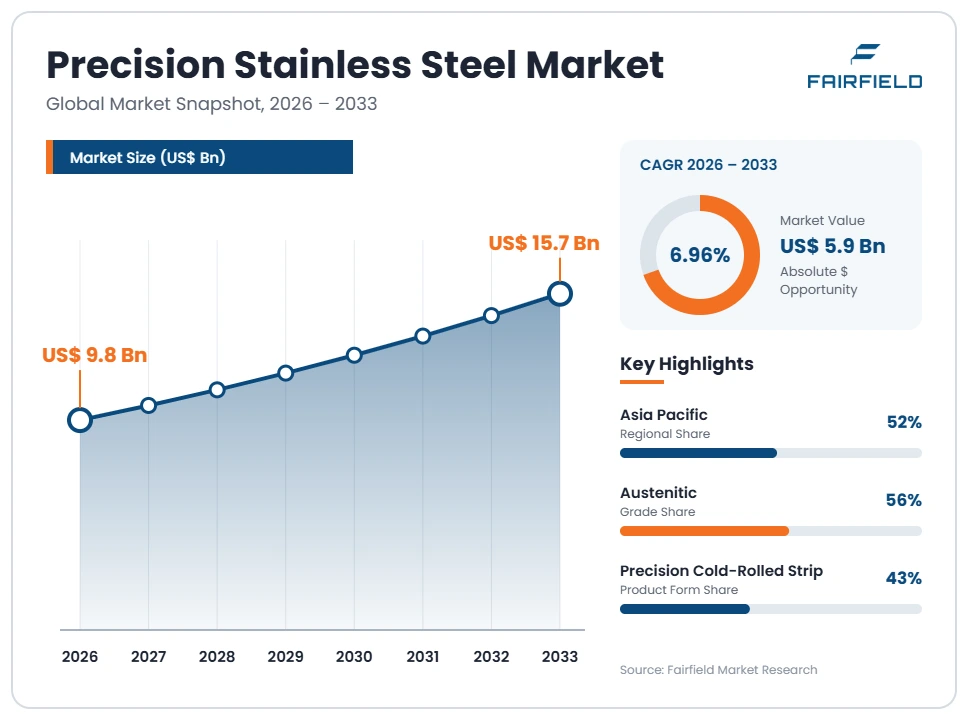
The global Precision Stainless Steel market size is expected to be valued at US$ 9.8 billion in 2026 and projected to reach US$ 15.7 billion by 2033, growing at a CAGR of 6.96% between 2026 and 2033.
Between 2020 and 2025 the market expanded at roughly a 4.8% CAGR, held back by weak appliance demand and volatile alloy surcharges. Three forces now lift the trajectory. Electronics and medical device makers keep moving to thinner gauges, so value per tonne rises even when tonnage is flat. Battery cell casing has become a genuine new outlet for ultra-thin strip and foil, pulling volume that did not exist a decade ago. Corrosion duty in desalination, chemical processing and offshore energy continues to shift specifications toward duplex grades that carry a higher price. The direction of travel is clear: a specialised flat-rolled niche growing on specification upgrade rather than on bulk tonnage.
Key Report Takeaways
- By Product Form: Precision Cold-Rolled Strip held 43% share in 2026, while Stainless Steel Foil is projected to expand at a 9.8% CAGR through 2033, because battery cell casing and fuel cell bipolar plates consume material below 0.1 mm.
- By Grade: Austenitic grades held 56% share in 2026, while Duplex and Super Duplex grades are projected to grow at a 9.1% CAGR through 2033, driven by chloride service in desalination, offshore structures and chemical process equipment.
- By Thickness: The 0.20–1.00 mm band held 39% share in 2026, while material Up to 0.05 mm is projected to advance at a 10.4% CAGR through 2033, reflecting shielding cans, flexure parts and ultra-thin gaskets in compact electronics.
- By End-Use Industry: Electrical and Electronics held 25% share in 2026, while Automotive and Battery is projected to post a 9.6% CAGR through 2033, as cell can conversion and busbar fabrication scale with electric vehicle output.
- By Geography: Asia Pacific held 52% share in 2026, while North America is projected to grow at an 8.2% CAGR through 2033, supported by domestic battery plant construction and hydrogen equipment fabrication.
Global Precision Stainless Steel Market Trends and Insights
Drivers Impact Analysis
Two demand forces explain most of the growth in thin-gauge stainless flat products through 2033.
| Driver | Impact on CAGR Forecast | Geographic Relevance | Impact Timeline |
| Electronics miniaturisation pushing designs below 0.1 mm | High | Asia Pacific, North America | Short term ≤2 years |
| Medical device output and single-use instrument conversion | Medium | North America, Europe, Asia Pacific | Medium term 2–4 years |
Electronics Miniaturisation Pushes Precision Stainless Strip Below the 0.1 mm Threshold
Consumer electronics miniaturisation is the steadiest volume driver for ultra-thin stainless strip. Device makers use material below 0.1 mm for electromagnetic shielding cans, spring contacts, hinge plates, speaker diaphragms and display stiffeners. Every product generation reduces internal volume while adding components, so designers replace thicker formed parts with thinner stainless sections carrying the same mechanical load. Consumption of precision flat-rolled material therefore grows faster than device unit shipments.
The mechanism is strength per unit thickness. Cold rolling lifts the tensile strength of austenitic grades far above the annealed condition, letting a 0.05 mm section replace a 0.10 mm one without losing stiffness in bending-critical parts. EN 10151 specifies stainless spring strip for precisely this duty, and ASTM A666 covers the annealed and cold-worked austenitic flat products used alongside it. Mills answer with Sendzimir cluster mills and bright annealing lines that hold thickness tolerance within a few microns across the full coil width.
Medical Device Output and Single-Use Instrument Conversion Sustain Martensitic Strip Demand
Medical manufacturing gives the market a demand base that is largely insulated from industrial cycles. Surgical blades, suture needles, guidewires, endoscopic tools, orthopaedic trials and dental instruments all start as narrow precision strip or fine-gauge tube. Hospital infection control policy has converted many reusable instruments into single-use items, which multiplies the strip tonnage consumed for the same number of procedures performed each year.
The causal chain runs through sterilisation and edge retention. Repeated steam autoclaving attacks poorly passivated surfaces, so buyers specify tightly controlled martensitic and austenitic chemistries with low inclusion counts and certified surface finish. EN 10088 sets the grade designations used across European medical supply chains, while ASTM A240 and ASTM A480 govern the flat-rolled requirements that United States device makers cite in their quality files. Each qualified strip supplier is written into a device master record, which makes positions durable once won.
Restraints Impact Analysis
Two structural constraints limit margin capture and cross-border flow in thin-gauge stainless products.
| Restraint | Impact on CAGR Forecast | Geographic Relevance | Impact Timeline |
| Alloy surcharge volatility in nickel, chromium and molybdenum | High | Global | Short term ≤2 years |
| Trade measures and carbon compliance cost on imported flat products | Medium | Europe, North America | Medium term 2–4 years |
Alloy Surcharge Volatility in Nickel and Molybdenum Squeezes Precision Strip Margins
Raw material volatility destabilises earnings across the precision flat-rolled chain. Austenitic grades carry roughly eight to eleven percent nickel, and molybdenum-bearing grades add a second volatile input, so the metal value inside a coil can swing sharply between order and delivery. Re-rollers and strip service centres buy wide coil months before shipping finished strip, which leaves them holding inventory bought at one metal price and sold at another.
The specific cost source is the alloy surcharge mechanism itself. Mills reset surcharges monthly against published nickel, chromium, molybdenum and ferrochrome references, but long-term contracts with electronics and automotive customers reprice quarterly or annually. That timing gap creates a structural lag. Hedging nickel on exchange markets covers only part of the exposure, because chromium and molybdenum lack deep liquid contracts. Working capital tied up in metal also rises with price, tightening cash exactly when demand is strongest.
Trade Measures and Carbon Compliance Raise the Landed Cost of Imported Thin-Gauge Stainless
Trade and carbon policy now adds a cost layer that falls hardest on cross-border thin-gauge shipments. Section 232 tariffs on steel imports into the United States and the European Union steel safeguard measures both apply to stainless flat products, so material that once moved freely between specialised mills and distant converters now arrives with duty or quota exposure attached. Smaller precision converters absorb this least well.
The underlying cause is administrative as much as fiscal. Under the Carbon Border Adjustment Mechanism, established by Regulation (EU) 2023/956, importers must report embedded emissions and, in the definitive regime, surrender certificates against them. Precision strip is often rolled in one country from coil melted in another, so establishing verified embedded emissions requires data from an upstream melt shop that may not supply it. Compliance staffing, verification fees and the risk of default emission values all raise the effective cost of imported coil.
Market Opportunities
Two emerging revenue pools sit outside the traditional precision strip customer base and carry higher specification value.
Battery Cell Casing Conversion Opens a High-Volume Foil Pool in Precision Stainless Steel
Battery cell casing is the largest genuinely new revenue pool in precision stainless. Cylindrical and prismatic cell cans have historically used aluminium or nickel-plated carbon steel, but several large-format cell designs now specify thin stainless because it resists electrolyte attack, tolerates deep drawing at reduced wall thickness and removes the plating step entirely. A single gigafactory consumes thousands of tonnes of narrow coil a year once it reaches rated output.
Mills with wide bright annealing and tight-tolerance rolling capability are positioned to capture this pool, usually alongside a deep-drawing converter. Demand comes from cell makers and the vehicle manufacturers specifying their cells, who want a casing that survives thermal runaway testing without rupture. Busbars, cell-to-pack connectors and vent discs create a secondary pull on the same lines, so a qualified position in casing often brings adjacent parts with it.
Hydrogen Electrolyser and Fuel Cell Hardware Creates a Premium Thin-Gauge Stainless Niche
Hydrogen equipment is the second new pool, smaller in tonnage but far richer in value per kilogram. Proton exchange membrane electrolysers and fuel cell stacks use hundreds of stamped bipolar plates per unit, typically formed from austenitic foil between 0.05 mm and 0.10 mm thick and then surface treated for contact resistance. Compressed hydrogen storage, refuelling hardware and pipeline liners add further thin-wall tube and strip demand.
Specialist mills and coating houses capture this jointly, since the plate must combine formability, flatness and a conductive corrosion-resistant surface. Demand comes from electrolyser builders, heavy-vehicle fuel cell integrators and industrial gas companies scaling low-carbon hydrogen capacity. REACH and RoHS constraints on certain surface treatment chemistries have pushed development toward physical vapour deposition and chromium-free passivation, which favours suppliers that can certify both the substrate and its finish.
Segment Analysis
- By Product Form: Cold-Rolled Strip Dominates Volume While Foil Scales Fastest
Precision Cold-Rolled Strip held 43% share in 2026, the leading product form, because it feeds the widest range of stamping, forming and spring applications across electronics, automotive and appliance manufacturing. Narrow coil in the 0.20–1.00 mm range remains the workhorse of the stainless flat-rolled niche. Stainless Steel Foil is the fastest-growing form at a 9.8% CAGR to 2033, because battery cell casing, bipolar plates and ultra-thin gaskets consume material below 0.1 mm that few mills can supply to flatness specification. Thin-Gauge Sheet and Plate holds a stable position in instrumentation panels and heat exchanger components. Precision Tube grows steadily with medical, hydraulic and sensor applications. The implication is that capital is flowing toward cluster mills and bright annealing capacity rather than toward wider conventional rolling lines.
- By Grade: Austenitic Grades Hold the Base as Duplex Expands Quickest
Austenitic grades accounted for 56% of value in 2026, the leading grade family, because 304 and 316L chemistries combine formability, weldability and corrosion resistance across almost every application in the precision flat-rolled market. EN 10088 and ASTM A240 designations for these grades are embedded in customer drawings worldwide. Duplex and Super Duplex grades form the fastest-growing family at a 9.1% CAGR through 2033, because their higher pitting resistance equivalent allows thinner sections in chloride service such as desalination, offshore platforms and chemical process equipment. Ferritic grades retain a useful position where nickel cost matters and chloride exposure is low, including automotive exhaust components and appliance trim. Martensitic and Precipitation Hardening grades serve cutting edges and high-strength springs. Grade mix shift is a quiet but significant source of value growth.
- By Thickness: The Mid Band Leads Volume While Ultra-Thin Gauges Grow Fastest
The 0.20–1.00 mm thickness band held 39% share in 2026, the leading band, because it covers the bulk of stamped brackets, springs, clips, housings and formed components that define everyday precision strip consumption. The band also suits the widest range of rolling and annealing equipment already installed. Material Up to 0.05 mm is the fastest-growing band at a 10.4% CAGR through 2033, driven by shielding cans, flexures, ultra-thin gaskets and bipolar plates where every micron of thickness removed saves weight or internal volume. The 0.05–0.20 mm band grows solidly with connectors and cell casing. Material Above 1.00 mm tracks general engineering demand and grows slowly. Commercially, rolling below 0.05 mm demands strip flatness, surface cleanliness and edge condition that act as a real barrier to entry.
- By End-Use Industry: Electronics Leads Consumption While Automotive and Battery Accelerates
Electrical and Electronics held 25% share in 2026, the leading end-use industry, because shielding, connectors, hinges, stiffeners and display components consume enormous quantities of narrow, tightly toleranced strip across consumer and industrial devices. Automotive and Battery is the fastest-growing industry at a 9.6% CAGR to 2033, as cell can production, busbar fabrication and sensor housings scale with electric vehicle assembly. Medical and Surgical demand remains the most price-resilient, protected by device master record qualification. Process Industry and Energy sustains duplex and super duplex volume through desalination, refining and offshore work. Aerospace and Defence consumes small tonnages of high-value precipitation hardening strip, while Consumer Appliances provides a mature base. The implication is that growth capital is concentrating where electrification creates entirely new part families rather than in replacement demand.
Geography Analysis
- Which Region Is Growing Fastest in the Precision Stainless Steel Market?
North America is the fastest-growing region at an 8.2% CAGR between 2026 and 2033, from a 17% share in 2026, because battery plant construction and hydrogen equipment fabrication are creating demand for gauges the region historically imported. The United States accounts for most consumption, with Mexico contributing through automotive stamping and appliance assembly, and Canada through medical devices and process equipment. Section 232 tariffs on steel imports have encouraged converters to qualify domestic re-rollers, and several service centres have added bright annealing and precision slitting capability. Medical device manufacturing clusters sustain high-margin martensitic strip demand. The barrier is limited domestic melting of specialty austenitic and duplex chemistries, which leaves converters dependent on imported wide coil. The clearest opportunity is cell casing stock, still largely sourced from distant mills despite nearby gigafactories.
- Europe Turns Standards Authority Into Premium Precision Strip Positions
Europe held 22% of the market in 2026, and its influence on specifications exceeds its tonnage share. Germany, Sweden, Finland, Italy, Spain and France host most of the relevant melting, re-rolling and converting activity. EN 10088 defines the stainless grade system used across global engineering drawings, while EN 10151 governs spring strip for connectors and flexures. Producers including Outokumpu Oyj, Aperam S.A., Alleima AB and voestalpine AG operate narrow strip and foil lines built around medical, electronics and energy customers rather than bulk tonnage. The Carbon Border Adjustment Mechanism and the regional safeguard measures both reshape import flows, favouring suppliers that can document embedded emissions. The change now shaping the region is electrolyser manufacturing, which is pulling bipolar plate foil qualification into mills previously focused on instrumentation and razor blade steel.
- Which Region Is Leading the Precision Stainless Steel Market?
Asia Pacific leads with 52% share in 2026, because the region hosts the majority of global stainless melting capacity and almost all of the electronics, appliance and battery assembly that consumes thin-gauge material. China dominates volume through integrated producers and a dense network of re-rollers supplying consumer electronics and cell casing converters. Japan supplies the highest-specification strip and foil through Nippon Steel Stainless Steel Corporation, JFE Steel Corporation, Nippon Yakin Kogyo Co., Ltd. and Toyo Kohan Co., Ltd., with surface finish capability built for hard disk and precision instrument work. South Korea and Taiwan supply connector and shielding strip alongside domestic device assembly, while India expands austenitic and ferritic capacity through Jindal Stainless Limited. Proximity between mill, slitter and stamper shortens qualification cycles. Rising domestic battery output is lifting average value per tonne across the region.
- Latin America Demand Tracks Appliance Output and Process Industry Maintenance
Latin America accounted for 5% of the market in 2026, with Brazil and Mexico generating nearly all of it. Brazil combines domestic stainless production with appliance, food equipment and sugar industry demand, giving it partial self-sufficiency in thinner gauges. Mexico draws on automotive stamping, medical device assembly in border clusters and appliance manufacturing for export. The barriers are familiar and persistent. Foil and ultra-tight tolerance strip are almost entirely imported, exposing buyers to currency swings and freight cost on high-value coil. Metallurgical testing and surface finish inspection capability is thin outside a few laboratories, which slows qualification for medical and electronics work. Capital for cluster mill investment is expensive. The opportunity lies in medical device contract manufacturing, which is expanding and currently imports almost all of its precision strip requirement.
- Middle East & Africa Growth Follows Desalination and Downstream Industrial Investment
Middle East & Africa represented 4% of the market in 2026, the smallest share but one with a distinctive grade profile. Saudi Arabia, the United Arab Emirates, Egypt, Qatar and South Africa account for most consumption, driven by desalination plants, petrochemical complexes and expanding food and pharmaceutical processing. Chloride-rich service water and high ambient temperatures push specifications toward duplex, super duplex and molybdenum-bearing austenitic chemistries far more often than in other markets. The barriers are structural. Almost no precision rolling capacity exists within the region, so strip arrives slit and finished from abroad with long lead times. Technical qualification resources are limited, and project procurement favours established international mills. The opportunity is industrial localisation policy, which increasingly requires regional fabrication content and is beginning to justify local slitting and finishing investment.
Competitive Landscape
The market is moderately concentrated, with a clear split between integrated producers and specialist re-rollers. A small group of mills, including Outokumpu Oyj, Aperam S.A., Acerinox, S.A., POSCO, Nippon Steel Stainless Steel Corporation, JFE Steel Corporation, Baoshan Iron & Steel Co., Ltd., Tsingshan Holding Group Co., Ltd. and Jindal Stainless Limited, controls melting and hot rolling. Below them sits a more fragmented layer of precision converters such as Alleima AB, voestalpine AG, Waelzholz Group, Zapp Precision Metals GmbH, Ulbrich Stainless Steels & Special Metals, Inc., Nippon Yakin Kogyo Co., Ltd., Toyo Kohan Co., Ltd. and Proterial, Ltd. Specialist converters hold disproportionate value because they control the final gauge, flatness and surface condition.
Competition turns on qualified capability rather than price per tonne. Buyers assess thickness tolerance across coil width, flatness after slitting, surface roughness and cleanliness, edge condition, consistency of mechanical properties coil to coil, and the ability to supply certified material traceable to a specific melt. Narrow strip for springs and connectors is judged on formability after cold work, while foil for cell casing and bipolar plates is judged on deep-drawing behaviour and freedom from pinholes. New entrants come mainly from carbon steel precision re-rollers moving into stainless, and from coating specialists adding surface treatment to partner mills’ foil.
Strategic activity has centred on capability rather than scale. Producers have added Sendzimir cluster mills, bright annealing furnaces and precision slitting lines aimed at gauges below 0.1 mm, built application laboratories close to electronics and medical customers, and expanded duplex and super duplex capacity to serve energy and desalination work. Several have also invested in electric arc furnace decarbonisation and scrap sourcing to improve their embedded emissions position ahead of carbon border reporting.
Strategic direction is converging on three themes: moving the portfolio toward gauges and finishes that commodity mills cannot roll, qualifying early into battery and hydrogen part families before designs freeze, and documenting emissions and material traceability well enough to survive customer and regulatory audit.
Recent Industry Developments
- March 2018: Section 232 tariffs on steel imports took effect in the United States – they redirected stainless flat-rolled trade flows and pushed converters toward qualifying domestic re-rolling sources.
- February 2019: Definitive European Union safeguard measures on steel imports entered into force – the tariff-rate quotas they created constrained cross-border movement of stainless flat products into the region.
- May 2023: Regulation (EU) 2023/956 establishing the Carbon Border Adjustment Mechanism was adopted – it extended carbon pricing exposure to imported iron and steel products, including stainless flat-rolled material.
- October 2023: The Carbon Border Adjustment Mechanism transitional reporting period began – importers started declaring embedded emissions, forcing precision converters to collect verified data from upstream melting operations.
- January 2026: The definitive Carbon Border Adjustment Mechanism regime began to apply – certificate obligations turned embedded emissions into a direct landed cost on imported stainless coil and strip.
Companies Covered in the Report
- Outokumpu Oyj
- Aperam S.A.
- Alleima AB
- Sandvik AB
- voestalpine AG
- Nippon Steel Stainless Steel Corporation
- JFE Steel Corporation
- Nippon Yakin Kogyo Co., Ltd.
- Toyo Kohan Co., Ltd.
- Proterial, Ltd.
- POSCO
- Acerinox, S.A.
- Jindal Stainless Limited
- Tata Steel Limited
- Yieh United Steel Corp.
- Tsingshan Holding Group Co., Ltd.
- Baoshan Iron & Steel Co., Ltd.
- Ulbrich Stainless Steels & Special Metals, Inc.
- Waelzholz Group
- Zapp Precision Metals GmbH
Precision Stainless Steel Market Report Scope
| Metric | Value |
| Study Period | 2020–2033 |
| Market Size 2026 | US$ 9.8 Billion |
| Market Size 2033 | US$ 15.7 Billion |
| CAGR 2026–2033 | 6.96% |
| Absolute Dollar Opportunity | US$ 5.9 Billion |
| Largest Market | Asia Pacific, 52% share in 2026 |
| Fastest-Growing Market | North America, 8.2% CAGR |
| Market Concentration | Medium |
| Major Players | Outokumpu Oyj, Aperam S.A., Alleima AB, Nippon Steel Stainless Steel Corporation, voestalpine AG |
Precision Stainless Steel Market Segmentation
Product Form
- Precision Cold-Rolled Strip
- Stainless Steel Foil
- Thin-Gauge Sheet and Plate
- Precision Tube
Grade
- Austenitic
- Ferritic
- Martensitic
- Duplex and Super Duplex
- Precipitation Hardening
Thickness
- Up to 0.05 mm
- 0.05–0.20 mm
- 0.20–1.00 mm
- Above 1.00 mm
End-Use Industry
- Electrical and Electronics
- Automotive and Battery
- Medical and Surgical
- Process Industry and Energy
- Aerospace and Defence
- Consumer Appliances
Regions
- North America
- Europe
- Asia Pacific
- Latin America
- Middle East & Africa
- Executive Summary
- Global Precision Stainless Steel Market Snapshot
- Market Size and Trend Analysis 2020–2033
- Historical Growth 2020–2025
- Base Year 2025
- Forecast Outlook 2026–2033
- Key Report Takeaways
- Market Overview
- Market Definition and Report Scope
- Market Dynamics
- Drivers
- Electronics Miniaturisation Pushes Precision Stainless Strip Below the 0.1 mm Threshold
- Medical Device Output and Single-Use Instrument Conversion Sustain Martensitic Strip Demand
- Restraints
- Alloy Surcharge Volatility in Nickel and Molybdenum Squeezes Precision Strip Margins
- Trade Measures and Carbon Compliance Raise the Landed Cost of Imported Thin-Gauge Stainless
- Market Opportunities
- Battery Cell Casing Conversion Opens a High-Volume Foil Pool in Precision Stainless Steel
- Hydrogen Electrolyser and Fuel Cell Hardware Creates a Premium Thin-Gauge Stainless Niche
- Drivers
- Segment Analysis
- By Product Form: Cold-Rolled Strip Dominates Volume While Foil Scales Fastest
- By Grade: Austenitic Grades Hold the Base as Duplex Expands Quickest
- By Thickness: The Mid Band Leads Volume While Ultra-Thin Gauges Grow Fastest
- By End-Use Industry: Electronics Leads Consumption While Automotive and Battery Accelerates
- Global Precision Stainless Steel Market Outlook, 2020–2033
- Global Precision Stainless Steel Market Outlook, by Product Form, Value (US$ Billion), 2020–2033
- Precision Cold-Rolled Strip
- Stainless Steel Foil
- Thin-Gauge Sheet and Plate
- Precision Tube
- Global Precision Stainless Steel Market Outlook, by Grade, Value (US$ Billion), 2020–2033
- Austenitic
- Ferritic
- Martensitic
- Duplex and Super Duplex
- Precipitation Hardening
- Global Precision Stainless Steel Market Outlook, by Thickness, Value (US$ Billion), 2020–2033
- Up to 0.05 mm
- 0.05–0.20 mm
- 0.20–1.00 mm
- Above 1.00 mm
- Global Precision Stainless Steel Market Outlook, by End-Use Industry, Value (US$ Billion), 2020–2033
- Electrical and Electronics
- Automotive and Battery
- Medical and Surgical
- Process Industry and Energy
- Aerospace and Defence
- Consumer Appliances
- Global Precision Stainless Steel Market Outlook, by Region, Value (US$ Billion), 2020–2033
- North America
- Europe
- Asia Pacific
- Latin America
- Middle East & Africa
- Global Precision Stainless Steel Market Outlook, by Product Form, Value (US$ Billion), 2020–2033
- North America Precision Stainless Steel Market Outlook, 2020–2033
- Regional Growth Outlook
- North America Precision Stainless Steel Market Outlook, by Product Form, Value (US$ Billion), 2020–2033
- Precision Cold-Rolled Strip
- Stainless Steel Foil
- Thin-Gauge Sheet and Plate
- Precision Tube
- North America Precision Stainless Steel Market Outlook, by Grade, Value (US$ Billion), 2020–2033
- Austenitic
- Ferritic
- Martensitic
- Duplex and Super Duplex
- Precipitation Hardening
- North America Precision Stainless Steel Market Outlook, by Thickness, Value (US$ Billion), 2020–2033
- Up to 0.05 mm
- 0.05–0.20 mm
- 0.20–1.00 mm
- Above 1.00 mm
- North America Precision Stainless Steel Market Outlook, by End-Use Industry, Value (US$ Billion), 2020–2033
- Electrical and Electronics
- Automotive and Battery
- Medical and Surgical
- Process Industry and Energy
- Aerospace and Defence
- Consumer Appliances
- North America Precision Stainless Steel Market Outlook, by Country, Value (US$ Billion), 2020–2033
- United States Precision Stainless Steel Market Outlook, by Product Form, 2020–2033
- United States Precision Stainless Steel Market Outlook, by Grade, 2020–2033
- United States Precision Stainless Steel Market Outlook, by Thickness, 2020–2033
- United States Precision Stainless Steel Market Outlook, by End-Use Industry, 2020–2033
- Mexico Precision Stainless Steel Market Outlook, by Product Form, 2020–2033
- Mexico Precision Stainless Steel Market Outlook, by Grade, 2020–2033
- Mexico Precision Stainless Steel Market Outlook, by Thickness, 2020–2033
- Mexico Precision Stainless Steel Market Outlook, by End-Use Industry, 2020–2033
- Canada Precision Stainless Steel Market Outlook, by Product Form, 2020–2033
- Canada Precision Stainless Steel Market Outlook, by Grade, 2020–2033
- Canada Precision Stainless Steel Market Outlook, by Thickness, 2020–2033
- Canada Precision Stainless Steel Market Outlook, by End-Use Industry, 2020–2033
- Europe Precision Stainless Steel Market Outlook, 2020–2033
- Europe Turns Standards Authority Into Premium Precision Strip Positions
- Europe Precision Stainless Steel Market Outlook, by Product Form, Value (US$ Billion), 2020–2033
- Precision Cold-Rolled Strip
- Stainless Steel Foil
- Thin-Gauge Sheet and Plate
- Precision Tube
- Europe Precision Stainless Steel Market Outlook, by Grade, Value (US$ Billion), 2020–2033
- Austenitic
- Ferritic
- Martensitic
- Duplex and Super Duplex
- Precipitation Hardening
- Europe Precision Stainless Steel Market Outlook, by Thickness, Value (US$ Billion), 2020–2033
- Up to 0.05 mm
- 0.05–0.20 mm
- 0.20–1.00 mm
- Above 1.00 mm
- Europe Precision Stainless Steel Market Outlook, by End-Use Industry, Value (US$ Billion), 2020–2033
- Electrical and Electronics
- Automotive and Battery
- Medical and Surgical
- Process Industry and Energy
- Aerospace and Defence
- Consumer Appliances
- Europe Precision Stainless Steel Market Outlook, by Country, Value (US$ Billion), 2020–2033
- Germany Precision Stainless Steel Market Outlook, by Product Form, 2020–2033
- Germany Precision Stainless Steel Market Outlook, by Grade, 2020–2033
- Germany Precision Stainless Steel Market Outlook, by Thickness, 2020–2033
- Germany Precision Stainless Steel Market Outlook, by End-Use Industry, 2020–2033
- Sweden Precision Stainless Steel Market Outlook, by Product Form, 2020–2033
- Sweden Precision Stainless Steel Market Outlook, by Grade, 2020–2033
- Sweden Precision Stainless Steel Market Outlook, by Thickness, 2020–2033
- Sweden Precision Stainless Steel Market Outlook, by End-Use Industry, 2020–2033
- Finland Precision Stainless Steel Market Outlook, by Product Form, 2020–2033
- Finland Precision Stainless Steel Market Outlook, by Grade, 2020–2033
- Finland Precision Stainless Steel Market Outlook, by Thickness, 2020–2033
- Finland Precision Stainless Steel Market Outlook, by End-Use Industry, 2020–2033
- Italy Precision Stainless Steel Market Outlook, by Product Form, 2020–2033
- Italy Precision Stainless Steel Market Outlook, by Grade, 2020–2033
- Italy Precision Stainless Steel Market Outlook, by Thickness, 2020–2033
- Italy Precision Stainless Steel Market Outlook, by End-Use Industry, 2020–2033
- Spain Precision Stainless Steel Market Outlook, by Product Form, 2020–2033
- Spain Precision Stainless Steel Market Outlook, by Grade, 2020–2033
- Spain Precision Stainless Steel Market Outlook, by Thickness, 2020–2033
- Spain Precision Stainless Steel Market Outlook, by End-Use Industry, 2020–2033
- France Precision Stainless Steel Market Outlook, by Product Form, 2020–2033
- France Precision Stainless Steel Market Outlook, by Grade, 2020–2033
- France Precision Stainless Steel Market Outlook, by Thickness, 2020–2033
- France Precision Stainless Steel Market Outlook, by End-Use Industry, 2020–2033
- Asia Pacific Precision Stainless Steel Market Outlook, 2020–2033
- Regional Market Leadership
- Asia Pacific Precision Stainless Steel Market Outlook, by Product Form, Value (US$ Billion), 2020–2033
- Precision Cold-Rolled Strip
- Stainless Steel Foil
- Thin-Gauge Sheet and Plate
- Precision Tube
- Asia Pacific Precision Stainless Steel Market Outlook, by Grade, Value (US$ Billion), 2020–2033
- Austenitic
- Ferritic
- Martensitic
- Duplex and Super Duplex
- Precipitation Hardening
- Asia Pacific Precision Stainless Steel Market Outlook, by Thickness, Value (US$ Billion), 2020–2033
- Up to 0.05 mm
- 0.05–0.20 mm
- 0.20–1.00 mm
- Above 1.00 mm
- Asia Pacific Precision Stainless Steel Market Outlook, by End-Use Industry, Value (US$ Billion), 2020–2033
- Electrical and Electronics
- Automotive and Battery
- Medical and Surgical
- Process Industry and Energy
- Aerospace and Defence
- Consumer Appliances
- Asia Pacific Precision Stainless Steel Market Outlook, by Country, Value (US$ Billion), 2020–2033
- China Precision Stainless Steel Market Outlook, by Product Form, 2020–2033
- China Precision Stainless Steel Market Outlook, by Grade, 2020–2033
- China Precision Stainless Steel Market Outlook, by Thickness, 2020–2033
- China Precision Stainless Steel Market Outlook, by End-Use Industry, 2020–2033
- Japan Precision Stainless Steel Market Outlook, by Product Form, 2020–2033
- Japan Precision Stainless Steel Market Outlook, by Grade, 2020–2033
- Japan Precision Stainless Steel Market Outlook, by Thickness, 2020–2033
- Japan Precision Stainless Steel Market Outlook, by End-Use Industry, 2020–2033
- South Korea Precision Stainless Steel Market Outlook, by Product Form, 2020–2033
- South Korea Precision Stainless Steel Market Outlook, by Grade, 2020–2033
- South Korea Precision Stainless Steel Market Outlook, by Thickness, 2020–2033
- South Korea Precision Stainless Steel Market Outlook, by End-Use Industry, 2020–2033
- Taiwan Precision Stainless Steel Market Outlook, by Product Form, 2020–2033
- Taiwan Precision Stainless Steel Market Outlook, by Grade, 2020–2033
- Taiwan Precision Stainless Steel Market Outlook, by Thickness, 2020–2033
- Taiwan Precision Stainless Steel Market Outlook, by End-Use Industry, 2020–2033
- India Precision Stainless Steel Market Outlook, by Product Form, 2020–2033
- India Precision Stainless Steel Market Outlook, by Grade, 2020–2033
- India Precision Stainless Steel Market Outlook, by Thickness, 2020–2033
- India Precision Stainless Steel Market Outlook, by End-Use Industry, 2020–2033
- Latin America Precision Stainless Steel Market Outlook, 2020–2033
- Latin America Demand Tracks Appliance Output and Process Industry Maintenance
- Latin America Precision Stainless Steel Market Outlook, by Product Form, Value (US$ Billion), 2020–2033
- Precision Cold-Rolled Strip
- Stainless Steel Foil
- Thin-Gauge Sheet and Plate
- Precision Tube
- Latin America Precision Stainless Steel Market Outlook, by Grade, Value (US$ Billion), 2020–2033
- Austenitic
- Ferritic
- Martensitic
- Duplex and Super Duplex
- Precipitation Hardening
- Latin America Precision Stainless Steel Market Outlook, by Thickness, Value (US$ Billion), 2020–2033
- Up to 0.05 mm
- 0.05–0.20 mm
- 0.20–1.00 mm
- Above 1.00 mm
- Latin America Precision Stainless Steel Market Outlook, by End-Use Industry, Value (US$ Billion), 2020–2033
- Electrical and Electronics
- Automotive and Battery
- Medical and Surgical
- Process Industry and Energy
- Aerospace and Defence
- Consumer Appliances
- Latin America Precision Stainless Steel Market Outlook, by Country, Value (US$ Billion), 2020–2033
- Brazil Precision Stainless Steel Market Outlook, by Product Form, 2020–2033
- Brazil Precision Stainless Steel Market Outlook, by Grade, 2020–2033
- Brazil Precision Stainless Steel Market Outlook, by Thickness, 2020–2033
- Brazil Precision Stainless Steel Market Outlook, by End-Use Industry, 2020–2033
- Mexico Precision Stainless Steel Market Outlook, by Product Form, 2020–2033
- Mexico Precision Stainless Steel Market Outlook, by Grade, 2020–2033
- Mexico Precision Stainless Steel Market Outlook, by Thickness, 2020–2033
- Mexico Precision Stainless Steel Market Outlook, by End-Use Industry, 2020–2033
- Middle East & Africa Precision Stainless Steel Market Outlook, 2020–2033
- Middle East & Africa Growth Follows Desalination and Downstream Industrial Investment
- Middle East & Africa Precision Stainless Steel Market Outlook, by Product Form, Value (US$ Billion), 2020–2033
- Precision Cold-Rolled Strip
- Stainless Steel Foil
- Thin-Gauge Sheet and Plate
- Precision Tube
- Middle East & Africa Precision Stainless Steel Market Outlook, by Grade, Value (US$ Billion), 2020–2033
- Austenitic
- Ferritic
- Martensitic
- Duplex and Super Duplex
- Precipitation Hardening
- Middle East & Africa Precision Stainless Steel Market Outlook, by Thickness, Value (US$ Billion), 2020–2033
- Up to 0.05 mm
- 0.05–0.20 mm
- 0.20–1.00 mm
- Above 1.00 mm
- Middle East & Africa Precision Stainless Steel Market Outlook, by End-Use Industry, Value (US$ Billion), 2020–2033
- Electrical and Electronics
- Automotive and Battery
- Medical and Surgical
- Process Industry and Energy
- Aerospace and Defence
- Consumer Appliances
- Middle East & Africa Precision Stainless Steel Market Outlook, by Country, Value (US$ Billion), 2020–2033
- Saudi Arabia Precision Stainless Steel Market Outlook, by Product Form, 2020–2033
- Saudi Arabia Precision Stainless Steel Market Outlook, by Grade, 2020–2033
- Saudi Arabia Precision Stainless Steel Market Outlook, by Thickness, 2020–2033
- Saudi Arabia Precision Stainless Steel Market Outlook, by End-Use Industry, 2020–2033
- United Arab Emirates Precision Stainless Steel Market Outlook, by Product Form, 2020–2033
- United Arab Emirates Precision Stainless Steel Market Outlook, by Grade, 2020–2033
- United Arab Emirates Precision Stainless Steel Market Outlook, by Thickness, 2020–2033
- United Arab Emirates Precision Stainless Steel Market Outlook, by End-Use Industry, 2020–2033
- Egypt Precision Stainless Steel Market Outlook, by Product Form, 2020–2033
- Egypt Precision Stainless Steel Market Outlook, by Grade, 2020–2033
- Egypt Precision Stainless Steel Market Outlook, by Thickness, 2020–2033
- Egypt Precision Stainless Steel Market Outlook, by End-Use Industry, 2020–2033
- Qatar Precision Stainless Steel Market Outlook, by Product Form, 2020–2033
- Qatar Precision Stainless Steel Market Outlook, by Grade, 2020–2033
- Qatar Precision Stainless Steel Market Outlook, by Thickness, 2020–2033
- Qatar Precision Stainless Steel Market Outlook, by End-Use Industry, 2020–2033
- South Africa Precision Stainless Steel Market Outlook, by Product Form, 2020–2033
- South Africa Precision Stainless Steel Market Outlook, by Grade, 2020–2033
- South Africa Precision Stainless Steel Market Outlook, by Thickness, 2020–2033
- South Africa Precision Stainless Steel Market Outlook, by End-Use Industry, 2020–2033
- Competitive Landscape
- Market Concentration and Supplier Participation
- Competitive Factors and Strategic Direction
- Recent Industry Developments
- U.S. Section 232 Steel Import Tariffs March 2018
- EU Steel Safeguard Measures February 2019
- EU Carbon Border Adjustment Mechanism Adoption May 2023
- Carbon Border Adjustment Mechanism Transitional Reporting October 2023
- Carbon Border Adjustment Mechanism Definitive Regime January 2026
- Company Profiles
- Outokumpu Oyj
- Aperam S.A.
- Alleima AB
- Sandvik AB
- voestalpine AG
- Nippon Steel Stainless Steel Corporation
- JFE Steel Corporation
- Nippon Yakin Kogyo Co., Ltd.
- Toyo Kohan Co., Ltd.
- Proterial, Ltd.
- POSCO
- Acerinox, S.A.
- Jindal Stainless Limited
- Tata Steel Limited
- Yieh United Steel Corp.
- Tsingshan Holding Group Co., Ltd.
- Baoshan Iron & Steel Co., Ltd.
- Ulbrich Stainless Steels & Special Metals, Inc.
- Waelzholz Group
- Zapp Precision Metals GmbH
- Appendix
- Research Methodology
- Report Assumptions
- Acronyms and Abbreviations
Product Form
- Precision Cold-Rolled Strip
- Stainless Steel Foil
- Thin-Gauge Sheet and Plate
- Precision Tube
Grade
- Austenitic
- Ferritic
- Martensitic
- Duplex and Super Duplex
- Precipitation Hardening
Thickness
- Up to 0.05 mm
- 0.05–0.20 mm
- 0.20–1.00 mm
- Above 1.00 mm
End-Use Industry
- Electrical and Electronics
- Automotive and Battery
- Medical and Surgical
- Process Industry and Energy
- Aerospace and Defence
- Consumer Appliances
Regions
- North America
- Europe
- Asia Pacific
- Latin America
- Middle East & Africa
Our Research Methodology
Considering the volatility of business today, traditional approaches to strategizing a game plan can be unfruitful if not detrimental. True ambiguity is no way to determine a forecast. A myriad of predetermined factors must be accounted for such as the degree of risk involved, the magnitude of circumstances, as well as conditions or consequences that are not known or unpredictable. To circumvent binary views that cast uncertainty, the application of market research intelligence to strategically posture, move, and enable actionable outcomes is necessary.
View Methodology
Quality Assured
Rigorous Validation Process

Confidentiality Assured
End-to-end Data Security

Custom Research Services
Tailored To Your Objectives
FAQs
The market is valued at US$ 9.8 billion in 2026, covering precision cold-rolled strip, foil, thin-gauge sheet and precision tube rather than all stainless steel.
The market is projected to reach US$ 15.7 billion by 2033 at a 6.96% CAGR, an absolute opportunity of US$ 5.9 billion over the period.
Precision Cold-Rolled Strip leads with 43% share in 2026, because it feeds the widest range of stamping, forming and spring applications across industries.
Automotive and Battery grows fastest at a 9.6% CAGR through 2033, driven by cell casing conversion, busbar fabrication and sensor housing demand.
Asia Pacific holds 52% share in 2026, because it hosts most global stainless melting capacity and nearly all thin-gauge electronics and battery assembly.
Related Reports
Multi-mode Receiver Market Insights, Competitive Landscape, and Market Forecast 2033
Multi-Mode Receiver Market is projected to reach US$2.18 billion by 2033, driven by aircraft modernization, navigation mandates and fleet expansion
Finished Lubricants Market Insights, Competitive Landscape, and Market Forecast 2026–2033
Finished Lubricants Market is projected to reach US$253.02 billion by 2033, driven by automotive growth, industrialization and stricter emissions standards
Discrete Capacitor Market Insights, Competitive Landscape, and Market Forecast 2026–2033
Discrete Capacitor Market is projected to reach US$32.51 billion by 2033, driven by EV production, AI infrastructure, semiconductor manufacturing
Polishing and Finishing Machine Market Insights, Competitive Landscape, and Market Forecast 2033
Polishing and Finishing Machine Market to reach US$7.41 Bn by 2033 at 3.3% CAGR, driven by EVs, semiconductors, automation, and precision manufacturing.
Offshore Decommissioning Market Insights, Competitive Landscape, and Market Forecast 2033
Offshore decommissioning market valued at US$ 9.00 Bn in 2026, projected to reach US$ 13.71 Bn by 2033, growing at a CAGR of 6.2%.
Gas Genset Market Insights, Competitive Landscape, and Market Forecast 2033
Gas Genset Market size is valued at US$ 5.50 Bn in 2026 & projected to reach US$ 8.89 Bn by 2033, growing at a CAGR of 7.1% from 2026 to 2033.