



Primary Hepatocytes Market
Primary Hepatocytes Market Insights, Competitive Landscape, and Market Forecast - 2033
Global Primary Hepatocytes Market Forecast
The Primary Hepatocytes Market is projected to rise from USD 274.6 Bn in 2026 to USD 429.5 Bn by 2033, driven by a steady 6.60% CAGR.
Primary Hepatocytes Market Insights
Key Growth Determinants
- Development of Novel Cancer Treatment Spurs Research and Development
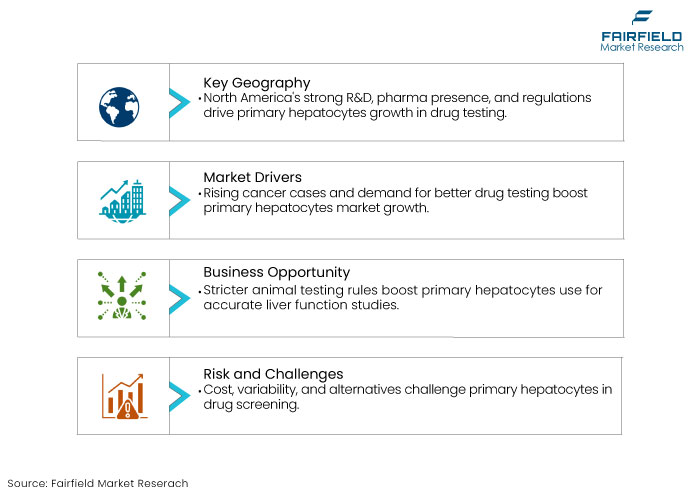
Improvements in the development of cancer treatments and the growing need for precise drug metabolism investigations are driving the market for primary hepatocytes. Better preclinical models are desperately needed to evaluate the safety and effectiveness of drugs, as the WHO projects a 47% increase in cancer cases worldwide by 2040.
3D cell culture technology, which mimics the human liver’s microenvironment, is becoming a critical tool in oncology research, providing more predictive and reliable in vitro models for drug testing. Companies like Lonza and Thermo Fisher Scientific are investing in organ-on-a-chip technologies, which enhance hepatocyte functionality, enabling more precise toxicity screening and reducing reliance on animal testing.
The need for primary hepatocytes in preclinical studies has increased because of the FDA's more stringent drug safety requirements, which guarantee improved translation of laboratory data into clinical settings. 3D hepatocyte models will be crucial in maximizing therapeutic efficacy as individualized cancer therapies gain traction, propelling the market growth.
- Rising Concerns of Liver Diseases Spurs Adoption of In-Vitro Models in Drug Discovery
The increasing preference for in vitro models in drug research and development is driving a boom in the market for primary hepatocytes. These models provide vital physiological information and are critical for assessing drug metabolism, hepatotoxicity, and enzyme function.
Regulatory bodies such as the FDA and EMA place a strong emphasis on the use of in vitro research to enhance early-stage drug screening and lessen the need for animal testing. The requirement for safe and efficient medication candidates is driving the move to human-relevant cell models. By detecting hepatotoxic substances early in the development process, primary hepatocyte tests can save money and time.
The need for efficient in vitro models to investigate liver pathophysiology, assess treatment responses, and screen substances for possible hepatotoxic effects has increased due to the rising frequency of liver illnesses and hepatotoxicity concerns. Growing liver disease rates worldwide, especially in North America, Europe, and Asia Pacific, are anticipated to fuel the demand for primary hepatocytes.
Key Growth Barriers
- Availability of induced pluripotent stem cell (iPSC)-derived hepatocytes and hepatoma cell lines for Drug Screening
The availability of substitute cell types for drug screening is posing problems for the main hepatocyte business. The gold standard for assessing drug metabolism and toxicity specific to the liver is primary hepatocytes, which are generated from liver tissue. However, broad drug development is hampered by their high cost, batch variability, and restricted availability.
Alternative cell types, such as hepatoma cell lines and induced pluripotent stem cell (iPSC)-derived hepatocytes, have become popular in response because of their affordability, scalability, and accessibility. These substitutes lessen the need for primary hepatocytes, which influences the demand for them on the market. These cell types may further limit the main hepatocyte market in drug screening applications as their functionality and physiological significance continue to advance.
Primary Hepatocytes Market Trends and Opportunities
- Stringent Regulations Regarding Animal Testing Presents Novel Avenues
The growing focus on animal testing regulations presents opportunities for the use of primary hepatocytes in research and development. These cells, derived from human or animal liver tissue, offer a more accurate representation of human liver function than traditional animal models. They replicate in vivo liver metabolism and toxicity, making them invaluable in preclinical studies.
As researchers face regulatory pressure, the adoption of these cells in drug discovery and toxicity testing becomes increasingly appealing. The shift towards reducing animal testing aligns with the broader trend of promoting humane and ethical research practices.
By leveraging primary hepatocytes, companies can adhere to regulatory requirements, enhance the predictability of drug responses in humans, streamline the drug development process, and reduce the potential for late-stage failures. Additionally, primary hepatocytes can facilitate the development of more efficient screening methods and predictive models for liver-related diseases, advancing scientific understanding and therapeutic innovation.
- Advancement in Research using 3D Cultures Paves the Way for Innovation
Developments in the 3D cell cultures are transforming tissue engineering, cancer research, and medication development. By simulating the in vivo environment, these 3D cultures enable cells to grow in three dimensions, offering more precise insights into biological processes. Because they can reproduce the intricate structure and microenvironment of tumors, they are especially useful in cancer research because they allow for more accurate investigations of metastasis, treatment responses, and tumor activity.
This invention enhances forecasts of how well therapies will function in the human body and lowers the possibility of late-stage clinical trial failures. Organoids, which may be created from patient-specific cells and are useful for customized treatment, are produced in drug research using 3D culturing.
In October 2024, collaborations between InSphero and the FDA's NCTR led to the largest benchmarking study demonstrating early detection of liver toxicity using 3D liver microtissues, demonstrating the predictive accuracy of these models and revolutionizing drug development and safety assessment.
Segments Covered in the Report
- Human segment Remain Top of Primary Hepatocytes product type
The human segment leads the primary hepatocytes market, primarily due to its critical role in drug testing and liver disease research. Human hepatocytes offer precise data for pharmacokinetics and toxicity studies, meeting stringent regulatory requirements. The growing prevalence of liver conditions like hepatitis and NAFLD has heightened the need for human-based research models.
Advances in cell isolation techniques have enhanced the availability and performance of human hepatocytes. Pharmaceutical companies increasingly prioritize these cells for personalized medicine and to minimize reliance on animal models. Additionally, the rising use of in vitro systems further supports the segment's expansion across therapeutic and research domains.
- Cell Viability Assay Segment Takes the Lead in Application/Assay
The cell viability assay segment is experiencing significant growth in the primary hepatocytes market due to its vital role in drug development. These assays assess cell health, providing accurate insights into toxicity and efficacy.
Growing investments in pharmaceutical research and development are driving demand for dependable viability testing. Essential for evaluating liver cell responses to drugs, chemicals, and environmental toxins, these assays are becoming increasingly integral.
Advances in assay technologies have enhanced sensitivity and reproducibility, encouraging broader adoption. The rising focus on personalized medicine and in vitro testing, along with regulatory support for safer drug screening, further accelerates the segment's expansion.
Regional Analysis
- North America Cultivates Investment Avenues for Research and Development
North America's sophisticated healthcare system, significant investment in research and development, and high concentration of pharmaceutical and biotechnology firms make it a major growth engine for the primary hepatocytes industry. The use of primary hepatocytes in toxicity and pharmacokinetics investigations has increased due to the region's emphasis on creative medication development and strict adherence to regulatory norms.
A high prevalence of liver diseases such as non-alcoholic fatty liver disease (NAFLD) and hepatitis further propels research initiatives. Additionally, government funding for biomedical research and advancements in cell culture technologies and personalized medicine reinforce North America’s dominant position in this market.
- Europe's Robust Biotechnology & Pharmaceutical Industry Fuels Research
Pharmaceutical and biotechnology firms in Europe are making significant investments in preclinical research and drug development, with nations like France, Germany, and the UK spearheading innovation-driven projects. In order to create novel treatment candidates, leading firms are increasingly employing primary hepatocytes for toxicity screening, drug metabolism, and enzyme activity research.
To comply with strict medication safety and effectiveness testing criteria, European regulatory agencies such as the European Medicines Agency (EMA) are promoting in vitro models such as primary hepatocytes and decreasing animal testing. As a result, primary hepatocyte cultures are now more widely used in both industrial and academic settings.
Fairfield’s Competitive Landscape Analysis
Fairfield's competitive landscape analysis highlights key players and strategies shaping the primary hepatocytes market. Leading companies focus on innovations in cell isolation, cryopreservation, and culture technologies to meet the growing demand for reliable in vitro models.
Partnerships between pharmaceutical firms and academic institutions drive advancements in hepatocyte functionality for drug testing and toxicity studies. Emerging players leverage regional opportunities, particularly in Asia-Pacific, by offering cost-effective solutions.
The market also sees increased competition in providing hepatocyte-specific assay kits and personalized medicine applications. Fairfield's report emphasizes the critical role of technological innovation, regulatory alignment, and geographic expansion in sustaining competitive advantage.
Key Market Companies
- QIAGEN
- Thermo Fisher Scientific Inc.
- Merck KGaA
- Lonza
- Takara Bio Inc.
- American Type Culture Collection (ATCC)
- Corning Inc.
- Cell Biologics, Inc.
- Creative Bioarray
- Axol Bioscience Ltd.
- HiMedia Laboratories
- NEXEL Co., Ltd.
- AnaBios
- Cytes Biotechnologies S.L.
- ZenBio, Inc. (BioIVT)
- iXCells Biotechnologies
- ScienCell Research Laboratories, Inc.
- Kerafast
- Kosheeka
- XenoTech
- LifeNet Health LifeSciences
- Cell Guidance Systems LLC
- Applied Biological Materials Inc. (abm)
- Discovery Life Sciences
- Innoprot
- Novabiosis
Global Primary Hepatocytes Market is Segmented as-
By Product
- Cryopreserved Suspension Hepatocytes
- Fresh Suspension Hepatocytes
- 3D (Spheroid) Hepatocytes
- Expanded Hepatocytes (Plateable)
- Non-characterized Hepatocytes
By Species
- Human
- Rat
- Mouse
- Dog
- Monkey
- Horse
- Others
By Application/Assay
- Cell Viability Assay
- Cytochrome Enzyme Activity
- High Content Cytotoxicity
- Transporter Inhibition Assay
- In Vitro Intrinsic Clearance
- Phospholipids Assay
- Others
By End User
- Biopharmaceutical companies
- Academic and Research institutes
- Contract Research Organizations
By Region
- North America
- Europe
- Asia Pacific
- Latin America
- The Middle East & Africa
- Executive Summary
- Global Primary Hepatocytes Market Snapshot
- Future Projections
- Key Market Trends
- Regional Snapshot, by Value, 2026
- Analyst Recommendations
- Market Overview
- Market Definitions and Segmentations
- Market Dynamics
- Drivers
- Restraints
- Market Opportunities
- Value Chain Analysis
- COVID-19 Impact Analysis
- Porter's Five Forces Analysis
- Impact of Russia-Ukraine Conflict
- PESTLE Analysis
- Regulatory Analysis
- Price Trend Analysis
- Current Prices and Future Projections, 2025-2033
- Price Impact Factors
- Global Primary Hepatocytes Market Outlook, 2020 - 2033
- Global Primary Hepatocytes Market Outlook, by Product Type, Value (US$ Bn), 2020-2033
- Cryopreserved Suspension Hepatocytes
- Fresh Suspension Hepatocytes
- 3D (Spheroid) Hepatocytes
- Expanded Hepatocytes (Plateable)
- Non-characterized Hepatocytes
- Global Primary Hepatocytes Market Outlook, by Species, Value (US$ Bn), 2020-2033
- Human
- Rat
- Mouse
- Dog
- Monkey
- Horse
- Others
- Global Primary Hepatocytes Market Outlook, by Application/Assay, Value (US$ Bn), 2020-2033
- Cell Viability Assay
- Cytochrome Enzyme Activity
- High Content Cytotoxicity
- Transporter Inhibition Assay
- In Vitro Intrinsic Clearance
- Phospholipids Assay
- Others
- Global Primary Hepatocytes Market Outlook, by End User, Value (US$ Bn), 2020-2033
- Biopharmaceutical companies
- Academic and Research institutes
- Contract Research Organizations
- Global Primary Hepatocytes Market Outlook, by Region, Value (US$ Bn), 2020-2033
- North America
- Europe
- Asia Pacific
- Latin America
- Middle East & Africa
- Global Primary Hepatocytes Market Outlook, by Product Type, Value (US$ Bn), 2020-2033
- North America Primary Hepatocytes Market Outlook, 2020 - 2033
- North America Primary Hepatocytes Market Outlook, by Product Type, Value (US$ Bn), 2020-2033
- Cryopreserved Suspension Hepatocytes
- Fresh Suspension Hepatocytes
- 3D (Spheroid) Hepatocytes
- Expanded Hepatocytes (Plateable)
- Non-characterized Hepatocytes
- North America Primary Hepatocytes Market Outlook, by Species, Value (US$ Bn), 2020-2033
- Human
- Rat
- Mouse
- Dog
- Monkey
- Horse
- Others
- North America Primary Hepatocytes Market Outlook, by Application/Assay, Value (US$ Bn), 2020-2033
- Cell Viability Assay
- Cytochrome Enzyme Activity
- High Content Cytotoxicity
- Transporter Inhibition Assay
- In Vitro Intrinsic Clearance
- Phospholipids Assay
- Others
- North America Primary Hepatocytes Market Outlook, by End User, Value (US$ Bn), 2020-2033
- Biopharmaceutical companies
- Academic and Research institutes
- Contract Research Organizations
- North America Primary Hepatocytes Market Outlook, by Country, Value (US$ Bn), 2020-2033
- U.S. Primary Hepatocytes Market Outlook, by Product Type, 2020-2033
- U.S. Primary Hepatocytes Market Outlook, by Species, 2020-2033
- U.S. Primary Hepatocytes Market Outlook, by Application/Assay, 2020-2033
- U.S. Primary Hepatocytes Market Outlook, by End User, 2020-2033
- Canada Primary Hepatocytes Market Outlook, by Product Type, 2020-2033
- Canada Primary Hepatocytes Market Outlook, by Species, 2020-2033
- Canada Primary Hepatocytes Market Outlook, by Application/Assay, 2020-2033
- Canada Primary Hepatocytes Market Outlook, by End User, 2020-2033
- BPS Analysis/Market Attractiveness Analysis
- North America Primary Hepatocytes Market Outlook, by Product Type, Value (US$ Bn), 2020-2033
- Europe Primary Hepatocytes Market Outlook, 2020 - 2033
- Europe Primary Hepatocytes Market Outlook, by Product Type, Value (US$ Bn), 2020-2033
- Cryopreserved Suspension Hepatocytes
- Fresh Suspension Hepatocytes
- 3D (Spheroid) Hepatocytes
- Expanded Hepatocytes (Plateable)
- Non-characterized Hepatocytes
- Europe Primary Hepatocytes Market Outlook, by Species, Value (US$ Bn), 2020-2033
- Human
- Rat
- Mouse
- Dog
- Monkey
- Horse
- Others
- Europe Primary Hepatocytes Market Outlook, by Application/Assay, Value (US$ Bn), 2020-2033
- Cell Viability Assay
- Cytochrome Enzyme Activity
- High Content Cytotoxicity
- Transporter Inhibition Assay
- In Vitro Intrinsic Clearance
- Phospholipids Assay
- Others
- Europe Primary Hepatocytes Market Outlook, by End User, Value (US$ Bn), 2020-2033
- Biopharmaceutical companies
- Academic and Research institutes
- Contract Research Organizations
- Europe Primary Hepatocytes Market Outlook, by Country, Value (US$ Bn), 2020-2033
- Germany Primary Hepatocytes Market Outlook, by Product Type, 2020-2033
- Germany Primary Hepatocytes Market Outlook, by Species, 2020-2033
- Germany Primary Hepatocytes Market Outlook, by Application/Assay, 2020-2033
- Germany Primary Hepatocytes Market Outlook, by End User, 2020-2033
- Italy Primary Hepatocytes Market Outlook, by Product Type, 2020-2033
- Italy Primary Hepatocytes Market Outlook, by Species, 2020-2033
- Italy Primary Hepatocytes Market Outlook, by Application/Assay, 2020-2033
- Italy Primary Hepatocytes Market Outlook, by End User, 2020-2033
- France Primary Hepatocytes Market Outlook, by Product Type, 2020-2033
- France Primary Hepatocytes Market Outlook, by Species, 2020-2033
- France Primary Hepatocytes Market Outlook, by Application/Assay, 2020-2033
- France Primary Hepatocytes Market Outlook, by End User, 2020-2033
- U.K. Primary Hepatocytes Market Outlook, by Product Type, 2020-2033
- U.K. Primary Hepatocytes Market Outlook, by Species, 2020-2033
- U.K. Primary Hepatocytes Market Outlook, by Application/Assay, 2020-2033
- U.K. Primary Hepatocytes Market Outlook, by End User, 2020-2033
- Spain Primary Hepatocytes Market Outlook, by Product Type, 2020-2033
- Spain Primary Hepatocytes Market Outlook, by Species, 2020-2033
- Spain Primary Hepatocytes Market Outlook, by Application/Assay, 2020-2033
- Spain Primary Hepatocytes Market Outlook, by End User, 2020-2033
- Russia Primary Hepatocytes Market Outlook, by Product Type, 2020-2033
- Russia Primary Hepatocytes Market Outlook, by Species, 2020-2033
- Russia Primary Hepatocytes Market Outlook, by Application/Assay, 2020-2033
- Russia Primary Hepatocytes Market Outlook, by End User, 2020-2033
- Rest of Europe Primary Hepatocytes Market Outlook, by Product Type, 2020-2033
- Rest of Europe Primary Hepatocytes Market Outlook, by Species, 2020-2033
- Rest of Europe Primary Hepatocytes Market Outlook, by Application/Assay, 2020-2033
- Rest of Europe Primary Hepatocytes Market Outlook, by End User, 2020-2033
- BPS Analysis/Market Attractiveness Analysis
- Europe Primary Hepatocytes Market Outlook, by Product Type, Value (US$ Bn), 2020-2033
- Asia Pacific Primary Hepatocytes Market Outlook, 2020 - 2033
- Asia Pacific Primary Hepatocytes Market Outlook, by Product Type, Value (US$ Bn), 2020-2033
- Cryopreserved Suspension Hepatocytes
- Fresh Suspension Hepatocytes
- 3D (Spheroid) Hepatocytes
- Expanded Hepatocytes (Plateable)
- Non-characterized Hepatocytes
- Asia Pacific Primary Hepatocytes Market Outlook, by Species, Value (US$ Bn), 2020-2033
- Human
- Rat
- Mouse
- Dog
- Monkey
- Horse
- Others
- Asia Pacific Primary Hepatocytes Market Outlook, by Application/Assay, Value (US$ Bn), 2020-2033
- Cell Viability Assay
- Cytochrome Enzyme Activity
- High Content Cytotoxicity
- Transporter Inhibition Assay
- In Vitro Intrinsic Clearance
- Phospholipids Assay
- Others
- Asia Pacific Primary Hepatocytes Market Outlook, by End User, Value (US$ Bn), 2020-2033
- Biopharmaceutical companies
- Academic and Research institutes
- Contract Research Organizations
- Asia Pacific Primary Hepatocytes Market Outlook, by Country, Value (US$ Bn), 2020-2033
- China Primary Hepatocytes Market Outlook, by Product Type, 2020-2033
- China Primary Hepatocytes Market Outlook, by Species, 2020-2033
- China Primary Hepatocytes Market Outlook, by Application/Assay, 2020-2033
- China Primary Hepatocytes Market Outlook, by End User, 2020-2033
- Japan Primary Hepatocytes Market Outlook, by Product Type, 2020-2033
- Japan Primary Hepatocytes Market Outlook, by Species, 2020-2033
- Japan Primary Hepatocytes Market Outlook, by Application/Assay, 2020-2033
- Japan Primary Hepatocytes Market Outlook, by End User, 2020-2033
- South Korea Primary Hepatocytes Market Outlook, by Product Type, 2020-2033
- South Korea Primary Hepatocytes Market Outlook, by Species, 2020-2033
- South Korea Primary Hepatocytes Market Outlook, by Application/Assay, 2020-2033
- South Korea Primary Hepatocytes Market Outlook, by End User, 2020-2033
- India Primary Hepatocytes Market Outlook, by Product Type, 2020-2033
- India Primary Hepatocytes Market Outlook, by Species, 2020-2033
- India Primary Hepatocytes Market Outlook, by Application/Assay, 2020-2033
- India Primary Hepatocytes Market Outlook, by End User, 2020-2033
- Southeast Asia Primary Hepatocytes Market Outlook, by Product Type, 2020-2033
- Southeast Asia Primary Hepatocytes Market Outlook, by Species, 2020-2033
- Southeast Asia Primary Hepatocytes Market Outlook, by Application/Assay, 2020-2033
- Southeast Asia Primary Hepatocytes Market Outlook, by End User, 2020-2033
- Rest of SAO Primary Hepatocytes Market Outlook, by Product Type, 2020-2033
- Rest of SAO Primary Hepatocytes Market Outlook, by Species, 2020-2033
- Rest of SAO Primary Hepatocytes Market Outlook, by Application/Assay, 2020-2033
- Rest of SAO Primary Hepatocytes Market Outlook, by End User, 2020-2033
- BPS Analysis/Market Attractiveness Analysis
- Asia Pacific Primary Hepatocytes Market Outlook, by Product Type, Value (US$ Bn), 2020-2033
- Latin America Primary Hepatocytes Market Outlook, 2020 - 2033
- Latin America Primary Hepatocytes Market Outlook, by Product Type, Value (US$ Bn), 2020-2033
- Cryopreserved Suspension Hepatocytes
- Fresh Suspension Hepatocytes
- 3D (Spheroid) Hepatocytes
- Expanded Hepatocytes (Plateable)
- Non-characterized Hepatocytes
- Latin America Primary Hepatocytes Market Outlook, by Species, Value (US$ Bn), 2020-2033
- Human
- Rat
- Mouse
- Dog
- Monkey
- Horse
- Others
- Latin America Primary Hepatocytes Market Outlook, by Application/Assay, Value (US$ Bn), 2020-2033
- Cell Viability Assay
- Cytochrome Enzyme Activity
- High Content Cytotoxicity
- Transporter Inhibition Assay
- In Vitro Intrinsic Clearance
- Phospholipids Assay
- Others
- Latin America Primary Hepatocytes Market Outlook, by End User, Value (US$ Bn), 2020-2033
- Biopharmaceutical companies
- Academic and Research institutes
- Contract Research Organizations
- Latin America Primary Hepatocytes Market Outlook, by Country, Value (US$ Bn), 2020-2033
- Brazil Primary Hepatocytes Market Outlook, by Product Type, 2020-2033
- Brazil Primary Hepatocytes Market Outlook, by Species, 2020-2033
- Brazil Primary Hepatocytes Market Outlook, by Application/Assay, 2020-2033
- Brazil Primary Hepatocytes Market Outlook, by End User, 2020-2033
- Mexico Primary Hepatocytes Market Outlook, by Product Type, 2020-2033
- Mexico Primary Hepatocytes Market Outlook, by Species, 2020-2033
- Mexico Primary Hepatocytes Market Outlook, by Application/Assay, 2020-2033
- Mexico Primary Hepatocytes Market Outlook, by End User, 2020-2033
- Argentina Primary Hepatocytes Market Outlook, by Product Type, 2020-2033
- Argentina Primary Hepatocytes Market Outlook, by Species, 2020-2033
- Argentina Primary Hepatocytes Market Outlook, by Application/Assay, 2020-2033
- Argentina Primary Hepatocytes Market Outlook, by End User, 2020-2033
- Rest of LATAM Primary Hepatocytes Market Outlook, by Product Type, 2020-2033
- Rest of LATAM Primary Hepatocytes Market Outlook, by Species, 2020-2033
- Rest of LATAM Primary Hepatocytes Market Outlook, by Application/Assay, 2020-2033
- Rest of LATAM Primary Hepatocytes Market Outlook, by End User, 2020-2033
- BPS Analysis/Market Attractiveness Analysis
- Latin America Primary Hepatocytes Market Outlook, by Product Type, Value (US$ Bn), 2020-2033
- Middle East & Africa Primary Hepatocytes Market Outlook, 2020 - 2033
- Middle East & Africa Primary Hepatocytes Market Outlook, by Product Type, Value (US$ Bn), 2020-2033
- Cryopreserved Suspension Hepatocytes
- Fresh Suspension Hepatocytes
- 3D (Spheroid) Hepatocytes
- Expanded Hepatocytes (Plateable)
- Non-characterized Hepatocytes
- Middle East & Africa Primary Hepatocytes Market Outlook, by Species, Value (US$ Bn), 2020-2033
- Human
- Rat
- Mouse
- Dog
- Monkey
- Horse
- Others
- Middle East & Africa Primary Hepatocytes Market Outlook, by Application/Assay, Value (US$ Bn), 2020-2033
- Cell Viability Assay
- Cytochrome Enzyme Activity
- High Content Cytotoxicity
- Transporter Inhibition Assay
- In Vitro Intrinsic Clearance
- Phospholipids Assay
- Others
- Middle East & Africa Primary Hepatocytes Market Outlook, by End User, Value (US$ Bn), 2020-2033
- Biopharmaceutical companies
- Academic and Research institutes
- Contract Research Organizations
- Middle East & Africa Primary Hepatocytes Market Outlook, by Country, Value (US$ Bn), 2020-2033
- GCC Primary Hepatocytes Market Outlook, by Product Type, 2020-2033
- GCC Primary Hepatocytes Market Outlook, by Species, 2020-2033
- GCC Primary Hepatocytes Market Outlook, by Application/Assay, 2020-2033
- GCC Primary Hepatocytes Market Outlook, by End User, 2020-2033
- South Africa Primary Hepatocytes Market Outlook, by Product Type, 2020-2033
- South Africa Primary Hepatocytes Market Outlook, by Species, 2020-2033
- South Africa Primary Hepatocytes Market Outlook, by Application/Assay, 2020-2033
- South Africa Primary Hepatocytes Market Outlook, by End User, 2020-2033
- Egypt Primary Hepatocytes Market Outlook, by Product Type, 2020-2033
- Egypt Primary Hepatocytes Market Outlook, by Species, 2020-2033
- Egypt Primary Hepatocytes Market Outlook, by Application/Assay, 2020-2033
- Egypt Primary Hepatocytes Market Outlook, by End User, 2020-2033
- Nigeria Primary Hepatocytes Market Outlook, by Product Type, 2020-2033
- Nigeria Primary Hepatocytes Market Outlook, by Species, 2020-2033
- Nigeria Primary Hepatocytes Market Outlook, by Application/Assay, 2020-2033
- Nigeria Primary Hepatocytes Market Outlook, by End User, 2020-2033
- Rest of Middle East Primary Hepatocytes Market Outlook, by Product Type, 2020-2033
- Rest of Middle East Primary Hepatocytes Market Outlook, by Species, 2020-2033
- Rest of Middle East Primary Hepatocytes Market Outlook, by Application/Assay, 2020-2033
- Rest of Middle East Primary Hepatocytes Market Outlook, by End User, 2020-2033
- BPS Analysis/Market Attractiveness Analysis
- Middle East & Africa Primary Hepatocytes Market Outlook, by Product Type, Value (US$ Bn), 2020-2033
- Competitive Landscape
- Company Vs Segment Heatmap
- Company Market Share Analysis, 2025
- Competitive Dashboard
- Company Profiles
- Thermo Fisher Scientific Inc.
- Company Overview
- Product Portfolio
- Financial Overview
- Business Strategies and Developments
- Corning Inc.
- Lonza
- Takara Bio Inc.
- Cell Biologics, Inc.
- Merck KGaA
- American Type Culture Collection (ATCC)
- Creative Bioarray
- Axol Bioscience Ltd.
- HiMedia Laboratories
- Thermo Fisher Scientific Inc.
- Appendix
- Research Methodology
- Report Assumptions
- Acronyms and Abbreviations
|
BASE YEAR |
HISTORICAL DATA |
FORECAST PERIOD |
UNITS |
|||
 |
2025 |
 |
2020 - 2025 |
 |
2026 - 2033 |
Value: US$ Million |
|
REPORT FEATURES |
DETAILS |
|
Product Coverage |
|
|
Species Coverage |
|
|
Assays Coverage |
|
|
End User Coverage |
|
|
Geographical Coverage |
|
|
Leading Companies |
|
|
Report Highlights |
Key Market Indicators, Macro-micro economic impact analysis, Technological Roadmap, Key Trends, Driver, Restraints, and Future Opportunities & Revenue Pockets, Porter’s 5 Forces Analysis, Historical Trend (2019-2021), Market Estimates and Forecast, Market Dynamics, Industry Trends, Competition Landscape, Category, Region, Country-wise Trends & Analysis, COVID-19 Impact Analysis (Demand and Supply Chain) |
Our Research Methodology
Considering the volatility of business today, traditional approaches to strategizing a game plan can be unfruitful if not detrimental. True ambiguity is no way to determine a forecast. A myriad of predetermined factors must be accounted for such as the degree of risk involved, the magnitude of circumstances, as well as conditions or consequences that are not known or unpredictable. To circumvent binary views that cast uncertainty, the application of market research intelligence to strategically posture, move, and enable actionable outcomes is necessary.
View Methodology
Quality Assured
Rigorous Validation Process

Confidentiality Assured
End-to-end Data Security

Custom Research Services
Tailored To Your Objectives
FAQs
Global primary hepatocytes market is anticipated to reach USD 429.5 Bn Mn in 2033.
Global primary hepatocytes market is anticipated to witness CAGR of 6.60% during the forecast period 2026-2033 with a value of US$ 247.5 Mn in 2025.
North America leads the global market in terms of value. The region will continue to lead its way through the forecast period to reach a value of US$ 136.7 Mn by 2032.
Cryopreserved suspension hepatocytes are anticipated to dominate the global primary hepatocytes market with a while non-characterized hepatocytes would report a CAGR of 6.60% from 2026 to 2033.
Human dominates the market throughout and is expected to exhibit strong revenue growth rate during the forecast period with CAGR of ~5.9%.
Related Reports
Oral Cancer Rapid Test Kit Market
The oral cancer rapid test kits market will grow from USD 240.00 Mn in 2026 to USD 550.80 Mn by 2033, driven by early detection and point-of-care screening.
Non-Hodgkin Lymphoma Therapeutics Market Insights, Competitive Landscape, and Market Forecast 2033
The non-Hodgkin lymphoma therapeutics market will expand from USD 16.80 billion in 2026 to USD 28.98 billion by 2033, driven by targeted therapies.
In Vitro Toxicology Testing Market Insights, Competitive Landscape, and Market Forecast 2033
The in vitro toxicology testing market is expected to grow from USD 8.60 billion in 2026 to USD 16.03 billion by 2033, driven by animal testing alternatives.
Healthcare Fintech Market Insights, Competitive Landscape, and Market Forecast 2033
Healthcare Fintech Market to reach USD 26.40 Bn by 2033, growing at 16.8% CAGR, driven by digital billing, patient payments, and claims automation.
Diagnostic Ultrasound Market Insights, Competitive Landscape, and Market Forecast - 2033
Diagnostic Ultrasound Market is valued at USD 9.70 Billion in 2026 and projected to reach USD 14.78 Billion by 2033, growing at a 6.2% CAGR.
Infection Control Supplies Market Forecast - 2033
The global infection control supplies market is set to reach US$ 19.76 Bn by 2033, growing at a 6.4% CAGR, driven by infection prevention demand