



Propylene Glycol Market
Global Propylene Glycol Industry Analysis, Size, Share, Growth, Trends, and Forecast 2026-2033 – (By Category, By Product Material, By Product, By Geographic Coverage and By Company)
Global Propylene Glycol Market: Comprehensive Strategic Analysis
Executive Summary & Key Highlights
- Global Propylene Glycol Market valued approximately at US$4.5 billion in 2026, and is projected to reach US$6.2 billion by 2033 at 4.8% CAGR, reflecting steady demand across industrial and pharma applications.
- Petroleum-based holds ~72% share in 2026; bio-based expands faster due to sustainability regulations, contributing to segment diversification.
- Unsaturated polyester resin leads at 32% share; pharmaceuticals/cosmetics demonstrate accelerated growth amid formulation demands.
- Asia Pacific commands 42-46% global share through 2033, led by China (70-75% regional); North America (U.S. ~92% regional) and Europe (Germany 28-30%) follow with mature structures.
- Pharma expansion and bio-based adoption drive 4.8% trajectory; while feedstock volatility poses restraint, per industry data.
- Top players (Dow, LyondellBasell, BASF) control >60% capacity via capacity expansions and bio-projects post-2023.
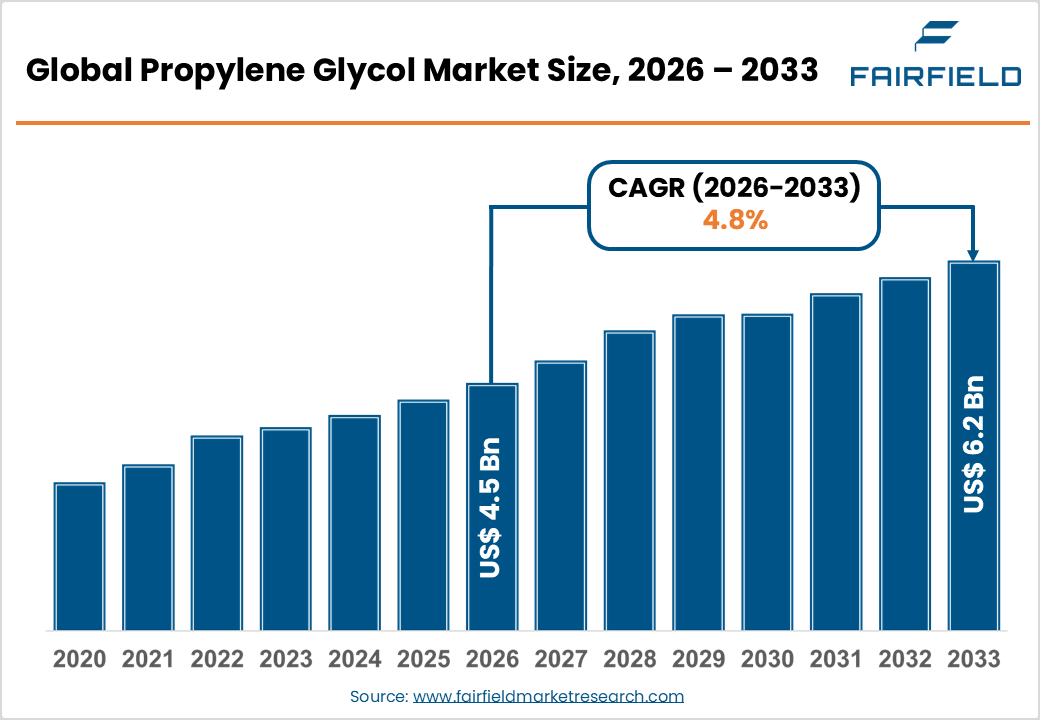
Market Dynamics: Drivers, Restraints, and Opportunities Analysis
Market Drivers
- Pharma and Personal Care Demand
Expanding formulations drive propylene glycol usage as solvents and carriers in pharma and personal care applications. U.S. FDA reports (2024) document a 5% volume rise, primarily influencing food and pharma grades through enhanced stability requirements. In Asia Pacific, this driver contributes approximately 2% growth points through 2033. Companies holding purity certifications secure competitive advantages, while ongoing monitoring of active pharmaceutical ingredient (API) integration maintains strategic relevance. Sustainability considerations moderate growth through increasing bio-based preferences, balancing performance needs with environmental compliance.
- Industrial Applications Growth
Demand for antifreeze and unsaturated polyester resins (UPR) links directly to automotive and construction sector expansion. OECD infrastructure data (2025) projects a 4% regional uptick, significantly impacting functional fluids applications. Europe benefits from approximately 1.5% growth contribution, as detailed in Fact.MR assessments. Large-scale operators capitalize through vertical integration, though feedstock access risks could amplify supply chain vulnerabilities. This dynamic underscores the need for secured raw material strategies amid cyclical industry demand patterns.
Market Restraints
- Feedstock Volatility
Propylene feedstock prices fluctuate directly with crude oil movements, raising production costs by 10-15% during peak periods. This volatility suppresses profit margins particularly within the petroleum-based segment, where cost structures remain highly sensitive to raw material pricing. Asia Pacific producers encounter elevated import dependency risks, exacerbating exposure during global supply disruptions. Market participants observe mitigation through long-term supply contracts, which stabilize input costs but require significant upfront commitments. This restraint underscores the strategic importance of diversified sourcing and hedging mechanisms to maintain competitive pricing amid unpredictable energy markets.
- Regulatory Compliance
REACH and EPA standards governing emissions and purity levels elevate compliance costs by approximately 5-8% across production facilities. These requirements particularly impact bio-based transition initiatives by increasing validation and certification expenses. EU regulatory data indicates compliance obligations delay overall market growth by 1% annually, as firms navigate extended approval timelines. Bio-alternative feedstocks partially address these constraints through favorable sustainability classifications, though scale-up challenges persist. Manufacturers must integrate regulatory foresight into capacity planning, balancing investment in compliant technologies against short-term margin pressures inherent to evolving environmental frameworks.
Market Opportunities
- Bio-Based Expansion
Regulatory pressures create substantial potential for the bio-based propylene glycol segment, projected to reach approximately US$1.2 billion by 2033. ADM projects (2024) emphasize the viability of corn-derived production pathways, positioning this segment to capture demand in pharmaceutical and food applications requiring sustainable certifications. Growth barriers center on production scale limitations and higher upfront capital requirements compared to petroleum alternatives. Strategic success hinges on collaborative partnerships between agricultural processors and chemical manufacturers, enabling technology transfer and shared infrastructure development. This opportunity supports long-term positioning in regulated markets prioritizing environmental compliance over immediate cost considerations.
- Emerging Markets Infrastructure
Construction expansion in India and ASEAN markets significantly boosts demand for unsaturated polyester resins (UPR), with World Bank forecasts indicating 6% GDP-correlated growth through infrastructure investments. This development creates an addressable market opportunity valued at approximately US$0.5 billion, driven by urbanization and public works programs. Realization requires navigation of local compliance standards, including environmental clearances and import duties on key inputs. Market participants must establish regional manufacturing footprints or strategic distribution alliances to capture growth, while monitoring policy shifts that could alter project timelines or material specifications in these high-potential developing economies.
Regional Market Assessment: Strategic Geography Analysis
- North America Propylene Glycol Market
The U.S. propylene glycol market, valued over US$0.63 billion in 2026, commands approximately 92% of the North American regional share, reflecting its dominant position within a mature market structure. This scale underscores a strategic focus on pharmaceutical and automotive applications, where high-purity grades meet established demand patterns. EPA standards governing emissions and product safety shape mandatory compliance frameworks, influencing production economics and facility configurations across the value chain. Innovation activity in bio-based grades concentrates in Midwest industrial hubs, leveraging agricultural feedstock proximity and R&D infrastructure. Market participants should evaluate capacity expansion opportunities against entrenched competition, prioritizing differentiated compliance capabilities and sustainable product portfolios to sustain positioning in this stable yet capacity-constrained environment.
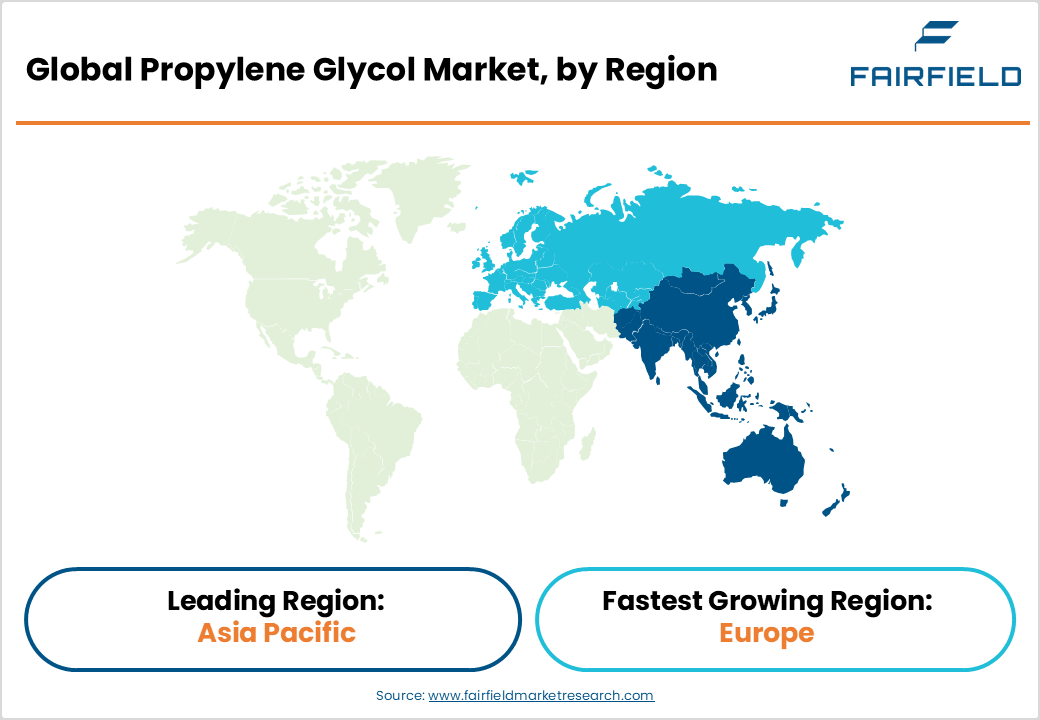
- Europe: Regulatory Harmonization and Differentiated Market Dynamics
The European propylene glycol market demonstrates differentiated dynamics, with Germany and the United Kingdom commanding 28-30% and 15-18% regional shares respectively, alongside a projection to surpass US$7 billion by 2033. REACH regulations establish harmonized standards for purity and emissions, creating consistent compliance requirements across member states while accelerating bio-based adoption through sustainability mandates. Market structure balances fragmented regional players against multinational incumbents, with recent M&A activity signaling ongoing consolidation trends that reshape competitive positioning. Strategic expansion demands granular country-level analysis to navigate varying regulatory interpretations, fiscal incentives, and end-market priorities, enabling optimized resource allocation within this regulatory-intensive geography.
- Asia-Pacific: Differential Growth and Competitive Positioning
The Asia-Pacific propylene glycol market exhibits dynamic positioning, with China dominating at 70-75% of regional share, followed by Japan and India, and the overall region projected to surpass US$3.5 billion by 2033. Manufacturing cost advantages and supply chain efficiencies particularly fuel demand for unsaturated polyester resins (UPR) in construction applications, while India demonstrates accelerated growth through infrastructure development and capacity expansion. Market consolidation progresses through interplay between local producers and multinational entrants, reshaping competitive structures across diverse regulatory environments. Strategic participants must assess evolving trade policies, tariff structures, and localization requirements to optimize market entry and sustain growth trajectories within this high-volume, rapidly evolving geography.
Segmentation Analysis: Category-Wise Strategic Assessment
- Source Segmentation
Petroleum-based propylene glycol represents approximately 72% of the global market, valued at ~US$3.2 billion in 2026, driven by inherent cost efficiencies and established production scale. Data confirms this dominance through high-volume industrial applications, where market leaders prioritize feedstock security to maintain competitive margins amid price volatility. The bio-based segment, holding ~28% share, demonstrates accelerated expansion influenced by tightening regulations. EU sustainability metrics (2025) document rising adoption rates in regulated end-markets, signaling a strategic industry shift that necessitates evaluation of alternative supply chain risks and higher production costs before significant resource reallocation.
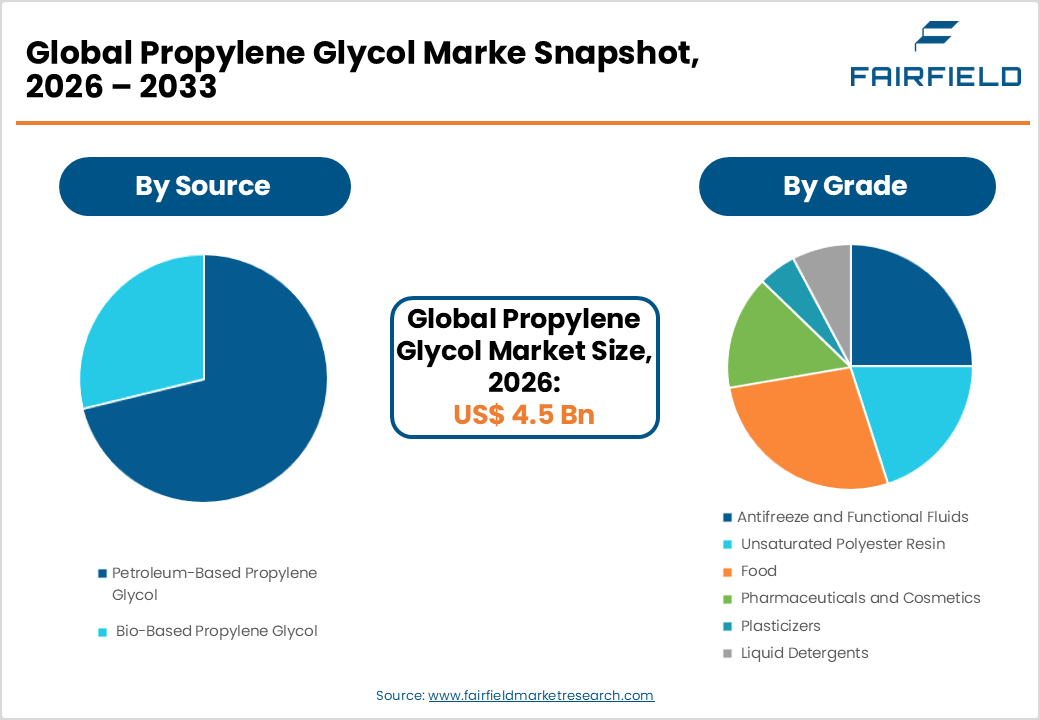
- Grade Segmentation
Unsaturated polyester resin commands 32% global market share, valued at approximately US$1.4 billion in 2026, reflecting strong construction sector linkages that sustain volume demand. Analysis attributes this leadership to consistent resin production requirements in infrastructure applications, where competitors prioritize capacity expansions to secure long-term supply commitments. Pharmaceuticals and cosmetics segments demonstrate the quickest growth trajectory from their current smaller market base, propelled by expanding formulation requirements across drug delivery and personal care products. Projections confirm this outpacing trend relative to overall market performance; however, strategic investments necessitate thorough assessment of stringent purity specification barriers and regulatory validation timelines before capital allocation decisions.
Competitive Landscape: Market Structure and Strategic Positioning
The propylene glycol market exhibits moderate consolidation, with leading players Dow, LyondellBasell, BASF, and INEOS controlling over 60% of global production capacity. Competitive differentiation centers on vertical integration and cost leadership strategies, enabling sustained margin performance across volatile feedstock environments. Entry barriers remain substantial, primarily through restricted propylene feedstock access requiring approximately US$500 million in capital expenditures for greenfield facilities. Post-2023 merger and acquisition activity signals strategic focus toward bio-based production capabilities, reflecting regulatory and customer sustainability imperatives that reshape long-term capacity allocation decisions across the industry value chain.
Key Players
- Dow Inc.
- BASF SE
- LyondellBasell Industries N.V.
- Archer Daniels Midland Company
- INEOS Group Holdings S.A.
- Huntsman Corporation
- SKC Co., Ltd.
- Shell plc
- Global Bio-Chem Technology Group Co., Ltd.
- Manali Petrochemicals Limited
- Adeka Corporation
- Repsol S.A.
- Sumitomo Chemical Co., Ltd.
- Chaoyang Chemicals, Inc.
- Qingdao Shida Shenghua Chemical Group Co., Ltd.
Key Industry Developments
- In October 2023, Dow Chemical expanded bio-propylene glycol (PG) production capacity at its North American facilities to meet escalating sustainability requirements across pharmaceutical and personal care segments.
- In August 2023, LyondellBasell publicly reported sustained demand surge in automotive antifreeze and construction unsaturated polyester resin applications during its quarterly earnings call.
- In June 2023, Indorama Ventures, through its Huntsman acquisition integration, completed a European propylene glycol manufacturing facility purchase in the Netherlands to strengthen regional supply chain resilience.
Market Segmentation
By Source
- Petroleum-Based Propylene Glycol
- Bio-Based Propylene Glycol
By Grade
- Antifreeze and Functional Fluids
- Unsaturated Polyester Resin
- Food
- Pharmaceuticals and Cosmetics
- Plasticizers
- Liquid Detergents
By End User
- Building and Construction
- Pharmaceuticals and Cosmetics
- Transportation
- Food and Beverages
By Region
- North America
- Europe
- Asia Pacific
- Latin America
- Middle East and Africa
- Executive Summary
- Global Propylene Glycol Market Snapshot
- Future Projections
- Key Market Trends
- Regional Snapshot, by Value, 2026
- Analyst Recommendations
- Market Overview
- Market Definitions and Segmentations
- Market Dynamics
- Drivers
- Restraints
- Market Opportunities
- Value Chain Analysis
- COVID-19 Impact Analysis
- Porter's Five Forces Analysis
- Impact of Russia-Ukraine Conflict
- PESTLE Analysis
- Regulatory Analysis
- Price Trend Analysis
- Current Prices and Future Projections, 2025-2033
- Price Impact Factors
- Global Propylene Glycol Market Outlook, 2020 - 2033
- Global Propylene Glycol Market Outlook, by Source, Value (US$ Bn), 2020-2033
- Petroleum-Based Propylene Glycol
- Bio-Based Propylene Glycol
- Global Propylene Glycol Market Outlook, by Grade, Value (US$ Bn), 2020-2033
- Antifreeze and Functional Fluids
- Unsaturated Polyester Resin
- Food
- Pharmaceuticals and Cosmetics
- Plasticizers
- Liquid Detergents
- Global Propylene Glycol Market Outlook, by End-User, Value (US$ Bn), 2020-2033
- Building and Construction
- Pharmaceuticals and Cosmetics
- Transportation
- Food and Beverages
- Global Propylene Glycol Market Outlook, by Region, Value (US$ Bn), 2020-2033
- North America
- Europe
- Asia Pacific
- Latin America
- Middle East & Africa
- Global Propylene Glycol Market Outlook, by Source, Value (US$ Bn), 2020-2033
- North America Propylene Glycol Market Outlook, 2020 - 2033
- North America Propylene Glycol Market Outlook, by Source, Value (US$ Bn), 2020-2033
- Petroleum-Based Propylene Glycol
- Bio-Based Propylene Glycol
- North America Propylene Glycol Market Outlook, by Grade, Value (US$ Bn), 2020-2033
- Antifreeze and Functional Fluids
- Unsaturated Polyester Resin
- Food
- Pharmaceuticals and Cosmetics
- Plasticizers
- Liquid Detergents
- North America Propylene Glycol Market Outlook, by End-User, Value (US$ Bn), 2020-2033
- Building and Construction
- Pharmaceuticals and Cosmetics
- Transportation
- Food and Beverages
- North America Propylene Glycol Market Outlook, by Country, Value (US$ Bn), 2020-2033
- S. Propylene Glycol Market Outlook, by Source, 2020-2033
- S. Propylene Glycol Market Outlook, by Grade, 2020-2033
- S. Propylene Glycol Market Outlook, by End-User, 2020-2033
- Canada Propylene Glycol Market Outlook, by Source, 2020-2033
- Canada Propylene Glycol Market Outlook, by Grade, 2020-2033
- Canada Propylene Glycol Market Outlook, by End-User, 2020-2033
- BPS Analysis/Market Attractiveness Analysis
- North America Propylene Glycol Market Outlook, by Source, Value (US$ Bn), 2020-2033
- Europe Propylene Glycol Market Outlook, 2020 - 2033
- Europe Propylene Glycol Market Outlook, by Source, Value (US$ Bn), 2020-2033
- Petroleum-Based Propylene Glycol
- Bio-Based Propylene Glycol
- Europe Propylene Glycol Market Outlook, by Grade, Value (US$ Bn), 2020-2033
- Antifreeze and Functional Fluids
- Unsaturated Polyester Resin
- Food
- Pharmaceuticals and Cosmetics
- Plasticizers
- Liquid Detergents
- Europe Propylene Glycol Market Outlook, by End-User, Value (US$ Bn), 2020-2033
- Building and Construction
- Pharmaceuticals and Cosmetics
- Transportation
- Food and Beverages
- Europe Propylene Glycol Market Outlook, by Country, Value (US$ Bn), 2020-2033
- Germany Propylene Glycol Market Outlook, by Source, 2020-2033
- Germany Propylene Glycol Market Outlook, by Grade, 2020-2033
- Germany Propylene Glycol Market Outlook, by End-User, 2020-2033
- Italy Propylene Glycol Market Outlook, by Source, 2020-2033
- Italy Propylene Glycol Market Outlook, by Grade, 2020-2033
- Italy Propylene Glycol Market Outlook, by End-User, 2020-2033
- France Propylene Glycol Market Outlook, by Source, 2020-2033
- France Propylene Glycol Market Outlook, by Grade, 2020-2033
- France Propylene Glycol Market Outlook, by End-User, 2020-2033
- K. Propylene Glycol Market Outlook, by Source, 2020-2033
- K. Propylene Glycol Market Outlook, by Grade, 2020-2033
- K. Propylene Glycol Market Outlook, by End-User, 2020-2033
- Spain Propylene Glycol Market Outlook, by Source, 2020-2033
- Spain Propylene Glycol Market Outlook, by Grade, 2020-2033
- Spain Propylene Glycol Market Outlook, by End-User, 2020-2033
- Russia Propylene Glycol Market Outlook, by Source, 2020-2033
- Russia Propylene Glycol Market Outlook, by Grade, 2020-2033
- Russia Propylene Glycol Market Outlook, by End-User, 2020-2033
- Rest of Europe Propylene Glycol Market Outlook, by Source, 2020-2033
- Rest of Europe Propylene Glycol Market Outlook, by Grade, 2020-2033
- Rest of Europe Propylene Glycol Market Outlook, by End-User, 2020-2033
- BPS Analysis/Market Attractiveness Analysis
- Europe Propylene Glycol Market Outlook, by Source, Value (US$ Bn), 2020-2033
- Asia Pacific Propylene Glycol Market Outlook, 2020 - 2033
- Asia Pacific Propylene Glycol Market Outlook, by Source, Value (US$ Bn), 2020-2033
- Petroleum-Based Propylene Glycol
- Bio-Based Propylene Glycol
- Asia Pacific Propylene Glycol Market Outlook, by Grade, Value (US$ Bn), 2020-2033
- Antifreeze and Functional Fluids
- Unsaturated Polyester Resin
- Food
- Pharmaceuticals and Cosmetics
- Plasticizers
- Liquid Detergents
- Asia Pacific Propylene Glycol Market Outlook, by End-User, Value (US$ Bn), 2020-2033
- Building and Construction
- Pharmaceuticals and Cosmetics
- Transportation
- Food and Beverages
- Asia Pacific Propylene Glycol Market Outlook, by Country, Value (US$ Bn), 2020-2033
- China Propylene Glycol Market Outlook, by Source, 2020-2033
- China Propylene Glycol Market Outlook, by Grade, 2020-2033
- China Propylene Glycol Market Outlook, by End-User, 2020-2033
- Japan Propylene Glycol Market Outlook, by Source, 2020-2033
- Japan Propylene Glycol Market Outlook, by Grade, 2020-2033
- Japan Propylene Glycol Market Outlook, by End-User, 2020-2033
- South Korea Propylene Glycol Market Outlook, by Source, 2020-2033
- South Korea Propylene Glycol Market Outlook, by Grade, 2020-2033
- South Korea Propylene Glycol Market Outlook, by End-User, 2020-2033
- India Propylene Glycol Market Outlook, by Source, 2020-2033
- India Propylene Glycol Market Outlook, by Grade, 2020-2033
- India Propylene Glycol Market Outlook, by End-User, 2020-2033
- Southeast Asia Propylene Glycol Market Outlook, by Source, 2020-2033
- Southeast Asia Propylene Glycol Market Outlook, by Grade, 2020-2033
- Southeast Asia Propylene Glycol Market Outlook, by End-User, 2020-2033
- Rest of SAO Propylene Glycol Market Outlook, by Source, 2020-2033
- Rest of SAO Propylene Glycol Market Outlook, by Grade, 2020-2033
- Rest of SAO Propylene Glycol Market Outlook, by End-User, 2020-2033
- BPS Analysis/Market Attractiveness Analysis
- Asia Pacific Propylene Glycol Market Outlook, by Source, Value (US$ Bn), 2020-2033
- Latin America Propylene Glycol Market Outlook, 2020 - 2033
- Latin America Propylene Glycol Market Outlook, by Source, Value (US$ Bn), 2020-2033
- Petroleum-Based Propylene Glycol
- Bio-Based Propylene Glycol
- Latin America Propylene Glycol Market Outlook, by Grade, Value (US$ Bn), 2020-2033
- Antifreeze and Functional Fluids
- Unsaturated Polyester Resin
- Food
- Pharmaceuticals and Cosmetics
- Plasticizers
- Liquid Detergents
- Latin America Propylene Glycol Market Outlook, by End-User, Value (US$ Bn), 2020-2033
- Building and Construction
- Pharmaceuticals and Cosmetics
- Transportation
- Food and Beverages
- Latin America Propylene Glycol Market Outlook, by Country, Value (US$ Bn), 2020-2033
- Brazil Propylene Glycol Market Outlook, by Source, 2020-2033
- Brazil Propylene Glycol Market Outlook, by Grade, 2020-2033
- Brazil Propylene Glycol Market Outlook, by End-User, 2020-2033
- Mexico Propylene Glycol Market Outlook, by Source, 2020-2033
- Mexico Propylene Glycol Market Outlook, by Grade, 2020-2033
- Mexico Propylene Glycol Market Outlook, by End-User, 2020-2033
- Argentina Propylene Glycol Market Outlook, by Source, 2020-2033
- Argentina Propylene Glycol Market Outlook, by Grade, 2020-2033
- Argentina Propylene Glycol Market Outlook, by End-User, 2020-2033
- Rest of LATAM Propylene Glycol Market Outlook, by Source, 2020-2033
- Rest of LATAM Propylene Glycol Market Outlook, by Grade, 2020-2033
- Rest of LATAM Propylene Glycol Market Outlook, by End-User, 2020-2033
- BPS Analysis/Market Attractiveness Analysis
- Latin America Propylene Glycol Market Outlook, by Source, Value (US$ Bn), 2020-2033
- Middle East & Africa Propylene Glycol Market Outlook, 2020 - 2033
- Middle East & Africa Propylene Glycol Market Outlook, by Source, Value (US$ Bn), 2020-2033
- Petroleum-Based Propylene Glycol
- Bio-Based Propylene Glycol
- Middle East & Africa Propylene Glycol Market Outlook, by Grade, Value (US$ Bn), 2020-2033
- Antifreeze and Functional Fluids
- Unsaturated Polyester Resin
- Food
- Pharmaceuticals and Cosmetics
- Plasticizers
- Liquid Detergents
- Middle East & Africa Propylene Glycol Market Outlook, by End-User, Value (US$ Bn), 2020-2033
- Building and Construction
- Pharmaceuticals and Cosmetics
- Transportation
- Food and Beverages
- Middle East & Africa Propylene Glycol Market Outlook, by Country, Value (US$ Bn), 2020-2033
- GCC Propylene Glycol Market Outlook, by Source, 2020-2033
- GCC Propylene Glycol Market Outlook, by Grade, 2020-2033
- GCC Propylene Glycol Market Outlook, by End-User, 2020-2033
- South Africa Propylene Glycol Market Outlook, by Source, 2020-2033
- South Africa Propylene Glycol Market Outlook, by Grade, 2020-2033
- South Africa Propylene Glycol Market Outlook, by End-User, 2020-2033
- Egypt Propylene Glycol Market Outlook, by Source, 2020-2033
- Egypt Propylene Glycol Market Outlook, by Grade, 2020-2033
- Egypt Propylene Glycol Market Outlook, by End-User, 2020-2033
- Nigeria Propylene Glycol Market Outlook, by Source, 2020-2033
- Nigeria Propylene Glycol Market Outlook, by Grade, 2020-2033
- Nigeria Propylene Glycol Market Outlook, by End-User, 2020-2033
- Rest of Middle East Propylene Glycol Market Outlook, by Source, 2020-2033
- Rest of Middle East Propylene Glycol Market Outlook, by Grade, 2020-2033
- Rest of Middle East Propylene Glycol Market Outlook, by End-User, 2020-2033
- BPS Analysis/Market Attractiveness Analysis
- Middle East & Africa Propylene Glycol Market Outlook, by Source, Value (US$ Bn), 2020-2033
- Competitive Landscape
- Company Vs Segment Heatmap
- Company Market Share Analysis, 2025
- Competitive Dashboard
- Company Profiles
- Dow Inc.
- Company Overview
- Product Portfolio
- Financial Overview
- Business Strategies and Developments
- BASF SE
- LyondellBasell Industries N.V.
- Archer Daniels Midland Company
- INEOS Group Holdings S.A.
- Huntsman Corporation
- SKC Co., Ltd.
- Shell plc
- Global Bio-Chem Technology Group Co., Ltd.
- Manali Petrochemicals Limited
- Adeka Corporation
- Repsol S.A.
- Sumitomo Chemical Co., Ltd.
- Chaoyang Chemicals, Inc.
- Qingdao Shida Shenghua Chemical Group Co., Ltd.
- Dow Inc.
- Appendix
- Research Methodology
- Report Assumptions
- Acronyms and Abbreviations
|
BASE YEAR |
HISTORICAL DATA |
FORECAST PERIOD |
UNITS |
|||
 |
2025 |
 |
2019 - 2024 |
 |
2026 - 2033 |
Value: US$ Billion |
|
REPORT FEATURES |
DETAILS |
|
By Source Coverage |
|
|
By Grade Coverage |
|
|
Geographical Coverage |
|
|
Leading Companies |
|
|
Report Highlights |
Key Market Indicators, Macro-micro economic impact analysis, Technological Roadmap, Key Trends, Driver, Restraints, and Future Opportunities & Revenue Pockets, Porter’s 5 Forces Analysis, Historical Trend (2019-2024), Market Estimates and Forecast, Market Dynamics, Industry Trends, Competition Landscape, Category, Region, Country-wise Trends & Analysis, COVID-19 Impact Analysis (Demand and Supply Chain) |
Our Research Methodology
Considering the volatility of business today, traditional approaches to strategizing a game plan can be unfruitful if not detrimental. True ambiguity is no way to determine a forecast. A myriad of predetermined factors must be accounted for such as the degree of risk involved, the magnitude of circumstances, as well as conditions or consequences that are not known or unpredictable. To circumvent binary views that cast uncertainty, the application of market research intelligence to strategically posture, move, and enable actionable outcomes is necessary.
View Methodology
Quality Assured
Rigorous Validation Process

Confidentiality Assured
End-to-end Data Security

Custom Research Services
Tailored To Your Objectives
FAQs
The Propylene Glycol Market size is US$4.5 billion in 2026.
The Propylene Glycol Market is projected 4.8% CAGR by 2033.
The Propylene Glycol Market growth drivers include pharma/personal care demand, industrial applications growth, and bio-based expansion.
Asia Pacific is a dominating region for Propylene Glycol Market.
Dow, LyondellBasell, BASF, INEOS, and Indorama Ventures are some leading industry players in the Propylene Glycol Market.
Related Reports
Pyrogel Insulation Insights, Competitive Landscape, and Market Forecast 2026 to 2033
Pyrogel Insulation Market is valued at US$1.02 billion in 2026 and projected to reach US$2.23 billion by 2033, growing at 11.8% CAGR.
High-Speed Separators Insights, Competitive Landscape, and Market Forecast 2026 to 2033
The global High-Speed Separators Market is projected to grow from US$2.90 billion in 2026 to US$4.30 billion by 2033, at a CAGR of 5.8%.
Space Materials Insights, Competitive Landscape, and Market Forecast 2026 to 2033
The global space materials market is valued at US$4.5 billion in 2026 and is projected to reach US$8.4 billion by 2033, growing at 9.3% CAGR
Recyclable Polyolefin Impact Modifiers Market Insights, Competitive Landscape, and Market Forecast 2033
Recyclable Polyolefin Impact Modifiers Market to reach USD 2.81 Bn by 2033, growing at 8.4% CAGR, driven by recycling, and sustainability demand.
Zero-Waste Beauty Market Insights, Competitive Landscape, and Market Forecast 2033
Zero-Waste Beauty Market to reach USD 5.97 Bn by 2033, growing at 14.6% CAGR, driven by packaging, waterless formulations, and consumer demand.
Dispersible Bio Films Market Insights, Competitive Landscape, and Market Forecast 2033
Dispersible Bio Films Market to reach USD 829.66 Mn by 2033, growing at 16.2% CAGR, driven by pharma delivery, nutraceuticals, and convenient dosing.