



Second-life EV Batteries Market
Second-Life EV Batteries Market Insights, Competitive Landscape, and Market Forecast - 2033
The Second-Life EV Batteries Market is valued at USD 6.3 Bn in 2026 and is projected to reach USD 47.4 Bn, growing at a CAGR of 33% by 2033
Market Analysis in Brief
Even when second-hand batteries have outlived their usefulness, they can still be employed in stationary energy systems that use wind and solar power. Lithium-ion batteries used in EVs still contain more than two-thirds of their useable energy storage after six to eight years. Depending on their condition, old electric car batteries can last for an additional five to eight years in different applications. For EV batteries to have a second life, effective recycling of EV batteries, or recovery of essential components from discharged batteries is necessary. For those living in urban and rural regions, second-life battery storage can be a dependable and economical power source. Moreover, it is anticipated that the demand for second-hand EV batteries will be fuelled by the implementation of testing requirements for recycling and reusing batteries, in addition to an increase in the adoption of the blockchain traceability management platform.
Key Report Findings
- The market for second-life electric vehicle batteries will demonstrate a significant expansion in terms of value between 2023 and 2030.
- The industry is primarily driven by installing smart grids and the growing use of electric vehicles.
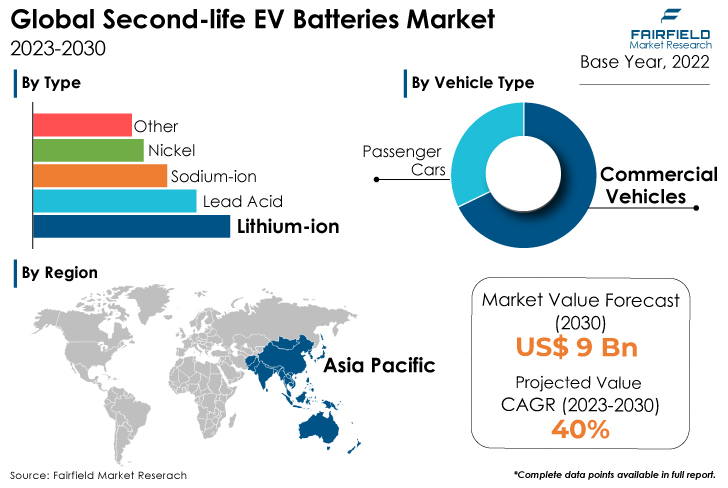
- By battery type, the demand for lithium-ion remains higher in the second-life electric vehicle batteries market.
- In terms of application, the EV charging category held the largest market revenue share in 2022.
- By the type of vehicle, the commercial vehicles segment held the major chunk of second-life electric vehicle batteries market revenue share in 2022.
- The
- Asia Pacific will continue to lead, whereas the North American second-life electric vehicle batteries market will experience the strongest growth until 2030.
Growth Drivers
Swelling EV Market
Over the past decade, the electric car industry has seen significant changes. Electric car sales have significantly increased and are anticipated to continue during the projection period. This is projected to increase the use of EV batteries. However, disposing of these batteries presents several environmental difficulties. As a result, batteries are now being recycled and reused after competition of their life cycle. The global market for second-life EV batteries is thus anticipated to grow throughout due to the increasing demand for electric vehicles during the forecast.
Recycled EV batteries from major EV manufacturers are used in various energy storage systems across industries, from modest residential buildings to massive commercial ones. For instance, in 2020, waste management business Société Nouvelle d'Affinage des Métaux (SNAM), and Honda Europe partnered strategically, wherein SNAM was to evaluate the usability of Honda EV battery packs in a second life. The development of second-life applications for high-voltage batteries has also been committed to by well-known automakers as part of the effort to establish a closed-loop system that guarantees all the components of cars are recycled.
More Emphasis on Using Green Energy
Batteries that have a second life can cut down on waste while also slowing the ongoing depletion of cobalt, lithium, and nickel minerals. Lithium extraction is an environmentally harmful procedure since it uses a lot of water. Without resorting to the unsustainable over-mining of battery materials, it is possible to employ more used batteries to satisfy the expanding need for energy storage. The best scenario for reusing EV batteries is when they are when their usage is terminated, and they still hold 70% to 80% of their capacity.
Applications that do not demand more usage, such as stationary storage, can use the remaining capacity. Reusing EV batteries for secondary uses could help to reduce CO2 emissions by 56% compared to natural gas, particularly during peak demand. Because of growing concerns about the state of the ozone layer and the depletion of minerals, the usage of batteries from electric cars in storage solutions has expanded.
Growth Challenges
Limited Stationary Applicability
The most common usage for used EV batteries is in stationary applications. This assumption is supported by the fact that mobile apps have extremely high demands for range, energy density, and power capacity during fast charging. During the vehicle's service life, as capacity declines and internal resistance increases, the battery will eventually reach a point where it cannot perform its function in a mobile application. When only considering these factors, stationary applications are determined to be the best uses for used vehicle batteries.
Overview of Key Segments
Lithium-ion Batteries Surge Ahead
The lithium-ion category will dominate the second-life electric vehicle batteries market over the forecast period. A car with a lithium-ion battery has the benefit of having more storage space for a lot of power and is not heavy, making it easier for the car to travel with less energy. Electric car sales have generally surpassed predictions and have steadily increased since 2020.
Europe has also revealed an additional 200 GWh of estimated capacity for electric vehicles and lithium-ion batteries for 2020 which was predicted to increase to 600 GWh in 2021. The demand for electric vehicles has increased significantly in recent years. As a result, various EV producers, including Tesla, Volkswagen, GM, SK Innovation, and LG Chem, are now competing with one another.
Commercial Vehicle Segment Accounts for the Maximum Share
Over the forecast period, the commercial vehicle category will dominate the second-life electric vehicle batteries market. The sharp increase in demand for electric vehicles to reduce vehicle emigration, tight government laws and regulations governing vehicle emigration, and rising consumer awareness of the function of electric vehicles in reducing emigration are all major factors in this market's exponential rapid rise.
Reducing the increase in demand for electric vehicles queue emigration by government rules and regulations and growing consumer awareness of the role of electric vehicles in decreasing emigration are all major contributors to the segment's explosive growth. Thus, demand for electric commercial cars will increase because of the favourable government initiatives, falling prices of energy, and growing prices for fossil fuels.
Growth Opportunities Across Regions
Asia Pacific Secures the Top Spot
The market second-life electric vehicle batteries market will continue to demonstrate the most significant performance in Asia Pacific. China remains in the lead with the strongest demand generation for used EV batteries in the Asia Pacific region. Furthermore, the demand for second-life EV batteries is high in Asia Pacific, according to a market research analysis on the subject, primarily because of the region's rapid expansion of the electric vehicle market.
The expansion of the second-life EV battery industry is due to the actions of the fast developing Asian countries like China, and India to achieve the COP26 goals of increasing the usage of renewable energy and reducing carbon emissions. There are currently insufficient regulations regarding management of the end-of-life batteries in several developing countries.
The practicality of utilising the used EV batteries must be subject to the legislation that these countries have designed. The market for second-life EV batteries here may thus witness encouraging initiatives for OEMs, as well as start-ups to investigate and manufacture used EV batteries.
North America Set for Fastest Growth
The market for second-life electric vehicle batteries across North America will display a significant CAGR over the forecast period, due to the increase in environmental protection emphasis in these areas as well as the surge in demand for energy storage systems in various sectors. The United States dominates most of the market in North America, while Canada is predicted to have a moderate rise in demand for used EV batteries during the projection period.
Second-life Electric Vehicle Batteries Market: Competitive Landscape
Some of the leading players at the forefront in the second-life electric vehicle batteries market space include Enel X S.R.L, Nissan Motors Corporation, Fortum, Renault Group, BeePlanet Factory, Mercedes-Benz Group AG, RWE, Mitsubishi Motors Corporation, Hyundai Motor Company, BELECTRIC, BYD Co. Ltd., BMW, Beijing Electric Vehicle, Proterra, Inc., Rivian Automotive, Inc., and Morris Garages (MG).
Recent Notable Developments
In March 2022, Mitsubishi, Bosch, and Blue Park joined forces to employ batteries for electric vehicles. According to the deal, Blue Park will contribute to the battery swap platform, which will be a crucial part of the partnership. Bosch will make its cloud-based battery technology available, and Mitsubishi will help it become a viable business. This step, according to Bosch and Mitsubishi Corporation, will hasten the deployment of batteries and the electrification of commercial vehicles.
In August 2021, the new model Volrguard was introduced by Yadea Group (China). An ATL lithium battery pack (72V27Ah*2), with ultra-high density and increased power output simultaneously, powers the scooter.
In June 2021, Fortum (a company testing battery recycling technologies) extended its operations in Finland by investing 24 million euros into the recycling facility to increase its ability to recycle batteries. The industry is primarily driven by installing smart grids and the growing use of electric vehicles.
In June 2018, the carmaker Hyundai Motor Group, and the Finnish energy solution supplier Wärtsilä signed a contract to establish a business connection for the use of old electric vehicle batteries in storage systems.
Volvo is creating EV batteries with BatteryLoop that can be used again in solar energy storage systems to power charging stations for cars and bicycles. As a result, the market for second-life batteries is predicted to increase in energy storage systems due to the rising popularity over the course of the forecast period.
The Global Second-life Electric Vehicle Batteries Market is Segmented as Below:
By Type
- Lithium-ion
- Lead Acid
- Sodium-ion
- Nickel
- Other
By Application
- Electric Vehicle Charging
- Commercial and Industrial Energy Storage
- Grid Charging
- Residential Energy Storage
- Off-grid
- Other
By Vehicle Type
- Passenger Cars
- Commercial Vehicles
By Battery Capacity
- 100–200 kWh
- 200–300 kWh
- >300 kWh
By Geographic Coverage
- North America
- U.S.
- Canada
- Europe
- Germany
- U.K.
- France
- Italy
- Turkey
- Russia
- Rest of Europe
- Asia Pacific
- China
- Japan
- South Korea
- India
- Southeast Asia
- Rest of Asia Pacific
- Latin America
- Brazil
- Mexico
- Argentina
- Rest of Latin America
- Middle East & Africa
- GCC
- South Africa
- Egypt
- Nigeria
- Rest of Middle East & Africa
Leading Companies
- Enel X S.R.L.
- Fortum
- Nissan Motors Corporation
- Renault Group
- Mercedes-Benz Group AG
- BeePlanet Factory
- RWE
- Hyundai Motor Company
- Mitsubishi Motors Corporation
- BELECTRIC
- BMW
- BYD Co. Ltd.
- Beijing Electric Vehicle
- Rivian Automotive, Inc.
- Proterra, Inc.
- Morris Garages (MG)
- Executive Summary
- Global Second-Life EV Batteries Market Snapshot
- Future Projections
- Key Market Trends
- Regional Snapshot, by Value, 2026
- Analyst Recommendations
- Market Overview
- Market Definitions and Segmentations
- Market Dynamics
- Drivers
- Restraints
- Market Opportunities
- Value Chain Analysis
- COVID-19 Impact Analysis
- Porter's Fiver Forces Analysis
- Impact of Russia-Ukraine Conflict
- PESTLE Analysis
- Regulatory Analysis
- Price Trend Analysis
- Current Prices and Future Projections, 2025-2033
- Price Impact Factors
- Global Second-Life EV Batteries Market Outlook, 2020 - 2033
- Global Second-Life EV Batteries Market Outlook, by Type, Value (US$ Bn), 2020-2033
- Lithium-ion
- Lead Acid
- Sodium-ion
- Nickel
- Other
- Global Second-Life EV Batteries Market Outlook, by Application, Value (US$ Bn), 2020-2033
- Electric Vehicle Charging
- Commercial and Industrial Energy Storage
- Grid Charging
- Residential Energy Storage
- Off-grid
- Other
- Global Second-Life EV Batteries Market Outlook, by Vehicle Type, Value (US$ Bn), 2020-2033
- Passenger Cars
- Commercial Vehicles
- Global Second-Life EV Batteries Market Outlook, by Battery Capacity, Value (US$ Bn), 2020-2033
- 100–200 kWh
- 200–300 kWh
- >300 kWh
- Global Second-Life EV Batteries Market Outlook, by Region, Value (US$ Bn), 2020-2033
- North America
- Europe
- Asia Pacific
- Latin America
- Middle East & Africa
- Global Second-Life EV Batteries Market Outlook, by Type, Value (US$ Bn), 2020-2033
- North America Second-Life EV Batteries Market Outlook, 2020 - 2033
- North America Second-Life EV Batteries Market Outlook, by Type, Value (US$ Bn), 2020-2033
- Lithium-ion
- Lead Acid
- Sodium-ion
- Nickel
- Other
- North America Second-Life EV Batteries Market Outlook, by Application, Value (US$ Bn), 2020-2033
- Electric Vehicle Charging
- Commercial and Industrial Energy Storage
- Grid Charging
- Residential Energy Storage
- Off-grid
- Other
- North America Second-Life EV Batteries Market Outlook, by Vehicle Type, Value (US$ Bn), 2020-2033
- Passenger Cars
- Commercial Vehicles
- North America Second-Life EV Batteries Market Outlook, by Battery Capacity, Value (US$ Bn), 2020-2033
- 100–200 kWh
- 200–300 kWh
- >300 kWh
- North America Second-Life EV Batteries Market Outlook, by Country, Value (US$ Bn), 2020-2033
- S. Second-Life EV Batteries Market Outlook, by Type, 2020-2033
- S. Second-Life EV Batteries Market Outlook, by Application, 2020-2033
- S. Second-Life EV Batteries Market Outlook, by Vehicle Type, 2020-2033
- S. Second-Life EV Batteries Market Outlook, by Battery Capacity, 2020-2033
- Canada Second-Life EV Batteries Market Outlook, by Type, 2020-2033
- Canada Second-Life EV Batteries Market Outlook, by Application, 2020-2033
- Canada Second-Life EV Batteries Market Outlook, by Vehicle Type, 2020-2033
- Canada Second-Life EV Batteries Market Outlook, by Battery Capacity, 2020-2033
- BPS Analysis/Market Attractiveness Analysis
- North America Second-Life EV Batteries Market Outlook, by Type, Value (US$ Bn), 2020-2033
- Europe Second-Life EV Batteries Market Outlook, 2020 - 2033
- Europe Second-Life EV Batteries Market Outlook, by Type, Value (US$ Bn), 2020-2033
- Lithium-ion
- Lead Acid
- Sodium-ion
- Nickel
- Other
- Europe Second-Life EV Batteries Market Outlook, by Application, Value (US$ Bn), 2020-2033
- Electric Vehicle Charging
- Commercial and Industrial Energy Storage
- Grid Charging
- Residential Energy Storage
- Off-grid
- Other
- Europe Second-Life EV Batteries Market Outlook, by Vehicle Type, Value (US$ Bn), 2020-2033
- Passenger Cars
- Commercial Vehicles
- Europe Second-Life EV Batteries Market Outlook, by Battery Capacity, Value (US$ Bn), 2020-2033
- 100–200 kWh
- 200–300 kWh
- >300 kWh
- Europe Second-Life EV Batteries Market Outlook, by Country, Value (US$ Bn), 2020-2033
- Germany Second-Life EV Batteries Market Outlook, by Type, 2020-2033
- Germany Second-Life EV Batteries Market Outlook, by Application, 2020-2033
- Germany Second-Life EV Batteries Market Outlook, by Vehicle Type, 2020-2033
- Germany Second-Life EV Batteries Market Outlook, by Battery Capacity, 2020-2033
- Italy Second-Life EV Batteries Market Outlook, by Type, 2020-2033
- Italy Second-Life EV Batteries Market Outlook, by Application, 2020-2033
- Italy Second-Life EV Batteries Market Outlook, by Vehicle Type, 2020-2033
- Italy Second-Life EV Batteries Market Outlook, by Battery Capacity, 2020-2033
- France Second-Life EV Batteries Market Outlook, by Type, 2020-2033
- France Second-Life EV Batteries Market Outlook, by Application, 2020-2033
- France Second-Life EV Batteries Market Outlook, by Vehicle Type, 2020-2033
- France Second-Life EV Batteries Market Outlook, by Battery Capacity, 2020-2033
- K. Second-Life EV Batteries Market Outlook, by Type, 2020-2033
- K. Second-Life EV Batteries Market Outlook, by Application, 2020-2033
- K. Second-Life EV Batteries Market Outlook, by Vehicle Type, 2020-2033
- K. Second-Life EV Batteries Market Outlook, by Battery Capacity, 2020-2033
- Spain Second-Life EV Batteries Market Outlook, by Type, 2020-2033
- Spain Second-Life EV Batteries Market Outlook, by Application, 2020-2033
- Spain Second-Life EV Batteries Market Outlook, by Vehicle Type, 2020-2033
- Spain Second-Life EV Batteries Market Outlook, by Battery Capacity, 2020-2033
- Russia Second-Life EV Batteries Market Outlook, by Type, 2020-2033
- Russia Second-Life EV Batteries Market Outlook, by Application, 2020-2033
- Russia Second-Life EV Batteries Market Outlook, by Vehicle Type, 2020-2033
- Russia Second-Life EV Batteries Market Outlook, by Battery Capacity, 2020-2033
- Rest of Europe Second-Life EV Batteries Market Outlook, by Type, 2020-2033
- Rest of Europe Second-Life EV Batteries Market Outlook, by Application, 2020-2033
- Rest of Europe Second-Life EV Batteries Market Outlook, by Vehicle Type, 2020-2033
- Rest of Europe Second-Life EV Batteries Market Outlook, by Battery Capacity, 2020-2033
- BPS Analysis/Market Attractiveness Analysis
- Europe Second-Life EV Batteries Market Outlook, by Type, Value (US$ Bn), 2020-2033
- Asia Pacific Second-Life EV Batteries Market Outlook, 2020 - 2033
- Asia Pacific Second-Life EV Batteries Market Outlook, by Type, Value (US$ Bn), 2020-2033
- Lithium-ion
- Lead Acid
- Sodium-ion
- Nickel
- Other
- Asia Pacific Second-Life EV Batteries Market Outlook, by Application, Value (US$ Bn), 2020-2033
- Electric Vehicle Charging
- Commercial and Industrial Energy Storage
- Grid Charging
- Residential Energy Storage
- Off-grid
- Other
- Asia Pacific Second-Life EV Batteries Market Outlook, by Vehicle Type, Value (US$ Bn), 2020-2033
- Passenger Cars
- Commercial Vehicles
- Asia Pacific Second-Life EV Batteries Market Outlook, by Battery Capacity, Value (US$ Bn), 2020-2033
- 100–200 kWh
- 200–300 kWh
- >300 kWh
- Asia Pacific Second-Life EV Batteries Market Outlook, by Country, Value (US$ Bn), 2020-2033
- China Second-Life EV Batteries Market Outlook, by Type, 2020-2033
- China Second-Life EV Batteries Market Outlook, by Application, 2020-2033
- China Second-Life EV Batteries Market Outlook, by Vehicle Type, 2020-2033
- China Second-Life EV Batteries Market Outlook, by Battery Capacity, 2020-2033
- Japan Second-Life EV Batteries Market Outlook, by Type, 2020-2033
- Japan Second-Life EV Batteries Market Outlook, by Application, 2020-2033
- Japan Second-Life EV Batteries Market Outlook, by Vehicle Type, 2020-2033
- Japan Second-Life EV Batteries Market Outlook, by Battery Capacity, 2020-2033
- South Korea Second-Life EV Batteries Market Outlook, by Type, 2020-2033
- South Korea Second-Life EV Batteries Market Outlook, by Application, 2020-2033
- South Korea Second-Life EV Batteries Market Outlook, by Vehicle Type, 2020-2033
- South Korea Second-Life EV Batteries Market Outlook, by Battery Capacity, 2020-2033
- India Second-Life EV Batteries Market Outlook, by Type, 2020-2033
- India Second-Life EV Batteries Market Outlook, by Application, 2020-2033
- India Second-Life EV Batteries Market Outlook, by Vehicle Type, 2020-2033
- India Second-Life EV Batteries Market Outlook, by Battery Capacity, 2020-2033
- Southeast Asia Second-Life EV Batteries Market Outlook, by Type, 2020-2033
- Southeast Asia Second-Life EV Batteries Market Outlook, by Application, 2020-2033
- Southeast Asia Second-Life EV Batteries Market Outlook, by Vehicle Type, 2020-2033
- Southeast Asia Second-Life EV Batteries Market Outlook, by Battery Capacity, 2020-2033
- Rest of SAO Second-Life EV Batteries Market Outlook, by Type, 2020-2033
- Rest of SAO Second-Life EV Batteries Market Outlook, by Application, 2020-2033
- Rest of SAO Second-Life EV Batteries Market Outlook, by Vehicle Type, 2020-2033
- Rest of SAO Second-Life EV Batteries Market Outlook, by Battery Capacity, 2020-2033
- BPS Analysis/Market Attractiveness Analysis
- Asia Pacific Second-Life EV Batteries Market Outlook, by Type, Value (US$ Bn), 2020-2033
- Latin America Second-Life EV Batteries Market Outlook, 2020 - 2033
- Latin America Second-Life EV Batteries Market Outlook, by Type, Value (US$ Bn), 2020-2033
- Lithium-ion
- Lead Acid
- Sodium-ion
- Nickel
- Other
- Latin America Second-Life EV Batteries Market Outlook, by Application, Value (US$ Bn), 2020-2033
- Electric Vehicle Charging
- Commercial and Industrial Energy Storage
- Grid Charging
- Residential Energy Storage
- Off-grid
- Other
- Latin America Second-Life EV Batteries Market Outlook, by Vehicle Type, Value (US$ Bn), 2020-2033
- Passenger Cars
- Commercial Vehicles
- Latin America Second-Life EV Batteries Market Outlook, by Battery Capacity, Value (US$ Bn), 2020-2033
- 100–200 kWh
- 200–300 kWh
- >300 kWh
- Latin America Second-Life EV Batteries Market Outlook, by Country, Value (US$ Bn), 2020-2033
- Brazil Second-Life EV Batteries Market Outlook, by Type, 2020-2033
- Brazil Second-Life EV Batteries Market Outlook, by Application, 2020-2033
- Brazil Second-Life EV Batteries Market Outlook, by Vehicle Type, 2020-2033
- Brazil Second-Life EV Batteries Market Outlook, by Battery Capacity, 2020-2033
- Mexico Second-Life EV Batteries Market Outlook, by Type, 2020-2033
- Mexico Second-Life EV Batteries Market Outlook, by Application, 2020-2033
- Mexico Second-Life EV Batteries Market Outlook, by Vehicle Type, 2020-2033
- Mexico Second-Life EV Batteries Market Outlook, by Battery Capacity, 2020-2033
- Argentina Second-Life EV Batteries Market Outlook, by Type, 2020-2033
- Argentina Second-Life EV Batteries Market Outlook, by Application, 2020-2033
- Argentina Second-Life EV Batteries Market Outlook, by Vehicle Type, 2020-2033
- Argentina Second-Life EV Batteries Market Outlook, by Battery Capacity, 2020-2033
- Rest of LATAM Second-Life EV Batteries Market Outlook, by Type, 2020-2033
- Rest of LATAM Second-Life EV Batteries Market Outlook, by Application, 2020-2033
- Rest of LATAM Second-Life EV Batteries Market Outlook, by Vehicle Type, 2020-2033
- Rest of LATAM Second-Life EV Batteries Market Outlook, by Battery Capacity, 2020-2033
- BPS Analysis/Market Attractiveness Analysis
- Latin America Second-Life EV Batteries Market Outlook, by Type, Value (US$ Bn), 2020-2033
- Middle East & Africa Second-Life EV Batteries Market Outlook, 2020 - 2033
- Middle East & Africa Second-Life EV Batteries Market Outlook, by Type, Value (US$ Bn), 2020-2033
- Lithium-ion
- Lead Acid
- Sodium-ion
- Nickel
- Other
- Middle East & Africa Second-Life EV Batteries Market Outlook, by Application, Value (US$ Bn), 2020-2033
- Electric Vehicle Charging
- Commercial and Industrial Energy Storage
- Grid Charging
- Residential Energy Storage
- Off-grid
- Other
- Middle East & Africa Second-Life EV Batteries Market Outlook, by Vehicle Type, Value (US$ Bn), 2020-2033
- Passenger Cars
- Commercial Vehicles
- Middle East & Africa Second-Life EV Batteries Market Outlook, by Battery Capacity, Value (US$ Bn), 2020-2033
- 100–200 kWh
- 200–300 kWh
- >300 kWh
- Middle East & Africa Second-Life EV Batteries Market Outlook, by Country, Value (US$ Bn), 2020-2033
- GCC Second-Life EV Batteries Market Outlook, by Type, 2020-2033
- GCC Second-Life EV Batteries Market Outlook, by Application, 2020-2033
- GCC Second-Life EV Batteries Market Outlook, by Vehicle Type, 2020-2033
- GCC Second-Life EV Batteries Market Outlook, by Battery Capacity, 2020-2033
- South Africa Second-Life EV Batteries Market Outlook, by Type, 2020-2033
- South Africa Second-Life EV Batteries Market Outlook, by Application, 2020-2033
- South Africa Second-Life EV Batteries Market Outlook, by Vehicle Type, 2020-2033
- South Africa Second-Life EV Batteries Market Outlook, by Battery Capacity, 2020-2033
- Egypt Second-Life EV Batteries Market Outlook, by Type, 2020-2033
- Egypt Second-Life EV Batteries Market Outlook, by Application, 2020-2033
- Egypt Second-Life EV Batteries Market Outlook, by Vehicle Type, 2020-2033
- Egypt Second-Life EV Batteries Market Outlook, by Battery Capacity, 2020-2033
- Nigeria Second-Life EV Batteries Market Outlook, by Type, 2020-2033
- Nigeria Second-Life EV Batteries Market Outlook, by Application, 2020-2033
- Nigeria Second-Life EV Batteries Market Outlook, by Vehicle Type, 2020-2033
- Nigeria Second-Life EV Batteries Market Outlook, by Battery Capacity, 2020-2033
- Rest of Middle East Second-Life EV Batteries Market Outlook, by Type, 2020-2033
- Rest of Middle East Second-Life EV Batteries Market Outlook, by Application, 2020-2033
- Rest of Middle East Second-Life EV Batteries Market Outlook, by Vehicle Type, 2020-2033
- Rest of Middle East Second-Life EV Batteries Market Outlook, by Battery Capacity, 2020-2033
- BPS Analysis/Market Attractiveness Analysis
- Middle East & Africa Second-Life EV Batteries Market Outlook, by Type, Value (US$ Bn), 2020-2033
- Competitive Landscape
- Company Vs Segment Heatmap
- Company Market Share Analysis, 2025
- Competitive Dashboard
- Company Profiles
- Enel X S.R.L.
- Company Overview
- Product Portfolio
- Financial Overview
- Business Strategies and Developments
- Fortum
- Nissan Motors Corporation
- Renault Group
- Mercedes-Benz Group AG
- BeePlanet Factory
- RWE
- Hyundai Motor Company
- Mitsubishi Motors Corporation
- BELECTRIC
- Enel X S.R.L.
- Appendix
- Research Methodology
- Report Assumptions
- Acronyms and Abbreviations
|
BASE YEAR |
HISTORICAL DATA |
FORECAST PERIOD |
UNITS |
|||
 |
2025 |
 |
2019 - 2024 |
 |
2026 - 2033 |
Value: US$ Billion |
|
REPORT FEATURES |
DETAILS |
|
Type Coverage |
|
|
Application Coverage |
|
|
Vehicle Type |
|
|
Geographical Coverage |
|
|
Leading Companies |
|
|
Report Highlights |
Key Market Indicators, Macro-micro economic impact analysis, Technological Roadmap, Key Trends, Driver, Restraints, and Future Opportunities & Revenue Pockets, Porter’s 5 Forces Analysis, Historical Trend (2019-2021), Market Estimates and Forecast, Market Dynamics, Industry Trends, Competition Landscape, Category, Region, Country-wise Trends & Analysis, COVID-19 Impact Analysis (Demand and Supply Chain) |
Our Research Methodology
Considering the volatility of business today, traditional approaches to strategizing a game plan can be unfruitful if not detrimental. True ambiguity is no way to determine a forecast. A myriad of predetermined factors must be accounted for such as the degree of risk involved, the magnitude of circumstances, as well as conditions or consequences that are not known or unpredictable. To circumvent binary views that cast uncertainty, the application of market research intelligence to strategically posture, move, and enable actionable outcomes is necessary.
View Methodology
Quality Assured
Rigorous Validation Process

Confidentiality Assured
End-to-end Data Security

Custom Research Services
Tailored To Your Objectives
FAQs
The global second-life electric vehicle batteries market size is projected for around 33.40% CAGR, reaching an estimated valuation of US$47.4 Bn.
Nissan Motors Corporation, Fortum, Renault Group, Mercedes-Benz Group AG, Mitsubishi Motors Corporation, Hyundai Motor Company, BYD Co. Ltd., and BMW constitute some of the goliaths in the worldwide market for second-life EV batteries space. The report has covered these and several more, prominent players in the industry under its strategic profiling and analysis section.
Led by China, the market second-life electric vehicle batteries market will continue to demonstrate the most significant performance in Asia Pacific. On the other hand, North America is slated to exhibit a substantial CAGR .
The lithium-ion battery type will maintain its dominance in the second-life electric vehicle batteries market through the end of forecast period. This primacy will prevail because the cars with a Li-ion battery have the benefit of more storage space that caters to a lot of power and is relatively lightweight, which makes it easier for these cars to travel with less energy.
The adoption of used EV batteries that have a second life very much resonates the global initiatives around green energy because these batteries can be practically employed to satisfy the expanding energy storage demands. Even when their usage is terminated, and they still hold 70-80% of their capacity, these batteries present us with the best use case scenario.
Related Reports
Full-System Vehicle Twins Market Size, Share, Insights, Competitive Landscape, and Forecast 2026 to 2033
The global full-system vehicle twins market will reach US$ 10.4374 Bn by 2033, growing at 15.1% CAGR, driven by demand for digital vehicle simulation
Electric Vehicle Battery Testing Equipment Market Size, Share, Insights, Competitive Landscape, and Forecast 2026 to 2033
The global electric vehicle battery testing equipment market will reach US$ 7.7904 Bn by 2033, growing at 10.8% CAGR, driven by EV adoption and battery safety
Smart Cabin Customization Market Size, Share, Insights, Competitive Landscape, and Forecast 2026 to 2033
Smart Cabin Customization Market is valued at US$6.2 billion in 2026 and projected to reach US$12.08 billion by 2033, growing at a 10.0% CAGR.
Solid Battery Modules Market Size, Share, Insights, Competitive Landscape, and Forecast 2026 to 2033
Solid Battery Modules Market is projected to grow from US$0.9800 billion in 2026 to US$5.8258 billion by 2033, expanding at a CAGR of 29.0%.
Edge Auto Chips Market Size, Share, Insights, Competitive Landscape, and Forecast 2026 to 2033
Edge Auto Chips Market is valued at US$2.10 billion in 2026 and is projected to reach US$7.52 billion by 2033, expanding at a 20.0% CAGR during the forecast period.
Zero-Click Vehicle Diagnostics Market Size, Share, Insights, Competitive Landscape, and Forecast 2026 to 2033
Zero-click vehicle diagnostics market is projected to reach US$26.3284 billion by 2033, growing at a 19.2% CAGR from US$7.7000 billion in 2026.