



Secure Flash Drive Market
Secure Flash Drive Market Size, Share, Insights, Competitive Landscape, and Forecast 2026 to 2033
Secure Flash Drive Market Size and Trend Analysis
What Is the Growth Outlook for Secure Flash Drives?
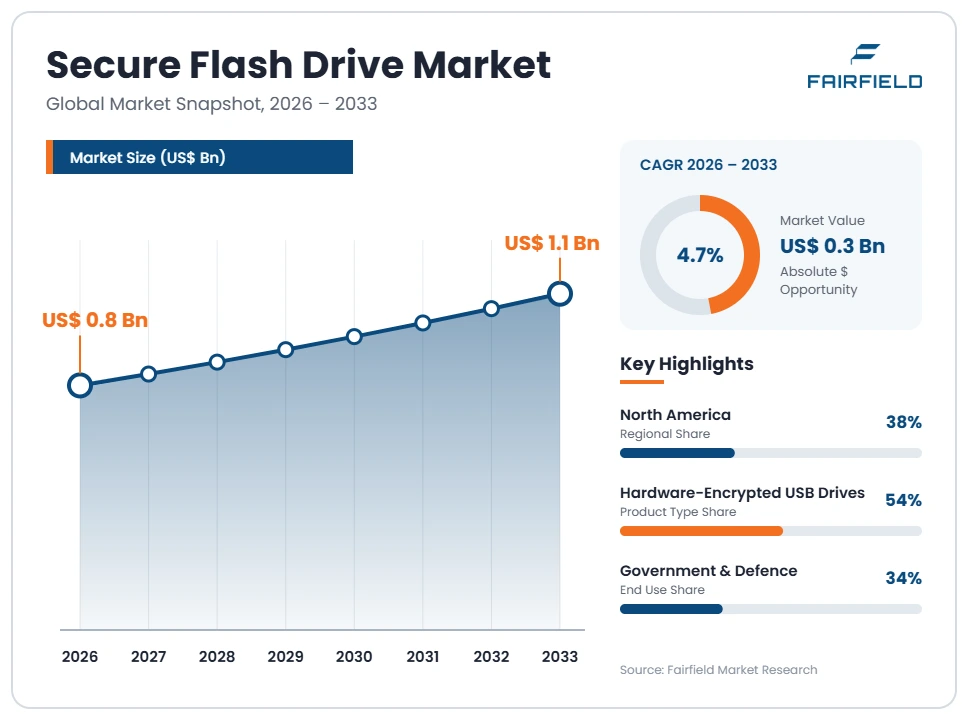
The global secure flash drive market size is expected to be valued at US$ 0.8 billion in 2026 and projected to reach US$ 1.1 billion by 2033, growing at a CAGR of 4.7% between 2026 and 2033.
Between 2020 and 2025 the market grew at roughly a 3.1% CAGR, from about US$ 0.66 billion to US$ 0.77 billion, a slow expansion that reflects two opposing forces. Demand held up in defence, government, healthcare and industrial settings where data must move between networks that are deliberately kept apart. At the same time, many corporate buyers withdrew from removable media altogether. Growth now comes from certification refresh cycles, higher capacities at higher unit prices, and managed drive deployments sold with central policy control. The direction to 2033 is modest, specialised growth rather than broad adoption, with unit volumes roughly flat and revenue carried by premium certified products.
Key Report Takeaways
- By Product Type: Hardware-encrypted USB flash drives held 54% share in 2026, while biometric authenticated drives are projected to expand at a 7.1% CAGR through 2033, driven by field users who cannot reliably enter a keypad code wearing gloves.
- By Storage Capacity: The 16 GB to 64 GB range held 39% share in 2026, while capacities above 512 GB are projected to expand at a 7.6% CAGR through 2033, driven by forensic imaging and engineering file transfer workloads.
- By Security Certification: FIPS 140-2 validated products held 47% share in 2026, while FIPS 140-3 validated products are projected to expand at a 9.2% CAGR through 2033, driven by procurement rules that require current validation status.
- By End Use: Government and defence held 34% share in 2026, while industrial and critical infrastructure buyers are projected to expand at a 6.3% CAGR through 2033, driven by patch and configuration transfers into air-gapped control systems.
- By Geography: North America held 38% share in 2026 on federal procurement volume, while Asia Pacific is projected to expand at a 5.8% CAGR through 2033 as national data protection rules take effect.
Global Secure Flash Drive Market Trends and Insights
Drivers Impact Analysis
Two forces sustain demand for encrypted portable storage despite falling general-purpose usage.
| Driver | Impact on CAGR Forecast | Geographic Relevance | Impact Timeline |
| Transition from FIPS 140-2 to FIPS 140-3 validation in public procurement | High | North America, Europe | Medium term (2–4 years) |
| Air-gapped operational technology networks requiring physical data transfer | Medium | Global | Long term (≥4 years) |
FIPS 140-3 Transition Forces a Certified Hardware Refresh Across Public Sector Buyers
The move to a newer cryptographic validation standard compels replacement of installed drives rather than new use cases. Public sector contracts routinely require a validated cryptographic module, and purchasing rules reference current validation status rather than the device’s physical condition. As older certificates age out, agencies must repurchase hardware that still works, which produces a replacement cycle independent of storage demand. Vendors able to ship newly validated modules capture that refresh.
The mechanism is administrative. Validation is granted to a specific cryptographic module under the Cryptographic Module Validation Program operated by NIST, and certificates carry a defined lifespan. Suppliers must requalify silicon and firmware, which takes time and limits how many products carry current certificates. Defence and civilian agencies, alongside Common Criteria buyers in Europe, therefore concentrate orders on the narrow set of drives holding valid certification.
Air-Gapped Control Networks Keep Encrypted Portable Storage Essential in Utilities and Defence
Isolated networks still need a physical way to move files, and that keeps hardware-encrypted drives in service where cloud transfer is impossible. Electricity grids, water utilities, oil and gas facilities, rail signalling and defence platforms run control systems deliberately disconnected from corporate networks. Patches, configuration files, firmware images and log exports must cross that boundary on removable media, under written procedure.
The causal factor is architecture rather than preference. Operational technology environments often run long-lived industrial controllers that cannot be patched over a network connection without breaking isolation requirements. Security guidance for these environments permits removable media only where the device enforces encryption, authenticates the user and can be centrally recorded. That specification excludes commodity drives entirely. Similar reasoning applies to classified defence workflows and to law enforcement evidence handling, where chain of custody demands a controlled physical device.
Restraints Impact Analysis
Two structural constraints cap the size of the addressable market for encrypted portable drives.
| Restraint | Impact on CAGR Forecast | Geographic Relevance | Impact Timeline |
| Enterprise removable-media bans and cloud collaboration displacing portable drives | High | Global | Long term (≥4 years) |
| Certification and secure element cost holding unit prices far above commodity drives | Medium | North America, Europe | Medium term (2–4 years) |
Removable Media Bans and Cloud Collaboration Shrink the Corporate Addressable Base
The most important constraint is that many organisations have stopped permitting portable storage at all. Endpoint management tools can block USB mass storage by policy, and security teams increasingly do so by default. Files move instead through managed cloud workspaces, secure file transfer services and virtual desktops, all of which log access centrally. Every enterprise that adopts a full block removes itself permanently from the buyer pool, which caps volume growth regardless of product quality.
The driver behind this is risk accounting rather than price. Removable drives have been implicated in malware introduction and data loss incidents, and data loss prevention suites make blocking simpler than governing. Regulatory expectations reinforce the choice, since auditors favour controls that generate central logs. The practical result is that general corporate demand is in long-term decline, leaving defence, government, healthcare, law enforcement and industrial users as the durable base.
Certification Expense and Secure Element Cost Keep Unit Prices Far Above Commodity Drives
Price sensitivity restricts adoption because a validated drive can cost several times an equivalent unencrypted model. Buyers outside regulated sectors struggle to justify that gap when a standard drive stores the same data. The premium suppresses volume in education, small business and general commercial use, and it pushes some buyers toward software encryption on ordinary hardware, which is weaker but effectively free.
The cost is specific and structural. It comes from the onboard cryptographic processor, tamper-evident or epoxy-potted enclosures, secure firmware development, and the laboratory testing and documentation required for FIPS 140-3 validation or Common Criteria evaluation. Those engineering and testing costs are amortised over small production runs, since certified drives ship in thousands rather than millions. Procurement rules such as Trade Agreements Act compliance further narrow eligible manufacturing locations, adding cost that commodity suppliers never incur.
Market Opportunities
Defence Supply Chain Compliance Spending Opens a Small-Supplier Revenue Pool
Compliance obligations flowing down to defence subcontractors create a new buyer group far larger than the prime contractors themselves. Thousands of small engineering, machining and electronics suppliers handle controlled unclassified information and must demonstrate protective controls during assessment. Many lack mature network security, so a certified encrypted drive is a practical, auditable way to protect data that must leave a facility. That converts compliance budget into hardware purchases.
Vendors with channel reach into defence distribution are positioned to capture this pool, since these buyers purchase through resellers rather than direct enterprise agreements. Demand concentrates in the United States defence industrial base, with parallel requirements emerging among European suppliers. The Cybersecurity Maturity Model Certification programme gives the requirement a defined assessment calendar, which turns a diffuse obligation into dated purchasing decisions.
Centrally Managed Drive Fleets With Remote Wipe Add Recurring Licence Revenue
Management software attached to certified hardware opens a recurring revenue line in a market otherwise limited to one-time device sales. Administrators enrol each drive in a console that enforces password policy, restricts use to approved machines, records file activity and remotely disables or wipes a lost unit. Organisations pay an annual licence per device, which raises lifetime revenue well above the hardware price.
Vendors already selling into regulated accounts can capture this most easily, because the buyer is the same security team. Demand comes from hospital networks handling electronic protected health information, from financial institutions and from government departments that must evidence control over every issued device. Obligations under the General Data Protection Regulation, the HIPAA security rule and the NIS2 Directive all reward documented proof that lost media can be rendered unreadable.
Segment Analysis
- By Product Type: Encrypted USB Drives Hold the Base While Biometric Models Accelerate
Hardware-encrypted USB flash drives led with 54% of revenue in 2026, because they are the established, lowest-cost certified format and the one most frequently named in procurement specifications. Their onboard cryptographic processor keeps keys off the host machine, which satisfies auditors without requiring software on the endpoint. Biometric authenticated drives are the fastest-growing type at a 7.1% CAGR to 2033, as fingerprint sensors became cheap enough to add without doubling the unit price. They suit field users in defence, policing and utilities who cannot reliably key a long PIN while wearing gloves or working in poor light. Keypad authenticated drives remain popular where the device must work on equipment with no operating system support, and hardware-encrypted portable solid state drives serve forensic and imaging workloads. The commercial effect is a slow shift of mix toward higher-priced authentication hardware.
- By Storage Capacity: Mid-Range Drives Dominate Shipments as High-Capacity Models Grow Fastest
The 16 GB to 64 GB range held 39% of revenue in 2026, because most regulated file transfers involve documents, configuration files and small datasets rather than bulk media. Buyers purchase these capacities in volume for general staff issue, keeping per-unit cost manageable across a department. Capacities above 512 GB are expanding fastest at a 7.6% CAGR through 2033, driven by digital forensic imaging, engineering design files, high-resolution body-worn camera footage and virtual machine images that no longer fit on small drives. The 128 GB to 512 GB band remains the practical middle choice for technical staff, while drives up to 8 GB are fading outside legacy equipment. The implication is rising average selling prices even where unit shipments stay flat, since high-capacity certified drives carry both a storage premium and a security premium.
- By Security Certification: FIPS 140-2 Still Leads Installed Spend While FIPS 140-3 Grows Rapidly
FIPS 140-2 validated products accounted for 47% of revenue in 2026, reflecting a large installed base and procurement documents that still reference the older standard by name. FIPS 140-3 validated products are the fastest-growing category at a 9.2% CAGR to 2033, because validation status is checked at purchase and agencies cannot buy modules whose certificates have lapsed. Common Criteria evaluated drives serve European and allied government buyers who require an evaluation assurance level rather than a cryptographic module certificate. Non-certified hardware-encrypted drives hold a meaningful commercial share where policy requires encryption but not formal validation. The business implication is sharp: suppliers without a current certificate are excluded from the highest-value contracts entirely, so validation throughput at accredited laboratories directly shapes competitive position in this market.
- By End Use: Government and Defence Lead Spending as Industrial Operators Grow Quickest
Government and defence buyers generated 34% of secure flash drive revenue in 2026, the largest single block, because classified and controlled unclassified workflows mandate validated encryption and because these buyers purchase in departmental volumes. Industrial and critical infrastructure operators are the fastest-growing end use at a 6.3% CAGR through 2033, as utilities, pipeline operators and manufacturers formalise how patches and configuration files enter air-gapped control networks. Healthcare and life sciences buyers follow obligations covering electronic protected health information, while banking and financial services deploy drives for disaster recovery keys and offline record handling. Legal and professional services form a smaller but steady base. The direction of travel is that general corporate demand continues to fall away, leaving buyers whose use of removable media is operationally unavoidable rather than merely convenient.
Geography Analysis
- Which Region Is Leading the Secure Flash Drive Market?
North America leads the secure flash drive market with 38% revenue share in 2026 and a 4.0% CAGR to 2033. Leadership comes from the scale of federal, state and defence procurement, which specifies validated cryptographic modules as a condition of purchase. The United States supplies most demand, with Canada adding government and energy sector volume. The Cryptographic Module Validation Program operated by NIST anchors product eligibility, the HIPAA security rule sustains healthcare demand, and Trade Agreements Act rules restrict which manufacturing origins qualify for federal contracts. Defence supply chain assessment requirements extend buying beyond prime contractors to thousands of smaller suppliers. The main restraint is the steady spread of removable media bans in private enterprises, which removes commercial volume even as public sector purchasing stays firm.
- Europe Anchors Demand in Data Protection and Critical Entity Obligations
Europe held 29% of global revenue in 2026, with a 4.6% CAGR forecast to 2033. Germany, the United Kingdom, France and the Netherlands account for most purchasing, supported by defence ministries, health services, police forces and energy operators. The General Data Protection Regulation treats encryption as a recognised safeguard, which materially reduces breach notification exposure when a device is lost, and that calculation drives procurement in public administration. The NIS2 Directive, formally Directive (EU) 2022/2555, extends security obligations across energy, transport, water and digital infrastructure operators, widening the set of organisations that must document control over portable media. Common Criteria evaluation carries more weight here than in other regions. Public sector buyers also favour suppliers with manufacturing and firmware development inside the region.
- Which Region Is Growing Fastest in the Secure Flash Drive Market?
Asia Pacific is growing fastest at a 5.8% CAGR through 2033, from a 22% revenue share in 2026. Growth is led by Japan, South Korea, Australia, India and Singapore, where national data protection laws have taken effect and government cybersecurity programmes now specify encrypted storage for sensitive records. Defence modernisation budgets across the region add demand for validated drives in classified workflows, and several governments prefer domestically assembled or independently evaluated hardware. The region is also the manufacturing base for flash memory and controller components, which gives local suppliers a cost position in non-certified encrypted drives. The constraint is price sensitivity among commercial buyers, who often accept software encryption instead. The defining change is procurement policy maturing from general guidance into specific, auditable device requirements.
- Latin America Builds Demand Around Public Administration and Banking Records
Latin America contributed 5% of revenue in 2026 and is forecast to grow at a 3.8% CAGR to 2033, the slowest of the five regions. Brazil and Mexico account for most purchasing, with Chile, Colombia and Argentina adding government and banking demand. The Brazilian general data protection law has raised awareness of encryption obligations among public bodies and financial institutions, and electoral, judicial and policing agencies are consistent buyers. Barriers are substantial: import duties and currency movements make certified drives expensive relative to local salaries, few suppliers maintain regional support, and procurement rules rarely name specific validation standards. Low-cost commodity drives remain widespread in general office use. The clearest opportunity sits in central banking, judicial records and federal policing, where document control requirements already justify validated hardware.
- Middle East & Africa Concentrates Purchasing in Government and Energy Infrastructure
Middle East & Africa represented 6% of global revenue in 2026, expanding at a 5.2% CAGR through 2033. Saudi Arabia, the United Arab Emirates, Qatar and Israel dominate demand, driven by national cybersecurity authorities that issue binding controls for government entities and critical sectors. Oil and gas operators are important buyers because their control systems are isolated and vendor engineers must bring files on site. South Africa, Egypt and Nigeria form the main African markets, led by banking and defence. Barriers include limited local technical support, uneven enforcement outside the Gulf states and reliance on imported hardware with long lead times. The clearest opportunity lies in smart city and national digital identity programmes, where government units handling citizen records increasingly specify validated encryption for any data that leaves a secure facility.
Competitive Landscape
The secure flash drive market is moderately concentrated and unusually specialised. A handful of vendors with current cryptographic validations hold most of the high-value public sector revenue, while large general memory brands participate mainly at the lower-assurance end. Certification acts as the real barrier to entry: a competitor cannot simply assemble an encrypted drive and bid, because validated modules require laboratory testing, documented firmware and sustained engineering support. That barrier keeps the vendor set small and surprisingly stable. Consolidation is limited, since the specialist firms are small and their value sits in certificates and government relationships rather than in manufacturing scale.
Competition rests on a short list of factors. Current validation status decides eligibility for most government tenders. Central management capability, including remote wipe and device enrolment, increasingly separates enterprise-grade products from simple encrypted sticks. Manufacturing origin matters where procurement rules restrict supply country. Durability ratings, read and write performance and warranty terms settle the remainder. New approaches come from vendors adding biometric authentication, from firms licensing encryption platforms to hardware assemblers, and from software vendors arguing that managed cloud transfer removes the need for the device entirely.
Strategic activity centres on recertification, capacity expansion within existing product lines and the attachment of management software to hardware sales. Vendors are also deepening distribution into the defence supplier base, where compliance assessments generate many small orders rather than a few large ones.
Strategic direction across the sector is defensive and focused. Suppliers are consolidating around the sectors where removable media remains permitted, pricing on assurance rather than capacity, and treating validation throughput as the key operational constraint.
Recent Industry Developments
- May 2018: The General Data Protection Regulation became applicable across the European Union, establishing encryption as a recognised safeguard that can reduce breach notification obligations when portable media is lost.
- September 2020: The Cryptographic Module Validation Program operated by NIST began accepting submissions against FIPS 140-3, starting the transition away from the previous validation standard for encrypted storage devices.
- September 2021: The same programme stopped accepting new FIPS 140-2 submissions, making FIPS 140-3 the forward path for any supplier seeking federal eligibility.
- October 2024: The transposition deadline for the NIS2 Directive, Directive (EU) 2022/2555, fell due, extending documented security obligations across energy, transport, water, health and digital infrastructure operators.
- October 2024: The Cybersecurity Maturity Model Certification programme rule was published by the United States Department of Defense, taking effect in December 2024 and setting assessment requirements across the defence supply chain.
Companies Covered in the Report
- Kingston Technology Company, Inc.
- Apricorn, Inc.
- DataLocker Inc.
- iStorage Limited
- Kanguru Solutions
- Integral Memory plc
- Verbatim Americas LLC
- SanDisk Corporation
- Lexar Co., Limited
- Transcend Information, Inc.
- ClevX, LLC
- EDGE Memory, LLC
- Axiom Memory Solutions, LLC
- Buffalo Inc.
Secure Flash Drive Market Report Scope
| Metric | Value |
| Study Period | 2020–2033 |
| Market Size 2026 | US$ 0.8 Billion |
| Market Size 2033 | US$ 1.1 Billion |
| CAGR 2026–2033 | 4.7% |
| Absolute Dollar Opportunity | US$ 0.3 Billion |
| Largest Market | North America (38% share in 2026) |
| Fastest-Growing Market | Asia Pacific (5.8% CAGR) |
| Market Concentration | Medium |
| Major Players | Kingston Technology, Apricorn, DataLocker, iStorage, Kanguru Solutions |
Secure Flash Drive Market Segmentation
Product Type
- Hardware-Encrypted USB Flash Drives
- Keypad Authenticated Drives
- Biometric Authenticated Drives
- Hardware-Encrypted Portable Solid State Drives
Storage Capacity
- Up to 8 GB
- 16 GB to 64 GB
- 128 GB to 512 GB
- Above 512 GB
Security Certification
- FIPS 140-2 Validated
- FIPS 140-3 Validated
- Common Criteria Evaluated
- Non-Certified Hardware Encryption
End Use
- Government and Defence
- Healthcare and Life Sciences
- Banking and Financial Services
- Industrial and Critical Infrastructure
- Legal and Professional Services
Regions
- North America
- Europe
- Asia Pacific
- Latin America
- Middle East & Africa
- Executive Summary
- Global Secure Flash Drive Market Snapshot
- Market Size and Trend Analysis 2020–2033
- Historical Growth 2020–2025
- Base Year 2025
- Forecast Outlook 2026–2033
- Key Report Takeaways
- Market Overview
- Market Definition and Report Scope
- Market Dynamics
- Drivers
- FIPS 140-3 Transition Forces a Certified Hardware Refresh Across Public Sector Buyers
- Air-Gapped Control Networks Keep Encrypted Portable Storage Essential in Utilities and Defence
- Restraints
- Removable Media Bans and Cloud Collaboration Shrink the Corporate Addressable Base
- Certification Expense and Secure Element Cost Keep Unit Prices Far Above Commodity Drives
- Market Opportunities
- Defence Supply Chain Compliance Spending Opens a Small-Supplier Revenue Pool
- Centrally Managed Drive Fleets With Remote Wipe Add Recurring Licence Revenue
- Drivers
- Segment Analysis
- By Product Type: Encrypted USB Drives Hold the Base While Biometric Models Accelerate
- By Storage Capacity: Mid-Range Drives Dominate Shipments as High-Capacity Models Grow Fastest
- By Security Certification: FIPS 140-2 Still Leads Installed Spend While FIPS 140-3 Grows Rapidly
- By End Use: Government and Defence Lead Spending as Industrial Operators Grow Quickest
- Global Secure Flash Drive Market Outlook, 2020–2033
- Global Secure Flash Drive Market Outlook, by Product Type, Value (US$ Billion), 2020–2033
- Hardware-Encrypted USB Flash Drives
- Keypad Authenticated Drives
- Biometric Authenticated Drives
- Hardware-Encrypted Portable Solid State Drives
- Global Secure Flash Drive Market Outlook, by Storage Capacity, Value (US$ Billion), 2020–2033
- Up to 8 GB
- 16 GB to 64 GB
- 128 GB to 512 GB
- Above 512 GB
- Global Secure Flash Drive Market Outlook, by Security Certification, Value (US$ Billion), 2020–2033
- FIPS 140-2 Validated
- FIPS 140-3 Validated
- Common Criteria Evaluated
- Non-Certified Hardware Encryption
- Global Secure Flash Drive Market Outlook, by End Use, Value (US$ Billion), 2020–2033
- Government and Defence
- Healthcare and Life Sciences
- Banking and Financial Services
- Industrial and Critical Infrastructure
- Legal and Professional Services
- Global Secure Flash Drive Market Outlook, by Region, Value (US$ Billion), 2020–2033
- North America
- Europe
- Asia Pacific
- Latin America
- Middle East & Africa
- Global Secure Flash Drive Market Outlook, by Product Type, Value (US$ Billion), 2020–2033
- North America Secure Flash Drive Market Outlook, 2020–2033
- Regional Market Leadership
- North America Secure Flash Drive Market Outlook, by Product Type, Value (US$ Billion), 2020–2033
- Hardware-Encrypted USB Flash Drives
- Keypad Authenticated Drives
- Biometric Authenticated Drives
- Hardware-Encrypted Portable Solid State Drives
- North America Secure Flash Drive Market Outlook, by Storage Capacity, Value (US$ Billion), 2020–2033
- Up to 8 GB
- 16 GB to 64 GB
- 128 GB to 512 GB
- Above 512 GB
- North America Secure Flash Drive Market Outlook, by Security Certification, Value (US$ Billion), 2020–2033
- FIPS 140-2 Validated
- FIPS 140-3 Validated
- Common Criteria Evaluated
- Non-Certified Hardware Encryption
- North America Secure Flash Drive Market Outlook, by End Use, Value (US$ Billion), 2020–2033
- Government and Defence
- Healthcare and Life Sciences
- Banking and Financial Services
- Industrial and Critical Infrastructure
- Legal and Professional Services
- North America Secure Flash Drive Market Outlook, by Country, Value (US$ Billion), 2020–2033
- United States Secure Flash Drive Market Outlook, by Product Type, 2020–2033
- United States Secure Flash Drive Market Outlook, by Storage Capacity, 2020–2033
- United States Secure Flash Drive Market Outlook, by Security Certification, 2020–2033
- United States Secure Flash Drive Market Outlook, by End Use, 2020–2033
- Canada Secure Flash Drive Market Outlook, by Product Type, 2020–2033
- Canada Secure Flash Drive Market Outlook, by Storage Capacity, 2020–2033
- Canada Secure Flash Drive Market Outlook, by Security Certification, 2020–2033
- Canada Secure Flash Drive Market Outlook, by End Use, 2020–2033
- Europe Secure Flash Drive Market Outlook, 2020–2033
- Europe Anchors Demand in Data Protection and Critical Entity Obligations
- Europe Secure Flash Drive Market Outlook, by Product Type, Value (US$ Billion), 2020–2033
- Hardware-Encrypted USB Flash Drives
- Keypad Authenticated Drives
- Biometric Authenticated Drives
- Hardware-Encrypted Portable Solid State Drives
- Europe Secure Flash Drive Market Outlook, by Storage Capacity, Value (US$ Billion), 2020–2033
- Up to 8 GB
- 16 GB to 64 GB
- 128 GB to 512 GB
- Above 512 GB
- Europe Secure Flash Drive Market Outlook, by Security Certification, Value (US$ Billion), 2020–2033
- FIPS 140-2 Validated
- FIPS 140-3 Validated
- Common Criteria Evaluated
- Non-Certified Hardware Encryption
- Europe Secure Flash Drive Market Outlook, by End Use, Value (US$ Billion), 2020–2033
- Government and Defence
- Healthcare and Life Sciences
- Banking and Financial Services
- Industrial and Critical Infrastructure
- Legal and Professional Services
- Europe Secure Flash Drive Market Outlook, by Country, Value (US$ Billion), 2020–2033
- Germany Secure Flash Drive Market Outlook, by Product Type, 2020–2033
- Germany Secure Flash Drive Market Outlook, by Storage Capacity, 2020–2033
- Germany Secure Flash Drive Market Outlook, by Security Certification, 2020–2033
- Germany Secure Flash Drive Market Outlook, by End Use, 2020–2033
- United Kingdom Secure Flash Drive Market Outlook, by Product Type, 2020–2033
- United Kingdom Secure Flash Drive Market Outlook, by Storage Capacity, 2020–2033
- United Kingdom Secure Flash Drive Market Outlook, by Security Certification, 2020–2033
- United Kingdom Secure Flash Drive Market Outlook, by End Use, 2020–2033
- France Secure Flash Drive Market Outlook, by Product Type, 2020–2033
- France Secure Flash Drive Market Outlook, by Storage Capacity, 2020–2033
- France Secure Flash Drive Market Outlook, by Security Certification, 2020–2033
- France Secure Flash Drive Market Outlook, by End Use, 2020–2033
- Netherlands Secure Flash Drive Market Outlook, by Product Type, 2020–2033
- Netherlands Secure Flash Drive Market Outlook, by Storage Capacity, 2020–2033
- Netherlands Secure Flash Drive Market Outlook, by Security Certification, 2020–2033
- Netherlands Secure Flash Drive Market Outlook, by End Use, 2020–2033
- Asia Pacific Secure Flash Drive Market Outlook, 2020–2033
- Regional Growth Outlook
- Asia Pacific Secure Flash Drive Market Outlook, by Product Type, Value (US$ Billion), 2020–2033
- Hardware-Encrypted USB Flash Drives
- Keypad Authenticated Drives
- Biometric Authenticated Drives
- Hardware-Encrypted Portable Solid State Drives
- Asia Pacific Secure Flash Drive Market Outlook, by Storage Capacity, Value (US$ Billion), 2020–2033
- Up to 8 GB
- 16 GB to 64 GB
- 128 GB to 512 GB
- Above 512 GB
- Asia Pacific Secure Flash Drive Market Outlook, by Security Certification, Value (US$ Billion), 2020–2033
- FIPS 140-2 Validated
- FIPS 140-3 Validated
- Common Criteria Evaluated
- Non-Certified Hardware Encryption
- Asia Pacific Secure Flash Drive Market Outlook, by End Use, Value (US$ Billion), 2020–2033
- Government and Defence
- Healthcare and Life Sciences
- Banking and Financial Services
- Industrial and Critical Infrastructure
- Legal and Professional Services
- Asia Pacific Secure Flash Drive Market Outlook, by Country, Value (US$ Billion), 2020–2033
- Japan Secure Flash Drive Market Outlook, by Product Type, 2020–2033
- Japan Secure Flash Drive Market Outlook, by Storage Capacity, 2020–2033
- Japan Secure Flash Drive Market Outlook, by Security Certification, 2020–2033
- Japan Secure Flash Drive Market Outlook, by End Use, 2020–2033
- South Korea Secure Flash Drive Market Outlook, by Product Type, 2020–2033
- South Korea Secure Flash Drive Market Outlook, by Storage Capacity, 2020–2033
- South Korea Secure Flash Drive Market Outlook, by Security Certification, 2020–2033
- South Korea Secure Flash Drive Market Outlook, by End Use, 2020–2033
- Australia Secure Flash Drive Market Outlook, by Product Type, 2020–2033
- Australia Secure Flash Drive Market Outlook, by Storage Capacity, 2020–2033
- Australia Secure Flash Drive Market Outlook, by Security Certification, 2020–2033
- Australia Secure Flash Drive Market Outlook, by End Use, 2020–2033
- India Secure Flash Drive Market Outlook, by Product Type, 2020–2033
- India Secure Flash Drive Market Outlook, by Storage Capacity, 2020–2033
- India Secure Flash Drive Market Outlook, by Security Certification, 2020–2033
- India Secure Flash Drive Market Outlook, by End Use, 2020–2033
- Singapore Secure Flash Drive Market Outlook, by Product Type, 2020–2033
- Singapore Secure Flash Drive Market Outlook, by Storage Capacity, 2020–2033
- Singapore Secure Flash Drive Market Outlook, by Security Certification, 2020–2033
- Singapore Secure Flash Drive Market Outlook, by End Use, 2020–2033
- Latin America Secure Flash Drive Market Outlook, 2020–2033
- Latin America Builds Demand Around Public Administration and Banking Records
- Latin America Secure Flash Drive Market Outlook, by Product Type, Value (US$ Billion), 2020–2033
- Hardware-Encrypted USB Flash Drives
- Keypad Authenticated Drives
- Biometric Authenticated Drives
- Hardware-Encrypted Portable Solid State Drives
- Latin America Secure Flash Drive Market Outlook, by Storage Capacity, Value (US$ Billion), 2020–2033
- Up to 8 GB
- 16 GB to 64 GB
- 128 GB to 512 GB
- Above 512 GB
- Latin America Secure Flash Drive Market Outlook, by Security Certification, Value (US$ Billion), 2020–2033
- FIPS 140-2 Validated
- FIPS 140-3 Validated
- Common Criteria Evaluated
- Non-Certified Hardware Encryption
- Latin America Secure Flash Drive Market Outlook, by End Use, Value (US$ Billion), 2020–2033
- Government and Defence
- Healthcare and Life Sciences
- Banking and Financial Services
- Industrial and Critical Infrastructure
- Legal and Professional Services
- Latin America Secure Flash Drive Market Outlook, by Country, Value (US$ Billion), 2020–2033
- Brazil Secure Flash Drive Market Outlook, by Product Type, 2020–2033
- Brazil Secure Flash Drive Market Outlook, by Storage Capacity, 2020–2033
- Brazil Secure Flash Drive Market Outlook, by Security Certification, 2020–2033
- Brazil Secure Flash Drive Market Outlook, by End Use, 2020–2033
- Mexico Secure Flash Drive Market Outlook, by Product Type, 2020–2033
- Mexico Secure Flash Drive Market Outlook, by Storage Capacity, 2020–2033
- Mexico Secure Flash Drive Market Outlook, by Security Certification, 2020–2033
- Mexico Secure Flash Drive Market Outlook, by End Use, 2020–2033
- Chile Secure Flash Drive Market Outlook, by Product Type, 2020–2033
- Chile Secure Flash Drive Market Outlook, by Storage Capacity, 2020–2033
- Chile Secure Flash Drive Market Outlook, by Security Certification, 2020–2033
- Chile Secure Flash Drive Market Outlook, by End Use, 2020–2033
- Colombia Secure Flash Drive Market Outlook, by Product Type, 2020–2033
- Colombia Secure Flash Drive Market Outlook, by Storage Capacity, 2020–2033
- Colombia Secure Flash Drive Market Outlook, by Security Certification, 2020–2033
- Colombia Secure Flash Drive Market Outlook, by End Use, 2020–2033
- Argentina Secure Flash Drive Market Outlook, by Product Type, 2020–2033
- Argentina Secure Flash Drive Market Outlook, by Storage Capacity, 2020–2033
- Argentina Secure Flash Drive Market Outlook, by Security Certification, 2020–2033
- Argentina Secure Flash Drive Market Outlook, by End Use, 2020–2033
- Middle East & Africa Secure Flash Drive Market Outlook, 2020–2033
- Middle East & Africa Concentrates Purchasing in Government and Energy Infrastructure
- Middle East & Africa Secure Flash Drive Market Outlook, by Product Type, Value (US$ Billion), 2020–2033
- Hardware-Encrypted USB Flash Drives
- Keypad Authenticated Drives
- Biometric Authenticated Drives
- Hardware-Encrypted Portable Solid State Drives
- Middle East & Africa Secure Flash Drive Market Outlook, by Storage Capacity, Value (US$ Billion), 2020–2033
- Up to 8 GB
- 16 GB to 64 GB
- 128 GB to 512 GB
- Above 512 GB
- Middle East & Africa Secure Flash Drive Market Outlook, by Security Certification, Value (US$ Billion), 2020–2033
- FIPS 140-2 Validated
- FIPS 140-3 Validated
- Common Criteria Evaluated
- Non-Certified Hardware Encryption
- Middle East & Africa Secure Flash Drive Market Outlook, by End Use, Value (US$ Billion), 2020–2033
- Government and Defence
- Healthcare and Life Sciences
- Banking and Financial Services
- Industrial and Critical Infrastructure
- Legal and Professional Services
- Middle East & Africa Secure Flash Drive Market Outlook, by Country, Value (US$ Billion), 2020–2033
- Saudi Arabia Secure Flash Drive Market Outlook, by Product Type, 2020–2033
- Saudi Arabia Secure Flash Drive Market Outlook, by Storage Capacity, 2020–2033
- Saudi Arabia Secure Flash Drive Market Outlook, by Security Certification, 2020–2033
- Saudi Arabia Secure Flash Drive Market Outlook, by End Use, 2020–2033
- United Arab Emirates Secure Flash Drive Market Outlook, by Product Type, 2020–2033
- United Arab Emirates Secure Flash Drive Market Outlook, by Storage Capacity, 2020–2033
- United Arab Emirates Secure Flash Drive Market Outlook, by Security Certification, 2020–2033
- United Arab Emirates Secure Flash Drive Market Outlook, by End Use, 2020–2033
- Qatar Secure Flash Drive Market Outlook, by Product Type, 2020–2033
- Qatar Secure Flash Drive Market Outlook, by Storage Capacity, 2020–2033
- Qatar Secure Flash Drive Market Outlook, by Security Certification, 2020–2033
- Qatar Secure Flash Drive Market Outlook, by End Use, 2020–2033
- Israel Secure Flash Drive Market Outlook, by Product Type, 2020–2033
- Israel Secure Flash Drive Market Outlook, by Storage Capacity, 2020–2033
- Israel Secure Flash Drive Market Outlook, by Security Certification, 2020–2033
- Israel Secure Flash Drive Market Outlook, by End Use, 2020–2033
- South Africa Secure Flash Drive Market Outlook, by Product Type, 2020–2033
- South Africa Secure Flash Drive Market Outlook, by Storage Capacity, 2020–2033
- South Africa Secure Flash Drive Market Outlook, by Security Certification, 2020–2033
- South Africa Secure Flash Drive Market Outlook, by End Use, 2020–2033
- Egypt Secure Flash Drive Market Outlook, by Product Type, 2020–2033
- Egypt Secure Flash Drive Market Outlook, by Storage Capacity, 2020–2033
- Egypt Secure Flash Drive Market Outlook, by Security Certification, 2020–2033
- Egypt Secure Flash Drive Market Outlook, by End Use, 2020–2033
- Nigeria Secure Flash Drive Market Outlook, by Product Type, 2020–2033
- Nigeria Secure Flash Drive Market Outlook, by Storage Capacity, 2020–2033
- Nigeria Secure Flash Drive Market Outlook, by Security Certification, 2020–2033
- Nigeria Secure Flash Drive Market Outlook, by End Use, 2020–2033
- Competitive Landscape
- Market Concentration and Supplier Participation
- Competitive Factors and Strategic Direction
- Recent Industry Developments
- General Data Protection Regulation Application May 2018
- FIPS 140-3 Submission Acceptance September 2020
- FIPS 140-2 New Submission Closure September 2021
- NIS2 Directive Transposition Deadline October 2024
- Cybersecurity Maturity Model Certification Rule Publication October 2024
- Company Profiles
- Kingston Technology Company, Inc.
- Apricorn, Inc.
- DataLocker Inc.
- iStorage Limited
- Kanguru Solutions
- Integral Memory plc
- Verbatim Americas LLC
- SanDisk Corporation
- Lexar Co., Limited
- Transcend Information, Inc.
- ClevX, LLC
- EDGE Memory, LLC
- Axiom Memory Solutions, LLC
- Buffalo Inc.
- Appendix
- Research Methodology
- Report Assumptions
- Acronyms and Abbreviations
Product Type
- Hardware-Encrypted USB Flash Drives
- Keypad Authenticated Drives
- Biometric Authenticated Drives
- Hardware-Encrypted Portable Solid State Drives
Storage Capacity
- Up to 8 GB
- 16 GB to 64 GB
- 128 GB to 512 GB
- Above 512 GB
Security Certification
- FIPS 140-2 Validated
- FIPS 140-3 Validated
- Common Criteria Evaluated
- Non-Certified Hardware Encryption
End Use
- Government and Defence
- Healthcare and Life Sciences
- Banking and Financial Services
- Industrial and Critical Infrastructure
- Legal and Professional Services
Regions
- North America
- Europe
- Asia Pacific
- Latin America
- Middle East & Africa
Our Research Methodology
Considering the volatility of business today, traditional approaches to strategizing a game plan can be unfruitful if not detrimental. True ambiguity is no way to determine a forecast. A myriad of predetermined factors must be accounted for such as the degree of risk involved, the magnitude of circumstances, as well as conditions or consequences that are not known or unpredictable. To circumvent binary views that cast uncertainty, the application of market research intelligence to strategically posture, move, and enable actionable outcomes is necessary.
View Methodology
Quality Assured
Rigorous Validation Process

Confidentiality Assured
End-to-end Data Security

Custom Research Services
Tailored To Your Objectives
FAQs
The secure flash drive market is valued at US$ 0.8 billion in 2026, covering hardware-encrypted portable drives and the management software licensed alongside them.
The market is projected to reach US$ 1.1 billion by 2033, growing at a 4.7% CAGR and adding US$ 0.3 billion in absolute revenue opportunity.
Hardware-encrypted USB flash drives lead with 54% of revenue in 2026, as the lowest-cost certified format most often named in procurement specifications.
Asia Pacific grows fastest at a 5.8% CAGR to 2033, as national data protection laws and defence modernisation programmes specify encrypted portable storage.
Many enterprises block removable media entirely and use cloud collaboration instead, leaving defence, government, healthcare and industrial users as the durable buyer base.
Related Reports
Optical I/O for AI Chips Market Size, Share, Insights, Competitive Landscape, and Forecast 2026 to 2033
The global optical I/O for AI chips market is valued at US$1.6 billion in 2026, reaching US$14.5 billion by 2033, growing at a 37.01% CAGR
Foldable Drones Market Size, Share, Insights, Competitive Landscape, and Forecast 2026 to 2033
The global foldable drones market is valued at US$3.76 billion in 2026 and is projected to reach US$7.57 billion by 2033, growing at a 10.5% CAGR.
BEV On-Board Charger Market Size, Share, Insights, Competitive Landscape, and Forecast 2026 to 2033
The global BEV On-Board Charger market is valued at US$ 6.8 Bn in 2026 and is projected to reach US$ 17.6 Bn by 2033, growing at a CAGR of 14.6%
Seismic Services Market Size, Share, Insights, Competitive Landscape, and Forecast 2026 to 2033
The global seismic services market is valued at US$ 10.2 billion in 2026 and is projected to reach US$ 14.9 billion by 2033, growing at a CAGR of 5.56%
Intelligent Power Module for AWHP Market Size, Share, Insights, Competitive Landscape, and Forecast 2026 to 2033
Intelligent Power Module for AWHP market is projected to grow from US$0.89 billion in 2026 to US$2.34 billion by 2033, at a CAGR of 14.8%.
LTE & 5G NR-based CBRS Networks Market Size, Share, Insights, Competitive Landscape, and Forecast 2026 to 2033
The LTE & 5G NR-based CBRS Networks market in 2026, valued at US$ 3.4 billion and projected to reach US$ 13.2 billion by 2033, growing at a 21.4% CAGR.