



Stationery Product Market
Global Stationery Product Industry Analysis, Size, Share, Growth, Trends, and Forecast 2026-2033 – (By Product Type, By End-User, By Geographic Coverage and By Company)
Stationery Product Market Size, Share, and Growth Forecast 2026 - 2033
Key Market Highlights
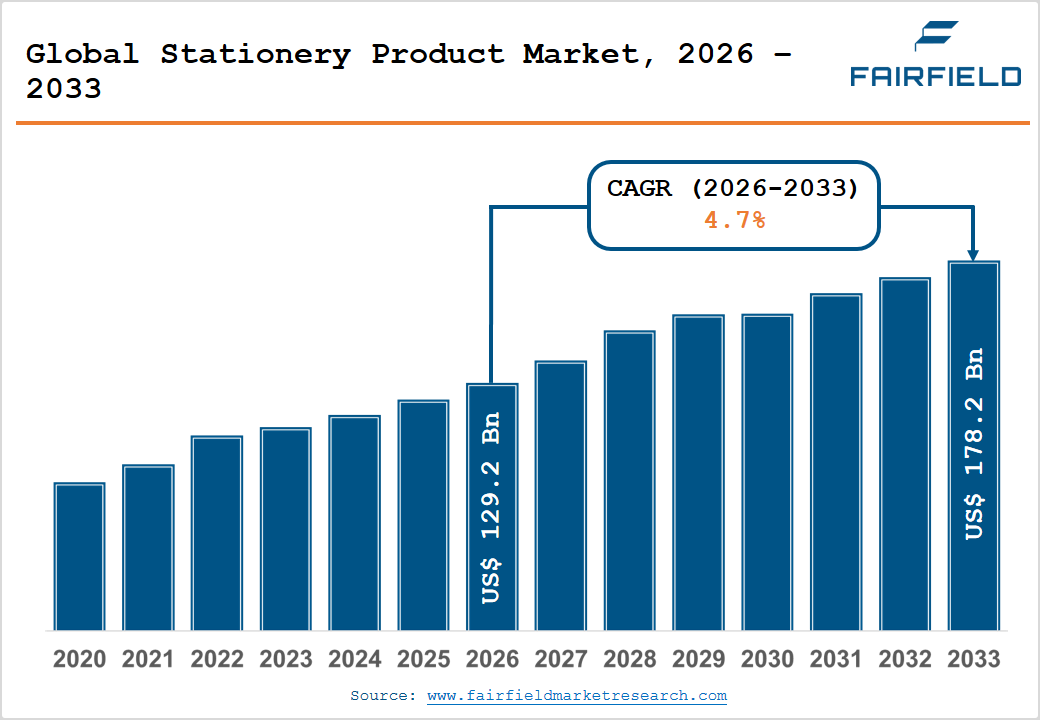
- The global Stationery Product Market size is likely to be valued at US$ 129.2 Billion in 2026 and is expected to reach US$ 178.2 Billion by 2033, growing at a CAGR of 4.70% during the forecast period from 2026 to 2033.
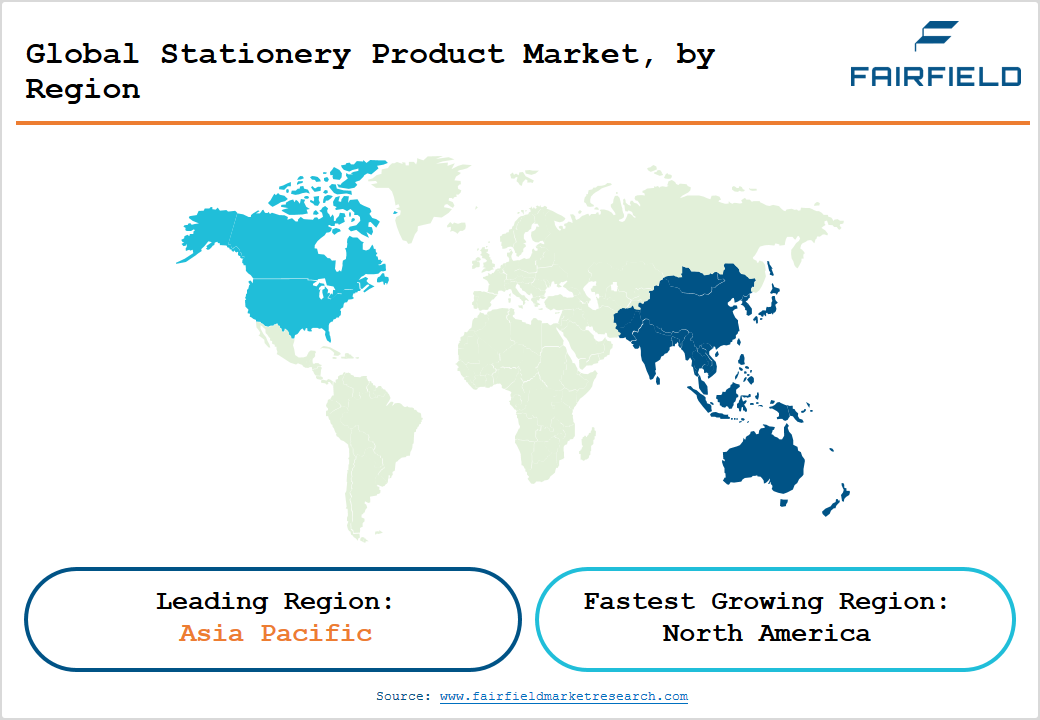
- Leading Region Market: Asia Pacific leads the global stationery product market with approximately 40% revenue share in 2026, driven by massive student populations in China and India and a robust manufacturing ecosystem.
- Fastest Growing Region Market: North America is the fastest growing region, supported by rising wellness stationery trends, back-to-school demand cycles, and expanding work-from-home office stationery consumption.
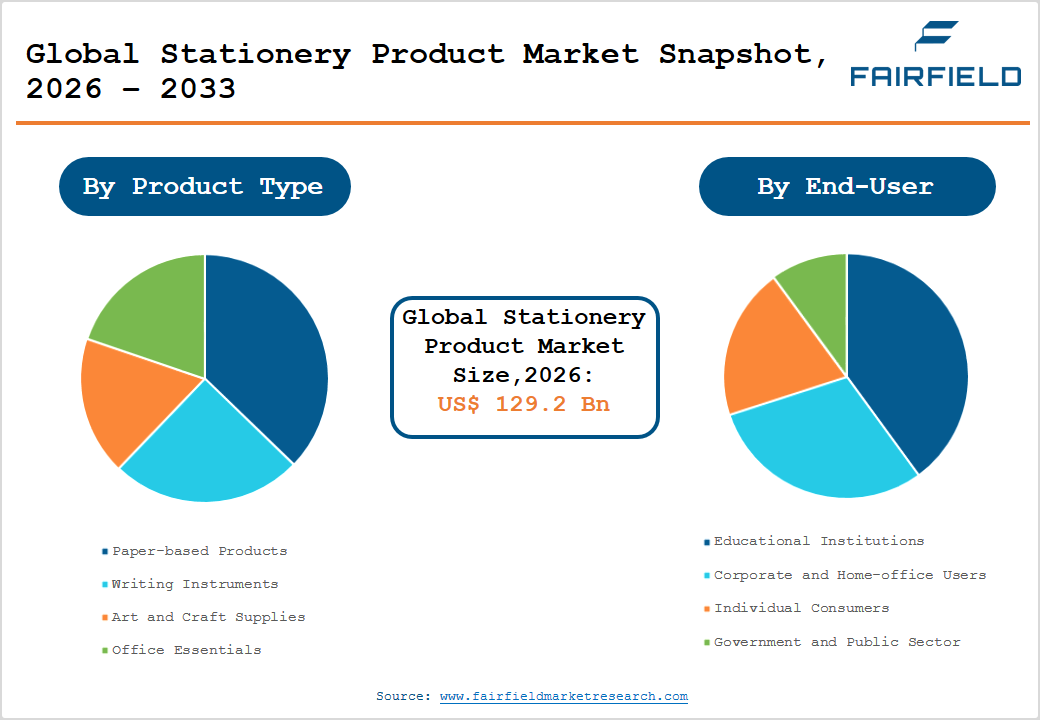
- Dominant Product Segment: Paper-based products hold the leading share 38% share in 2026, the Product Type category, driven by sustained school enrollment, institutional procurement, and growing demand for eco-certified notebooks and diaries.
- Fastest Growing Segment: Art and Craft Supplies is among the fastest growing product type segments, fueled by the bullet journaling trend, DIY crafting culture, and rising creative hobby participation across North America and Europe.
- Key Market Opportunity: Expansion into high-enrollment emerging markets particularly India, Nigeria, Brazil, and Vietnam through affordable, curriculum-aligned, and locally adapted stationery product lines offers significant untapped revenue potential.
Market Dynamics
Market Growth Drivers
- Rising Global Student Enrollment and Educational Infrastructure Expansion
Global educational enrollment has reached unprecedented levels, providing a structural backbone for stationery demand. According to UNESCO estimates that a vast number of students worldwide are enrolled in educational institutions, spanning primary, secondary, and tertiary levels. Governments in developing economies particularly in South and Southeast Asia are aggressively investing in school infrastructure under programs such as India's Samagra Shiksha scheme and Indonesia's Smart Indonesia Program. These initiatives directly fuel consumption of paper-based products, writing instruments, and art supplies in educational settings. Furthermore, increased literacy campaigns in Sub-Saharan Africa and parts of Latin America are creating new consumer bases in emerging markets, reinforcing the upward trajectory of the stationery product market across the forecast period.
- Growth of Organized Retail and E-Commerce Channels for Stationery
The proliferation of e-commerce platforms has significantly broadened consumer access to stationery products, particularly for premium and niche segments such as fountain pens, luxury notebooks, and specialized art supplies. According to data from the International Trade Centre (ITC), global trade in paper and related products has grown consistently, with e-commerce contributing to a measurable share of specialty stationery sales. Major platforms such as Amazon, Flipkart, and regional e-tailers have dedicated stationery categories offering thousands of SKUs, enabling brands to reach geographically dispersed consumers. Subscription-based stationery boxes, direct-to-consumer (DTC) models, and customization options have further strengthened online demand, particularly among millennials and Gen Z consumers who value curated, aesthetic stationery experiences.
Market Restraints
- Accelerating Digitization and Declining Paper Consumption in Offices
The rapid adoption of digital tools including tablets, e-notes, cloud-based document management, and virtual collaboration platforms has materially reduced dependence on traditional paper-based stationery in corporate and government environments. According to the European Environment Agency (EEA), office paper consumption in Europe declined by approximately 20% between 2012 and 2022 as enterprises transitioned toward paperless workflows. The increased penetration of Microsoft Teams, Google Workspace, and digital signing tools has further eroded demand for conventional writing and filing supplies. While the decline is more acute in mature markets, this shift is gradually influencing corporate procurement behavior globally, presenting a structural headwind for conventional stationery vendors.
- Rising Raw Material Costs and Supply Chain Disruptions
The stationery industry is heavily dependent on raw materials such as wood pulp, plastics, and metal alloys. Volatility in these commodity markets, exacerbated by geopolitical disruptions and inflationary pressures, has elevated manufacturing costs. According to the Food and Agriculture Organization (FAO), global wood pulp prices surged by over 30% during 2021-2022 due to supply chain dislocations and robust post-pandemic demand recovery. Although prices have partially normalized, persistent logistical challenges and energy cost inflation continue to pressure manufacturers' margins. Small and mid-sized stationery firms, in particular, face difficulty absorbing these input cost increases without passing them on to consumers, which can suppress demand in price-sensitive markets.
Market Opportunities
- Rising Popularity of the 'Bullet Journaling' and Stationery Wellness Trend
The wellness-oriented stationery movement encompassing bullet journaling, mindful coloring, gratitude journals, and planners has emerged as a powerful demand catalyst, particularly among adult consumers in North America and Europe. Social media platforms such as Pinterest and Instagram have cultivated extensive communities around stationery aesthetics, with millions of posts tagged under journaling and planner-related hashtags. The stationery gifting segment has grown alongside this trend, driving demand for premium notebooks, specialty pens, and art sets. Market participants that develop curated product ecosystems combining high-quality notebooks, brush pens, and organizational tools stand to capture significant incremental revenue from this growing consumer segment. Collaborations with lifestyle influencers and limited-edition product launches can further amplify brand visibility and consumer loyalty in this expanding niche.
- Expansion into Emerging Markets via Affordable, Localized Product Offerings
Rapid urbanization and rising disposable incomes in markets such as India, Nigeria, Brazil, and Vietnam present substantial untapped opportunities for stationery manufacturers. India alone has over 250 million school-going children, making it one of the world's largest addressable markets for educational stationery. Government initiatives such as India's National Education Policy (NEP) 2020 are expected to increase the quality and frequency of learning materials used in schools, directly boosting stationery demand. Companies that develop affordable, vernacular-language, and culturally relevant stationery lines tailored to local curricula can build significant first-mover advantages. Partnerships with local distributors and regional retail chains can facilitate last-mile access in underserved areas, unlocking new revenue streams across Asia Pacific and African regions.
Segmental Insights
- By Product Type Analysis
Paper-based products represent the dominant segment in the global stationery product market, accounting for approximately 38% market share in 2026. This dominance reflects the foundational role that notebooks, writing pads, diaries, and exercise books play across both educational and professional settings. According to the Confederation of European Paper Industries (CEPI), Europe alone accounts for significant volumes of paper-stationery consumption annually, underscoring the segment's enduring relevance. Rising demand for eco-friendly, recycled-paper notebooks driven by sustainability mandates and consumer preference for green products is further sustaining segment growth. Brands investing in FSC-certified paper stationery and biodegradable packaging are increasingly preferred by institutional buyers such as schools and government procurement agencies, reinforcing paper-based products' lead position in the stationery product market.
- By End-User Analysis
Educational institutions constitute the largest end-user segment in the stationery product market, representing an estimated 42% market share in 2026. This dominance is rooted in the sustained requirement for writing instruments, exercise books, art supplies, and related materials across primary, secondary, and tertiary educational levels. According to UNESCO's Global Education Monitoring Report notes that a vast number of primary school students worldwide rely on traditional stationery as core learning tools. Government-funded school supply programs particularly in developing economies across Asia, Africa, and Latin America further amplify bulk procurement of stationery, giving educational institutions a structural spending advantage over other end-user categories and maintaining their plurality share in the market.
Regional Insights
- North America Stationery Product Market Trends
North America is the fastest growing region in the global stationery product market, characterized by high consumer spending on premium and specialty stationery, a robust back-to-school retail cycle, and the rising popularity of wellness stationery. The U.S. Bureau of Economic Analysis reports steady household expenditure growth, translating into consistent retail sales of notebooks, planners, and art supplies. Leading U.S. retailers such as Staples and Target have expanded their stationery assortments to cater to both traditional office buyers and lifestyle-driven consumers.
The region benefits from a dynamic innovation ecosystem, with brands increasingly incorporating sustainable materials and ergonomic designs into product lines. The growing work-from-home culture has sustained demand for home-office stationery, while the collegiate market remains a reliable seasonal driver. The U.S. remains the dominant national market in the region, supported by robust retail distribution infrastructure, high digital literacy that paradoxically fuels premium analog stationery demand, and a thriving independent stationery retail segment.
- Europe Stationery Product Market Trends
Europe is a mature but innovation-driven market for stationery products, with strong consumption anchored by countries such as Germany, the U.K., France, and Spain. The region's emphasis on educational quality and paper-based learning continues to sustain demand across key product categories. The European Commission's focus on green procurement standards has accelerated the shift toward eco-certified stationery among institutional buyers, benefiting manufacturers with strong sustainability credentials.
The U.K. market is notable for its vibrant artisanal stationery sector, driven by premium brands and a culture of gifting. Germany leads in functional office stationery and filing systems, while France maintains robust demand for luxury writing instruments. Regulatory harmonization under EU sustainability directives is increasingly shaping product design and packaging standards, compelling brands to invest in recyclable materials and reduced-plastic product lines to maintain market access and comply with evolving procurement requirements.
- Asia Pacific Stationery Product Market Trends
Asia Pacific stands as the dominant region in the global stationery product market, commanding approximately 40% market share in 2026. The region's scale is underpinned by massive student populations in China and India, high stationery consumption per student, and the presence of leading manufacturers serving both domestic and export markets. China is the world's largest producer and consumer of stationery products, with companies such as Shanghai M&G Stationery operating at significant scale across writing instruments and paper products.
India is among the fastest-growing markets in the region, fueled by growing school enrollment, the National Education Policy 2020, and expanding organized retail. Japan leads in premium and specialized stationery, with companies such as Kokuyo Co., Ltd. and Pilot Corporation maintaining global reputations for quality. The ASEAN bloc including Indonesia, Vietnam, and Thailand presents high-growth opportunities driven by demographic expansion and rising consumer incomes. Manufacturing advantages in the region, including lower labor costs and integrated supply chains, further reinforce Asia Pacific's dominant position.
Competitive Landscape
The global stationery product market exhibits a moderately fragmented competitive structure, with a mix of large multinational corporations and regional players competing across product categories. Key players such as Newell Brands, BIC, Faber-Castell, and Pilot Corporation command significant global market share through extensive distribution networks and broad product portfolios. Market leaders differentiate via brand equity, innovation in ergonomic design, and sustainability initiatives. Strategic mergers, acquisitions, and product line expansions are common growth strategies, while premium and specialty stationery brands focus on direct-to-consumer channels and limited-edition collections to command higher margins and build enduring consumer loyalty.
Key Market Developments
- March 2025: BIC announced the launch of a new line of 100% recycled plastic writing instruments under its EcoBic range, aimed at capturing environmentally conscious consumers in Europe and North America.
- November 2024: Faber-Castell expanded its Castell 9000 pencil range with FSC-certified wood variants and strengthened its retail presence across key Asian markets, including India and Japan.
- September 2023: Kokuyo Co., Ltd. launched a new series of ergonomic campus notebooks with adaptive binding technology, targeting university students in Japan and export markets across Southeast Asia.
Companies Covered in the Stationery Product Market
- Newell Brands
- BIC
- Hallmark Cards
- Faber-Castell
- Pilot Corporation
- Shanghai M&G Stationery
- Kokuyo Co., Ltd.
- Montblanc
- Staples
- Esselte
- Maped
- Avery
- Hamelin Brands
- True Colors
- Pentel Co., Ltd.
- Mitsubishi Pencil Co., Ltd. (Uni)
- Herlitz PBS AG
- ACCO Brands Corporation
Market Segmentation
By Product Type
- Paper-based Products
- Writing Instruments
- Art and Craft Supplies
- Office Essentials
By End-User
- Educational Institutions
- Corporate and Home-office Users
- Individual Consumers
- Government and Public Sector
By Regions
- North America
- Europe
- Asia Pacific
- Latin America
- Middle East & Africa
- Executive Summary
- Global Stationery Product Market Snapshot
- Future Projections
- Key Market Trends
- Regional Snapshot, by Value, 2026
- Analyst Recommendations
- Market Overview
- Market Definitions and Segmentations
- Market Dynamics
- Drivers
- Restraints
- Market Opportunities
- Value Chain Analysis
- COVID-19 Impact Analysis
- Porter's Five Forces Analysis
- Impact of Russia-Ukraine Conflict
- PESTLE Analysis
- Regulatory Analysis
- Price Trend Analysis
- Current Prices and Future Projections, 2025-2033
- Price Impact Factors
- Global Stationery Product Market Outlook, 2020 - 2033
- Global Stationery Product Market Outlook, by Product Type, Value (US$ Bn), 2020-2033
- Paper-based Products
- Writing Instruments
- Art and Craft Supplies
- Office Essentials
- Global Stationery Product Market Outlook, by End-User, Value (US$ Bn), 2020-2033
- Educational Institutions
- Corporate and Home-office Users
- Individual Consumers
- Government and Public Sector
- Global Stationery Product Market Outlook, by Region, Value (US$ Bn), 2020-2033
- North America
- Europe
- Asia Pacific
- Latin America
- Middle East & Africa
- Global Stationery Product Market Outlook, by Product Type, Value (US$ Bn), 2020-2033
- North America Stationery Product Market Outlook, 2020 - 2033
- North America Stationery Product Market Outlook, by Product Type, Value (US$ Bn), 2020-2033
- Paper-based Products
- Writing Instruments
- Art and Craft Supplies
- Office Essentials
- North America Stationery Product Market Outlook, by End-User, Value (US$ Bn), 2020-2033
- Educational Institutions
- Corporate and Home-office Users
- Individual Consumers
- Government and Public Sector
- North America Stationery Product Market Outlook, by Country, Value (US$ Bn), 2020-2033
- S. Stationery Product Market Outlook, by Product Type, 2020-2033
- S. Stationery Product Market Outlook, by End-User, 2020-2033
- Canada Stationery Product Market Outlook, by Product Type, 2020-2033
- Canada Stationery Product Market Outlook, by End-User, 2020-2033
- BPS Analysis/Market Attractiveness Analysis
- North America Stationery Product Market Outlook, by Product Type, Value (US$ Bn), 2020-2033
- Europe Stationery Product Market Outlook, 2020 - 2033
- Europe Stationery Product Market Outlook, by Product Type, Value (US$ Bn), 2020-2033
- Paper-based Products
- Writing Instruments
- Art and Craft Supplies
- Office Essentials
- Europe Stationery Product Market Outlook, by End-User, Value (US$ Bn), 2020-2033
- Educational Institutions
- Corporate and Home-office Users
- Individual Consumers
- Government and Public Sector
- Europe Stationery Product Market Outlook, by Country, Value (US$ Bn), 2020-2033
- Germany Stationery Product Market Outlook, by Product Type, 2020-2033
- Germany Stationery Product Market Outlook, by End-User, 2020-2033
- Italy Stationery Product Market Outlook, by Product Type, 2020-2033
- Italy Stationery Product Market Outlook, by End-User, 2020-2033
- France Stationery Product Market Outlook, by Product Type, 2020-2033
- France Stationery Product Market Outlook, by End-User, 2020-2033
- K. Stationery Product Market Outlook, by Product Type, 2020-2033
- K. Stationery Product Market Outlook, by End-User, 2020-2033
- Spain Stationery Product Market Outlook, by Product Type, 2020-2033
- Spain Stationery Product Market Outlook, by End-User, 2020-2033
- Russia Stationery Product Market Outlook, by Product Type, 2020-2033
- Russia Stationery Product Market Outlook, by End-User, 2020-2033
- Rest of Europe Stationery Product Market Outlook, by Product Type, 2020-2033
- Rest of Europe Stationery Product Market Outlook, by End-User, 2020-2033
- BPS Analysis/Market Attractiveness Analysis
- Europe Stationery Product Market Outlook, by Product Type, Value (US$ Bn), 2020-2033
- Asia Pacific Stationery Product Market Outlook, 2020 - 2033
- Asia Pacific Stationery Product Market Outlook, by Product Type, Value (US$ Bn), 2020-2033
- Paper-based Products
- Writing Instruments
- Art and Craft Supplies
- Office Essentials
- Asia Pacific Stationery Product Market Outlook, by End-User, Value (US$ Bn), 2020-2033
- Educational Institutions
- Corporate and Home-office Users
- Individual Consumers
- Government and Public Sector
- Asia Pacific Stationery Product Market Outlook, by Country, Value (US$ Bn), 2020-2033
- China Stationery Product Market Outlook, by Product Type, 2020-2033
- China Stationery Product Market Outlook, by End-User, 2020-2033
- Japan Stationery Product Market Outlook, by Product Type, 2020-2033
- Japan Stationery Product Market Outlook, by End-User, 2020-2033
- South Korea Stationery Product Market Outlook, by Product Type, 2020-2033
- South Korea Stationery Product Market Outlook, by End-User, 2020-2033
- India Stationery Product Market Outlook, by Product Type, 2020-2033
- India Stationery Product Market Outlook, by End-User, 2020-2033
- Southeast Asia Stationery Product Market Outlook, by Product Type, 2020-2033
- Southeast Asia Stationery Product Market Outlook, by End-User, 2020-2033
- Rest of SAO Stationery Product Market Outlook, by Product Type, 2020-2033
- Rest of SAO Stationery Product Market Outlook, by End-User, 2020-2033
- BPS Analysis/Market Attractiveness Analysis
- Asia Pacific Stationery Product Market Outlook, by Product Type, Value (US$ Bn), 2020-2033
- Latin America Stationery Product Market Outlook, 2020 - 2033
- Latin America Stationery Product Market Outlook, by Product Type, Value (US$ Bn), 2020-2033
- Paper-based Products
- Writing Instruments
- Art and Craft Supplies
- Office Essentials
- Latin America Stationery Product Market Outlook, by End-User, Value (US$ Bn), 2020-2033
- Educational Institutions
- Corporate and Home-office Users
- Individual Consumers
- Government and Public Sector
- Latin America Stationery Product Market Outlook, by Country, Value (US$ Bn), 2020-2033
- Brazil Stationery Product Market Outlook, by Product Type, 2020-2033
- Brazil Stationery Product Market Outlook, by End-User, 2020-2033
- Mexico Stationery Product Market Outlook, by Product Type, 2020-2033
- Mexico Stationery Product Market Outlook, by End-User, 2020-2033
- Argentina Stationery Product Market Outlook, by Product Type, 2020-2033
- Argentina Stationery Product Market Outlook, by End-User, 2020-2033
- Rest of LATAM Stationery Product Market Outlook, by Product Type, 2020-2033
- Rest of LATAM Stationery Product Market Outlook, by End-User, 2020-2033
- BPS Analysis/Market Attractiveness Analysis
- Latin America Stationery Product Market Outlook, by Product Type, Value (US$ Bn), 2020-2033
- Middle East & Africa Stationery Product Market Outlook, 2020 - 2033
- Middle East & Africa Stationery Product Market Outlook, by Product Type, Value (US$ Bn), 2020-2033
- Paper-based Products
- Writing Instruments
- Art and Craft Supplies
- Office Essentials
- Middle East & Africa Stationery Product Market Outlook, by End-User, Value (US$ Bn), 2020-2033
- Educational Institutions
- Corporate and Home-office Users
- Individual Consumers
- Government and Public Sector
- Middle East & Africa Stationery Product Market Outlook, by Country, Value (US$ Bn), 2020-2033
- GCC Stationery Product Market Outlook, by Product Type, 2020-2033
- GCC Stationery Product Market Outlook, by End-User, 2020-2033
- South Africa Stationery Product Market Outlook, by Product Type, 2020-2033
- South Africa Stationery Product Market Outlook, by End-User, 2020-2033
- Egypt Stationery Product Market Outlook, by Product Type, 2020-2033
- Egypt Stationery Product Market Outlook, by End-User, 2020-2033
- Nigeria Stationery Product Market Outlook, by Product Type, 2020-2033
- Nigeria Stationery Product Market Outlook, by End-User, 2020-2033
- Rest of Middle East Stationery Product Market Outlook, by Product Type, 2020-2033
- Rest of Middle East Stationery Product Market Outlook, by End-User, 2020-2033
- BPS Analysis/Market Attractiveness Analysis
- Middle East & Africa Stationery Product Market Outlook, by Product Type, Value (US$ Bn), 2020-2033
- Competitive Landscape
- Company Vs Segment Heatmap
- Company Market Share Analysis, 2025
- Competitive Dashboard
- Company Profiles
- Newell Brands
- Company Overview
- Product Portfolio
- Financial Overview
- Business Strategies and Developments
- BIC
- Hallmark Cards
- Faber-Catell
- Pilot Corporation
- Shanghai M&G Stationery
- Kokuyo Co., Ltd.
- Montblanc
- Staples
- Esselte
- Maped
- Avery
- Hamelin Brands
- True Colors
- Newell Brands
- Appendix
- Research Methodology
- Report Assumptions
- Acronyms and Abbreviations
|
BASE YEAR |
HISTORICAL DATA |
FORECAST PERIOD |
UNITS |
|||
 |
2025 |
 |
2019 - 2024 |
 |
2026 - 2033 |
Value: US$ Million |
|
REPORT FEATURES |
DETAILS |
|
By Product Type Coverage |
|
|
By End-User Coverage |
|
|
Geographical Coverage |
|
|
Leading Companies |
|
|
Report Highlights |
Key Market Indicators, Macro-micro economic impact analysis, Technological Roadmap, Key Trends, Driver, Restraints, and Future Opportunities & Revenue Pockets, Porter’s 5 Forces Analysis, Historical Trend (2019-2024), Market Estimates and Forecast, Market Dynamics, Industry Trends, Competition Landscape, Category, Region, Country-wise Trends & Analysis, COVID-19 Impact Analysis (Demand and Supply Chain) |
Our Research Methodology
Considering the volatility of business today, traditional approaches to strategizing a game plan can be unfruitful if not detrimental. True ambiguity is no way to determine a forecast. A myriad of predetermined factors must be accounted for such as the degree of risk involved, the magnitude of circumstances, as well as conditions or consequences that are not known or unpredictable. To circumvent binary views that cast uncertainty, the application of market research intelligence to strategically posture, move, and enable actionable outcomes is necessary.
View Methodology
Quality Assured
Rigorous Validation Process

Confidentiality Assured
End-to-end Data Security

Custom Research Services
Tailored To Your Objectives
FAQs
The Stationery Product market size is US$ 129.2 Billion in 2026.
The Stationery Product market is projected to grow at a CAGR of 4.70% by 2033.
The Stationery Product market growth drivers include rising global student enrollment, expansion of e-commerce channels, and increasing educational infrastructure investments.
Asia Pacific is the dominating region for Stationery Product market.
Newell Brands, BIC, Faber-Castell, Pilot Corporation, and Kokuyo Co., Ltd. are some leading industry players in the Stationery Product market.
Related Reports
Heritage Tourism Market Insights, Competitive Landscape, and Market Forecast 2026–2033
The heritage tourism market is expected to grow from US$648.50 billion in 2026 to US$937.12 billion by 2033, growing at a 5.4% CAGR over the forecast period.
Cooling Fabrics Market Insights, Competitive Landscape, and Market Forecast 2026–2033
The cooling fabrics market is projected to rise from US$2.30 billion in 2026 to US$3.99 billion by 2033, expanding at an 8.2% CAGR over the forecast period.
Wood and Timber Products Market Insights, Competitive Landscape, and Market Forecast 2026–2033
Wood and Timber Products Market is projected to reach US$1.52 billion by 2033, driven by construction, furniture, packaging, and sustainable timber demand.
Pet Travel Services Market Insights, Competitive Landscape, and Market Forecast 2026–2033
Pet Travel Services Market is projected to reach US$5.09 billion by 2033, driven by rising pet ownership, travel, and specialized relocation services.
Natural Hair Care Products Market Insights, Competitive Landscape, and Market Forecast 2026–2033
Natural Hair Care Products Market is set for strong growth, driven by clean beauty trends, ingredient regulations, and rising demand for textured-hair care
Decorated Apparel Market Insights, Competitive Landscape, and Market Forecast 2026–2033
Decorated Apparel Market is projected to reach US$98 billion by 2033, driven by e-commerce, on-demand printing, customization and digital printing