



Jojoba Oil Market
Jojoba Oil Market Insights, Competitive Landscape, and Market Forecast - 2033
Jojoba Oil Market Size, Share, and Growth Forecast 2026 - 2033
Key Market Highlights
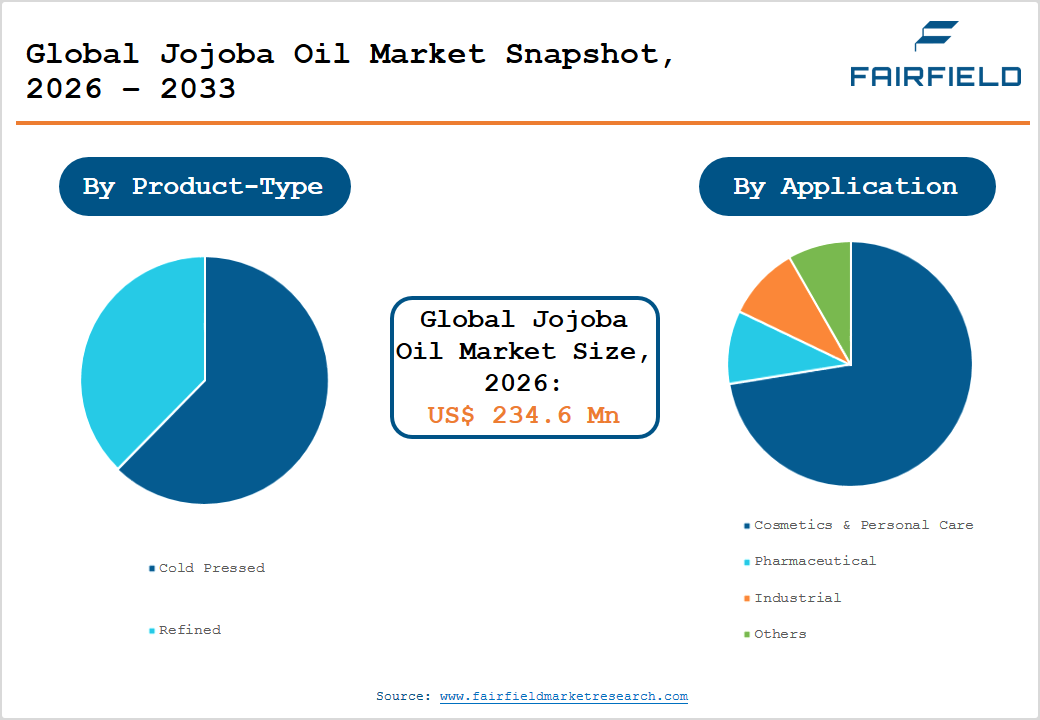
- The global Jojoba Oil market size is likely to be valued at USD 234.6 million in 2026 and is expected to reach USD 386.7 million by 2033, growing at a CAGR of 7.40% during the forecast period from 2026 to 2033.
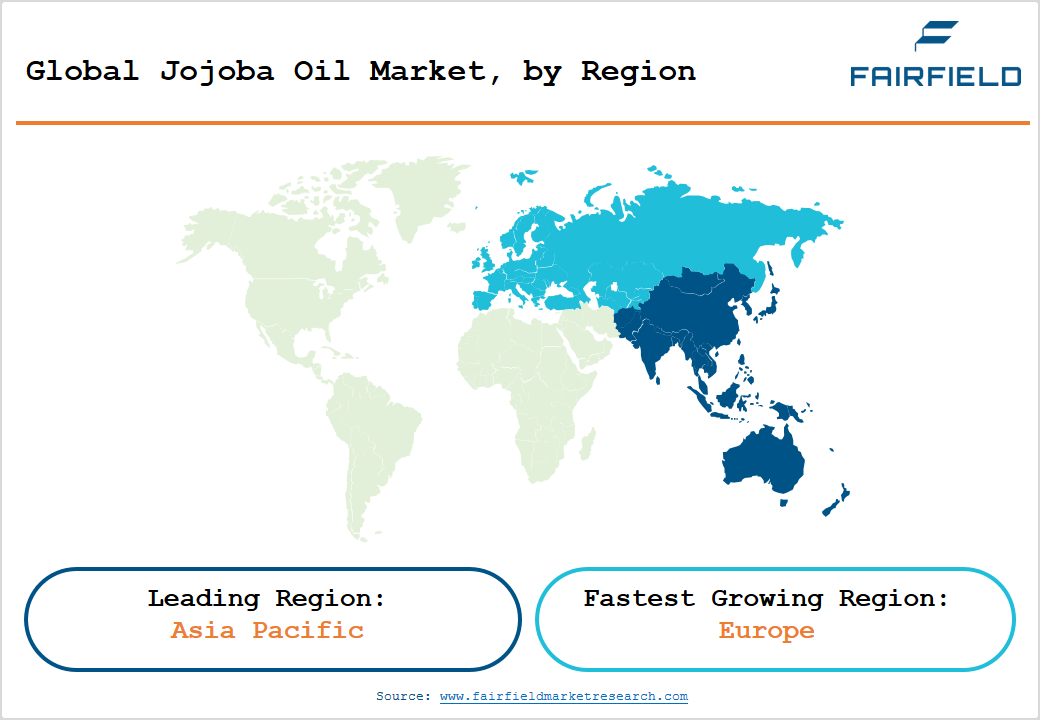
- Asia Pacific leads the global Jojoba Oil market with approximately 46% market share, driven by high-volume consumption across China, India, Japan, and ASEAN nations, supported by rapid growth in premium personal care adoption.
- Europe is the fastest growing regional market, propelled by stringent EU cosmetic ingredient regulations, expanding clean-beauty certifications, and robust demand from Germany, France, the UK, and Spain for natural botanical ingredients.
- The Cosmetics & Personal Care application segment dominates, accounting for approximately 68% of market revenue, underpinned by widespread use of jojoba oil in serums, moisturizers, hair care, and color cosmetics formulations worldwide.
- The Cold Pressed product segment records the fastest growth within By Product category, driven by increasing clean-label preferences, organic certification demand, and premium skincare brand specifications globally.
- Industrial bio-lubricant applications and pharmaceutical-grade jojoba oil represent significant untapped opportunities, supported by growing sustainability mandates and regulatory incentives favoring biodegradable, plant-based alternatives to petroleum-derived materials.

Market Dynamics
Market Growth Drivers
- Surging Demand from the Cosmetics & Personal Care Industry
The cosmetics and personal care industry represents the most significant demand engine for jojoba oil globally. Jojoba oil is chemically a liquid wax ester that closely mimics human sebum, making it an exceptional moisturizer, emollient, and carrier oil. According to the Cosmetic, Toiletry, and Fragrance Association (CTFA), natural ingredient adoption in skincare formulations has risen markedly over the past decade, with plant-based oils occupying a central role. The global natural cosmetics market has been expanding at double-digit rates in several markets, reinforcing ingredient-level demand. Jojoba oil's non-comedogenic properties, oxidative stability, and compatibility with sensitive skin types make it a sought-after ingredient in moisturizers, serums, lip balms, and hair care products, sustaining robust off-take from formulators across both mass-market and luxury personal care tiers.
- Pharmaceutical and Nutraceutical Applications Broadening Market Scope
Beyond cosmetics, jojoba oil is gaining traction in pharmaceutical formulations as a vehicle for transdermal drug delivery systems and topical medications. Its chemical inertness, long shelf life without preservatives, and skin-penetration-enhancing properties make it a preferred excipient. The U.S. Food and Drug Administration (FDA) recognizes jojoba oil as generally safe for topical use, lending regulatory credibility to its pharmaceutical incorporation. Additionally, nutraceutical interest in jojoba-derived compounds, including simmondsin, a dietary appetite suppressant under ongoing research, continues to attract academic and commercial investment. As pharmaceutical R&D increasingly pivots toward bio-based excipients to satisfy green-pharmacy principles, the demand for high-purity, refined jojoba oil is expected to witness meaningful acceleration across regulated markets in North America and Europe.
Market Restraints
- Supply Concentration and Climate Vulnerability of Jojoba Cultivation
Jojoba cultivation is geographically restricted to arid and semi-arid climatic zones, with production heavily concentrated in U.S. (Arizona, California), Argentina, Peru, Israel, and Australia. This geographic concentration exposes the supply chain to climatic shocks, including prolonged drought, unseasonal frost, and pest infestations. Yield variability resulting from erratic precipitation patterns has historically led to price volatility, dampening the confidence of end-use formulators who require consistent, cost-stable raw material inputs. The long gestation period of jojoba plants typically 3-5 years before commercial yields are achievable further limits rapid supply-side responses to demand spikes.
- Premium Pricing Relative to Competing Natural Oils
Jojoba oil commands a significant price premium compared to widely available vegetable and mineral oils such as sunflower, coconut, and argan oil. The relatively high cost of cultivation, harvesting, and cold-press extraction translates into elevated raw material costs for end-use formulators. This pricing dynamic can be prohibitive for small and mid-sized cosmetic manufacturers operating on constrained margins, especially in price-sensitive markets across Southeast Asia and parts of Latin America. Cost-driven substitution with synthetic silicones or lower-cost natural oils in budget product lines poses a tangible competitive risk to jojoba oil demand growth in mass-market cosmetic segments.
Market Opportunities
- Clean-Beauty Regulatory Tailwinds Driving Premium Formulation Adoption
The clean-beauty movement is transitioning from a consumer trend to a regulatory imperative in several jurisdictions. The European Union's updated Cosmetics Regulation, alongside California's Cleaning Product Right to Know Act and similar disclosure frameworks, is compelling formulators to re-examine synthetic ingredient lists. Jojoba oil, with its natural origin, minimal processing requirements, and established safety profile, stands to benefit directly from this regulatory realignment. Companies investing in certified organic and sustainably sourced jojoba oil backed by certifications from bodies such as the USDA National Organic Program (NOP) and COSMOS Organic are well-positioned to capture premium shelf space with retail partners and direct-to-consumer platforms. The high-margin premium skincare sub-segment is forecast to sustain above-average growth, offering significant revenue uplift for jojoba oil suppliers with traceable and certified supply chains.
- Industrial and Specialty Lubrication Applications Offering Diversified Demand
Jojoba oil's exceptional thermal and oxidative stability, combined with its high flash point and biodegradability, positions it as an attractive bio-lubricant for industrial applications. The U.S. Department of Agriculture (USDA) and European Lubricants Industry Association (ELGI) have both highlighted bio-based lubricants as a critical avenue for reducing industrial reliance on petroleum-derived products. Growing regulatory pressure to limit environmentally persistent lubricants, particularly in ecologically sensitive sectors such as forestry, agriculture, and marine operations, is generating tangible pull-through demand for food-grade and biodegradable alternatives. Jojoba-based lubricants, waxes, and transmission fluid additives are increasingly evaluated by industrial end-users and OEMs as part of sustainable procurement strategies, creating a meaningful and relatively untapped demand vector for jojoba oil market participants.
Segmental Insights
- By Product Analysis
The Cold Pressed segment dominates the Jojoba Oil market by product type, commanding approximately 62% of overall revenue. Cold pressing preserves the complete molecular integrity of jojoba oil, including its natural wax esters, tocopherols, and sterols, which are highly valued in premium cosmetic and pharmaceutical formulations. The technique avoids exposure to heat or chemical solvents, ensuring that the resulting oil retains its characteristic golden color, mild nutty aroma, and superior skin-conditioning properties. Consumer-facing brands and natural personal care formulators increasingly specify cold pressed origin on product labeling, driven by clean-beauty positioning and certification requirements. Growing institutional preference for cold pressed jojoba oil in prestige skincare, organic hair care, and specialty wellness products continues to reinforce the segment's leading position.
- By Application Analysis
The Cosmetics & Personal Care segment leads the Jojoba Oil market by application, accounting for an estimated 68% market share. Jojoba oil's unique biochemical resemblance to human skin sebum renders it an exceptionally effective moisturizing, conditioning, and carrying agent in skin and hair care formulations. It is extensively utilized in facial serums, moisturizers, sunscreens, lip care products, shampoos, conditioners, and color cosmetics. The global prestige beauty market has posted consistent growth, with ingredient transparency and plant-based sourcing emerging as primary purchase motivators among millennial and Gen Z consumers. Major multinational personal care companies including Unilever, L'Oréal, and Estée Lauder continue to incorporate jojoba oil as a key botanical ingredient across their natural and clean-beauty product lines.
Regional Insights
- North America Jojoba Oil Trends
North America is the largest producing and consuming region in the global jojoba oil market, with the United States serving as both the primary cultivation hub and the most developed end-use market. Arizona and California account for the majority of domestic jojoba cultivation, supported by favorable desert climatic conditions and organized grower cooperatives such as the Desert Whale Jojoba Company. The region's well-established cosmetics and pharmaceutical manufacturing base provides a stable demand pipeline for both cold pressed and refined jojoba oil grades.
Regulatory frameworks underpinning clean-label and organic ingredient adoption including the USDA National Organic Program (NOP) and state-level cosmetic ingredient disclosure laws continue to incentivize formulators to source certified jojoba oil. The robust e-commerce beauty ecosystem and direct-to-consumer clean beauty brands in the U.S. further amplify end-consumer demand, reinforcing North America's market leadership throughout the forecast period.
- Europe Jojoba Oil Trends
Europe represents the fastest growing regional market for jojoba oil, driven by stringent regulatory oversight of cosmetic ingredients under EU Regulation (EC) No 1223/2009 and the accelerating clean-beauty movement across Germany, France, the United Kingdom, and Spain. The EU Green Deal and associated chemicals strategy, including the Chemicals Strategy for Sustainability (CSS), are pushing formulators toward natural and biodegradable raw materials, with jojoba oil benefiting as a preferred plant-based emollient.
Germany and France serve as key innovation centers for natural and organic cosmetics, home to prominent certification bodies including COSMOS and NATRUE. The expansion of certified organic personal care product launches across European retail channels particularly through premium health and beauty outlets, apothecaries, and e-commerce platforms is translating into robust and sustained jojoba oil demand growth, affirming Europe's position as the fastest growing regional market.
- Asia Pacific Jojoba Oil Trends
Asia Pacific accounts for approximately 46% of the global jojoba oil market share, making it the leading region by volume consumption. Rapid urbanization, rising disposable incomes, and a swelling middle-class population across China, India, Japan, and ASEAN nations are driving unprecedented growth in premium skincare and hair care product adoption. The Korean beauty (K-beauty) and Japanese skincare culture continue to influence broader ASEAN consumer preferences, elevating demand for high-quality botanical ingredients including jojoba oil.
India is emerging as a significant manufacturing and re-export hub for jojoba oil-infused formulations, supported by the country's established Ayurveda and herbal personal care industry. Meanwhile, China's rapidly evolving domestic cosmetics regulation framework and growing e-commerce beauty market are facilitating adoption of premium natural oils. The region's cost-competitive manufacturing infrastructure additionally positions Asia Pacific as an attractive destination for global jojoba oil suppliers seeking volume-scale distribution partnerships.
Competitive Landscape
The global jojoba oil market exhibits a moderately fragmented competitive structure, with a mix of established specialty chemical distributors, dedicated jojoba cultivators, and natural ingredient suppliers competing for market share. Leading players such as Desert Whale Jojoba Company, Croda International Plc, and Elementis plc leverage vertically integrated supply chains, proprietary cold-press and refining technologies, and broad distribution networks as key differentiators. Companies are increasingly prioritizing sustainability certifications, traceability programs, and long-term farm partnership agreements to secure supply reliability. Strategic expansion into pharmaceutical-grade and industrial-grade jojoba oil segments, alongside investments in organic certification, represents a prevailing growth strategy among market leaders seeking to capture premium margins.
Key Developments
- In March 2024, Croda International Plc announced expansion of its natural ingredient portfolio with enhanced capacity for certified organic jojoba oil, targeting premium personal care and pharmaceutical formulation markets across Europe and North America.
- In September 2024, Elementis plc completed the integration of its Lebermuth division's jojoba sourcing operations, consolidating supply chain capabilities to strengthen its competitive positioning in the specialty cosmetic ingredients segment.
- In January 2025, Azelis Group expanded its distribution agreement for jojoba oil in the Asia Pacific region, adding new distribution partnerships across India and Southeast Asia to address growing regional demand from personal care formulators.
Companies Covered in Jojoba Oil Market
- Desert Whale Jojoba Company
- Croda International Plc
- The Lebermuth Company
- Gracefruit Ltd.
- Jedwards International, Inc.
- Elementis plc
- Azelis Group
- Botanical Beauty, LLC
- Hansen & Rosenthal, Inc.
- Heritage Store, Inc.
- NOW Foods
- Lebermuth (a division of Elementis)
- M. Todd & Co.
- Vantage Specialty Ingredients
- Biolandes SAS
- International Jojoba Export Company (IJEC)
- Jojoba Desert (A.C.S) Ltd.
- Purcell Jojoba International
Market Segmentation
By Product
- Cold Pressed
- Refined
By Application
- Cosmetics & Personal Care
- Pharmaceutical
- Industrial
- Other Applications
By Region
- North America
- Europe
- Asia Pacific
- Latin America
- Middle East & Africa
- Executive Summary
- Global Jojoba Oil Market Snapshot
- Future Projections
- Key Market Trends
- Regional Snapshot, by Value, 2026
- Analyst Recommendations
- Market Overview
- Market Definitions and Segmentations
- Market Dynamics
- Drivers
- Restraints
- Market Opportunities
- Value Chain Analysis
- COVID-19 Impact Analysis
- Porter's Five Forces Analysis
- Impact of Russia-Ukraine Conflict
- PESTLE Analysis
- Regulatory Analysis
- Price Trend Analysis
- Current Prices and Future Projections, 2025-2033
- Price Impact Factors
- Global Jojoba Oil Market Outlook, 2020 - 2033
- Global Jojoba Oil Market Outlook, by Product Type, Value (US$ Mn), 2020-2033
- Cold Pressed
- Refined
- Global Jojoba Oil Market Outlook, by Application, Value (US$ Mn), 2020-2033
- Cosmetics & Personal Care
- Pharmaceutical
- Industrial
- Others
- Global Jojoba Oil Market Outlook, by Region, Value (US$ Mn), 2020-2033
- North America
- Europe
- Asia Pacific
- Latin America
- Middle East & Africa
- Global Jojoba Oil Market Outlook, by Product Type, Value (US$ Mn), 2020-2033
- North America Jojoba Oil Market Outlook, 2020 - 2033
- North America Jojoba Oil Market Outlook, by Product Type, Value (US$ Mn), 2020-2033
- Cold Pressed
- Refined
- North America Jojoba Oil Market Outlook, by Application, Value (US$ Mn), 2020-2033
- Cosmetics & Personal Care
- Pharmaceutical
- Industrial
- Others
- North America Jojoba Oil Market Outlook, by Country, Value (US$ Mn), 2020-2033
- U.S. Jojoba Oil Market Outlook, by Product Type, 2020-2033
- U.S. Jojoba Oil Market Outlook, by Application, 2020-2033
- Canada Jojoba Oil Market Outlook, by Product Type, 2020-2033
- Canada Jojoba Oil Market Outlook, by Application, 2020-2033
- BPS Analysis/Market Attractiveness Analysis
- North America Jojoba Oil Market Outlook, by Product Type, Value (US$ Mn), 2020-2033
- Europe Jojoba Oil Market Outlook, 2020 - 2033
- Europe Jojoba Oil Market Outlook, by Product Type, Value (US$ Mn), 2020-2033
- Cold Pressed
- Refined
- Europe Jojoba Oil Market Outlook, by Application, Value (US$ Mn), 2020-2033
- Cosmetics & Personal Care
- Pharmaceutical
- Industrial
- Others
- Europe Jojoba Oil Market Outlook, by Country, Value (US$ Mn), 2020-2033
- Germany Jojoba Oil Market Outlook, by Product Type, 2020-2033
- Germany Jojoba Oil Market Outlook, by Application, 2020-2033
- Italy Jojoba Oil Market Outlook, by Product Type, 2020-2033
- Italy Jojoba Oil Market Outlook, by Application, 2020-2033
- France Jojoba Oil Market Outlook, by Product Type, 2020-2033
- France Jojoba Oil Market Outlook, by Application, 2020-2033
- U.K. Jojoba Oil Market Outlook, by Product Type, 2020-2033
- U.K. Jojoba Oil Market Outlook, by Application, 2020-2033
- Spain Jojoba Oil Market Outlook, by Product Type, 2020-2033
- Spain Jojoba Oil Market Outlook, by Application, 2020-2033
- Russia Jojoba Oil Market Outlook, by Product Type, 2020-2033
- Russia Jojoba Oil Market Outlook, by Application, 2020-2033
- Rest of Europe Jojoba Oil Market Outlook, by Product Type, 2020-2033
- Rest of Europe Jojoba Oil Market Outlook, by Application, 2020-2033
- BPS Analysis/Market Attractiveness Analysis
- Europe Jojoba Oil Market Outlook, by Product Type, Value (US$ Mn), 2020-2033
- Asia Pacific Jojoba Oil Market Outlook, 2020 - 2033
- Asia Pacific Jojoba Oil Market Outlook, by Product Type, Value (US$ Mn), 2020-2033
- Cold Pressed
- Refined
- Asia Pacific Jojoba Oil Market Outlook, by Application, Value (US$ Mn), 2020-2033
- Cosmetics & Personal Care
- Pharmaceutical
- Industrial
- Others
- Asia Pacific Jojoba Oil Market Outlook, by Country, Value (US$ Mn), 2020-2033
- China Jojoba Oil Market Outlook, by Product Type, 2020-2033
- China Jojoba Oil Market Outlook, by Application, 2020-2033
- Japan Jojoba Oil Market Outlook, by Product Type, 2020-2033
- Japan Jojoba Oil Market Outlook, by Application, 2020-2033
- South Korea Jojoba Oil Market Outlook, by Product Type, 2020-2033
- South Korea Jojoba Oil Market Outlook, by Application, 2020-2033
- India Jojoba Oil Market Outlook, by Product Type, 2020-2033
- India Jojoba Oil Market Outlook, by Application, 2020-2033
- Southeast Asia Jojoba Oil Market Outlook, by Product Type, 2020-2033
- Southeast Asia Jojoba Oil Market Outlook, by Application, 2020-2033
- Rest of SAO Jojoba Oil Market Outlook, by Product Type, 2020-2033
- Rest of SAO Jojoba Oil Market Outlook, by Application, 2020-2033
- BPS Analysis/Market Attractiveness Analysis
- Asia Pacific Jojoba Oil Market Outlook, by Product Type, Value (US$ Mn), 2020-2033
- Latin America Jojoba Oil Market Outlook, 2020 - 2033
- Latin America Jojoba Oil Market Outlook, by Product Type, Value (US$ Mn), 2020-2033
- Cold Pressed
- Refined
- Latin America Jojoba Oil Market Outlook, by Application, Value (US$ Mn), 2020-2033
- Cosmetics & Personal Care
- Pharmaceutical
- Industrial
- Others
- Latin America Jojoba Oil Market Outlook, by Country, Value (US$ Mn), 2020-2033
- Brazil Jojoba Oil Market Outlook, by Product Type, 2020-2033
- Brazil Jojoba Oil Market Outlook, by Application, 2020-2033
- Mexico Jojoba Oil Market Outlook, by Product Type, 2020-2033
- Mexico Jojoba Oil Market Outlook, by Application, 2020-2033
- Argentina Jojoba Oil Market Outlook, by Product Type, 2020-2033
- Argentina Jojoba Oil Market Outlook, by Application, 2020-2033
- Rest of LATAM Jojoba Oil Market Outlook, by Product Type, 2020-2033
- Rest of LATAM Jojoba Oil Market Outlook, by Application, 2020-2033
- BPS Analysis/Market Attractiveness Analysis
- Latin America Jojoba Oil Market Outlook, by Product Type, Value (US$ Mn), 2020-2033
- Middle East & Africa Jojoba Oil Market Outlook, 2020 - 2033
- Middle East & Africa Jojoba Oil Market Outlook, by Product Type, Value (US$ Mn), 2020-2033
- Cold Pressed
- Refined
- Middle East & Africa Jojoba Oil Market Outlook, by Application, Value (US$ Mn), 2020-2033
- Cosmetics & Personal Care
- Pharmaceutical
- Industrial
- Others
- Middle East & Africa Jojoba Oil Market Outlook, by Country, Value (US$ Mn), 2020-2033
- GCC Jojoba Oil Market Outlook, by Product Type, 2020-2033
- GCC Jojoba Oil Market Outlook, by Application, 2020-2033
- South Africa Jojoba Oil Market Outlook, by Product Type, 2020-2033
- South Africa Jojoba Oil Market Outlook, by Application, 2020-2033
- Egypt Jojoba Oil Market Outlook, by Product Type, 2020-2033
- Egypt Jojoba Oil Market Outlook, by Application, 2020-2033
- Nigeria Jojoba Oil Market Outlook, by Product Type, 2020-2033
- Nigeria Jojoba Oil Market Outlook, by Application, 2020-2033
- Rest of Middle East Jojoba Oil Market Outlook, by Product Type, 2020-2033
- Rest of Middle East Jojoba Oil Market Outlook, by Application, 2020-2033
- BPS Analysis/Market Attractiveness Analysis
- Middle East & Africa Jojoba Oil Market Outlook, by Product Type, Value (US$ Mn), 2020-2033
- Competitive Landscape
- Company Vs Segment Heatmap
- Company Market Share Analysis, 2025
- Competitive Dashboard
- Company Profiles
- Desert Whale Jojoba Company
- Company Overview
- Product Portfolio
- Financial Overview
- Business Strategies and Developments
- Croda International Plc
- The Lebermuth Company
- Gracefruit Ltd.
- Jedwards International, Inc.
- Elementis plc
- Azelis Group
- Botanical Beauty, LLC
- Hansen & Rosenthal, Inc.
- Heritage Store, Inc.
- NOW Foods
- Lebermuth (a division of Elementis)
- M. Todd & Co.
- Vantage Specialty Ingredients
- Biolandes SAS
- Desert Whale Jojoba Company
- Appendix
- Research Methodology
- Report Assumptions
- Acronyms and Abbreviations
|
BASE YEAR |
HISTORICAL DATA |
FORECAST PERIOD |
UNITS |
|||
 |
2025 |
 |
2019 - 2024 |
 |
2026 - 2033 |
Value: US$ Million |
|
REPORT FEATURES |
DETAILS |
|
By Product-Type Coverage |
|
|
By Application Coverage |
|
|
Geographical Coverage |
|
|
Leading Companies |
|
|
Report Highlights |
Key Market Indicators, Macro-micro economic impact analysis, Technological Roadmap, Key Trends, Driver, Restraints, and Future Opportunities & Revenue Pockets, Porter’s 5 Forces Analysis, Historical Trend (2019-2024), Market Estimates and Forecast, Market Dynamics, Industry Trends, Competition Landscape, Category, Region, Country-wise Trends & Analysis, COVID-19 Impact Analysis (Demand and Supply Chain) |
Our Research Methodology
Considering the volatility of business today, traditional approaches to strategizing a game plan can be unfruitful if not detrimental. True ambiguity is no way to determine a forecast. A myriad of predetermined factors must be accounted for such as the degree of risk involved, the magnitude of circumstances, as well as conditions or consequences that are not known or unpredictable. To circumvent binary views that cast uncertainty, the application of market research intelligence to strategically posture, move, and enable actionable outcomes is necessary.
View Methodology
Quality Assured
Rigorous Validation Process

Confidentiality Assured
End-to-end Data Security

Custom Research Services
Tailored To Your Objectives
FAQs
The Jojoba Oil Market size is USD 234.6 million in 2026.
The Jojoba Oil Market is projected to reach USD 386.7 million at 9.40% CAGR by 2033.
The Jojoba Oil Market growth drivers include rising demand for natural cosmetics, consumer preference for plant-based skincare, and expanding personal care applications.
Asia Pacific is a dominating region for Jojoba Oil Market.
The Hallstar Company, Jojoba Valley, Desert Whale Jojoba Company, Eco Urban, and AVO Botanicals are some leading industry players in the Jojoba Oil Market.
Related Reports
E-commerce Last-mile Delivery Market Insights, Competitive Landscape, and Market Forecast 2033
The E-commerce last-mile delivery market is valued at USD 145.00 Bn in 2026 and projected to reach USD 275.58 Bn by 2033, growing at a 9.6% CAGR
Stone Plastic Composite Flooring Market Insights, Competitive Landscape, and Market Forecast 2033
The stone plastic composite flooring market to reach USD9.64 Bn by 2033, growing at 10.8% CAGR from USD4.70 Bn in 2026, driven by high flooring demand worldwide
Recycled and Bio-Based Flooring Market Insights, Competitive Landscape, and Market Forecast 2033
The recycled and bio-based flooring market reaches USD 6.50 Bn by 2033, growing at 9.7% CAGR from USD 3.40 Bn in 2026, driven by sustainable construction
Lithium-Ion Battery Safety Systems Market Insights, Competitive Landscape, and Market Forecast 2033
The lithium-ion battery safety systems market reaches USD 6.35 Bn by 2033, growing at 13.6% CAGR from USD 2.60 Bn in 2026, driven by battery safety needs
Fans And Blowers Market Forecast - 2033
The global fans and blowers market is set to reach US$ 27.45 Bn by 2033, growing at a 5.8% CAGR, driven by rising demand for efficient ventilation
Diabetic Footwear Market Insights, Competitive Landscape, and Market Forecast 2033
The diabetic footwear market will grow from USD 5.60 billion in 2026 to USD 9.85 billion by 2033, driven by rising diabetes prevalence and foot care awareness.