



Vascular Stent Market
Vascular Stent Market Insights, Competitive Landscape, and Market Forecast - 2033
The Vascular Stent Market is valued at USD 13.6 Bn in 2026 and is projected to reach USD 19.8 Bn, growing at a CAGR of 6% by 2033
Vascular Stent Market Insights
A Look Back and a Look Forward - Comparative Analysis
The global vascular stent market experienced steady growth during the historical period from 2019 to 2023, driven by a rising global burden of cardiovascular diseases (CVDs) due to lifestyle changes, aging populations, and increasing rates of diabetes and hypertension.
Technological advancements, such as the development of drug-eluting stents (DES) with enhanced safety and efficacy, significantly boosted adoption rates. The market also benefited from increasing healthcare expenditure and infrastructure improvements in emerging economies, particularly in Asia Pacific
The vascular stent market is estimated to experience accelerated growth due to bio-absorbable and combination-material stent advancements over the forecast period. Emerging regions like Asia Pacific and Latin America are expected to play a large role in market expansion, fueled by increasing healthcare investments and better access to advanced medical devices.
Government initiatives to combat CVDs and promote minimally invasive procedures will further drive demand. Continued research and development efforts to improve biocompatibility and long-term efficacy will sustain growth despite persistent challenges like cost pressures and competition.
Key Growth Determinants
- Increasing Inclination Towards Minimally Invasive Techniques
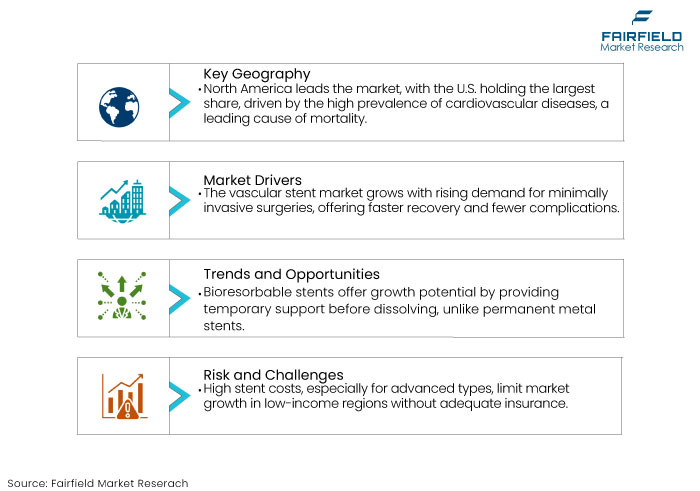
The vascular stent market is mainly propelled by the increasing inclination and demand for minimally invasive surgical techniques. Patients increasingly choose angioplasty and comparable operations because of several benefits, such as reduced recovery times, low postoperative problems, and smaller incisions.
Preserving arterial blood flow is crucial for managing peripheral artery disease (PAD) and coronary artery disease (CAD). As a result, there is an increasing demand for sophisticated medical interventions, including stenting, a conventional technique employed in angioplasty.
The concurrent increase in chronic heart diseases propels the growing demand for vascular stents. According to reports, in 2021, more than one million percutaneous coronary interventions (PCIs) were conducted annually in the United States, while 1.1 million transluminal coronary angioplasties were executed throughout 25 European Union countries. These figures illustrate the essential function of stents in providing modern vascular treatment.
- Advancements in Stent Technologies Remain a Key Driver
Innovative advancements in vascular stent technologies are driving vascular stent market growth over the forecast period. The development of drug-eluting stents (DES) with medications that prevent restenosis has significantly improved patient outcomes compared to traditional bare-metal stents.
Bio-absorbable stents, designed to dissolve after fulfilling their purpose, have emerged as a breakthrough, reducing long-term complications. Enhanced imaging and delivery systems have improved stent placement precision, reducing procedural risks.
These technological advancements enhance treatment efficacy and attract healthcare providers to adopt the latest devices, boosting market expansion.
Innovations in imaging technologies, such as intravascular ultrasound (IVUS) and optical coherence tomography (OCT), have also improved stent placement precision, minimizing complications and procedural risks. Advancements in stent technologies have driven higher adoption rates, expanded the patient base, and solidified the position of stents in modern cardiovascular care.
Key Growth Barriers
- High Cost of Stent Procedures and Devices
The high cost of vascular stents and the associated procedures is a key restraint for the vascular stent market growth, particularly in low and middle-income countries. Advanced stents like drug-eluting stents (DES) and bio-absorbable stents often come at premium prices, which can be prohibitive for patients without adequate insurance coverage.
The cost of minimally invasive stenting procedures, including hospital charges, physician fees, and post-operative care, further limits accessibility. Adopting advanced stent technologies remains limited in regions with constrained healthcare budgets or inadequate reimbursement frameworks. Such financial barriers restrict market expansion, especially in underserved populations, despite the growing burden of cardiovascular diseases globally.
- Stringent Regulatory Requirements Governing Device Approval
The vascular stent market faces growth challenges due to stringent regulatory frameworks governing device approval and quality standards. Stents must undergo rigorous preclinical and clinical testing to ensure safety and efficacy, prolonging the market for new products.
The lengthy and costly processes can deter smaller companies from entering the market, limiting competition and innovation. Regulatory inconsistencies across regions create additional hurdles for manufacturers aiming to commercialize their products globally. Such challenges slow the introduction of advanced stent technologies and increase costs, which are often passed on to consumers, further restricting market growth.
Vascular Stent Market Trends and Opportunities
- Advancement of Bioresorbable Vascular Scaffold Stents
Vascular stents present a significant growth opportunity in developing bioresorbable vascular scaffold (BRS) stents. Unlike permanent metallic stents, bio-resorbable scaffolds (BRSs) provide temporary mechanical support to the vascular wall before gradually disintegrating.
BRSs minimizes the risk of adverse reactions and decreasing the presence of foreign materials over time. The increasing prevalence of bioresorbable materials is anticipated to enhance market expansion. Ongoing innovations in medical devices are anticipated to enhance the safety and efficacy of vascular stents in the forthcoming years.
As research progresses, newer bio-absorbable stents with improved designs and materials are entering the market, offering greater efficacy and safety. With growing patient and physician preference for less invasive and temporary solutions, bio-absorbable stents have the potential to become a significant market segment, particularly as regulatory approvals increase and production costs decrease.
- Integration of Artificial Intelligence (AI) and Robotics
The integration of AI and robotics in interventional cardiology is revolutionizing stent procedures, providing a transformative opportunity for the vascular stent market. AI-powered imaging and diagnostic tools enhance the precision of stent placement, reducing complications and improving patient outcomes.
Robotic-assisted procedures allow for great accuracy and consistency, even in complex cases, while minimizing radiation exposure for clinicians. These technological advancements also improve procedural efficiency, making stenting more accessible and attractive to healthcare providers. As the adoption of AI and robotics grows, they will play a critical role in driving demand for high-performance stents designed for advanced techniques.
How Does Regulatory Scenario Shape the Industry?
The regulatory scenario plays a critical role in shaping the vascular stent market by ensuring device safety, efficacy, and quality. Stringent regulatory frameworks are in place to evaluate stents through rigorous preclinical and clinical trials, focusing on material durability, biocompatibility, and risk of complications like restenosis or thrombosis.
Regulatory harmonization across regions remains an ongoing effort, which, if achieved, could reduce approval delays and foster notable adoption of innovative technologies. The regulatory environment is steering the market toward high quality and safety benchmarks, stimulating technological advancements while moderating market entry for new players.
Segments Covered in the Report
- Drug-Eluting Stents (DES) Take the Lead with Their Superior Performance in Reducing Restenosis
Drug-eluting stents (DES) are the dominant type, accounting for around 55% of the total market share as of 2025. These specialized devices treat narrowed or blocked arteries. DES are coated with medication that is gradually released to prevent the recurrence of arterial blockages, known as restenosis, which significantly reduces the need for repeat procedures compared to bare-metal stents.
The medication released by DES inhibits cell proliferation, minimizing the risk of the artery becoming narrow again. DES further helps improve patient outcomes by maintaining arterial openness and enhancing blood flow, leading to better overall patient health post-procedure.
Continuous improvements have led to the development of newer DES with enhanced efficacy and safety profiles. The preference for DES over other types, such as bare-metal stents and bio-absorbable stents, is largely due to their superior performance in reducing restenosis and improving long-term patient outcomes.
- Metal Stents Remain the Dominant Material Type
Metal stents are small, expandable mesh tubes made from metals such as stainless steel, cobalt-chromium alloys, or nickel-titanium (Nitinol). They are inserted into narrowed or blocked blood vessels to restore and maintain proper blood flow. Inherent strength of metals and flexibility make these stents effective in providing immediate structural support to the vessel walls.
Metal stents offer robust mechanical support, ensuring the vessel remains open over time. The adaptable nature of metals allows these stents to conform to various vessel anatomies, enhancing their applicability across different vascular conditions.
Recent advancements in metal alloys have improved their compatibility with body tissues, reducing the risk of adverse reactions, which is one of the prime reasons for their dominance over other materials. Cost-effectiveness is a key factor in the dominance of metallic stents. Compared to some new materials, metallic stents are generally affordable, contributing to their widespread use, especially in regions with limited healthcare budgets.
Regional Analysis
- North America’s Dominance Prevails in the Vascular Stent Market
North America dominates the market, with the United States contributing the largest share. The regional growth is driven by a high prevalence of cardiovascular diseases (CVDs), which remain a leading cause of mortality in the region.
The presence of advanced healthcare systems ensures rapid adoption of innovative stent technologies, including drug-eluting stents and bio-absorbable stents. Substantial investments in research and development, coupled with favourable reimbursement policies, enhance market growth.
The region also benefits from a strong network of key players and clinical research organizations, accelerating the approval and commercialization of new stent products.
- Europe to be the Second Largest Contributor with Rapid Adoption of Advanced Medical Devices
Europe holds the second largest share of the vascular stents market, driven by increasing awareness of vascular diseases and widespread adoption of advanced medical devices. Countries like Germany, the UK, and France lead the market, supported by robust healthcare systems and a growing emphasis on minimally invasive procedures. Europe market is also characterized by strong government support for healthcare innovation and rising healthcare expenditure.
Aging population and lifestyle changes lead to higher incidences of CVDs have significantly boosted demand for vascular stents. Regulatory frameworks like CE marking ensure the availability of safe and effective stent technologies across the region.
Fairfield’s Competitive Landscape Analysis
The vascular stent market is highly competitive, with key players focusing on innovation and strategic collaborations to maintain market dominance. Leading companies include Boston Scientific Corporation, Medtronic PLC, and Abbott Laboratories, recognized for their extensive product portfolios and advanced technologies.
Emerging players and regional firms, particularly in Asia Pacific, are intensifying competition with cost-effective solutions. Strategic mergers, acquisitions, and partnerships are common, aiming to expand market reach and technological capabilities.
Significant research and development investments drive the development of next-generation stents with improved safety and efficacy profiles. Regulatory approvals and robust distribution networks further solidify the competitive positioning of major players in this dynamic market.
Key Market Companies
• Medtronic Plc (Ireland)
• Abbott Laboratories (US)
• Boston Scientific Corporation (US)
• B Braun SE (Germany)
• Terumo Corporation (Japan)
• Biotronik SE & Co. KG (Germany)
• Shanghai Microport Medical (Group) Co., Ltd (China)
• Meril Life Science Pvt. Ltd (India)
• Sahajanand Medical Technologies Limited (India)
• Becton, Dickinson, and Company (US)
Global Vascular Stent Market is Segmented as-
By Type
- Drug-Eluting Stents
- Bare-Metal Stents
- Bio absorbable Stents
By Material
- Metal
- Polymeric
- Combination
By End User
- Hospitals
- Ambulatory Surgery Centers (ASCs)
- Specialty Clinics
By Region
- North America
- Europe
- Asia Pacific
- Latin America
- The Middle East & Africa
- Executive Summary
- Global Vascular Stent Market Snapshot
- Future Projections
- Key Market Trends
- Regional Snapshot, by Value, 2026
- Analyst Recommendations
- Market Overview
- Market Definitions and Segmentations
- Market Dynamics
- Drivers
- Restraints
- Market Opportunities
- Value Chain Analysis
- COVID-19 Impact Analysis
- Porter's Five Forces Analysis
- Impact of Russia-Ukraine Conflict
- PESTLE Analysis
- Regulatory Analysis
- Price Trend Analysis
- Current Prices and Future Projections, 2025-2033
- Price Impact Factors
- Global Vascular Stent Market Outlook, 2020 - 2033
- Global Vascular Stent Market Outlook, by Type, Value (US$ Bn), 2020-2033
- Drug-Eluting Stents
- Bare-Metal Stents
- Bio absorbable Stents
- Global Vascular Stent Market Outlook, by Material, Value (US$ Bn), 2020-2033
- Metal
- Polymeric
- Combination
- Global Vascular Stent Market Outlook, by End User, Value (US$ Bn), 2020-2033
- Hospitals
- Ambulatory Surgery Centers (ASCs)
- Specialty Clinics
- Global Vascular Stent Market Outlook, by Region, Value (US$ Bn), 2020-2033
- North America
- Europe
- Asia Pacific
- Latin America
- Middle East & Africa
- Global Vascular Stent Market Outlook, by Type, Value (US$ Bn), 2020-2033
- North America Vascular Stent Market Outlook, 2020 - 2033
- North America Vascular Stent Market Outlook, by Type, Value (US$ Bn), 2020-2033
- Drug-Eluting Stents
- Bare-Metal Stents
- Bio absorbable Stents
- North America Vascular Stent Market Outlook, by Material, Value (US$ Bn), 2020-2033
- Metal
- Polymeric
- Combination
- North America Vascular Stent Market Outlook, by End User, Value (US$ Bn), 2020-2033
- Hospitals
- Ambulatory Surgery Centers (ASCs)
- Specialty Clinics
- North America Vascular Stent Market Outlook, by Country, Value (US$ Bn), 2020-2033
- U.S. Vascular Stent Market Outlook, by Type, 2020-2033
- U.S. Vascular Stent Market Outlook, by Material, 2020-2033
- U.S. Vascular Stent Market Outlook, by End User, 2020-2033
- Canada Vascular Stent Market Outlook, by Type, 2020-2033
- Canada Vascular Stent Market Outlook, by Material, 2020-2033
- Canada Vascular Stent Market Outlook, by End User, 2020-2033
- BPS Analysis/Market Attractiveness Analysis
- North America Vascular Stent Market Outlook, by Type, Value (US$ Bn), 2020-2033
- Europe Vascular Stent Market Outlook, 2020 - 2033
- Europe Vascular Stent Market Outlook, by Type, Value (US$ Bn), 2020-2033
- Drug-Eluting Stents
- Bare-Metal Stents
- Bio absorbable Stents
- Europe Vascular Stent Market Outlook, by Material, Value (US$ Bn), 2020-2033
- Metal
- Polymeric
- Combination
- Europe Vascular Stent Market Outlook, by End User, Value (US$ Bn), 2020-2033
- Hospitals
- Ambulatory Surgery Centers (ASCs)
- Specialty Clinics
- Europe Vascular Stent Market Outlook, by Country, Value (US$ Bn), 2020-2033
- Germany Vascular Stent Market Outlook, by Type, 2020-2033
- Germany Vascular Stent Market Outlook, by Material, 2020-2033
- Germany Vascular Stent Market Outlook, by End User, 2020-2033
- Italy Vascular Stent Market Outlook, by Type, 2020-2033
- Italy Vascular Stent Market Outlook, by Material, 2020-2033
- Italy Vascular Stent Market Outlook, by End User, 2020-2033
- France Vascular Stent Market Outlook, by Type, 2020-2033
- France Vascular Stent Market Outlook, by Material, 2020-2033
- France Vascular Stent Market Outlook, by End User, 2020-2033
- U.K. Vascular Stent Market Outlook, by Type, 2020-2033
- U.K. Vascular Stent Market Outlook, by Material, 2020-2033
- U.K. Vascular Stent Market Outlook, by End User, 2020-2033
- Spain Vascular Stent Market Outlook, by Type, 2020-2033
- Spain Vascular Stent Market Outlook, by Material, 2020-2033
- Spain Vascular Stent Market Outlook, by End User, 2020-2033
- Russia Vascular Stent Market Outlook, by Type, 2020-2033
- Russia Vascular Stent Market Outlook, by Material, 2020-2033
- Russia Vascular Stent Market Outlook, by End User, 2020-2033
- Rest of Europe Vascular Stent Market Outlook, by Type, 2020-2033
- Rest of Europe Vascular Stent Market Outlook, by Material, 2020-2033
- Rest of Europe Vascular Stent Market Outlook, by End User, 2020-2033
- BPS Analysis/Market Attractiveness Analysis
- Europe Vascular Stent Market Outlook, by Type, Value (US$ Bn), 2020-2033
- Asia Pacific Vascular Stent Market Outlook, 2020 - 2033
- Asia Pacific Vascular Stent Market Outlook, by Type, Value (US$ Bn), 2020-2033
- Drug-Eluting Stents
- Bare-Metal Stents
- Bio absorbable Stents
- Asia Pacific Vascular Stent Market Outlook, by Material, Value (US$ Bn), 2020-2033
- Metal
- Polymeric
- Combination
- Asia Pacific Vascular Stent Market Outlook, by End User, Value (US$ Bn), 2020-2033
- Hospitals
- Ambulatory Surgery Centers (ASCs)
- Specialty Clinics
- Asia Pacific Vascular Stent Market Outlook, by Country, Value (US$ Bn), 2020-2033
- China Vascular Stent Market Outlook, by Type, 2020-2033
- China Vascular Stent Market Outlook, by Material, 2020-2033
- China Vascular Stent Market Outlook, by End User, 2020-2033
- Japan Vascular Stent Market Outlook, by Type, 2020-2033
- Japan Vascular Stent Market Outlook, by Material, 2020-2033
- Japan Vascular Stent Market Outlook, by End User, 2020-2033
- South Korea Vascular Stent Market Outlook, by Type, 2020-2033
- South Korea Vascular Stent Market Outlook, by Material, 2020-2033
- South Korea Vascular Stent Market Outlook, by End User, 2020-2033
- India Vascular Stent Market Outlook, by Type, 2020-2033
- India Vascular Stent Market Outlook, by Material, 2020-2033
- India Vascular Stent Market Outlook, by End User, 2020-2033
- Southeast Asia Vascular Stent Market Outlook, by Type, 2020-2033
- Southeast Asia Vascular Stent Market Outlook, by Material, 2020-2033
- Southeast Asia Vascular Stent Market Outlook, by End User, 2020-2033
- Rest of SAO Vascular Stent Market Outlook, by Type, 2020-2033
- Rest of SAO Vascular Stent Market Outlook, by Material, 2020-2033
- Rest of SAO Vascular Stent Market Outlook, by End User, 2020-2033
- BPS Analysis/Market Attractiveness Analysis
- Asia Pacific Vascular Stent Market Outlook, by Type, Value (US$ Bn), 2020-2033
- Latin America Vascular Stent Market Outlook, 2020 - 2033
- Latin America Vascular Stent Market Outlook, by Type, Value (US$ Bn), 2020-2033
- Drug-Eluting Stents
- Bare-Metal Stents
- Bio absorbable Stents
- Latin America Vascular Stent Market Outlook, by Material, Value (US$ Bn), 2020-2033
- Metal
- Polymeric
- Combination
- Latin America Vascular Stent Market Outlook, by End User, Value (US$ Bn), 2020-2033
- Hospitals
- Ambulatory Surgery Centers (ASCs)
- Specialty Clinics
- Latin America Vascular Stent Market Outlook, by Country, Value (US$ Bn), 2020-2033
- Brazil Vascular Stent Market Outlook, by Type, 2020-2033
- Brazil Vascular Stent Market Outlook, by Material, 2020-2033
- Brazil Vascular Stent Market Outlook, by End User, 2020-2033
- Mexico Vascular Stent Market Outlook, by Type, 2020-2033
- Mexico Vascular Stent Market Outlook, by Material, 2020-2033
- Mexico Vascular Stent Market Outlook, by End User, 2020-2033
- Argentina Vascular Stent Market Outlook, by Type, 2020-2033
- Argentina Vascular Stent Market Outlook, by Material, 2020-2033
- Argentina Vascular Stent Market Outlook, by End User, 2020-2033
- Rest of LATAM Vascular Stent Market Outlook, by Type, 2020-2033
- Rest of LATAM Vascular Stent Market Outlook, by Material, 2020-2033
- Rest of LATAM Vascular Stent Market Outlook, by End User, 2020-2033
- BPS Analysis/Market Attractiveness Analysis
- Latin America Vascular Stent Market Outlook, by Type, Value (US$ Bn), 2020-2033
- Middle East & Africa Vascular Stent Market Outlook, 2020 - 2033
- Middle East & Africa Vascular Stent Market Outlook, by Type, Value (US$ Bn), 2020-2033
- Drug-Eluting Stents
- Bare-Metal Stents
- Bio absorbable Stents
- Middle East & Africa Vascular Stent Market Outlook, by Material, Value (US$ Bn), 2020-2033
- Metal
- Polymeric
- Combination
- Middle East & Africa Vascular Stent Market Outlook, by End User, Value (US$ Bn), 2020-2033
- Hospitals
- Ambulatory Surgery Centers (ASCs)
- Specialty Clinics
- Middle East & Africa Vascular Stent Market Outlook, by Country, Value (US$ Bn), 2020-2033
- GCC Vascular Stent Market Outlook, by Type, 2020-2033
- GCC Vascular Stent Market Outlook, by Material, 2020-2033
- GCC Vascular Stent Market Outlook, by End User, 2020-2033
- South Africa Vascular Stent Market Outlook, by Type, 2020-2033
- South Africa Vascular Stent Market Outlook, by Material, 2020-2033
- South Africa Vascular Stent Market Outlook, by End User, 2020-2033
- Egypt Vascular Stent Market Outlook, by Type, 2020-2033
- Egypt Vascular Stent Market Outlook, by Material, 2020-2033
- Egypt Vascular Stent Market Outlook, by End User, 2020-2033
- Nigeria Vascular Stent Market Outlook, by Type, 2020-2033
- Nigeria Vascular Stent Market Outlook, by Material, 2020-2033
- Nigeria Vascular Stent Market Outlook, by End User, 2020-2033
- Rest of Middle East Vascular Stent Market Outlook, by Type, 2020-2033
- Rest of Middle East Vascular Stent Market Outlook, by Material, 2020-2033
- Rest of Middle East Vascular Stent Market Outlook, by End User, 2020-2033
- BPS Analysis/Market Attractiveness Analysis
- Middle East & Africa Vascular Stent Market Outlook, by Type, Value (US$ Bn), 2020-2033
- Competitive Landscape
- Company Vs Segment Heatmap
- Company Market Share Analysis, 2025
- Competitive Dashboard
- Company Profiles
- Medtronic Plc (Ireland)
- Company Overview
- Product Portfolio
- Financial Overview
- Business Strategies and Developments
- Abbott Laboratories (US)
- Boston Scientific Corporation (US)
- B Braun SE (Germany)
- Terumo Corporation (Japan)
- Biotronik SE & Co. KG (Germany)
- Shanghai Microport Medical (Group) Co., Ltd (China)
- Meril Life Science Pvt. Ltd (India)
- Sahajanand Medical Technologies Limited (India)
- Becton, Dickinson, and Company (US)
- Medtronic Plc (Ireland)
- Appendix
- Research Methodology
- Report Assumptions
- Acronyms and Abbreviations
Add the following code to the source code:
BASE YEAR |
HISTORICAL DATA |
FORECAST PERIOD |
UNITS |
|||
 |
2025 |
 |
2020 - 2025 |
 |
2026 - 2033 |
Value: US$ Million |
Our Research Methodology
Considering the volatility of business today, traditional approaches to strategizing a game plan can be unfruitful if not detrimental. True ambiguity is no way to determine a forecast. A myriad of predetermined factors must be accounted for such as the degree of risk involved, the magnitude of circumstances, as well as conditions or consequences that are not known or unpredictable. To circumvent binary views that cast uncertainty, the application of market research intelligence to strategically posture, move, and enable actionable outcomes is necessary.
View Methodology
Quality Assured
Rigorous Validation Process

Confidentiality Assured
End-to-end Data Security

Custom Research Services
Tailored To Your Objectives
FAQs
The Vascular Stent Market is valued at USD 13.6 Bn in 2026.
The Vascular Stent Market is projected to grow at a CAGR of 6% through 2033, reaching USD 19.8 Bn.
The market is driven by the rising prevalence of cardiovascular diseases, increasing adoption of minimally invasive procedures, and advancements in drug-eluting and bioresorbable stent technologies.
North America is the dominant regional market for Vascular Stent due to its advanced healthcare infrastructure, high cardiovascular disease burden, and strong adoption of innovative stent technologies.
Medtronic Plc, Abbott Laboratories, Boston Scientific Corporation, Terumo Corporation, and Becton, Dickinson, and Company are among the leading players in the Vascular Stent Market.
Related Reports
Particle-Engineered Probiotic Stabilizers Market Size, Share, Insights, Competitive Landscape, and Forecast 2026 to 2033
The global particle-engineered probiotic stabilizers market is projected to reach US$ 2.98 Billion by 2033, growing at an 11.4% CAGR during 2026–2033
Probiotic Stability Excipients Market Size, Share, Insights, Competitive Landscape, and Forecast 2026 to 2033
The global probiotic stability excipients market is projected to reach US$ 2.8 Bn by 2033, growing at an 11.6% CAGR , driven by stable probiotic formulations
GLP-1 Telehealth Platforms Market Size, Share, Insights, Competitive Landscape, and Forecast 2026 to 2033
GLP-1 Telehealth Platforms Market is valued at US$0.7638 Billion in 2026 and projected to reach US$2.1199 Billion by 2033, growing at 15.7% CAGR.
GLP-1 Nutrition Coaching Market Size, Share, Insights, Competitive Landscape, and Forecast 2026 to 2033
GLP-1 Nutrition Coaching Market is projected to reach US$0.4095 billion by 2033 from US$0.1248 billion in 2026, growing at a CAGR of 18.5%.
Laboratory Andrology Equipment Market Size, Share, Insights, Competitive Landscape, and Forecast 2026 to 2033
Laboratory Andrology Equipment Market to reach US$1.4165 Bn by 2033, growing at 5.1% CAGR, driven by sample handling, automation, and preservation.
Lab Automation Workstations Market Size, Share, Insights, Competitive Landscape, and Forecast 2026 to 2033
Lab Automation Workstations Market to reach US$14.39 Bn by 2033, growing at 10.4% CAGR, driven by molecular biology, automation, and connected workflows.