



Virtual Power Plant Market
Virtual Power Plant Market Insights, Competitive Landscape, and Market Forecast - 2033
The Virtual Power Plant Market is valued at USD 5.6 Bn in 2026 and is projected to reach USD 21.6 Bn, growing at a CAGR of 21% by 2033.
Virtual Power Plant Market Insights
Key Growth Determinants
- Innovations in Digital Technology and Grid Decentralization
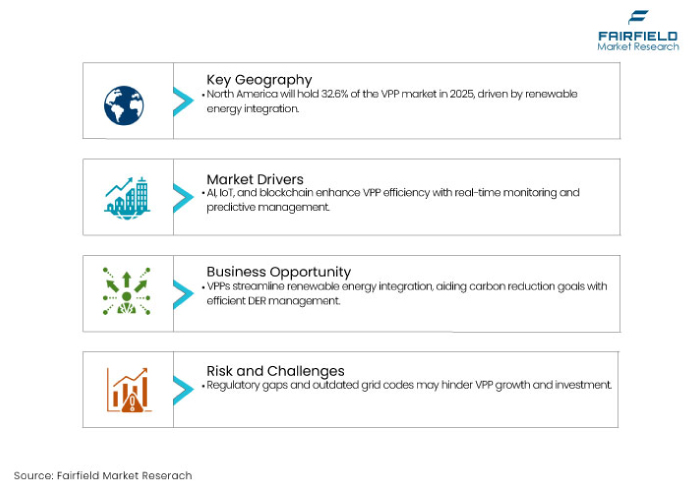
The operational efficiency of Virtual Power Plants (VPPs) is being improved by technologies such as blockchain, Artificial Intelligence (AI), and the Internet of Things (IoT). By enabling data analysis, predictive energy management, and real-time monitoring, these technologies increase the scalability and dependability of VPPs.
Meeting peak demand and controlling the unpredictability of renewable energy present difficulties for conventional centralized power systems. In order to provide load balancing, grid flexibility, and auxiliary services, VPPs combine dispersed resources. Owing to the aforementioned factors, the virtual power plant market is set to show steady growth.
- Environmental and Economic Benefits
VPPs offer cost savings by reducing the need for investment in new power plants and grid infrastructure. Utilities can rely on VPPs to manage peak loads and defer costly upgrades. By enabling greater use of renewable energy and reducing reliance on fossil fuel-based power generation, VPPs contribute to carbon emission reductions, aligning with global climate goals.
By offering backup power and grid stabilization services, VPPs improve energy resilience as extreme weather events and grid outages become more frequent. VPPs with battery storage systems can store extra renewable energy and release it during blackouts or periods of high demand. The above-mentioned factors are anticipated to propel the virtual power plant market by 2033.
Key Growth Barriers
- Policy Changes and Market Saturation in Developed Regions
The virtual power plant market may be hampered by the uneven regulatory environment in several areas. Sometimes the effectiveness of VPPs is restricted by out-of-date grid codes, ambiguous laws regarding the integration of Distributed Energy Resources (DERs). For example, investment and involvement in VPP initiatives may stall if governments do not provide incentives for decentralized energy systems or do not acknowledge the importance of VPPs in energy markets.
VPP implementation may have peaked in developed energy markets like parts of Europe and North America, especially in regions with high levels of DER adoption and renewable energy integration. Further growth may necessitate substantial innovation or broader applications once the initial wave of adoption declines, which could postpone the increase of VPP demand.
Virtual Power Plant Market Trends and Opportunities
- Integration into Smart Appliances and Home Batteries
Renewable energy sources like solar and wind have become more integrated into the grid as countries work to reach their carbon reduction goals. By combining Distributed Energy Resources (DERs), VPPs make this shift easier and enable more effective management of renewable outputs.
The trend of consumer involvement in energy markets is on the rise. In order to optimize energy use and offer demand response services, VPPs can make use of consumer-owned resources like smart appliances and home batteries. This makes the energy ecosystem more dynamic, thereby bolstering the virtual power plant market growth.
- Collaboration Efforts and Energy Storage Investments
Utilities, energy service providers, and technology providers could form beneficial alliances. Partnerships can increase VPPs' technological prowess and broaden their customer base. There will be chances to invest in infrastructure that facilitates grid modernization and DER integration as the demand for VPPs rises. To support distributed generating, this entails modernizing the transmission and distribution networks.
VPPs have the chance to improve grid stability and dependability as energy storage technologies, like batteries, proliferate. VPPs can provide energy during times of high demand by storing excess energy produced during peak production periods. The virtual power plant market is anticipated to see investments in novel management solutions.
Segments Covered in the Report
- Demand Response Gains Traction with Decarbonization Goals
By technology type, the demand response segment is set to dominate the global virtual power plant market by 2032. Power grids now experience instability and intermittency as a result of the rapid growth of renewable energy sources like wind and solar. By allowing for dynamic adjustments in electricity consumption to match the availability of renewable energy, demand response helps balance these variations.
Demand response programs, for example, might encourage users to charge electric vehicles or use energy-intensive appliances during times of excess solar generation. It is projected to lower dependency on backup power derived from fossil fuels. Achieving decarbonization objectives and improving the financial feasibility of renewable energy projects depend on this factor.
- Residential Segment to Lead Amid Rooftop Solar Panel Installations
The residential end use segment is anticipated to witness a steady growth rate in the virtual power plant market. Distributed Energy Resources (DERs) like Electric Vehicles (EVs), battery storage systems, and rooftop solar panels are surging significantly in the residential sector.
The resources are ideal additions to VPPs since they have the ability to produce, store, and distribute electricity. By combining energy from different sources, VPPs lessen dependency on centralized fossil fuel power plants and empower homes to take an active role in the energy environment. For example, VPPs incorporate Tesla's Powerwall systems, which are frequently installed in houses, to provide electricity during times of high demand.
Regional Analysis
- North America Sees Increasing Shift toward Renewable Energy
North America is set to generate a virtual power plant market share of 32.6% in 2025. The substantial transition to renewable energy sources is one of the main factors driving demand for VPP in North America. The need to successfully integrate these variable energy sources into the grid is surging as states and provinces establish new renewable energy targets.
A more dependable and steady energy supply is made possible by VPPs, which enable the aggregation of Distributed Energy Resources (DERs), including energy storage devices, wind turbines, and solar panels. VPPs can ensure a steady energy flow by mitigating the volatility of renewable energy generation by controlling these resources jointly.
- Energy Security and Resilience to Support Demand in Asia Pacific
Asia Pacific is anticipated to hold a share of 26.4% in the virtual power plant market in 2025. Several Asia Pacific nations are very concerned about energy security, especially those that depend on imported fossil fuels.
By lowering reliance on centralized power generation and diversifying energy sources, VPPs improve energy resilience. VPPs also help provide a more stable and secure energy supply by leveraging locally accessible renewable resources. This is especially important in areas where traditional energy infrastructure may be under risk from natural disasters.
Fairfield’s Competitive Landscape Analysis
The competitive landscape of the virtual power plant market is dynamic, with a mix of established energy companies, technology providers, and start-ups vying for share. To take advantage of Distributed Energy Resources (DERs) like solar panels, wind turbines, and battery storage systems, leading utility companies including Engie, Siemens, and General Electric are actively investing in VPP solutions.
Businesses that specialize in offering cutting-edge energy management platforms, Internet of Things technologies, and AI-driven analytics for optimizing VPP operations include Schneider Electric, ABB, and AutoGrid. Start-ups like Sunverge Energy and Next Kraftwerke are committed to creating cutting-edge software solutions that will improve the adaptability and scalability of VPPs.
Key Market Companies
- Next Kraftwerke GmbH
- Hitachi Ltd.
- TOSHIBA CORPORATION
- Siemens
- ABB
- Tesla
- Limejump Limited
- Sunverge Energy, Inc.
- Centrica plc
- AutoGrid Systems, Inc.
Global Virtual Power Plant Market is Segmented as-
By Technology Type
- Demand Response
- Distribution Energy Resource
- Mixed Asset
By End Use
- Commercial
- Industrial
- Residential
By Region
- North America
- Europe
- Asia Pacific
- Latin America
- Middle East & Africa
- Executive Summary
- Global Virtual Power Plant Market Snapshot
- Future Projections
- Key Market Trends
- Regional Snapshot, by Value, 2026
- Analyst Recommendations
- Market Overview
- Market Definitions and Segmentations
- Market Dynamics
- Drivers
- Restraints
- Market Opportunities
- Value Chain Analysis
- COVID-19 Impact Analysis
- Porter's Five Forces Analysis
- Impact of Russia-Ukraine Conflict
- PESTLE Analysis
- Regulatory Analysis
- Price Trend Analysis
- Current Prices and Future Projections, 2025-2033
- Price Impact Factors
- Global Virtual Power Plant Market Outlook, 2020 - 2033
- Global Virtual Power Plant Market Outlook, by Technology Type, Value (US$ Mn), 2020-2033
- Demand Response
- Distribution Energy Resource
- Mixed Asset
- Global Virtual Power Plant Market Outlook, by End Use, Value (US$ Mn), 2020-2033
- Commercial
- Industrial
- Residential
- Global Virtual Power Plant Market Outlook, by Region, Value (US$ Mn), 2020-2033
- North America
- Europe
- Asia Pacific
- Latin America
- Middle East & Africa
- Global Virtual Power Plant Market Outlook, by Technology Type, Value (US$ Mn), 2020-2033
- North America Virtual Power Plant Market Outlook, 2020 - 2033
- North America Virtual Power Plant Market Outlook, by Technology Type, Value (US$ Mn), 2020-2033
- Demand Response
- Distribution Energy Resource
- Mixed Asset
- North America Virtual Power Plant Market Outlook, by End Use, Value (US$ Mn), 2020-2033
- Commercial
- Industrial
- Residential
- North America Virtual Power Plant Market Outlook, by Country, Value (US$ Mn), 2020-2033
- U.S. Virtual Power Plant Market Outlook, by Technology Type, 2020-2033
- U.S. Virtual Power Plant Market Outlook, by End Use, 2020-2033
- Canada Virtual Power Plant Market Outlook, by Technology Type, 2020-2033
- Canada Virtual Power Plant Market Outlook, by End Use, 2020-2033
- BPS Analysis/Market Attractiveness Analysis
- North America Virtual Power Plant Market Outlook, by Technology Type, Value (US$ Mn), 2020-2033
- Europe Virtual Power Plant Market Outlook, 2020 - 2033
- Europe Virtual Power Plant Market Outlook, by Technology Type, Value (US$ Mn), 2020-2033
- Demand Response
- Distribution Energy Resource
- Mixed Asset
- Europe Virtual Power Plant Market Outlook, by End Use, Value (US$ Mn), 2020-2033
- Commercial
- Industrial
- Residential
- Europe Virtual Power Plant Market Outlook, by Country, Value (US$ Mn), 2020-2033
- Germany Virtual Power Plant Market Outlook, by Technology Type, 2020-2033
- Germany Virtual Power Plant Market Outlook, by End Use, 2020-2033
- Italy Virtual Power Plant Market Outlook, by Technology Type, 2020-2033
- Italy Virtual Power Plant Market Outlook, by End Use, 2020-2033
- France Virtual Power Plant Market Outlook, by Technology Type, 2020-2033
- France Virtual Power Plant Market Outlook, by End Use, 2020-2033
- U.K. Virtual Power Plant Market Outlook, by Technology Type, 2020-2033
- U.K. Virtual Power Plant Market Outlook, by End Use, 2020-2033
- Spain Virtual Power Plant Market Outlook, by Technology Type, 2020-2033
- Spain Virtual Power Plant Market Outlook, by End Use, 2020-2033
- Russia Virtual Power Plant Market Outlook, by Technology Type, 2020-2033
- Russia Virtual Power Plant Market Outlook, by End Use, 2020-2033
- Rest of Europe Virtual Power Plant Market Outlook, by Technology Type, 2020-2033
- Rest of Europe Virtual Power Plant Market Outlook, by End Use, 2020-2033
- BPS Analysis/Market Attractiveness Analysis
- Europe Virtual Power Plant Market Outlook, by Technology Type, Value (US$ Mn), 2020-2033
- Asia Pacific Virtual Power Plant Market Outlook, 2020 - 2033
- Asia Pacific Virtual Power Plant Market Outlook, by Technology Type, Value (US$ Mn), 2020-2033
- Demand Response
- Distribution Energy Resource
- Mixed Asset
- Asia Pacific Virtual Power Plant Market Outlook, by End Use, Value (US$ Mn), 2020-2033
- Commercial
- Industrial
- Residential
- Asia Pacific Virtual Power Plant Market Outlook, by Country, Value (US$ Mn), 2020-2033
- China Virtual Power Plant Market Outlook, by Technology Type, 2020-2033
- China Virtual Power Plant Market Outlook, by End Use, 2020-2033
- Japan Virtual Power Plant Market Outlook, by Technology Type, 2020-2033
- Japan Virtual Power Plant Market Outlook, by End Use, 2020-2033
- South Korea Virtual Power Plant Market Outlook, by Technology Type, 2020-2033
- South Korea Virtual Power Plant Market Outlook, by End Use, 2020-2033
- India Virtual Power Plant Market Outlook, by Technology Type, 2020-2033
- India Virtual Power Plant Market Outlook, by End Use, 2020-2033
- Southeast Asia Virtual Power Plant Market Outlook, by Technology Type, 2020-2033
- Southeast Asia Virtual Power Plant Market Outlook, by End Use, 2020-2033
- Rest of SAO Virtual Power Plant Market Outlook, by Technology Type, 2020-2033
- Rest of SAO Virtual Power Plant Market Outlook, by End Use, 2020-2033
- BPS Analysis/Market Attractiveness Analysis
- Asia Pacific Virtual Power Plant Market Outlook, by Technology Type, Value (US$ Mn), 2020-2033
- Latin America Virtual Power Plant Market Outlook, 2020 - 2033
- Latin America Virtual Power Plant Market Outlook, by Technology Type, Value (US$ Mn), 2020-2033
- Demand Response
- Distribution Energy Resource
- Mixed Asset
- Latin America Virtual Power Plant Market Outlook, by End Use, Value (US$ Mn), 2020-2033
- Commercial
- Industrial
- Residential
- Latin America Virtual Power Plant Market Outlook, by Country, Value (US$ Mn), 2020-2033
- Brazil Virtual Power Plant Market Outlook, by Technology Type, 2020-2033
- Brazil Virtual Power Plant Market Outlook, by End Use, 2020-2033
- Mexico Virtual Power Plant Market Outlook, by Technology Type, 2020-2033
- Mexico Virtual Power Plant Market Outlook, by End Use, 2020-2033
- Argentina Virtual Power Plant Market Outlook, by Technology Type, 2020-2033
- Argentina Virtual Power Plant Market Outlook, by End Use, 2020-2033
- Rest of LATAM Virtual Power Plant Market Outlook, by Technology Type, 2020-2033
- Rest of LATAM Virtual Power Plant Market Outlook, by End Use, 2020-2033
- BPS Analysis/Market Attractiveness Analysis
- Latin America Virtual Power Plant Market Outlook, by Technology Type, Value (US$ Mn), 2020-2033
- Middle East & Africa Virtual Power Plant Market Outlook, 2020 - 2033
- Middle East & Africa Virtual Power Plant Market Outlook, by Technology Type, Value (US$ Mn), 2020-2033
- Demand Response
- Distribution Energy Resource
- Mixed Asset
- Middle East & Africa Virtual Power Plant Market Outlook, by End Use, Value (US$ Mn), 2020-2033
- Commercial
- Industrial
- Residential
- Middle East & Africa Virtual Power Plant Market Outlook, by Country, Value (US$ Mn), 2020-2033
- GCC Virtual Power Plant Market Outlook, by Technology Type, 2020-2033
- GCC Virtual Power Plant Market Outlook, by End Use, 2020-2033
- South Africa Virtual Power Plant Market Outlook, by Technology Type, 2020-2033
- South Africa Virtual Power Plant Market Outlook, by End Use, 2020-2033
- Egypt Virtual Power Plant Market Outlook, by Technology Type, 2020-2033
- Egypt Virtual Power Plant Market Outlook, by End Use, 2020-2033
- Nigeria Virtual Power Plant Market Outlook, by Technology Type, 2020-2033
- Nigeria Virtual Power Plant Market Outlook, by End Use, 2020-2033
- Rest of Middle East Virtual Power Plant Market Outlook, by Technology Type, 2020-2033
- Rest of Middle East Virtual Power Plant Market Outlook, by End Use, 2020-2033
- BPS Analysis/Market Attractiveness Analysis
- Middle East & Africa Virtual Power Plant Market Outlook, by Technology Type, Value (US$ Mn), 2020-2033
- Competitive Landscape
- Company Vs Segment Heatmap
- Company Market Share Analysis, 2025
- Competitive Dashboard
- Company Profiles
- Next Kraftwerke GmbH
- Company Overview
- Product Portfolio
- Financial Overview
- Business Strategies and Developments
- Hitachi Ltd.
- TOSHIBA CORPORATION
- Siemens
- ABB
- Tesla
- Limejump Limited
- Sunverge Energy, Inc.
- Centrica plc
- AutoGrid Systems, Inc.
- Next Kraftwerke GmbH
- Appendix
- Research Methodology
- Report Assumptions
- Acronyms and Abbreviations
|
BASE YEAR |
HISTORICAL DATA |
FORECAST PERIOD |
UNITS |
|||
 |
2025 |
 |
2019 - 2024 |
 |
2026 - 2033 |
Value: US$ Billion |
|
REPORT FEATURES |
DETAILS |
|
Technology Type Coverage |
|
|
End Use Coverage |
|
|
Geographical Coverage |
|
|
Leading Companies |
|
|
Report Highlights |
Key Market Indicators, Macro-micro economic impact analysis, Technological Roadmap, Key Trends, Driver, Restraints, and Future Opportunities & Revenue Pockets, Porter’s 5 Forces Analysis, Historical Trend (2019-2023), Market Estimates and Forecast, Market Dynamics, Industry Trends, Competition Landscape, Category, Region, Country-wise Trends & Analysis, COVID-19 Impact Analysis (Demand and Supply Chain) |
Our Research Methodology
Considering the volatility of business today, traditional approaches to strategizing a game plan can be unfruitful if not detrimental. True ambiguity is no way to determine a forecast. A myriad of predetermined factors must be accounted for such as the degree of risk involved, the magnitude of circumstances, as well as conditions or consequences that are not known or unpredictable. To circumvent binary views that cast uncertainty, the application of market research intelligence to strategically posture, move, and enable actionable outcomes is necessary.
View Methodology
Quality Assured
Rigorous Validation Process

Confidentiality Assured
End-to-end Data Security

Custom Research Services
Tailored To Your Objectives
FAQs
The industry is set to reach USD 5.6 Bn in 2026.
Hitachi Ltd., Siemens, and Tesla are the most influential entities.
The industry is anticipated to witness a CAGR of 21% through 2033.
Increasing shift toward renewable energy is set to be a leading driver.
Asia Pacific is set to generate a share of 26.4% in 2025.
Related Reports
Waste Pre-processing For Alternate Fuel and Raw Materials (AFR) Market Forecast - 2033
The global waste pre-processing for alternate fuel and raw materials market is set to reach US$ 7.30 Bn by 2033, growing at an 8.6% CAGR from 2026-2033
Micro Turbine Market Insights, Competitive Landscape, and Market Forecast 2033
The micro turbine market is projected to rise from US$2.4 billion in 2026 to US$4.1 billion by 2033 at a 7.9% CAGR, driven by decentralized energy generation.
U.S. Fire Protection System Market Insights, Competitive Landscape, and Market Forecast 2026–2033
U.S. Fire Protection System Market is projected to reach US$12.86 billion by 2033, driven by stringent safety regulations and smart systems.
Underfloor Heating Market Insights, Competitive Landscape, and Market Forecast 2026–2033
Underfloor Heating Market is projected to reach US$9.72 billion by 2033, driven by energy efficiency, smart homes, premium housing, and retrofit demand.
Power Boiler Market Insights, Competitive Landscape, and Market Forecast 2026–2033
Power Boiler Market is projected to reach US$31.38 billion by 2033, driven by industrial modernization, power generation expansion, fleet replacement
Offshore Mooring Systems Market Insights, Competitive Landscape, and Market Forecast 2026–2033
Offshore Mooring Systems Market is projected to reach US$2.28 billion by 2033, driven by deepwater investments, FPSO deployment, floating wind projects