



3D Drawing Doodle Printing Pen Market
3D Drawing Doodle Printing Pen Market Size, Share, Insights, Competitive Landscape, and Forecast 2026 to 2033
3D Drawing Doodle Printing Pen Market Size and Trend Analysis
Is the 3D Doodle Pen Market Still Growing Steadily?
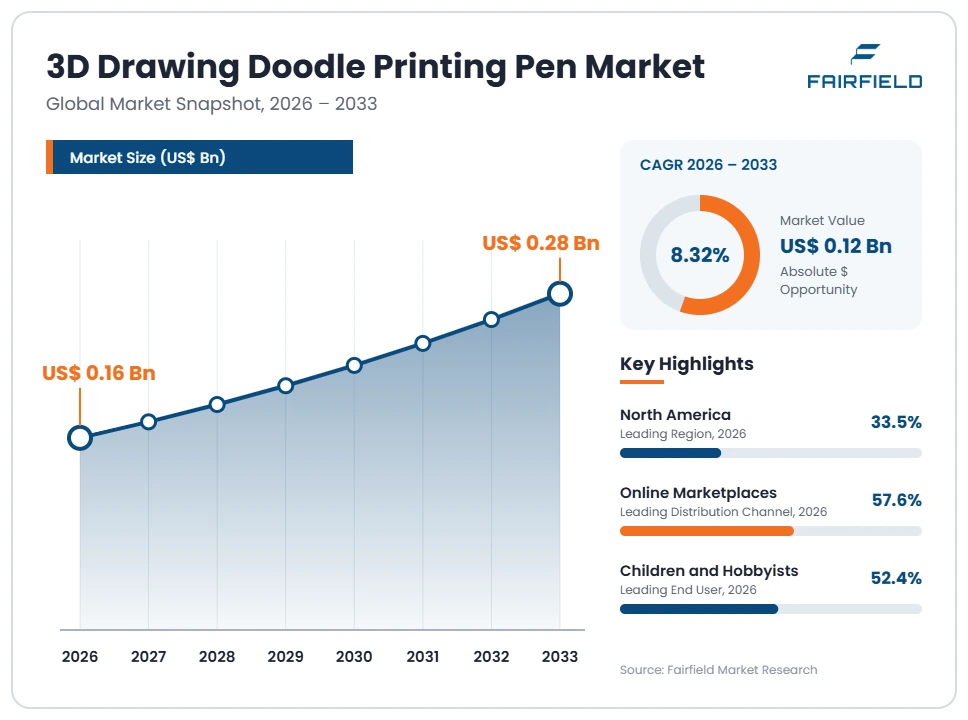
The global 3D Drawing Doodle Printing Pen market size is expected to be valued at US$ 0.16 billion in 2026 and projected to reach US$ 0.28 billion by 2033, growing at a CAGR of 8.32% between 2026 and 2033.
The market grew at a 6.5% CAGR from 2020 to 2025, reaching about US$ 148 million in 2025 from roughly US$ 108 million in 2020, with a pandemic-era spike in home craft buying followed by a flat period. Three factors support the forecast. School and makerspace programmes now buy pens in classroom sets rather than as single units. Low-temperature polycaprolactone models have opened the category to younger children. Filament refills generate repeat purchases from an installed base. This remains a small, price-sensitive consumer hardware category rather than a professional tool market.
Key Report Takeaways
- By Product Type: High-Temperature Filament Pens held 46.8% share in 2026, while Low-Temperature Polycaprolactone Pens are projected to expand at an 11.4% CAGR through 2033, because a cool tip removes the burn objection for younger users.
- By Filament Material: PLA held 43.2% share in 2026, while Polycaprolactone is projected to expand at a 12.1% CAGR through 2033, as low-temperature pen sales pull a matching refill format behind them.
- By End User: Children and Hobbyists held 52.4% share in 2026, while Schools and Education Institutions are projected to expand at a 10.9% CAGR through 2033, driven by funded classroom technology and design programmes.
- By Distribution Channel: Online Marketplaces held 57.6% share in 2026, while Brand Websites and Direct-to-Consumer are projected to expand at an 11.8% CAGR through 2033, as compliance duties push brands toward controlled channels.
- By Geography: North America held 33.5% share in 2026, while Asia Pacific is projected to expand at a 10.6% CAGR through 2033, supported by manufacturing depth and rising domestic demand in China and India.
Global 3D Drawing Doodle Printing Pen Market Trends and Insights
Drivers Impact Analysis
Two demand sources explain most of the additional pen and filament volume expected through 2033.
| Driver | Impact on CAGR Forecast | Geographic Relevance | Impact Timeline |
| School and makerspace design programmes buying pens in class sets | High | North America, Europe, Asia Pacific | Medium term 2–4 years |
| Low-temperature polycaprolactone pens widening the usable age range | High | Global | Short term ≤2 years |
Classroom Design Programmes Turn 3D Drawing Pens Into Institutional Equipment Purchases
Education buying has changed the order size in this category. A parent buys one pen, but a school buys thirty with spare nozzles, charging trolleys, and a term’s filament supply, then repeats the order as consumables run out. That converts an impulse gift product into a budgeted equipment line with predictable reorder behaviour.
The mechanism is curriculum rather than technology. Design, technology, and art programmes need a way to let students build three-dimensional objects without the queue, cost, and supervision burden of a desktop printer. A pen produces a result in minutes, needs no slicing software, and costs a fraction of a printer per student. Procurement teams require CE or UKCA marking and evidence of conformity with the EN 71 series before purchase, which favours established brands over unbranded marketplace stock and raises the average selling price in this channel.
Low-Temperature Polycaprolactone Pens Widen the Usable Age Range for 3D Doodling
Cool-tip pens have enlarged the addressable buyer base more than any design change in the category. High-temperature pens extrude at temperatures that make them unsuitable for younger children, which excluded a large part of the toy market. Polycaprolactone softens at far lower temperatures, so manufacturers can market pens to primary-age users and parents will buy them.
The causal mechanism is material chemistry meeting safety expectation. Polycaprolactone is a low-melting biodegradable polyester that extrudes while warm rather than hot, and it sets quickly enough to hold a drawn shape. That lets a pen avoid the exposed hot tip that dominates parental objections and product reviews. Conformity with EN 71-1 on mechanical and physical properties and EN 71-3 on the migration of certain elements is easier to evidence for a cool-running device, which also eases retail listing decisions.
Restraints Impact Analysis
Two constraints hold back both unit volume and the margin available on each pen sold.
| Restraint | Impact on CAGR Forecast | Geographic Relevance | Impact Timeline |
| Hot tip burn hazard and filament emission concerns limiting retail placement | Medium | Europe, North America | Medium term 2–4 years |
| Commodity clone supply and marketplace price competition compressing margins | High | Global | Long term ≥4 years |
Burn Hazard and Filament Emission Concerns Limit Retail Placement of Hot-Tip Pens
Safety perception restricts where high-temperature pens can be sold and to whom. Mainstream toy buyers hesitate to stock a device with an exposed heated nozzle, so many pens are listed as hobby or electronics products with higher recommended ages. That narrows shelf access and shifts volume toward online channels where margins are thinner.
Two technical issues underlie the concern. The extrusion tip operates well above skin contact safety thresholds, and younger users handle pens close to the nozzle while drawing. Separately, melting thermoplastic releases volatile organic compounds and ultrafine particles, with ABS producing substantially more than PLA at typical extrusion temperatures. Ventilation guidance is rarely enforced in a bedroom or classroom. Compliance with Directive 2009/48/EC and ASTM F963 addresses mechanical and chemical hazards, but emission behaviour during use remains a reputational issue manufacturers must manage.
Commodity Clone Supply and Marketplace Pricing Compress 3D Pen Hardware Margins
Price competition is the defining commercial problem in this category. A working extrusion pen requires a heater, a small motor, a feed mechanism, and a controller, all of which are commodity components available from the same contract manufacturers. Dozens of near-identical products therefore reach marketplaces within months of any successful design, and prices converge quickly.
The cost structure explains why margins do not recover. Manufacturing is concentrated in Guangdong province, where shared tooling and component sourcing mean a newcomer carries almost no development cost. Branded suppliers must absorb testing to the EN 71 series and ASTM F963, certification fees, packaging, instruction translation, and product liability cover, while a clone seller often absorbs none of it. Advertising costs on marketplaces then take a further share of a retail price that frequently sits below thirty dollars.
Market Opportunities
Branded Filament Refill Programmes Open a Recurring Pool Beyond One-Off Pen Sales
Filament refills represent the only durable annuity in a category where hardware sells once. An active user consumes strands continuously, and over a pen’s life the cumulative spend on refills can exceed the original purchase. Capturing that spend rather than losing it to generic third-party packs is the clearest margin opportunity available to brands.
Established pen makers with loyal users and education accounts are best placed to capture it, since schools reorder filament on a term cycle and value guaranteed compatibility. Colour sets, glow and specialty finishes, and themed project packs all raise the value of a single reorder. Certification helps defend the position: refills sold for children’s products must evidence conformity with EN 71-3 on element migration, which generic suppliers often cannot document, giving branded filament a compliance argument alongside the performance one.
Marketplace Compliance Enforcement Opens Share for Certified 3D Pen Brands in Europe
Tighter online marketplace obligations create a share-shift opportunity for compliant suppliers. This category sells overwhelmingly through marketplaces, where unbranded, untested pens have long competed on price alone. As platforms are required to verify trader details and act on dangerous product notifications, the cheapest non-compliant listings become harder to sustain.
Brands that already hold full technical files and test reports can capture the vacated volume, and the demand comes from the same price-conscious parents and schools buying today. Regulation (EU) 2023/988 on general product safety places duties on online marketplaces, including trader traceability and cooperation with authorities. The proposed Toy Safety Regulation intended to replace Directive 2009/48/EC would add a digital product passport for toys, making conformity evidence machine-readable at the point of listing and considerably harder to fabricate or copy between unrelated sellers.
Segment Analysis
- By Product Type: Hot-Tip Pens Hold the Base While Cool-Tip Models Climb Fastest
High-Temperature Filament Pens led with 46.8% share in 2026, because they print the widest range of materials, bond layers firmly, and produce structures rigid enough for models that hold their shape. Hobbyists and older students prefer them. Low-Temperature Polycaprolactone Pens grow fastest at an 11.4% CAGR to 2033, since a cool tip removes the single objection that keeps parents of younger children out of the category.
Cordless Rechargeable Pens remove the mains lead that restricts drawing freedom and are increasingly the default classroom choice. Professional Precision Pens serve model makers, prop builders, and repair work with finer nozzles and adjustable feed control. The commercial implication is that product type now maps directly onto buyer age, and brands increasingly maintain parallel ranges rather than a single flagship device.
- By Filament Material: PLA Dominates Refill Volume While Polycaprolactone Gains Share Quickest
PLA held 43.2% share in 2026, because it extrudes at a moderate temperature, smells mild, is derived from plant starch, and emits far fewer ultrafine particles than styrenic alternatives. Schools specify it almost exclusively. Polycaprolactone expands fastest at a 12.1% CAGR through 2033, pulled along by low-temperature pen sales that require a matching refill format.
ABS retains a following among hobbyists who want higher impact strength and easier sanding or acetone smoothing, but its emission profile has pushed it out of the education channel. Specialty and Composite Filaments including wood-filled, flexible, glow-in-the-dark, and colour-changing strands carry the highest margin per gram. Refill compliance with EN 71-3 on element migration has become a purchasing criterion rather than a technical footnote.
- By End User: Children and Hobbyists Buy Most While Schools Expand Their Share Fastest
Children and Hobbyists accounted for 52.4% of purchases in 2026, because the product is bought primarily as a gift and sits in the same consideration set as craft kits and construction toys. Volume peaks sharply in the fourth quarter. Schools and Education Institutions grow fastest at a 10.9% CAGR through 2033, as design and technology programmes adopt pens as low-cost alternatives to shared desktop printers.
Professional Designers and Artists use pens for rapid sketch models, jewellery concepts, and set decoration, buying fewer units at higher prices. Industrial and Prototyping Users apply them to weld repairs and quick fixture modifications on printed parts. For brands, the education channel is strategically important because it buys certified products, reorders filament predictably, and resists discount-driven switching.
- By Distribution Channel: Marketplaces Carry Volume While Direct Brand Sales Grow Fastest
Online Marketplaces led with 57.6% share in 2026, reflecting a low unit price, strong impulse purchase behaviour, and the ease with which new entrants list products without retail negotiation. Search ranking, reviews, and price are the decisive variables. Brand Websites and Direct-to-Consumer channels grow fastest at an 11.8% CAGR to 2033, as brands move refill subscriptions and bundled project kits onto their own storefronts.
Specialty Toy and Hobby Retailers provide demonstration space that converts undecided buyers, while Mass Merchandisers and Electronics Chains take seasonal volume at the lowest prices. Compliance obligations under Regulation (EU) 2023/988 fall on marketplaces as well as sellers, which raises listing requirements. The implication is that owned channels are becoming a margin defence rather than a minor supplement.
Geography Analysis
- Which Region Is Leading the 3D Drawing Doodle Printing Pen Market?
North America leads with 33.5% share in 2026, because the United States combines high discretionary spending on children’s technology products, an established maker culture, and the brands that created the category. Canada contributes steady education and hobby demand.
Three causes sustain the position. Household gifting budgets for science and craft toys are the largest of any region, and the fourth quarter alone carries a disproportionate share of annual sales. School and library makerspace programmes buy pens in sets alongside desktop printers. The Consumer Product Safety Improvement Act and the ASTM F963 toy safety standard set a clear compliance baseline that larger retailers enforce before listing.
The regional change underway is a shift in spending from hardware to refills and project kits, as an installed base built over a decade now reorders filament rather than buying first pens.
- Europe Sets the Conformity Requirements That Shape 3D Pen Specifications
Europe held 27.8% share in 2026, with Germany, the United Kingdom, France, Italy, and Poland the largest national markets. The region’s influence is regulatory rather than volumetric, since conformity rules written here determine how pens are designed and documented everywhere.
Directive 2009/48/EC on the safety of toys and the EN 71 series govern the category, with EN 71-1 covering mechanical and physical properties and EN 71-3 limiting the migration of certain elements. Regulation (EU) 2023/988 on general product safety extends duties to online marketplaces, and the proposed Toy Safety Regulation would introduce a digital product passport.
CE and UKCA marking requirements raise the cost of entry for small sellers. The clearest regional opportunity lies in certified education supply, where procurement rules exclude undocumented products entirely.
- Which Region Is Growing Fastest in the 3D Drawing Doodle Printing Pen Market?
Asia Pacific is growing fastest at a 10.6% CAGR between 2026 and 2033, from 29.4% share in 2026, because the region manufactures almost all of these pens and domestic demand is now rising alongside export volume.
The causes are supply and income. Guangdong province concentrates the heater, motor, and controller supply chain, so local brands reach market faster and cheaper than importers anywhere else. Chinese domestic platforms have built a large consumer base for low-priced creative toys. India’s education technology spending and growing middle-class gifting market are adding volume, while Japan and South Korea support a smaller premium segment focused on craft and model making.
The change shaping the region is domestic brand building, as manufacturers that once supplied others under white label now market certified products under their own names.
- Latin America Grows on Marketplace Access and School Technology Programmes
Latin America held 5.4% share in 2026, with Brazil and Mexico accounting for most of it and Argentina, Chile, and Colombia following. Growth tracks the expansion of regional online marketplaces, which brought low-cost creative products within reach of middle-income households for the first time.
Public and private school technology programmes have introduced pens into design classes in several Brazilian and Mexican states, usually in small sets rather than one per student.
Barriers are mainly economic. Import duties and currency movement push retail prices above comparable levels elsewhere, filament refills are often unavailable locally so users substitute generic strands of uncertain quality, and after-sales support is limited. The opportunity lies in local filament packing and distribution, which would stabilise refill supply and protect the installed base from switching.
- Middle East & Africa Adopts 3D Pens Through Gulf Retail and Education Investment
Middle East & Africa represented 3.9% share in 2026, the smallest regional position, concentrated in the United Arab Emirates, Saudi Arabia, Qatar, Egypt, Turkey, and South Africa. Gulf retail and e-commerce platforms stock international brands at prices close to those in other high-income markets, supported by strong household spending on children’s technology.
National education reform programmes in Saudi Arabia and the United Arab Emirates have funded school innovation laboratories, which buy pens alongside robotics kits and desktop printers.
Constraints are real. Market size per country is small, which discourages brands from local registration and support, heat and humidity shorten filament shelf life without sealed packaging, and counterfeit goods circulate widely through informal channels. The clearest opportunity is distributor-led education bundles that package certified pens, filament, lesson plans, and teacher training into a single tender-ready offer.
Competitive Landscape
The market is fragmented and shows no sign of consolidating. A handful of recognised brands including 3Doodler, MYNT3D, AIO Robotics, and SCRIB3D hold the premium and education positions, while hundreds of Chinese manufacturers and marketplace-only labels such as those operating around Shenzhen Myriwell Technology and Shenzhen Sunlu Industrial supply the value tier. Barriers to entry are minimal because heaters, motors, feed mechanisms, and controllers are standard components sourced from the same industrial cluster. Acquisition is rare, since there is little proprietary technology worth buying.
Competition turns on trust and distribution rather than performance. The decisive factors are marketplace search ranking, review volume, recommended age labelling, visible conformity marking, refill availability, and the perceived safety of the tip. Education buyers add technical files and teacher support material to that list. New entrants arrive continuously from consumer electronics and stationery manufacturing, typically copying a proven form factor and competing on price, while a smaller group differentiates through low-temperature polycaprolactone designs and cordless operation.
Strategic activity concentrates on three themes. Brands are extending from single pens into bundled kits, stencil packs, and lesson-aligned classroom sets, because bundles resist direct price comparison. Several are building refill subscription programmes to convert one-off buyers into repeat customers. Others are investing in compliance documentation ahead of tighter marketplace obligations, treating certification as a commercial barrier that excludes untested competitors rather than as a cost.
The prevailing strategic direction is a split between two models. One group pursues branded, certified, education-focused supply with recurring filament revenue, and the other pursues high-volume, low-margin marketplace distribution with minimal product differentiation.
Recent Industry Developments
- August 2008: The Consumer Product Safety Improvement Act was signed into law in the United States – introduced mandatory third-party testing and tracking labels for children’s products, raising the compliance floor for pens sold as toys.
- June 2009: The European Union adopted Directive 2009/48/EC on the safety of toys – established the essential safety requirements and the EN 71 test route that still define conformity for this category.
- May 2023: The European Union adopted Regulation (EU) 2023/988 on general product safety – created traceability and recall duties for online marketplaces, the dominant sales channel for these products.
- July 2023: The European Commission published its proposal for a Toy Safety Regulation to replace Directive 2009/48/EC – proposed a digital product passport that would make conformity evidence machine-readable at the point of listing.
- December 2024: Regulation (EU) 2023/988 became applicable across the European Union, replacing the earlier general product safety directive – shifted enforcement pressure onto platforms hosting unbranded pen listings.
Companies Covered in the Report
- WobbleWorks LLC (3Doodler)
- MYNT3D
- AIO Robotics, Inc.
- SCRIB3D
- Shenzhen Myriwell Technology Co., Ltd.
- Shenzhen Sunlu Industrial Co., Ltd.
- Lix Pen Ltd.
- Tecboss
- Dikale
3D Drawing Doodle Printing Pen Market Report Scope
| Metric | Value |
| Study Period | 2020–2033 |
| Market Size 2026 | US$ 0.16 Billion |
| Market Size 2033 | US$ 0.28 Billion |
| CAGR 2026–2033 | 8.32% |
| Absolute Dollar Opportunity | US$ 0.12 Billion |
| Largest Market | North America |
| Fastest-Growing Market | Asia Pacific |
| Market Concentration | Low |
| Major Players | 3Doodler, MYNT3D, AIO Robotics, SCRIB3D, Shenzhen Myriwell Technology |
3D Drawing Doodle Printing Pen Market Segmentation
Product Type
- High-Temperature Filament Pens
- Low-Temperature Polycaprolactone Pens
- Cordless Rechargeable Pens
- Professional Precision Pens
Filament Material
- PLA
- ABS
- Polycaprolactone
- Specialty and Composite Filaments
End User
- Children and Hobbyists
- Schools and Education Institutions
- Professional Designers and Artists
- Industrial and Prototyping Users
Distribution Channel
- Online Marketplaces
- Brand Websites and Direct-to-Consumer
- Specialty Toy and Hobby Retailers
- Mass Merchandisers and Electronics Chains
Regions
- North America
- Europe
- Asia Pacific
- Latin America
- Middle East & Africa
- Executive Summary
- Global 3D Drawing Doodle Printing Pen Market Snapshot
- Future Projections
- Key Report Takeaways
- Regional Snapshot
- Market Overview
- Market Definition and Report Scope
- Historical Trends 2020–2025
- Market Dynamics
- Drivers
- Classroom Design Programmes Turn 3D Drawing Pens Into Institutional Equipment Purchases
- Low-Temperature Polycaprolactone Pens Widen the Usable Age Range for 3D Doodling
- Restraints
- Burn Hazard and Filament Emission Concerns Limit Retail Placement of Hot-Tip Pens
- Commodity Clone Supply and Marketplace Pricing Compress 3D Pen Hardware Margins
- Market Opportunities
- Branded Filament Refill Programmes Open a Recurring Pool Beyond One-Off Pen Sales
- Marketplace Compliance Enforcement Opens Share for Certified 3D Pen Brands in Europe
- Drivers
- Global 3D Drawing Doodle Printing Pen Market Outlook, 2020–2033
- Global 3D Drawing Doodle Printing Pen Market Outlook, by Product Type, Value (US$ Billion), 2020–2033
- High-Temperature Filament Pens
- Low-Temperature Polycaprolactone Pens
- Cordless Rechargeable Pens
- Professional Precision Pens
- Global 3D Drawing Doodle Printing Pen Market Outlook, by Filament Material, Value (US$ Billion), 2020–2033
- PLA
- ABS
- Polycaprolactone
- Specialty and Composite Filaments
- Global 3D Drawing Doodle Printing Pen Market Outlook, by End User, Value (US$ Billion), 2020–2033
- Children and Hobbyists
- Schools and Education Institutions
- Professional Designers and Artists
- Industrial and Prototyping Users
- Global 3D Drawing Doodle Printing Pen Market Outlook, by Distribution Channel, Value (US$ Billion), 2020–2033
- Online Marketplaces
- Brand Websites and Direct-to-Consumer
- Specialty Toy and Hobby Retailers
- Mass Merchandisers and Electronics Chains
- Global 3D Drawing Doodle Printing Pen Market Outlook, by Region, Value (US$ Billion), 2020–2033
- North America
- Europe
- Asia Pacific
- Latin America
- Middle East & Africa
- Global 3D Drawing Doodle Printing Pen Market Outlook, by Product Type, Value (US$ Billion), 2020–2033
- North America 3D Drawing Doodle Printing Pen Market Outlook, 2020–2033
- North America 3D Drawing Doodle Printing Pen Market Outlook, by Product Type, Value (US$ Billion), 2020–2033
- High-Temperature Filament Pens
- Low-Temperature Polycaprolactone Pens
- Cordless Rechargeable Pens
- Professional Precision Pens
- North America 3D Drawing Doodle Printing Pen Market Outlook, by Filament Material, Value (US$ Billion), 2020–2033
- PLA
- ABS
- Polycaprolactone
- Specialty and Composite Filaments
- North America 3D Drawing Doodle Printing Pen Market Outlook, by End User, Value (US$ Billion), 2020–2033
- Children and Hobbyists
- Schools and Education Institutions
- Professional Designers and Artists
- Industrial and Prototyping Users
- North America 3D Drawing Doodle Printing Pen Market Outlook, by Distribution Channel, Value (US$ Billion), 2020–2033
- Online Marketplaces
- Brand Websites and Direct-to-Consumer
- Specialty Toy and Hobby Retailers
- Mass Merchandisers and Electronics Chains
- North America 3D Drawing Doodle Printing Pen Market Outlook, by Country, Value (US$ Billion), 2020–2033
- United States 3D Drawing Doodle Printing Pen Market Outlook, by Product Type, 2020–2033
- United States 3D Drawing Doodle Printing Pen Market Outlook, by Filament Material, 2020–2033
- United States 3D Drawing Doodle Printing Pen Market Outlook, by End User, 2020–2033
- United States 3D Drawing Doodle Printing Pen Market Outlook, by Distribution Channel, 2020–2033
- Canada 3D Drawing Doodle Printing Pen Market Outlook, by Product Type, 2020–2033
- Canada 3D Drawing Doodle Printing Pen Market Outlook, by Filament Material, 2020–2033
- Canada 3D Drawing Doodle Printing Pen Market Outlook, by End User, 2020–2033
- Canada 3D Drawing Doodle Printing Pen Market Outlook, by Distribution Channel, 2020–2033
- North America 3D Drawing Doodle Printing Pen Market Outlook, by Product Type, Value (US$ Billion), 2020–2033
- Europe 3D Drawing Doodle Printing Pen Market Outlook, 2020–2033
- Europe 3D Drawing Doodle Printing Pen Market Outlook, by Product Type, Value (US$ Billion), 2020–2033
- High-Temperature Filament Pens
- Low-Temperature Polycaprolactone Pens
- Cordless Rechargeable Pens
- Professional Precision Pens
- Europe 3D Drawing Doodle Printing Pen Market Outlook, by Filament Material, Value (US$ Billion), 2020–2033
- PLA
- ABS
- Polycaprolactone
- Specialty and Composite Filaments
- Europe 3D Drawing Doodle Printing Pen Market Outlook, by End User, Value (US$ Billion), 2020–2033
- Children and Hobbyists
- Schools and Education Institutions
- Professional Designers and Artists
- Industrial and Prototyping Users
- Europe 3D Drawing Doodle Printing Pen Market Outlook, by Distribution Channel, Value (US$ Billion), 2020–2033
- Online Marketplaces
- Brand Websites and Direct-to-Consumer
- Specialty Toy and Hobby Retailers
- Mass Merchandisers and Electronics Chains
- Europe 3D Drawing Doodle Printing Pen Market Outlook, by Country, Value (US$ Billion), 2020–2033
- Germany 3D Drawing Doodle Printing Pen Market Outlook, by Product Type, 2020–2033
- Germany 3D Drawing Doodle Printing Pen Market Outlook, by Filament Material, 2020–2033
- Germany 3D Drawing Doodle Printing Pen Market Outlook, by End User, 2020–2033
- Germany 3D Drawing Doodle Printing Pen Market Outlook, by Distribution Channel, 2020–2033
- United Kingdom 3D Drawing Doodle Printing Pen Market Outlook, by Product Type, 2020–2033
- United Kingdom 3D Drawing Doodle Printing Pen Market Outlook, by Filament Material, 2020–2033
- United Kingdom 3D Drawing Doodle Printing Pen Market Outlook, by End User, 2020–2033
- United Kingdom 3D Drawing Doodle Printing Pen Market Outlook, by Distribution Channel, 2020–2033
- France 3D Drawing Doodle Printing Pen Market Outlook, by Product Type, 2020–2033
- France 3D Drawing Doodle Printing Pen Market Outlook, by Filament Material, 2020–2033
- France 3D Drawing Doodle Printing Pen Market Outlook, by End User, 2020–2033
- France 3D Drawing Doodle Printing Pen Market Outlook, by Distribution Channel, 2020–2033
- Italy 3D Drawing Doodle Printing Pen Market Outlook, by Product Type, 2020–2033
- Italy 3D Drawing Doodle Printing Pen Market Outlook, by Filament Material, 2020–2033
- Italy 3D Drawing Doodle Printing Pen Market Outlook, by End User, 2020–2033
- Italy 3D Drawing Doodle Printing Pen Market Outlook, by Distribution Channel, 2020–2033
- Poland 3D Drawing Doodle Printing Pen Market Outlook, by Product Type, 2020–2033
- Poland 3D Drawing Doodle Printing Pen Market Outlook, by Filament Material, 2020–2033
- Poland 3D Drawing Doodle Printing Pen Market Outlook, by End User, 2020–2033
- Poland 3D Drawing Doodle Printing Pen Market Outlook, by Distribution Channel, 2020–2033
- Europe 3D Drawing Doodle Printing Pen Market Outlook, by Product Type, Value (US$ Billion), 2020–2033
- Asia Pacific 3D Drawing Doodle Printing Pen Market Outlook, 2020–2033
- Asia Pacific 3D Drawing Doodle Printing Pen Market Outlook, by Product Type, Value (US$ Billion), 2020–2033
- High-Temperature Filament Pens
- Low-Temperature Polycaprolactone Pens
- Cordless Rechargeable Pens
- Professional Precision Pens
- Asia Pacific 3D Drawing Doodle Printing Pen Market Outlook, by Filament Material, Value (US$ Billion), 2020–2033
- PLA
- ABS
- Polycaprolactone
- Specialty and Composite Filaments
- Asia Pacific 3D Drawing Doodle Printing Pen Market Outlook, by End User, Value (US$ Billion), 2020–2033
- Children and Hobbyists
- Schools and Education Institutions
- Professional Designers and Artists
- Industrial and Prototyping Users
- Asia Pacific 3D Drawing Doodle Printing Pen Market Outlook, by Distribution Channel, Value (US$ Billion), 2020–2033
- Online Marketplaces
- Brand Websites and Direct-to-Consumer
- Specialty Toy and Hobby Retailers
- Mass Merchandisers and Electronics Chains
- Asia Pacific 3D Drawing Doodle Printing Pen Market Outlook, by Country, Value (US$ Billion), 2020–2033
- India 3D Drawing Doodle Printing Pen Market Outlook, by Product Type, 2020–2033
- India 3D Drawing Doodle Printing Pen Market Outlook, by Filament Material, 2020–2033
- India 3D Drawing Doodle Printing Pen Market Outlook, by End User, 2020–2033
- India 3D Drawing Doodle Printing Pen Market Outlook, by Distribution Channel, 2020–2033
- Japan 3D Drawing Doodle Printing Pen Market Outlook, by Product Type, 2020–2033
- Japan 3D Drawing Doodle Printing Pen Market Outlook, by Filament Material, 2020–2033
- Japan 3D Drawing Doodle Printing Pen Market Outlook, by End User, 2020–2033
- Japan 3D Drawing Doodle Printing Pen Market Outlook, by Distribution Channel, 2020–2033
- South Korea 3D Drawing Doodle Printing Pen Market Outlook, by Product Type, 2020–2033
- South Korea 3D Drawing Doodle Printing Pen Market Outlook, by Filament Material, 2020–2033
- South Korea 3D Drawing Doodle Printing Pen Market Outlook, by End User, 2020–2033
- South Korea 3D Drawing Doodle Printing Pen Market Outlook, by Distribution Channel, 2020–2033
- Asia Pacific 3D Drawing Doodle Printing Pen Market Outlook, by Product Type, Value (US$ Billion), 2020–2033
- Latin America 3D Drawing Doodle Printing Pen Market Outlook, 2020–2033
- Latin America 3D Drawing Doodle Printing Pen Market Outlook, by Product Type, Value (US$ Billion), 2020–2033
- High-Temperature Filament Pens
- Low-Temperature Polycaprolactone Pens
- Cordless Rechargeable Pens
- Professional Precision Pens
- Latin America 3D Drawing Doodle Printing Pen Market Outlook, by Filament Material, Value (US$ Billion), 2020–2033
- PLA
- ABS
- Polycaprolactone
- Specialty and Composite Filaments
- Latin America 3D Drawing Doodle Printing Pen Market Outlook, by End User, Value (US$ Billion), 2020–2033
- Children and Hobbyists
- Schools and Education Institutions
- Professional Designers and Artists
- Industrial and Prototyping Users
- Latin America 3D Drawing Doodle Printing Pen Market Outlook, by Distribution Channel, Value (US$ Billion), 2020–2033
- Online Marketplaces
- Brand Websites and Direct-to-Consumer
- Specialty Toy and Hobby Retailers
- Mass Merchandisers and Electronics Chains
- Latin America 3D Drawing Doodle Printing Pen Market Outlook, by Country, Value (US$ Billion), 2020–2033
- Brazil 3D Drawing Doodle Printing Pen Market Outlook, by Product Type, 2020–2033
- Brazil 3D Drawing Doodle Printing Pen Market Outlook, by Filament Material, 2020–2033
- Brazil 3D Drawing Doodle Printing Pen Market Outlook, by End User, 2020–2033
- Brazil 3D Drawing Doodle Printing Pen Market Outlook, by Distribution Channel, 2020–2033
- Mexico 3D Drawing Doodle Printing Pen Market Outlook, by Product Type, 2020–2033
- Mexico 3D Drawing Doodle Printing Pen Market Outlook, by Filament Material, 2020–2033
- Mexico 3D Drawing Doodle Printing Pen Market Outlook, by End User, 2020–2033
- Mexico 3D Drawing Doodle Printing Pen Market Outlook, by Distribution Channel, 2020–2033
- Argentina 3D Drawing Doodle Printing Pen Market Outlook, by Product Type, 2020–2033
- Argentina 3D Drawing Doodle Printing Pen Market Outlook, by Filament Material, 2020–2033
- Argentina 3D Drawing Doodle Printing Pen Market Outlook, by End User, 2020–2033
- Argentina 3D Drawing Doodle Printing Pen Market Outlook, by Distribution Channel, 2020–2033
- Chile 3D Drawing Doodle Printing Pen Market Outlook, by Product Type, 2020–2033
- Chile 3D Drawing Doodle Printing Pen Market Outlook, by Filament Material, 2020–2033
- Chile 3D Drawing Doodle Printing Pen Market Outlook, by End User, 2020–2033
- Chile 3D Drawing Doodle Printing Pen Market Outlook, by Distribution Channel, 2020–2033
- Colombia 3D Drawing Doodle Printing Pen Market Outlook, by Product Type, 2020–2033
- Colombia 3D Drawing Doodle Printing Pen Market Outlook, by Filament Material, 2020–2033
- Colombia 3D Drawing Doodle Printing Pen Market Outlook, by End User, 2020–2033
- Colombia 3D Drawing Doodle Printing Pen Market Outlook, by Distribution Channel, 2020–2033
- Latin America 3D Drawing Doodle Printing Pen Market Outlook, by Product Type, Value (US$ Billion), 2020–2033
- Middle East & Africa 3D Drawing Doodle Printing Pen Market Outlook, 2020–2033
- Middle East & Africa 3D Drawing Doodle Printing Pen Market Outlook, by Product Type, Value (US$ Billion), 2020–2033
- High-Temperature Filament Pens
- Low-Temperature Polycaprolactone Pens
- Cordless Rechargeable Pens
- Professional Precision Pens
- Middle East & Africa 3D Drawing Doodle Printing Pen Market Outlook, by Filament Material, Value (US$ Billion), 2020–2033
- PLA
- ABS
- Polycaprolactone
- Specialty and Composite Filaments
- Middle East & Africa 3D Drawing Doodle Printing Pen Market Outlook, by End User, Value (US$ Billion), 2020–2033
- Children and Hobbyists
- Schools and Education Institutions
- Professional Designers and Artists
- Industrial and Prototyping Users
- Middle East & Africa 3D Drawing Doodle Printing Pen Market Outlook, by Distribution Channel, Value (US$ Billion), 2020–2033
- Online Marketplaces
- Brand Websites and Direct-to-Consumer
- Specialty Toy and Hobby Retailers
- Mass Merchandisers and Electronics Chains
- Middle East & Africa 3D Drawing Doodle Printing Pen Market Outlook, by Country, Value (US$ Billion), 2020–2033
- United Arab Emirates 3D Drawing Doodle Printing Pen Market Outlook, by Product Type, 2020–2033
- United Arab Emirates 3D Drawing Doodle Printing Pen Market Outlook, by Filament Material, 2020–2033
- United Arab Emirates 3D Drawing Doodle Printing Pen Market Outlook, by End User, 2020–2033
- United Arab Emirates 3D Drawing Doodle Printing Pen Market Outlook, by Distribution Channel, 2020–2033
- Saudi Arabia 3D Drawing Doodle Printing Pen Market Outlook, by Product Type, 2020–2033
- Saudi Arabia 3D Drawing Doodle Printing Pen Market Outlook, by Filament Material, 2020–2033
- Saudi Arabia 3D Drawing Doodle Printing Pen Market Outlook, by End User, 2020–2033
- Saudi Arabia 3D Drawing Doodle Printing Pen Market Outlook, by Distribution Channel, 2020–2033
- Qatar 3D Drawing Doodle Printing Pen Market Outlook, by Product Type, 2020–2033
- Qatar 3D Drawing Doodle Printing Pen Market Outlook, by Filament Material, 2020–2033
- Qatar 3D Drawing Doodle Printing Pen Market Outlook, by End User, 2020–2033
- Qatar 3D Drawing Doodle Printing Pen Market Outlook, by Distribution Channel, 2020–2033
- Egypt 3D Drawing Doodle Printing Pen Market Outlook, by Product Type, 2020–2033
- Egypt 3D Drawing Doodle Printing Pen Market Outlook, by Filament Material, 2020–2033
- Egypt 3D Drawing Doodle Printing Pen Market Outlook, by End User, 2020–2033
- Egypt 3D Drawing Doodle Printing Pen Market Outlook, by Distribution Channel, 2020–2033
- Turkey 3D Drawing Doodle Printing Pen Market Outlook, by Product Type, 2020–2033
- Turkey 3D Drawing Doodle Printing Pen Market Outlook, by Filament Material, 2020–2033
- Turkey 3D Drawing Doodle Printing Pen Market Outlook, by End User, 2020–2033
- Turkey 3D Drawing Doodle Printing Pen Market Outlook, by Distribution Channel, 2020–2033
- South Africa 3D Drawing Doodle Printing Pen Market Outlook, by Product Type, 2020–2033
- South Africa 3D Drawing Doodle Printing Pen Market Outlook, by Filament Material, 2020–2033
- South Africa 3D Drawing Doodle Printing Pen Market Outlook, by End User, 2020–2033
- South Africa 3D Drawing Doodle Printing Pen Market Outlook, by Distribution Channel, 2020–2033
- Middle East & Africa 3D Drawing Doodle Printing Pen Market Outlook, by Product Type, Value (US$ Billion), 2020–2033
- Competitive Landscape
- Market Concentration and Industry Leaders
- Competitive Differentiation
- Strategic Moves and Market Direction
- Recent Industry Developments
- Company Profiles
- WobbleWorks LLC (3Doodler)
- MYNT3D
- AIO Robotics, Inc.
- SCRIB3D
- Shenzhen Myriwell Technology Co., Ltd.
- Shenzhen Sunlu Industrial Co., Ltd.
- Lix Pen Ltd.
- Tecboss
- Dikale
- Appendix
- Research Methodology
- Report Assumptions
- Acronyms and Abbreviations
Product Type
- High-Temperature Filament Pens
- Low-Temperature Polycaprolactone Pens
- Cordless Rechargeable Pens
- Professional Precision Pens
Filament Material
- PLA
- ABS
- Polycaprolactone
- Specialty and Composite Filaments
End User
- Children and Hobbyists
- Schools and Education Institutions
- Professional Designers and Artists
- Industrial and Prototyping Users
Distribution Channel
- Online Marketplaces
- Brand Websites and Direct-to-Consumer
- Specialty Toy and Hobby Retailers
- Mass Merchandisers and Electronics Chains
Regions
- North America
- Europe
- Asia Pacific
- Latin America
- Middle East & Africa
Our Research Methodology
Considering the volatility of business today, traditional approaches to strategizing a game plan can be unfruitful if not detrimental. True ambiguity is no way to determine a forecast. A myriad of predetermined factors must be accounted for such as the degree of risk involved, the magnitude of circumstances, as well as conditions or consequences that are not known or unpredictable. To circumvent binary views that cast uncertainty, the application of market research intelligence to strategically posture, move, and enable actionable outcomes is necessary.
View Methodology
Quality Assured
Rigorous Validation Process

Confidentiality Assured
End-to-end Data Security

Custom Research Services
Tailored To Your Objectives
FAQs
The market is valued at US$ 0.16 billion in 2026, or about US$ 160 million, counting handheld extrusion pens and their filament refills.
The market is projected to reach US$ 0.28 billion by 2033, growing at an 8.32% CAGR and adding US$ 0.12 billion in absolute opportunity.
High-Temperature Filament Pens hold 46.8% share in 2026, because they print more materials and produce rigid structures that keep their shape.
Schools and Education Institutions grow fastest at a 10.9% CAGR through 2033, because design programmes buy certified pens in classroom sets.
North America leads with 33.5% share in 2026, and competition is highly fragmented between a few recognised brands and many marketplace suppliers.
Related Reports
Knee High Boots Market Size, Share, Insights, Competitive Landscape, and Forecast 2026 to 2033
The global knee high boots market is valued at US$18.7 billion in 2026, reaching US$26.4 billion by 2033, growing at a 5.05% CAGR
Drop Shipping Market Size, Share, Insights, Competitive Landscape, and Forecast 2026 to 2033
The global drop shipping market is valued at US$420.0 billion in 2026, reaching US$985.0 billion by 2033, growing at a 12.95% CAGR
Esports Arenas Market Size, Share, Insights, Competitive Landscape, and Forecast 2026 to 2033
Esports Arenas Market to reach US$6.5 Bn by 2033, growing at 14.0% CAGR, driven by esports events, venue upgrades, and broadcast infrastructure.
Automated Tape Application Systems (ATAS) Market Size, Share, Insights, Competitive Landscape, and Forecast 2026 to 2033
The Automated Tape Application Systems market, valued at US$ 0.46 billion in 2026, and projected to reach US$ 0.82 billion by 2033 at an 8.6% CAGR.
Surf Parks Market Size, Share, Insights, Competitive Landscape, and Forecast 2026 to 2033
Surf Parks Market to reach US$4.1 Bn by 2033, growing at 16.59% CAGR, driven by wave technology, resort development, and tourism investment.
Golf Simulator Lounges Market Size, Share, Insights, Competitive Landscape, and Forecast 2026 to 2033
Golf Simulator Lounges Market to reach US$14.8 Bn by 2033, growing at 13.24% CAGR, driven by indoor golf, memberships, and social play.