



Acrylonitrile Butadiene Styrene Market
Acrylonitrile Butadiene Styrene Market Size, Share, Insights, Competitive Landscape, and Forecast 2026 to 2033
Acrylonitrile Butadiene Styrene Market Size and Trend Analysis
What Is the Outlook for ABS Resin Demand to 2033?
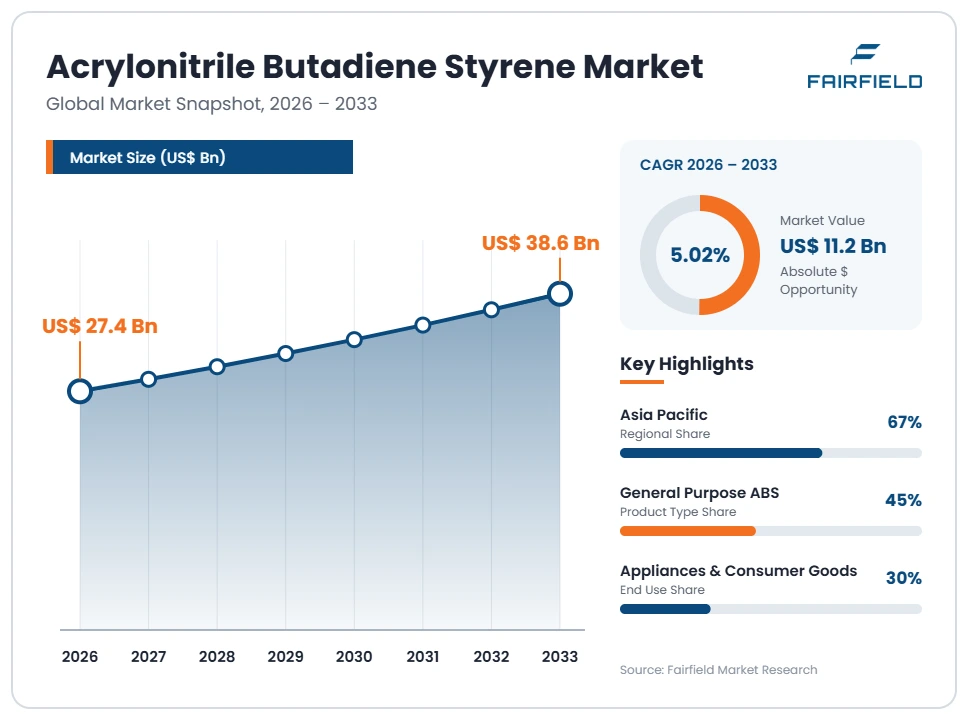
The global Acrylonitrile Butadiene Styrene market size is expected to be valued at US$ 27.4 billion in 2026 and projected to reach US$ 38.6 billion by 2033, growing at a CAGR of 5.02% between 2026 and 2033.
The market grew at roughly a 3.4% CAGR between 2020 and 2025, with volume rising faster than value because selling prices fell under heavy new capacity. Three forces shape the outlook. Appliance and consumer electronics housing output remains the volume backbone, concentrated close to where the resin is made. Vehicle interiors continue to absorb substantial tonnage, with electric models adding charging and battery-adjacent housings. Circularity rules are starting to create a separate, higher-priced recycled grade segment. The counterweight is capacity: large additions in China have built structural oversupply that caps price recovery. Growth is therefore volume-led, with margin, not demand, as the binding constraint.
Key Report Takeaways
- By Product Type: General Purpose ABS held 45% share in 2026, while Flame-Retardant ABS is projected to expand at a 7.1% CAGR through 2033, because charger housings, switchgear and energy storage enclosures require certified ignition resistance.
- By Production Process: Emulsion Polymerisation held 61% share in 2026, while Bulk (Mass) Polymerisation is projected to grow at a 6.2% CAGR through 2033, since it avoids the coagulation wastewater and effluent treatment load that emulsion plants carry.
- By End-Use Industry: Appliances and Consumer Goods held 30% share in 2026, while Automotive is projected to advance at a 6.0% CAGR through 2033, driven by larger moulded interior surfaces and new electric vehicle component families.
- By Source: Virgin ABS held 92% share in 2026, while Chemically Recycled ABS is projected to post a 16.5% CAGR through 2033, as vehicle and electronics recycled-content rules create demand that mechanical recycling alone cannot meet.
- By Geography: Asia Pacific held 67% share in 2026, while Middle East & Africa is projected to grow at a 6.6% CAGR through 2033, supported by appliance assembly localisation and downstream petrochemical investment.
Global Acrylonitrile Butadiene Styrene Market Trends and Insights
Drivers Impact Analysis
Two end-use forces account for most of the incremental resin tonnage expected through 2033.
| Driver | Impact on CAGR Forecast | Geographic Relevance | Impact Timeline |
| Appliance and consumer electronics housing output | High | Asia Pacific, Middle East & Africa | Short term ≤2 years |
| Vehicle interior surfaces and electric vehicle component families | Medium | Asia Pacific, Europe, North America | Medium term 2–4 years |
Appliance and Consumer Electronics Housing Output Anchors ABS Resin Volume Growth
Appliance and electronics housings remain the single largest pull on ABS resin, and that pull is still growing. Refrigerator liners and door panels, washing machine components, vacuum cleaner bodies, air conditioner fascias, television bezels, printer casings and small kitchen appliances all rely on the resin for impact strength, surface finish and easy moulding. Household appliance ownership continues to rise across populous middle-income economies, which converts directly into tonnage.
The mechanism is substitution economics at the moulding press. ABS tolerates thin-wall injection moulding at moderate pressures, takes texture and gloss straight from the tool, and accepts painting, printing and electroplating without special pretreatment. Competing resins either cost more or require secondary finishing. Refrigerator sheet extrusion is a particularly durable outlet, because thermoformed liners need the resin’s combination of stiffness and chemical resistance to blowing agents used in the surrounding insulation foam.
Vehicle Interiors and Electric Model Launches Expand ABS and ABS Blend Content per Car
Automotive remains the highest-value volume outlet for ABS, and content per vehicle is still climbing. Instrument panel carriers, pillar and door trim, console surrounds, air vents, speaker grilles and plated badges use general purpose, high-heat and plating grades. Electric models add charging port housings, battery management covers and interior panels sized for larger uninterrupted surfaces, which favours flow-length performance that the resin and its polycarbonate blends deliver well.
The causal driver is design consolidation. Manufacturers are merging several small trim parts into single large mouldings to cut assembly time and squeak-and-rattle risk, which increases shot weight per vehicle. Interior air quality expectations push suppliers toward low-residual-monomer grades with controlled volatile organic compound and fogging behaviour. Plating grade ABS retains decorative applications where chrome appearance is still specified, though matte and backlit surfaces are taking share in newer interior design languages.
Restraints Impact Analysis
Two constraints weigh on realised value far more than on physical demand for the resin.
| Restraint | Impact on CAGR Forecast | Geographic Relevance | Impact Timeline |
| Structural overcapacity following large Chinese plant additions | High | Global | Short term ≤2 years |
| Monomer classification, exposure limits and flame retardant restriction | Medium | Europe, North America | Medium term 2–4 years |
Structural Overcapacity From Chinese Plant Additions Compresses ABS Margins Worldwide
Oversupply is the defining commercial feature of this market and the main brake on value growth. A long wave of new bulk and emulsion capacity in China, much of it integrated backward into acrylonitrile and styrene monomer, has lifted national output well beyond domestic consumption. The country has shifted from large net importer toward self-sufficiency and export, and that swing alone displaced established trade flows across the region.
The cost consequence is specific. Operating rates at older plants in several regions have fallen toward levels where fixed cost recovery per tonne becomes difficult, and spot resin prices have repeatedly tracked close to the sum of monomer costs, leaving thin conversion margins. Producers without monomer integration are most exposed, because they pay market prices for acrylonitrile, styrene and butadiene while selling into a buyer’s market. Several high-cost lines have been idled or converted to specialty grades in response.
Monomer Exposure Limits and Flame Retardant Restrictions Raise ABS Compliance Costs
Chemical regulation adds cost at both ends of the production chain. All three monomers are registered under REACH and carry serious hazard classifications: 1,3-butadiene and acrylonitrile are treated as carcinogens, and styrene carries reproductive and neurotoxicity concerns. Tightening workplace exposure limits force investment in containment, monitoring and ventilation at polymerisation sites, and raise the documentation burden on every shipment of monomer and resin.
The second cost source sits downstream. RoHS Directive 2011/65/EU restricts polybrominated biphenyls and polybrominated diphenyl ethers in electrical and electronic equipment, and customer specifications increasingly exclude brominated flame retardants altogether. Halogen-free alternatives based on phosphorus chemistry are more expensive, often require higher loadings, and can reduce impact strength and heat distortion temperature. Reformulating and requalifying a flame-retardant grade for a certified appliance or charger housing is a slow, test-heavy process.
Market Opportunities
Two revenue pools sit apart from commodity resin volume and price at a clear premium to it.
Recycled-Content Rules for Vehicles and Electronics Open a Premium Recycled ABS Pool
Recycled ABS is the clearest premium pool in a market otherwise defined by surplus. Policy, not cost, creates the demand: proposed vehicle circularity rules in the European Union would require a defined share of recycled plastic in new vehicles, and electronics brands have set their own recycled-content commitments for housings. Because recycled resin that meets colour, odour and impact specification is scarce, it frequently sells above comparable virgin material rather than below it.
Compounders, recyclers and producers with sorting partnerships are positioned to capture this. The demand comes from vehicle manufacturers, appliance brands and electronics assemblers who must document recycled content in regulatory filings and sustainability reports. Supply is the constraint. Post-consumer housings arrive painted, plated, flame retarded and mixed with other styrenics, so sorting technology, deplating and decontamination capability determine who can serve the pool reliably.
Halogen-Free Flame-Retardant Grades Serve Charging and Energy Storage Enclosure Demand
Halogen-free flame-retardant ABS is a second premium pool, created by electrification rather than by appliance replacement. Electric vehicle chargers, wall boxes, inverters, battery management housings, switchgear covers and stationary energy storage enclosures all require resins that pass stringent ignition and glow-wire testing while keeping dimensional stability at elevated temperature. These grades command a substantial premium over general purpose resin and sell into applications that barely existed a decade ago.
Producers with phosphorus-based additive expertise and the ability to hold impact properties at high flame retardant loadings can capture this pool, typically in partnership with a specialist compounder. The customer group is electrical equipment manufacturers and charging infrastructure builders rather than traditional appliance converters. RoHS Directive 2011/65/EU and brand-level restrictions on brominated chemistry support the shift, while ABS and polycarbonate blends extend the usable temperature range further.
Segment Analysis
- By Product Type: General Purpose Grades Lead as Flame-Retardant Resin Grows Fastest
General Purpose ABS held 45% share in 2026, the leading product type, because the balance of impact strength, rigidity, surface quality and price suits the appliance, toy, luggage and interior trim applications that consume most tonnage. It is also the grade most exposed to commodity pricing. Flame-Retardant ABS is the fastest-growing type at a 7.1% CAGR to 2033, driven by charger housings, switchgear covers and energy storage enclosures that must pass certified ignition tests. High-Heat ABS grows steadily with vehicle interiors and appliance parts close to heat sources. Plating Grade ABS remains important for decorative automotive and sanitary hardware, though matte interior surfaces reduce its share. Transparent ABS serves medical and consumer sight glasses in small volume. The mix is slowly shifting toward grades that carry a technical specification rather than a price.
- By Production Process: Emulsion Polymerisation Dominates While Bulk Routes Gain Ground
Emulsion Polymerisation accounted for 61% of output in 2026, the leading production route, because it allows high rubber loadings and precise control of particle size distribution, which is what high-impact and plating grades require. Most installed capacity worldwide was built on this chemistry. Bulk (Mass) Polymerisation is the fastest-growing route at a 6.2% CAGR through 2033, because it eliminates the coagulation, dewatering and drying steps that generate wastewater and consume energy in emulsion plants. Lower effluent treatment cost and smaller utility consumption matter more as environmental permitting tightens and as margin pressure forces producers to defend cash cost position. Bulk grades cannot match emulsion resin across the full property range, particularly in plating and very high impact applications. The practical outcome is a two-route industry, with new commodity capacity favouring mass polymerisation.
- By End-Use Industry: Appliances Hold the Largest Share While Automotive Expands Quickest
Appliances and Consumer Goods held 30% share in 2026, the leading end-use industry, because refrigerator liners, washing machine parts, vacuum cleaners, small kitchen equipment, luggage and toys together absorb more resin than any other outlet. Automotive is the fastest-growing industry at a 6.0% CAGR to 2033, as interior parts consolidate into larger mouldings and electric models add charging and battery-adjacent housings. Electrical and Electronics remains a substantial and specification-heavy outlet for flame-retardant grades. Building and Construction consumes extruded sheet and pipe fittings in modest volume. Toys and Sports Goods provides a stable base with strong seasonality. Medical and Other applications take transparent and gamma-stable grades in small quantities. The commercial implication is that growth is concentrating where technical qualification protects margin from commodity price competition.
- By Source: Virgin Resin Still Dominates While Chemically Recycled Material Accelerates
Virgin ABS held 92% share in 2026, overwhelmingly the dominant source, because recycled feedstock remains scarce, inconsistent in colour and odour, and difficult to certify for demanding applications. Abundant virgin capacity also keeps prices low enough to discourage substitution on cost grounds alone. Chemically Recycled ABS is the fastest-growing source at a 16.5% CAGR through 2033, from a very small base, because depolymerisation and dissolution routes can strip pigments, plating residues and legacy flame retardants that mechanical recycling cannot remove. Mechanically Recycled ABS holds the larger recycled volume today, serving non-visible and dark-coloured parts where appearance tolerance is wider. Regulatory recycled-content requirements, not economics, drive the shift. For producers, securing feedstock from electronics and vehicle dismantling streams is becoming a strategic position in its own right.
Geography Analysis
- North America Demand Centres on Automotive, Electrical Equipment and Imported Resin
North America held 10% of the market in 2026, with consumption concentrated in the United States, Mexico and Canada. Vehicle assembly and interior trim moulding account for the largest share, followed by electrical equipment, appliances and recreational products. Mexico has become the region’s moulding hub, drawing appliance and automotive converters close to assembly plants and absorbing a growing share of imported resin. Domestic production capacity is limited relative to demand, so the region relies on imports and is exposed to freight cost and trade policy. Electrical codes and certification requirements make flame-retardant grades a disproportionately large part of regional value. The change now shaping demand is charging infrastructure buildout, which is creating enclosure volume that did not previously exist and favours certified halogen-free formulations over commodity resin.
- Europe Prioritises Circularity and Specification Over Tonnage in ABS Resin
Europe held 12% of the market in 2026, and its regulatory agenda influences grade development far beyond its share. Germany, Italy, France, Spain, Poland and Czechia host most of the moulding activity, with automotive interiors and appliance manufacturing dominating consumption. Directive 2000/53/EC on end-of-life vehicles and the proposed vehicle circularity regulation have made recycled content a procurement condition rather than an aspiration. Regulation (EU) 2025/40 on packaging and packaging waste extends similar thinking where the resin appears in durable packaging and closures. REACH registration obligations and tightening monomer exposure limits add operating cost at the few remaining regional polymerisation sites. The defining change is reformulation: producers including INEOS Styrolution Group GmbH, Trinseo PLC and ELIX Polymers, S.L.U. are repositioning toward recycled and low-emission grades rather than competing on commodity tonnage.
- Which Region Is Leading the Acrylonitrile Butadiene Styrene Market?
Asia Pacific leads with 67% share in 2026, because the region holds most global production capacity and nearly all of the appliance, electronics and toy manufacturing that consumes the resin. China alone accounts for the majority of output and demand, having added large integrated bulk and emulsion plants that turned the country from importer into exporter and reset regional pricing. South Korea remains a major exporter through LG Chem Ltd. and LOTTE Chemical Corporation, while Taiwan supplies substantial volume via Chi Mei Corporation and Formosa Chemicals & Fibre Corporation. Japan focuses on specialty and automotive grades through Techno-UMG Co., Ltd., Denka Company Limited and Toray Industries, Inc. India, Thailand, Vietnam and Indonesia are the fastest-expanding consumption points as appliance ownership rises. Surplus capacity keeps regional margins thin despite strong volume.
- Latin America Consumption Follows Appliance Assembly and Vehicle Interior Moulding
Latin America accounted for 6% of the market in 2026, with Brazil, Mexico and Argentina generating most of it. Brazil combines a large domestic appliance industry with vehicle assembly and a moulding base serving both, making it the single largest consumption point. Demand is weighted toward general purpose and high-impact grades for refrigerators, washing machines and interior trim. The barriers are substantial. Regional polymerisation capacity is minimal, so almost all resin is imported and subject to currency volatility, port delays and anti-dumping investigations that periodically disrupt supply. Credit cost for converters is high, which limits investment in new moulding capacity. The opportunity lies in appliance export manufacturing and in nearshoring of automotive component production, both of which raise local resin consumption without requiring new polymerisation investment.
- Which Region Is Growing Fastest in the Acrylonitrile Butadiene Styrene Market?
Middle East & Africa is the fastest-growing region at a 6.6% CAGR between 2026 and 2033, from a 5% share in 2026, because appliance assembly localisation and downstream petrochemical investment are rising together. Saudi Arabia, the United Arab Emirates, Egypt, Turkey, Morocco and South Africa account for most of the activity. Industrial policy in the Gulf Cooperation Council states explicitly targets conversion of hydrocarbon feedstock into higher-value polymers, and SABIC anchors regional styrenics capability. Egypt and Morocco have built appliance and automotive component export industries that pull imported resin. Barriers remain real: polymerisation capacity for this specific resin is narrow, compounding and colour matching capability is limited, and power reliability constrains continuous processing. The opportunity is local compounding, which would capture value currently exported with finished parts.
Competitive Landscape
The market is moderately concentrated at the global level but increasingly fragmented in practice. A recognised group of producers, including LG Chem Ltd., Chi Mei Corporation, INEOS Styrolution Group GmbH, Trinseo PLC, SABIC, Formosa Chemicals & Fibre Corporation, Techno-UMG Co., Ltd., LOTTE Chemical Corporation, Denka Company Limited and Versalis S.p.A., historically set reference pricing. That influence has weakened as China Petroleum & Chemical Corporation, CNPC Jilin Petrochemical Company, Zhejiang Petroleum & Chemical Co., Ltd. and other domestic producers brought large integrated lines online. Capacity now exceeds demand by a wide margin, so the competitive question has shifted from who can supply to who can run profitably at low operating rates.
Competition turns on cost position and grade portfolio rather than availability. Backward integration into acrylonitrile, styrene and butadiene is the strongest single determinant of margin, since non-integrated producers buy monomers at market price into a buyer’s resin market. Beyond cost, vendors compete on heat resistance, flow length for large thin-wall mouldings, certified flame retardant performance, colour consistency and residual monomer content for interior air quality compliance. New competition comes from compounders such as Kingfa Sci. & Tech. Co., Ltd. that build recycled and specialty grades on purchased base resin, and from blend specialists including Covestro AG working at the polycarbonate interface.
Strategic activity has concentrated on rationalisation and repositioning rather than expansion. High-cost lines in mature regions have been idled or converted toward specialty output, producers have deepened monomer integration where possible, and several have built recycled and mass-balance grade families with certification to support customer content claims. Investment in bulk polymerisation capacity reflects the same cost logic.
Strategic direction is converging on three themes: defending cash cost through integration and scale, migrating portfolios toward flame-retardant, high-heat and recycled grades that resist commoditisation, and securing post-consumer feedstock before recycled-content rules bind.
Recent Industry Developments
- September 2000: Directive 2000/53/EC on end-of-life vehicles was adopted in the European Union – it established reuse and recovery targets that first made vehicle plastics recovery a design consideration for resin suppliers.
- July 2011: RoHS Directive 2011/65/EU entered into force – its restriction of polybrominated biphenyls and polybrominated diphenyl ethers reshaped flame-retardant grade formulation for electrical and electronic housings.
- March 2022: Directive (EU) 2022/431 amending the carcinogens and mutagens framework was adopted – it introduced the first European Union-wide binding occupational exposure limit for acrylonitrile, raising containment and monitoring costs at polymerisation sites.
- July 2023: The European Commission proposed a regulation on circularity requirements for vehicle design to replace Directive 2000/53/EC – its recycled plastic content target created the first firm policy pull for recycled styrenic resin.
- February 2025: Regulation (EU) 2025/40 on packaging and packaging waste entered into force – it extended recycled content and recyclability obligations to applications where the resin is used in durable packaging and closures.
Companies Covered in the Report
- LG Chem Ltd.
- Chi Mei Corporation
- INEOS Styrolution Group GmbH
- Trinseo PLC
- SABIC
- Formosa Chemicals & Fibre Corporation
- Techno-UMG Co., Ltd.
- Toray Industries, Inc.
- Denka Company Limited
- Asahi Kasei Corporation
- LOTTE Chemical Corporation
- ELIX Polymers, S.L.U.
- CNPC Jilin Petrochemical Company
- China Petroleum & Chemical Corporation
- Zhejiang Petroleum & Chemical Co., Ltd.
- Shanghai Kumho Sunny Plastics Co., Ltd.
- Versalis S.p.A.
- Kingfa Sci. & Tech. Co., Ltd.
- Covestro AG
- Mitsubishi Chemical Group Corporation
Acrylonitrile Butadiene Styrene Market Report Scope
| Metric | Value |
| Study Period | 2020–2033 |
| Market Size 2026 | US$ 27.4 Billion |
| Market Size 2033 | US$ 38.6 Billion |
| CAGR 2026–2033 | 5.02% |
| Absolute Dollar Opportunity | US$ 11.2 Billion |
| Largest Market | Asia Pacific, 67% share in 2026 |
| Fastest-Growing Market | Middle East & Africa, 6.6% CAGR |
| Market Concentration | Medium |
| Major Players | LG Chem Ltd., Chi Mei Corporation, INEOS Styrolution Group GmbH, Trinseo PLC, SABIC |
Acrylonitrile Butadiene Styrene Market Segmentation
Product Type
- General Purpose ABS
- High-Heat ABS
- Flame-Retardant ABS
- Plating Grade ABS
- Transparent ABS
Production Process
- Emulsion Polymerisation
- Bulk (Mass) Polymerisation
End-Use Industry
- Appliances and Consumer Goods
- Automotive
- Electrical and Electronics
- Building and Construction
- Toys and Sports Goods
- Medical and Other
Source
- Virgin ABS
- Mechanically Recycled ABS
- Chemically Recycled ABS
Regions
- North America
- Europe
- Asia Pacific
- Latin America
- Middle East & Africa
- Executive Summary
- Global Acrylonitrile Butadiene Styrene Market Snapshot
- Market Size and Trend Analysis 2020–2033
- Historical Growth 2020–2025
- Base Year 2025
- Forecast Outlook 2026–2033
- Key Report Takeaways
- Market Overview
- Market Definition and Report Scope
- Market Dynamics
- Drivers
- Appliance and Consumer Electronics Housing Output Anchors ABS Resin Volume Growth
- Vehicle Interiors and Electric Model Launches Expand ABS and ABS Blend Content per Car
- Restraints
- Structural Overcapacity From Chinese Plant Additions Compresses ABS Margins Worldwide
- Monomer Exposure Limits and Flame Retardant Restrictions Raise ABS Compliance Costs
- Market Opportunities
- Recycled-Content Rules for Vehicles and Electronics Open a Premium Recycled ABS Pool
- Halogen-Free Flame-Retardant Grades Serve Charging and Energy Storage Enclosure Demand
- Drivers
- Segment Analysis
- By Product Type: General Purpose Grades Lead as Flame-Retardant Resin Grows Fastest
- By Production Process: Emulsion Polymerisation Dominates While Bulk Routes Gain Ground
- By End-Use Industry: Appliances Hold the Largest Share While Automotive Expands Quickest
- By Source: Virgin Resin Still Dominates While Chemically Recycled Material Accelerates
- Global Acrylonitrile Butadiene Styrene Market Outlook, 2020–2033
- Global Acrylonitrile Butadiene Styrene Market Outlook, by Product Type, Value (US$ Billion), 2020–2033
- General Purpose ABS
- High-Heat ABS
- Flame-Retardant ABS
- Plating Grade ABS
- Transparent ABS
- Global Acrylonitrile Butadiene Styrene Market Outlook, by Production Process, Value (US$ Billion), 2020–2033
- Emulsion Polymerisation
- Bulk (Mass) Polymerisation
- Global Acrylonitrile Butadiene Styrene Market Outlook, by End-Use Industry, Value (US$ Billion), 2020–2033
- Appliances and Consumer Goods
- Automotive
- Electrical and Electronics
- Building and Construction
- Toys and Sports Goods
- Medical and Other
- Global Acrylonitrile Butadiene Styrene Market Outlook, by Source, Value (US$ Billion), 2020–2033
- Virgin ABS
- Mechanically Recycled ABS
- Chemically Recycled ABS
- Global Acrylonitrile Butadiene Styrene Market Outlook, by Region, Value (US$ Billion), 2020–2033
- North America
- Europe
- Asia Pacific
- Latin America
- Middle East & Africa
- Global Acrylonitrile Butadiene Styrene Market Outlook, by Product Type, Value (US$ Billion), 2020–2033
- North America Acrylonitrile Butadiene Styrene Market Outlook, 2020–2033
- North America Demand Centres on Automotive, Electrical Equipment and Imported Resin
- North America Acrylonitrile Butadiene Styrene Market Outlook, by Product Type, Value (US$ Billion), 2020–2033
- General Purpose ABS
- High-Heat ABS
- Flame-Retardant ABS
- Plating Grade ABS
- Transparent ABS
- North America Acrylonitrile Butadiene Styrene Market Outlook, by Production Process, Value (US$ Billion), 2020–2033
- Emulsion Polymerisation
- Bulk (Mass) Polymerisation
- North America Acrylonitrile Butadiene Styrene Market Outlook, by End-Use Industry, Value (US$ Billion), 2020–2033
- Appliances and Consumer Goods
- Automotive
- Electrical and Electronics
- Building and Construction
- Toys and Sports Goods
- Medical and Other
- North America Acrylonitrile Butadiene Styrene Market Outlook, by Source, Value (US$ Billion), 2020–2033
- Virgin ABS
- Mechanically Recycled ABS
- Chemically Recycled ABS
- North America Acrylonitrile Butadiene Styrene Market Outlook, by Country, Value (US$ Billion), 2020–2033
- United States Acrylonitrile Butadiene Styrene Market Outlook, by Product Type, 2020–2033
- United States Acrylonitrile Butadiene Styrene Market Outlook, by Production Process, 2020–2033
- United States Acrylonitrile Butadiene Styrene Market Outlook, by End-Use Industry, 2020–2033
- United States Acrylonitrile Butadiene Styrene Market Outlook, by Source, 2020–2033
- Mexico Acrylonitrile Butadiene Styrene Market Outlook, by Product Type, 2020–2033
- Mexico Acrylonitrile Butadiene Styrene Market Outlook, by Production Process, 2020–2033
- Mexico Acrylonitrile Butadiene Styrene Market Outlook, by End-Use Industry, 2020–2033
- Mexico Acrylonitrile Butadiene Styrene Market Outlook, by Source, 2020–2033
- Canada Acrylonitrile Butadiene Styrene Market Outlook, by Product Type, 2020–2033
- Canada Acrylonitrile Butadiene Styrene Market Outlook, by Production Process, 2020–2033
- Canada Acrylonitrile Butadiene Styrene Market Outlook, by End-Use Industry, 2020–2033
- Canada Acrylonitrile Butadiene Styrene Market Outlook, by Source, 2020–2033
- Europe Acrylonitrile Butadiene Styrene Market Outlook, 2020–2033
- Europe Prioritises Circularity and Specification Over Tonnage in ABS Resin
- Europe Acrylonitrile Butadiene Styrene Market Outlook, by Product Type, Value (US$ Billion), 2020–2033
- General Purpose ABS
- High-Heat ABS
- Flame-Retardant ABS
- Plating Grade ABS
- Transparent ABS
- Europe Acrylonitrile Butadiene Styrene Market Outlook, by Production Process, Value (US$ Billion), 2020–2033
- Emulsion Polymerisation
- Bulk (Mass) Polymerisation
- Europe Acrylonitrile Butadiene Styrene Market Outlook, by End-Use Industry, Value (US$ Billion), 2020–2033
- Appliances and Consumer Goods
- Automotive
- Electrical and Electronics
- Building and Construction
- Toys and Sports Goods
- Medical and Other
- Europe Acrylonitrile Butadiene Styrene Market Outlook, by Source, Value (US$ Billion), 2020–2033
- Virgin ABS
- Mechanically Recycled ABS
- Chemically Recycled ABS
- Europe Acrylonitrile Butadiene Styrene Market Outlook, by Country, Value (US$ Billion), 2020–2033
- Germany Acrylonitrile Butadiene Styrene Market Outlook, by Product Type, 2020–2033
- Germany Acrylonitrile Butadiene Styrene Market Outlook, by Production Process, 2020–2033
- Germany Acrylonitrile Butadiene Styrene Market Outlook, by End-Use Industry, 2020–2033
- Germany Acrylonitrile Butadiene Styrene Market Outlook, by Source, 2020–2033
- Italy Acrylonitrile Butadiene Styrene Market Outlook, by Product Type, 2020–2033
- Italy Acrylonitrile Butadiene Styrene Market Outlook, by Production Process, 2020–2033
- Italy Acrylonitrile Butadiene Styrene Market Outlook, by End-Use Industry, 2020–2033
- Italy Acrylonitrile Butadiene Styrene Market Outlook, by Source, 2020–2033
- France Acrylonitrile Butadiene Styrene Market Outlook, by Product Type, 2020–2033
- France Acrylonitrile Butadiene Styrene Market Outlook, by Production Process, 2020–2033
- France Acrylonitrile Butadiene Styrene Market Outlook, by End-Use Industry, 2020–2033
- France Acrylonitrile Butadiene Styrene Market Outlook, by Source, 2020–2033
- Spain Acrylonitrile Butadiene Styrene Market Outlook, by Product Type, 2020–2033
- Spain Acrylonitrile Butadiene Styrene Market Outlook, by Production Process, 2020–2033
- Spain Acrylonitrile Butadiene Styrene Market Outlook, by End-Use Industry, 2020–2033
- Spain Acrylonitrile Butadiene Styrene Market Outlook, by Source, 2020–2033
- Poland Acrylonitrile Butadiene Styrene Market Outlook, by Product Type, 2020–2033
- Poland Acrylonitrile Butadiene Styrene Market Outlook, by Production Process, 2020–2033
- Poland Acrylonitrile Butadiene Styrene Market Outlook, by End-Use Industry, 2020–2033
- Poland Acrylonitrile Butadiene Styrene Market Outlook, by Source, 2020–2033
- Czechia Acrylonitrile Butadiene Styrene Market Outlook, by Product Type, 2020–2033
- Czechia Acrylonitrile Butadiene Styrene Market Outlook, by Production Process, 2020–2033
- Czechia Acrylonitrile Butadiene Styrene Market Outlook, by End-Use Industry, 2020–2033
- Czechia Acrylonitrile Butadiene Styrene Market Outlook, by Source, 2020–2033
- Asia Pacific Acrylonitrile Butadiene Styrene Market Outlook, 2020–2033
- Regional Market Leadership
- Asia Pacific Acrylonitrile Butadiene Styrene Market Outlook, by Product Type, Value (US$ Billion), 2020–2033
- General Purpose ABS
- High-Heat ABS
- Flame-Retardant ABS
- Plating Grade ABS
- Transparent ABS
- Asia Pacific Acrylonitrile Butadiene Styrene Market Outlook, by Production Process, Value (US$ Billion), 2020–2033
- Emulsion Polymerisation
- Bulk (Mass) Polymerisation
- Asia Pacific Acrylonitrile Butadiene Styrene Market Outlook, by End-Use Industry, Value (US$ Billion), 2020–2033
- Appliances and Consumer Goods
- Automotive
- Electrical and Electronics
- Building and Construction
- Toys and Sports Goods
- Medical and Other
- Asia Pacific Acrylonitrile Butadiene Styrene Market Outlook, by Source, Value (US$ Billion), 2020–2033
- Virgin ABS
- Mechanically Recycled ABS
- Chemically Recycled ABS
- Asia Pacific Acrylonitrile Butadiene Styrene Market Outlook, by Country, Value (US$ Billion), 2020–2033
- China Acrylonitrile Butadiene Styrene Market Outlook, by Product Type, 2020–2033
- China Acrylonitrile Butadiene Styrene Market Outlook, by Production Process, 2020–2033
- China Acrylonitrile Butadiene Styrene Market Outlook, by End-Use Industry, 2020–2033
- China Acrylonitrile Butadiene Styrene Market Outlook, by Source, 2020–2033
- South Korea Acrylonitrile Butadiene Styrene Market Outlook, by Product Type, 2020–2033
- South Korea Acrylonitrile Butadiene Styrene Market Outlook, by Production Process, 2020–2033
- South Korea Acrylonitrile Butadiene Styrene Market Outlook, by End-Use Industry, 2020–2033
- South Korea Acrylonitrile Butadiene Styrene Market Outlook, by Source, 2020–2033
- Taiwan Acrylonitrile Butadiene Styrene Market Outlook, by Product Type, 2020–2033
- Taiwan Acrylonitrile Butadiene Styrene Market Outlook, by Production Process, 2020–2033
- Taiwan Acrylonitrile Butadiene Styrene Market Outlook, by End-Use Industry, 2020–2033
- Taiwan Acrylonitrile Butadiene Styrene Market Outlook, by Source, 2020–2033
- Japan Acrylonitrile Butadiene Styrene Market Outlook, by Product Type, 2020–2033
- Japan Acrylonitrile Butadiene Styrene Market Outlook, by Production Process, 2020–2033
- Japan Acrylonitrile Butadiene Styrene Market Outlook, by End-Use Industry, 2020–2033
- Japan Acrylonitrile Butadiene Styrene Market Outlook, by Source, 2020–2033
- India Acrylonitrile Butadiene Styrene Market Outlook, by Product Type, 2020–2033
- India Acrylonitrile Butadiene Styrene Market Outlook, by Production Process, 2020–2033
- India Acrylonitrile Butadiene Styrene Market Outlook, by End-Use Industry, 2020–2033
- India Acrylonitrile Butadiene Styrene Market Outlook, by Source, 2020–2033
- Thailand Acrylonitrile Butadiene Styrene Market Outlook, by Product Type, 2020–2033
- Thailand Acrylonitrile Butadiene Styrene Market Outlook, by Production Process, 2020–2033
- Thailand Acrylonitrile Butadiene Styrene Market Outlook, by End-Use Industry, 2020–2033
- Thailand Acrylonitrile Butadiene Styrene Market Outlook, by Source, 2020–2033
- Vietnam Acrylonitrile Butadiene Styrene Market Outlook, by Product Type, 2020–2033
- Vietnam Acrylonitrile Butadiene Styrene Market Outlook, by Production Process, 2020–2033
- Vietnam Acrylonitrile Butadiene Styrene Market Outlook, by End-Use Industry, 2020–2033
- Vietnam Acrylonitrile Butadiene Styrene Market Outlook, by Source, 2020–2033
- Indonesia Acrylonitrile Butadiene Styrene Market Outlook, by Product Type, 2020–2033
- Indonesia Acrylonitrile Butadiene Styrene Market Outlook, by Production Process, 2020–2033
- Indonesia Acrylonitrile Butadiene Styrene Market Outlook, by End-Use Industry, 2020–2033
- Indonesia Acrylonitrile Butadiene Styrene Market Outlook, by Source, 2020–2033
- Latin America Acrylonitrile Butadiene Styrene Market Outlook, 2020–2033
- Latin America Consumption Follows Appliance Assembly and Vehicle Interior Moulding
- Latin America Acrylonitrile Butadiene Styrene Market Outlook, by Product Type, Value (US$ Billion), 2020–2033
- General Purpose ABS
- High-Heat ABS
- Flame-Retardant ABS
- Plating Grade ABS
- Transparent ABS
- Latin America Acrylonitrile Butadiene Styrene Market Outlook, by Production Process, Value (US$ Billion), 2020–2033
- Emulsion Polymerisation
- Bulk (Mass) Polymerisation
- Latin America Acrylonitrile Butadiene Styrene Market Outlook, by End-Use Industry, Value (US$ Billion), 2020–2033
- Appliances and Consumer Goods
- Automotive
- Electrical and Electronics
- Building and Construction
- Toys and Sports Goods
- Medical and Other
- Latin America Acrylonitrile Butadiene Styrene Market Outlook, by Source, Value (US$ Billion), 2020–2033
- Virgin ABS
- Mechanically Recycled ABS
- Chemically Recycled ABS
- Latin America Acrylonitrile Butadiene Styrene Market Outlook, by Country, Value (US$ Billion), 2020–2033
- Brazil Acrylonitrile Butadiene Styrene Market Outlook, by Product Type, 2020–2033
- Brazil Acrylonitrile Butadiene Styrene Market Outlook, by Production Process, 2020–2033
- Brazil Acrylonitrile Butadiene Styrene Market Outlook, by End-Use Industry, 2020–2033
- Brazil Acrylonitrile Butadiene Styrene Market Outlook, by Source, 2020–2033
- Mexico Acrylonitrile Butadiene Styrene Market Outlook, by Product Type, 2020–2033
- Mexico Acrylonitrile Butadiene Styrene Market Outlook, by Production Process, 2020–2033
- Mexico Acrylonitrile Butadiene Styrene Market Outlook, by End-Use Industry, 2020–2033
- Mexico Acrylonitrile Butadiene Styrene Market Outlook, by Source, 2020–2033
- Argentina Acrylonitrile Butadiene Styrene Market Outlook, by Product Type, 2020–2033
- Argentina Acrylonitrile Butadiene Styrene Market Outlook, by Production Process, 2020–2033
- Argentina Acrylonitrile Butadiene Styrene Market Outlook, by End-Use Industry, 2020–2033
- Argentina Acrylonitrile Butadiene Styrene Market Outlook, by Source, 2020–2033
- Middle East & Africa Acrylonitrile Butadiene Styrene Market Outlook, 2020–2033
- Regional Growth Outlook
- Middle East & Africa Acrylonitrile Butadiene Styrene Market Outlook, by Product Type, Value (US$ Billion), 2020–2033
- General Purpose ABS
- High-Heat ABS
- Flame-Retardant ABS
- Plating Grade ABS
- Transparent ABS
- Middle East & Africa Acrylonitrile Butadiene Styrene Market Outlook, by Production Process, Value (US$ Billion), 2020–2033
- Emulsion Polymerisation
- Bulk (Mass) Polymerisation
- Middle East & Africa Acrylonitrile Butadiene Styrene Market Outlook, by End-Use Industry, Value (US$ Billion), 2020–2033
- Appliances and Consumer Goods
- Automotive
- Electrical and Electronics
- Building and Construction
- Toys and Sports Goods
- Medical and Other
- Middle East & Africa Acrylonitrile Butadiene Styrene Market Outlook, by Source, Value (US$ Billion), 2020–2033
- Virgin ABS
- Mechanically Recycled ABS
- Chemically Recycled ABS
- Middle East & Africa Acrylonitrile Butadiene Styrene Market Outlook, by Country, Value (US$ Billion), 2020–2033
- Saudi Arabia Acrylonitrile Butadiene Styrene Market Outlook, by Product Type, 2020–2033
- Saudi Arabia Acrylonitrile Butadiene Styrene Market Outlook, by Production Process, 2020–2033
- Saudi Arabia Acrylonitrile Butadiene Styrene Market Outlook, by End-Use Industry, 2020–2033
- Saudi Arabia Acrylonitrile Butadiene Styrene Market Outlook, by Source, 2020–2033
- United Arab Emirates Acrylonitrile Butadiene Styrene Market Outlook, by Product Type, 2020–2033
- United Arab Emirates Acrylonitrile Butadiene Styrene Market Outlook, by Production Process, 2020–2033
- United Arab Emirates Acrylonitrile Butadiene Styrene Market Outlook, by End-Use Industry, 2020–2033
- United Arab Emirates Acrylonitrile Butadiene Styrene Market Outlook, by Source, 2020–2033
- Egypt Acrylonitrile Butadiene Styrene Market Outlook, by Product Type, 2020–2033
- Egypt Acrylonitrile Butadiene Styrene Market Outlook, by Production Process, 2020–2033
- Egypt Acrylonitrile Butadiene Styrene Market Outlook, by End-Use Industry, 2020–2033
- Egypt Acrylonitrile Butadiene Styrene Market Outlook, by Source, 2020–2033
- Turkey Acrylonitrile Butadiene Styrene Market Outlook, by Product Type, 2020–2033
- Turkey Acrylonitrile Butadiene Styrene Market Outlook, by Production Process, 2020–2033
- Turkey Acrylonitrile Butadiene Styrene Market Outlook, by End-Use Industry, 2020–2033
- Turkey Acrylonitrile Butadiene Styrene Market Outlook, by Source, 2020–2033
- Morocco Acrylonitrile Butadiene Styrene Market Outlook, by Product Type, 2020–2033
- Morocco Acrylonitrile Butadiene Styrene Market Outlook, by Production Process, 2020–2033
- Morocco Acrylonitrile Butadiene Styrene Market Outlook, by End-Use Industry, 2020–2033
- Morocco Acrylonitrile Butadiene Styrene Market Outlook, by Source, 2020–2033
- South Africa Acrylonitrile Butadiene Styrene Market Outlook, by Product Type, 2020–2033
- South Africa Acrylonitrile Butadiene Styrene Market Outlook, by Production Process, 2020–2033
- South Africa Acrylonitrile Butadiene Styrene Market Outlook, by End-Use Industry, 2020–2033
- South Africa Acrylonitrile Butadiene Styrene Market Outlook, by Source, 2020–2033
- Competitive Landscape
- Market Concentration and Supplier Participation
- Competitive Factors and Strategic Direction
- Recent Industry Developments
- EU End-of-Life Vehicles Directive Adoption September 2000
- RoHS Directive Entry into Force July 2011
- EU Acrylonitrile Occupational Exposure Limit Directive March 2022
- EU Vehicle Circularity Regulation Proposal July 2023
- EU Packaging and Packaging Waste Regulation Entry into Force February 2025
- Company Profiles
- LG Chem Ltd.
- Chi Mei Corporation
- INEOS Styrolution Group GmbH
- Trinseo PLC
- SABIC
- Formosa Chemicals & Fibre Corporation
- Techno-UMG Co., Ltd.
- Toray Industries, Inc.
- Denka Company Limited
- Asahi Kasei Corporation
- LOTTE Chemical Corporation
- ELIX Polymers, S.L.U.
- CNPC Jilin Petrochemical Company
- China Petroleum & Chemical Corporation
- Zhejiang Petroleum & Chemical Co., Ltd.
- Shanghai Kumho Sunny Plastics Co., Ltd.
- Versalis S.p.A.
- Kingfa Sci. & Tech. Co., Ltd.
- Covestro AG
- Mitsubishi Chemical Group Corporation
- Appendix
- Research Methodology
- Report Assumptions
- Acronyms and Abbreviations
Product Type
- General Purpose ABS
- High-Heat ABS
- Flame-Retardant ABS
- Plating Grade ABS
- Transparent ABS
Production Process
- Emulsion Polymerisation
- Bulk (Mass) Polymerisation
End-Use Industry
- Appliances and Consumer Goods
- Automotive
- Electrical and Electronics
- Building and Construction
- Toys and Sports Goods
- Medical and Other
Source
- Virgin ABS
- Mechanically Recycled ABS
- Chemically Recycled ABS
Regions
- North America
- Europe
- Asia Pacific
- Latin America
- Middle East & Africa
Our Research Methodology
Considering the volatility of business today, traditional approaches to strategizing a game plan can be unfruitful if not detrimental. True ambiguity is no way to determine a forecast. A myriad of predetermined factors must be accounted for such as the degree of risk involved, the magnitude of circumstances, as well as conditions or consequences that are not known or unpredictable. To circumvent binary views that cast uncertainty, the application of market research intelligence to strategically posture, move, and enable actionable outcomes is necessary.
View Methodology
Quality Assured
Rigorous Validation Process

Confidentiality Assured
End-to-end Data Security

Custom Research Services
Tailored To Your Objectives
FAQs
The market is valued at US$ 27.4 billion in 2026, covering emulsion and bulk polymerised resin sold as moulding and extrusion grades worldwide.
The market is projected to reach US$ 38.6 billion by 2033 at a 5.02% CAGR, an absolute opportunity of US$ 11.2 billion over the period.
General Purpose ABS leads with 45% share in 2026, because its balance of impact strength, rigidity, surface quality and price suits high-volume applications.
Chemically Recycled ABS grows fastest at a 16.5% CAGR through 2033, because recycled-content rules demand material that mechanical recycling cannot adequately supply.
Asia Pacific holds 67% share in 2026, because it contains most global production capacity and nearly all appliance, electronics and toy manufacturing.
Related Reports
Automotive NVH Materials Market Size, Share, Insights, Competitive Landscape, and Forecast 2026 to 2033
The global automotive NVH materials market is valued at US$13.8 billion in 2026, reaching US$20.5 billion by 2033, growing at a 5.82% CAGR
Tank Mix Adjuvants Market Size, Share, Insights, Competitive Landscape, and Forecast 2026 to 2033
The global tank mix adjuvants market is valued at US$4.3 billion in 2026, reaching US$6.6 billion by 2033, growing at a 6.3% CAGR
Glass Flake Coatings Market Size, Share, Insights, Competitive Landscape, and Forecast 2026 to 2033
The glass flake coatings market is projected to grow from US$0.64 billion in 2026 to US$0.96 billion by 2033, at a 5.96% CAGR
Paint Protection Films Market Size, Share, Insights, Competitive Landscape, and Forecast 2026 to 2033
The global paint protection films market is valued at US$1.05 billion in 2026 and is projected to reach US$2.25 billion by 2033, growing at 11.5% CAGR
Electrical Steel Coatings Market Size, Share, Insights, Competitive Landscape, and Forecast 2026 to 2033
The electrical steel coatings market, valued at US$ 1.42 billion in 2026, and forecast to reach US$ 2.41 billion by 2033, growing at a 7.85% CAGR
Self-repairing Polymers Market Size, Share, Insights, Competitive Landscape, and Forecast 2026 to 2033
The global self-repairing polymers market is projected to grow from US$ 0.42 billion in 2026 to US$ 1.18 billion by 2033, at a CAGR of 15.90%