



Automotive NVH Materials Market
Automotive NVH Materials Market Size, Share, Insights, Competitive Landscape, and Forecast 2026 to 2033
Automotive NVH Materials Market Size and Trend Analysis
Will Electric Vehicles Grow or Shrink NVH Material Demand?
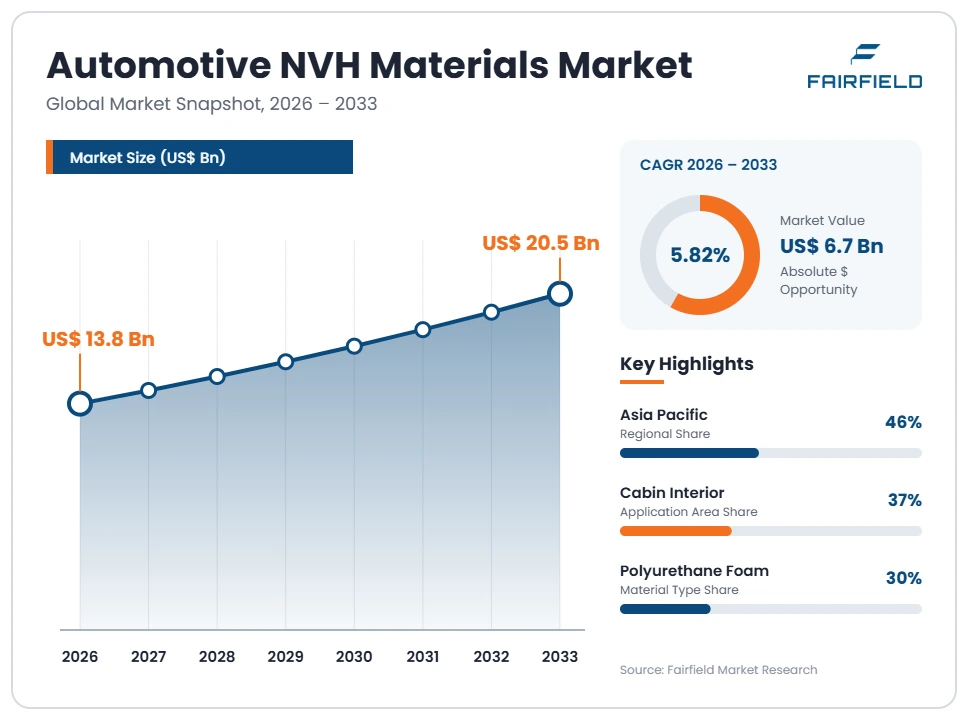
The global Automotive NVH Materials market size is expected to be valued at US$ 13.8 billion in 2026 and projected to reach US$ 20.5 billion by 2033, growing at a CAGR of 5.82% between 2026 and 2033.
Between 2020 and 2025 the market grew at roughly a 3.9% CAGR, tracking vehicle build volumes through a disrupted production cycle. Three forces now lift it above build-rate growth. Regulatory pass-by noise limits have tightened in steps, forcing more absorption and sealing content into each vehicle. Battery electric vehicles do not reduce the work: removing engine masking exposes road, wind, tyre and high-frequency drive unit noise that previously went unnoticed. Recyclability and interior air quality rules are simultaneously forcing material substitution, which raises value per vehicle. Growth is therefore led by content and specification per vehicle rather than by the number of vehicles built.
Key Report Takeaways
- By Material Type: Polyurethane Foam held 30% share in 2026, while Natural and Recycled Fibre Composites are projected to expand at an 8.4% CAGR through 2033, because end-of-life recovery targets penalise mixed-material and bitumen-based treatments.
- By Product Type: Acoustic Absorbers held 29% share in 2026, while Underbody and Wheel Arch Shields are projected to grow at an 8.0% CAGR through 2033, driven by road and tyre noise that becomes audible once engine masking disappears.
- By Vehicle Type: Passenger Cars with Internal Combustion Engines held 52% share in 2026, while Battery Electric Vehicles are projected to advance at a 12.4% CAGR through 2033, reflecting both rising build share and higher treatment value per unit.
- By Application Area: Cabin Interior held 37% share in 2026, while Underbody and Chassis is projected to post a 7.8% CAGR through 2033, as structure-borne and airborne road noise paths take priority in quiet powertrains.
- By Geography: Asia Pacific held 46% share in 2026, while Europe is projected to grow at a 6.6% CAGR through 2033, supported by phased sound limit reductions and a high electric vehicle build mix.
Global Automotive NVH Materials Market Trends and Insights
Drivers Impact Analysis
Two forces raise acoustic treatment content per vehicle faster than global vehicle output is growing.
| Driver | Impact on CAGR Forecast | Geographic Relevance | Impact Timeline |
| Phased reductions in regulated vehicle pass-by sound limits | High | Europe, Asia Pacific, North America | Short term ≤2 years |
| Redistribution of noise paths in electric powertrains | High | Global | Medium term 2–4 years |
Tighter Pass-By Sound Limits Force More Absorption and Sealing Into Every Vehicle
Regulated exterior noise limits are the most reliable content driver in vehicle acoustic materials. UNECE Regulation No. 51 defines the pass-by test procedure used for type approval across most major markets, and Regulation (EU) No 540/2014 sets limit values that have stepped downward in defined phases. Each reduction removes headroom that engineers previously recovered through tuning, so they add physical treatment instead.
The causal mechanism runs through source ranking. Once intake, exhaust and powertrain radiation are optimised, the remaining pass-by contributors are tyre-road interaction and structural radiation from the underbody and wheel arches. Engineers respond with wheel arch liners, engine bay undershields, transmission tunnel absorbers and improved body cavity sealing, because these attack airborne paths directly. Type approval is pass or fail at a fixed decibel value, so manufacturers specify generously rather than risk a failed homologation late in a vehicle programme.
Electric Powertrains Redistribute Noise Paths Rather Than Removing the NVH Problem
Electrification changes where acoustic material goes without reducing how much is needed. Removing the internal combustion engine eliminates the broadband masking that hid road rumble, wind rush, HVAC flow noise, pump whine and structural booming. Occupants in a quiet cabin notice tonal and intermittent sounds that were previously inaudible, and customer satisfaction scores respond sharply. Programme teams therefore reallocate the acoustic budget rather than cutting it.
The specific mechanism is a shift toward high-frequency and narrowband content. Electric drive units produce gear mesh and inverter switching tones in bands where thin absorbers work well but mass-based barriers do not. Treatment moves to targeted locations: drive unit covers, motor mounts, dash and floor absorbers tuned to higher frequencies, acoustic glazing, and sealed body cavities that block wind-induced leakage. Battery pack structures also create large flat radiating surfaces that need damping. The result is more parts with tighter specifications.
Restraints Impact Analysis
Two constraints limit how freely acoustic material can be added to modern vehicle programmes.
| Restraint | Impact on CAGR Forecast | Geographic Relevance | Impact Timeline |
| Mass reduction targets conflicting with acoustic treatment weight | High | Global | Short term ≤2 years |
| Recyclability targets and chemical restrictions on conventional materials | Medium | Europe, Asia Pacific | Medium term 2–4 years |
Vehicle Mass Reduction Targets Pull Directly Against Acoustic Treatment Weight
The central tension in this market is that acoustic performance has traditionally been bought with mass. Barrier layers, bitumen damping pads and heavy-layer carpet backing all work by adding density, yet every added kilogram reduces electric vehicle range or raises fleet emissions on a combustion platform. Battery packs have already consumed much of the mass budget, so acoustic engineers are told to deliver equal or better performance at lower weight.
The cost consequence is measurable per decibel. Replacing a heavy-layer barrier with a tuned porous absorber or a micro-perforated system delivers similar insertion loss at a fraction of the weight, but costs considerably more per square metre and requires acoustic simulation and validation work that a bitumen pad never needed. Programme teams must fund additional prototype testing, hemi-anechoic chamber time and transfer path analysis. Lightweight acoustic solutions therefore compete against a cheap incumbent with decades of proven application.
Recyclability Targets and Chemical Restrictions Narrow the Usable Material Palette
Environmental regulation is steadily removing conventional acoustic materials from the approved list. Directive 2000/53/EC on end-of-life vehicles sets reuse and recovery targets that make heavy bitumen damping and bonded multi-material laminates problematic, because they cannot be separated economically at dismantling and contaminate recovered polymer streams. Suppliers must therefore redesign parts around single-polymer construction or mechanically separable layers.
The constraint tightens further through chemistry. REACH restricts and authorises substances relevant to acoustic foams, including several flame retardants, while diisocyanate use requires documented training for industrial handling. Interior air quality specifications add another layer, with manufacturers applying volatile organic compound and fogging test methods to every trim and insulation part. Each reformulation triggers a full requalification cycle covering acoustic absorption curves, flammability, odour, ageing and fogging, which absorbs development budget without improving measured acoustic performance.
Market Opportunities
Two revenue pools sit outside conventional treatment supply and carry higher technical content.
Recyclable Mono-Material Acoustic Systems Replace Bitumen and Mixed-Layer Laminates
Mono-material acoustic systems represent the clearest new revenue pool in vehicle sound packages. Converting dash insulators, floor systems, wheel arch liners and parcel shelves to a single polymer family, typically polyester or polypropylene across fibre, scrim and backing layers, allows the whole part to be recovered as one stream at dismantling. Because these parts replace cheaper bitumen and bonded laminate constructions, the conversion lifts supplier revenue per vehicle rather than simply substituting it.
Tier-one acoustic specialists and nonwoven producers with fibre engineering capability are positioned to capture this. Demand comes from vehicle manufacturers writing recycled content and recyclability requirements into sourcing documents well ahead of regulatory deadlines. Recycled polyester from bottle and textile streams gives these systems a documented recycled content figure, which supports sustainability reporting. Directive 2000/53/EC recovery targets and the proposed vehicle circularity rules give the shift firm policy backing.
Robot-Applied Sprayable Damping Opens a New Pool in Body Shop Noise Treatment
Liquid applied sound damping is a second pool, created by manufacturing economics rather than acoustics alone. Robot-sprayed damping compound applied in the paint shop replaces manually placed bitumen pads, covering complex geometry precisely and only where modal analysis shows panel radiation matters. Material is placed at variable thickness, which typically removes significant mass while improving coverage consistency across a production run.
Material formulators and application equipment suppliers capture this jointly, usually through joint development with a vehicle manufacturer’s paint shop engineering team. The customer group is assembly plant operations rather than the interior trim buyer, which opens a different commercial channel. Demand is strongest where new electric vehicle plants are being designed, since installing spray cells is far easier in a greenfield body shop than retrofitting one, and battery pack enclosures present exactly the flat radiating surfaces this technology treats well.
Segment Analysis
- By Material Type: Polyurethane Foam Leads While Natural and Recycled Fibres Scale Fastest
Polyurethane Foam held 30% share in 2026, the leading material type, because moulded and slab foams deliver absorption, sealing and decoupling functions across dash insulators, floor systems, seats and cavity fillers at acceptable cost. Formulations can be tuned for density and airflow resistance across a wide range. Natural and Recycled Fibre Composites form the fastest-growing material at an 8.4% CAGR to 2033, because recovery targets penalise constructions that cannot be separated and recycled polyester nonwovens give a documented recycled content figure. Thermoplastic Felt and Nonwovens hold a large and stable position in headliners, parcel shelves and underbody shields. Rubber and Thermoplastic Elastomers serve seals, mounts and bushings. Bitumen-Based Damping Materials decline steadily as mass and recyclability pressure mount. The palette is narrowing toward materials that satisfy acoustic, weight and end-of-life requirements at once.
- By Product Type: Acoustic Absorbers Hold the Largest Share While Underbody Shields Grow Quickest
Acoustic Absorbers held 29% share in 2026, the leading product category, because porous treatments appear in almost every compartment of the vehicle and address the broadband and high-frequency content that dominates quiet cabins. Underbody and Wheel Arch Shields are the fastest-growing category at an 8.0% CAGR through 2033, because tyre-road noise becomes the dominant exterior and interior source once engine noise is removed, and because shields also serve aerodynamic drag targets. Damping Sheets and Sprayable Damping grow moderately as liquid applied systems take share from cut pads. Acoustic Barriers face mass pressure and grow slowly despite strong technical need. Sealing Foams and Gaskets expand with body cavity sealing requirements in electric platforms. Suppliers that can model and supply a complete system rather than individual parts capture a disproportionate share of programme value.
- By Vehicle Type: Combustion Passenger Cars Still Lead as Battery Electric Vehicles Surge
Passenger Cars with Internal Combustion Engines held 52% share in 2026, the leading vehicle category, simply because they still represent most of global production and carry mature, fully developed sound packages. Battery Electric Vehicles are the fastest-growing category at a 12.4% CAGR to 2033, outpacing their build share growth because treatment value per unit is higher. Quiet cabins expose previously masked noise, battery enclosures add radiating surfaces, and UNECE Regulation No. 138 requires an acoustic vehicle alerting system that must be audible outside without intruding inside. Hybrid Vehicles present the hardest engineering problem, since engine start and stop events create transient noise in an otherwise quiet cabin. Light Commercial Vehicles grow with delivery fleet electrification. Heavy Commercial Vehicles remain a specialised outlet focused on cab isolation and driver fatigue.
- By Application Area: Cabin Interior Dominates Spend While Underbody and Chassis Accelerate
Cabin Interior held 37% share in 2026, the leading application area, because dash insulators, floor carpet systems, headliners, pillar trim and door panels together absorb more acoustic material by value than any other zone. Interior parts also carry odour, fogging and flammability requirements that raise their specification value. Underbody and Chassis is the fastest-growing area at a 7.8% CAGR through 2033, as structure-borne and airborne road noise paths move to the top of the source ranking in quiet powertrains. Engine and Electric Drive Compartment treatment shifts from broadband encapsulation toward targeted high-frequency covers. Doors and Body Cavities grow with expanding foam and sealing content that blocks wind noise leakage. Trunk and Rear Compartment treatment rises where rear-mounted drive units sit close to occupants. Acoustic spend is migrating outward from the cabin toward the sources themselves.
Geography Analysis
- North America Focuses on Large Vehicle Cabin Refinement and Light Truck Sound Packages
North America held 21% of the market in 2026, with the United States, Mexico and Canada forming an integrated production and supply base. The regional vehicle mix is weighted toward pickups, large sport utility vehicles and crossovers, which carry generous acoustic packages because cabin quietness is a strongly marketed attribute in these segments. Larger body surfaces mean more square metres of carpet backing, dash insulation and underbody shielding per unit than the global average. Mexico hosts a dense cluster of acoustic component plants supplying assembly across the region. Federal fuel economy standards keep mass reduction pressure on every treatment decision. The change now shaping demand is electric pickup and van production, where very large flat floor and battery enclosure surfaces require damping and absorption solutions that passenger car packages do not translate to directly.
- Which Region Is Growing Fastest in the Automotive NVH Materials Market?
Europe is the fastest-growing region at a 6.6% CAGR between 2026 and 2033, from a 19% share in 2026, because phased sound limit reductions and a high electric build mix are raising value per vehicle faster than anywhere else. Germany, France, Italy, Spain, Czechia, Slovakia and Poland account for most production. Regulation (EU) No 540/2014 has stepped pass-by limits downward in defined phases, with the final stage now applying to all new registrations, and UNECE Regulation No. 138 governs the alerting systems fitted to quiet vehicles. Directive 2000/53/EC simultaneously forces recyclable construction, so suppliers including Autoneum Holding AG, Adler Pelzer Group and Carcoustics International GmbH are converting portfolios to mono-material systems. Interior air quality and fogging requirements add further specification value. The main constraint is flat regional vehicle output, which caps volume growth.
- Which Region Is Leading the Automotive NVH Materials Market?
Asia Pacific leads with 46% share in 2026, because the region builds roughly half of the world’s vehicles and hosts most of the acoustic component supply base serving them. China dominates on volume, and its domestic brands have made cabin quietness a central competitive claim in electric models, which pushes treatment content above what equivalent combustion vehicles carried. Japan contributes deep materials capability through Sumitomo Riko Company Limited, Nihon Tokushu Toryo Co., Ltd., Howa Co., Ltd. and Kotobukiya Fronte Co., Ltd. South Korea and India expand output rapidly, with India emerging as a low-cost production base for both domestic sale and export. Proximity between nonwoven producers, moulders and assembly plants shortens development cycles considerably. Rising electric build share is lifting average acoustic content per vehicle across the region.
- Latin America Demand Tracks Regional Assembly and Durability-Led Specification
Latin America accounted for 7% of the market in 2026, with Brazil, Mexico and Argentina generating nearly all of it. Brazil supports a substantial domestic assembly industry producing compact cars and light commercial vehicles for regional sale, while Argentina contributes pickup and van production. Acoustic specification tends to prioritise durability and dust and water sealing over refined cabin tuning, reflecting road conditions and price sensitivity. The barriers are familiar. Vehicle programmes are often derivatives of designs engineered elsewhere, leaving limited local acoustic development authority, and currency volatility discourages investment in moulding and nonwoven capacity. Testing infrastructure such as hemi-anechoic chambers is scarce. The opportunity comes from export-oriented assembly, which must meet destination market noise limits and therefore pulls higher specification treatments into regional plants.
- Middle East & Africa Growth Follows Assembly Localisation and Harsh-Climate Requirements
Middle East & Africa represented 7% of the market in 2026, the smallest base but a steadily expanding one. Morocco, South Africa, Egypt and Turkey host the relevant assembly activity, much of it exporting into markets with strict type approval requirements, which raises specification above what local sales alone would justify. Morocco in particular has built a large export-focused vehicle industry with a growing local component base. Climate shapes material choice, since high ambient temperature and ultraviolet exposure accelerate foam ageing and adhesive failure, pushing specifications toward thermally stable fibre systems. The barriers are structural. Local acoustic engineering capability is limited, nonwoven and moulding capacity is thin, and tooling investment usually follows rather than leads a vehicle programme. The opportunity is deeper localisation of trim and insulation manufacture alongside existing assembly plants.
Competitive Landscape
The market is moderately concentrated and splits into two distinct competitive layers. A small group of acoustic system integrators, including Autoneum Holding AG, Adler Pelzer Group, Sumitomo Riko Company Limited, Toyota Boshoku Corporation, Howa Co., Ltd., Kotobukiya Fronte Co., Ltd., Grupo Antolin-Irausa, S.A., FORVIA SE and Carcoustics International GmbH, supplies complete sound packages directly to vehicle manufacturers. Behind them sits a materials layer of BASF SE, Dow Inc., Huntsman Corporation, Covestro AG, 3M Company, Henkel AG & Co. KGaA, Sika AG, Freudenberg Performance Materials SE & Co. KG and Nihon Tokushu Toryo Co., Ltd. Consolidation among integrators has been steady, driven by the need to carry global programme footprints.
Competition turns on validated acoustic performance per kilogram and per dollar, assessed inside the vehicle manufacturer’s own simulation and test process. Buyers evaluate sound absorption and transmission loss curves, loss factor for damping treatments, part weight, packaging thickness, flammability, odour and fogging results, and recyclability documentation. The ability to run transfer path analysis and statistical energy analysis early in a programme increasingly decides who wins the package, because the supplier that models the vehicle also specifies the parts. New competition comes from nonwoven textile producers moving downstream into moulded parts, and from adhesive and sealant formulators extending into sprayable damping.
Strategic activity has concentrated on capability and footprint rather than scale alone. Integrators have built acoustic testing centres near vehicle engineering offices, converted product lines from bitumen and mixed laminates to recyclable single-polymer constructions, and added capacity close to new electric vehicle assembly plants. Materials suppliers have developed lower-emission foam systems and halogen-free flame retardant formulations in anticipation of tighter restriction.
Strategic direction is converging on three themes: selling simulation-backed systems instead of discrete parts, rebuilding portfolios around recyclable single-polymer construction, and developing targeted high-frequency treatments for electric drive units rather than broad-coverage mass.
Recent Industry Developments
- April 2014: Regulation (EU) No 540/2014 on the sound level of motor vehicles was adopted – it set a multi-phase schedule of pass-by limit reductions that has governed acoustic content planning ever since.
- January 2015: The 95% reuse and recovery target under Directive 2000/53/EC became applicable to end-of-life vehicles – it made bitumen damping and bonded mixed-material laminates a recovery liability for vehicle manufacturers.
- July 2019: The acoustic vehicle alerting system requirement under Regulation (EU) No 540/2014 became mandatory for new types of hybrid and pure electric vehicles – it formalised the engineering problem of adding exterior sound while suppressing interior sound.
- July 2024: Phase 3 sound limits under Regulation (EU) No 540/2014 began to apply to new vehicle types – the reduced decibel ceiling pushed wheel arch, underbody and cavity sealing content into new platform designs.
- July 2026: Phase 3 sound limits extended to all new vehicle registrations – it removed the remaining carryover allowance and forced acoustic upgrades onto platforms already in production.
Companies Covered in the Report
- Autoneum Holding AG
- Adler Pelzer Group
- Sumitomo Riko Company Limited
- Nihon Tokushu Toryo Co., Ltd.
- 3M Company
- Henkel AG & Co. KGaA
- Sika AG
- BASF SE
- Dow Inc.
- Huntsman Corporation
- Covestro AG
- Toyota Boshoku Corporation
- Howa Co., Ltd.
- Kotobukiya Fronte Co., Ltd.
- Grupo Antolin-Irausa, S.A.
- FORVIA SE
- ElringKlinger AG
- Carcoustics International GmbH
- Freudenberg Performance Materials SE & Co. KG
- Zhuzhou Times New Material Technology Co., Ltd.
Automotive NVH Materials Market Report Scope
| Metric | Value |
| Study Period | 2020–2033 |
| Market Size 2026 | US$ 13.8 Billion |
| Market Size 2033 | US$ 20.5 Billion |
| CAGR 2026–2033 | 5.82% |
| Absolute Dollar Opportunity | US$ 6.7 Billion |
| Largest Market | Asia Pacific, 46% share in 2026 |
| Fastest-Growing Market | Europe, 6.6% CAGR |
| Market Concentration | Medium |
| Major Players | Adler Pelzer Group, Autoneum Holding AG, 3M Company, Sumitomo Riko Company Limited, Henkel AG & Co. KGaA |
Automotive NVH Materials Market Segmentation
Material Type
- Polyurethane Foam
- Thermoplastic Felt and Nonwovens
- Rubber and Thermoplastic Elastomers
- Bitumen-Based Damping Materials
- Natural and Recycled Fibre Composites
Product Type
- Acoustic Absorbers
- Acoustic Barriers
- Damping Sheets and Sprayable Damping
- Sealing Foams and Gaskets
- Underbody and Wheel Arch Shields
Vehicle Type
- Passenger Cars with Internal Combustion Engines
- Hybrid Vehicles
- Battery Electric Vehicles
- Light Commercial Vehicles
- Heavy Commercial Vehicles
Application Area
- Cabin Interior
- Engine and Electric Drive Compartment
- Underbody and Chassis
- Doors and Body Cavities
- Trunk and Rear Compartment
Regions
- North America
- Europe
- Asia Pacific
- Latin America
- Middle East & Africa
- Executive Summary
- Global Automotive NVH Materials Market Snapshot
- Market Size and Trend Analysis 2020–2033
- Historical Growth 2020–2025
- Base Year 2025
- Forecast Outlook 2026–2033
- Key Report Takeaways
- Market Overview
- Market Definition and Report Scope
- Market Dynamics
- Drivers
- Tighter Pass-By Sound Limits Force More Absorption and Sealing Into Every Vehicle
- Electric Powertrains Redistribute Noise Paths Rather Than Removing the NVH Problem
- Restraints
- Vehicle Mass Reduction Targets Pull Directly Against Acoustic Treatment Weight
- Recyclability Targets and Chemical Restrictions Narrow the Usable Material Palette
- Market Opportunities
- Recyclable Mono-Material Acoustic Systems Replace Bitumen and Mixed-Layer Laminates
- Robot-Applied Sprayable Damping Opens a New Pool in Body Shop Noise Treatment
- Drivers
- Segment Analysis
- By Material Type: Polyurethane Foam Leads While Natural and Recycled Fibres Scale Fastest
- By Product Type: Acoustic Absorbers Hold the Largest Share While Underbody Shields Grow Quickest
- By Vehicle Type: Combustion Passenger Cars Still Lead as Battery Electric Vehicles Surge
- By Application Area: Cabin Interior Dominates Spend While Underbody and Chassis Accelerate
- Global Automotive NVH Materials Market Outlook, 2020–2033
- Global Automotive NVH Materials Market Outlook, by Material Type, Value (US$ Billion), 2020–2033
- Polyurethane Foam
- Thermoplastic Felt and Nonwovens
- Rubber and Thermoplastic Elastomers
- Bitumen-Based Damping Materials
- Natural and Recycled Fibre Composites
- Global Automotive NVH Materials Market Outlook, by Product Type, Value (US$ Billion), 2020–2033
- Acoustic Absorbers
- Acoustic Barriers
- Damping Sheets and Sprayable Damping
- Sealing Foams and Gaskets
- Underbody and Wheel Arch Shields
- Global Automotive NVH Materials Market Outlook, by Vehicle Type, Value (US$ Billion), 2020–2033
- Passenger Cars with Internal Combustion Engines
- Hybrid Vehicles
- Battery Electric Vehicles
- Light Commercial Vehicles
- Heavy Commercial Vehicles
- Global Automotive NVH Materials Market Outlook, by Application Area, Value (US$ Billion), 2020–2033
- Cabin Interior
- Engine and Electric Drive Compartment
- Underbody and Chassis
- Doors and Body Cavities
- Trunk and Rear Compartment
- Global Automotive NVH Materials Market Outlook, by Region, Value (US$ Billion), 2020–2033
- North America
- Europe
- Asia Pacific
- Latin America
- Middle East & Africa
- Global Automotive NVH Materials Market Outlook, by Material Type, Value (US$ Billion), 2020–2033
- North America Automotive NVH Materials Market Outlook, 2020–2033
- North America Focuses on Large Vehicle Cabin Refinement and Light Truck Sound Packages
- North America Automotive NVH Materials Market Outlook, by Material Type, Value (US$ Billion), 2020–2033
- Polyurethane Foam
- Thermoplastic Felt and Nonwovens
- Rubber and Thermoplastic Elastomers
- Bitumen-Based Damping Materials
- Natural and Recycled Fibre Composites
- North America Automotive NVH Materials Market Outlook, by Product Type, Value (US$ Billion), 2020–2033
- Acoustic Absorbers
- Acoustic Barriers
- Damping Sheets and Sprayable Damping
- Sealing Foams and Gaskets
- Underbody and Wheel Arch Shields
- North America Automotive NVH Materials Market Outlook, by Vehicle Type, Value (US$ Billion), 2020–2033
- Passenger Cars with Internal Combustion Engines
- Hybrid Vehicles
- Battery Electric Vehicles
- Light Commercial Vehicles
- Heavy Commercial Vehicles
- North America Automotive NVH Materials Market Outlook, by Application Area, Value (US$ Billion), 2020–2033
- Cabin Interior
- Engine and Electric Drive Compartment
- Underbody and Chassis
- Doors and Body Cavities
- Trunk and Rear Compartment
- North America Automotive NVH Materials Market Outlook, by Country, Value (US$ Billion), 2020–2033
- United States Automotive NVH Materials Market Outlook, by Material Type, 2020–2033
- United States Automotive NVH Materials Market Outlook, by Product Type, 2020–2033
- United States Automotive NVH Materials Market Outlook, by Vehicle Type, 2020–2033
- United States Automotive NVH Materials Market Outlook, by Application Area, 2020–2033
- Mexico Automotive NVH Materials Market Outlook, by Material Type, 2020–2033
- Mexico Automotive NVH Materials Market Outlook, by Product Type, 2020–2033
- Mexico Automotive NVH Materials Market Outlook, by Vehicle Type, 2020–2033
- Mexico Automotive NVH Materials Market Outlook, by Application Area, 2020–2033
- Canada Automotive NVH Materials Market Outlook, by Material Type, 2020–2033
- Canada Automotive NVH Materials Market Outlook, by Product Type, 2020–2033
- Canada Automotive NVH Materials Market Outlook, by Vehicle Type, 2020–2033
- Canada Automotive NVH Materials Market Outlook, by Application Area, 2020–2033
- Europe Automotive NVH Materials Market Outlook, 2020–2033
- Regional Growth Outlook
- Europe Automotive NVH Materials Market Outlook, by Material Type, Value (US$ Billion), 2020–2033
- Polyurethane Foam
- Thermoplastic Felt and Nonwovens
- Rubber and Thermoplastic Elastomers
- Bitumen-Based Damping Materials
- Natural and Recycled Fibre Composites
- Europe Automotive NVH Materials Market Outlook, by Product Type, Value (US$ Billion), 2020–2033
- Acoustic Absorbers
- Acoustic Barriers
- Damping Sheets and Sprayable Damping
- Sealing Foams and Gaskets
- Underbody and Wheel Arch Shields
- Europe Automotive NVH Materials Market Outlook, by Vehicle Type, Value (US$ Billion), 2020–2033
- Passenger Cars with Internal Combustion Engines
- Hybrid Vehicles
- Battery Electric Vehicles
- Light Commercial Vehicles
- Heavy Commercial Vehicles
- Europe Automotive NVH Materials Market Outlook, by Application Area, Value (US$ Billion), 2020–2033
- Cabin Interior
- Engine and Electric Drive Compartment
- Underbody and Chassis
- Doors and Body Cavities
- Trunk and Rear Compartment
- Europe Automotive NVH Materials Market Outlook, by Country, Value (US$ Billion), 2020–2033
- Germany Automotive NVH Materials Market Outlook, by Material Type, 2020–2033
- Germany Automotive NVH Materials Market Outlook, by Product Type, 2020–2033
- Germany Automotive NVH Materials Market Outlook, by Vehicle Type, 2020–2033
- Germany Automotive NVH Materials Market Outlook, by Application Area, 2020–2033
- France Automotive NVH Materials Market Outlook, by Material Type, 2020–2033
- France Automotive NVH Materials Market Outlook, by Product Type, 2020–2033
- France Automotive NVH Materials Market Outlook, by Vehicle Type, 2020–2033
- France Automotive NVH Materials Market Outlook, by Application Area, 2020–2033
- Italy Automotive NVH Materials Market Outlook, by Material Type, 2020–2033
- Italy Automotive NVH Materials Market Outlook, by Product Type, 2020–2033
- Italy Automotive NVH Materials Market Outlook, by Vehicle Type, 2020–2033
- Italy Automotive NVH Materials Market Outlook, by Application Area, 2020–2033
- Spain Automotive NVH Materials Market Outlook, by Material Type, 2020–2033
- Spain Automotive NVH Materials Market Outlook, by Product Type, 2020–2033
- Spain Automotive NVH Materials Market Outlook, by Vehicle Type, 2020–2033
- Spain Automotive NVH Materials Market Outlook, by Application Area, 2020–2033
- Czechia Automotive NVH Materials Market Outlook, by Material Type, 2020–2033
- Czechia Automotive NVH Materials Market Outlook, by Product Type, 2020–2033
- Czechia Automotive NVH Materials Market Outlook, by Vehicle Type, 2020–2033
- Czechia Automotive NVH Materials Market Outlook, by Application Area, 2020–2033
- Slovakia Automotive NVH Materials Market Outlook, by Material Type, 2020–2033
- Slovakia Automotive NVH Materials Market Outlook, by Product Type, 2020–2033
- Slovakia Automotive NVH Materials Market Outlook, by Vehicle Type, 2020–2033
- Slovakia Automotive NVH Materials Market Outlook, by Application Area, 2020–2033
- Poland Automotive NVH Materials Market Outlook, by Material Type, 2020–2033
- Poland Automotive NVH Materials Market Outlook, by Product Type, 2020–2033
- Poland Automotive NVH Materials Market Outlook, by Vehicle Type, 2020–2033
- Poland Automotive NVH Materials Market Outlook, by Application Area, 2020–2033
- Asia Pacific Automotive NVH Materials Market Outlook, 2020–2033
- Regional Market Leadership
- Asia Pacific Automotive NVH Materials Market Outlook, by Material Type, Value (US$ Billion), 2020–2033
- Polyurethane Foam
- Thermoplastic Felt and Nonwovens
- Rubber and Thermoplastic Elastomers
- Bitumen-Based Damping Materials
- Natural and Recycled Fibre Composites
- Asia Pacific Automotive NVH Materials Market Outlook, by Product Type, Value (US$ Billion), 2020–2033
- Acoustic Absorbers
- Acoustic Barriers
- Damping Sheets and Sprayable Damping
- Sealing Foams and Gaskets
- Underbody and Wheel Arch Shields
- Asia Pacific Automotive NVH Materials Market Outlook, by Vehicle Type, Value (US$ Billion), 2020–2033
- Passenger Cars with Internal Combustion Engines
- Hybrid Vehicles
- Battery Electric Vehicles
- Light Commercial Vehicles
- Heavy Commercial Vehicles
- Asia Pacific Automotive NVH Materials Market Outlook, by Application Area, Value (US$ Billion), 2020–2033
- Cabin Interior
- Engine and Electric Drive Compartment
- Underbody and Chassis
- Doors and Body Cavities
- Trunk and Rear Compartment
- Asia Pacific Automotive NVH Materials Market Outlook, by Country, Value (US$ Billion), 2020–2033
- China Automotive NVH Materials Market Outlook, by Material Type, 2020–2033
- China Automotive NVH Materials Market Outlook, by Product Type, 2020–2033
- China Automotive NVH Materials Market Outlook, by Vehicle Type, 2020–2033
- China Automotive NVH Materials Market Outlook, by Application Area, 2020–2033
- Japan Automotive NVH Materials Market Outlook, by Material Type, 2020–2033
- Japan Automotive NVH Materials Market Outlook, by Product Type, 2020–2033
- Japan Automotive NVH Materials Market Outlook, by Vehicle Type, 2020–2033
- Japan Automotive NVH Materials Market Outlook, by Application Area, 2020–2033
- South Korea Automotive NVH Materials Market Outlook, by Material Type, 2020–2033
- South Korea Automotive NVH Materials Market Outlook, by Product Type, 2020–2033
- South Korea Automotive NVH Materials Market Outlook, by Vehicle Type, 2020–2033
- South Korea Automotive NVH Materials Market Outlook, by Application Area, 2020–2033
- India Automotive NVH Materials Market Outlook, by Material Type, 2020–2033
- India Automotive NVH Materials Market Outlook, by Product Type, 2020–2033
- India Automotive NVH Materials Market Outlook, by Vehicle Type, 2020–2033
- India Automotive NVH Materials Market Outlook, by Application Area, 2020–2033
- Latin America Automotive NVH Materials Market Outlook, 2020–2033
- Latin America Demand Tracks Regional Assembly and Durability-Led Specification
- Latin America Automotive NVH Materials Market Outlook, by Material Type, Value (US$ Billion), 2020–2033
- Polyurethane Foam
- Thermoplastic Felt and Nonwovens
- Rubber and Thermoplastic Elastomers
- Bitumen-Based Damping Materials
- Natural and Recycled Fibre Composites
- Latin America Automotive NVH Materials Market Outlook, by Product Type, Value (US$ Billion), 2020–2033
- Acoustic Absorbers
- Acoustic Barriers
- Damping Sheets and Sprayable Damping
- Sealing Foams and Gaskets
- Underbody and Wheel Arch Shields
- Latin America Automotive NVH Materials Market Outlook, by Vehicle Type, Value (US$ Billion), 2020–2033
- Passenger Cars with Internal Combustion Engines
- Hybrid Vehicles
- Battery Electric Vehicles
- Light Commercial Vehicles
- Heavy Commercial Vehicles
- Latin America Automotive NVH Materials Market Outlook, by Application Area, Value (US$ Billion), 2020–2033
- Cabin Interior
- Engine and Electric Drive Compartment
- Underbody and Chassis
- Doors and Body Cavities
- Trunk and Rear Compartment
- Latin America Automotive NVH Materials Market Outlook, by Country, Value (US$ Billion), 2020–2033
- Brazil Automotive NVH Materials Market Outlook, by Material Type, 2020–2033
- Brazil Automotive NVH Materials Market Outlook, by Product Type, 2020–2033
- Brazil Automotive NVH Materials Market Outlook, by Vehicle Type, 2020–2033
- Brazil Automotive NVH Materials Market Outlook, by Application Area, 2020–2033
- Mexico Automotive NVH Materials Market Outlook, by Material Type, 2020–2033
- Mexico Automotive NVH Materials Market Outlook, by Product Type, 2020–2033
- Mexico Automotive NVH Materials Market Outlook, by Vehicle Type, 2020–2033
- Mexico Automotive NVH Materials Market Outlook, by Application Area, 2020–2033
- Argentina Automotive NVH Materials Market Outlook, by Material Type, 2020–2033
- Argentina Automotive NVH Materials Market Outlook, by Product Type, 2020–2033
- Argentina Automotive NVH Materials Market Outlook, by Vehicle Type, 2020–2033
- Argentina Automotive NVH Materials Market Outlook, by Application Area, 2020–2033
- Middle East & Africa Automotive NVH Materials Market Outlook, 2020–2033
- Middle East & Africa Growth Follows Assembly Localisation and Harsh-Climate Requirements
- Middle East & Africa Automotive NVH Materials Market Outlook, by Material Type, Value (US$ Billion), 2020–2033
- Polyurethane Foam
- Thermoplastic Felt and Nonwovens
- Rubber and Thermoplastic Elastomers
- Bitumen-Based Damping Materials
- Natural and Recycled Fibre Composites
- Middle East & Africa Automotive NVH Materials Market Outlook, by Product Type, Value (US$ Billion), 2020–2033
- Acoustic Absorbers
- Acoustic Barriers
- Damping Sheets and Sprayable Damping
- Sealing Foams and Gaskets
- Underbody and Wheel Arch Shields
- Middle East & Africa Automotive NVH Materials Market Outlook, by Vehicle Type, Value (US$ Billion), 2020–2033
- Passenger Cars with Internal Combustion Engines
- Hybrid Vehicles
- Battery Electric Vehicles
- Light Commercial Vehicles
- Heavy Commercial Vehicles
- Middle East & Africa Automotive NVH Materials Market Outlook, by Application Area, Value (US$ Billion), 2020–2033
- Cabin Interior
- Engine and Electric Drive Compartment
- Underbody and Chassis
- Doors and Body Cavities
- Trunk and Rear Compartment
- Middle East & Africa Automotive NVH Materials Market Outlook, by Country, Value (US$ Billion), 2020–2033
- Morocco Automotive NVH Materials Market Outlook, by Material Type, 2020–2033
- Morocco Automotive NVH Materials Market Outlook, by Product Type, 2020–2033
- Morocco Automotive NVH Materials Market Outlook, by Vehicle Type, 2020–2033
- Morocco Automotive NVH Materials Market Outlook, by Application Area, 2020–2033
- South Africa Automotive NVH Materials Market Outlook, by Material Type, 2020–2033
- South Africa Automotive NVH Materials Market Outlook, by Product Type, 2020–2033
- South Africa Automotive NVH Materials Market Outlook, by Vehicle Type, 2020–2033
- South Africa Automotive NVH Materials Market Outlook, by Application Area, 2020–2033
- Egypt Automotive NVH Materials Market Outlook, by Material Type, 2020–2033
- Egypt Automotive NVH Materials Market Outlook, by Product Type, 2020–2033
- Egypt Automotive NVH Materials Market Outlook, by Vehicle Type, 2020–2033
- Egypt Automotive NVH Materials Market Outlook, by Application Area, 2020–2033
- Turkey Automotive NVH Materials Market Outlook, by Material Type, 2020–2033
- Turkey Automotive NVH Materials Market Outlook, by Product Type, 2020–2033
- Turkey Automotive NVH Materials Market Outlook, by Vehicle Type, 2020–2033
- Turkey Automotive NVH Materials Market Outlook, by Application Area, 2020–2033
- Competitive Landscape
- Market Concentration and Supplier Participation
- Competitive Factors and Strategic Direction
- Recent Industry Developments
- EU Motor Vehicle Sound Level Regulation Adoption April 2014
- End-of-Life Vehicle Reuse and Recovery Target Application January 2015
- Acoustic Vehicle Alerting System Requirement July 2019
- Phase 3 Sound Limits for New Vehicle Types July 2024
- Phase 3 Sound Limits for All New Registrations July 2026
- Company Profiles
- Autoneum Holding AG
- Adler Pelzer Group
- Sumitomo Riko Company Limited
- Nihon Tokushu Toryo Co., Ltd.
- 3M Company
- Henkel AG & Co. KGaA
- Sika AG
- BASF SE
- Dow Inc.
- Huntsman Corporation
- Covestro AG
- Toyota Boshoku Corporation
- Howa Co., Ltd.
- Kotobukiya Fronte Co., Ltd.
- Grupo Antolin-Irausa, S.A.
- FORVIA SE
- ElringKlinger AG
- Carcoustics International GmbH
- Freudenberg Performance Materials SE & Co. KG
- Zhuzhou Times New Material Technology Co., Ltd.
- Appendix
- Research Methodology
- Report Assumptions
- Acronyms and Abbreviations
Material Type
- Polyurethane Foam
- Thermoplastic Felt and Nonwovens
- Rubber and Thermoplastic Elastomers
- Bitumen-Based Damping Materials
- Natural and Recycled Fibre Composites
Product Type
- Acoustic Absorbers
- Acoustic Barriers
- Damping Sheets and Sprayable Damping
- Sealing Foams and Gaskets
- Underbody and Wheel Arch Shields
Vehicle Type
- Passenger Cars with Internal Combustion Engines
- Hybrid Vehicles
- Battery Electric Vehicles
- Light Commercial Vehicles
- Heavy Commercial Vehicles
Application Area
- Cabin Interior
- Engine and Electric Drive Compartment
- Underbody and Chassis
- Doors and Body Cavities
- Trunk and Rear Compartment
Regions
- North America
- Europe
- Asia Pacific
- Latin America
- Middle East & Africa
Our Research Methodology
Considering the volatility of business today, traditional approaches to strategizing a game plan can be unfruitful if not detrimental. True ambiguity is no way to determine a forecast. A myriad of predetermined factors must be accounted for such as the degree of risk involved, the magnitude of circumstances, as well as conditions or consequences that are not known or unpredictable. To circumvent binary views that cast uncertainty, the application of market research intelligence to strategically posture, move, and enable actionable outcomes is necessary.
View Methodology
Quality Assured
Rigorous Validation Process

Confidentiality Assured
End-to-end Data Security

Custom Research Services
Tailored To Your Objectives
FAQs
The market is valued at US$ 13.8 billion in 2026, covering acoustic absorbers, barriers, damping, sealing foams and shields fitted to vehicles.
The market is projected to reach US$ 20.5 billion by 2033 at a 5.82% CAGR, an absolute opportunity of US$ 6.7 billion over the period.
Polyurethane Foam leads with 30% share in 2026, because it delivers absorption, sealing and decoupling across dash, floor and cavity applications affordably.
Battery Electric Vehicles grow fastest at a 12.4% CAGR through 2033, because quiet cabins expose noise paths that require more treatment per unit.
Asia Pacific holds 46% share in 2026, because it builds roughly half the world’s vehicles and hosts most of the acoustic component supply base.
Related Reports
2-Methoxy-2-Methylheptane Market Size, Share, Insights, Competitive Landscape, and Forecast 2026 to 2033
The global 2-methoxy-2-methylheptane market is valued at US$0.04 billion in 2026, reaching US$0.07 billion by 2033, growing at an 8.3% CAGR
2D Materials Market Size, Share, Insights, Competitive Landscape, and Forecast 2026 to 2033
The global 2D materials market is valued at US$3.65 billion in 2026, reaching US$10.20 billion by 2033, growing at a 15.8% CAGR
2,4-Dichloro-5-Fluorobenzoic Acid Market Size, Share, Insights, Competitive Landscape, and Forecast 2026 to 2033
The global 2,4-dichloro-5-fluorobenzoic acid market is valued at US$0.09 billion in 2026, reaching US$0.12 billion by 2033, at a 4.2% CAGR
1,5-Hexadiene Market Size, Share, Insights, Competitive Landscape, and Forecast 2026 to 2033
The global 1,5-hexadiene market is valued at US$0.14 billion in 2026, reaching US$0.22 billion by 2033, growing at a 6.7% CAGR
Acrylonitrile Butadiene Styrene Market Size, Share, Insights, Competitive Landscape, and Forecast 2026 to 2033
The global acrylonitrile butadiene styrene market is valued at US$27.4 billion in 2026, reaching US$38.6 billion by 2033, growing at a 5.02% CAGR
Tank Mix Adjuvants Market Size, Share, Insights, Competitive Landscape, and Forecast 2026 to 2033
The global tank mix adjuvants market is valued at US$4.3 billion in 2026, reaching US$6.6 billion by 2033, growing at a 6.3% CAGR