



1,5-Hexadiene Market
1,5-Hexadiene Market Size, Share, Insights, Competitive Landscape, and Forecast 2026 to 2033
1,5-Hexadiene Market Size and Trend Analysis
How Fast Will the 1,5-Hexadiene Market Grow by 2033?
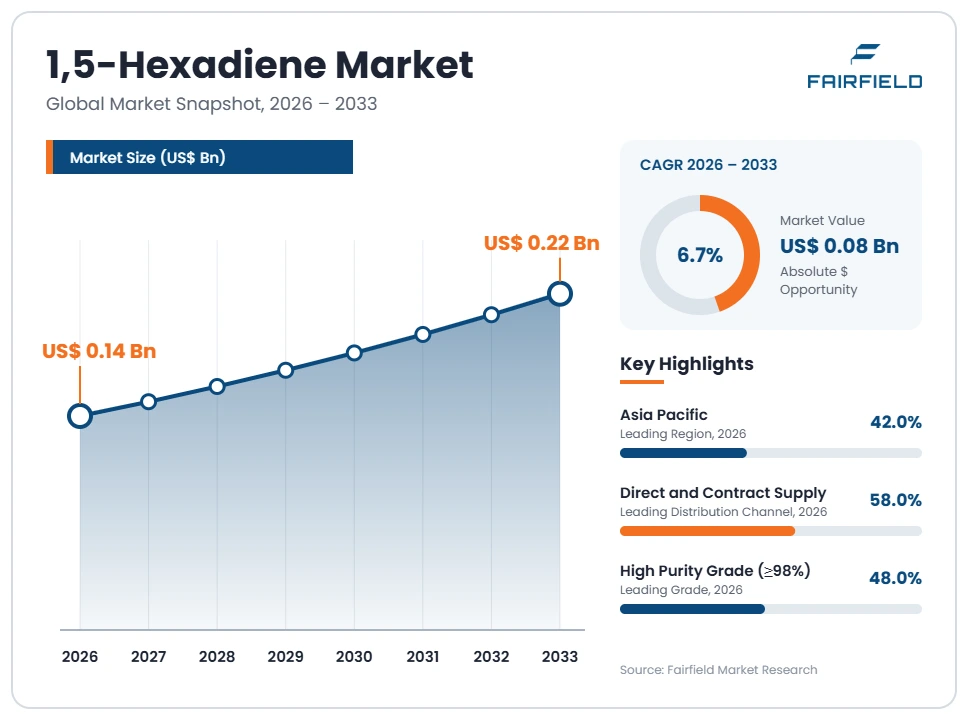
The global 1,5-Hexadiene market size is expected to be valued at US$ 0.14 billion in 2026 and projected to reach US$ 0.22 billion by 2033, growing at a CAGR of 6.7% between 2026 and 2033.
In precise terms, the merchant market is estimated at US$ 141.8 million in 2026 and US$ 222.6 million in 2033. Between 2020 and 2025 the category expanded at roughly 5.1% annually, held back by pandemic-era elastomer demand and volatile butadiene feedstock costs. Three factors now lift the trajectory. Crosslinking demand from specialty elastomers and wire-and-cable compounds continues to broaden. Silicone formulators are adopting the diene in addition-cure and hydrosilylation systems. Olefin metathesis chemistry has moved from academic work into commercial telechelic polymer and fine chemical routes. Direction of travel is steady specialty growth rather than commodity expansion, because dosing rates stay low and much production remains captive.
Key Report Takeaways
- By Grade: High Purity Grade (≥98%) held 48% share in 2026, while Ultra-High Purity Grade (≥99.5%) is projected to expand at a 9.1% CAGR through 2033, driven by electronic-grade silicone encapsulants that cannot tolerate catalyst-poisoning sulphur or chloride residues.
- By Application: Crosslinking Agent for Silicones and Elastomers held 37% share in 2026, while Metathesis and Specialty Polymer Chemistry is projected to grow at an 8.4% CAGR, as ruthenium catalyst costs fall and telechelic oligomer routes commercialise.
- By End-use Industry: Polymers and Plastics held 41% share in 2026, while Electronics is projected to advance at an 8.7% CAGR, supported by potting compounds, thermal interface materials and optical encapsulants used in power modules.
- By Distribution Channel: Direct and Contract Supply held 58% share in 2026, while Specialty Chemical Distributors are projected to grow at a 7.4% CAGR, reflecting smaller formulators that buy drummed quantities rather than negotiating annual tolling contracts.
- By Geography: Asia Pacific held 42% share in 2026, while Middle East & Africa is projected to expand at an 8.4% CAGR through 2033, as Gulf polyolefin complexes move downstream into specialty elastomer and compounding capacity.
Global 1,5-Hexadiene Market Trends and Insights
Drivers Impact Analysis
Two demand mechanisms account for most of the forecast expansion in this non-conjugated diene market.
| Driver | Impact on CAGR Forecast | Geographic Relevance | Impact Timeline |
| Crosslinking demand from specialty elastomers and cable compounds | High | Asia Pacific, Europe, North America | Medium term 2–4 years |
| Adoption as a silicone crosslinker in addition-cure systems | Medium | Asia Pacific, North America | Long term ≥4 years |
Elastomer Crosslinking Demand Anchors 1,5-Hexadiene Consumption Growth
Crosslinking in specialty elastomers is the single largest pull on 1,5-Hexadiene volumes. Compounders use the diene to introduce pendant vinyl groups that later cure into a three-dimensional network. That chemistry lets producers of ethylene-propylene rubber, wire and cable insulation and thermoplastic vulcanisates raise heat resistance without redesigning the polymer backbone. Dosing stays low, so buyers accept specialty pricing rather than commodity olefin pricing.
The causal mechanism is the molecule itself. Two terminal double bonds separated by a flexible four-carbon spacer allow one end to be incorporated during polymerisation while the second vinyl group remains free for peroxide cure. Standards for low-smoke halogen-free cable insulation and automotive sealing systems both reward controlled crosslink density. As converters in Europe replace legacy additives restricted under REACH, clean hydrocarbon crosslinkers gain share in qualified formulations.
Silicone Addition-Cure Chemistry Widens the 1,5-Hexadiene Customer Base
Silicone formulation is the second growth engine, and it brings higher-margin business than rubber compounding. Addition-cure and hydrosilylation systems use the diene as a difunctional chain extender or network former, reacting both vinyl ends with silicon-hydride groups across a platinum catalyst. The result is a tighter, more thermally stable network in potting compounds, gaskets and conformal coatings. These customers buy small volumes but specify tight purity and pay accordingly.
What changes the demand picture is device thermal load. Power electronics, electric vehicle inverters and LED modules run hotter and demand encapsulants that resist thermal cycling without cracking. Formulators tune crosslink density with short alpha,omega-dienes instead of adding filler. Because platinum catalysts are poisoned by sulphur and chloride, suppliers that can certify low-residue material capture the qualified positions in this application.
Restraints Impact Analysis
Two structural constraints hold the diene market below the growth rate of the elastomer end markets it serves.
| Restraint | Impact on CAGR Forecast | Geographic Relevance | Impact Timeline |
| Butadiene and allyl feedstock price volatility | High | Global | Short term ≤2 years |
| Flammable liquid process safety and transport compliance costs | Medium | Europe, North America | Medium term 2–4 years |
Feedstock Volatility Compresses 1,5-Hexadiene Producer Margins
Feedstock price swings compress producer margins and discourage capacity commitments in this diene chemistry. Routes based on butadiene dimerisation or allylic coupling both depend on steam cracker co-products whose availability follows naphtha versus ethane cracking economics rather than diene demand. When crackers shift to lighter feed, butadiene tightens and the cost base for downstream C6 dienes rises sharply within a quarter.
The specific cost source is yield loss across multi-step synthesis combined with distillation energy. Separating a C6 diene from close-boiling isomers such as 1,4-hexadiene and 2,4-hexadiene requires efficient fractionation, and every additional theoretical plate adds steam load. Producers cannot pass through short-term feedstock spikes because elastomer compounders hold annual price agreements. That mismatch keeps merchant capacity deliberately conservative and pushes several large converters toward captive or tolled production arrangements they control directly.
Flammable Liquid Compliance Raises 1,5-Hexadiene Handling Costs
Process safety and transport compliance raise the delivered cost of the diene and limit which sites can handle it. The material is classified as a highly flammable liquid under the EU CLP Regulation, with a low flash point and a broad vapour explosion range. Smaller compounders therefore buy through distributors in drums instead of holding bulk inventory, which caps order sizes and slows adoption in price-sensitive applications.
The underlying cause is regulatory rather than technical. Sites holding meaningful inventories fall within the scope of the Seveso III Directive 2012/18/EU in Europe and process safety management obligations enforced by OSHA in the United States. Both require hazard analysis, mechanical integrity programmes and documented management of change. Transport under the UN Model Regulations and ADR adds packaging, placarding and driver training costs that fall heavily on small shipments.
Market Opportunities
Olefin Metathesis Routes Open a Telechelic Polymer Revenue Pool for 1,5-Hexadiene
Olefin metathesis creates a genuinely new revenue pool rather than more of the same crosslinker demand. Acyclic diene metathesis polymerisation converts alpha,omega-dienes into precisely branched polyethylene analogues and telechelic oligomers with defined end groups. These materials command prices far above commodity polyolefins and are sold by the kilogram into adhesives, compatibilisers and specialty thermoplastic elastomers. A symmetrical C6 diene is among the cheapest usable monomers for that chemistry.
Capture favours fine chemical producers with clean distillation capability and access to ruthenium catalyst licences. Demand comes from adhesive and sealant formulators seeking narrow-dispersity prepolymers, and from compatibiliser suppliers serving mechanical plastics recycling. Falling catalyst loadings have cut the main cost barrier that kept metathesis in laboratories. Suppliers able to certify peroxide-free, inhibitor-stabilised material will hold the qualified positions as these routes scale.
Electronic-Grade Encapsulants Create a High-Value 1,5-Hexadiene Purity Premium
Electronic-grade purity is the second untapped pool, and it monetises purification rather than volume. Encapsulants, thermal interface materials and optical potting compounds for power semiconductors tolerate only parts-per-million levels of chloride, sulphur and metals. Material meeting those limits sells at a substantial premium over technical grade, and qualification cycles lock suppliers in for years. Volumes are modest, but gross margins can be several times those of elastomer-grade supply.
The customer group is clear: silicone system houses supplying power module assemblers, electric vehicle inverter makers and LED packagers. Supporting this shift is wide bandgap semiconductor adoption, where silicon carbide devices run at junction temperatures that conventional epoxy encapsulants cannot survive. Producers that invest in low-metal distillation trains, dedicated drumming lines and full analytical certification can enter a segment where few merchant suppliers currently qualify.
Segment Analysis
- By Grade: High Purity Material Leads While Ultra-High Purity Grade Accelerates
High Purity Grade (≥98%) held 48% of 2026 revenue because it is the minimum specification that silicone and elastomer formulators will qualify. Isomeric dienes and residual chloride interfere with peroxide and platinum cure systems, so compounders rarely accept technical material in production formulations. Ultra-High Purity Grade (≥99.5%) is the fastest-growing tier at a 9.1% CAGR, pulled by electronic encapsulants and metathesis chemistry where catalyst poisoning is the binding constraint. Technical Grade (≥95%) accounts for the remaining volume, serving organic synthesis users who purify in-house. The purity ladder matters commercially because each step adds distillation energy and analytical burden rather than raw material cost. Suppliers that can document trace metals, peroxide value and isomer distribution capture disproportionate margin, which is why purification capability now separates merchant producers from simple repackagers in this diene market.
- By Application: Crosslinking Leads as Metathesis Chemistry Builds Momentum
Crosslinking Agent for Silicones and Elastomers led with 37% share in 2026, reflecting the molecule’s core value as a difunctional network former. Comonomer in Polyolefins followed at 31%, where small additions introduce long-chain branching and improve melt strength in film and pipe resins. Organic Synthesis Intermediate holds 20%, covering ring-closing reactions, hydroformylation and specialty surfactant routes. Metathesis and Specialty Polymer Chemistry is the fastest-expanding application at an 8.4% CAGR from a 12% base, as ruthenium catalyst costs fall and acyclic diene metathesis moves into commercial adhesives and compatibilisers. The business implication is that revenue growth is shifting away from tonnage applications toward low-volume, high-specification chemistry. Suppliers aligned only to elastomer compounding will track general rubber demand, while those serving metathesis users gain exposure to a faster and less cyclical revenue stream.
- By End-use Industry: Polymers and Plastics Dominate While Electronics Grows Quickest
Polymers and Plastics accounted for 41% of 2026 demand, the predictable result of comonomer and crosslinker use in polyolefin resins, thermoplastic vulcanisates and cable compounds. Chemicals and Pharmaceuticals follows at 24%, buying the diene as a bifunctional building block for ring-closing metathesis and intermediate synthesis. Automotive and Industrial Rubber represents 21%, concentrated in sealing systems, hoses and vibration damping parts. Electronics is the fastest-growing industry at an 8.7% CAGR from a 14% base, driven by silicone potting compounds, thermal interface materials and optical encapsulants in power modules. Wide bandgap semiconductor adoption is the specific pull, because silicon carbide junction temperatures exceed what standard epoxies tolerate. For suppliers, the implication is a gradual mix shift toward customers who audit plants, demand certificates of analysis and reward consistency over price.
- By Distribution Channel: Direct Supply Leads While Distributors Expand Fastest
Direct and Contract Supply held 58% of 2026 revenue because large elastomer and silicone producers buy on annual agreements with specification lock-in and dedicated tolling arrangements. Specialty Chemical Distributors hold 29% and are the fastest-growing channel at a 7.4% CAGR, as mid-sized compounders and adhesive formulators order drummed quantities without committing to volume contracts. Catalog and Research Suppliers account for 13%, serving laboratories, metathesis researchers and early-stage process development at gram to kilogram scale. Channel structure reflects the hazard profile: flammable liquid storage, nitrogen blanketing and inhibitor management are easier to outsource to distributors with licensed warehouses. The commercial consequence is that distributors increasingly control access to the long tail of small formulators, and producers that neglect channel partners lose visibility of emerging applications before they scale into contract volumes.
Geography Analysis
- North America Sustains a Technology-Led Position in 1,5-Hexadiene Supply
North America held 26% of 2026 revenue and is forecast to grow at 7.0% annually, the strongest performance among the established industrial blocs. The United States dominates regional activity, with Gulf Coast specialty olefin capability supplying both domestic silicone system houses and export customers. Demand is anchored in wire and cable compounds, automotive sealing systems and a deep base of power electronics packaging. Research institutions and catalyst developers also make the region the centre of commercial metathesis chemistry, which pulls ultra-high purity grades. Regulatory cost is real: inventory listing under the Toxic Substances Control Act and process safety management enforced by OSHA both raise the compliance baseline. The clearest regional opportunity lies in semiconductor packaging materials, where domestic chip fabrication investment is creating qualified demand for encapsulant chemistries that previously shipped from overseas formulators.
- Europe Combines Regulatory Rigour With Specialty Silicone Demand
Europe accounted for 21% of 2026 revenue and is expected to grow at 5.4%, the slowest rate among major blocs. Germany, France, the Netherlands and Belgium host the silicone system houses, specialty elastomer compounders and fine chemical producers that consume most regional volume. Growth is restrained by high energy costs, mature automotive output and the compliance burden that comes with handling a highly flammable liquid. Registration obligations under REACH, classification under the CLP Regulation and upper-tier site duties under the Seveso III Directive 2012/18/EU all add fixed cost per tonne handled. The offsetting change is qualitative. Regional buyers increasingly specify low-residue, fully documented material for medical silicones and rail and building cable, which favours suppliers with strong analytical certification over those competing purely on delivered price.
- Which Region Is Leading the 1,5-Hexadiene Market?
Asia Pacific leads the 1,5-Hexadiene market with 42% share in 2026 and a forecast 7.2% CAGR through 2033. China supplies the majority of regional volume, supported by integrated C4 processing, a dense fine chemical base and the world’s largest wire and cable manufacturing industry. Japan and South Korea contribute high-specification demand through silicone system houses and semiconductor packaging materials, while India adds growing elastomer compounding capacity. Leadership rests on three verifiable causes: proximity to butadiene and allyl feedstocks, concentration of downstream polyolefin and silicone converters, and lower conversion costs for multi-step distillation. Much regional output never reaches the merchant market because integrated producers consume it internally. The main change underway is purity upgrading, as domestic suppliers invest in fractionation to serve electronic-grade customers previously served by imports.
- Latin America Builds Demand Around Cable and Automotive Rubber Compounding
Latin America represented 6% of 2026 revenue with a forecast 6.1% CAGR, making it a small but steadily improving consumption base. Brazil and Mexico drive almost all activity through automotive sealing components, construction wire and industrial rubber goods tied to North American supply chains. The binding barrier is the absence of local diene production, which leaves formulators dependent on imported drums with long lead times and currency exposure. Flammable liquid import licensing and limited licensed warehouse capacity add further friction, pushing many compounders toward alternative crosslinkers that are easier to store. The opportunity is nearshoring. As automotive component assembly consolidates in Mexico, silicone and elastomer formulators are qualifying regional stockholding arrangements, which would shorten lead times and make specialty crosslinker adoption commercially viable for mid-sized compounders.
- Which Region Is Growing Fastest in the 1,5-Hexadiene Market?
Middle East & Africa is the fastest-growing geography in the 1,5-Hexadiene market, with a forecast 8.4% CAGR from a 5% share in 2026. Saudi Arabia and the United Arab Emirates account for most of that momentum as Gulf petrochemical groups extend beyond base polyolefins into compounding, specialty elastomers and cable materials. Abundant C4 feedstock, low energy cost and national industrial diversification programmes make downstream specialty chemistry economically attractive for the first time. South Africa and Egypt add modest demand through wire, cable and automotive rubber. Barriers remain significant: limited local formulation expertise, thin analytical infrastructure and reliance on imported catalysts and additives. The decisive change is investment in conversion rather than extraction, which gradually turns the region from a feedstock exporter into a genuine consumer of specialty diene chemistry.
Competitive Landscape
The 1,5-Hexadiene market is moderately concentrated, with a small number of integrated specialty olefin producers supplying bulk merchant volume and a wider group of fine chemical houses serving laboratory and development demand. Concentration is a consequence of scale economics in distillation rather than intellectual property. Producing a clean C6 diene requires separating close-boiling isomers, and the fractionation trains that make this economic are expensive and rarely built for a single product. Chevron Phillips Chemical Company LLC is positioned through its specialty olefins capability, while catalog suppliers including Merck KGaA, Thermo Fisher Scientific Inc. and Tokyo Chemical Industry Co., Ltd. cover research and small-volume industrial demand. Significant captive and tolled production sits entirely outside the traded figure.
Competition turns on purity certification, supply reliability and hazard logistics rather than list price. Buyers in silicone and electronics applications run long qualification cycles and will not switch suppliers over small price differences. Analytical depth is the practical differentiator: trace metals, peroxide value, inhibitor content and isomer distribution all appear on modern specifications. New entrants have come mainly from Chinese and Indian fine chemical producers upgrading purification capability to move from technical grade into qualified industrial supply.
Strategically, vendors are pursuing deeper purification, broader regulatory documentation and closer formulation support rather than tonnage expansion. Several suppliers now position the diene within a wider alpha,omega-diene portfolio alongside longer homologues, letting customers tune chain length. Others focus on inhibitor systems and packaging that extend shelf life in hot climates. The common theme is the move from selling a commodity molecule to selling a qualified, documented input for sensitive cure chemistry.
Recent Industry Developments
- June 2015: The Seveso III Directive 2012/18/EU became applicable across the European Union, tightening major-accident duties for sites storing highly flammable liquids – raising the fixed compliance cost of holding bulk diene inventory in Europe.
- June 2016: The United States enacted the Frank R. Lautenberg Chemical Safety Act amending the Toxic Substances Control Act – giving the Environmental Protection Agency stronger authority to prioritise and evaluate existing industrial chemicals, including specialty olefins.
- May 2018: The final REACH registration deadline closed for phase-in substances manufactured or imported at 1 to 100 tonnes per year – effectively setting the minimum data burden for any supplier placing the diene on the European Union market.
- January 2025: The 2025 edition of ADR entered into force for international road transport of dangerous goods – updating packaging and documentation requirements that govern drummed shipments of flammable diene products.
- May 2025: New hazard classes introduced by Commission Delegated Regulation (EU) 2023/707 became applicable to substances under the CLP Regulation – obliging suppliers to reassess classification and labelling for specialty hydrocarbons placed on the European Union market.
Companies Covered in the Report
- Chevron Phillips Chemical Company LLC
- Merck KGaA
- Thermo Fisher Scientific Inc.
- Tokyo Chemical Industry Co., Ltd.
- Apollo Scientific Ltd.
- Oakwood Products, Inc.
- BLD Pharmatech Ltd.
- Toronto Research Chemicals
1,5-Hexadiene Market Report Scope
| Metric | Value |
| Study Period | 2020–2033 |
| Market Size 2026 | US$ 0.14 Billion |
| Market Size 2033 | US$ 0.22 Billion |
| CAGR 2026–2033 | 6.7% |
| Absolute Dollar Opportunity | US$ 0.08 Billion |
| Largest Market | Asia Pacific |
| Fastest-Growing Market | Middle East & Africa |
| Market Concentration | Medium |
| Major Players | Chevron Phillips Chemical Company LLC, Merck KGaA, Thermo Fisher Scientific Inc., Tokyo Chemical Industry Co., Ltd., Apollo Scientific Ltd. |
1,5-Hexadiene Market Segmentation
Grade
- Technical Grade (≥95%)
- High Purity Grade (≥98%)
- Ultra-High Purity Grade (≥99.5%)
Application
- Comonomer in Polyolefins
- Crosslinking Agent for Silicones and Elastomers
- Organic Synthesis Intermediate
- Metathesis and Specialty Polymer Chemistry
End-use Industry
- Polymers and Plastics
- Chemicals and Pharmaceuticals
- Electronics
- Automotive and Industrial Rubber
Distribution Channel
- Direct and Contract Supply
- Specialty Chemical Distributors
- Catalog and Research Suppliers
Regions
- North America
- Europe
- Asia Pacific
- Latin America
- Middle East & Africa
- Executive Summary
- Global 1,5-Hexadiene Market Snapshot
- Future Projections
- Key Report Takeaways
- Regional Snapshot
- Market Overview
- Market Definition and Report Scope
- Historical Trends 2020–2025
- Market Dynamics
- Drivers
- Elastomer Crosslinking Demand Anchors 1,5-Hexadiene Consumption Growth
- Silicone Addition-Cure Chemistry Widens the 1,5-Hexadiene Customer Base
- Restraints
- Feedstock Volatility Compresses 1,5-Hexadiene Producer Margins
- Flammable Liquid Compliance Raises 1,5-Hexadiene Handling Costs
- Market Opportunities
- Olefin Metathesis Routes Open a Telechelic Polymer Revenue Pool for 1,5-Hexadiene
- Electronic-Grade Encapsulants Create a High-Value 1,5-Hexadiene Purity Premium
- Drivers
- Global 1,5-Hexadiene Market Outlook, 2020–2033
- Global 1,5-Hexadiene Market Outlook, by Grade, Value (US$ Billion), 2020–2033
- Technical Grade (≥95%)
- High Purity Grade (≥98%)
- Ultra-High Purity Grade (≥99.5%)
- Global 1,5-Hexadiene Market Outlook, by Application, Value (US$ Billion), 2020–2033
- Comonomer in Polyolefins
- Crosslinking Agent for Silicones and Elastomers
- Organic Synthesis Intermediate
- Metathesis and Specialty Polymer Chemistry
- Global 1,5-Hexadiene Market Outlook, by End-use Industry, Value (US$ Billion), 2020–2033
- Polymers and Plastics
- Chemicals and Pharmaceuticals
- Electronics
- Automotive and Industrial Rubber
- Global 1,5-Hexadiene Market Outlook, by Distribution Channel, Value (US$ Billion), 2020–2033
- Direct and Contract Supply
- Specialty Chemical Distributors
- Catalog and Research Suppliers
- Global 1,5-Hexadiene Market Outlook, by Region, Value (US$ Billion), 2020–2033
- North America
- Europe
- Asia Pacific
- Latin America
- Middle East & Africa
- Global 1,5-Hexadiene Market Outlook, by Grade, Value (US$ Billion), 2020–2033
- North America 1,5-Hexadiene Market Outlook, 2020–2033
- North America 1,5-Hexadiene Market Outlook, by Grade, Value (US$ Billion), 2020–2033
- Technical Grade (≥95%)
- High Purity Grade (≥98%)
- Ultra-High Purity Grade (≥99.5%)
- North America 1,5-Hexadiene Market Outlook, by Application, Value (US$ Billion), 2020–2033
- Comonomer in Polyolefins
- Crosslinking Agent for Silicones and Elastomers
- Organic Synthesis Intermediate
- Metathesis and Specialty Polymer Chemistry
- North America 1,5-Hexadiene Market Outlook, by End-use Industry, Value (US$ Billion), 2020–2033
- Polymers and Plastics
- Chemicals and Pharmaceuticals
- Electronics
- Automotive and Industrial Rubber
- North America 1,5-Hexadiene Market Outlook, by Distribution Channel, Value (US$ Billion), 2020–2033
- Direct and Contract Supply
- Specialty Chemical Distributors
- Catalog and Research Suppliers
- North America 1,5-Hexadiene Market Outlook, by Country, Value (US$ Billion), 2020–2033
- United States 1,5-Hexadiene Market Outlook, by Grade, 2020–2033
- United States 1,5-Hexadiene Market Outlook, by Application, 2020–2033
- United States 1,5-Hexadiene Market Outlook, by End-use Industry, 2020–2033
- United States 1,5-Hexadiene Market Outlook, by Distribution Channel, 2020–2033
- North America 1,5-Hexadiene Market Outlook, by Grade, Value (US$ Billion), 2020–2033
- Europe 1,5-Hexadiene Market Outlook, 2020–2033
- Europe 1,5-Hexadiene Market Outlook, by Grade, Value (US$ Billion), 2020–2033
- Technical Grade (≥95%)
- High Purity Grade (≥98%)
- Ultra-High Purity Grade (≥99.5%)
- Europe 1,5-Hexadiene Market Outlook, by Application, Value (US$ Billion), 2020–2033
- Comonomer in Polyolefins
- Crosslinking Agent for Silicones and Elastomers
- Organic Synthesis Intermediate
- Metathesis and Specialty Polymer Chemistry
- Europe 1,5-Hexadiene Market Outlook, by End-use Industry, Value (US$ Billion), 2020–2033
- Polymers and Plastics
- Chemicals and Pharmaceuticals
- Electronics
- Automotive and Industrial Rubber
- Europe 1,5-Hexadiene Market Outlook, by Distribution Channel, Value (US$ Billion), 2020–2033
- Direct and Contract Supply
- Specialty Chemical Distributors
- Catalog and Research Suppliers
- Europe 1,5-Hexadiene Market Outlook, by Country, Value (US$ Billion), 2020–2033
- Germany 1,5-Hexadiene Market Outlook, by Grade, 2020–2033
- Germany 1,5-Hexadiene Market Outlook, by Application, 2020–2033
- Germany 1,5-Hexadiene Market Outlook, by End-use Industry, 2020–2033
- Germany 1,5-Hexadiene Market Outlook, by Distribution Channel, 2020–2033
- France 1,5-Hexadiene Market Outlook, by Grade, 2020–2033
- France 1,5-Hexadiene Market Outlook, by Application, 2020–2033
- France 1,5-Hexadiene Market Outlook, by End-use Industry, 2020–2033
- France 1,5-Hexadiene Market Outlook, by Distribution Channel, 2020–2033
- Netherlands 1,5-Hexadiene Market Outlook, by Grade, 2020–2033
- Netherlands 1,5-Hexadiene Market Outlook, by Application, 2020–2033
- Netherlands 1,5-Hexadiene Market Outlook, by End-use Industry, 2020–2033
- Netherlands 1,5-Hexadiene Market Outlook, by Distribution Channel, 2020–2033
- Belgium 1,5-Hexadiene Market Outlook, by Grade, 2020–2033
- Belgium 1,5-Hexadiene Market Outlook, by Application, 2020–2033
- Belgium 1,5-Hexadiene Market Outlook, by End-use Industry, 2020–2033
- Belgium 1,5-Hexadiene Market Outlook, by Distribution Channel, 2020–2033
- Europe 1,5-Hexadiene Market Outlook, by Grade, Value (US$ Billion), 2020–2033
- Asia Pacific 1,5-Hexadiene Market Outlook, 2020–2033
- Asia Pacific 1,5-Hexadiene Market Outlook, by Grade, Value (US$ Billion), 2020–2033
- Technical Grade (≥95%)
- High Purity Grade (≥98%)
- Ultra-High Purity Grade (≥99.5%)
- Asia Pacific 1,5-Hexadiene Market Outlook, by Application, Value (US$ Billion), 2020–2033
- Comonomer in Polyolefins
- Crosslinking Agent for Silicones and Elastomers
- Organic Synthesis Intermediate
- Metathesis and Specialty Polymer Chemistry
- Asia Pacific 1,5-Hexadiene Market Outlook, by End-use Industry, Value (US$ Billion), 2020–2033
- Polymers and Plastics
- Chemicals and Pharmaceuticals
- Electronics
- Automotive and Industrial Rubber
- Asia Pacific 1,5-Hexadiene Market Outlook, by Distribution Channel, Value (US$ Billion), 2020–2033
- Direct and Contract Supply
- Specialty Chemical Distributors
- Catalog and Research Suppliers
- Asia Pacific 1,5-Hexadiene Market Outlook, by Country, Value (US$ Billion), 2020–2033
- China 1,5-Hexadiene Market Outlook, by Grade, 2020–2033
- China 1,5-Hexadiene Market Outlook, by Application, 2020–2033
- China 1,5-Hexadiene Market Outlook, by End-use Industry, 2020–2033
- China 1,5-Hexadiene Market Outlook, by Distribution Channel, 2020–2033
- Japan 1,5-Hexadiene Market Outlook, by Grade, 2020–2033
- Japan 1,5-Hexadiene Market Outlook, by Application, 2020–2033
- Japan 1,5-Hexadiene Market Outlook, by End-use Industry, 2020–2033
- Japan 1,5-Hexadiene Market Outlook, by Distribution Channel, 2020–2033
- South Korea 1,5-Hexadiene Market Outlook, by Grade, 2020–2033
- South Korea 1,5-Hexadiene Market Outlook, by Application, 2020–2033
- South Korea 1,5-Hexadiene Market Outlook, by End-use Industry, 2020–2033
- South Korea 1,5-Hexadiene Market Outlook, by Distribution Channel, 2020–2033
- India 1,5-Hexadiene Market Outlook, by Grade, 2020–2033
- India 1,5-Hexadiene Market Outlook, by Application, 2020–2033
- India 1,5-Hexadiene Market Outlook, by End-use Industry, 2020–2033
- India 1,5-Hexadiene Market Outlook, by Distribution Channel, 2020–2033
- Asia Pacific 1,5-Hexadiene Market Outlook, by Grade, Value (US$ Billion), 2020–2033
- Latin America 1,5-Hexadiene Market Outlook, 2020–2033
- Latin America 1,5-Hexadiene Market Outlook, by Grade, Value (US$ Billion), 2020–2033
- Technical Grade (≥95%)
- High Purity Grade (≥98%)
- Ultra-High Purity Grade (≥99.5%)
- Latin America 1,5-Hexadiene Market Outlook, by Application, Value (US$ Billion), 2020–2033
- Comonomer in Polyolefins
- Crosslinking Agent for Silicones and Elastomers
- Organic Synthesis Intermediate
- Metathesis and Specialty Polymer Chemistry
- Latin America 1,5-Hexadiene Market Outlook, by End-use Industry, Value (US$ Billion), 2020–2033
- Polymers and Plastics
- Chemicals and Pharmaceuticals
- Electronics
- Automotive and Industrial Rubber
- Latin America 1,5-Hexadiene Market Outlook, by Distribution Channel, Value (US$ Billion), 2020–2033
- Direct and Contract Supply
- Specialty Chemical Distributors
- Catalog and Research Suppliers
- Latin America 1,5-Hexadiene Market Outlook, by Country, Value (US$ Billion), 2020–2033
- Brazil 1,5-Hexadiene Market Outlook, by Grade, 2020–2033
- Brazil 1,5-Hexadiene Market Outlook, by Application, 2020–2033
- Brazil 1,5-Hexadiene Market Outlook, by End-use Industry, 2020–2033
- Brazil 1,5-Hexadiene Market Outlook, by Distribution Channel, 2020–2033
- Mexico 1,5-Hexadiene Market Outlook, by Grade, 2020–2033
- Mexico 1,5-Hexadiene Market Outlook, by Application, 2020–2033
- Mexico 1,5-Hexadiene Market Outlook, by End-use Industry, 2020–2033
- Mexico 1,5-Hexadiene Market Outlook, by Distribution Channel, 2020–2033
- Latin America 1,5-Hexadiene Market Outlook, by Grade, Value (US$ Billion), 2020–2033
- Middle East & Africa 1,5-Hexadiene Market Outlook, 2020–2033
- Middle East & Africa 1,5-Hexadiene Market Outlook, by Grade, Value (US$ Billion), 2020–2033
- Technical Grade (≥95%)
- High Purity Grade (≥98%)
- Ultra-High Purity Grade (≥99.5%)
- Middle East & Africa 1,5-Hexadiene Market Outlook, by Application, Value (US$ Billion), 2020–2033
- Comonomer in Polyolefins
- Crosslinking Agent for Silicones and Elastomers
- Organic Synthesis Intermediate
- Metathesis and Specialty Polymer Chemistry
- Middle East & Africa 1,5-Hexadiene Market Outlook, by End-use Industry, Value (US$ Billion), 2020–2033
- Polymers and Plastics
- Chemicals and Pharmaceuticals
- Electronics
- Automotive and Industrial Rubber
- Middle East & Africa 1,5-Hexadiene Market Outlook, by Distribution Channel, Value (US$ Billion), 2020–2033
- Direct and Contract Supply
- Specialty Chemical Distributors
- Catalog and Research Suppliers
- Middle East & Africa 1,5-Hexadiene Market Outlook, by Country, Value (US$ Billion), 2020–2033
- Saudi Arabia 1,5-Hexadiene Market Outlook, by Grade, 2020–2033
- Saudi Arabia 1,5-Hexadiene Market Outlook, by Application, 2020–2033
- Saudi Arabia 1,5-Hexadiene Market Outlook, by End-use Industry, 2020–2033
- Saudi Arabia 1,5-Hexadiene Market Outlook, by Distribution Channel, 2020–2033
- United Arab Emirates 1,5-Hexadiene Market Outlook, by Grade, 2020–2033
- United Arab Emirates 1,5-Hexadiene Market Outlook, by Application, 2020–2033
- United Arab Emirates 1,5-Hexadiene Market Outlook, by End-use Industry, 2020–2033
- United Arab Emirates 1,5-Hexadiene Market Outlook, by Distribution Channel, 2020–2033
- South Africa 1,5-Hexadiene Market Outlook, by Grade, 2020–2033
- South Africa 1,5-Hexadiene Market Outlook, by Application, 2020–2033
- South Africa 1,5-Hexadiene Market Outlook, by End-use Industry, 2020–2033
- South Africa 1,5-Hexadiene Market Outlook, by Distribution Channel, 2020–2033
- Egypt 1,5-Hexadiene Market Outlook, by Grade, 2020–2033
- Egypt 1,5-Hexadiene Market Outlook, by Application, 2020–2033
- Egypt 1,5-Hexadiene Market Outlook, by End-use Industry, 2020–2033
- Egypt 1,5-Hexadiene Market Outlook, by Distribution Channel, 2020–2033
- Middle East & Africa 1,5-Hexadiene Market Outlook, by Grade, Value (US$ Billion), 2020–2033
- Competitive Landscape
- Market Concentration and Industry Leaders
- Competitive Differentiation
- Strategic Moves and Market Direction
- Recent Industry Developments
- Company Profiles
- Chevron Phillips Chemical Company LLC
- Merck KGaA
- Thermo Fisher Scientific Inc.
- Tokyo Chemical Industry Co., Ltd.
- Apollo Scientific Ltd.
- Oakwood Products, Inc.
- BLD Pharmatech Ltd.
- Toronto Research Chemicals
- Appendix
- Research Methodology
- Report Assumptions
- Acronyms and Abbreviations
Grade
- Technical Grade (≥95%)
- High Purity Grade (≥98%)
- Ultra-High Purity Grade (≥99.5%)
Application
- Comonomer in Polyolefins
- Crosslinking Agent for Silicones and Elastomers
- Organic Synthesis Intermediate
- Metathesis and Specialty Polymer Chemistry
End-use Industry
- Polymers and Plastics
- Chemicals and Pharmaceuticals
- Electronics
- Automotive and Industrial Rubber
Distribution Channel
- Direct and Contract Supply
- Specialty Chemical Distributors
- Catalog and Research Suppliers
Regions
- North America
- Europe
- Asia Pacific
- Latin America
- Middle East & Africa
Our Research Methodology
Considering the volatility of business today, traditional approaches to strategizing a game plan can be unfruitful if not detrimental. True ambiguity is no way to determine a forecast. A myriad of predetermined factors must be accounted for such as the degree of risk involved, the magnitude of circumstances, as well as conditions or consequences that are not known or unpredictable. To circumvent binary views that cast uncertainty, the application of market research intelligence to strategically posture, move, and enable actionable outcomes is necessary.
View Methodology
Quality Assured
Rigorous Validation Process

Confidentiality Assured
End-to-end Data Security

Custom Research Services
Tailored To Your Objectives
FAQs
The market is valued at US$ 0.14 billion, or US$ 141.8 million, in 2026, reflecting merchant sales only and excluding captive or tolled production volumes.
Revenue is projected to reach US$ 0.22 billion by 2033, advancing at a 6.7% CAGR and creating an absolute opportunity of US$ 0.08 billion.
Crosslinking Agent for Silicones and Elastomers leads with 37% share in 2026, because the diene forms thermally stable networks in cure systems.
Metathesis and Specialty Polymer Chemistry grows fastest at 8.4%, while Middle East & Africa leads regional growth at an 8.4% CAGR through 2033.
Asia Pacific holds 42% share in 2026, supported by integrated C4 feedstock access, dense cable manufacturing and concentrated silicone formulation capacity.
Related Reports
2-Methoxy-2-Methylheptane Market Size, Share, Insights, Competitive Landscape, and Forecast 2026 to 2033
The global 2-methoxy-2-methylheptane market is valued at US$0.04 billion in 2026, reaching US$0.07 billion by 2033, growing at an 8.3% CAGR
2D Materials Market Size, Share, Insights, Competitive Landscape, and Forecast 2026 to 2033
The global 2D materials market is valued at US$3.65 billion in 2026, reaching US$10.20 billion by 2033, growing at a 15.8% CAGR
2,4-Dichloro-5-Fluorobenzoic Acid Market Size, Share, Insights, Competitive Landscape, and Forecast 2026 to 2033
The global 2,4-dichloro-5-fluorobenzoic acid market is valued at US$0.09 billion in 2026, reaching US$0.12 billion by 2033, at a 4.2% CAGR
Automotive NVH Materials Market Size, Share, Insights, Competitive Landscape, and Forecast 2026 to 2033
The global automotive NVH materials market is valued at US$13.8 billion in 2026, reaching US$20.5 billion by 2033, growing at a 5.82% CAGR
Acrylonitrile Butadiene Styrene Market Size, Share, Insights, Competitive Landscape, and Forecast 2026 to 2033
The global acrylonitrile butadiene styrene market is valued at US$27.4 billion in 2026, reaching US$38.6 billion by 2033, growing at a 5.02% CAGR
Tank Mix Adjuvants Market Size, Share, Insights, Competitive Landscape, and Forecast 2026 to 2033
The global tank mix adjuvants market is valued at US$4.3 billion in 2026, reaching US$6.6 billion by 2033, growing at a 6.3% CAGR