



2D Materials Market
2D Materials Market Size, Share, Insights, Competitive Landscape, and Forecast 2026 to 2033
2D Materials Market Size and Trend Analysis
How Fast Is the 2D Materials Market Growing?
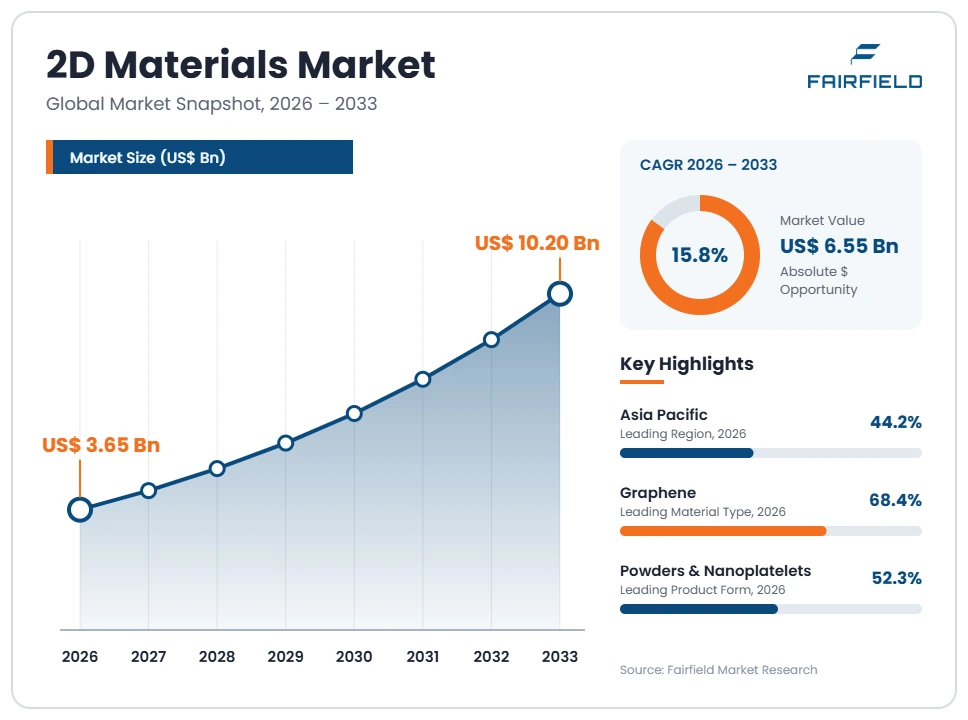
The global 2D materials market size is expected to be valued at US$ 3.65 billion in 2026 and projected to reach US$ 10.20 billion by 2033, growing at a CAGR of 15.8% between 2026 and 2033.
Between 2020 and 2025, the market grew at a CAGR of about 11.4%, as graphene moved from laboratory curiosity to commercial additives in coatings, composites, and battery materials. Three factors now drive faster growth: demand for lighter, stronger composites in vehicles and construction, the need for better conductive additives in batteries, and semiconductor research into atomically thin channels and photonic chips. The market is shifting from small research volumes toward tonne-scale graphene powder production and wafer-scale growth of transition metal dichalcogenides and hexagonal boron nitride for electronics.
Key Report Takeaways
- By Material Type: Graphene held 68.4% share in 2026, while Transition Metal Dichalcogenides are projected to expand at a 21.3% CAGR through 2033, driven by semiconductor research into atomically thin transistor channels.
- By Production Method: Liquid Exfoliation held 41.7% share in 2026, while Chemical Vapor Deposition is projected to expand at an 18.9% CAGR through 2033, driven by wafer-scale films needed for electronics and photonics.
- By Product Form: Powders & Nanoplatelets held 52.3% share in 2026, while Films & Wafers are projected to expand at a 19.4% CAGR through 2033, driven by sensors, photonic chips, and transparent electrodes.
- By Application: Composites & Coatings held 36.8% share in 2026, while Energy Storage is projected to expand at an 18.7% CAGR through 2033, driven by conductive additives and silicon-anode supports in lithium-ion batteries.
- By Region: Asia Pacific held 44.2% share in 2026, while North America is projected to expand at a 17.1% CAGR through 2033, driven by semiconductor funding and graphene-enhanced automotive and construction materials.
Global 2D Materials Market Trends and Insights
Drivers Impact Analysis
Two drivers carry the strongest influence on 2D materials demand during the forecast period.
| Driver | Impact on CAGR Forecast | Geographic Relevance | Impact Timeline |
| Lightweight composites and performance coatings | High | Asia Pacific, North America, Europe | Medium term (2–4 years) |
| Next-generation semiconductors and photonics | High | Europe, North America, Asia Pacific | Long term (≥4 years) |
Composites and Coatings Are Driving Commercial Demand for 2D Materials
Composites and coatings are the largest commercial outlet for 2D materials today. Small additions of graphene nanoplatelets can raise strength, stiffness, thermal conductivity, and barrier performance in plastics, concrete, paints, and rubber.
The evidence is industrial capacity investment. In January 2024, NanoXplore in Canada announced a capacity expansion at its St-Clotilde, Quebec, plant to meet demand for graphene-enhanced sheet molding compound parts used in trucks and vehicles. In February 2025, Black Swan Graphene closed a US$ 6 million financing to expand its Consett, United Kingdom facility from about 30 to 40 tonnes to about 140 tonnes a year. Automakers want lighter parts to extend electric vehicle range, while concrete and coatings makers want lower material use and longer life. These graphene composites offer measurable gains at low dosage, which supports wider adoption.
Semiconductor and Photonics Research Is Opening a High-Value 2D Materials Market
Semiconductor and photonics research is creating a high-value, long-term market for 2D materials. As silicon transistors approach physical limits, chipmakers are studying atomically thin materials that can carry current with very little leakage.
The mechanism is the need for smaller, faster, and more energy-efficient chips. Transition metal dichalcogenides such as molybdenum disulfide and tungsten diselenide can form transistor channels only a few atoms thick. Hexagonal boron nitride serves as an ultra-thin insulator. Graphene can switch and guide light for optical interconnects. In June 2024, Black Semiconductor in Germany secured €254.4 million, including €228.7 million of public funding under the IPCEI ME/CT program, to build a pilot line for graphene-based photonic chips in Aachen. Major research centers such as imec and Samsung Advanced Institute of Technology are also advancing 2D semiconductors.
Restraints Impact Analysis
Two restraints limit how quickly 2D materials move into mass markets.
| Restraint | Impact on CAGR Forecast | Geographic Relevance | Impact Timeline |
| Inconsistent quality and lack of standards | High | Global | Medium term (2–4 years) |
| High production cost for high-purity films | Medium | Global | Long term (≥4 years) |
Inconsistent Quality and Weak Standards Slow 2D Materials Adoption
Inconsistent product quality and weak standards slow 2D materials adoption. Many products sold as graphene vary widely in layer count, flake size, oxygen content, and defects, which makes performance hard to predict.
The underlying cause is the variety of production methods and limited measurement standards. Buyers in automotive, aerospace, and electronics require consistent materials before they qualify a supplier. Without agreed test methods, they must run long internal trials. The International Organization for Standardization has already published terminology and measurement guidance for graphene, and national laboratories such as the UK National Physical Laboratory support characterization, but adoption across suppliers is uneven. Some low-quality products marketed as graphene contain mostly graphite, which damages trust. These issues lengthen sales cycles, raise qualification costs, and keep many promising applications in pilot stages.
High Production Costs Limit Use of High-Purity 2D Materials
High production costs limit the use of high-purity 2D materials, especially single-layer films for electronics. While bulk graphene powders have become much cheaper over the past decade, defect-free wafer-scale films remain expensive.
The specific cost sources are equipment, energy, and yield. Chemical vapor deposition reactors operate at high temperatures under vacuum and need expensive precursor gases. Transferring films from growth substrates to target wafers can introduce tears and contamination, which lowers yield. Growing transition metal dichalcogenides with uniform thickness over large areas is still difficult. Metrology tools for checking atomic-scale quality, such as Raman spectroscopy and electron microscopy, add further cost. These factors keep high-end 2D materials in research and pilot production, and they make it hard to compete with established silicon and copper technologies on price.
Market Opportunities
Battery Conductive Additives Open a Large Revenue Pool for 2D Materials
Battery conductive additives and anode supports create a large, fast-growing revenue pool for 2D materials. Lithium-ion battery makers need better electrical networks inside electrodes to support faster charging and higher energy density.
Graphene producers and battery material suppliers can capture this opportunity. Graphene and few-layer graphene improve electron flow in cathodes and help stabilize silicon-rich anodes that swell during charging. MXenes, a newer family of 2D carbides and nitrides, show promise for supercapacitors and fast-charging electrodes. Cell makers in China, South Korea, Japan, and the United States are the main customers, along with cathode and anode material suppliers. As battery production expands for electric vehicles and grid storage, even small additive loadings translate into large volumes of 2D materials, especially where performance gains justify higher costs.
Graphene-Enhanced Concrete and Construction Materials Create a Volume Opportunity for 2D Materials
Graphene-enhanced concrete and construction materials create a large-volume opportunity for 2D materials. Cement production is responsible for about 8% of global carbon dioxide emissions, so reducing cement use is a major climate goal.
Graphene producers that partner with cement and admixture companies can capture this demand. Very small amounts of graphene can increase concrete strength, allowing builders to use less cement for the same structural performance. Graphene can also improve water resistance, crack control, and long-term durability. Pilot projects in the United Kingdom and other countries have tested graphene-enhanced concrete in floors and infrastructure. Construction companies, cement producers, ready-mix suppliers, and public infrastructure agencies are the main customers. If standards and approvals advance, construction could become one of the largest volume outlets for graphene production.
Segment Analysis
- By Material Type: Graphene Leads While Transition Metal Dichalcogenides Grow Fastest
Graphene held 68.4% share in 2026. It is the most studied and commercially mature 2D material, with established production routes, hundreds of suppliers, and proven applications in composites, coatings, batteries, conductive inks, and thermal management films.
Transition Metal Dichalcogenides are the fastest-growing material type, expanding at a 21.3% CAGR through 2033. Materials such as molybdenum disulfide and tungsten diselenide have natural band gaps, which makes them suitable for transistors, photodetectors, and sensors. Semiconductor companies and research institutes such as imec are developing wafer-scale growth and integration methods. Hexagonal boron nitride, black phosphorus, MXenes, and other materials also add new functions. For the broader market, diversification beyond graphene expands use into electronics and optoelectronics, where materials command much higher prices per gram.
- By Production Method: Liquid Exfoliation Leads While Chemical Vapor Deposition Grows Fastest
Liquid Exfoliation held 41.7% share in 2026. This method separates layered materials into thin flakes in liquids using shear or ultrasound, producing graphene and other 2D powders and dispersions at relatively low cost and large scale. It suits composites, coatings, inks, and battery additives.
Chemical Vapor Deposition is the fastest-growing production method, expanding at an 18.9% CAGR through 2033. It grows continuous films on metal foils or wafers, which are needed for electronics, sensors, and photonic chips. Equipment makers such as AIXTRON and CVD Equipment supply reactors for 2D growth. Mechanical exfoliation remains mainly for research, while plasma-based and electrochemical methods are emerging. For the market, chemical vapor deposition growth reflects the move toward high-value electronic and photonic applications.
- By Product Form: Powders & Nanoplatelets Lead While Films & Wafers Grow Fastest
Powders & Nanoplatelets held 52.3% share in 2026. Graphene nanoplatelets and other 2D powders are easy to handle, store, ship, and mix into plastics, concrete, paints, and battery electrodes. Large producers sell them by the tonne to industrial customers.
Films & Wafers are the fastest-growing product form, expanding at a 19.4% CAGR through 2033. Electronics, sensors, transparent electrodes, and photonic devices require continuous, uniform layers on substrates. Pilot lines such as Black Semiconductor’s planned facility in Aachen depend on these films. Dispersions, conductive inks, and composite masterbatches are also important for printed electronics and plastics processors. For the market, film growth raises value per unit, because wafer-scale materials sell at far higher prices than bulk powders and require advanced quality control.
- By Application: Composites & Coatings Lead While Energy Storage Grows Fastest
Composites & Coatings held 36.8% share in 2026. Graphene improves strength, stiffness, thermal conductivity, and corrosion resistance in plastics, rubber, concrete, and paints. Automotive parts, sporting goods, anti-corrosion coatings, and construction materials are leading uses.
Energy Storage is the fastest-growing application, expanding at an 18.7% CAGR through 2033. Lithium-ion battery makers use graphene as a conductive additive and as support for silicon-rich anodes. Supercapacitors and emerging battery chemistries, such as lithium-sulfur, also benefit from 2D materials. Electronics, sensors, thermal management, and biomedical uses add further demand across many industries. For the market, energy storage growth links 2D materials to the fast-expanding electric vehicle and grid battery industries, which offer very large potential volumes.
Geography Analysis
- Which Region Is Growing Fastest in the 2D Materials Market?
North America is growing fastest in the 2D materials market at a 17.1% CAGR through 2033. The United States supports semiconductor and advanced materials research through the CHIPS and Science Act and national laboratories. Universities such as MIT and Columbia University lead 2D semiconductor research. Canada has strong graphene producers, including NanoXplore, which supplies graphene-enhanced composites to vehicle makers. Battery and electric vehicle investment across the Midwest and South adds demand for conductive additives. Scale-up costs and long customer qualification timelines remain challenges. One opportunity is domestic supply of advanced materials for semiconductor and battery supply chains.
- Europe Builds 2D Materials Research Into Industry
Europe is a key region for 2D materials research and early commercialization. The Graphene Flagship, a large European Union research program, has supported hundreds of researchers and spin-off companies. Germany hosts AIXTRON, BASF, and Black Semiconductor. The United Kingdom has the National Graphene Institute in Manchester, along with producers such as Black Swan Graphene, Haydale, and Paragraf. Spain is home to Graphenea, and Italy to Directa Plus. Funding for industrial scale-up remains a challenge for many spin-offs. One opportunity is photonic chips and sensors using European pilot lines.
- Which Region Is Leading the 2D Materials Market?
Asia Pacific is leading the 2D materials market with a 44.2% share in 2026. China has the largest graphene production capacity and many producers, including Sixth Element Materials Technology, serving coatings, batteries, and thermal films. South Korea has strong research through Samsung and LG Chem. Japan leads in hexagonal boron nitride and advanced material research. Large electronics, display, and battery industries create strong local demand. The region also produces most 2D materials research papers and patents. Quality variation among smaller producers remains a challenge for export buyers. One opportunity is graphene battery additives for Asian cell makers.
- Latin America Develops Graphene Supply Chains in the 2D Materials Market
Latin America is an emerging region in this market with natural graphite resources and growing research interest. Brazil has large natural graphite reserves and university research centers developing graphene production and applications. Mexico and Chile are exploring 2D materials for composites, mining equipment coatings, and energy storage. Key barriers include limited production capacity, low industrial awareness of graphene benefits, and limited venture funding. Most advanced materials are imported from Asia and Europe, which raises costs. One clear opportunity is linking local graphite mining to graphene production, which could add value to natural resources and supply growing regional composites and coatings markets.
- Middle East & Africa Explores Advanced Materials in the 2D Materials Market
Middle East & Africa is an early-stage region with growing interest in advanced materials. The United Arab Emirates and Saudi Arabia are funding research centers focused on materials for construction, energy, and water. Khalifa University in Abu Dhabi conducts graphene research. Graphene-enhanced concrete and coatings suit large construction programs and giga-projects in the Gulf. In Africa, graphite resources in Mozambique, Madagascar, and Tanzania could support future graphene supply chains. Key barriers include limited production capacity, few specialized researchers, and small local electronics industries. One opportunity is graphene coatings for desalination and harsh-climate infrastructure.
Competitive Landscape
The 2D materials market is fragmented. Hundreds of companies produce graphene and other 2D materials, ranging from large chemical firms such as BASF and LG Chem to specialist producers such as NanoXplore, Graphenea, Sixth Element Materials Technology, Black Swan Graphene, Haydale, Directa Plus, and Thomas Swan. Equipment makers such as AIXTRON and CVD Equipment supply deposition and growth systems to producers and research centers. Start-ups such as Black Semiconductor and Paragraf focus on electronic devices.
Companies compete on material quality, batch consistency, cost per kilogram, production scale, application support, and intellectual property portfolios. Proven, documented performance in customer products is a key differentiator. Many suppliers work closely with customers to develop tailored formulations, masterbatches, and dispersions, which deepens relationships and raises switching costs.
Strategic moves show how competition is changing. NanoXplore expanded capacity in Quebec in January 2024. Black Semiconductor secured €254.4 million in June 2024 for a graphene photonics pilot line and acquired Applied Nanolayers in March 2025. Black Swan Graphene raised US$ 6 million in February 2025 to expand production to about 140 tonnes a year. Together, these moves show the market moving from research toward industrial scale and device production.
Three themes shape vendor strategy. First, producers are scaling capacity and steadily lowering cost per kilogram. Second, they are partnering with end users to qualify materials in specific products. Third, they are steadily expanding beyond graphene into transition metal dichalcogenides, boron nitride, and MXenes for electronics and energy storage.
Recent Industry Developments
- March 2025: Black Semiconductor acquired Applied Nanolayers – strengthens its graphene photonics platform with wafer-scale growth technology.
- February 2025: Black Swan Graphene closed a US$ 6 million financing to expand capacity to about 140 tonnes a year – supports volume supply for composites and concrete.
- June 2024: Black Semiconductor secured €254.4 million for a graphene photonic chip pilot line – signals public support for 2D electronics in Europe.
- January 2024: NanoXplore announced a capacity expansion in Quebec – meets demand for graphene-enhanced automotive parts.
Companies Covered in the Report
- BASF
- NanoXplore
- AIXTRON
- Sixth Element Materials Technology
- Graphenea
- LG Chem
- Black Swan Graphene
- Haydale
- Directa Plus
- Thomas Swan
- ACS Material
- CVD Equipment
2D Materials Market Report Scope
| Metric | Value |
| Study Period | 2020–2033 |
| Market Size 2026 | US$ 3.65 Billion |
| Market Size 2033 | US$ 10.20 Billion |
| CAGR 2026–2033 | 15.8% |
| Absolute Dollar Opportunity | US$ 6.55 Billion |
| Largest Market | Asia Pacific |
| Fastest-Growing Market | North America |
| Market Concentration | Low |
| Major Players | BASF, NanoXplore, AIXTRON, Sixth Element Materials Technology, Graphenea |
2D Materials Market Segmentation
Material Type
- Graphene
- Transition Metal Dichalcogenides
- Hexagonal Boron Nitride
- Black Phosphorus
- MXenes & Others
Production Method
- Liquid Exfoliation
- Chemical Vapor Deposition
- Mechanical Exfoliation
- Other Methods
Product Form
- Powders & Nanoplatelets
- Dispersions & Inks
- Films & Wafers
Application
- Composites & Coatings
- Energy Storage
- Electronics & Semiconductors
- Sensors & Photonics
- Thermal Management
- Biomedical
Regions
- North America
- Europe
- Asia Pacific
- Latin America
- Middle East & Africa
- Executive Summary
- Global 2D Materials Market Snapshot
- Future Projections
- Key Report Takeaways
- Regional Snapshot
- Market Overview
- Market Definition and Report Scope
- Historical Trends 2020–2025
- Market Dynamics
- Drivers
- Composites and Coatings Are Driving Commercial Demand for 2D Materials
- Semiconductor and Photonics Research Is Opening a High-Value 2D Materials Market
- Restraints
- Inconsistent Quality and Weak Standards Slow 2D Materials Adoption
- High Production Costs Limit Use of High-Purity 2D Materials
- Market Opportunities
- Battery Conductive Additives Open a Large Revenue Pool for 2D Materials
- Graphene-Enhanced Concrete and Construction Materials Create a Volume Opportunity for 2D Materials
- Drivers
- Global 2D Materials Market Outlook, 2020–2033
- Global 2D Materials Market Outlook, by Material Type, Value (US$ Billion), 2020–2033
- Graphene
- Transition Metal Dichalcogenides
- Hexagonal Boron Nitride
- Black Phosphorus
- MXenes & Others
- Global 2D Materials Market Outlook, by Production Method, Value (US$ Billion), 2020–2033
- Liquid Exfoliation
- Chemical Vapor Deposition
- Mechanical Exfoliation
- Other Methods
- Global 2D Materials Market Outlook, by Product Form, Value (US$ Billion), 2020–2033
- Powders & Nanoplatelets
- Dispersions & Inks
- Films & Wafers
- Global 2D Materials Market Outlook, by Application, Value (US$ Billion), 2020–2033
- Composites & Coatings
- Energy Storage
- Electronics & Semiconductors
- Sensors & Photonics
- Thermal Management
- Biomedical
- Global 2D Materials Market Outlook, by Region, Value (US$ Billion), 2020–2033
- North America
- Europe
- Asia Pacific
- Latin America
- Middle East & Africa
- Global 2D Materials Market Outlook, by Material Type, Value (US$ Billion), 2020–2033
- North America 2D Materials Market Outlook, 2020–2033
- North America 2D Materials Market Outlook, by Material Type, Value (US$ Billion), 2020–2033
- Graphene
- Transition Metal Dichalcogenides
- Hexagonal Boron Nitride
- Black Phosphorus
- MXenes & Others
- North America 2D Materials Market Outlook, by Production Method, Value (US$ Billion), 2020–2033
- Liquid Exfoliation
- Chemical Vapor Deposition
- Mechanical Exfoliation
- Other Methods
- North America 2D Materials Market Outlook, by Product Form, Value (US$ Billion), 2020–2033
- Powders & Nanoplatelets
- Dispersions & Inks
- Films & Wafers
- North America 2D Materials Market Outlook, by Application, Value (US$ Billion), 2020–2033
- Composites & Coatings
- Energy Storage
- Electronics & Semiconductors
- Sensors & Photonics
- Thermal Management
- Biomedical
- North America 2D Materials Market Outlook, by Country, Value (US$ Billion), 2020–2033
- United States 2D Materials Market Outlook, by Material Type, 2020–2033
- United States 2D Materials Market Outlook, by Production Method, 2020–2033
- United States 2D Materials Market Outlook, by Product Form, 2020–2033
- United States 2D Materials Market Outlook, by Application, 2020–2033
- Canada 2D Materials Market Outlook, by Material Type, 2020–2033
- Canada 2D Materials Market Outlook, by Production Method, 2020–2033
- Canada 2D Materials Market Outlook, by Product Form, 2020–2033
- Canada 2D Materials Market Outlook, by Application, 2020–2033
- North America 2D Materials Market Outlook, by Material Type, Value (US$ Billion), 2020–2033
- Europe 2D Materials Market Outlook, 2020–2033
- Europe 2D Materials Market Outlook, by Material Type, Value (US$ Billion), 2020–2033
- Graphene
- Transition Metal Dichalcogenides
- Hexagonal Boron Nitride
- Black Phosphorus
- MXenes & Others
- Europe 2D Materials Market Outlook, by Production Method, Value (US$ Billion), 2020–2033
- Liquid Exfoliation
- Chemical Vapor Deposition
- Mechanical Exfoliation
- Other Methods
- Europe 2D Materials Market Outlook, by Product Form, Value (US$ Billion), 2020–2033
- Powders & Nanoplatelets
- Dispersions & Inks
- Films & Wafers
- Europe 2D Materials Market Outlook, by Application, Value (US$ Billion), 2020–2033
- Composites & Coatings
- Energy Storage
- Electronics & Semiconductors
- Sensors & Photonics
- Thermal Management
- Biomedical
- Europe 2D Materials Market Outlook, by Country, Value (US$ Billion), 2020–2033
- Germany 2D Materials Market Outlook, by Material Type, 2020–2033
- Germany 2D Materials Market Outlook, by Production Method, 2020–2033
- Germany 2D Materials Market Outlook, by Product Form, 2020–2033
- Germany 2D Materials Market Outlook, by Application, 2020–2033
- United Kingdom 2D Materials Market Outlook, by Material Type, 2020–2033
- United Kingdom 2D Materials Market Outlook, by Production Method, 2020–2033
- United Kingdom 2D Materials Market Outlook, by Product Form, 2020–2033
- United Kingdom 2D Materials Market Outlook, by Application, 2020–2033
- Spain 2D Materials Market Outlook, by Material Type, 2020–2033
- Spain 2D Materials Market Outlook, by Production Method, 2020–2033
- Spain 2D Materials Market Outlook, by Product Form, 2020–2033
- Spain 2D Materials Market Outlook, by Application, 2020–2033
- Italy 2D Materials Market Outlook, by Material Type, 2020–2033
- Italy 2D Materials Market Outlook, by Production Method, 2020–2033
- Italy 2D Materials Market Outlook, by Product Form, 2020–2033
- Italy 2D Materials Market Outlook, by Application, 2020–2033
- Europe 2D Materials Market Outlook, by Material Type, Value (US$ Billion), 2020–2033
- Asia Pacific 2D Materials Market Outlook, 2020–2033
- Asia Pacific 2D Materials Market Outlook, by Material Type, Value (US$ Billion), 2020–2033
- Graphene
- Transition Metal Dichalcogenides
- Hexagonal Boron Nitride
- Black Phosphorus
- MXenes & Others
- Asia Pacific 2D Materials Market Outlook, by Production Method, Value (US$ Billion), 2020–2033
- Liquid Exfoliation
- Chemical Vapor Deposition
- Mechanical Exfoliation
- Other Methods
- Asia Pacific 2D Materials Market Outlook, by Product Form, Value (US$ Billion), 2020–2033
- Powders & Nanoplatelets
- Dispersions & Inks
- Films & Wafers
- Asia Pacific 2D Materials Market Outlook, by Application, Value (US$ Billion), 2020–2033
- Composites & Coatings
- Energy Storage
- Electronics & Semiconductors
- Sensors & Photonics
- Thermal Management
- Biomedical
- Asia Pacific 2D Materials Market Outlook, by Country, Value (US$ Billion), 2020–2033
- China 2D Materials Market Outlook, by Material Type, 2020–2033
- China 2D Materials Market Outlook, by Production Method, 2020–2033
- China 2D Materials Market Outlook, by Product Form, 2020–2033
- China 2D Materials Market Outlook, by Application, 2020–2033
- South Korea 2D Materials Market Outlook, by Material Type, 2020–2033
- South Korea 2D Materials Market Outlook, by Production Method, 2020–2033
- South Korea 2D Materials Market Outlook, by Product Form, 2020–2033
- South Korea 2D Materials Market Outlook, by Application, 2020–2033
- Japan 2D Materials Market Outlook, by Material Type, 2020–2033
- Japan 2D Materials Market Outlook, by Production Method, 2020–2033
- Japan 2D Materials Market Outlook, by Product Form, 2020–2033
- Japan 2D Materials Market Outlook, by Application, 2020–2033
- Asia Pacific 2D Materials Market Outlook, by Material Type, Value (US$ Billion), 2020–2033
- Latin America 2D Materials Market Outlook, 2020–2033
- Latin America 2D Materials Market Outlook, by Material Type, Value (US$ Billion), 2020–2033
- Graphene
- Transition Metal Dichalcogenides
- Hexagonal Boron Nitride
- Black Phosphorus
- MXenes & Others
- Latin America 2D Materials Market Outlook, by Production Method, Value (US$ Billion), 2020–2033
- Liquid Exfoliation
- Chemical Vapor Deposition
- Mechanical Exfoliation
- Other Methods
- Latin America 2D Materials Market Outlook, by Product Form, Value (US$ Billion), 2020–2033
- Powders & Nanoplatelets
- Dispersions & Inks
- Films & Wafers
- Latin America 2D Materials Market Outlook, by Application, Value (US$ Billion), 2020–2033
- Composites & Coatings
- Energy Storage
- Electronics & Semiconductors
- Sensors & Photonics
- Thermal Management
- Biomedical
- Latin America 2D Materials Market Outlook, by Country, Value (US$ Billion), 2020–2033
- Brazil 2D Materials Market Outlook, by Material Type, 2020–2033
- Brazil 2D Materials Market Outlook, by Production Method, 2020–2033
- Brazil 2D Materials Market Outlook, by Product Form, 2020–2033
- Brazil 2D Materials Market Outlook, by Application, 2020–2033
- Mexico 2D Materials Market Outlook, by Material Type, 2020–2033
- Mexico 2D Materials Market Outlook, by Production Method, 2020–2033
- Mexico 2D Materials Market Outlook, by Product Form, 2020–2033
- Mexico 2D Materials Market Outlook, by Application, 2020–2033
- Chile 2D Materials Market Outlook, by Material Type, 2020–2033
- Chile 2D Materials Market Outlook, by Production Method, 2020–2033
- Chile 2D Materials Market Outlook, by Product Form, 2020–2033
- Chile 2D Materials Market Outlook, by Application, 2020–2033
- Latin America 2D Materials Market Outlook, by Material Type, Value (US$ Billion), 2020–2033
- Middle East & Africa 2D Materials Market Outlook, 2020–2033
- Middle East & Africa 2D Materials Market Outlook, by Material Type, Value (US$ Billion), 2020–2033
- Graphene
- Transition Metal Dichalcogenides
- Hexagonal Boron Nitride
- Black Phosphorus
- MXenes & Others
- Middle East & Africa 2D Materials Market Outlook, by Production Method, Value (US$ Billion), 2020–2033
- Liquid Exfoliation
- Chemical Vapor Deposition
- Mechanical Exfoliation
- Other Methods
- Middle East & Africa 2D Materials Market Outlook, by Product Form, Value (US$ Billion), 2020–2033
- Powders & Nanoplatelets
- Dispersions & Inks
- Films & Wafers
- Middle East & Africa 2D Materials Market Outlook, by Application, Value (US$ Billion), 2020–2033
- Composites & Coatings
- Energy Storage
- Electronics & Semiconductors
- Sensors & Photonics
- Thermal Management
- Biomedical
- Middle East & Africa 2D Materials Market Outlook, by Country, Value (US$ Billion), 2020–2033
- United Arab Emirates 2D Materials Market Outlook, by Material Type, 2020–2033
- United Arab Emirates 2D Materials Market Outlook, by Production Method, 2020–2033
- United Arab Emirates 2D Materials Market Outlook, by Product Form, 2020–2033
- United Arab Emirates 2D Materials Market Outlook, by Application, 2020–2033
- Saudi Arabia 2D Materials Market Outlook, by Material Type, 2020–2033
- Saudi Arabia 2D Materials Market Outlook, by Production Method, 2020–2033
- Saudi Arabia 2D Materials Market Outlook, by Product Form, 2020–2033
- Saudi Arabia 2D Materials Market Outlook, by Application, 2020–2033
- Mozambique 2D Materials Market Outlook, by Material Type, 2020–2033
- Mozambique 2D Materials Market Outlook, by Production Method, 2020–2033
- Mozambique 2D Materials Market Outlook, by Product Form, 2020–2033
- Mozambique 2D Materials Market Outlook, by Application, 2020–2033
- Madagascar 2D Materials Market Outlook, by Material Type, 2020–2033
- Madagascar 2D Materials Market Outlook, by Production Method, 2020–2033
- Madagascar 2D Materials Market Outlook, by Product Form, 2020–2033
- Madagascar 2D Materials Market Outlook, by Application, 2020–2033
- Tanzania 2D Materials Market Outlook, by Material Type, 2020–2033
- Tanzania 2D Materials Market Outlook, by Production Method, 2020–2033
- Tanzania 2D Materials Market Outlook, by Product Form, 2020–2033
- Tanzania 2D Materials Market Outlook, by Application, 2020–2033
- Middle East & Africa 2D Materials Market Outlook, by Material Type, Value (US$ Billion), 2020–2033
- Competitive Landscape
- Market Concentration and Industry Leaders
- Competitive Differentiation
- Strategic Moves and Market Direction
- Recent Industry Developments
- Company Profiles
- BASF
- NanoXplore
- AIXTRON
- Sixth Element Materials Technology
- Graphenea
- LG Chem
- Black Swan Graphene
- Haydale
- Directa Plus
- Thomas Swan
- ACS Material
- CVD Equipment
- Appendix
- Research Methodology
- Report Assumptions
- Acronyms and Abbreviations
Material Type
- Graphene
- Transition Metal Dichalcogenides
- Hexagonal Boron Nitride
- Black Phosphorus
- MXenes & Others
Production Method
- Liquid Exfoliation
- Chemical Vapor Deposition
- Mechanical Exfoliation
- Other Methods
Product Form
- Powders & Nanoplatelets
- Dispersions & Inks
- Films & Wafers
Application
- Composites & Coatings
- Energy Storage
- Electronics & Semiconductors
- Sensors & Photonics
- Thermal Management
- Biomedical
Regions
- North America
- Europe
- Asia Pacific
- Latin America
- Middle East & Africa
Our Research Methodology
Considering the volatility of business today, traditional approaches to strategizing a game plan can be unfruitful if not detrimental. True ambiguity is no way to determine a forecast. A myriad of predetermined factors must be accounted for such as the degree of risk involved, the magnitude of circumstances, as well as conditions or consequences that are not known or unpredictable. To circumvent binary views that cast uncertainty, the application of market research intelligence to strategically posture, move, and enable actionable outcomes is necessary.
View Methodology
Quality Assured
Rigorous Validation Process

Confidentiality Assured
End-to-end Data Security

Custom Research Services
Tailored To Your Objectives
FAQs
The 2D materials market is valued at US$ 3.65 billion in 2026, led by graphene used in composites and coatings.
The market is projected to reach US$ 10.20 billion by 2033, growing at a 15.8% CAGR and adding US$ 6.55 billion.
Transition Metal Dichalcogenides are growing fastest at a 21.3% CAGR through 2033, driven by research into atomically thin transistors.
North America is growing fastest at a 17.1% CAGR through 2033, driven by semiconductor funding and graphene-enhanced materials.
Asia Pacific holds the largest share at 44.2% in 2026, supported by China’s graphene production capacity and electronics industries.
Related Reports
2-Methoxy-2-Methylheptane Market Size, Share, Insights, Competitive Landscape, and Forecast 2026 to 2033
The global 2-methoxy-2-methylheptane market is valued at US$0.04 billion in 2026, reaching US$0.07 billion by 2033, growing at an 8.3% CAGR
2,4-Dichloro-5-Fluorobenzoic Acid Market Size, Share, Insights, Competitive Landscape, and Forecast 2026 to 2033
The global 2,4-dichloro-5-fluorobenzoic acid market is valued at US$0.09 billion in 2026, reaching US$0.12 billion by 2033, at a 4.2% CAGR
1,5-Hexadiene Market Size, Share, Insights, Competitive Landscape, and Forecast 2026 to 2033
The global 1,5-hexadiene market is valued at US$0.14 billion in 2026, reaching US$0.22 billion by 2033, growing at a 6.7% CAGR
Automotive NVH Materials Market Size, Share, Insights, Competitive Landscape, and Forecast 2026 to 2033
The global automotive NVH materials market is valued at US$13.8 billion in 2026, reaching US$20.5 billion by 2033, growing at a 5.82% CAGR
Acrylonitrile Butadiene Styrene Market Size, Share, Insights, Competitive Landscape, and Forecast 2026 to 2033
The global acrylonitrile butadiene styrene market is valued at US$27.4 billion in 2026, reaching US$38.6 billion by 2033, growing at a 5.02% CAGR
Tank Mix Adjuvants Market Size, Share, Insights, Competitive Landscape, and Forecast 2026 to 2033
The global tank mix adjuvants market is valued at US$4.3 billion in 2026, reaching US$6.6 billion by 2033, growing at a 6.3% CAGR