



2,4-Dichloro-5-Fluorobenzoic Acid Market
2,4-Dichloro-5-Fluorobenzoic Acid Market Size, Share, Insights, Competitive Landscape, and Forecast 2026 to 2033
2,4-Dichloro-5-Fluorobenzoic Acid Market Size and Trend Analysis
How Large Is the 2,4-Dichloro-5-Fluorobenzoic Acid Market?
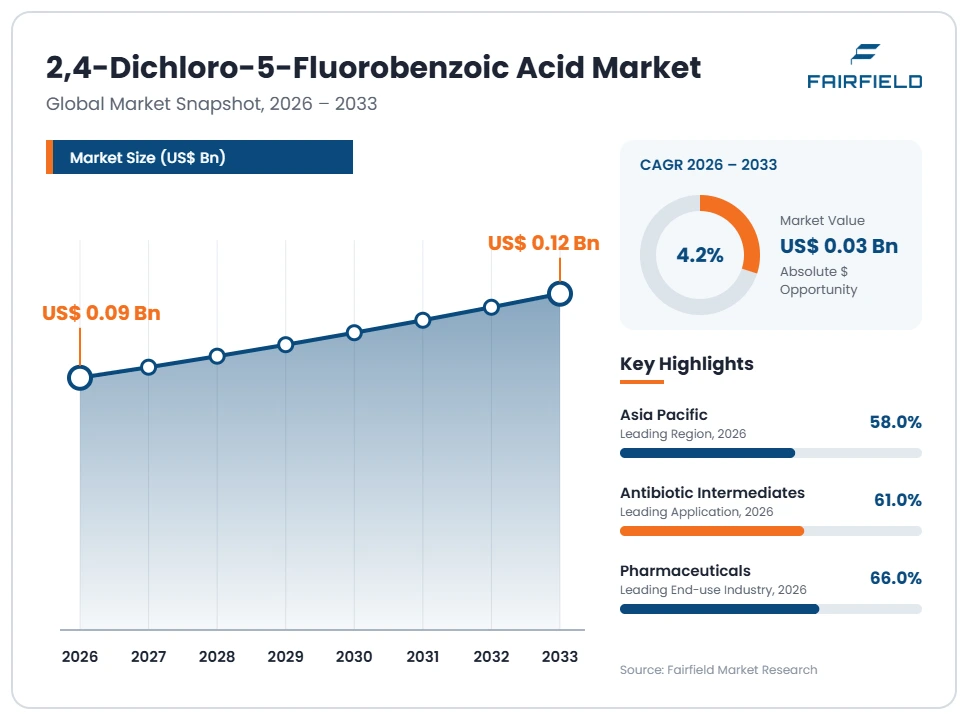
The global 2,4-Dichloro-5-Fluorobenzoic Acid market size is expected to be valued at US$ 0.09 billion in 2026 and projected to reach US$ 0.12 billion by 2033, growing at a CAGR of 4.2% between 2026 and 2033.
Stated precisely, merchant sales are estimated at US$ 88.6 million in 2026 and US$ 118.1 million in 2033. Growth between 2020 and 2025 was slower, at roughly 2.6% annually, because tightened fluoroquinolone prescribing in several regulated markets offset volume gains in emerging economies. Two factors support the modest improvement ahead. Generic antibiotic manufacturing continues to expand in Asia Pacific, Latin America and Africa, where access rather than restriction drives consumption. Agrochemical chemistry is also absorbing more halogenated benzoic acid intermediates. Overall direction is steady, low single-digit expansion of a mature pharmaceutical intermediate rather than any step change in demand.
Key Report Takeaways
- By Grade: Pharmaceutical Intermediate Grade held 57% share in 2026, while Technical Grade is projected to expand at a 5.1% CAGR through 2033, driven by agrochemical synthesis users who accept wider impurity tolerances than regulated medicine supply chains.
- By Application: Fluoroquinolone Antibiotic Intermediates held 61% share in 2026, while Agrochemical Intermediates are projected to grow at a 6.3% CAGR, as fluorinated crop protection actives replace older chemistries facing resistance problems.
- By End-use Industry: Pharmaceuticals held 66% share in 2026, while Specialty Chemicals is projected to advance at a 6.5% CAGR, supported by liquid crystal, dye and performance material routes that use halogenated aromatic building blocks.
- By Distribution Channel: Direct Contract Manufacturing Supply held 64% share in 2026, while Specialty Chemical Distributors are projected to grow at a 5.4% CAGR, reflecting mid-sized formulators that cannot commit to annual campaign volumes.
- By Geography: Asia Pacific held 58% share in 2026, while Middle East & Africa is projected to expand at a 6.0% CAGR through 2033, as national programmes build local antibiotic manufacturing capacity.
Global 2,4-Dichloro-5-Fluorobenzoic Acid Market Trends and Insights
Drivers Impact Analysis
Two demand mechanisms account for most of the modest forecast expansion in this halogenated benzoic acid market.
| Driver | Impact on CAGR Forecast | Geographic Relevance | Impact Timeline |
| Generic antibiotic manufacturing growth in emerging markets | High | Asia Pacific, Latin America, Middle East & Africa | Medium term 2–4 years |
| Expanding use of fluorinated building blocks in agrochemical synthesis | Medium | Asia Pacific, Latin America | Long term ≥4 years |
Generic Antibiotic Production Sustains Demand for This Fluoroquinolone Intermediate
Generic antibiotic manufacturing remains the backbone of demand for this halogenated benzoic acid. The molecule is a committed intermediate on established routes to fluoroquinolone active substances, where the chlorine and fluorine positions set up the subsequent cyclisation and amination steps. Because those synthetic routes are written into approved regulatory filings, volume tracks finished dose production closely and switching to an alternative building block is impractical.
The causal mechanism is access-driven consumption outside the most tightly regulated markets. Public health systems in India, China, Brazil, Indonesia and much of Africa continue to rely on oral fluoroquinolones for respiratory, urinary and gastrointestinal infections where alternatives are costlier. Expanding health insurance coverage and tender-based procurement raise unit volumes even as prices fall. Intermediate suppliers therefore see stable offtake tied to campaign schedules at a relatively small number of active substance producers.
Fluorinated Crop Protection Chemistry Broadens the Intermediate Customer Base
Agrochemical synthesis is the second demand engine and is growing faster than the pharmaceutical core. Crop protection developers increasingly place fluorine on aromatic rings to improve metabolic stability, soil persistence and binding affinity. A benzoic acid carrying both chlorine and fluorine in defined positions is a convenient entry point for herbicide and fungicide scaffolds, and agrochemical buyers often accept technical grade material.
What creates the demand is resistance management. Growers facing resistant weed and fungal populations need actives with new modes of action, and registration dossiers increasingly feature fluorinated structures. Agrochemical campaigns also run at larger batch sizes than pharmaceutical ones, which improves plant utilisation for intermediate producers between antibiotic campaigns. Several fluorochemical manufacturers now deliberately balance pharmaceutical and crop protection customers to smooth seasonal loading across halogenation assets.
Restraints Impact Analysis
Two constraints hold this intermediate market to low single-digit growth despite stable underlying manufacturing demand.
| Restraint | Impact on CAGR Forecast | Geographic Relevance | Impact Timeline |
| Regulatory restrictions on fluoroquinolone prescribing | High | Europe, North America | Long term ≥4 years |
| Halogenation, effluent treatment and compliance costs | Medium | Asia Pacific, Europe | Medium term 2–4 years |
Fluoroquinolone Prescribing Restrictions Cap Downstream Intermediate Volumes
Prescribing restrictions in regulated markets are the clearest limit on demand for this intermediate. The European Medicines Agency completed a review of disabling and potentially long-lasting side effects affecting muscles, tendons, joints and the nervous system, and restrictions on systemic and inhaled fluoroquinolones followed across the European Union. The United States Food and Drug Administration has added boxed warnings and advised reserving these antibiotics for patients without alternative treatment options for several common indications.
The underlying cause is a reassessment of benefit and risk rather than a manufacturing problem. Prescribing audits, formulary restrictions and antimicrobial stewardship programmes have reduced fluoroquinolone use in several high-value markets. Volume lost in Europe and North America is replaced only partly by growth elsewhere, and at considerably lower prices. Intermediate producers consequently plan around flat regulated-market offtake and compete on cost for emerging market tenders.
Halogenation and Effluent Costs Restrict Capacity Outside Established Clusters
Processing cost and environmental compliance prevent new capacity from emerging outside established fluorochemical clusters. The route involves selective chlorination and fluorine introduction, both of which demand corrosion-resistant equipment, careful temperature control and specialised handling of hydrogen fluoride or fluoride salts. Few sites outside China and India can run this chemistry at competitive cost, which concentrates supply and leaves buyers exposed to single-region disruption.
The specific cost sources are effluent treatment and equipment metallurgy rather than raw materials. Halogenation generates saline, fluoride-bearing wastewater that requires dedicated treatment before discharge, and provincial environmental enforcement in China has forced consolidation into licensed chemical parks with higher fixed overheads. Hastelloy or lined reactors raise capital intensity further. Combined with inspection obligations under ICH Q7 for material destined for medicine manufacture, these costs deter greenfield entry.
Market Opportunities
Supply Diversification Programmes Open a Qualified Second-Source Revenue Pool
Supply security policy is creating a genuinely new revenue pool for producers located outside the dominant manufacturing cluster. Pharmaceutical companies and health authorities now pay premiums for qualified second sources of antibiotic intermediates after repeated shortage episodes. That willingness to pay converts geographic location into a commercial asset, and it rewards suppliers who can document equivalent quality rather than simply quote a lower price.
Capture favours fluorochemical producers in India and Europe with existing halogenation assets and audited quality systems. The customers are generic active substance manufacturers supplying tenders that increasingly score supply resilience, plus government stockpiling programmes for essential antibiotics. The supporting development is the European Commission’s proposal for a Critical Medicines Act, which signals procurement preference for diversified supply chains and gives second-source suppliers a durable policy tailwind.
Veterinary and Specialty Fluorine Chemistry Creates an Underserved Revenue Pool
Veterinary medicine and specialty materials represent an underserved pool that sits outside human antibiotic demand entirely. Fluoroquinolones remain widely used in companion animal and livestock treatment, where the human prescribing restrictions do not apply in the same form. Beyond animal health, halogenated benzoic acids feed liquid crystal, dye and performance polymer routes that value precise substitution patterns and pay well for consistent isomeric purity.
Capture favours producers willing to serve smaller, more varied campaigns rather than chasing large antibiotic contracts. The customer groups are veterinary pharmaceutical formulators, display material producers and specialty chemical houses developing fluorinated performance additives. Supporting this shift is continued investment in fluorination capability across Asia Pacific and Europe, which lets suppliers offer a family of related halogenated aromatics instead of a single committed intermediate.
Segment Analysis
- By Grade: Pharmaceutical Intermediate Material Leads While Technical Grade Accelerates
Pharmaceutical Intermediate Grade held 57% of 2026 revenue because most volume feeds registered active substance routes where impurity profiles are fixed in regulatory filings. Material supplied for medicine manufacture must be made under systems aligned to ICH Q7 expectations, with documented change control and full impurity characterisation. Technical Grade accounts for 33% and is the fastest-growing tier at a 5.1% CAGR, pulled by agrochemical synthesis where isomeric tolerances are wider and cost matters more than documentation. Research Grade represents the remaining 10%, serving method development and reference standard work. The grade split is commercially decisive because quality system overhead, not chemistry, determines margin. Producers able to run both qualified pharmaceutical campaigns and lower-specification agrochemical batches on the same halogenation assets achieve far better utilisation than single-market suppliers in this intermediate category.
- By Application: Antibiotic Intermediates Lead as Agrochemical Routes Gain Share
Fluoroquinolone Antibiotic Intermediates led with 61% share in 2026, reflecting the molecule’s established position on commercial routes to ciprofloxacin-class active substances. Agrochemical Intermediates follow at 21% and form the fastest-growing application at a 6.3% CAGR, as fluorinated herbicide and fungicide actives displace older chemistries losing effectiveness to resistance. Other Fine Chemical Synthesis holds 12%, covering liquid crystal, dye and performance additive routes that exploit the defined chlorine and fluorine substitution pattern. Research and Reference Standards accounts for 6%. The business implication is that the historic single-application dependency is slowly easing. Suppliers that qualify agrochemical customers reduce their exposure to antibiotic prescribing policy, which has already proved capable of removing demand in regulated markets faster than emerging market growth can replace it.
- By End-use Industry: Pharmaceuticals Dominate While Specialty Chemicals Grow Quickest
Pharmaceuticals accounted for 66% of 2026 demand, dominated by generic active substance producers running antibiotic campaigns against tender and contract commitments. Agrochemicals follow at 19%, buying larger batches with less documentation burden. Specialty Chemicals represents 9% and is the fastest-growing industry at a 6.5% CAGR, driven by display materials, dyes and fluorinated performance additives that need precisely substituted aromatic building blocks. Academic and Contract Research holds 6%, concentrated in route scouting and analytical work. Veterinary formulation sits within the pharmaceutical figure and is proving more resilient than human antibiotic demand. For suppliers, the implication is that diversification away from a single therapeutic class is now a strategic necessity rather than an option, because specialty chemical customers value the same halogenation capability without the prescribing policy exposure.
- By Distribution Channel: Direct Contract Supply Leads While Distributors Expand Fastest
Direct Contract Manufacturing Supply held 64% of 2026 revenue because active substance producers buy committed intermediates on named-supplier terms written into regulatory filings. Changing source requires variation filings and sometimes fresh impurity qualification, so these relationships are unusually sticky. Specialty Chemical Distributors hold 26% and are the fastest-growing channel at a 5.4% CAGR, serving mid-sized agrochemical and specialty formulators that need flexible quantities without campaign commitments. Catalog and Research Suppliers account for 10%, covering gram to kilogram development needs. Channel structure reflects regulatory lock-in more than logistics. The commercial consequence is that distributors are the practical entry route for new producers, since winning direct pharmaceutical business requires audit, qualification and often a Drug Master File reference before a single commercial kilogram ships.
Geography Analysis
- North America Relies on Imported Intermediate Supply for Antibiotic Manufacturing
North America held 14% of 2026 revenue with a forecast 3.0% CAGR, the slowest growth of any region in this intermediate market. The United States accounts for nearly all consumption, concentrated among generic antibiotic finishers, veterinary pharmaceutical producers and a small number of specialty chemical users. Almost no commercial production of this halogenated benzoic acid takes place domestically, so buyers depend on imported material supported by Drug Master File filings with the Food and Drug Administration. Demand is constrained directly by prescribing policy, since boxed warnings and restricted indications have reduced fluoroquinolone use in ambulatory care. The change worth watching is federal interest in domestic essential medicine manufacturing, which is prompting evaluation of onshore intermediate capacity even though halogenation cost economics remain unfavourable against established overseas suppliers.
- Europe Combines Strict Quality Oversight With Declining Antibiotic Volumes
Europe accounted for 16% of 2026 revenue with a forecast 2.8% CAGR, the weakest expansion among the five regions. Germany, Italy, Spain and Ireland host the active substance and finished dose producers that consume most regional material, while limited fluorochemical production exists in France and Italy. Volume growth is constrained by antimicrobial stewardship programmes and the restrictions placed on systemic fluoroquinolone prescribing. Regulatory overhead is heavy: imported active substances require written confirmation from the exporting authority, intermediates may be registered under REACH as strictly controlled intermediates, and active substance master files must document impurity control. The offsetting opportunity is supply resilience policy, which is encouraging regional producers with existing halogenation assets to qualify as second sources for essential antibiotic supply chains.
- Which Region Is Leading the 2,4-Dichloro-5-Fluorobenzoic Acid Market?
Asia Pacific leads the 2,4-Dichloro-5-Fluorobenzoic Acid market with 58% share in 2026 and a forecast 4.8% CAGR through 2033. China and India between them account for the overwhelming majority of global production and a large share of consumption. Leadership rests on three verifiable causes: established fluorine and chlorine chemistry clusters with licensed effluent treatment, integration between intermediate producers and active substance manufacturers, and the scale of generic antibiotic output serving domestic and export tenders. Japan and South Korea add smaller volumes through specialty chemical and veterinary applications. Environmental enforcement has consolidated production into designated chemical parks, raising costs but improving consistency. The change underway is upward integration, as intermediate producers move into regulated active substance supply to capture margin rather than remaining captive to a handful of downstream buyers.
- Latin America Builds Demand Around Regional Generic Antibiotic Production
Latin America represented 7% of 2026 revenue with a forecast 4.4% CAGR, a modest but steadily growing consumption base. Brazil, Mexico and Argentina drive activity through domestic generic manufacturers supplying public health tenders, alongside a sizeable veterinary pharmaceutical sector serving livestock production. The binding barrier is the absence of local halogenation capability, which leaves formulators dependent on imported intermediate with long lead times, import licensing steps and currency exposure on every campaign. Analytical capacity for impurity verification is also limited outside the largest producers. The opportunity lies in public procurement. National health systems buying antibiotics on volume tenders are increasingly asking about supply continuity, which gives regional finishers reason to hold qualified inventory and encourages suppliers to establish local stockholding arrangements.
- Which Region Is Growing Fastest in the 2,4-Dichloro-5-Fluorobenzoic Acid Market?
Middle East & Africa is the fastest-growing geography in the 2,4-Dichloro-5-Fluorobenzoic Acid market, with a forecast 6.0% CAGR from a 5% share in 2026. Egypt, Saudi Arabia, Morocco, Algeria and South Africa are investing in domestic pharmaceutical manufacturing to reduce import dependence on essential medicines, and oral antibiotics are usually among the first products localised. Infection burden remains high and prescribing is less restricted than in regulated markets, so underlying consumption is strong. Barriers are considerable: almost no local intermediate synthesis, limited analytical infrastructure for impurity profiling, and regulatory systems still building active substance oversight capacity. The decisive change is industrial policy, with national pharmaceutical strategies funding formulation plants that import this intermediate today and may eventually justify regional synthesis capability.
Competitive Landscape
The 2,4-Dichloro-5-Fluorobenzoic Acid market is moderately concentrated, with a limited group of fluorochemical producers in China and India supplying most commercial volume. Concentration reflects the capital intensity of halogenation chemistry and the environmental permitting required for fluoride-bearing effluent, not proprietary technology. Indian specialty fluorine producers including Navin Fluorine International Limited, SRF Limited and Gujarat Fluorochemicals Limited compete with Chinese producers such as Zhejiang Yongtai Technology Co., Ltd., while Aarti Industries Limited and Jubilant Ingrevia Limited bring aromatic chlorination and fine chemical breadth. A substantial share of output is captive to integrated active substance producers and never enters the merchant figure, which makes the traded market smaller than production volumes suggest.
Competition is based on regulatory documentation, impurity consistency and campaign reliability rather than headline price. Buyers compare impurity profiles against the specification already approved in their filings, because an unmatched profile can require costly requalification. Audit readiness against ICH Q7 expectations and the ability to support a Drug Master File or active substance master file reference frequently decide awards. New entrants have come mostly from Indian producers upgrading from agrochemical intermediates into regulated pharmaceutical supply, competing on supply diversification rather than cost.
Strategic direction centres on moving up the value chain and spreading end-market risk. Suppliers are adding downstream steps toward finished active substances, broadening into agrochemical and specialty fluorine chemistry, and investing in effluent treatment that satisfies tightening environmental enforcement. Several are positioning explicitly as qualified second sources for buyers concerned about single-region dependence in essential antibiotic supply chains.
Recent Industry Developments
- November 2000: The International Council for Harmonisation adopted ICH Q7, the good manufacturing practice guide for active pharmaceutical ingredients – setting the quality system expectations that still govern how committed antibiotic intermediates are manufactured and documented.
- July 2013: The European Union written confirmation requirement for imported active substances took effect under Directive 2011/62/EU – obliging exporting authorities to attest manufacturing standards and raising the compliance threshold for suppliers shipping into Europe.
- May 2016: The United States Food and Drug Administration advised restricting systemic fluoroquinolone use for uncomplicated infections where alternatives exist – reducing prescribing volumes in a major regulated market and flattening intermediate offtake.
- March 2019: European Union-wide restrictions on systemic and inhaled fluoroquinolones took effect following the European Medicines Agency review of disabling and potentially long-lasting side effects – further narrowing approved indications across member states.
- March 2025: The European Commission proposed the Critical Medicines Act to strengthen supply security for essential medicines – creating procurement incentives for diversified intermediate sourcing outside the dominant manufacturing cluster.
Companies Covered in the Report
- Navin Fluorine International Limited
- SRF Limited
- Aarti Industries Limited
- Zhejiang Yongtai Technology Co., Ltd.
- Jubilant Ingrevia Limited
- Gujarat Fluorochemicals Limited
- Hikal Limited
- Merck KGaA
- Tokyo Chemical Industry Co., Ltd.
2,4-Dichloro-5-Fluorobenzoic Acid Market Report Scope
| Metric | Value |
| Study Period | 2020–2033 |
| Market Size 2026 | US$ 0.09 Billion |
| Market Size 2033 | US$ 0.12 Billion |
| CAGR 2026–2033 | 4.2% |
| Absolute Dollar Opportunity | US$ 0.03 Billion |
| Largest Market | Asia Pacific |
| Fastest-Growing Market | Middle East & Africa |
| Market Concentration | Medium |
| Major Players | Navin Fluorine International Limited, SRF Limited, Aarti Industries Limited, Zhejiang Yongtai Technology Co., Ltd., Jubilant Ingrevia Limited |
2,4-Dichloro-5-Fluorobenzoic Acid Market Segmentation
Grade
- Technical Grade
- Pharmaceutical Intermediate Grade
- Research Grade
Application
- Fluoroquinolone Antibiotic Intermediates
- Agrochemical Intermediates
- Other Fine Chemical Synthesis
- Research and Reference Standards
End-use Industry
- Pharmaceuticals
- Agrochemicals
- Specialty Chemicals
- Academic and Contract Research
Distribution Channel
- Direct Contract Manufacturing Supply
- Specialty Chemical Distributors
- Catalog and Research Suppliers
Regions
- North America
- Europe
- Asia Pacific
- Latin America
- Middle East & Africa
- Executive Summary
- Global 2,4-Dichloro-5-Fluorobenzoic Acid Market Snapshot
- Future Projections
- Key Report Takeaways
- Regional Snapshot
- Market Overview
- Market Definition and Report Scope
- Historical Trends 2020–2025
- Market Dynamics
- Drivers
- Generic Antibiotic Production Sustains Demand for This Fluoroquinolone Intermediate
- Fluorinated Crop Protection Chemistry Broadens the Intermediate Customer Base
- Restraints
- Fluoroquinolone Prescribing Restrictions Cap Downstream Intermediate Volumes
- Halogenation and Effluent Costs Restrict Capacity Outside Established Clusters
- Market Opportunities
- Supply Diversification Programmes Open a Qualified Second-Source Revenue Pool
- Veterinary and Specialty Fluorine Chemistry Creates an Underserved Revenue Pool
- Drivers
- Global 2,4-Dichloro-5-Fluorobenzoic Acid Market Outlook, 2020–2033
- Global 2,4-Dichloro-5-Fluorobenzoic Acid Market Outlook, by Grade, Value (US$ Billion), 2020–2033
- Technical Grade
- Pharmaceutical Intermediate Grade
- Research Grade
- Global 2,4-Dichloro-5-Fluorobenzoic Acid Market Outlook, by Application, Value (US$ Billion), 2020–2033
- Fluoroquinolone Antibiotic Intermediates
- Agrochemical Intermediates
- Other Fine Chemical Synthesis
- Research and Reference Standards
- Global 2,4-Dichloro-5-Fluorobenzoic Acid Market Outlook, by End-use Industry, Value (US$ Billion), 2020–2033
- Pharmaceuticals
- Agrochemicals
- Specialty Chemicals
- Academic and Contract Research
- Global 2,4-Dichloro-5-Fluorobenzoic Acid Market Outlook, by Distribution Channel, Value (US$ Billion), 2020–2033
- Direct Contract Manufacturing Supply
- Specialty Chemical Distributors
- Catalog and Research Suppliers
- Global 2,4-Dichloro-5-Fluorobenzoic Acid Market Outlook, by Region, Value (US$ Billion), 2020–2033
- North America
- Europe
- Asia Pacific
- Latin America
- Middle East & Africa
- Global 2,4-Dichloro-5-Fluorobenzoic Acid Market Outlook, by Grade, Value (US$ Billion), 2020–2033
- North America 2,4-Dichloro-5-Fluorobenzoic Acid Market Outlook, 2020–2033
- North America 2,4-Dichloro-5-Fluorobenzoic Acid Market Outlook, by Grade, Value (US$ Billion), 2020–2033
- Technical Grade
- Pharmaceutical Intermediate Grade
- Research Grade
- North America 2,4-Dichloro-5-Fluorobenzoic Acid Market Outlook, by Application, Value (US$ Billion), 2020–2033
- Fluoroquinolone Antibiotic Intermediates
- Agrochemical Intermediates
- Other Fine Chemical Synthesis
- Research and Reference Standards
- North America 2,4-Dichloro-5-Fluorobenzoic Acid Market Outlook, by End-use Industry, Value (US$ Billion), 2020–2033
- Pharmaceuticals
- Agrochemicals
- Specialty Chemicals
- Academic and Contract Research
- North America 2,4-Dichloro-5-Fluorobenzoic Acid Market Outlook, by Distribution Channel, Value (US$ Billion), 2020–2033
- Direct Contract Manufacturing Supply
- Specialty Chemical Distributors
- Catalog and Research Suppliers
- North America 2,4-Dichloro-5-Fluorobenzoic Acid Market Outlook, by Country, Value (US$ Billion), 2020–2033
- United States 2,4-Dichloro-5-Fluorobenzoic Acid Market Outlook, by Grade, 2020–2033
- United States 2,4-Dichloro-5-Fluorobenzoic Acid Market Outlook, by Application, 2020–2033
- United States 2,4-Dichloro-5-Fluorobenzoic Acid Market Outlook, by End-use Industry, 2020–2033
- United States 2,4-Dichloro-5-Fluorobenzoic Acid Market Outlook, by Distribution Channel, 2020–2033
- North America 2,4-Dichloro-5-Fluorobenzoic Acid Market Outlook, by Grade, Value (US$ Billion), 2020–2033
- Europe 2,4-Dichloro-5-Fluorobenzoic Acid Market Outlook, 2020–2033
- Europe 2,4-Dichloro-5-Fluorobenzoic Acid Market Outlook, by Grade, Value (US$ Billion), 2020–2033
- Technical Grade
- Pharmaceutical Intermediate Grade
- Research Grade
- Europe 2,4-Dichloro-5-Fluorobenzoic Acid Market Outlook, by Application, Value (US$ Billion), 2020–2033
- Fluoroquinolone Antibiotic Intermediates
- Agrochemical Intermediates
- Other Fine Chemical Synthesis
- Research and Reference Standards
- Europe 2,4-Dichloro-5-Fluorobenzoic Acid Market Outlook, by End-use Industry, Value (US$ Billion), 2020–2033
- Pharmaceuticals
- Agrochemicals
- Specialty Chemicals
- Academic and Contract Research
- Europe 2,4-Dichloro-5-Fluorobenzoic Acid Market Outlook, by Distribution Channel, Value (US$ Billion), 2020–2033
- Direct Contract Manufacturing Supply
- Specialty Chemical Distributors
- Catalog and Research Suppliers
- Europe 2,4-Dichloro-5-Fluorobenzoic Acid Market Outlook, by Country, Value (US$ Billion), 2020–2033
- Germany 2,4-Dichloro-5-Fluorobenzoic Acid Market Outlook, by Grade, 2020–2033
- Germany 2,4-Dichloro-5-Fluorobenzoic Acid Market Outlook, by Application, 2020–2033
- Germany 2,4-Dichloro-5-Fluorobenzoic Acid Market Outlook, by End-use Industry, 2020–2033
- Germany 2,4-Dichloro-5-Fluorobenzoic Acid Market Outlook, by Distribution Channel, 2020–2033
- Italy 2,4-Dichloro-5-Fluorobenzoic Acid Market Outlook, by Grade, 2020–2033
- Italy 2,4-Dichloro-5-Fluorobenzoic Acid Market Outlook, by Application, 2020–2033
- Italy 2,4-Dichloro-5-Fluorobenzoic Acid Market Outlook, by End-use Industry, 2020–2033
- Italy 2,4-Dichloro-5-Fluorobenzoic Acid Market Outlook, by Distribution Channel, 2020–2033
- Spain 2,4-Dichloro-5-Fluorobenzoic Acid Market Outlook, by Grade, 2020–2033
- Spain 2,4-Dichloro-5-Fluorobenzoic Acid Market Outlook, by Application, 2020–2033
- Spain 2,4-Dichloro-5-Fluorobenzoic Acid Market Outlook, by End-use Industry, 2020–2033
- Spain 2,4-Dichloro-5-Fluorobenzoic Acid Market Outlook, by Distribution Channel, 2020–2033
- Ireland 2,4-Dichloro-5-Fluorobenzoic Acid Market Outlook, by Grade, 2020–2033
- Ireland 2,4-Dichloro-5-Fluorobenzoic Acid Market Outlook, by Application, 2020–2033
- Ireland 2,4-Dichloro-5-Fluorobenzoic Acid Market Outlook, by End-use Industry, 2020–2033
- Ireland 2,4-Dichloro-5-Fluorobenzoic Acid Market Outlook, by Distribution Channel, 2020–2033
- France 2,4-Dichloro-5-Fluorobenzoic Acid Market Outlook, by Grade, 2020–2033
- France 2,4-Dichloro-5-Fluorobenzoic Acid Market Outlook, by Application, 2020–2033
- France 2,4-Dichloro-5-Fluorobenzoic Acid Market Outlook, by End-use Industry, 2020–2033
- France 2,4-Dichloro-5-Fluorobenzoic Acid Market Outlook, by Distribution Channel, 2020–2033
- Europe 2,4-Dichloro-5-Fluorobenzoic Acid Market Outlook, by Grade, Value (US$ Billion), 2020–2033
- Asia Pacific 2,4-Dichloro-5-Fluorobenzoic Acid Market Outlook, 2020–2033
- Asia Pacific 2,4-Dichloro-5-Fluorobenzoic Acid Market Outlook, by Grade, Value (US$ Billion), 2020–2033
- Technical Grade
- Pharmaceutical Intermediate Grade
- Research Grade
- Asia Pacific 2,4-Dichloro-5-Fluorobenzoic Acid Market Outlook, by Application, Value (US$ Billion), 2020–2033
- Fluoroquinolone Antibiotic Intermediates
- Agrochemical Intermediates
- Other Fine Chemical Synthesis
- Research and Reference Standards
- Asia Pacific 2,4-Dichloro-5-Fluorobenzoic Acid Market Outlook, by End-use Industry, Value (US$ Billion), 2020–2033
- Pharmaceuticals
- Agrochemicals
- Specialty Chemicals
- Academic and Contract Research
- Asia Pacific 2,4-Dichloro-5-Fluorobenzoic Acid Market Outlook, by Distribution Channel, Value (US$ Billion), 2020–2033
- Direct Contract Manufacturing Supply
- Specialty Chemical Distributors
- Catalog and Research Suppliers
- Asia Pacific 2,4-Dichloro-5-Fluorobenzoic Acid Market Outlook, by Country, Value (US$ Billion), 2020–2033
- China 2,4-Dichloro-5-Fluorobenzoic Acid Market Outlook, by Grade, 2020–2033
- China 2,4-Dichloro-5-Fluorobenzoic Acid Market Outlook, by Application, 2020–2033
- China 2,4-Dichloro-5-Fluorobenzoic Acid Market Outlook, by End-use Industry, 2020–2033
- China 2,4-Dichloro-5-Fluorobenzoic Acid Market Outlook, by Distribution Channel, 2020–2033
- India 2,4-Dichloro-5-Fluorobenzoic Acid Market Outlook, by Grade, 2020–2033
- India 2,4-Dichloro-5-Fluorobenzoic Acid Market Outlook, by Application, 2020–2033
- India 2,4-Dichloro-5-Fluorobenzoic Acid Market Outlook, by End-use Industry, 2020–2033
- India 2,4-Dichloro-5-Fluorobenzoic Acid Market Outlook, by Distribution Channel, 2020–2033
- Japan 2,4-Dichloro-5-Fluorobenzoic Acid Market Outlook, by Grade, 2020–2033
- Japan 2,4-Dichloro-5-Fluorobenzoic Acid Market Outlook, by Application, 2020–2033
- Japan 2,4-Dichloro-5-Fluorobenzoic Acid Market Outlook, by End-use Industry, 2020–2033
- Japan 2,4-Dichloro-5-Fluorobenzoic Acid Market Outlook, by Distribution Channel, 2020–2033
- South Korea 2,4-Dichloro-5-Fluorobenzoic Acid Market Outlook, by Grade, 2020–2033
- South Korea 2,4-Dichloro-5-Fluorobenzoic Acid Market Outlook, by Application, 2020–2033
- South Korea 2,4-Dichloro-5-Fluorobenzoic Acid Market Outlook, by End-use Industry, 2020–2033
- South Korea 2,4-Dichloro-5-Fluorobenzoic Acid Market Outlook, by Distribution Channel, 2020–2033
- Asia Pacific 2,4-Dichloro-5-Fluorobenzoic Acid Market Outlook, by Grade, Value (US$ Billion), 2020–2033
- Latin America 2,4-Dichloro-5-Fluorobenzoic Acid Market Outlook, 2020–2033
- Latin America 2,4-Dichloro-5-Fluorobenzoic Acid Market Outlook, by Grade, Value (US$ Billion), 2020–2033
- Technical Grade
- Pharmaceutical Intermediate Grade
- Research Grade
- Latin America 2,4-Dichloro-5-Fluorobenzoic Acid Market Outlook, by Application, Value (US$ Billion), 2020–2033
- Fluoroquinolone Antibiotic Intermediates
- Agrochemical Intermediates
- Other Fine Chemical Synthesis
- Research and Reference Standards
- Latin America 2,4-Dichloro-5-Fluorobenzoic Acid Market Outlook, by End-use Industry, Value (US$ Billion), 2020–2033
- Pharmaceuticals
- Agrochemicals
- Specialty Chemicals
- Academic and Contract Research
- Latin America 2,4-Dichloro-5-Fluorobenzoic Acid Market Outlook, by Distribution Channel, Value (US$ Billion), 2020–2033
- Direct Contract Manufacturing Supply
- Specialty Chemical Distributors
- Catalog and Research Suppliers
- Latin America 2,4-Dichloro-5-Fluorobenzoic Acid Market Outlook, by Country, Value (US$ Billion), 2020–2033
- Brazil 2,4-Dichloro-5-Fluorobenzoic Acid Market Outlook, by Grade, 2020–2033
- Brazil 2,4-Dichloro-5-Fluorobenzoic Acid Market Outlook, by Application, 2020–2033
- Brazil 2,4-Dichloro-5-Fluorobenzoic Acid Market Outlook, by End-use Industry, 2020–2033
- Brazil 2,4-Dichloro-5-Fluorobenzoic Acid Market Outlook, by Distribution Channel, 2020–2033
- Mexico 2,4-Dichloro-5-Fluorobenzoic Acid Market Outlook, by Grade, 2020–2033
- Mexico 2,4-Dichloro-5-Fluorobenzoic Acid Market Outlook, by Application, 2020–2033
- Mexico 2,4-Dichloro-5-Fluorobenzoic Acid Market Outlook, by End-use Industry, 2020–2033
- Mexico 2,4-Dichloro-5-Fluorobenzoic Acid Market Outlook, by Distribution Channel, 2020–2033
- Argentina 2,4-Dichloro-5-Fluorobenzoic Acid Market Outlook, by Grade, 2020–2033
- Argentina 2,4-Dichloro-5-Fluorobenzoic Acid Market Outlook, by Application, 2020–2033
- Argentina 2,4-Dichloro-5-Fluorobenzoic Acid Market Outlook, by End-use Industry, 2020–2033
- Argentina 2,4-Dichloro-5-Fluorobenzoic Acid Market Outlook, by Distribution Channel, 2020–2033
- Latin America 2,4-Dichloro-5-Fluorobenzoic Acid Market Outlook, by Grade, Value (US$ Billion), 2020–2033
- Middle East & Africa 2,4-Dichloro-5-Fluorobenzoic Acid Market Outlook, 2020–2033
- Middle East & Africa 2,4-Dichloro-5-Fluorobenzoic Acid Market Outlook, by Grade, Value (US$ Billion), 2020–2033
- Technical Grade
- Pharmaceutical Intermediate Grade
- Research Grade
- Middle East & Africa 2,4-Dichloro-5-Fluorobenzoic Acid Market Outlook, by Application, Value (US$ Billion), 2020–2033
- Fluoroquinolone Antibiotic Intermediates
- Agrochemical Intermediates
- Other Fine Chemical Synthesis
- Research and Reference Standards
- Middle East & Africa 2,4-Dichloro-5-Fluorobenzoic Acid Market Outlook, by End-use Industry, Value (US$ Billion), 2020–2033
- Pharmaceuticals
- Agrochemicals
- Specialty Chemicals
- Academic and Contract Research
- Middle East & Africa 2,4-Dichloro-5-Fluorobenzoic Acid Market Outlook, by Distribution Channel, Value (US$ Billion), 2020–2033
- Direct Contract Manufacturing Supply
- Specialty Chemical Distributors
- Catalog and Research Suppliers
- Middle East & Africa 2,4-Dichloro-5-Fluorobenzoic Acid Market Outlook, by Country, Value (US$ Billion), 2020–2033
- Egypt 2,4-Dichloro-5-Fluorobenzoic Acid Market Outlook, by Grade, 2020–2033
- Egypt 2,4-Dichloro-5-Fluorobenzoic Acid Market Outlook, by Application, 2020–2033
- Egypt 2,4-Dichloro-5-Fluorobenzoic Acid Market Outlook, by End-use Industry, 2020–2033
- Egypt 2,4-Dichloro-5-Fluorobenzoic Acid Market Outlook, by Distribution Channel, 2020–2033
- Saudi Arabia 2,4-Dichloro-5-Fluorobenzoic Acid Market Outlook, by Grade, 2020–2033
- Saudi Arabia 2,4-Dichloro-5-Fluorobenzoic Acid Market Outlook, by Application, 2020–2033
- Saudi Arabia 2,4-Dichloro-5-Fluorobenzoic Acid Market Outlook, by End-use Industry, 2020–2033
- Saudi Arabia 2,4-Dichloro-5-Fluorobenzoic Acid Market Outlook, by Distribution Channel, 2020–2033
- Morocco 2,4-Dichloro-5-Fluorobenzoic Acid Market Outlook, by Grade, 2020–2033
- Morocco 2,4-Dichloro-5-Fluorobenzoic Acid Market Outlook, by Application, 2020–2033
- Morocco 2,4-Dichloro-5-Fluorobenzoic Acid Market Outlook, by End-use Industry, 2020–2033
- Morocco 2,4-Dichloro-5-Fluorobenzoic Acid Market Outlook, by Distribution Channel, 2020–2033
- Algeria 2,4-Dichloro-5-Fluorobenzoic Acid Market Outlook, by Grade, 2020–2033
- Algeria 2,4-Dichloro-5-Fluorobenzoic Acid Market Outlook, by Application, 2020–2033
- Algeria 2,4-Dichloro-5-Fluorobenzoic Acid Market Outlook, by End-use Industry, 2020–2033
- Algeria 2,4-Dichloro-5-Fluorobenzoic Acid Market Outlook, by Distribution Channel, 2020–2033
- South Africa 2,4-Dichloro-5-Fluorobenzoic Acid Market Outlook, by Grade, 2020–2033
- South Africa 2,4-Dichloro-5-Fluorobenzoic Acid Market Outlook, by Application, 2020–2033
- South Africa 2,4-Dichloro-5-Fluorobenzoic Acid Market Outlook, by End-use Industry, 2020–2033
- South Africa 2,4-Dichloro-5-Fluorobenzoic Acid Market Outlook, by Distribution Channel, 2020–2033
- Middle East & Africa 2,4-Dichloro-5-Fluorobenzoic Acid Market Outlook, by Grade, Value (US$ Billion), 2020–2033
- Competitive Landscape
- Market Concentration and Industry Leaders
- Competitive Differentiation
- Strategic Moves and Market Direction
- Recent Industry Developments
- Company Profiles
- Navin Fluorine International Limited
- SRF Limited
- Aarti Industries Limited
- Zhejiang Yongtai Technology Co., Ltd.
- Jubilant Ingrevia Limited
- Gujarat Fluorochemicals Limited
- Hikal Limited
- Merck KGaA
- Tokyo Chemical Industry Co., Ltd.
- Appendix
- Research Methodology
- Report Assumptions
- Acronyms and Abbreviations
Grade
- Technical Grade
- Pharmaceutical Intermediate Grade
- Research Grade
Application
- Fluoroquinolone Antibiotic Intermediates
- Agrochemical Intermediates
- Other Fine Chemical Synthesis
- Research and Reference Standards
End-use Industry
- Pharmaceuticals
- Agrochemicals
- Specialty Chemicals
- Academic and Contract Research
Distribution Channel
- Direct Contract Manufacturing Supply
- Specialty Chemical Distributors
- Catalog and Research Suppliers
Regions
- North America
- Europe
- Asia Pacific
- Latin America
- Middle East & Africa
Our Research Methodology
Considering the volatility of business today, traditional approaches to strategizing a game plan can be unfruitful if not detrimental. True ambiguity is no way to determine a forecast. A myriad of predetermined factors must be accounted for such as the degree of risk involved, the magnitude of circumstances, as well as conditions or consequences that are not known or unpredictable. To circumvent binary views that cast uncertainty, the application of market research intelligence to strategically posture, move, and enable actionable outcomes is necessary.
View Methodology
Quality Assured
Rigorous Validation Process

Confidentiality Assured
End-to-end Data Security

Custom Research Services
Tailored To Your Objectives
FAQs
The market is valued at US$ 0.09 billion, or US$ 88.6 million, in 2026, covering merchant sales only and excluding captive or tolled production.
Revenue is projected to reach US$ 0.12 billion by 2033 at a 4.2% CAGR, giving an absolute opportunity of US$ 0.03 billion.
Fluoroquinolone Antibiotic Intermediates lead with 61% share in 2026, because the molecule sits on established commercial routes to approved active substances.
Specialty Chemicals grows fastest at 6.5% among end-use industries, while Middle East & Africa leads regional growth at a 6.0% CAGR to 2033.
Asia Pacific holds 58% share in 2026, supported by established halogenation clusters in China and India and large generic antibiotic output.
Related Reports
2-Methoxy-2-Methylheptane Market Size, Share, Insights, Competitive Landscape, and Forecast 2026 to 2033
The global 2-methoxy-2-methylheptane market is valued at US$0.04 billion in 2026, reaching US$0.07 billion by 2033, growing at an 8.3% CAGR
2D Materials Market Size, Share, Insights, Competitive Landscape, and Forecast 2026 to 2033
The global 2D materials market is valued at US$3.65 billion in 2026, reaching US$10.20 billion by 2033, growing at a 15.8% CAGR
1,5-Hexadiene Market Size, Share, Insights, Competitive Landscape, and Forecast 2026 to 2033
The global 1,5-hexadiene market is valued at US$0.14 billion in 2026, reaching US$0.22 billion by 2033, growing at a 6.7% CAGR
Automotive NVH Materials Market Size, Share, Insights, Competitive Landscape, and Forecast 2026 to 2033
The global automotive NVH materials market is valued at US$13.8 billion in 2026, reaching US$20.5 billion by 2033, growing at a 5.82% CAGR
Acrylonitrile Butadiene Styrene Market Size, Share, Insights, Competitive Landscape, and Forecast 2026 to 2033
The global acrylonitrile butadiene styrene market is valued at US$27.4 billion in 2026, reaching US$38.6 billion by 2033, growing at a 5.02% CAGR
Tank Mix Adjuvants Market Size, Share, Insights, Competitive Landscape, and Forecast 2026 to 2033
The global tank mix adjuvants market is valued at US$4.3 billion in 2026, reaching US$6.6 billion by 2033, growing at a 6.3% CAGR