



2-Methoxy-2-Methylheptane Market
2-Methoxy-2-Methylheptane Market Size, Share, Insights, Competitive Landscape, and Forecast 2026 to 2033
2-Methoxy-2-Methylheptane Market Size and Trend Analysis
What Is the Growth Outlook for 2-Methoxy-2-Methylheptane?
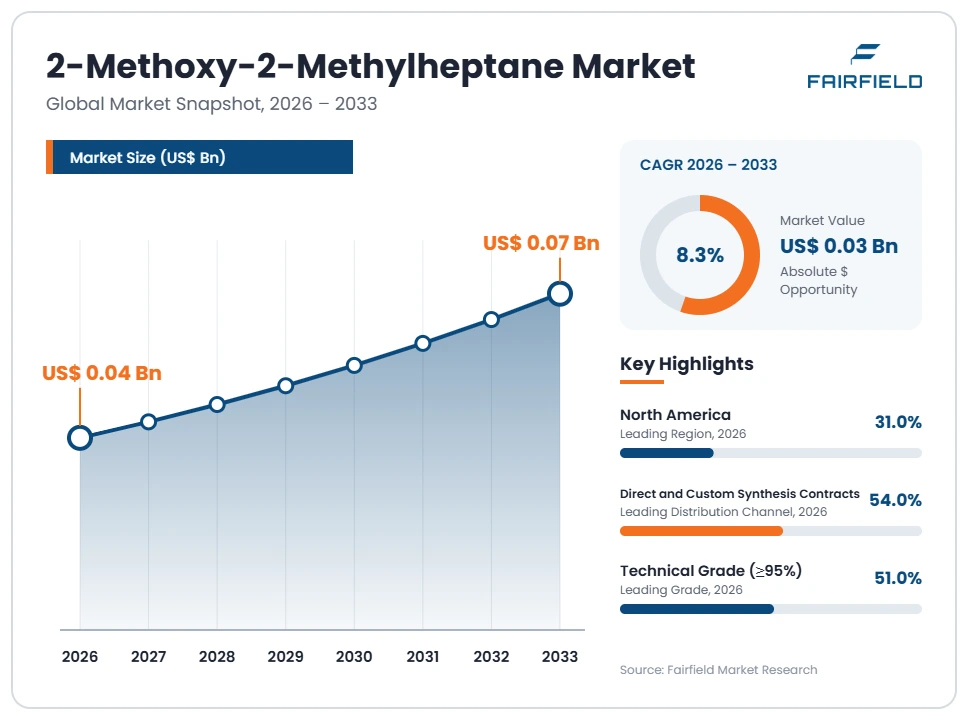
The global 2-Methoxy-2-Methylheptane market size is expected to be valued at US$ 0.04 billion in 2026 and projected to reach US$ 0.07 billion by 2033, growing at a CAGR of 8.3% between 2026 and 2033.
Stated precisely, merchant sales are estimated at US$ 39.4 million in 2026 and US$ 68.9 million in 2033. This is an emerging specialty solvent opportunity rather than an established market, and published information on the molecule is genuinely thin. Between 2020 and 2025 the category grew at roughly 6.4% annually from a very small base, driven almost entirely by custom synthesis orders. Three factors now support faster expansion. Formulators are seeking higher-boiling replacements for volatile ethers and glycol ethers. Reaction chemists want aprotic media with better thermal range. Interest in branched ether oxygenates persists in selected fuel research programmes, though commercial adoption remains unproven.
Key Report Takeaways
- By Grade: Technical Grade (≥95%) held 51% share in 2026, while High Purity Grade (≥99%) is projected to expand at a 9.2% CAGR through 2033, driven by reaction chemistry users who need low water and low peroxide content.
- By Application: Specialty Solvent held 44% share in 2026, while Reaction Medium and Extraction is projected to grow at a 9.6% CAGR, as process chemists seek aprotic ethers with a wider usable temperature window.
- By End-use Industry: Coatings and Adhesives held 36% share in 2026, while Electronics and Cleaning is projected to advance at a 9.9% CAGR, supported by precision cleaning formulations that need slow-evaporating, low-polarity carriers.
- By Distribution Channel: Direct and Custom Synthesis Contracts held 54% share in 2026, while Specialty Chemical Distributors are projected to grow at an 8.8% CAGR, reflecting evaluation-scale purchases by formulators trialling the ether.
- By Geography: North America held 31% share in 2026, while Asia Pacific is projected to expand at a 10.6% CAGR through 2033, as regional fine chemical producers add branched ether synthesis and purification capability.
Global 2-Methoxy-2-Methylheptane Market Trends and Insights
Drivers Impact Analysis
Two demand mechanisms explain most of the forecast expansion in this branched tertiary ether market.
| Driver | Impact on CAGR Forecast | Geographic Relevance | Impact Timeline |
| Substitution away from volatile and restricted industrial solvents | High | North America, Europe | Medium term 2–4 years |
| Demand for high-boiling aprotic reaction media in fine chemical synthesis | Medium | Asia Pacific, Europe | Long term ≥4 years |
Solvent Substitution Pressure Creates Openings for 2-Methoxy-2-Methylheptane
Solvent substitution programmes are the clearest demand mechanism for this branched tertiary ether. Formulators replacing restricted glycol ethers, chlorinated solvents and highly volatile hydrocarbons need replacements that keep performance while cutting emissions. A tertiary ether with a long alkyl chain offers low polarity, limited water miscibility and a boiling point well above lighter ethers. That combination suits coatings, cleaning and extraction formulations that currently lose material to evaporation.
The mechanism is regulatory and operational at once. Solvent emission controls under the Industrial Emissions Directive 2010/75/EU cap organic solvent consumption at installations in Europe, while United States operators manage compliance against Environmental Protection Agency volatile organic compound definitions and exemptions. Both regimes reward lower vapour pressure per unit of performance. Because tertiary ethers resist oxidation at the blocked carbon, they also hold up better than linear ethers in warm, recirculating industrial systems.
Fine Chemical Synthesis Lifts Demand for High-Boiling Ether Reaction Media
Process chemistry is the second growth engine, and it brings higher value per kilogram than bulk solvent use. Reaction media such as tetrahydrofuran and methyl tert-butyl ether are limited by low boiling points, which cap reaction temperature and complicate reflux at scale. A heptane-backbone methyl ether extends the usable range substantially while keeping the aprotic, weakly coordinating character that organometallic and Grignard chemistry needs.
What creates the demand is the shift toward continuous and higher-temperature processing in fine chemical and pharmaceutical intermediate manufacture. Flow reactors and telescoped sequences favour a single solvent across several steps rather than repeated solvent swaps. Steric protection of the tertiary carbon also slows acid-catalysed cleavage, which matters where Lewis acids are present. Custom synthesis houses report evaluation-scale orders from process development groups testing exactly this substitution.
Restraints Impact Analysis
Two constraints keep this ether confined to a small merchant market despite its technical attractions.
| Restraint | Impact on CAGR Forecast | Geographic Relevance | Impact Timeline |
| Peroxide formation risk and stabiliser management in storage | High | Global | Short term ≤2 years |
| Regulatory legacy of ether fuel oxygenates and groundwater contamination | High | North America, Europe | Long term ≥4 years |
Peroxide Formation Limits Shelf Life and Raises Handling Costs
Peroxide formation is the most practical barrier to wider industrial adoption of this ether. Ethers react slowly with atmospheric oxygen to form hydroperoxides and peroxides that concentrate during distillation and can detonate when a still is taken to dryness. Safety officers therefore restrict container sizes, impose expiry dating and require peroxide testing before any distillation step. Those rules discourage bulk purchasing and keep order sizes small.
The specific cost source is inventory management rather than raw material. Suppliers must add stabilisers such as butylated hydroxytoluene, blanket containers with nitrogen, use amber or lined packaging and document peroxide value on every certificate of analysis. Users must run periodic test strips and dispose of aged stock as hazardous waste. A tertiary carbon offers some protection against radical attack, but it does not eliminate the hazard, so the handling regime still applies in full.
Oxygenate Regulatory History Constrains Fuel Market Entry
The regulatory history of ether oxygenates is a genuine ceiling on the largest theoretical application for this molecule. Any ether marketed as a gasoline blending component inherits the reputational and legal legacy of methyl tert-butyl ether. That legacy removes the single use case capable of lifting volumes from tonnes to thousands of tonnes, which is why realistic forecasts keep this market in the tens of millions of dollars.
The underlying cause is documented environmental behaviour. Ether oxygenates are water-soluble, resist biodegradation and migrate quickly in groundwater, producing taste and odour complaints at very low concentrations. Those findings led several United States states to restrict methyl tert-butyl ether in gasoline, and federal legislation later removed the oxygenate mandate that supported it. Refiners consequently moved to ethanol blending, and liability-conscious fuel marketers now treat novel ether oxygenates with considerable caution.
Market Opportunities
Precision Cleaning Formulations Open a Defensible 2-Methoxy-2-Methylheptane Revenue Pool
Precision cleaning is the most realistic near-term revenue pool for this ether, and it is distinct from general solvent substitution. Electronics assemblers, optics manufacturers and medical device makers need carriers that dissolve flux residues, oils and silicones without flash-drying on contact. A slow-evaporating, low-polarity ether can serve as the active carrier in co-solvent blends sold at prices several times those of commodity hydrocarbon solvents.
Capture favours formulators rather than molecule producers, because the value sits in blend design and qualification support. Demand originates with contract electronics manufacturers facing tighter residue specifications and with device makers validating cleaning under quality system rules. The supporting development is the continuing phase-down of legacy halogenated cleaning agents, which has left a performance gap that aqueous systems cannot always fill in sealed or heat-sensitive assemblies.
Custom Synthesis and Evaluation-Scale Supply Build an Early Profit Pool
Custom synthesis is an immediate profit pool that most observers overlook because the volumes look trivial. At gram to kilogram scale, a branched tertiary ether of this type sells at research pricing many times its eventual bulk value. Suppliers that stock the molecule, publish full analytical data and ship reliably earn strong margins while competitors treat every order as a bespoke campaign requiring fresh route development.
The customers are process development chemists, solvent screening groups and academic laboratories comparing ether performance across reaction classes. Those evaluations also decide which molecules reach pilot scale, so early suppliers gain informal specification lock-in. Supporting this is the practical burden of REACH registration, where low-volume thresholds let suppliers serve evaluation demand under lighter data obligations before committing to full registration at higher tonnage bands.
Segment Analysis
- By Grade: Technical Material Leads While High Purity Grade Accelerates
Technical Grade (≥95%) held 51% of 2026 revenue because most current use is as a bulk carrier in cleaning and coating formulations where trace isomers are harmless. High Purity Grade (≥99%) is the fastest-expanding tier at a 9.2% CAGR, pulled by reaction chemistry users who need controlled water content, low peroxide value and no residual alcohol that would quench organometallic reagents. Research and Analytical Grade (≥99.5%) accounts for the remaining 16%, serving solvent screening studies and reference work. The purity ladder is commercially important because purification, drying and stabiliser addition account for most of the delivered cost rather than the ether synthesis itself. Suppliers able to certify peroxide value at shipment and guarantee it through a stated shelf life command premium pricing, which is why analytical capability separates serious suppliers from simple repackagers in this emerging specialty solvent category.
- By Application: Specialty Solvent Use Leads as Reaction Media Gain Ground
Specialty Solvent led with 44% share in 2026, covering coating thinners, degreasing blends and extraction formulations that exploit low polarity and high boiling point. Reaction Medium and Extraction follows at 25% and is the fastest-growing application at a 9.6% CAGR, as process chemists adopt higher-boiling aprotic ethers for reactions that tetrahydrofuran cannot support at temperature. Fuel Oxygenate and Blending Component holds 19%, almost entirely research and small blending trials rather than commercial refining offtake. Research and Analytical Standards represents 12%. The business implication is that growth is concentrated in technically demanding, low-volume uses rather than any large commodity outlet. Suppliers building a strategy around fuel oxygenate adoption face a long and uncertain path, while those serving process chemistry can monetise the molecule’s thermal range immediately at far better margins.
- By End-use Industry: Coatings and Adhesives Dominate While Electronics Grows Quickest
Coatings and Adhesives accounted for 36% of 2026 demand, the natural home for a slow-evaporating, low-polarity carrier that improves flow and open time in solvent-borne systems. Chemicals and Pharmaceuticals follows at 28%, buying the ether as a reaction and extraction medium in intermediate manufacture. Energy and Fuels represents 21%, dominated by blending research rather than production use. Electronics and Cleaning is the fastest-growing industry at a 9.9% CAGR from a 15% base, driven by precision cleaning of assemblies where residue limits have tightened and halogenated agents are being withdrawn. Device qualification cycles are the specific pull, because validated cleaning chemistries are difficult to change once approved. For suppliers, the implication is a mix shift toward customers who audit documentation and reward consistency, which rewards investment in certification over price competition.
- By Distribution Channel: Direct Contracts Lead While Distributors Expand Fastest
Direct and Custom Synthesis Contracts held 54% of 2026 revenue because most material is made to order against a named customer’s specification rather than produced for stock. Specialty Chemical Distributors hold 27% and form the fastest-growing channel at an 8.8% CAGR, as formulators buying evaluation quantities prefer a single supplier who also provides stabilised packaging and hazard documentation. Catalog and Research Suppliers account for 19%, serving laboratories at gram to kilogram scale. Channel structure follows the peroxide hazard directly: stabiliser addition, nitrogen blanketing, amber packaging and expiry dating are easier to manage through intermediaries with licensed warehousing. The commercial consequence is that distributors see emerging applications first. Producers without distribution partners risk discovering a new use only after a competitor has already been written into the customer’s qualified formulation.
Geography Analysis
- Which Region Is Leading the 2-Methoxy-2-Methylheptane Market?
North America leads the 2-Methoxy-2-Methylheptane market with 31% share in 2026 and a forecast 7.6% CAGR through 2033. The United States accounts for almost all regional demand through a deep base of specialty formulators, contract research organisations and pharmaceutical process development groups that buy evaluation quantities of novel solvents. Leadership rests on three causes: concentrated fine chemical research spending, an established catalog supply infrastructure, and active substitution programmes replacing legacy cleaning and coating solvents. Canada adds modest demand through industrial coatings. Regulatory framing matters here, since volatile organic compound definitions and exemptions administered by the Environmental Protection Agency shape which solvents formulators evaluate at all. The main change underway is the tightening of residue limits in electronics and medical device cleaning, which is steadily moving the ether from laboratory trials into qualified production blends.
- Europe Pairs Strict Solvent Emission Rules With Cautious Industrial Adoption
Europe held 28% of 2026 revenue with a forecast 6.9% CAGR, the slowest growth among the major blocs despite strong technical interest. Germany, Switzerland, France and the Netherlands host the fine chemical producers, coatings houses and contract manufacturers that consume most regional volume. Solvent emission provisions within the Industrial Emissions Directive 2010/75/EU push installations toward lower-volatility alternatives, which favours a high-boiling ether in principle. In practice, adoption is slow because REACH registration obligations make it costly to introduce a substance that has no established tonnage history. Safety culture around peroxide-forming ethers is also unusually strict, with mandatory testing regimes at many sites. The opportunity lies in closed-loop solvent recovery, where high boiling point and thermal stability allow repeated distillation and reuse that justifies the registration investment.
- Which Region Is Growing Fastest in the 2-Methoxy-2-Methylheptane Market?
Asia Pacific is the fastest-growing geography in the 2-Methoxy-2-Methylheptane market, with a forecast 10.6% CAGR from a 30% share in 2026. China and India supply most of the world’s custom synthesis capacity for branched ethers, and their domestic fine chemical sectors are now consuming more of that output internally. Japan and South Korea contribute high-specification demand through electronics cleaning and precision coatings. Growth has three verifiable causes: local availability of the alcohol and methylating feedstocks, low conversion cost for small campaign production, and rapid expansion of contract research capacity serving global pharmaceutical clients. Much of the regional output is produced to order and never appears in traded statistics. The decisive change is purity upgrading, as producers invest in drying and stabilisation to serve reaction-grade customers rather than only bulk solvent buyers.
- Latin America Shows Early Interest Led by Industrial Coatings Formulators
Latin America represented 6% of 2026 revenue with a forecast 8.0% CAGR, making it a small base growing from very limited current consumption. Brazil and Mexico account for nearly all activity, concentrated in industrial coatings, adhesives and maintenance cleaning products serving automotive and construction customers. The binding barrier is supply access: there is no regional production, so formulators depend on imported drums with long lead times, and stabiliser shelf life erodes during transit and customs clearance. Limited local analytical capacity makes peroxide verification difficult, which discourages purchase of older stock. The opportunity is reformulation driven by workplace exposure rules, as national authorities tighten limits on aromatic and chlorinated solvents. That pressure is creating genuine evaluation demand for higher-boiling ethers among mid-sized coatings houses seeking compliant replacements.
- Middle East & Africa Remains an Early-Stage Market Tied to Fuel Research
Middle East & Africa accounted for 5% of 2026 revenue with a forecast 7.5% CAGR, the smallest regional position in this ether market. Saudi Arabia and the United Arab Emirates drive most activity, where refining research centres and petrochemical innovation units examine branched ether oxygenates as part of broader fuel quality programmes. South Africa adds limited demand through industrial cleaning and coatings. Barriers are substantial: almost no local fine chemical synthesis capability, thin distribution infrastructure for stabilised ethers, and high ambient temperatures that shorten safe storage life considerably. The change worth watching is downstream diversification investment. As Gulf producers build specialty chemical capacity alongside existing refining assets, the technical knowledge needed to evaluate and eventually produce branched ethers is accumulating within the region for the first time.
Competitive Landscape
The 2-Methoxy-2-Methylheptane market is highly fragmented, with no identifiable producer operating dedicated commercial-scale capacity for this specific molecule. Supply comes from catalog chemical houses holding small stocks and from custom synthesis operations that run campaigns against firm orders. Fragmentation reflects demand structure rather than technical difficulty: the etherification chemistry is well understood, but nobody can justify a dedicated plant for a market measured in tens of millions of dollars. Merck KGaA, Thermo Fisher Scientific Inc. and Tokyo Chemical Industry Co., Ltd. anchor catalog availability, while BLD Pharmatech Ltd. and Apollo Scientific Ltd. serve development-scale demand. A meaningful share of consumption never reaches the merchant market at all, because users with the relevant alcohol feedstock prepare the ether in-house.
Competition turns on availability, documentation and lead time rather than price. Buyers evaluating a novel solvent need certificates showing water content, peroxide value, stabiliser identity and isomeric purity before they will commit to a screening programme. Speed matters as much as cost, since a process chemist blocked on solvent supply will simply choose a listed alternative. New entrants have come mainly from Chinese and Indian custom synthesis houses that compete on campaign turnaround and now publish analytical data matching Western catalog standards.
Strategic direction is shifting from one-off synthesis toward stocked availability with guaranteed shelf life. Suppliers are investing in stabiliser systems, nitrogen-blanketed packaging and published hazard documentation that lowers the evaluation barrier for industrial formulators. Several position the ether within a broader branched ether portfolio so customers can compare boiling points across a homologous series, which is a practical way to build early specification presence.
Recent Industry Developments
- December 2003: California’s prohibition on the use of methyl tert-butyl ether in gasoline took effect – establishing the regulatory precedent that still shapes how refiners and regulators assess any ether proposed as a fuel oxygenate.
- August 2005: The United States enacted the Energy Policy Act of 2005, removing the reformulated gasoline oxygenate requirement – accelerating the refining industry’s shift from ether oxygenates to ethanol blending.
- May 2018: The final REACH registration deadline closed for phase-in substances at 1 to 100 tonnes per year – defining the data burden any supplier must meet before placing a low-volume specialty ether on the European Union market.
- November 2023: Directive (EU) 2023/2413 revising the Renewable Energy Directive entered into force – reinforcing renewable fuel targets that favour bio-based blending components over conventional petrochemical oxygenates.
- August 2024: Directive (EU) 2024/1785 revising the Industrial Emissions Directive 2010/75/EU entered into force – tightening permitting and emission expectations for installations using organic solvents across the European Union.
Companies Covered in the Report
- Merck KGaA
- Thermo Fisher Scientific Inc.
- Tokyo Chemical Industry Co., Ltd.
- BLD Pharmatech Ltd.
- Apollo Scientific Ltd.
- Oakwood Products, Inc.
- Toronto Research Chemicals
2-Methoxy-2-Methylheptane Market Report Scope
| Metric | Value |
| Study Period | 2020–2033 |
| Market Size 2026 | US$ 0.04 Billion |
| Market Size 2033 | US$ 0.07 Billion |
| CAGR 2026–2033 | 8.3% |
| Absolute Dollar Opportunity | US$ 0.03 Billion |
| Largest Market | North America |
| Fastest-Growing Market | Asia Pacific |
| Market Concentration | Low |
| Major Players | Merck KGaA, Thermo Fisher Scientific Inc., Tokyo Chemical Industry Co., Ltd., BLD Pharmatech Ltd., Apollo Scientific Ltd. |
2-Methoxy-2-Methylheptane Market Segmentation
Grade
- Technical Grade (≥95%)
- High Purity Grade (≥99%)
- Research and Analytical Grade (≥99.5%)
Application
- Specialty Solvent
- Reaction Medium and Extraction
- Fuel Oxygenate and Blending Component
- Research and Analytical Standards
End-use Industry
- Coatings and Adhesives
- Chemicals and Pharmaceuticals
- Energy and Fuels
- Electronics and Cleaning
Distribution Channel
- Direct and Custom Synthesis Contracts
- Specialty Chemical Distributors
- Catalog and Research Suppliers
Regions
- North America
- Europe
- Asia Pacific
- Latin America
- Middle East & Africa
- Executive Summary
- Global 2-Methoxy-2-Methylheptane Market Snapshot
- Future Projections
- Key Report Takeaways
- Regional Snapshot
- Market Overview
- Market Definition and Report Scope
- Historical Trends 2020–2025
- Market Dynamics
- Drivers
- Solvent Substitution Pressure Creates Openings for 2-Methoxy-2-Methylheptane
- Fine Chemical Synthesis Lifts Demand for High-Boiling Ether Reaction Media
- Restraints
- Peroxide Formation Limits Shelf Life and Raises Handling Costs
- Oxygenate Regulatory History Constrains Fuel Market Entry
- Market Opportunities
- Precision Cleaning Formulations Open a Defensible 2-Methoxy-2-Methylheptane Revenue Pool
- Custom Synthesis and Evaluation-Scale Supply Build an Early Profit Pool
- Drivers
- Global 2-Methoxy-2-Methylheptane Market Outlook, 2020–2033
- Global 2-Methoxy-2-Methylheptane Market Outlook, by Grade, Value (US$ Billion), 2020–2033
- Technical Grade (≥95%)
- High Purity Grade (≥99%)
- Research and Analytical Grade (≥99.5%)
- Global 2-Methoxy-2-Methylheptane Market Outlook, by Application, Value (US$ Billion), 2020–2033
- Specialty Solvent
- Reaction Medium and Extraction
- Fuel Oxygenate and Blending Component
- Research and Analytical Standards
- Global 2-Methoxy-2-Methylheptane Market Outlook, by End-use Industry, Value (US$ Billion), 2020–2033
- Coatings and Adhesives
- Chemicals and Pharmaceuticals
- Energy and Fuels
- Electronics and Cleaning
- Global 2-Methoxy-2-Methylheptane Market Outlook, by Distribution Channel, Value (US$ Billion), 2020–2033
- Direct and Custom Synthesis Contracts
- Specialty Chemical Distributors
- Catalog and Research Suppliers
- Global 2-Methoxy-2-Methylheptane Market Outlook, by Region, Value (US$ Billion), 2020–2033
- North America
- Europe
- Asia Pacific
- Latin America
- Middle East & Africa
- Global 2-Methoxy-2-Methylheptane Market Outlook, by Grade, Value (US$ Billion), 2020–2033
- North America 2-Methoxy-2-Methylheptane Market Outlook, 2020–2033
- North America 2-Methoxy-2-Methylheptane Market Outlook, by Grade, Value (US$ Billion), 2020–2033
- Technical Grade (≥95%)
- High Purity Grade (≥99%)
- Research and Analytical Grade (≥99.5%)
- North America 2-Methoxy-2-Methylheptane Market Outlook, by Application, Value (US$ Billion), 2020–2033
- Specialty Solvent
- Reaction Medium and Extraction
- Fuel Oxygenate and Blending Component
- Research and Analytical Standards
- North America 2-Methoxy-2-Methylheptane Market Outlook, by End-use Industry, Value (US$ Billion), 2020–2033
- Coatings and Adhesives
- Chemicals and Pharmaceuticals
- Energy and Fuels
- Electronics and Cleaning
- North America 2-Methoxy-2-Methylheptane Market Outlook, by Distribution Channel, Value (US$ Billion), 2020–2033
- Direct and Custom Synthesis Contracts
- Specialty Chemical Distributors
- Catalog and Research Suppliers
- North America 2-Methoxy-2-Methylheptane Market Outlook, by Country, Value (US$ Billion), 2020–2033
- United States 2-Methoxy-2-Methylheptane Market Outlook, by Grade, 2020–2033
- United States 2-Methoxy-2-Methylheptane Market Outlook, by Application, 2020–2033
- United States 2-Methoxy-2-Methylheptane Market Outlook, by End-use Industry, 2020–2033
- United States 2-Methoxy-2-Methylheptane Market Outlook, by Distribution Channel, 2020–2033
- Canada 2-Methoxy-2-Methylheptane Market Outlook, by Grade, 2020–2033
- Canada 2-Methoxy-2-Methylheptane Market Outlook, by Application, 2020–2033
- Canada 2-Methoxy-2-Methylheptane Market Outlook, by End-use Industry, 2020–2033
- Canada 2-Methoxy-2-Methylheptane Market Outlook, by Distribution Channel, 2020–2033
- North America 2-Methoxy-2-Methylheptane Market Outlook, by Grade, Value (US$ Billion), 2020–2033
- Europe 2-Methoxy-2-Methylheptane Market Outlook, 2020–2033
- Europe 2-Methoxy-2-Methylheptane Market Outlook, by Grade, Value (US$ Billion), 2020–2033
- Technical Grade (≥95%)
- High Purity Grade (≥99%)
- Research and Analytical Grade (≥99.5%)
- Europe 2-Methoxy-2-Methylheptane Market Outlook, by Application, Value (US$ Billion), 2020–2033
- Specialty Solvent
- Reaction Medium and Extraction
- Fuel Oxygenate and Blending Component
- Research and Analytical Standards
- Europe 2-Methoxy-2-Methylheptane Market Outlook, by End-use Industry, Value (US$ Billion), 2020–2033
- Coatings and Adhesives
- Chemicals and Pharmaceuticals
- Energy and Fuels
- Electronics and Cleaning
- Europe 2-Methoxy-2-Methylheptane Market Outlook, by Distribution Channel, Value (US$ Billion), 2020–2033
- Direct and Custom Synthesis Contracts
- Specialty Chemical Distributors
- Catalog and Research Suppliers
- Europe 2-Methoxy-2-Methylheptane Market Outlook, by Country, Value (US$ Billion), 2020–2033
- Germany 2-Methoxy-2-Methylheptane Market Outlook, by Grade, 2020–2033
- Germany 2-Methoxy-2-Methylheptane Market Outlook, by Application, 2020–2033
- Germany 2-Methoxy-2-Methylheptane Market Outlook, by End-use Industry, 2020–2033
- Germany 2-Methoxy-2-Methylheptane Market Outlook, by Distribution Channel, 2020–2033
- Switzerland 2-Methoxy-2-Methylheptane Market Outlook, by Grade, 2020–2033
- Switzerland 2-Methoxy-2-Methylheptane Market Outlook, by Application, 2020–2033
- Switzerland 2-Methoxy-2-Methylheptane Market Outlook, by End-use Industry, 2020–2033
- Switzerland 2-Methoxy-2-Methylheptane Market Outlook, by Distribution Channel, 2020–2033
- France 2-Methoxy-2-Methylheptane Market Outlook, by Grade, 2020–2033
- France 2-Methoxy-2-Methylheptane Market Outlook, by Application, 2020–2033
- France 2-Methoxy-2-Methylheptane Market Outlook, by End-use Industry, 2020–2033
- France 2-Methoxy-2-Methylheptane Market Outlook, by Distribution Channel, 2020–2033
- Netherlands 2-Methoxy-2-Methylheptane Market Outlook, by Grade, 2020–2033
- Netherlands 2-Methoxy-2-Methylheptane Market Outlook, by Application, 2020–2033
- Netherlands 2-Methoxy-2-Methylheptane Market Outlook, by End-use Industry, 2020–2033
- Netherlands 2-Methoxy-2-Methylheptane Market Outlook, by Distribution Channel, 2020–2033
- Europe 2-Methoxy-2-Methylheptane Market Outlook, by Grade, Value (US$ Billion), 2020–2033
- Asia Pacific 2-Methoxy-2-Methylheptane Market Outlook, 2020–2033
- Asia Pacific 2-Methoxy-2-Methylheptane Market Outlook, by Grade, Value (US$ Billion), 2020–2033
- Technical Grade (≥95%)
- High Purity Grade (≥99%)
- Research and Analytical Grade (≥99.5%)
- Asia Pacific 2-Methoxy-2-Methylheptane Market Outlook, by Application, Value (US$ Billion), 2020–2033
- Specialty Solvent
- Reaction Medium and Extraction
- Fuel Oxygenate and Blending Component
- Research and Analytical Standards
- Asia Pacific 2-Methoxy-2-Methylheptane Market Outlook, by End-use Industry, Value (US$ Billion), 2020–2033
- Coatings and Adhesives
- Chemicals and Pharmaceuticals
- Energy and Fuels
- Electronics and Cleaning
- Asia Pacific 2-Methoxy-2-Methylheptane Market Outlook, by Distribution Channel, Value (US$ Billion), 2020–2033
- Direct and Custom Synthesis Contracts
- Specialty Chemical Distributors
- Catalog and Research Suppliers
- Asia Pacific 2-Methoxy-2-Methylheptane Market Outlook, by Country, Value (US$ Billion), 2020–2033
- China 2-Methoxy-2-Methylheptane Market Outlook, by Grade, 2020–2033
- China 2-Methoxy-2-Methylheptane Market Outlook, by Application, 2020–2033
- China 2-Methoxy-2-Methylheptane Market Outlook, by End-use Industry, 2020–2033
- China 2-Methoxy-2-Methylheptane Market Outlook, by Distribution Channel, 2020–2033
- India 2-Methoxy-2-Methylheptane Market Outlook, by Grade, 2020–2033
- India 2-Methoxy-2-Methylheptane Market Outlook, by Application, 2020–2033
- India 2-Methoxy-2-Methylheptane Market Outlook, by End-use Industry, 2020–2033
- India 2-Methoxy-2-Methylheptane Market Outlook, by Distribution Channel, 2020–2033
- Japan 2-Methoxy-2-Methylheptane Market Outlook, by Grade, 2020–2033
- Japan 2-Methoxy-2-Methylheptane Market Outlook, by Application, 2020–2033
- Japan 2-Methoxy-2-Methylheptane Market Outlook, by End-use Industry, 2020–2033
- Japan 2-Methoxy-2-Methylheptane Market Outlook, by Distribution Channel, 2020–2033
- South Korea 2-Methoxy-2-Methylheptane Market Outlook, by Grade, 2020–2033
- South Korea 2-Methoxy-2-Methylheptane Market Outlook, by Application, 2020–2033
- South Korea 2-Methoxy-2-Methylheptane Market Outlook, by End-use Industry, 2020–2033
- South Korea 2-Methoxy-2-Methylheptane Market Outlook, by Distribution Channel, 2020–2033
- Asia Pacific 2-Methoxy-2-Methylheptane Market Outlook, by Grade, Value (US$ Billion), 2020–2033
- Latin America 2-Methoxy-2-Methylheptane Market Outlook, 2020–2033
- Latin America 2-Methoxy-2-Methylheptane Market Outlook, by Grade, Value (US$ Billion), 2020–2033
- Technical Grade (≥95%)
- High Purity Grade (≥99%)
- Research and Analytical Grade (≥99.5%)
- Latin America 2-Methoxy-2-Methylheptane Market Outlook, by Application, Value (US$ Billion), 2020–2033
- Specialty Solvent
- Reaction Medium and Extraction
- Fuel Oxygenate and Blending Component
- Research and Analytical Standards
- Latin America 2-Methoxy-2-Methylheptane Market Outlook, by End-use Industry, Value (US$ Billion), 2020–2033
- Coatings and Adhesives
- Chemicals and Pharmaceuticals
- Energy and Fuels
- Electronics and Cleaning
- Latin America 2-Methoxy-2-Methylheptane Market Outlook, by Distribution Channel, Value (US$ Billion), 2020–2033
- Direct and Custom Synthesis Contracts
- Specialty Chemical Distributors
- Catalog and Research Suppliers
- Latin America 2-Methoxy-2-Methylheptane Market Outlook, by Country, Value (US$ Billion), 2020–2033
- Brazil 2-Methoxy-2-Methylheptane Market Outlook, by Grade, 2020–2033
- Brazil 2-Methoxy-2-Methylheptane Market Outlook, by Application, 2020–2033
- Brazil 2-Methoxy-2-Methylheptane Market Outlook, by End-use Industry, 2020–2033
- Brazil 2-Methoxy-2-Methylheptane Market Outlook, by Distribution Channel, 2020–2033
- Mexico 2-Methoxy-2-Methylheptane Market Outlook, by Grade, 2020–2033
- Mexico 2-Methoxy-2-Methylheptane Market Outlook, by Application, 2020–2033
- Mexico 2-Methoxy-2-Methylheptane Market Outlook, by End-use Industry, 2020–2033
- Mexico 2-Methoxy-2-Methylheptane Market Outlook, by Distribution Channel, 2020–2033
- Latin America 2-Methoxy-2-Methylheptane Market Outlook, by Grade, Value (US$ Billion), 2020–2033
- Middle East & Africa 2-Methoxy-2-Methylheptane Market Outlook, 2020–2033
- Middle East & Africa 2-Methoxy-2-Methylheptane Market Outlook, by Grade, Value (US$ Billion), 2020–2033
- Technical Grade (≥95%)
- High Purity Grade (≥99%)
- Research and Analytical Grade (≥99.5%)
- Middle East & Africa 2-Methoxy-2-Methylheptane Market Outlook, by Application, Value (US$ Billion), 2020–2033
- Specialty Solvent
- Reaction Medium and Extraction
- Fuel Oxygenate and Blending Component
- Research and Analytical Standards
- Middle East & Africa 2-Methoxy-2-Methylheptane Market Outlook, by End-use Industry, Value (US$ Billion), 2020–2033
- Coatings and Adhesives
- Chemicals and Pharmaceuticals
- Energy and Fuels
- Electronics and Cleaning
- Middle East & Africa 2-Methoxy-2-Methylheptane Market Outlook, by Distribution Channel, Value (US$ Billion), 2020–2033
- Direct and Custom Synthesis Contracts
- Specialty Chemical Distributors
- Catalog and Research Suppliers
- Middle East & Africa 2-Methoxy-2-Methylheptane Market Outlook, by Country, Value (US$ Billion), 2020–2033
- Saudi Arabia 2-Methoxy-2-Methylheptane Market Outlook, by Grade, 2020–2033
- Saudi Arabia 2-Methoxy-2-Methylheptane Market Outlook, by Application, 2020–2033
- Saudi Arabia 2-Methoxy-2-Methylheptane Market Outlook, by End-use Industry, 2020–2033
- Saudi Arabia 2-Methoxy-2-Methylheptane Market Outlook, by Distribution Channel, 2020–2033
- United Arab Emirates 2-Methoxy-2-Methylheptane Market Outlook, by Grade, 2020–2033
- United Arab Emirates 2-Methoxy-2-Methylheptane Market Outlook, by Application, 2020–2033
- United Arab Emirates 2-Methoxy-2-Methylheptane Market Outlook, by End-use Industry, 2020–2033
- United Arab Emirates 2-Methoxy-2-Methylheptane Market Outlook, by Distribution Channel, 2020–2033
- South Africa 2-Methoxy-2-Methylheptane Market Outlook, by Grade, 2020–2033
- South Africa 2-Methoxy-2-Methylheptane Market Outlook, by Application, 2020–2033
- South Africa 2-Methoxy-2-Methylheptane Market Outlook, by End-use Industry, 2020–2033
- South Africa 2-Methoxy-2-Methylheptane Market Outlook, by Distribution Channel, 2020–2033
- Middle East & Africa 2-Methoxy-2-Methylheptane Market Outlook, by Grade, Value (US$ Billion), 2020–2033
- Competitive Landscape
- Market Concentration and Industry Leaders
- Competitive Differentiation
- Strategic Moves and Market Direction
- Recent Industry Developments
- Company Profiles
- Merck KGaA
- Thermo Fisher Scientific Inc.
- Tokyo Chemical Industry Co., Ltd.
- BLD Pharmatech Ltd.
- Apollo Scientific Ltd.
- Oakwood Products, Inc.
- Toronto Research Chemicals
- Appendix
- Research Methodology
- Report Assumptions
- Acronyms and Abbreviations
Grade
- Technical Grade (≥95%)
- High Purity Grade (≥99%)
- Research and Analytical Grade (≥99.5%)
Application
- Specialty Solvent
- Reaction Medium and Extraction
- Fuel Oxygenate and Blending Component
- Research and Analytical Standards
End-use Industry
- Coatings and Adhesives
- Chemicals and Pharmaceuticals
- Energy and Fuels
- Electronics and Cleaning
Distribution Channel
- Direct and Custom Synthesis Contracts
- Specialty Chemical Distributors
- Catalog and Research Suppliers
Regions
- North America
- Europe
- Asia Pacific
- Latin America
- Middle East & Africa
Our Research Methodology
Considering the volatility of business today, traditional approaches to strategizing a game plan can be unfruitful if not detrimental. True ambiguity is no way to determine a forecast. A myriad of predetermined factors must be accounted for such as the degree of risk involved, the magnitude of circumstances, as well as conditions or consequences that are not known or unpredictable. To circumvent binary views that cast uncertainty, the application of market research intelligence to strategically posture, move, and enable actionable outcomes is necessary.
View Methodology
Quality Assured
Rigorous Validation Process

Confidentiality Assured
End-to-end Data Security

Custom Research Services
Tailored To Your Objectives
FAQs
The market is valued at US$ 0.04 billion, or US$ 39.4 million, in 2026, covering merchant sales only and excluding captive or custom-synthesised volumes.
Revenue is projected to reach US$ 0.07 billion by 2033 at an 8.3% CAGR, representing an absolute opportunity of US$ 0.03 billion.
Specialty Solvent leads with 44% share in 2026, reflecting use as a slow-evaporating, low-polarity carrier in coating and cleaning formulations.
Electronics and Cleaning grows fastest at 9.9% among end-use industries, while Asia Pacific leads regional growth at a 10.6% CAGR to 2033.
Concentration is low and the supply base is fragmented, with catalog houses and custom synthesis operations serving demand instead of dedicated production plants.
Related Reports
2D Materials Market Size, Share, Insights, Competitive Landscape, and Forecast 2026 to 2033
The global 2D materials market is valued at US$3.65 billion in 2026, reaching US$10.20 billion by 2033, growing at a 15.8% CAGR
2,4-Dichloro-5-Fluorobenzoic Acid Market Size, Share, Insights, Competitive Landscape, and Forecast 2026 to 2033
The global 2,4-dichloro-5-fluorobenzoic acid market is valued at US$0.09 billion in 2026, reaching US$0.12 billion by 2033, at a 4.2% CAGR
1,5-Hexadiene Market Size, Share, Insights, Competitive Landscape, and Forecast 2026 to 2033
The global 1,5-hexadiene market is valued at US$0.14 billion in 2026, reaching US$0.22 billion by 2033, growing at a 6.7% CAGR
Automotive NVH Materials Market Size, Share, Insights, Competitive Landscape, and Forecast 2026 to 2033
The global automotive NVH materials market is valued at US$13.8 billion in 2026, reaching US$20.5 billion by 2033, growing at a 5.82% CAGR
Acrylonitrile Butadiene Styrene Market Size, Share, Insights, Competitive Landscape, and Forecast 2026 to 2033
The global acrylonitrile butadiene styrene market is valued at US$27.4 billion in 2026, reaching US$38.6 billion by 2033, growing at a 5.02% CAGR
Tank Mix Adjuvants Market Size, Share, Insights, Competitive Landscape, and Forecast 2026 to 2033
The global tank mix adjuvants market is valued at US$4.3 billion in 2026, reaching US$6.6 billion by 2033, growing at a 6.3% CAGR