



Active Wound Care Market
Active Wound Care Market Insights, Competitive Landscape, and Market Forecast - 2033
Global Active Wound Care Market Forecast
- Global active wound care market size to reach USD 3.8 Bn in 2033 from USD 2.8 Bn recorded in 2026
- Market for active wound care solutions to exhibit a CAGR of 5% during 2026-2033
Quick Report Digest
Key Growth Determinants
- Technological Intervention in Wound Care Sector
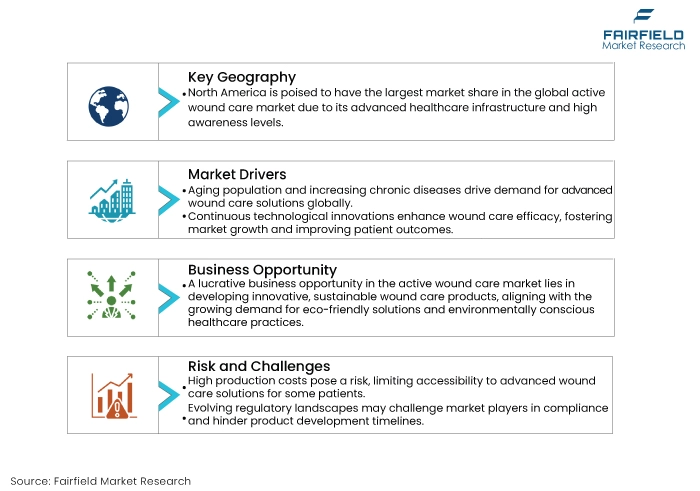
The perpetual quest for technological advancement serves as a fundamental catalyst that propels the active wound care industry. Technological advancements, including telemedicine applications, smart dressings, and connected wound care devices, are significantly transforming the field of wound management. These advancements optimise the efficacy of medical interventions by providing individualised attention and continuous monitoring.
The incorporation of Artificial Intelligence (AI) into the processes of wound assessment and treatment planning contributes to the expansion of the market by offering healthcare practitioners significant insights that can enhance patient outcomes. The market expands as the industry further adopts state-of-the-art technologies, motivated by the prospect of enhanced therapeutic results and more efficient healthcare procedures.
- Rising Prevalence of Chronic Disorders
The increasing incidence of chronic diseases on a global scale, specifically diabetes and vascular disorders, is a substantial fact propelling the need for active wound care solutions. Complex wounds frequently result from chronic conditions, necessitating the use of sophisticated and specialised wound care products. In response to this escalating healthcare challenge, the market provides customised remedies, including growth factors and bioactive dressings, which foster expedited recovery.
The global increase in the elderly population further amplifies the prevalence of chronic wounds, thereby generating an ongoing need for efficacious interventions in wound care. The convergence of this demographic pattern and the escalating prevalence of chronic ailments situates the market as an essential participant in tackling the healthcare requirements of these demographic groups.
- Growing Demographic Consumer Base
Activity-related wound care is significantly impacted by the demographic transition toward an ageing population. The ageing population on a global scale contributes to an elevated vulnerability to chronic ailments and impedes the rate of wound healing. The demographic trend stimulates the market for specialised wound care products that cater to the specific requirements of elderly patients, such as growth factors and skin substitutes.
The geriatric population not only increases the prevalence of chronic wounds but also underscores the criticality of sophisticated wound care interventions to facilitate expedited recovery and mitigate complications. The market continues to expand as healthcare systems adjust to the needs of an ageing population, primarily motivated by the necessity to deliver efficient wound care for the aged.
Major Growth Barriers
- Higher Investments
The significant impediment to the growth of the active wound care market is the exorbitant expense incurred for sophisticated wound care products. Notwithstanding their effectiveness, the financial implications of these specialised solutions for healthcare systems and patients may impede their pervasive adoption and accessibility, especially in settings with limited resources.
- Limited Availability
One notable market limitation pertains to the restricted reimbursement policies that are in place for specific active wound care products. The limited availability of coverage, and reimbursement for advanced wound care treatments could impede their extensive implementation, thereby affecting healthcare providers and patients alike and constraining the market's capacity for greater accessibility and utilisation.
Key Trends and Opportunities to Look at
The utilisation of telemedicine in the field of wound care has experienced tremendous expansion, primarily propelled by its effectiveness and availability. The global adoption of this trend is increasing, with developed regions such as North America, and Europe taking the lead.
Smith & Nephew and Teladoc Health have formed strategic alliances to improve remote wound monitoring. Brands will probably utilise telemedicine platforms to facilitate remote consultations, real-time wound assessment, and seamless patient engagement, thereby guaranteeing broad accessibility and individualised care.
- Focus on Environmentally Favourable Solutions
- Technological Trends Like Smart Dressings
Consistent growth has been observed in the demand for sustainable wound care practices, which reflects the worldwide trend toward environmentally favourable healthcare solutions. This phenomenon is gaining significant traction in developed regions, with Europe being a prominent adopter.
Prominent entities such as Molnlycke Health Care prioritise the development of sustainable products. Brands will probably utilise energy-efficient manufacturing processes, environmentally friendly packaging, and biodegradable materials to appeal to consumer preferences and support the cause of eco-conscious healthcare.
Prominent examples of technological advancements in wound healing include connected device, and intelligent dressings, which are reshaping the industry. This trend is prevalent throughout the world, with Asia Pacific, and North America leading the way.
Smith & Nephew, and 3M invest in the research and development of intelligent wound care solutions. Brands will probably utilise data-driven insights, cloud computing, and IoT integration to improve the effectiveness of their products, patient outcomes, and overall competitiveness in the market.
How Does the Regulatory Scenario Shape this Industry?
Regulatory frameworks are of utmost importance in the active wound care market as they guarantee the safety, effectiveness, and compliance with industry standards of products. Using the 510(k) clearance procedure, the Food and Drug Administration (FDA) ensures regulatory compliance for wound care products in the US.
The European market is regulated by the Medicines and Healthcare Products Regulatory Agency (MHRA) and the European Medicines Agency (EMA), which enforce the Medical Devices Regulation (MDR) of the European Union. These organisations establish rigorous standards that impact market dynamics through their guidance on product development and market entry tactics.
In response to region-specific developments, such as the implementation of MDR in Europe, businesses have been compelled to conform to stricter standards. Adherence to regulatory standards influences market entry and competitiveness in addition to ensuring patient safety. To comply with industry standards and obtain market sanction, stakeholders are required to navigate dynamic frameworks amidst evolving regulatory environments.
Fairfield’s Ranking Board
Top Segments
Out of the three segments mentioned—growth factors, biomaterials, and skin substitutes—skin substitutes are projected to hold the most market share. The versatility of skin substitutes in areas such as tissue regeneration, wound closure, and infection prevention propels their demand. The segment characterised by effective skin substitutes for facilitating efficient healing, particularly in the case of chronic wounds, is positioned at the vanguard of the active wound care market.
Although skin substitutes currently hold a larger market share, growth factors are anticipated to demonstrate the most rapid expansion. The growing acknowledgment of the role that growth factors play in promoting angiogenesis, tissue repair, and cell proliferation contributes to their increasing prevalence.
The expansion of knowledge regarding the biological processes involved in wound healing because of ongoing research and development, is anticipated to propel the Growth Factors sector forward. This is primarily due to the rising need for sophisticated and biologically active wound care products.
- Chronic Wounds to Generate the Maximum Demand
- Hospitals Represent the Leading Consumer Segment
Regarding acute and chronic wounds, it is anticipated that the chronic wounds segment will hold the largest market share. Sustained demand for specialised wound care solutions is driven by the prevalence of chronic conditions, including diabetes and vascular diseases.
The prevalence of complex pathologies, and extended healing times for chronic wounds motivates the development of active wound care products designed to address the unique challenges associated with these persistent conditions.
Even though chronic wounds hold the largest market share, Acute Wounds is anticipated to expand at the quickest rate. Irrespective of the circumstances, acute lesions, which frequently arise from traumatic incidents or surgical procedures, necessitate prompt and efficacious interventions.
The growing need for active wound care solutions is driven by the rapid onset, and relatively brief healing periods of acute wounds. This places this market segment in a favourable position to experience accelerated growth in response to the urgent healthcare demands.
Except for specialty clinics, home healthcare, and hospitals, it is expected that the hospital segment will hold the most substantial portion of the market. Hospitals function as primary centres for active wound care, providing a regulated setting, sophisticated infrastructure, and proficient healthcare personnel.
The significance of wound management in a hospital environment, specifically in intricate cases and surgical procedures, enhances the prominence of this sector within the market.
Despite hospitals holding the largest market share, home healthcare is anticipated to experience the most rapid growth. Enhanced wound care technologies, and growing focus on patient-centred care contribute to the effectiveness of wound management in the home environment.
As patients seek more accessible and individualised healthcare solutions in the comfort of their own homes, decentralised wound care is the fastest-growing segment due to the cost-effectiveness and convenience of home healthcare services.
Regional Frontrunners
North America’s Leadership Prevails on the Back of Extensive Healthcare Spending
With the highest potential market share, North America is positioned to dominate the worldwide active wound care industry. The main factors contributing to this are the region's firmly established healthcare infrastructure, significant rates of advanced technology adoption, and substantial investment in research and development.
North America's dominance is further bolstered by the substantial investments in healthcare and the presence of key market participants. Furthermore, the escalating prevalence of chronic diseases, and the expansion of the elderly demographic serve to reinforce North America's dominant status on the international market by driving the demand for active wound care products.
Asia Pacific Attains the Status of a High-Potential Market
It is anticipated that the Asia Pacific region will experience the most rapid growth in the worldwide active wound care market. Increasing awareness of sophisticated healthcare solutions, rising healthcare expenditures, and expanding access to healthcare in developing economies are all contributors to this expansion.
In conjunction with an ageing population, the prevalence of chronic diseases drives the demand for active wound care products. Furthermore, the continuous advancements in healthcare infrastructure and the implementation of innovative technologies are factors that contribute to the heightened expansion of the active wound care market in the Asia Pacific area.
Fairfield’s Competitive Landscape Analysis
The current pricing framework significantly influences the competitive environment, wherein differentiation strategies assume a pivotal function. Organisations that provide innovative, cost-effective solutions are likely to prosper. The impact of pricing on long-term growth will persist, as participants in the market strive to strike a nuanced equilibrium between profitability and affordability.
Significant market forces that influence competition are an emphasis on geographical expansion, personalised medicine strategies, and sustainability. Analysis of the supply chain demonstrates that agile and resilient supply networks are crucial for mitigating risks and guaranteeing product availability. In general, the active wound care market presents prospects for growth through approaches that prioritise the needs and interests of customers, strategic partnerships, and technological progress.
Who are the Leaders in the Global Active Wound Care Space?
- Smith & Nephew
- MiMedx
- Tissue Regenix
- Organogenesis Inc.
- Acell Inc.
- Integra Life Sciences
- Solsys Medical
- Osiris Therapeutics Inc.
- Cytori Therapeutics Inc.
- Human BioSciences
- Wright Medical Group N.V.
Global Active Wound Care Market is Segmented as Below:
By Product:
- Skin Substitutes
- Growth Factors
- Biomaterials
By Automation:
- Chronic Wounds
- Acute Wounds
By End User:
- Hospitals
- Home Healthcare
- Specialty Clinics
- Others
By Geographic Coverage:
- North America
- Europe
- Asia Pacific
- Latin America
- Middle East & Africa
- Executive Summary
- Global Active Wound Care Market Snapshot
- Future Projections
- Key Market Trends
- Regional Snapshot, by Value, 2026
- Analyst Recommendations
- Market Overview
- Market Definitions and Segmentations
- Market Dynamics
- Drivers
- Restraints
- Market Opportunities
- Value Chain Analysis
- COVID-19 Impact Analysis
- Porter's Five Forces Analysis
- Impact of Russia-Ukraine Conflict
- PESTLE Analysis
- Regulatory Analysis
- Price Trend Analysis
- Current Prices and Future Projections, 2025-2033
- Price Impact Factors
- Global Active Wound Care Market Outlook, 2020 - 2033
- Global Active Wound Care Market Outlook, by Product, Value (US$ Mn), 2020-2033
- Skin Substitutes
- Growth Factors
- Biomaterials
- Global Active Wound Care Market Outlook, by Automation, Value (US$ Mn), 2020-2033
- Chronic Wounds
- Acute Wounds
- Global Active Wound Care Market Outlook, by End User, Value (US$ Mn), 2020-2033
- Hospitals
- Home Healthcare
- Specialty Clinics
- Others
- Global Active Wound Care Market Outlook, by Region, Value (US$ Mn), 2020-2033
- North America
- Europe
- Asia Pacific
- Latin America
- Middle East & Africa
- Global Active Wound Care Market Outlook, by Product, Value (US$ Mn), 2020-2033
- North America Active Wound Care Market Outlook, 2020 - 2033
- North America Active Wound Care Market Outlook, by Product, Value (US$ Mn), 2020-2033
- Skin Substitutes
- Growth Factors
- Biomaterials
- North America Active Wound Care Market Outlook, by Automation, Value (US$ Mn), 2020-2033
- Chronic Wounds
- Acute Wounds
- North America Active Wound Care Market Outlook, by End User, Value (US$ Mn), 2020-2033
- Hospitals
- Home Healthcare
- Specialty Clinics
- Others
- North America Active Wound Care Market Outlook, by Country, Value (US$ Mn), 2020-2033
- U.S. Active Wound Care Market Outlook, by Product, 2020-2033
- U.S. Active Wound Care Market Outlook, by Automation, 2020-2033
- U.S. Active Wound Care Market Outlook, by End User, 2020-2033
- Canada Active Wound Care Market Outlook, by Product, 2020-2033
- Canada Active Wound Care Market Outlook, by Automation, 2020-2033
- Canada Active Wound Care Market Outlook, by End User, 2020-2033
- BPS Analysis/Market Attractiveness Analysis
- North America Active Wound Care Market Outlook, by Product, Value (US$ Mn), 2020-2033
- Europe Active Wound Care Market Outlook, 2020 - 2033
- Europe Active Wound Care Market Outlook, by Product, Value (US$ Mn), 2020-2033
- Skin Substitutes
- Growth Factors
- Biomaterials
- Europe Active Wound Care Market Outlook, by Automation, Value (US$ Mn), 2020-2033
- Chronic Wounds
- Acute Wounds
- Europe Active Wound Care Market Outlook, by End User, Value (US$ Mn), 2020-2033
- Hospitals
- Home Healthcare
- Specialty Clinics
- Others
- Europe Active Wound Care Market Outlook, by Country, Value (US$ Mn), 2020-2033
- Germany Active Wound Care Market Outlook, by Product, 2020-2033
- Germany Active Wound Care Market Outlook, by Automation, 2020-2033
- Germany Active Wound Care Market Outlook, by End User, 2020-2033
- Italy Active Wound Care Market Outlook, by Product, 2020-2033
- Italy Active Wound Care Market Outlook, by Automation, 2020-2033
- Italy Active Wound Care Market Outlook, by End User, 2020-2033
- France Active Wound Care Market Outlook, by Product, 2020-2033
- France Active Wound Care Market Outlook, by Automation, 2020-2033
- France Active Wound Care Market Outlook, by End User, 2020-2033
- U.K. Active Wound Care Market Outlook, by Product, 2020-2033
- U.K. Active Wound Care Market Outlook, by Automation, 2020-2033
- U.K. Active Wound Care Market Outlook, by End User, 2020-2033
- Spain Active Wound Care Market Outlook, by Product, 2020-2033
- Spain Active Wound Care Market Outlook, by Automation, 2020-2033
- Spain Active Wound Care Market Outlook, by End User, 2020-2033
- Russia Active Wound Care Market Outlook, by Product, 2020-2033
- Russia Active Wound Care Market Outlook, by Automation, 2020-2033
- Russia Active Wound Care Market Outlook, by End User, 2020-2033
- Rest of Europe Active Wound Care Market Outlook, by Product, 2020-2033
- Rest of Europe Active Wound Care Market Outlook, by Automation, 2020-2033
- Rest of Europe Active Wound Care Market Outlook, by End User, 2020-2033
- BPS Analysis/Market Attractiveness Analysis
- Europe Active Wound Care Market Outlook, by Product, Value (US$ Mn), 2020-2033
- Asia Pacific Active Wound Care Market Outlook, 2020 - 2033
- Asia Pacific Active Wound Care Market Outlook, by Product, Value (US$ Mn), 2020-2033
- Skin Substitutes
- Growth Factors
- Biomaterials
- Asia Pacific Active Wound Care Market Outlook, by Automation, Value (US$ Mn), 2020-2033
- Chronic Wounds
- Acute Wounds
- Asia Pacific Active Wound Care Market Outlook, by End User, Value (US$ Mn), 2020-2033
- Hospitals
- Home Healthcare
- Specialty Clinics
- Others
- Asia Pacific Active Wound Care Market Outlook, by Country, Value (US$ Mn), 2020-2033
- China Active Wound Care Market Outlook, by Product, 2020-2033
- China Active Wound Care Market Outlook, by Automation, 2020-2033
- China Active Wound Care Market Outlook, by End User, 2020-2033
- Japan Active Wound Care Market Outlook, by Product, 2020-2033
- Japan Active Wound Care Market Outlook, by Automation, 2020-2033
- Japan Active Wound Care Market Outlook, by End User, 2020-2033
- South Korea Active Wound Care Market Outlook, by Product, 2020-2033
- South Korea Active Wound Care Market Outlook, by Automation, 2020-2033
- South Korea Active Wound Care Market Outlook, by End User, 2020-2033
- India Active Wound Care Market Outlook, by Product, 2020-2033
- India Active Wound Care Market Outlook, by Automation, 2020-2033
- India Active Wound Care Market Outlook, by End User, 2020-2033
- Southeast Asia Active Wound Care Market Outlook, by Product, 2020-2033
- Southeast Asia Active Wound Care Market Outlook, by Automation, 2020-2033
- Southeast Asia Active Wound Care Market Outlook, by End User, 2020-2033
- Rest of SAO Active Wound Care Market Outlook, by Product, 2020-2033
- Rest of SAO Active Wound Care Market Outlook, by Automation, 2020-2033
- Rest of SAO Active Wound Care Market Outlook, by End User, 2020-2033
- BPS Analysis/Market Attractiveness Analysis
- Asia Pacific Active Wound Care Market Outlook, by Product, Value (US$ Mn), 2020-2033
- Latin America Active Wound Care Market Outlook, 2020 - 2033
- Latin America Active Wound Care Market Outlook, by Product, Value (US$ Mn), 2020-2033
- Skin Substitutes
- Growth Factors
- Biomaterials
- Latin America Active Wound Care Market Outlook, by Automation, Value (US$ Mn), 2020-2033
- Chronic Wounds
- Acute Wounds
- Latin America Active Wound Care Market Outlook, by End User, Value (US$ Mn), 2020-2033
- Hospitals
- Home Healthcare
- Specialty Clinics
- Others
- Latin America Active Wound Care Market Outlook, by Country, Value (US$ Mn), 2020-2033
- Brazil Active Wound Care Market Outlook, by Product, 2020-2033
- Brazil Active Wound Care Market Outlook, by Automation, 2020-2033
- Brazil Active Wound Care Market Outlook, by End User, 2020-2033
- Mexico Active Wound Care Market Outlook, by Product, 2020-2033
- Mexico Active Wound Care Market Outlook, by Automation, 2020-2033
- Mexico Active Wound Care Market Outlook, by End User, 2020-2033
- Argentina Active Wound Care Market Outlook, by Product, 2020-2033
- Argentina Active Wound Care Market Outlook, by Automation, 2020-2033
- Argentina Active Wound Care Market Outlook, by End User, 2020-2033
- Rest of LATAM Active Wound Care Market Outlook, by Product, 2020-2033
- Rest of LATAM Active Wound Care Market Outlook, by Automation, 2020-2033
- Rest of LATAM Active Wound Care Market Outlook, by End User, 2020-2033
- BPS Analysis/Market Attractiveness Analysis
- Latin America Active Wound Care Market Outlook, by Product, Value (US$ Mn), 2020-2033
- Middle East & Africa Active Wound Care Market Outlook, 2020 - 2033
- Middle East & Africa Active Wound Care Market Outlook, by Product, Value (US$ Mn), 2020-2033
- Skin Substitutes
- Growth Factors
- Biomaterials
- Middle East & Africa Active Wound Care Market Outlook, by Automation, Value (US$ Mn), 2020-2033
- Chronic Wounds
- Acute Wounds
- Middle East & Africa Active Wound Care Market Outlook, by End User, Value (US$ Mn), 2020-2033
- Hospitals
- Home Healthcare
- Specialty Clinics
- Others
- Middle East & Africa Active Wound Care Market Outlook, by Country, Value (US$ Mn), 2020-2033
- GCC Active Wound Care Market Outlook, by Product, 2020-2033
- GCC Active Wound Care Market Outlook, by Automation, 2020-2033
- GCC Active Wound Care Market Outlook, by End User, 2020-2033
- South Africa Active Wound Care Market Outlook, by Product, 2020-2033
- South Africa Active Wound Care Market Outlook, by Automation, 2020-2033
- South Africa Active Wound Care Market Outlook, by End User, 2020-2033
- Egypt Active Wound Care Market Outlook, by Product, 2020-2033
- Egypt Active Wound Care Market Outlook, by Automation, 2020-2033
- Egypt Active Wound Care Market Outlook, by End User, 2020-2033
- Nigeria Active Wound Care Market Outlook, by Product, 2020-2033
- Nigeria Active Wound Care Market Outlook, by Automation, 2020-2033
- Nigeria Active Wound Care Market Outlook, by End User, 2020-2033
- Rest of Middle East Active Wound Care Market Outlook, by Product, 2020-2033
- Rest of Middle East Active Wound Care Market Outlook, by Automation, 2020-2033
- Rest of Middle East Active Wound Care Market Outlook, by End User, 2020-2033
- BPS Analysis/Market Attractiveness Analysis
- Middle East & Africa Active Wound Care Market Outlook, by Product, Value (US$ Mn), 2020-2033
- Competitive Landscape
- Company Vs Segment Heatmap
- Company Market Share Analysis, 2025
- Competitive Dashboard
- Company Profiles
- Smith & Nephew
- Company Overview
- Product Portfolio
- Financial Overview
- Business Strategies and Developments
- MiMedx
- Tissue Regenix
- Organogenesis Inc.
- Acell Inc.
- Integra Life Sciences
- Solsys Medical
- Osiris Therapeutics Inc.
- Cytori Therapeutics Inc.
- Human BioSciences
- Smith & Nephew
- Appendix
- Research Methodology
- Report Assumptions
- Acronyms and Abbreviations
|
BASE YEAR |
HISTORICAL DATA |
FORECAST PERIOD |
UNITS |
|||
 |
2025 |
 |
2019 - 2024 |
 |
2026 - 2033 |
Value: US$ Billion |
|
REPORT FEATURES |
DETAILS |
|
Product Coverage |
|
|
Automation Coverage |
|
|
End User Coverage |
|
|
Geographical Coverage |
|
|
Leading Companies |
|
|
Report Highlights |
Key Market Indicators, Macro-micro economic impact analysis, Technological Roadmap, Key Trends, Driver, Restraints, and Future Opportunities & Revenue Pockets, Porter’s 5 Forces Analysis, Historical Trend (2019-2021), Market Estimates and Forecast, Market Dynamics, Industry Trends, Competition Landscape, Category, Region, Country-wise Trends & Analysis, COVID-19 Impact Analysis (Demand and Supply Chain) |
Our Research Methodology
Considering the volatility of business today, traditional approaches to strategizing a game plan can be unfruitful if not detrimental. True ambiguity is no way to determine a forecast. A myriad of predetermined factors must be accounted for such as the degree of risk involved, the magnitude of circumstances, as well as conditions or consequences that are not known or unpredictable. To circumvent binary views that cast uncertainty, the application of market research intelligence to strategically posture, move, and enable actionable outcomes is necessary.
View Methodology
Quality Assured
Rigorous Validation Process

Confidentiality Assured
End-to-end Data Security

Custom Research Services
Tailored To Your Objectives
FAQs
The global active wound care market size was approximately USD 2.8 billion in 2026.
North America holds the largest share of the global active wound care market.
The primary factor projected to drive the active wound care market expansion is the increasing chronic disease prevalence, and an expanding ageing population.
In 2026, the skin substitutes category held a significant share of the global market.
The acute wound segment captures a major share of the market for active wound care.
Related Reports
Ankle Boots Market Insights, Competitive Landscape, and Market Forecast 2033
The ankle boots market is valued at USD 18.50 Bn in 2026 and is projected to reach USD 27.45 Bn by 2033, expanding at a CAGR of 5.8% during 2026-2033
Foot And Ankle Devices Market Insights, Competitive Landscape, and Market Forecast 2033
The foot and ankle devices market will grow from USD 6.40 Bn in 2026 to USD 10.14 Bn by 2033 at a CAGR of 6.8%, driven by rising trauma & sports injuries.
Digital Therapeutics Delivery Devices Market Insights, Competitive Landscape, and Market Forecast 2033
The digital therapeutics delivery devices market will expand at a 15.5% CAGR from USD 2.10 Bn in 2026 to USD 5.76 Bn by 2033, led by wearable devices.
Global Infant Incubator Insights, Competitive Landscape, and Market Forecast 2033
Infant Incubator Market to reach US$1,306.72 Mn by 2033, growing at 5.3% CAGR, driven by preterm births, NICU expansion and transport incubators care.
Pulse Electromagnetic Field Therapy Devices Market Insights, Competitive Landscape, and Market Forecast 2026–2033
Pulse Electromagnetic Field Therapy Devices Market to reach US$930.86 Mn by 2033, driven by pain management and wearable devices.
Vaginal Rejuvenation Market Insights, Competitive Landscape, and Market Forecast 2026–2033
Vaginal Rejuvenation Market to Reach US$26.75 Billion by 2033, Driven by Rising Demand for Minimally Invasive Women's Health Solutions.