



AI for Drug Discovery Market
AI for Drug Discovery Market Insights, Competitive Landscape, and Market Forecast - 2033
Global AI for Drug Discovery Market Forecast
The AI for Drug Discovery Market is valued at USD 8.8 Bn in 2026 and is projected to reach USD 114.4 Bn, growing at a CAGR of 44% by 2033.
Quick Report Digest
A Look Back and a Look Forward - Comparative Analysis
The AI for drug discovery market is experiencing significant growth due to its potential to accelerate drug development processes. AI algorithms can analyse vast datasets, predict molecular interactions, and identify potential drug candidates, substantially reducing time and costs.
With the increasing demand for innovative therapies and the complexity of modern drug research, pharmaceutical companies and researchers are increasingly turning to AI to expedite drug discovery and development.
The market witnessed staggered growth during the historical period 2019 – 2024. This is due to the substantial growth of the major end-use application sectors, such as pharmaceutical and biotechnology companies, and contract research organisations. However, in some applications, the demand for AI for drug discovery has increased, such as in research centres and academic and government institutes.
The future of the AI for drug discovery market is promising. AI technologies will continue to revolutionise drug development, leading to more efficient and cost-effective processes. Advanced machine learning and predictive analytics will enable the discovery of novel drug candidates and personalised therapies.
Collaboration between AI developers and pharmaceutical companies will drive innovation, ultimately improving patient outcomes and the speed at which new treatments reach the market.
Key Growth Determinants
- Growing Cross-Industry Collaborations, and Partnerships
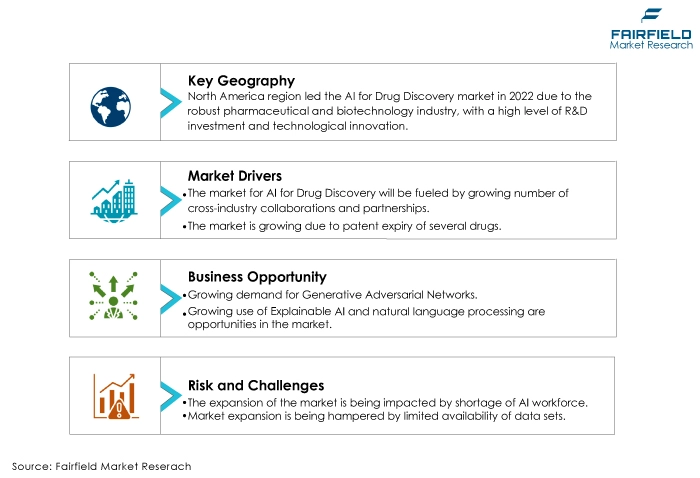
A growing number of cross-industry collaborations and partnerships is propelling the AI for drug discovery market. Pharmaceutical companies are teaming up with AI technology providers, academic institutions, and research organisations to leverage AI's potential in drug discovery.
Such collaborations bring together domain expertise and advanced AI capabilities, leading to faster and more accurate drug candidate identification and optimisation. Such partnerships enhance innovation, reduce development costs, and expedite the delivery of new therapies, driving the growth of the AI for drug discovery market.
- Rising Need to Control Drug Discovery and Development Costs, and Reduce Drug Development Time
The AI for drug discovery market is driven by the urgent need to control drug discovery and development costs while expediting the process. AI algorithms can analyse vast datasets, predict drug candidates, and optimise research strategies, significantly reducing the time and financial resources required for drug development.
In an industry where the cost and time to market are substantial, AI's ability to enhance efficiency and precision is compelling pharmaceutical companies and researchers to adopt AI-driven solutions, thus driving market growth.
- Patent Expiry of Several Drugs
The patent expiry of numerous drugs is accelerating the AI for drug discovery market. As pharmaceutical companies seek to fill their pipelines with new, patent-protected drugs, AI plays a pivotal role in identifying novel drug candidates efficiently.
AI algorithms analyse vast datasets and predict potential compounds, saving time and costs. This is particularly crucial in the race to develop generic versions and maintain competitive advantages, driving the adoption of AI-driven drug discovery solutions.
Major Growth Barriers
- Inadequate of AI Workforce
The AI for drug discovery market faces a challenge due to a shortage of AI workforce. The demand for skilled AI professionals in pharmaceutical research outpaces the available talent pool. This scarcity hinders the implementation of AI-driven solutions, slows down research projects, and potentially delays drug discovery timelines.
Companies and organisations are competing for AI experts, making it challenging to fully leverage AI's capabilities in drug development, highlighting the need for workforce development and education in this field.
- Limited Availability of Data Sets
The AI for drug discovery market encounters challenges due to the limited availability of high-quality datasets. AI models rely on extensive, diverse, and well-curated data to provide accurate predictions.
However, in drug discovery, such datasets are often limited, making it challenging to train robust AI algorithms. This data scarcity hampers the development and validation of AI-driven solutions, impacting their effectiveness in identifying drug candidates and optimizing research processes, thus posing a significant challenge to the market growth.
Key Trends and Opportunities to Look at
Generative adversarial networks (GANs) are transformative in the AI for drug discovery market. GANs use two neural networks, a generator and a discriminator, to create and evaluate molecular structures. They enable the generation of novel chemical compounds, aiding in the identification of potential drug candidates efficiently.
GANs significantly accelerate drug discovery by exploring a vast chemical space, providing innovative solutions to pharmaceutical research challenges.
- Explainable AI
- Natural Language Processing
Explainable AI (XAI) is crucial in the AI for drug discovery Market for enhancing model transparency and interpretability. It enables researchers and regulators to understand how AI-driven decisions are made. This transparency is essential for gaining regulatory approval, ensuring trust in AI-generated drug candidates, and pinpointing the molecular features contributing to a compound's efficacy or safety. XAI empowers researchers to make more informed decisions and fosters confidence in AI's role in drug discovery.
Natural language processing (NLP) is a game-changer in the AI for drug discovery market. NLP enables the analysis of vast amounts of scientific literature, patents, and clinical records. By extracting valuable insights from textual data, NLP aids in drug target identification, biomarker discovery, and literature-based knowledge integration. It accelerates the research process, facilitating the discovery of potential drug candidates and streamlining the drug development pipeline, making it an invaluable technology in pharmaceutical research.
How Does the Regulatory Scenario Shape this Industry?
The regulatory scenario in the AI for drug discovery market is evolving to ensure the safety and efficacy of AI-driven drug development. Regulatory agencies like the US FDA, and EMA are actively working on guidelines for AI-based tools and models.
There's a growing emphasis on Explainable AI (XAI) to provide transparency and interpretability in AI-generated insights. Additionally, regulators are addressing data privacy and security concerns, especially in handling sensitive patient data. Compliance with existing regulations, such as GDPR, is essential.
As AI continues to play a pivotal role in drug discovery, the regulatory framework aims to strike a balance between fostering innovation and maintaining rigorous standards, ensuring that AI-driven drug candidates meet the required safety and efficacy criteria before reaching the market.
Fairfield’s Ranking Board
Top Segments
Software offerings dominate the AI for drug discovery market due to their pivotal role in enabling AI-driven research. These offerings encompass a wide range of AI algorithms, platforms, and tools that facilitate data analysis, predictive modeling, and molecular simulations.
Pharmaceutical companies and research institutions rely on software to harness the power of AI, reducing drug development time and costs. The flexibility and scalability of software solutions make them indispensable for both small-scale research projects and large-scale drug discovery efforts, contributing to their largest market share in this dynamic industry.
Services offerings are projected to grow at the fastest pace by 2030 due to their essential role in assisting organisations with AI implementation. These services include AI consulting, data annotation, model validation, and custom AI development.
As the demand for AI in drug discovery increases, organisations require specialised expertise, and support. Service providers offer tailored solutions, helping companies navigate the complexities of AI adoption, optimise their workflows, and ensure the successful integration of AI-driven approaches, leading to the expected high growth rate in this segment.
- Preference for Machine Learning Technology the Highest
- Cardiovascular Diseases - Leading Application Segment
- Pharma & Biotech Companies Take the Lead
Machine learning (ML) technology dominates the AI for drug discovery market due to its versatility, and proven track record. ML algorithms analyse vast datasets to identify patterns and generate predictive models, aiding in drug target identification, compound screening, and toxicity prediction.
The adaptability of ML algorithms to various drug discovery stages and potential for high accuracy make ML solutions the go-to choice for researchers. With a history of successful applications in pharmaceutical research, ML technology has gained trust and recognition, leading to its largest market share in the industry.
Supervised learning technology is poised for the exceptional growth in adoption because of its potential to enhance drug development processes. Supervised learning algorithms utilise labelled data to train models, enabling accurate predictions in areas like drug-target interaction and compound screening.
As pharmaceutical companies increasingly embrace AI, supervised learning's adaptability and performance in predictive tasks make it an attractive choice. Its ability to reduce research time and costs while improving accuracy is driving its expected high growth rate in the AI for drug discovery market.
Cardiovascular disease application commands the largest market share in the AI for drug discovery market due to the prevalence and critical nature of these diseases. AI-driven tools excel in identifying novel drug candidates, predicting disease mechanisms, and optimizing treatment strategies.
With the rising global burden of cardiovascular conditions, pharmaceutical companies and researchers prioritise this area, contributing to extensive adoption of AI. Additionally, AI's potential to expedite cardiovascular drug development and improve patient outcomes cements its leadership in this crucial healthcare sector, leading to the largest market share.
Neurodegenerative disease applications are anticipated to witness the highest growth in the global AI for drug discovery market. This is because of the growing prevalence of neurodegenerative disorders like Alzheimer's, and Parkinson's, and the pressing need for effective treatments.
AI-powered tools offer great promise in identifying potential drug candidates, understanding disease mechanisms, and accelerating research in this complex field. The high demand for innovative therapies for these challenging conditions is driving increased investment and research focus, leading to the expected high growth rate in neurodegenerative diseases within the AI for drug discovery market.
Pharmaceutical and biotechnology companies hold the largest market share in the AI for drug discovery market because of their substantial investments in AI-driven research. These companies leverage AI to expedite drug development, optimise lead compound identification, and streamline clinical trial processes.
With the pressing need for innovative therapies and cost-effective drug discovery, pharmaceutical and biotech firms are at the forefront of AI adoption, contributing to their dominant position. Their extensive resources and commitment to innovation solidify their leadership in harnessing AI's potential for transforming drug discovery processes.
Research centres, academic institutions, and government institutes will more likely experience the fastest CAGR through the end of 2030. This growth is due to the increasing collaborations between academia, government, and the pharmaceutical industry to advance drug discovery efforts. These organisations often have access to valuable data and domain expertise, making them crucial players in AI-driven research.
The growing emphasis on public-private partnerships and government funding in AI-based drug discovery initiatives is expected to drive the substantial growth of this segment.
Regional Frontrunners
North America Contributes the Lion’s Share
North America leads in the AI for drug discovery market due to several key factors. The region boasts a robust pharmaceutical and biotechnology industry, with a high level of R&D investment and technological innovation. North America is home to numerous AI start-ups and established players, fostering a dynamic ecosystem.
Additionally, supportive regulatory frameworks and collaborations between pharmaceutical companies, research institutions, and technology firms drive AI adoption. The region's wealth of healthcare data, coupled with a growing emphasis on personalised medicine, further fuels AI-driven drug discovery initiatives.
With a strong commitment to addressing healthcare challenges and the need for novel treatments, North America continues to invest in AI solutions, securing its position with the largest market share in this transformative field.
Asia Pacific Awaits Substantial Market Growth
The market of Asia Pacific is driven by the thriving pharmaceutical industry, increasing research and development activities, and rising investment in AI technologies. Additionally, the region's large patient population, diverse genetic profiles, and healthcare advancements create a fertile ground for AI-driven drug discovery.
As governments and organisationsa in Asia Pacific alike recognise the potential of AI in healthcare, the adoption of AI solutions for drug discovery is set to surge, leading to the highest CAGR in this market.
Who are the Leaders in the Global AI for Drug Discovery Space?
An Expert’s Eye
Demand and Future Growth
An increase in healthcare sector demand is driving the market. The demand for AI in drug discovery is surging as pharmaceutical companies seek innovative solutions to accelerate drug development, reduce costs, and address complex diseases. AI's potential to analyse vast datasets, predict drug candidates, and optimise research processes is driving market growth.
The future promises even more significant expansion, with AI expected to play a pivotal role in personalised medicine and the discovery of novel therapies. As technology matures and regulatory frameworks evolve, the AI for Drug Discovery Market is poised for robust and sustained growth.
Supply Side of the Market
The major countries in the AI for drug discovery market include the United States, Canada, the United Kingdom, Germany, France, China, Japan, South Korea, India, and Australia. These countries have well-established pharmaceutical industries, robust research ecosystems, and significant investments in AI-driven drug discovery initiatives.
The presence of leading pharmaceutical companies, academic institutions, and technology firms in these regions contributes to their prominence in this transformative market.
The AI for drug discovery market primarily relies on computational resources, high-performance computing clusters, cloud computing infrastructure, and specialised software tools for data analysis.
Manufacturers of these raw materials include tech giants like IBM, Microsoft, Amazon Web Services (AWS), Google Cloud, and NVIDIA, which provide the computational power and cloud services required for AI-driven drug discovery. Additionally, numerous software companies offer AI-driven drug discovery platforms and tools, including Schrödinger, ChemAxon, and OpenEye Scientific Software, contributing to the essential raw materials in this market.
The AI for Drug Discovery Market Segmented as Below:
By Offering
- Software
- Services
By Technology
- Machine Learning
- Deep Learning
- Supervised Learning
- Reinforcement Learning
- Unsupervised Learning
- Other Technologies
By Application
- Immuno-oncology
- Neurodegenerative Diseases
- Cardiovascular Diseases
- Metabolic Diseases
- Other Applications
By End User
- Pharmaceutical & Biotechnology Companies
- Contract Research Organisations
- Research Centres and Academic & Government Institutes
By Geographic Coverage:
- North America
- Europe
- Asia Pacific
- Latin America
- Middle East & Africa
- Executive Summary
- Global AI for Drug Discovery Market Snapshot
- Future Projections
- Key Market Trends
- Regional Snapshot, by Value, 2026
- Analyst Recommendations
- Market Overview
- Market Definitions and Segmentations
- Market Dynamics
- Drivers
- Restraints
- Market Opportunities
- Value Chain Analysis
- COVID-19 Impact Analysis
- Porter's Five Forces Analysis
- Impact of Russia-Ukraine Conflict
- PESTLE Analysis
- Regulatory Analysis
- Price Trend Analysis
- Current Prices and Future Projections, 2025-2033
- Price Impact Factors
- Global AI for Drug Discovery Market Outlook, 2020 - 2033
- Global AI for Drug Discovery Market Outlook, by Offering, Value (US$ Mn), 2020-2033
- Software
- Services
- Global AI for Drug Discovery Market Outlook, by Technology, Value (US$ Mn), 2020-2033
- Machine Learning
- Deep Learning
- Supervised Learning
- Reinforcement Learning
- Unsupervised Learning
- Other Technologies
- Global AI for Drug Discovery Market Outlook, by Application, Value (US$ Mn), 2020-2033
- Immuno-oncology
- Neurodegenerative Diseases
- Cardiovascular Diseases
- Metabolic Diseases
- Other Applications
- Global AI for Drug Discovery Market Outlook, by End User, Value (US$ Mn), 2020-2033
- Pharmaceutical & Biotechnology Companies
- Contract Research Organisations
- Research Centres and Academic & Government Institutes
- Global AI for Drug Discovery Market Outlook, by Region, Value (US$ Mn), 2020-2033
- North America
- Europe
- Asia Pacific
- Latin America
- Middle East & Africa
- Global AI for Drug Discovery Market Outlook, by Offering, Value (US$ Mn), 2020-2033
- North America AI for Drug Discovery Market Outlook, 2020 - 2033
- North America AI for Drug Discovery Market Outlook, by Offering, Value (US$ Mn), 2020-2033
- Software
- Services
- North America AI for Drug Discovery Market Outlook, by Technology, Value (US$ Mn), 2020-2033
- Machine Learning
- Deep Learning
- Supervised Learning
- Reinforcement Learning
- Unsupervised Learning
- Other Technologies
- North America AI for Drug Discovery Market Outlook, by Application, Value (US$ Mn), 2020-2033
- Immuno-oncology
- Neurodegenerative Diseases
- Cardiovascular Diseases
- Metabolic Diseases
- Other Applications
- North America AI for Drug Discovery Market Outlook, by End User, Value (US$ Mn), 2020-2033
- Pharmaceutical & Biotechnology Companies
- Contract Research Organisations
- Research Centres and Academic & Government Institutes
- North America AI for Drug Discovery Market Outlook, by Country, Value (US$ Mn), 2020-2033
- U.S. AI for Drug Discovery Market Outlook, by Offering, 2020-2033
- U.S. AI for Drug Discovery Market Outlook, by Technology, 2020-2033
- U.S. AI for Drug Discovery Market Outlook, by Application, 2020-2033
- U.S. AI for Drug Discovery Market Outlook, by End User, 2020-2033
- Canada AI for Drug Discovery Market Outlook, by Offering, 2020-2033
- Canada AI for Drug Discovery Market Outlook, by Technology, 2020-2033
- Canada AI for Drug Discovery Market Outlook, by Application, 2020-2033
- Canada AI for Drug Discovery Market Outlook, by End User, 2020-2033
- BPS Analysis/Market Attractiveness Analysis
- North America AI for Drug Discovery Market Outlook, by Offering, Value (US$ Mn), 2020-2033
- Europe AI for Drug Discovery Market Outlook, 2020 - 2033
- Europe AI for Drug Discovery Market Outlook, by Offering, Value (US$ Mn), 2020-2033
- Software
- Services
- Europe AI for Drug Discovery Market Outlook, by Technology, Value (US$ Mn), 2020-2033
- Machine Learning
- Deep Learning
- Supervised Learning
- Reinforcement Learning
- Unsupervised Learning
- Other Technologies
- Europe AI for Drug Discovery Market Outlook, by Application, Value (US$ Mn), 2020-2033
- Immuno-oncology
- Neurodegenerative Diseases
- Cardiovascular Diseases
- Metabolic Diseases
- Other Applications
- Europe AI for Drug Discovery Market Outlook, by End User, Value (US$ Mn), 2020-2033
- Pharmaceutical & Biotechnology Companies
- Contract Research Organisations
- Research Centres and Academic & Government Institutes
- Europe AI for Drug Discovery Market Outlook, by Country, Value (US$ Mn), 2020-2033
- Germany AI for Drug Discovery Market Outlook, by Offering, 2020-2033
- Germany AI for Drug Discovery Market Outlook, by Technology, 2020-2033
- Germany AI for Drug Discovery Market Outlook, by Application, 2020-2033
- Germany AI for Drug Discovery Market Outlook, by End User, 2020-2033
- Italy AI for Drug Discovery Market Outlook, by Offering, 2020-2033
- Italy AI for Drug Discovery Market Outlook, by Technology, 2020-2033
- Italy AI for Drug Discovery Market Outlook, by Application, 2020-2033
- Italy AI for Drug Discovery Market Outlook, by End User, 2020-2033
- France AI for Drug Discovery Market Outlook, by Offering, 2020-2033
- France AI for Drug Discovery Market Outlook, by Technology, 2020-2033
- France AI for Drug Discovery Market Outlook, by Application, 2020-2033
- France AI for Drug Discovery Market Outlook, by End User, 2020-2033
- U.K. AI for Drug Discovery Market Outlook, by Offering, 2020-2033
- U.K. AI for Drug Discovery Market Outlook, by Technology, 2020-2033
- U.K. AI for Drug Discovery Market Outlook, by Application, 2020-2033
- U.K. AI for Drug Discovery Market Outlook, by End User, 2020-2033
- Spain AI for Drug Discovery Market Outlook, by Offering, 2020-2033
- Spain AI for Drug Discovery Market Outlook, by Technology, 2020-2033
- Spain AI for Drug Discovery Market Outlook, by Application, 2020-2033
- Spain AI for Drug Discovery Market Outlook, by End User, 2020-2033
- Russia AI for Drug Discovery Market Outlook, by Offering, 2020-2033
- Russia AI for Drug Discovery Market Outlook, by Technology, 2020-2033
- Russia AI for Drug Discovery Market Outlook, by Application, 2020-2033
- Russia AI for Drug Discovery Market Outlook, by End User, 2020-2033
- Rest of Europe AI for Drug Discovery Market Outlook, by Offering, 2020-2033
- Rest of Europe AI for Drug Discovery Market Outlook, by Technology, 2020-2033
- Rest of Europe AI for Drug Discovery Market Outlook, by Application, 2020-2033
- Rest of Europe AI for Drug Discovery Market Outlook, by End User, 2020-2033
- BPS Analysis/Market Attractiveness Analysis
- Europe AI for Drug Discovery Market Outlook, by Offering, Value (US$ Mn), 2020-2033
- Asia Pacific AI for Drug Discovery Market Outlook, 2020 - 2033
- Asia Pacific AI for Drug Discovery Market Outlook, by Offering, Value (US$ Mn), 2020-2033
- Software
- Services
- Asia Pacific AI for Drug Discovery Market Outlook, by Technology, Value (US$ Mn), 2020-2033
- Machine Learning
- Deep Learning
- Supervised Learning
- Reinforcement Learning
- Unsupervised Learning
- Other Technologies
- Asia Pacific AI for Drug Discovery Market Outlook, by Application, Value (US$ Mn), 2020-2033
- Immuno-oncology
- Neurodegenerative Diseases
- Cardiovascular Diseases
- Metabolic Diseases
- Other Applications
- Asia Pacific AI for Drug Discovery Market Outlook, by End User, Value (US$ Mn), 2020-2033
- Pharmaceutical & Biotechnology Companies
- Contract Research Organisations
- Research Centres and Academic & Government Institutes
- Asia Pacific AI for Drug Discovery Market Outlook, by Country, Value (US$ Mn), 2020-2033
- China AI for Drug Discovery Market Outlook, by Offering, 2020-2033
- China AI for Drug Discovery Market Outlook, by Technology, 2020-2033
- China AI for Drug Discovery Market Outlook, by Application, 2020-2033
- China AI for Drug Discovery Market Outlook, by End User, 2020-2033
- Japan AI for Drug Discovery Market Outlook, by Offering, 2020-2033
- Japan AI for Drug Discovery Market Outlook, by Technology, 2020-2033
- Japan AI for Drug Discovery Market Outlook, by Application, 2020-2033
- Japan AI for Drug Discovery Market Outlook, by End User, 2020-2033
- South Korea AI for Drug Discovery Market Outlook, by Offering, 2020-2033
- South Korea AI for Drug Discovery Market Outlook, by Technology, 2020-2033
- South Korea AI for Drug Discovery Market Outlook, by Application, 2020-2033
- South Korea AI for Drug Discovery Market Outlook, by End User, 2020-2033
- India AI for Drug Discovery Market Outlook, by Offering, 2020-2033
- India AI for Drug Discovery Market Outlook, by Technology, 2020-2033
- India AI for Drug Discovery Market Outlook, by Application, 2020-2033
- India AI for Drug Discovery Market Outlook, by End User, 2020-2033
- Southeast Asia AI for Drug Discovery Market Outlook, by Offering, 2020-2033
- Southeast Asia AI for Drug Discovery Market Outlook, by Technology, 2020-2033
- Southeast Asia AI for Drug Discovery Market Outlook, by Application, 2020-2033
- Southeast Asia AI for Drug Discovery Market Outlook, by End User, 2020-2033
- Rest of SAO AI for Drug Discovery Market Outlook, by Offering, 2020-2033
- Rest of SAO AI for Drug Discovery Market Outlook, by Technology, 2020-2033
- Rest of SAO AI for Drug Discovery Market Outlook, by Application, 2020-2033
- Rest of SAO AI for Drug Discovery Market Outlook, by End User, 2020-2033
- BPS Analysis/Market Attractiveness Analysis
- Asia Pacific AI for Drug Discovery Market Outlook, by Offering, Value (US$ Mn), 2020-2033
- Latin America AI for Drug Discovery Market Outlook, 2020 - 2033
- Latin America AI for Drug Discovery Market Outlook, by Offering, Value (US$ Mn), 2020-2033
- Software
- Services
- Latin America AI for Drug Discovery Market Outlook, by Technology, Value (US$ Mn), 2020-2033
- Machine Learning
- Deep Learning
- Supervised Learning
- Reinforcement Learning
- Unsupervised Learning
- Other Technologies
- Latin America AI for Drug Discovery Market Outlook, by Application, Value (US$ Mn), 2020-2033
- Immuno-oncology
- Neurodegenerative Diseases
- Cardiovascular Diseases
- Metabolic Diseases
- Other Applications
- Latin America AI for Drug Discovery Market Outlook, by End User, Value (US$ Mn), 2020-2033
- Pharmaceutical & Biotechnology Companies
- Contract Research Organisations
- Research Centres and Academic & Government Institutes
- Latin America AI for Drug Discovery Market Outlook, by Country, Value (US$ Mn), 2020-2033
- Brazil AI for Drug Discovery Market Outlook, by Offering, 2020-2033
- Brazil AI for Drug Discovery Market Outlook, by Technology, 2020-2033
- Brazil AI for Drug Discovery Market Outlook, by Application, 2020-2033
- Brazil AI for Drug Discovery Market Outlook, by End User, 2020-2033
- Mexico AI for Drug Discovery Market Outlook, by Offering, 2020-2033
- Mexico AI for Drug Discovery Market Outlook, by Technology, 2020-2033
- Mexico AI for Drug Discovery Market Outlook, by Application, 2020-2033
- Mexico AI for Drug Discovery Market Outlook, by End User, 2020-2033
- Argentina AI for Drug Discovery Market Outlook, by Offering, 2020-2033
- Argentina AI for Drug Discovery Market Outlook, by Technology, 2020-2033
- Argentina AI for Drug Discovery Market Outlook, by Application, 2020-2033
- Argentina AI for Drug Discovery Market Outlook, by End User, 2020-2033
- Rest of LATAM AI for Drug Discovery Market Outlook, by Offering, 2020-2033
- Rest of LATAM AI for Drug Discovery Market Outlook, by Technology, 2020-2033
- Rest of LATAM AI for Drug Discovery Market Outlook, by Application, 2020-2033
- Rest of LATAM AI for Drug Discovery Market Outlook, by End User, 2020-2033
- BPS Analysis/Market Attractiveness Analysis
- Latin America AI for Drug Discovery Market Outlook, by Offering, Value (US$ Mn), 2020-2033
- Middle East & Africa AI for Drug Discovery Market Outlook, 2020 - 2033
- Middle East & Africa AI for Drug Discovery Market Outlook, by Offering, Value (US$ Mn), 2020-2033
- Software
- Services
- Middle East & Africa AI for Drug Discovery Market Outlook, by Technology, Value (US$ Mn), 2020-2033
- Machine Learning
- Deep Learning
- Supervised Learning
- Reinforcement Learning
- Unsupervised Learning
- Other Technologies
- Middle East & Africa AI for Drug Discovery Market Outlook, by Application, Value (US$ Mn), 2020-2033
- Immuno-oncology
- Neurodegenerative Diseases
- Cardiovascular Diseases
- Metabolic Diseases
- Other Applications
- Middle East & Africa AI for Drug Discovery Market Outlook, by End User, Value (US$ Mn), 2020-2033
- Pharmaceutical & Biotechnology Companies
- Contract Research Organisations
- Research Centres and Academic & Government Institutes
- Middle East & Africa AI for Drug Discovery Market Outlook, by Country, Value (US$ Mn), 2020-2033
- GCC AI for Drug Discovery Market Outlook, by Offering, 2020-2033
- GCC AI for Drug Discovery Market Outlook, by Technology, 2020-2033
- GCC AI for Drug Discovery Market Outlook, by Application, 2020-2033
- GCC AI for Drug Discovery Market Outlook, by End User, 2020-2033
- South Africa AI for Drug Discovery Market Outlook, by Offering, 2020-2033
- South Africa AI for Drug Discovery Market Outlook, by Technology, 2020-2033
- South Africa AI for Drug Discovery Market Outlook, by Application, 2020-2033
- South Africa AI for Drug Discovery Market Outlook, by End User, 2020-2033
- Egypt AI for Drug Discovery Market Outlook, by Offering, 2020-2033
- Egypt AI for Drug Discovery Market Outlook, by Technology, 2020-2033
- Egypt AI for Drug Discovery Market Outlook, by Application, 2020-2033
- Egypt AI for Drug Discovery Market Outlook, by End User, 2020-2033
- Nigeria AI for Drug Discovery Market Outlook, by Offering, 2020-2033
- Nigeria AI for Drug Discovery Market Outlook, by Technology, 2020-2033
- Nigeria AI for Drug Discovery Market Outlook, by Application, 2020-2033
- Nigeria AI for Drug Discovery Market Outlook, by End User, 2020-2033
- Rest of Middle East AI for Drug Discovery Market Outlook, by Offering, 2020-2033
- Rest of Middle East AI for Drug Discovery Market Outlook, by Technology, 2020-2033
- Rest of Middle East AI for Drug Discovery Market Outlook, by Application, 2020-2033
- Rest of Middle East AI for Drug Discovery Market Outlook, by End User, 2020-2033
- BPS Analysis/Market Attractiveness Analysis
- Middle East & Africa AI for Drug Discovery Market Outlook, by Offering, Value (US$ Mn), 2020-2033
- Competitive Landscape
- Company Vs Segment Heatmap
- Company Market Share Analysis, 2025
- Competitive Dashboard
- Company Profiles
- IBM Watson Health
- Company Overview
- Product Portfolio
- Financial Overview
- Business Strategies and Developments
- Benevolent AI
- Atomwise
- Insilico Medicine
- Dahua Technology
- Exscientia
- Numerate
- Berg Health
- GNS Healthcare
- TwoXAR
- IBM Watson Health
- Appendix
- Research Methodology
- Report Assumptions
- Acronyms and Abbreviations
|
BASE YEAR |
HISTORICAL DATA |
FORECAST PERIOD |
UNITS |
|||
 |
2025 |
 |
2019 - 2024 |
 |
2026 - 2033 |
Value: US$ Billion |
|
REPORT FEATURES |
DETAILS |
|
Offering Coverage |
|
|
Technology Coverage |
|
|
Application Coverage |
|
|
End User Coverage |
|
|
Geographical Coverage |
|
|
Leading Companies |
|
|
Report Highlights |
Key Market Indicators, Macro-micro economic impact analysis, Technological Roadmap, Key Trends, Driver, Restraints, and Future Opportunities & Revenue Pockets, Porter’s 5 Forces Analysis, Historical Trend (2019-2021), Market Estimates and Forecast, Market Dynamics, Industry Trends, Competition Landscape, Category, Region, Country-wise Trends & Analysis, COVID-19 Impact Analysis (Demand and Supply Chain) |
Our Research Methodology
Considering the volatility of business today, traditional approaches to strategizing a game plan can be unfruitful if not detrimental. True ambiguity is no way to determine a forecast. A myriad of predetermined factors must be accounted for such as the degree of risk involved, the magnitude of circumstances, as well as conditions or consequences that are not known or unpredictable. To circumvent binary views that cast uncertainty, the application of market research intelligence to strategically posture, move, and enable actionable outcomes is necessary.
View Methodology
Quality Assured
Rigorous Validation Process

Confidentiality Assured
End-to-end Data Security

Custom Research Services
Tailored To Your Objectives
FAQs
AI is revolutionizing drug discovery by accelerating target identification, predicting compound interactions, and optimizing lead compounds, leading to more efficient and cost-effective drug development.
Machine learning algorithms analyze vast datasets to identify potential drug targets, significantly improving the precision and speed of target identification and validation in the drug discovery pipeline.
AI enables the analysis of individual patient data, facilitating the development of personalized medicines by identifying specific drug responses and optimizing treatment strategies based on a patient's unique genetic and molecular profile.
Challenges include data privacy concerns and the need for robust regulatory frameworks, while opportunities lie in the potential for AI to uncover novel drug candidates, streamline clinical trials, and bring innovative therapies to market more rapidly.
Collaborations between pharmaceutical companies and AI technology providers are on the rise, fostering innovation and expediting drug discovery processes by combining industry expertise with advanced AI capabilities.
Related Reports
Advanced Therapy Medicinal Products Market
The global advanced therapy medicinal products market will reach US$ 48.04 Bn by 2033, growing at a 14.6% CAGR, driven by demand for innovative therapies
Pen and Injector Drug Delivery Devices Market
The global pen and injector drug delivery devices market will reach US$ 20.88 Billion by 2033, growing at an 8.9% CAGR from 2026-2033
Healthcare Waste Treatment Market Insights, Competitive Landscape, and Market Forecast - 2033
The healthcare waste treatment market will grow from USD12.80 billion in 2026 to USD20.15 billion by 2033, driven by expanding healthcare systems.
Medical Rehabilitation Service Market Size and Forecast 2033
Medical Rehabilitation Service Market to reach USD 54.27 Bn by 2033, growing at 7.6% CAGR, driven by aging populations, outpatient care, and home-based rehabilitation.
Growth Factor Plus Market Insights, Competitive Landscape, and Market Forecast 2033
Growth Factor Plus Market to reach USD 798.88 Mn by 2033, growing at 9.6% CAGR, driven by clinical skincare, dermatology, medical aesthetics, and premium formulations.
At-home Genetic Testing Market Insights, Competitive Landscape, and Market Forecast - 2033
The at-home genetic testing market is expected to grow from USD 3.10 billion in 2026 to USD 7.38 billion by 2033, driven by rising consumer health data interest