



Aircraft Battery Market
Aircraft Battery Market Insights, Competitive Landscape, and Market Forecast - 2033
Market Overview
Aircraft batteries provide critical electrical power for engine starting, avionics systems, and emergency backup power across commercial, military, and general aviation platforms, with battery chemistry and design engineered to meet stringent aviation reliability, weight, and safety certification requirements. As aircraft systems have grown increasingly electrified and new aircraft categories such as electric and hybrid-electric platforms have emerged, aircraft battery technology has become an increasingly dynamic and strategically important component category.
Demand growth through the 2026-2033 window is closely tied to steady global aircraft fleet growth requiring both original equipment and replacement battery supply, ongoing transition from nickel-cadmium to lithium-ion battery technology across new aircraft designs seeking weight and performance advantages, and emerging demand from electric and hybrid-electric aircraft and urban air mobility platforms requiring high-performance propulsion battery systems. Continued advancement in battery safety and certification standards continues to support broader lithium-ion adoption across commercial and general aviation applications.
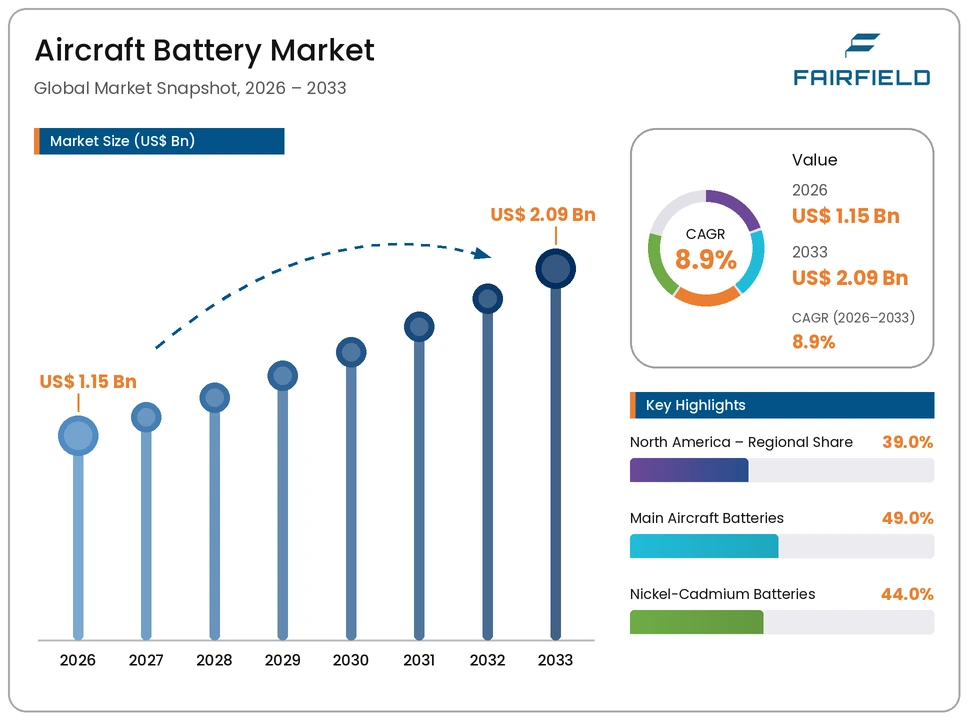
The market is valued at USD 1.15 Billion in 2026, with manufacturers directing investment toward lithium-ion battery certification and safety system development addressing the thermal management requirements unique to aviation applications. By 2033, the market is forecast to reach USD 2.09 Billion, reflecting steady replacement demand across the existing fleet alongside rapidly expanding electric propulsion battery applications.
Key Highlights
- The global aircraft battery market is valued at USD 1.15 Billion in 2026 and is projected to reach USD 2.09 Billion by 2033, expanding at a CAGR of 8.9% across the 2026-2033 forecast period.
- Nickel-Cadmium Batteries lead the type segment with a 44.0% share in 2026, equivalent to USD 0.51 Billion.
- Main Aircraft Batteries remain the dominant application, accounting for 49.0% of global demand, or USD 0.56 Billion, in 2026.
- North America commands the largest regional share at 39.0% of the global market in 2026.
- Electric and hybrid-electric propulsion batteries are emerging as the fastest-growing application through 2033.
Key Growth Drivers
Growth in the aircraft battery market is driven primarily by steady global aircraft fleet growth, as expanding commercial, military, and general aviation fleets require both original equipment battery installation on new aircraft and ongoing replacement battery supply for the existing global fleet.
A second driver is the ongoing transition from nickel-cadmium to lithium-ion battery technology, as new aircraft designs increasingly specify lithium-ion batteries for their weight and performance advantages, supported by advancing safety certification standards that have addressed historical thermal management concerns associated with lithium-ion chemistry in aviation applications.
Key Restraints
The stringent safety certification requirements for aviation batteries, particularly for lithium-ion chemistry given historical thermal runaway concerns, create lengthy and costly certification pathways that can delay new battery technology introduction relative to less regulated battery applications.
Additionally, the specialized manufacturing and quality control processes required to meet aviation reliability standards limit the pool of qualified aircraft battery suppliers, creating potential supply constraints during periods of elevated fleet growth or replacement demand.
Market Opportunities
The emergence of electric and hybrid-electric aircraft and urban air mobility platforms presents a substantial opportunity, as these next-generation aircraft categories require high-performance propulsion battery systems fundamentally different from traditional aircraft starting and backup power batteries, creating an entirely new demand category for battery manufacturers.
A second opportunity lies in continued advancement of lithium-ion battery safety and thermal management technology, further accelerating the transition away from nickel-cadmium chemistry across a broader range of aircraft platforms. Manufacturers that successfully advance these safety and performance capabilities stand to capture growing replacement and original equipment demand.
Segmentation Analysis
- By Type
Nickel-Cadmium Batteries lead the type segment, accounting for 44.0% of global market value in 2026, equivalent to USD 0.51 Billion. Their leadership reflects the large existing global aircraft fleet that continues to rely on this proven, long-established battery chemistry. Lead-Acid Batteries serve specific general aviation applications. Lithium-ion Batteries represent the fastest-growing type category through 2033, driven by new aircraft designs and electric propulsion platforms increasingly specifying this higher-performance chemistry.
- By Application
Main Aircraft Batteries form the leading application segment, representing 49.0% of global demand in 2026, or USD 0.56 Billion, reflecting their essential role in engine starting and primary electrical system support across all aircraft categories. Auxiliary Power Unit (APU) Batteries represent a significant, established application area. Electric & Hybrid-Electric Propulsion Batteries represent the fastest-growing application category, propelled by the emergence of electric aviation and urban air mobility platforms.
Regional Insights
- North America
North America holds the largest regional share, at 39.0% of the global market in 2026, equivalent to USD 0.45 Billion. The region's leadership reflects its large commercial and general aviation fleet alongside substantial electric aviation development activity across the United States and Canada.
- Europe
Europe accounts for 27.0% of the global market in 2026, valued at USD 0.31 Billion. Demand is supported by the region's substantial commercial aviation fleet and active electric aviation research and certification programs.
- Asia Pacific
Asia Pacific represents 24.0% of the global market in 2026, or USD 0.28 Billion. Growth is underpinned by rapidly expanding commercial aviation fleets across China and India alongside growing regional aircraft battery manufacturing capacity.
- Latin America
Latin America contributes 6.0% of the global market in 2026, equivalent to USD 0.07 Billion. Growth is linked to steady commercial and general aviation fleet expansion in Brazil and Mexico.
- Middle East & Africa
Middle East & Africa holds 4.0% of the global market in 2026, valued at USD 0.05 Billion. Growth remains gradual, tied to expanding commercial aviation fleets across major Gulf carriers.
Competitive Landscape
The global aircraft battery market is moderately concentrated, with a limited number of established aviation battery specialists holding strong positions supported by extensive certification track records and long-standing original equipment manufacturer relationships. Competition centers on battery reliability and certification compliance, weight and performance characteristics, and the ability to support the emerging electric and hybrid-electric aircraft battery category. Manufacturers are increasingly differentiating through lithium-ion certification advancement and electric propulsion battery development rather than competing on traditional battery pricing alone.
Key Market Players
- EaglePicher Technologies, LLC
- Saft Groupe SAS
- Concorde Battery Corporation
- EnerSys
- Panasonic Corporation
- Teledyne Technologies Incorporated
- GS Yuasa Corporation
- Electric Power Systems, Inc.
- H55 SA
- True Blue Power
Market Segmentation
By Type
- Nickel-Cadmium Batteries
- Lithium-ion Batteries
- Lead-Acid Batteries
By Application
- Main Aircraft Batteries
- Auxiliary Power Unit (APU) Batteries
- Electric & Hybrid-Electric Propulsion Batteries
- Others
By Aircraft Type
- Commercial Aircraft
- Military Aircraft
- General Aviation Aircraft
By Geography
- North America
- Europe
- Asia Pacific
- Latin America\
- Middle East & Africa
- Executive Summary
- Global Aircraft Battery Market Snapshot
- Future Projections
- Key Market Trends
- Regional Snapshot, by Value, 2026
- Analyst Recommendations
- Market Overview
- Market Definitions and Segmentations
- Market Dynamics
- Drivers
- Restraints
- Market Opportunities
- Value Chain Analysis
- COVID-19 Impact Analysis
- Porter's Five Forces Analysis
- Impact of Russia-Ukraine Conflict
- PESTLE Analysis
- Regulatory Analysis
- Price Trend Analysis
- Current Prices and Future Projections, 2025-2033
- Price Impact Factors
- Global Aircraft Battery Market Outlook, 2020 - 2033
- Global Aircraft Battery Market Outlook, by Type, Value (US$ Mn), 2020-2033
- Nickel-Cadmium Batteries
- Nickel-Cadmium Batteries
- Lead-Acid Batteries
- Global Aircraft Battery Market Outlook, by Application, Value (US$ Mn), 2020-2033
- Main Aircraft Batteries
- Auxiliary Power Unit (APU) Batteries
- Electric & Hybrid-Electric Propulsion Batteries
- Others
- Global Aircraft Battery Market Outlook, by Aircraft Type, Value (US$ Mn), 2020-2033
- Commercial Aircraft
- Military Aircraft
- General Aviation Aircraft
- Global Aircraft Battery Market Outlook, by Region, Value (US$ Mn), 2020-2033
- North America
- Europe
- Asia Pacific
- Latin America
- Middle East & Africa
- Global Aircraft Battery Market Outlook, by Type, Value (US$ Mn), 2020-2033
- North America Aircraft Battery Market Outlook, 2020 - 2033
- North America Aircraft Battery Market Outlook, by Type, Value (US$ Mn), 2020-2033
- Nickel-Cadmium Batteries
- Nickel-Cadmium Batteries
- Lead-Acid Batteries
- North America Aircraft Battery Market Outlook, by Application, Value (US$ Mn), 2020-2033
- Main Aircraft Batteries
- Auxiliary Power Unit (APU) Batteries
- Electric & Hybrid-Electric Propulsion Batteries
- Others
- North America Aircraft Battery Market Outlook, by Aircraft Type, Value (US$ Mn), 2020-2033
- Commercial Aircraft
- Military Aircraft
- General Aviation Aircraft
- North America Aircraft Battery Market Outlook, by Country, Value (US$ Mn), 2020-2033
- U.S. Aircraft Battery Market Outlook, by Type, 2020-2033
- U.S. Aircraft Battery Market Outlook, by Application, 2020-2033
- U.S. Aircraft Battery Market Outlook, by Aircraft Type, 2020-2033
- Canada Aircraft Battery Market Outlook, by Type, 2020-2033
- Canada Aircraft Battery Market Outlook, by Application, 2020-2033
- Canada Aircraft Battery Market Outlook, by Aircraft Type, 2020-2033
- BPS Analysis/Market Attractiveness Analysis
- North America Aircraft Battery Market Outlook, by Type, Value (US$ Mn), 2020-2033
- Europe Aircraft Battery Market Outlook, 2020 - 2033
- Europe Aircraft Battery Market Outlook, by Type, Value (US$ Mn), 2020-2033
- Nickel-Cadmium Batteries
- Nickel-Cadmium Batteries
- Lead-Acid Batteries
- Europe Aircraft Battery Market Outlook, by Application, Value (US$ Mn), 2020-2033
- Main Aircraft Batteries
- Auxiliary Power Unit (APU) Batteries
- Electric & Hybrid-Electric Propulsion Batteries
- Others
- Europe Aircraft Battery Market Outlook, by Aircraft Type, Value (US$ Mn), 2020-2033
- Commercial Aircraft
- Military Aircraft
- General Aviation Aircraft
- Europe Aircraft Battery Market Outlook, by Country, Value (US$ Mn), 2020-2033
- Germany Aircraft Battery Market Outlook, by Type, 2020-2033
- Germany Aircraft Battery Market Outlook, by Application, 2020-2033
- Germany Aircraft Battery Market Outlook, by Aircraft Type, 2020-2033
- Italy Aircraft Battery Market Outlook, by Type, 2020-2033
- Italy Aircraft Battery Market Outlook, by Application, 2020-2033
- Italy Aircraft Battery Market Outlook, by Aircraft Type, 2020-2033
- France Aircraft Battery Market Outlook, by Type, 2020-2033
- France Aircraft Battery Market Outlook, by Application, 2020-2033
- France Aircraft Battery Market Outlook, by Aircraft Type, 2020-2033
- U.K. Aircraft Battery Market Outlook, by Type, 2020-2033
- U.K. Aircraft Battery Market Outlook, by Application, 2020-2033
- U.K. Aircraft Battery Market Outlook, by Aircraft Type, 2020-2033
- Spain Aircraft Battery Market Outlook, by Type, 2020-2033
- Spain Aircraft Battery Market Outlook, by Application, 2020-2033
- Spain Aircraft Battery Market Outlook, by Aircraft Type, 2020-2033
- Russia Aircraft Battery Market Outlook, by Type, 2020-2033
- Russia Aircraft Battery Market Outlook, by Application, 2020-2033
- Russia Aircraft Battery Market Outlook, by Aircraft Type, 2020-2033
- Rest of Europe Aircraft Battery Market Outlook, by Type, 2020-2033
- Rest of Europe Aircraft Battery Market Outlook, by Application, 2020-2033
- Rest of Europe Aircraft Battery Market Outlook, by Aircraft Type, 2020-2033
- BPS Analysis/Market Attractiveness Analysis
- Europe Aircraft Battery Market Outlook, by Type, Value (US$ Mn), 2020-2033
- Asia Pacific Aircraft Battery Market Outlook, 2020 - 2033
- Asia Pacific Aircraft Battery Market Outlook, by Type, Value (US$ Mn), 2020-2033
- Nickel-Cadmium Batteries
- Nickel-Cadmium Batteries
- Lead-Acid Batteries
- Asia Pacific Aircraft Battery Market Outlook, by Application, Value (US$ Mn), 2020-2033
- Main Aircraft Batteries
- Auxiliary Power Unit (APU) Batteries
- Electric & Hybrid-Electric Propulsion Batteries
- Others
- Asia Pacific Aircraft Battery Market Outlook, by Aircraft Type, Value (US$ Mn), 2020-2033
- Commercial Aircraft
- Military Aircraft
- General Aviation Aircraft
- Asia Pacific Aircraft Battery Market Outlook, by Country, Value (US$ Mn), 2020-2033
- China Aircraft Battery Market Outlook, by Type, 2020-2033
- China Aircraft Battery Market Outlook, by Application, 2020-2033
- China Aircraft Battery Market Outlook, by Aircraft Type, 2020-2033
- Japan Aircraft Battery Market Outlook, by Type, 2020-2033
- Japan Aircraft Battery Market Outlook, by Application, 2020-2033
- Japan Aircraft Battery Market Outlook, by Aircraft Type, 2020-2033
- South Korea Aircraft Battery Market Outlook, by Type, 2020-2033
- South Korea Aircraft Battery Market Outlook, by Application, 2020-2033
- South Korea Aircraft Battery Market Outlook, by Aircraft Type, 2020-2033
- India Aircraft Battery Market Outlook, by Type, 2020-2033
- India Aircraft Battery Market Outlook, by Application, 2020-2033
- India Aircraft Battery Market Outlook, by Aircraft Type, 2020-2033
- Southeast Asia Aircraft Battery Market Outlook, by Type, 2020-2033
- Southeast Asia Aircraft Battery Market Outlook, by Application, 2020-2033
- Southeast Asia Aircraft Battery Market Outlook, by Aircraft Type, 2020-2033
- Rest of SAO Aircraft Battery Market Outlook, by Type, 2020-2033
- Rest of SAO Aircraft Battery Market Outlook, by Application, 2020-2033
- Rest of SAO Aircraft Battery Market Outlook, by Aircraft Type, 2020-2033
- BPS Analysis/Market Attractiveness Analysis
- Asia Pacific Aircraft Battery Market Outlook, by Type, Value (US$ Mn), 2020-2033
- Latin America Aircraft Battery Market Outlook, 2020 - 2033
- Latin America Aircraft Battery Market Outlook, by Type, Value (US$ Mn), 2020-2033
- Nickel-Cadmium Batteries
- Nickel-Cadmium Batteries
- Lead-Acid Batteries
- Latin America Aircraft Battery Market Outlook, by Application, Value (US$ Mn), 2020-2033
- Main Aircraft Batteries
- Auxiliary Power Unit (APU) Batteries
- Electric & Hybrid-Electric Propulsion Batteries
- Others
- Latin America Aircraft Battery Market Outlook, by Aircraft Type, Value (US$ Mn), 2020-2033
- Commercial Aircraft
- Military Aircraft
- General Aviation Aircraft
- Latin America Aircraft Battery Market Outlook, by Country, Value (US$ Mn), 2020-2033
- Brazil Aircraft Battery Market Outlook, by Type, 2020-2033
- Brazil Aircraft Battery Market Outlook, by Application, 2020-2033
- Brazil Aircraft Battery Market Outlook, by Aircraft Type, 2020-2033
- Mexico Aircraft Battery Market Outlook, by Type, 2020-2033
- Mexico Aircraft Battery Market Outlook, by Application, 2020-2033
- Mexico Aircraft Battery Market Outlook, by Aircraft Type, 2020-2033
- Argentina Aircraft Battery Market Outlook, by Type, 2020-2033
- Argentina Aircraft Battery Market Outlook, by Application, 2020-2033
- Argentina Aircraft Battery Market Outlook, by Aircraft Type, 2020-2033
- Rest of LATAM Aircraft Battery Market Outlook, by Type, 2020-2033
- Rest of LATAM Aircraft Battery Market Outlook, by Application, 2020-2033
- Rest of LATAM Aircraft Battery Market Outlook, by Aircraft Type, 2020-2033
- BPS Analysis/Market Attractiveness Analysis
- Latin America Aircraft Battery Market Outlook, by Type, Value (US$ Mn), 2020-2033
- Middle East & Africa Aircraft Battery Market Outlook, 2020 - 2033
- Middle East & Africa Aircraft Battery Market Outlook, by Type, Value (US$ Mn), 2020-2033
- Nickel-Cadmium Batteries
- Nickel-Cadmium Batteries
- Lead-Acid Batteries
- Middle East & Africa Aircraft Battery Market Outlook, by Application, Value (US$ Mn), 2020-2033
- Main Aircraft Batteries
- Auxiliary Power Unit (APU) Batteries
- Electric & Hybrid-Electric Propulsion Batteries
- Others
- Middle East & Africa Aircraft Battery Market Outlook, by Aircraft Type, Value (US$ Mn), 2020-2033
- Commercial Aircraft
- Military Aircraft
- General Aviation Aircraft
- Middle East & Africa Aircraft Battery Market Outlook, by Country, Value (US$ Mn), 2020-2033
- GCC Aircraft Battery Market Outlook, by Type, 2020-2033
- GCC Aircraft Battery Market Outlook, by Application, 2020-2033
- GCC Aircraft Battery Market Outlook, by Aircraft Type, 2020-2033
- South Africa Aircraft Battery Market Outlook, by Type, 2020-2033
- South Africa Aircraft Battery Market Outlook, by Application, 2020-2033
- South Africa Aircraft Battery Market Outlook, by Aircraft Type, 2020-2033
- Egypt Aircraft Battery Market Outlook, by Type, 2020-2033
- Egypt Aircraft Battery Market Outlook, by Application, 2020-2033
- Egypt Aircraft Battery Market Outlook, by Aircraft Type, 2020-2033
- Nigeria Aircraft Battery Market Outlook, by Type, 2020-2033
- Nigeria Aircraft Battery Market Outlook, by Application, 2020-2033
- Nigeria Aircraft Battery Market Outlook, by Aircraft Type, 2020-2033
- Rest of Middle East Aircraft Battery Market Outlook, by Type, 2020-2033
- Rest of Middle East Aircraft Battery Market Outlook, by Application, 2020-2033
- Rest of Middle East Aircraft Battery Market Outlook, by Aircraft Type, 2020-2033
- BPS Analysis/Market Attractiveness Analysis
- Middle East & Africa Aircraft Battery Market Outlook, by Type, Value (US$ Mn), 2020-2033
- Competitive Landscape
- Company Vs Segment Heatmap
- Company Market Share Analysis, 2025
- Competitive Dashboard
- Company Profiles
- EaglePicher Technologies, LLC
- Company Overview
- Product Portfolio
- Financial Overview
- Business Strategies and Developments
- Saft Groupe SAS
- Concorde Battery Corporation
- EnerSys
- Panasonic Corporation
- Teledyne Technologies Incorporated
- GS Yuasa Corporation
- Electric Power Systems, Inc.
- H55 SA
- True Blue Power
- EaglePicher Technologies, LLC
- Appendix
- Research Methodology
- Report Assumptions
- Acronyms and Abbreviations
By Type
- Nickel-Cadmium Batteries
- Lithium-ion Batteries
- Lead-Acid Batteries
By Application
- Main Aircraft Batteries
- Auxiliary Power Unit (APU) Batteries
- Electric & Hybrid-Electric Propulsion Batteries
- Others
By Aircraft Type
- Commercial Aircraft
- Military Aircraft
- General Aviation Aircraft
By Geography
- North America
- Europe
- Asia Pacific
- Latin America\
- Middle East & Africa
Our Research Methodology
Considering the volatility of business today, traditional approaches to strategizing a game plan can be unfruitful if not detrimental. True ambiguity is no way to determine a forecast. A myriad of predetermined factors must be accounted for such as the degree of risk involved, the magnitude of circumstances, as well as conditions or consequences that are not known or unpredictable. To circumvent binary views that cast uncertainty, the application of market research intelligence to strategically posture, move, and enable actionable outcomes is necessary.
View Methodology
Quality Assured
Rigorous Validation Process

Confidentiality Assured
End-to-end Data Security

Custom Research Services
Tailored To Your Objectives
FAQs
The global aircraft battery market is valued at USD 1.15 Billion in 2026, reflecting steady fleet-driven demand across commercial, military, and general aviation.
The market is projected to grow at a CAGR of 8.9%, reaching USD 2.09 Billion by 2033, driven by lithium-ion adoption and emerging electric aviation demand.
Nickel-Cadmium Batteries lead with a 44.0% share in 2026, reflecting the large existing global fleet relying on this established chemistry.
North America leads with a 39.0% share in 2026, supported by its large aviation fleet and active electric aviation development.
The largest opportunity lies in electric and hybrid-electric propulsion batteries, expanding alongside the emergence of electric aviation and urban air mobility platforms.
Related Reports
Hybrid Electric Vehicle (EV) Conversion Kit Market Size, Share, Insights, Competitive Landscape, and Forecast 2026 to 2033
The global hybrid EV conversion kit market will reach US$ 1.42 Bn by 2033, growing at 11.09% CAGR from 2026-2033, driven by cost-effective electrification
Passenger Vehicles HVAC Services Market Size, Share, Insights, Competitive Landscape, and Forecast 2026 to 2033
The passenger vehicles HVAC services market, valued at US$ 48.6 billion in 2026, and projected to reach US$ 73.4 billion by 2033, growing at 6.1% CAGR
Automotive 48-Volt Electronic Junction Box and Power Distribution Center Market Size, Share, Insights, Competitive Landscape, and Forecast 2026 to 2033
The global automotive 48-volt junction box and power distribution center market will reach US$ 4.55 Bn by 2033, growing at 11.68% CAGR from 2026-2033
Ultra-Fast EV Charging (350kW+) Systems Market Size, Share, Insights, Competitive Landscape, and Forecast 2026 to 2033
The global Ultra-Fast EV charging systems market will grow from US$ 7.1 billion in 2026 to US$ 34.5 billion by 2033, at a 25.3% CAGR. Discover key trends
Full-System Vehicle Twins Market Size, Share, Insights, Competitive Landscape, and Forecast 2026 to 2033
The global full-system vehicle twins market will reach US$ 10.4374 Bn by 2033, growing at 15.1% CAGR, driven by demand for digital vehicle simulation
Electric Vehicle Battery Testing Equipment Market Size, Share, Insights, Competitive Landscape, and Forecast 2026 to 2033
The global electric vehicle battery testing equipment market will reach US$ 7.7904 Bn by 2033, growing at 10.8% CAGR, driven by EV adoption and battery safety