



Recreational Vehicle Market
Recreational Vehicle Market Size, Share, Insights, Competitive Landscape, and Forecast 2026 to 2033
Recreational Vehicle Market Size and Trend Analysis
How Fast Is the Recreational Vehicle Market Growing?
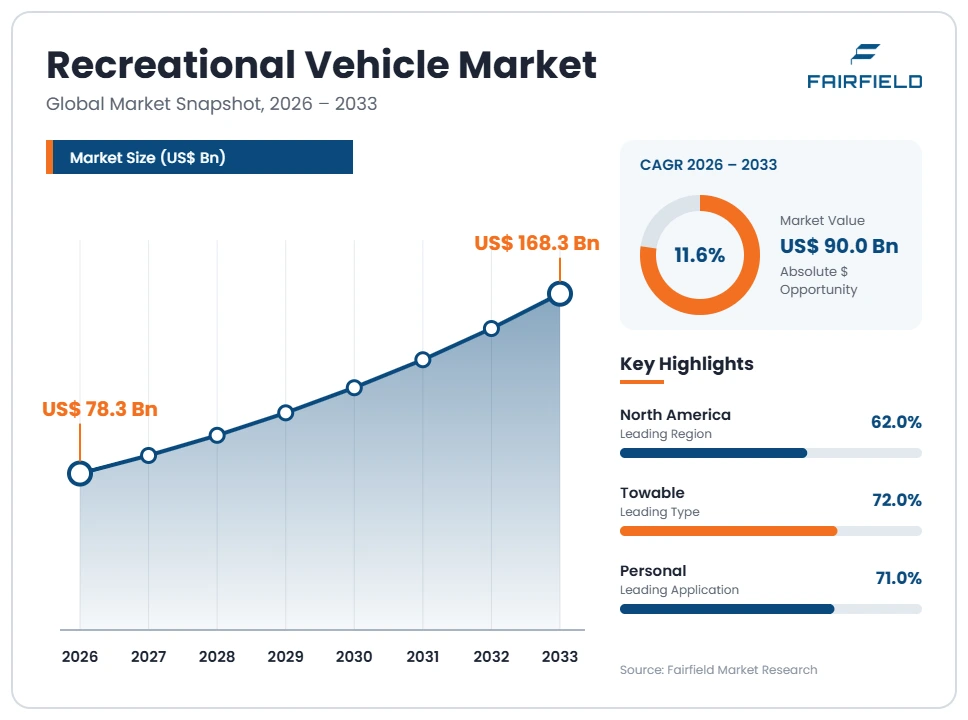
The global recreational vehicle market size is expected to be valued at US$ 78.3 billion in 2026 and projected to reach US$ 168.3 billion by 2033, growing at a CAGR of 11.6% between 2026 and 2033.
Between 2020 and 2025, the market went through a boom and bust, as pandemic travel limits drove record RV demand in 2021, when North America shipped more than 600,000 units, followed by a sharp fall in 2023 as interest rates rose and dealers cut inventory. The recreational vehicle market covers towable RVs such as travel trailers, fifth wheels, folding campers, and truck campers, and motorhomes such as Class A, Class B camper vans, and Class C models, along with caravans and camper vans sold in Europe, Australia, and Asia Pacific. RVs combine transport and living space for vacations, long trips, outdoor recreation, remote work, and full-time living. Growth comes from interest in outdoor travel, younger buyers, remote work, new campgrounds, and rental platforms. The market is shifting toward lighter towables, camper vans, solar power, and hybrid and electric chassis. In September 2026, Thor Industries reported fiscal 2026 revenue of US$ 9.61 billion.
Key Report Takeaways
- By Type: Towable held about 72% share in 2025, while Motorhomes are projected to expand at a 12.8% CAGR through 2033, driven by camper van popularity, younger buyers seeking flexible travel, and strong motorhome demand in Europe and Australia.
- By Application: Personal held 71% share in 2025, while Commercial is projected to expand at a 13.4% CAGR through 2033, driven by RV rental platforms, peer-to-peer sharing services, glamping operators, and mobile businesses using RVs as offices or shops.
- By Propulsion: ICE held about 96% share in 2025, while Electric is projected to expand at a 24.0% CAGR through 2033, driven by hybrid motorhome chassis, electric camper van concepts, battery-powered towables, and emission rules in cities in Europe.
- By Region: North America held about 62% share in 2025, while Asia Pacific is projected to expand at a 14.1% CAGR through 2033, driven by rising camping culture in China, Japan, South Korea, and Australia and new campground development.
Global Recreational Vehicle Market Trends and Insights
Drivers Impact Analysis
Two drivers carry the strongest influence on recreational vehicle market demand during the forecast period.
| Driver | Impact on CAGR Forecast | Geographic Relevance | Impact Timeline |
| Rising interest in outdoor travel and flexible lifestyles | High | Global, strongest in North America and Europe | Long term (≥4 years) |
| Campground expansion and RV rental growth | Medium | North America, Europe, Asia Pacific | Medium term (2-4 years) |
Outdoor Travel Demand Is Driving the Recreational Vehicle Market
Rising interest in outdoor travel and flexible lifestyles is the strongest driver of the recreational vehicle market. More people want to travel on their own terms.
The mechanism is a lasting shift in how people vacation and work. The pandemic introduced millions of new buyers to RV travel, and many continue to camp because RVs let families travel safely, cheaply, and flexibly, cooking their own meals and avoiding hotels and flights. Remote and hybrid work allow some owners to travel while working, using solar panels and satellite internet. Younger buyers, including millennials and Generation Z, now make up a large share of new RV owners, often choosing camper vans and lightweight trailers. Retirees in North America, Europe, and Australia continue to buy larger motorhomes for long trips. These trends support steady long-term demand for RVs across regions.
Campground Growth Is Expanding the Recreational Vehicle Market
Campground expansion and RV rental growth are expanding the recreational vehicle market. More places to stay attract more buyers.
The cause is investment in outdoor hospitality. KOA and other operators are adding campgrounds and sites, and more than 5,700 new campsites were planned across North America between 2024 and early 2026. Resorts with full hookups, pools, and activities appeal to families. Rental platforms such as Outdoorsy and RVshare let people try RVs before buying, turning renters into buyers over time. Fleet operators buy many units for rental, and rental demand peaks in summer and around holidays. State and national parks are adding RV sites and upgrading electric hookups, while private parks offer long-stay options for remote workers and retirees. Campgrounds in Europe and Australia are also expanding. These trends expand the customer base and support sales growth.
Restraints Impact Analysis
Two restraints limit how quickly the recreational vehicle market grows.
| Restraint | Impact on CAGR Forecast | Geographic Relevance | Impact Timeline |
| High prices, interest rates, and financing costs | High | North America, Europe | Medium term (2-4 years) |
| Cyclical demand and dealer inventory swings | Medium | North America | Medium term (2-4 years) |
Financing Costs Slow the Recreational Vehicle Market
High prices, interest rates, and financing costs slow the recreational vehicle market. RVs are expensive discretionary purchases.
The specific causes are rising prices and borrowing costs. RV prices rose sharply in 2021 and 2022 because of higher material, labor, and chassis costs, and many buyers finance purchases over 10 to 20 years, so higher interest rates raise monthly payments a lot. Tariffs on steel, aluminum, and imported parts in 2025 added cost. Fuel, insurance, storage, and campground fees add ownership costs. When household budgets are tight, families delay buying RVs. Thor Industries reported in September 2026 that the retail market never reached the expected recovery. Lower-income buyers are hit hardest, and many first-time buyers turn to used RVs instead. These factors slow sales and pressure margins for makers and dealers.
Cyclical Demand Restricts the Recreational Vehicle Market
Cyclical demand and dealer inventory swings restrict the recreational vehicle market. Sales rise and fall sharply with the economy.
The underlying causes are the luxury nature of RVs and dealer ordering patterns. Dealers built large inventories during the boom, then cut orders sharply in 2023, causing wholesale shipments to fall much faster than retail sales. Makers cut shifts and closed some plants. Used RVs from the boom years compete with new units. RVIA expects only modest shipment growth in 2026. Labor shortages at plants in Indiana add delays when demand recovers, and suppliers of chassis, appliances, and windows face their own cycles. Large price discounts to clear old stock hurt brand value and dealer profits. These factors restrict growth and make planning harder for makers, suppliers, and dealers.
Market Opportunities
Camper Vans and Lightweight Towables Open a Fast-Growth Revenue Pool
Camper vans and lightweight towables open a fast-growth revenue pool in the recreational vehicle market. Younger buyers want smaller RVs.
Makers can capture this opportunity. Class B camper vans built on Mercedes-Benz Sprinter, Ford Transit, and Ram ProMaster chassis are easy to drive and park, can be used daily, and suit couples and solo travelers. Lightweight trailers can be towed by SUVs and crossovers, avoiding the need for large pickup trucks. In 2024, Class B motorhome sales exceeded Class A sales in North America. Camper vans are also the fastest-growing RV type in Europe. Prices for camper vans are high, but buyers value their flexibility and strong resale values. Companies offering compact, well-equipped, connected models can win younger buyers and repeat customers.
Electrified RVs Create a Growth Revenue Pool
Electrified RVs create a growth revenue pool in the recreational vehicle market. Battery systems improve comfort and cut emissions.
Makers can capture this opportunity. Hybrid and electric chassis, large lithium batteries, and solar panels let RVs run appliances without generators. Thor Industries and Harbinger unveiled a hybrid Class A motorhome in 2024, and Winnebago and Lightship are developing electric models. Self-propelled electric trailers can reduce the load on tow vehicles, including electric pickups and SUVs with limited range. Low-emission zones in Europe favor cleaner vehicles, and campgrounds are adding chargers. Buyers want quiet, clean power at campsites without generator noise. Battery prices keep falling, and new chassis from truck makers will offer hybrid options. Early electric models are expensive, but costs should drop as volumes grow and charging networks expand along highways. Companies leading in electrification can grow.
Segment Analysis
- By Type: Towable Leads While Motorhomes Grow Fastest
Towable held about 72% share in 2025. Travel trailers and fifth wheels are the most popular RVs in North America because they cost much less than motorhomes and can be left at campsites while owners use their tow vehicles. In 2024, travel trailer shipments exceeded 245,000 units, far more than any other type. Folding campers, truck campers, and park model RVs add smaller volumes.
Motorhomes are the fastest-growing type, expanding at a 12.8% CAGR through 2033. Camper vans, Class C, and Class A motorhomes offer built-in driving and living space, and they are popular with retirees and younger travelers alike. Motorhomes and camper vans dominate the market in Europe. For the market, motorhome growth raises average selling prices and supports chassis innovation.
- By Application: Personal Leads While Commercial Grows Fastest
Personal held 71% share in 2025. Most RVs are bought by families, couples, and retirees for weekend trips, holidays, and long road trips, and some owners live in their RVs full time. Personal buyers value comfort, space, and features such as solar power, outdoor kitchens, bunk beds, and pet-friendly layouts. Many owners take several trips each year and keep their RVs for many years, and repeat buyers often trade up to larger or more luxurious models over time.
Commercial is the fastest-growing application, expanding at a 13.4% CAGR through 2033. Rental companies, peer-to-peer platforms, glamping resorts, film crews, and mobile businesses buy RVs, and rental lets new customers try the lifestyle. For the market, commercial growth broadens demand and keeps fleets refreshed.
- By Propulsion: ICE Leads While Electric Grows Fastest
ICE held about 96% share in 2025. Gasoline and diesel chassis from Ford, Mercedes-Benz, Stellantis, and Freightliner power almost all motorhomes, and towables depend on fuel-powered tow vehicles. Long range and quick refueling matter to RV travelers who drive long distances between campgrounds, often through remote areas with few charging stations. Diesel engines are common on large Class A motorhomes and heavy tow vehicles because of their torque and fuel economy.
Electric is the fastest-growing propulsion type, expanding at a 24.0% CAGR through 2033. Hybrid chassis, electric camper vans, and self-powered trailers with batteries and motors are entering the market. Charging networks and battery costs still limit adoption. For the market, electric growth adds new technology and higher-value products.
Geography Analysis
- Which Region Is Leading the Recreational Vehicle Market?
North America is leading the recreational vehicle market with about 62% share in 2025. The United States is the world’s largest RV market, with about 11 million households owning RVs and a manufacturing hub in Indiana where most units are built. Thor Industries, Forest River, Winnebago Industries, and REV Group dominate production, and national parks and campgrounds support strong demand. RVIA expected about 349,000 wholesale shipments in 2026. Canada adds demand, with strong camping traditions and many seasonal campers. Mexico hosts some parts production. Key barriers include high interest rates. One change shaping the region is the shift to camper vans.
- Europe Shapes the Recreational Vehicle Market Through Motorhomes and Caravans
Europe is a major recreational vehicle market. Germany, France, the United Kingdom, Italy, and the Netherlands have strong caravan and motorhome cultures and many campsites. Erwin Hymer Group, owned by Thor Industries, Knaus Tabbert, Trigano, Swift Group, and Dethleffs are leading makers. Camper vans are the fastest-growing type, and Thor’s European revenue grew 5% in fiscal 2026. Many European buyers prefer compact motorhomes that fit narrow roads and small parking spaces, and rental fleets are large in popular holiday areas such as the Alps and coasts. Key barriers include high prices. One opportunity is electric camper vans.
- Which Region Is Growing Fastest in the Recreational Vehicle Market?
Asia Pacific is growing fastest in the recreational vehicle market, expanding at a 14.1% CAGR through 2033. Australia and New Zealand have strong caravan cultures and long road trip traditions, while China is building camping sites and RV parks as self-drive travel grows. Japan and South Korea see rising demand for compact camper vans. Local makers in China are expanding production, and caravan makers in Australia such as Jayco Australia build off-road models for rough outback roads. Rental fleets are growing in tourist areas. Key barriers include limited campground infrastructure. One change shaping the region is growing camping culture.
- Latin America Grows the Recreational Vehicle Market Through Domestic Tourism
Latin America is a small recreational vehicle market. Brazil, Argentina, Chile, and Mexico have growing interest in road trips and outdoor tourism, especially in Patagonia and along coasts. Most RVs are imported or built by small local workshops, and camper van conversions are popular. Rental services are emerging in tourist areas, and some travelers ship RVs from North America for long trips. Campgrounds are few outside popular tourist regions, so many travelers camp freely or use simple sites near beaches and parks. Key barriers include high import duties, poor rural roads, and security concerns. One opportunity is rental tourism.
- Middle East & Africa Develops the Recreational Vehicle Market Through Outdoor Tourism
Middle East & Africa is a developing recreational vehicle market. South Africa has a strong caravan and off-road camping culture, with local makers such as Jurgens, while the United Arab Emirates and Saudi Arabia are promoting desert camping and outdoor tourism. Safari and overland trips in Kenya, Namibia, and Botswana use camper vehicles. Tour companies rent fully equipped four-wheel-drive campers to foreign visitors, and local workshops build rooftop tent and trailer setups. Desert camping festivals in Saudi Arabia are popular in winter. Key barriers include hot climates, long distances, and limited sites. One change shaping the region is tourism investment.
Competitive Landscape
The recreational vehicle market is highly consolidated. Thor Industries, Forest River, Winnebago Industries, REV Group, and Knaus Tabbert are leading players, while Trigano, Erwin Hymer Group, Tiffin Motorhomes, Grand Design, Swift Group, Dethleffs, and Jayco compete strongly. Thor Industries and Forest River, owned by Berkshire Hathaway, together build most RVs sold in North America, while Thor, Trigano, and Knaus Tabbert lead in Europe. Many small makers serve niche markets such as off-road trailers and luxury coaches.
Companies compete on price, floor plans, build quality, weight, features, dealer networks, warranty service, and brand loyalty. Buyers often choose based on layout and towing weight, so makers offer many models each year. Strong dealer relationships and financing programs drive sales, and owner clubs build loyalty. Technology such as solar power, lithium batteries, smart controls, and connectivity is becoming a key differentiator.
Strategic moves show how competition is changing. In September 2024, Thor Industries and Harbinger unveiled a hybrid Class A motorhome chassis. In December 2025, RVIA projected a slight increase in 2026 shipments to about 349,300 units. In September 2026, Thor reported fiscal 2026 revenue of US$ 9.61 billion, with lower profits, and announced more than US$ 100 million in cost improvements. These moves show competition shifting toward cost control and electrification.
Three themes shape vendor strategy. First, companies are cutting costs and managing dealer inventory carefully. Second, they are launching camper vans, lightweight towables, and electrified models. Third, they are growing in Europe and Asia Pacific to reduce dependence on the North American cycle.
Recreational Vehicle Market Industry Leaders
Thor Industries Forest River Winnebago Industries REV Group Knaus Tabbert
Recent Industry Developments
- September 2026: Thor Industries reported fiscal 2026 revenue of US$ 9.61 billion, with North American towable revenue down 22.7% and European revenue up 5%, and announced more than US$ 100 million in annual cost improvements - reflects a soft recreational vehicle market in North America.
- December 2025: RVIA projected 2026 wholesale shipments of about 349,300 units, a median rise of nearly 3% over 2025 - signals modest recovery for towable RVs and motorhomes.
- September 2024: Thor Industries and Harbinger unveiled what they described as the world’s first hybrid Class A motorhome chassis - advances electrification in the RV industry.
Companies Covered in the Report
- Thor Industries
- Forest River
- Winnebago Industries
- REV Group
- Knaus Tabbert
- Trigano
- Erwin Hymer Group
- Tiffin Motorhomes
- Swift Group
- Dethleffs
- Jayco
- Lightship
Recreational Vehicle Market Report Scope
| Metric | Value |
| Study Period | 2020-2033 |
| Market Size 2026 | US$ 78.3 Billion |
| Market Size 2033 | US$ 168.3 Billion |
| CAGR 2026-2033 | 11.6% |
| Absolute Dollar Opportunity | US$ 90.0 Billion |
| Largest Market | North America |
| Fastest-Growing Market | Asia Pacific |
| Market Concentration | Highly Consolidated |
| Major Players | Thor Industries, Forest River, Winnebago Industries, REV Group, Knaus Tabbert |
Recreational Vehicle Market Segmentation
- Executive Summary
- Global Recreational Vehicle Market Snapshot
- Future Projections, 2026-2033
- Key Market Trends
- Regional Snapshot
- Market Overview
- Market Definition and Scope
- Historical Market Trends, 2020-2025
- Market Dynamics
- Drivers Impact Analysis
- Outdoor Travel Demand Is Driving the Recreational Vehicle Market
- Campground Growth Is Expanding the Recreational Vehicle Market
- Restraints Impact Analysis
- Financing Costs Slow the Recreational Vehicle Market
- Cyclical Demand Restricts the Recreational Vehicle Market
- Market Opportunities
- Camper Vans and Lightweight Towables Open a Fast-Growth Revenue Pool
- Electrified RVs Create a Growth Revenue Pool
- Drivers Impact Analysis
- Global Recreational Vehicle Market Outlook, 2020-2033
- Global Recreational Vehicle Market Outlook, by Type, Value (US$ Billion), 2020-2033
- Towable
- Motorhomes
- Global Recreational Vehicle Market Outlook, by Application, Value (US$ Billion), 2020-2033
- Personal
- Commercial
- Global Recreational Vehicle Market Outlook, by Propulsion, Value (US$ Billion), 2020-2033
- ICE
- Electric
- Global Recreational Vehicle Market Outlook, by Region, Value (US$ Billion), 2020-2033
- North America
- Europe
- Asia Pacific
- Latin America
- Middle East & Africa
- Global Recreational Vehicle Market Outlook, by Type, Value (US$ Billion), 2020-2033
- North America Recreational Vehicle Market Outlook, 2020-2033
- North America Recreational Vehicle Market Outlook, by Type, Value (US$ Billion), 2020-2033
- Towable
- Motorhomes
- North America Recreational Vehicle Market Outlook, by Application, Value (US$ Billion), 2020-2033
- Personal
- Commercial
- North America Recreational Vehicle Market Outlook, by Propulsion, Value (US$ Billion), 2020-2033
- ICE
- Electric
- North America Recreational Vehicle Market Outlook, by Country, Value (US$ Billion), 2020-2033
- United States Recreational Vehicle Market Outlook, by Type, 2020-2033
- United States Recreational Vehicle Market Outlook, by Application, 2020-2033
- United States Recreational Vehicle Market Outlook, by Propulsion, 2020-2033
- Canada Recreational Vehicle Market Outlook, by Type, 2020-2033
- Canada Recreational Vehicle Market Outlook, by Application, 2020-2033
- Canada Recreational Vehicle Market Outlook, by Propulsion, 2020-2033
- Mexico Recreational Vehicle Market Outlook, by Type, 2020-2033
- Mexico Recreational Vehicle Market Outlook, by Application, 2020-2033
- Mexico Recreational Vehicle Market Outlook, by Propulsion, 2020-2033
- North America Recreational Vehicle Market Outlook, by Type, Value (US$ Billion), 2020-2033
- Europe Recreational Vehicle Market Outlook, 2020-2033
- Europe Recreational Vehicle Market Outlook, by Type, Value (US$ Billion), 2020-2033
- Towable
- Motorhomes
- Europe Recreational Vehicle Market Outlook, by Application, Value (US$ Billion), 2020-2033
- Personal
- Commercial
- Europe Recreational Vehicle Market Outlook, by Propulsion, Value (US$ Billion), 2020-2033
- ICE
- Electric
- Europe Recreational Vehicle Market Outlook, by Country, Value (US$ Billion), 2020-2033
- Germany Recreational Vehicle Market Outlook, by Type, 2020-2033
- Germany Recreational Vehicle Market Outlook, by Application, 2020-2033
- Germany Recreational Vehicle Market Outlook, by Propulsion, 2020-2033
- France Recreational Vehicle Market Outlook, by Type, 2020-2033
- France Recreational Vehicle Market Outlook, by Application, 2020-2033
- France Recreational Vehicle Market Outlook, by Propulsion, 2020-2033
- United Kingdom Recreational Vehicle Market Outlook, by Type, 2020-2033
- United Kingdom Recreational Vehicle Market Outlook, by Application, 2020-2033
- United Kingdom Recreational Vehicle Market Outlook, by Propulsion, 2020-2033
- Italy Recreational Vehicle Market Outlook, by Type, 2020-2033
- Italy Recreational Vehicle Market Outlook, by Application, 2020-2033
- Italy Recreational Vehicle Market Outlook, by Propulsion, 2020-2033
- Netherlands Recreational Vehicle Market Outlook, by Type, 2020-2033
- Netherlands Recreational Vehicle Market Outlook, by Application, 2020-2033
- Netherlands Recreational Vehicle Market Outlook, by Propulsion, 2020-2033
- Europe Recreational Vehicle Market Outlook, by Type, Value (US$ Billion), 2020-2033
- Asia Pacific Recreational Vehicle Market Outlook, 2020-2033
- Asia Pacific Recreational Vehicle Market Outlook, by Type, Value (US$ Billion), 2020-2033
- Towable
- Motorhomes
- Asia Pacific Recreational Vehicle Market Outlook, by Application, Value (US$ Billion), 2020-2033
- Personal
- Commercial
- Asia Pacific Recreational Vehicle Market Outlook, by Propulsion, Value (US$ Billion), 2020-2033
- ICE
- Electric
- Asia Pacific Recreational Vehicle Market Outlook, by Country, Value (US$ Billion), 2020-2033
- Australia Recreational Vehicle Market Outlook, by Type, 2020-2033
- Australia Recreational Vehicle Market Outlook, by Application, 2020-2033
- Australia Recreational Vehicle Market Outlook, by Propulsion, 2020-2033
- New Zealand Recreational Vehicle Market Outlook, by Type, 2020-2033
- New Zealand Recreational Vehicle Market Outlook, by Application, 2020-2033
- New Zealand Recreational Vehicle Market Outlook, by Propulsion, 2020-2033
- China Recreational Vehicle Market Outlook, by Type, 2020-2033
- China Recreational Vehicle Market Outlook, by Application, 2020-2033
- China Recreational Vehicle Market Outlook, by Propulsion, 2020-2033
- Japan Recreational Vehicle Market Outlook, by Type, 2020-2033
- Japan Recreational Vehicle Market Outlook, by Application, 2020-2033
- Japan Recreational Vehicle Market Outlook, by Propulsion, 2020-2033
- South Korea Recreational Vehicle Market Outlook, by Type, 2020-2033
- South Korea Recreational Vehicle Market Outlook, by Application, 2020-2033
- South Korea Recreational Vehicle Market Outlook, by Propulsion, 2020-2033
- Asia Pacific Recreational Vehicle Market Outlook, by Type, Value (US$ Billion), 2020-2033
- Latin America Recreational Vehicle Market Outlook, 2020-2033
- Latin America Recreational Vehicle Market Outlook, by Type, Value (US$ Billion), 2020-2033
- Towable
- Motorhomes
- Latin America Recreational Vehicle Market Outlook, by Application, Value (US$ Billion), 2020-2033
- Personal
- Commercial
- Latin America Recreational Vehicle Market Outlook, by Propulsion, Value (US$ Billion), 2020-2033
- ICE
- Electric
- Latin America Recreational Vehicle Market Outlook, by Country, Value (US$ Billion), 2020-2033
- Brazil Recreational Vehicle Market Outlook, by Type, 2020-2033
- Brazil Recreational Vehicle Market Outlook, by Application, 2020-2033
- Brazil Recreational Vehicle Market Outlook, by Propulsion, 2020-2033
- Argentina Recreational Vehicle Market Outlook, by Type, 2020-2033
- Argentina Recreational Vehicle Market Outlook, by Application, 2020-2033
- Argentina Recreational Vehicle Market Outlook, by Propulsion, 2020-2033
- Chile Recreational Vehicle Market Outlook, by Type, 2020-2033
- Chile Recreational Vehicle Market Outlook, by Application, 2020-2033
- Chile Recreational Vehicle Market Outlook, by Propulsion, 2020-2033
- Mexico Recreational Vehicle Market Outlook, by Type, 2020-2033
- Mexico Recreational Vehicle Market Outlook, by Application, 2020-2033
- Mexico Recreational Vehicle Market Outlook, by Propulsion, 2020-2033
- Latin America Recreational Vehicle Market Outlook, by Type, Value (US$ Billion), 2020-2033
- Middle East & Africa Recreational Vehicle Market Outlook, 2020-2033
- Middle East & Africa Recreational Vehicle Market Outlook, by Type, Value (US$ Billion), 2020-2033
- Towable
- Motorhomes
- Middle East & Africa Recreational Vehicle Market Outlook, by Application, Value (US$ Billion), 2020-2033
- Personal
- Commercial
- Middle East & Africa Recreational Vehicle Market Outlook, by Propulsion, Value (US$ Billion), 2020-2033
- ICE
- Electric
- Middle East & Africa Recreational Vehicle Market Outlook, by Country, Value (US$ Billion), 2020-2033
- South Africa Recreational Vehicle Market Outlook, by Type, 2020-2033
- South Africa Recreational Vehicle Market Outlook, by Application, 2020-2033
- South Africa Recreational Vehicle Market Outlook, by Propulsion, 2020-2033
- United Arab Emirates Recreational Vehicle Market Outlook, by Type, 2020-2033
- United Arab Emirates Recreational Vehicle Market Outlook, by Application, 2020-2033
- United Arab Emirates Recreational Vehicle Market Outlook, by Propulsion, 2020-2033
- Saudi Arabia Recreational Vehicle Market Outlook, by Type, 2020-2033
- Saudi Arabia Recreational Vehicle Market Outlook, by Application, 2020-2033
- Saudi Arabia Recreational Vehicle Market Outlook, by Propulsion, 2020-2033
- Kenya Recreational Vehicle Market Outlook, by Type, 2020-2033
- Kenya Recreational Vehicle Market Outlook, by Application, 2020-2033
- Kenya Recreational Vehicle Market Outlook, by Propulsion, 2020-2033
- Namibia Recreational Vehicle Market Outlook, by Type, 2020-2033
- Namibia Recreational Vehicle Market Outlook, by Application, 2020-2033
- Namibia Recreational Vehicle Market Outlook, by Propulsion, 2020-2033
- Middle East & Africa Recreational Vehicle Market Outlook, by Type, Value (US$ Billion), 2020-2033
- Competitive Landscape
- Industry Leaders
- Recent Industry Developments
- Company Profiles
- Thor Industries
- Forest River
- Winnebago Industries
- REV Group
- Knaus Tabbert
- Trigano
- Erwin Hymer Group
- Tiffin Motorhomes
- Swift Group
- Dethleffs
- Jayco
- Lightship
- Appendix
- Research Methodology
- Report Assumptions
- Acronyms and Abbreviations
Type
- Towable
- Motorhomes
Application
- Personal
- Commercial
Propulsion
- ICE
- Electric
Regions
- North America
- Europe
- Asia Pacific
- Latin America
- Middle East & Africa
Our Research Methodology
Considering the volatility of business today, traditional approaches to strategizing a game plan can be unfruitful if not detrimental. True ambiguity is no way to determine a forecast. A myriad of predetermined factors must be accounted for such as the degree of risk involved, the magnitude of circumstances, as well as conditions or consequences that are not known or unpredictable. To circumvent binary views that cast uncertainty, the application of market research intelligence to strategically posture, move, and enable actionable outcomes is necessary.
View Methodology
Quality Assured
Rigorous Validation Process

Confidentiality Assured
End-to-end Data Security

Custom Research Services
Tailored To Your Objectives
FAQs
The recreational vehicle market is valued at US$ 78.3 billion in 2026, led by towable RVs and North America.
The market is projected to reach US$ 168.3 billion by 2033, growing at an 11.6% CAGR and adding US$ 90.0 billion.
Motorhomes are growing fastest at a 12.8% CAGR through 2033, driven by camper van popularity and strong demand in Europe.
Asia Pacific is growing fastest at a 14.1% CAGR through 2033, driven by rising camping culture and new campgrounds in China.
North America holds the largest share at about 62% in 2025, supported by about 11 million RV-owning households in the United States.
Related Reports
In-Vehicle Payment Services Market Size, Share, Insights, Competitive Landscape, and Forecast 2026 to 2033
The in-vehicle payment services market is forecast to reach US$30.86 billion by 2033 at a 17.3% CAGR as connected cars expand access to in-car payments.
Automotive TIC Services Market Size, Share, Insights, Competitive Landscape, and Forecast 2026 to 2033
The global automotive TIC services market is valued at US$25.30 billion in 2026, reaching US$37.79 billion by 2033, growing at a 5.9% CAGR
Off-highway Electric Vehicle Market Size, Share, Insights, Competitive Landscape, and Forecast 2026 to 2033
The global off-highway electric vehicle market is valued at US$3.64 billion in 2026, reaching US$10.11 billion by 2033, growing at a 15.7% CAGR
Leisure Boat Market Size, Share, Insights, Competitive Landscape, and Forecast 2026 to 2033
The leisure boat market is projected to grow from US$ 53.90 billion in 2026 to US$ 81.04 billion by 2033 at a 6.0% CAGR.
Hydrogen Aircraft Market Size, Share, Insights, Competitive Landscape, and Forecast 2026 to 2033
The hydrogen aircraft market is forecast to grow from US$ 1.20 billion in 2026 to US$ 7.60 billion by 2033 at a 33.6% CAGR.
Exhaust Flexible Couplings Market Size, Share, Insights, Competitive Landscape, and Forecast 2026 to 2033
The exhaust flexible couplings market is projected to grow from US$ 756.4 million in 2026 to US$ 1,057.3 million by 2033 at a 4.9% CAGR.