



Automotive TIC Services Market
Automotive TIC Services Market Size, Share, Insights, Competitive Landscape, and Forecast 2026 to 2033
Automotive TIC Services Market Size and Trend Analysis
How Fast Is the Automotive TIC Services Market Growing?
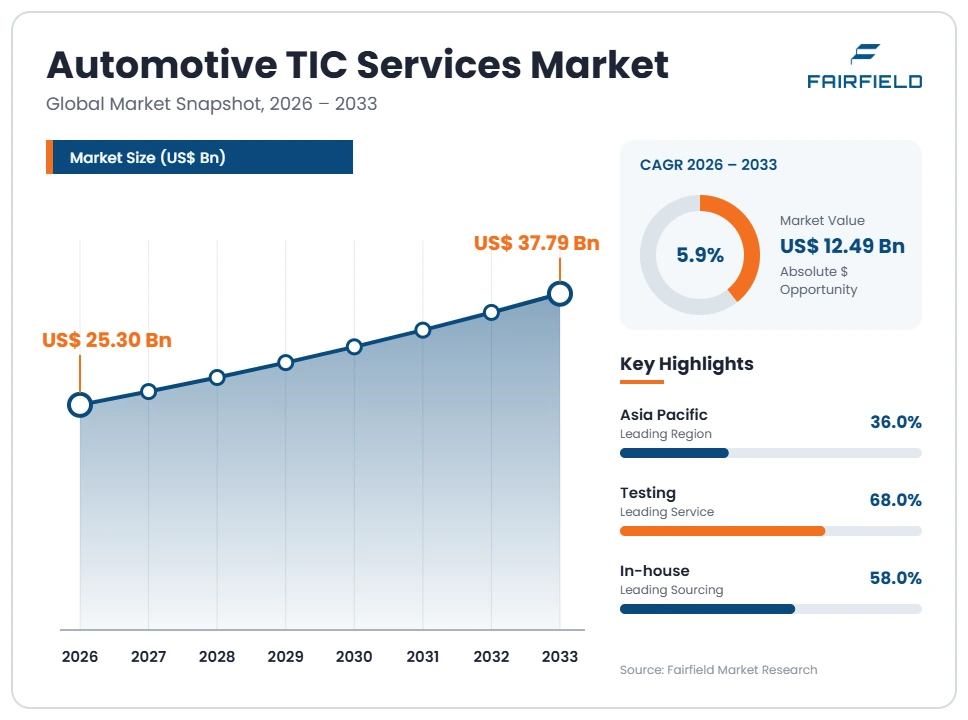
The global automotive TIC services market size is expected to be valued at US$ 25.30 billion in 2026 and projected to reach US$ 37.79 billion by 2033, growing at a CAGR of 5.9% between 2026 and 2033.
Between 2020 and 2025, the market grew at a CAGR of about 4.8%, as periodic vehicle inspections paused during pandemic lockdowns, then recovered, while electric vehicles, batteries, ADAS, and connected car rules created new testing work. The automotive TIC services market covers testing, inspection, and certification services for vehicles, components, and systems, including crash and safety testing, emissions testing, battery and EV safety testing, electromagnetic compatibility, cybersecurity assessment, ADAS validation, periodic roadworthiness inspections, homologation, and type approval, delivered in-house by carmakers or outsourced to independent labs. Vehicle homologation confirms that each new model meets national rules before sale. Growth comes from more complex vehicles, new EV battery standards, software and cybersecurity rules, and periodic vehicle inspection programs in emerging markets. The market is shifting toward EV battery testing, ADAS, and outsourced labs. In May 2025, UL Solutions opened an advanced battery testing center in Germany.
Key Report Takeaways
- By Service: Testing held about 68% share in 2025, while Certification is projected to expand at a 8.3% CAGR through 2033, driven by new type approval rules for cybersecurity, software updates, EV batteries, and automated driving systems in Europe, China, and India.
- By Sourcing: In-house held about 58% share in 2025, while Outsourced is projected to expand at a 7.2% CAGR through 2033, driven by carmakers and suppliers turning to independent labs for costly EV, battery, and ADAS testing equipment and expertise.
- By Application: Vehicle Inspection held about 25% share in 2025, while ADAS is projected to expand at a 9.6% CAGR through 2033, driven by mandatory safety systems, new Euro NCAP protocols, and validation of camera, radar, and lidar sensors.
- By Region: Asia Pacific held about 36% share in 2025, while India is projected to expand at a 8.2% CAGR through 2033, driven by new automated testing stations, crash test rules under Bharat NCAP, and fast EV and vehicle production growth.
Global Automotive TIC Services Market Trends and Insights
Drivers Impact Analysis
Two drivers carry the strongest influence on automotive TIC services market demand during the forecast period.
| Driver | Impact on CAGR Forecast | Geographic Relevance | Impact Timeline |
| Electric vehicle and battery safety testing needs | High | Asia Pacific, Europe, North America | Long term (≥4 years) |
| New rules for ADAS, software, and cybersecurity | High | Europe, Asia Pacific, North America | Medium term (2-4 years) |
EV Testing Needs Are Driving the Automotive TIC Services Market
Electric vehicle and battery safety testing needs are the strongest driver of the automotive TIC services market. EVs bring new risks that must be tested.
The mechanism is the large amount of testing required for batteries and high-voltage systems. Each new battery pack must pass tests for crush, short circuit, overcharge, fire, water immersion, vibration, and thermal runaway, and chargers and power electronics need electrical safety and electromagnetic compatibility testing. New rules raise the bar: China’s GB 38031-2025 standard, announced in January 2025, requires that batteries do not catch fire or explode after thermal runaway, effective for new models from July 2026. In the United States, FMVSS No. 305a for electric vehicle safety became effective in February 2025. Carmakers launch many new EV models each year, and battery makers test new chemistries. These needs drive strong demand for EV battery testing labs worldwide.
Software and ADAS Rules Are Expanding the Automotive TIC Services Market
New rules for ADAS, software, and cybersecurity are expanding the automotive TIC services market. Software now needs approval too.
The cause is the rapid growth of software and driver assistance features. UN R155 and R156 require cybersecurity and software update management systems for new vehicles in Europe, Japan, and South Korea. The European Union General Safety Regulation requires emergency braking, lane keeping, and driver monitoring. Euro NCAP and other programs test ADAS performance. Independent labs audit, test, and certify these systems, and many carmakers hire them to prepare for audits by approval authorities. China and India are adding their own ADAS and software rules. Over-the-air updates mean software must be reviewed throughout a vehicle’s life, not just at launch. Automated driving rules in Germany, Japan, and China require extensive safety cases. These rules expand service demand.
Restraints Impact Analysis
Two restraints limit how quickly the automotive TIC services market grows.
| Restraint | Impact on CAGR Forecast | Geographic Relevance | Impact Timeline |
| High costs of advanced testing facilities | High | Global | Long term (≥4 years) |
| Differences in national standards and slow harmonization | Medium | Global | Medium term (2-4 years) |
High Facility Costs Slow the Automotive TIC Services Market
High costs of advanced testing facilities slow the automotive TIC services market. New labs need huge investment.
The specific causes are expensive equipment and fast-changing technology. Battery abuse labs need fire-proof chambers and safety systems, crash test centers need large sleds and barriers, and ADAS testing needs proving grounds, robot targets, and simulation software. Equipment can become outdated quickly as standards change. Skilled engineers are scarce. Price pressure from carmakers limits fees, and some carmakers prefer to build their own labs to keep control of schedules and data. Testing slots can be booked up during busy launch periods, delaying projects. Insurance and safety costs for battery fire testing are high, and some cities do not allow such labs near homes. These factors slow expansion, especially for smaller labs.
Different Standards Restrict the Automotive TIC Services Market
Differences in national standards and slow harmonization restrict the automotive TIC services market. Rules vary from country to country.
The underlying causes are separate regulatory systems. Vehicles sold in Europe, the United States, China, and India must meet different rules, and some countries do not accept foreign test results. This raises costs for carmakers, who may repeat similar tests in several countries. Trade tensions can lead to new national rules that limit foreign labs and require local testing. Smaller countries may lack local labs, so carmakers must ship vehicles and parts abroad for testing, which adds cost and time. Efforts by the UNECE World Forum to harmonize rules help but move slowly, and some large markets stay outside them. These factors restrict efficient growth and add delays for global vehicle launches.
Market Opportunities
ADAS and Automated Driving Validation Opens a Fast-Growth Revenue Pool
ADAS and automated driving validation opens a fast-growth revenue pool in the automotive TIC services market. Self-driving features need proof of safety.
Labs can capture this opportunity. Automated lane keeping, highway pilots, and robotaxis need millions of kilometers of testing, simulation, and scenario-based validation. Applus+ IDIADA, DEKRA, TÜV SÜD, and UTAC run proving grounds and simulation services. Regulators in Europe, China, and the United States are writing rules for automated driving, and independent assessment is often required. Simulation and digital twin tools reduce the need for physical test kilometers but still need validation. Sensor calibration services for repair shops are also growing as ADAS spreads to mass-market cars, creating new recurring work. Companies with advanced test tracks, simulation tools, and regulatory expertise can win.
Emerging Market Inspection Programs Create a Growth Revenue Pool
Emerging market inspection programs create a growth revenue pool in the automotive TIC services market. Many countries are adding vehicle inspections.
Inspection firms can capture this opportunity. India is building hundreds of automated testing stations to check vehicle fitness and is setting up a vehicle scrappage policy, while countries in Latin America and Middle East & Africa are launching or modernizing programs to improve road safety and cut pollution. DEKRA, Applus+, and SGS run inspection concessions in many countries. Long concession contracts give stable revenue, and digital records help fight fraud in inspections. Many older vehicles on roads in these regions are unsafe or highly polluting, so governments see inspections as a quick way to improve road safety and air quality. Companies running stations with digital systems can grow.
Segment Analysis
- By Service: Testing Leads While Certification Grows Fastest
Testing held about 68% share in 2025. Crash, emissions, durability, battery, electrical, and EMC testing make up most spending, because every new vehicle and component must be tested many times during development. EV batteries, electronics, and ADAS sensors have added large new testing programs, and suppliers test parts before delivery to carmakers. Testing also continues after launch for quality checks and recalls, and more tests are now run on software.
Certification is the fastest-growing service, expanding at a 8.3% CAGR through 2033. New rules for cybersecurity, software, and batteries require formal approval, and carmakers need certificates to sell in each market. Inspection forms another service, including periodic vehicle checks and factory audits. Certificates must often be renewed when vehicles are updated. For the market, certification growth adds high-value work.
- By Sourcing: In-house Leads While Outsourced Grows Fastest
In-house held about 58% share in 2025. Large carmakers and tier one suppliers run their own labs for crash, durability, emissions, and electronics testing, because in-house testing protects confidential designs and lets engineers work quickly. Brands such as Toyota, Volkswagen, General Motors, and BYD own huge test centers and proving grounds.
Outsourced is the fastest-growing sourcing type, expanding at a 7.2% CAGR through 2033. Independent labs provide costly battery, EMC, and ADAS equipment that many companies cannot justify owning, and they offer the official accreditation needed for certification. New EV startups and parts makers rely heavily on outside labs, and many carmakers use outside labs during busy periods to handle peak demand. For the market, outsourcing growth favors independent firms.
- By Application: Vehicle Inspection Leads While ADAS Grows Fastest
Vehicle Inspection held about 25% share in 2025. Periodic roadworthiness tests are required in many countries, checking brakes, lights, emissions, and safety parts on vehicles in use. Germany’s TÜV and DEKRA inspections, the United Kingdom’s MOT test, and programs in Japan cover millions of cars each year. Emission checks are part of many inspections, and new programs are starting in emerging markets where older vehicles make up much of the fleet.
ADAS is the fastest-growing application, expanding at a 9.6% CAGR through 2033. Driver assistance features need validation with test tracks, targets, and simulation, and Euro NCAP ratings depend on ADAS results. Electrical, battery, and cybersecurity form other applications, each with new rules and test methods. For the market, ADAS growth adds value.
Geography Analysis
- Why Is North America Important to the Automotive TIC Services Market?
North America is important to the automotive TIC services market because the United States has strict federal safety and emission rules from NHTSA and the EPA, along with state rules in California. Carmakers and EV startups test many new models, and FMVSS No. 305a adds new EV safety requirements. UL Solutions, Intertek, and Element Materials Technology are based in the region, and Mexico and Canada add testing for vehicle and parts production. Many new EV makers are based in the region, and independent labs are adding battery and cybersecurity test centers. Key barriers include costs. One change shaping the region is EV testing.
- Europe Shapes the Automotive TIC Services Market Through Type Approval
Europe is a major automotive TIC services market. Germany hosts DEKRA, TÜV SÜD, TÜV Rheinland, and TÜV NORD, while Spain hosts Applus+ IDIADA and France hosts UTAC. European Union type approval, UN R155 cybersecurity rules, the General Safety Regulation, and Euro 7 create large testing and certification needs. Periodic inspections are mandatory across the region, covering hundreds of millions of vehicles. Strong carmakers in the region launch many new EV models that need battery and electrical testing, and many labs serve customers from around the world. Key barriers include costs. One opportunity is cybersecurity certification.
- Which Region Is Leading the Automotive TIC Services Market?
Asia Pacific is leading the automotive TIC services market with about 36% share in 2025. China is the largest vehicle and battery producer, with CATARC and other national labs, and its new battery standard drives testing. Japan and South Korea have strong carmakers and labs, and Thailand and Indonesia are growing EV production hubs that need testing capacity. India is the fastest-growing country, expanding at an 8.2% CAGR through 2033, as it builds automated testing stations and Bharat NCAP crash testing. Local labs such as ARAI and ICAT are expanding capacity. Key barriers include different standards. One change shaping the region is battery rules.
- Latin America Grows the Automotive TIC Services Market Through Inspection Programs
Latin America is a growing automotive TIC services market. Brazil and Mexico lead, with Argentina, Chile, and Colombia adding demand. Mexico has large vehicle and parts exports that need testing, and Brazil has emission rules such as Proconve and safety rules. Several countries are modernizing periodic inspection programs through private concessions. Latin NCAP promotes safer cars through crash tests and ratings, which pushes carmakers to add safety features and test them. Global firms such as SGS, Applus+, and Bureau Veritas run labs and inspection centers in the region. Key barriers include funding. One opportunity is inspection programs.
- Middle East & Africa Develops the Automotive TIC Services Market Through New Rules
Middle East & Africa is a developing automotive TIC services market. Saudi Arabia and Morocco lead, with the United Arab Emirates, South Africa, and Egypt adding demand. Saudi Arabia runs national vehicle inspection programs and is building EV production, while Morocco and South Africa export cars to Europe. Import vehicles must meet local conformity rules, creating certification work for labs that check that cars match approved models. Many countries in the region are also writing rules for EVs and charging equipment. Inspection centers are expanding in large cities. Key barriers include small production. One change shaping the region is assembly growth.
Competitive Landscape
The automotive TIC services market is fragmented. DEKRA, TÜV SÜD, TÜV Rheinland, Applus+ IDIADA, and UL Solutions are leading players, together holding about 26% of the market, with DEKRA the largest at about 14%. SGS, Bureau Veritas, Intertek, TÜV NORD, Element Materials Technology, UTAC, and CATARC compete strongly, and thousands of local inspection stations and specialized labs serve regional customers. Carmakers and large suppliers such as Bosch and Continental also run extensive in-house test centers.
Companies compete on accreditation, technical expertise, lab capacity, test speed, global coverage, price, and relationships with regulators and carmakers. Being designated as a technical service by type approval authorities is a major advantage, because carmakers need approved labs for homologation. Investment in battery, EMC, cybersecurity, and ADAS facilities is now key to winning new work. Periodic inspection markets depend on government concessions and licenses.
Strategic moves show how competition is changing. In December 2024, the United States finalized FMVSS No. 305a for EV safety, which became effective in February 2025. In January 2025, China announced the stricter GB 38031-2025 battery standard. In May 2025, UL Solutions opened an advanced battery testing center in Germany, and labs across the industry are adding battery and EMC capacity. These moves show competition shifting toward EV and software testing.
Three themes shape vendor strategy. First, companies are building battery, EMC, and cybersecurity labs. Second, they are expanding ADAS proving grounds and simulation services. Third, they are growing in Asia Pacific, Latin America, and Middle East & Africa through inspection concessions and acquisitions.
Automotive TIC Services Market Industry Leaders
DEKRA TÜV SÜD TÜV Rheinland Applus+ IDIADA UL Solutions
Recent Industry Developments
- May 2025: UL Solutions launched an advanced battery testing center in Germany - expands EV battery testing capacity for carmakers in Europe.
- February 2025: FMVSS No. 305a for electric-powered vehicles became effective in the United States, after being finalized in December 2024 - adds new EV safety testing in the automotive TIC services market.
- January 2025: China announced GB 38031-2025, a stricter battery safety standard requiring no fire or explosion after thermal runaway, effective for new models from July 2026 - drives battery testing and vehicle homologation work.
Companies Covered in the Report
- DEKRA
- TÜV SÜD
- TÜV Rheinland
- Applus+ IDIADA
- UL Solutions
- SGS
- Bureau Veritas
- Intertek
- TÜV NORD
- Element Materials Technology
- UTAC
- CATARC
Automotive TIC Services Market Report Scope
| Metric | Value |
| Study Period | 2020-2033 |
| Market Size 2026 | US$ 25.30 Billion |
| Market Size 2033 | US$ 37.79 Billion |
| CAGR 2026-2033 | 5.9% |
| Absolute Dollar Opportunity | US$ 12.49 Billion |
| Largest Market | Asia Pacific |
| Fastest-Growing Market | India |
| Market Concentration | Fragmented |
| Major Players | DEKRA, TÜV SÜD, TÜV Rheinland, Applus+ IDIADA, UL Solutions |
Automotive TIC Services Market Segmentation
- Executive Summary
- Global Automotive TIC Services Market Snapshot
- Future Projections, 2026-2033
- Key Market Trends
- Regional Snapshot
- Market Overview
- Market Definition and Report Scope
- Historical Market Trends
- Market Dynamics
- Drivers Impact Analysis
- EV Testing Needs Are Driving the Automotive TIC Services Market
- Software and ADAS Rules Are Expanding the Automotive TIC Services Market
- Restraints Impact Analysis
- High Facility Costs Slow the Automotive TIC Services Market
- Different Standards Restrict the Automotive TIC Services Market
- Market Opportunities
- ADAS and Automated Driving Validation Opens a Fast-Growth Revenue Pool
- Emerging Market Inspection Programs Create a Growth Revenue Pool
- Drivers Impact Analysis
- Global Automotive TIC Services Market Outlook, 2020-2033
- Global Automotive TIC Services Market Outlook, by Service, Value (US$ Billion), 2020-2033
- Testing
- Inspection
- Certification
- Global Automotive TIC Services Market Outlook, by Sourcing, Value (US$ Billion), 2020-2033
- In-house
- Outsourced
- Global Automotive TIC Services Market Outlook, by Application, Value (US$ Billion), 2020-2033
- Vehicle Inspection
- Electrical and Electronics
- EV and Battery
- ADAS
- Cybersecurity
- Emissions and Safety
- Global Automotive TIC Services Market Outlook, by Region, Value (US$ Billion), 2020-2033
- North America
- Europe
- Asia Pacific
- Latin America
- Middle East & Africa
- Global Automotive TIC Services Market Outlook, by Service, Value (US$ Billion), 2020-2033
- North America Automotive TIC Services Market Outlook, 2020-2033
- North America Automotive TIC Services Market Outlook, by Service, Value (US$ Billion), 2020-2033
- Testing
- Inspection
- Certification
- North America Automotive TIC Services Market Outlook, by Sourcing, Value (US$ Billion), 2020-2033
- In-house
- Outsourced
- North America Automotive TIC Services Market Outlook, by Application, Value (US$ Billion), 2020-2033
- Vehicle Inspection
- Electrical and Electronics
- EV and Battery
- ADAS
- Cybersecurity
- Emissions and Safety
- North America Automotive TIC Services Market Outlook, by Country, Value (US$ Billion), 2020-2033
- United States Automotive TIC Services Market Outlook, by Service, 2020-2033
- United States Automotive TIC Services Market Outlook, by Sourcing, 2020-2033
- United States Automotive TIC Services Market Outlook, by Application, 2020-2033
- Mexico Automotive TIC Services Market Outlook, by Service, 2020-2033
- Mexico Automotive TIC Services Market Outlook, by Sourcing, 2020-2033
- Mexico Automotive TIC Services Market Outlook, by Application, 2020-2033
- Canada Automotive TIC Services Market Outlook, by Service, 2020-2033
- Canada Automotive TIC Services Market Outlook, by Sourcing, 2020-2033
- Canada Automotive TIC Services Market Outlook, by Application, 2020-2033
- North America Automotive TIC Services Market Outlook, by Service, Value (US$ Billion), 2020-2033
- Europe Automotive TIC Services Market Outlook, 2020-2033
- Europe Automotive TIC Services Market Outlook, by Service, Value (US$ Billion), 2020-2033
- Testing
- Inspection
- Certification
- Europe Automotive TIC Services Market Outlook, by Sourcing, Value (US$ Billion), 2020-2033
- In-house
- Outsourced
- Europe Automotive TIC Services Market Outlook, by Application, Value (US$ Billion), 2020-2033
- Vehicle Inspection
- Electrical and Electronics
- EV and Battery
- ADAS
- Cybersecurity
- Emissions and Safety
- Europe Automotive TIC Services Market Outlook, by Country, Value (US$ Billion), 2020-2033
- Germany Automotive TIC Services Market Outlook, by Service, 2020-2033
- Germany Automotive TIC Services Market Outlook, by Sourcing, 2020-2033
- Germany Automotive TIC Services Market Outlook, by Application, 2020-2033
- Spain Automotive TIC Services Market Outlook, by Service, 2020-2033
- Spain Automotive TIC Services Market Outlook, by Sourcing, 2020-2033
- Spain Automotive TIC Services Market Outlook, by Application, 2020-2033
- France Automotive TIC Services Market Outlook, by Service, 2020-2033
- France Automotive TIC Services Market Outlook, by Sourcing, 2020-2033
- France Automotive TIC Services Market Outlook, by Application, 2020-2033
- Europe Automotive TIC Services Market Outlook, by Service, Value (US$ Billion), 2020-2033
- Asia Pacific Automotive TIC Services Market Outlook, 2020-2033
- Asia Pacific Automotive TIC Services Market Outlook, by Service, Value (US$ Billion), 2020-2033
- Testing
- Inspection
- Certification
- Asia Pacific Automotive TIC Services Market Outlook, by Sourcing, Value (US$ Billion), 2020-2033
- In-house
- Outsourced
- Asia Pacific Automotive TIC Services Market Outlook, by Application, Value (US$ Billion), 2020-2033
- Vehicle Inspection
- Electrical and Electronics
- EV and Battery
- ADAS
- Cybersecurity
- Emissions and Safety
- Asia Pacific Automotive TIC Services Market Outlook, by Country, Value (US$ Billion), 2020-2033
- China Automotive TIC Services Market Outlook, by Service, 2020-2033
- China Automotive TIC Services Market Outlook, by Sourcing, 2020-2033
- China Automotive TIC Services Market Outlook, by Application, 2020-2033
- Japan Automotive TIC Services Market Outlook, by Service, 2020-2033
- Japan Automotive TIC Services Market Outlook, by Sourcing, 2020-2033
- Japan Automotive TIC Services Market Outlook, by Application, 2020-2033
- South Korea Automotive TIC Services Market Outlook, by Service, 2020-2033
- South Korea Automotive TIC Services Market Outlook, by Sourcing, 2020-2033
- South Korea Automotive TIC Services Market Outlook, by Application, 2020-2033
- Thailand Automotive TIC Services Market Outlook, by Service, 2020-2033
- Thailand Automotive TIC Services Market Outlook, by Sourcing, 2020-2033
- Thailand Automotive TIC Services Market Outlook, by Application, 2020-2033
- Indonesia Automotive TIC Services Market Outlook, by Service, 2020-2033
- Indonesia Automotive TIC Services Market Outlook, by Sourcing, 2020-2033
- Indonesia Automotive TIC Services Market Outlook, by Application, 2020-2033
- India Automotive TIC Services Market Outlook, by Service, 2020-2033
- India Automotive TIC Services Market Outlook, by Sourcing, 2020-2033
- India Automotive TIC Services Market Outlook, by Application, 2020-2033
- Asia Pacific Automotive TIC Services Market Outlook, by Service, Value (US$ Billion), 2020-2033
- Latin America Automotive TIC Services Market Outlook, 2020-2033
- Latin America Automotive TIC Services Market Outlook, by Service, Value (US$ Billion), 2020-2033
- Testing
- Inspection
- Certification
- Latin America Automotive TIC Services Market Outlook, by Sourcing, Value (US$ Billion), 2020-2033
- In-house
- Outsourced
- Latin America Automotive TIC Services Market Outlook, by Application, Value (US$ Billion), 2020-2033
- Vehicle Inspection
- Electrical and Electronics
- EV and Battery
- ADAS
- Cybersecurity
- Emissions and Safety
- Latin America Automotive TIC Services Market Outlook, by Country, Value (US$ Billion), 2020-2033
- Brazil Automotive TIC Services Market Outlook, by Service, 2020-2033
- Brazil Automotive TIC Services Market Outlook, by Sourcing, 2020-2033
- Brazil Automotive TIC Services Market Outlook, by Application, 2020-2033
- Mexico Automotive TIC Services Market Outlook, by Service, 2020-2033
- Mexico Automotive TIC Services Market Outlook, by Sourcing, 2020-2033
- Mexico Automotive TIC Services Market Outlook, by Application, 2020-2033
- Argentina Automotive TIC Services Market Outlook, by Service, 2020-2033
- Argentina Automotive TIC Services Market Outlook, by Sourcing, 2020-2033
- Argentina Automotive TIC Services Market Outlook, by Application, 2020-2033
- Chile Automotive TIC Services Market Outlook, by Service, 2020-2033
- Chile Automotive TIC Services Market Outlook, by Sourcing, 2020-2033
- Chile Automotive TIC Services Market Outlook, by Application, 2020-2033
- Colombia Automotive TIC Services Market Outlook, by Service, 2020-2033
- Colombia Automotive TIC Services Market Outlook, by Sourcing, 2020-2033
- Colombia Automotive TIC Services Market Outlook, by Application, 2020-2033
- Latin America Automotive TIC Services Market Outlook, by Service, Value (US$ Billion), 2020-2033
- Middle East & Africa Automotive TIC Services Market Outlook, 2020-2033
- Middle East & Africa Automotive TIC Services Market Outlook, by Service, Value (US$ Billion), 2020-2033
- Testing
- Inspection
- Certification
- Middle East & Africa Automotive TIC Services Market Outlook, by Sourcing, Value (US$ Billion), 2020-2033
- In-house
- Outsourced
- Middle East & Africa Automotive TIC Services Market Outlook, by Application, Value (US$ Billion), 2020-2033
- Vehicle Inspection
- Electrical and Electronics
- EV and Battery
- ADAS
- Cybersecurity
- Emissions and Safety
- Middle East & Africa Automotive TIC Services Market Outlook, by Country, Value (US$ Billion), 2020-2033
- Saudi Arabia Automotive TIC Services Market Outlook, by Service, 2020-2033
- Saudi Arabia Automotive TIC Services Market Outlook, by Sourcing, 2020-2033
- Saudi Arabia Automotive TIC Services Market Outlook, by Application, 2020-2033
- Morocco Automotive TIC Services Market Outlook, by Service, 2020-2033
- Morocco Automotive TIC Services Market Outlook, by Sourcing, 2020-2033
- Morocco Automotive TIC Services Market Outlook, by Application, 2020-2033
- United Arab Emirates Automotive TIC Services Market Outlook, by Service, 2020-2033
- United Arab Emirates Automotive TIC Services Market Outlook, by Sourcing, 2020-2033
- United Arab Emirates Automotive TIC Services Market Outlook, by Application, 2020-2033
- South Africa Automotive TIC Services Market Outlook, by Service, 2020-2033
- South Africa Automotive TIC Services Market Outlook, by Sourcing, 2020-2033
- South Africa Automotive TIC Services Market Outlook, by Application, 2020-2033
- Egypt Automotive TIC Services Market Outlook, by Service, 2020-2033
- Egypt Automotive TIC Services Market Outlook, by Sourcing, 2020-2033
- Egypt Automotive TIC Services Market Outlook, by Application, 2020-2033
- Middle East & Africa Automotive TIC Services Market Outlook, by Service, Value (US$ Billion), 2020-2033
- Competitive Landscape
- Industry Leaders
- Recent Industry Developments
- Company Profiles
- DEKRA
- TÜV SÜD
- TÜV Rheinland
- Applus+ IDIADA
- UL Solutions
- SGS
- Bureau Veritas
- Intertek
- TÜV NORD
- Element Materials Technology
- UTAC
- CATARC
- Appendix
- Research Methodology
- Report Assumptions
- Acronyms and Abbreviations
Service
- Testing
- Inspection
- Certification
Sourcing
- In-house
- Outsourced
Application
- Vehicle Inspection
- Electrical and Electronics
- EV and Battery
- ADAS
- Cybersecurity
- Emissions and Safety
Regions
- North America
- Europe
- Asia Pacific
- Latin America
- Middle East & Africa
Our Research Methodology
Considering the volatility of business today, traditional approaches to strategizing a game plan can be unfruitful if not detrimental. True ambiguity is no way to determine a forecast. A myriad of predetermined factors must be accounted for such as the degree of risk involved, the magnitude of circumstances, as well as conditions or consequences that are not known or unpredictable. To circumvent binary views that cast uncertainty, the application of market research intelligence to strategically posture, move, and enable actionable outcomes is necessary.
View Methodology
Quality Assured
Rigorous Validation Process

Confidentiality Assured
End-to-end Data Security

Custom Research Services
Tailored To Your Objectives
FAQs
The automotive TIC services market is valued at US$ 25.30 billion in 2026, led by testing services and Asia Pacific.
The market is projected to reach US$ 37.79 billion by 2033, growing at a 5.9% CAGR and adding US$ 12.49 billion.
ADAS is growing fastest at a 9.6% CAGR through 2033, driven by mandatory safety systems and sensor validation for camera and radar.
India is growing fastest at an 8.2% CAGR through 2033, driven by automated testing stations, Bharat NCAP, and rising vehicle production.
Asia Pacific holds the largest share at about 36% in 2025, supported by huge vehicle and battery production in China.
Related Reports
In-Vehicle Payment Services Market Size, Share, Insights, Competitive Landscape, and Forecast 2026 to 2033
The in-vehicle payment services market is forecast to reach US$30.86 billion by 2033 at a 17.3% CAGR as connected cars expand access to in-car payments.
Recreational Vehicle Market Size, Share, Insights, Competitive Landscape, and Forecast 2026 to 2033
The global recreational vehicle market is valued at US$78.3 billion in 2026, reaching US$168.3 billion by 2033, growing at an 11.6% CAGR
Off-highway Electric Vehicle Market Size, Share, Insights, Competitive Landscape, and Forecast 2026 to 2033
The global off-highway electric vehicle market is valued at US$3.64 billion in 2026, reaching US$10.11 billion by 2033, growing at a 15.7% CAGR
Leisure Boat Market Size, Share, Insights, Competitive Landscape, and Forecast 2026 to 2033
The leisure boat market is projected to grow from US$ 53.90 billion in 2026 to US$ 81.04 billion by 2033 at a 6.0% CAGR.
Hydrogen Aircraft Market Size, Share, Insights, Competitive Landscape, and Forecast 2026 to 2033
The hydrogen aircraft market is forecast to grow from US$ 1.20 billion in 2026 to US$ 7.60 billion by 2033 at a 33.6% CAGR.
Exhaust Flexible Couplings Market Size, Share, Insights, Competitive Landscape, and Forecast 2026 to 2033
The exhaust flexible couplings market is projected to grow from US$ 756.4 million in 2026 to US$ 1,057.3 million by 2033 at a 4.9% CAGR.