



Exhaust Flexible Couplings Market
Exhaust Flexible Couplings Market Size, Share, Insights, Competitive Landscape, and Forecast 2026 to 2033
How Fast Is the Exhaust Flexible Couplings Market Growing?
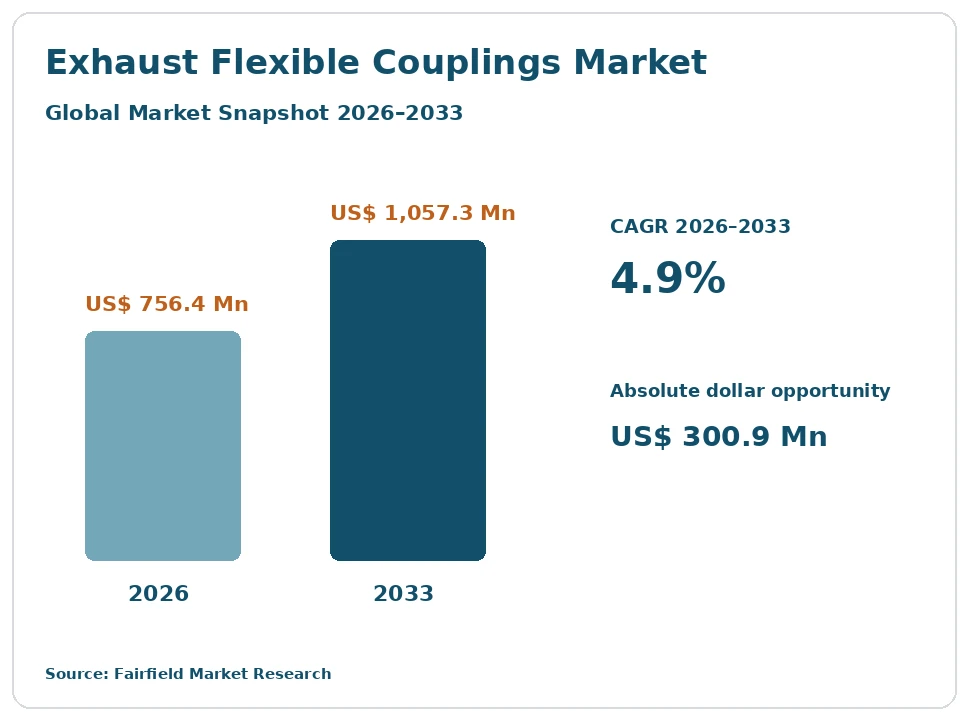
The global exhaust flexible couplings market size is expected to be valued at US$ 756.4 million in 2026 and projected to reach US$ 1,057.3 million by 2033, growing at a CAGR of 4.9% between 2026 and 2033.
Between 2020 and 2025, the market grew at a CAGR of about 3.6%, as vehicle and engine production fell sharply in 2020 during the pandemic, then recovered with truck demand, generator orders for data centers, and stricter emission rules that required more complex exhaust systems. The exhaust flexible couplings market covers metal bellows, braided exhaust flex pipe, interlock hoses, elastomeric connectors, and expansion joints that join exhaust pipes while absorbing vibration, engine movement, and thermal expansion. These parts are used in cars, light and heavy trucks, buses, off-highway machines, marine engines, gensets, gas turbines, and industrial plants. Exhaust bellows prevent cracks and leaks that would otherwise occur when rigid pipes face constant movement and heat. Growth comes from commercial vehicle production, emission aftertreatment systems, backup power generation, and replacement demand from aging fleets. The market is shifting toward lightweight stainless steel designs and sensor-equipped couplings. In July 2025, Trelleborg launched a high-temperature coupling for heavy-duty turbines.
Key Report Takeaways
- By Product Type: Elastomeric held about 48% share in 2025, while Metallic is projected to expand at a 5.6% CAGR through 2033, driven by higher exhaust temperatures in modern engines, aftertreatment systems, and heavy-duty, marine, and power generation applications that need durable stainless steel.
- By Vehicle Type: Commercial Trucks held about 46% share in 2025, while Passenger Cars are projected to expand at a 5.3% CAGR through 2033, driven by hybrid vehicles, turbocharged engines, and rising car production and replacement demand in Asia Pacific.
- By End User: Automotive held about 49% share in 2025, while Marine and Power Generation is projected to expand at a 5.7% CAGR through 2033, driven by data center backup generators, cleaner marine engines, and growing gas engine and turbine installations.
- By Region: Asia Pacific held about 41% share in 2025, while Europe is projected to expand at a 5.4% CAGR through 2033, driven by Euro 7 and Stage V rules, strong truck and engine makers, and marine and power plant upgrades across the region.
Global Exhaust Flexible Couplings Market Trends and Insights
Drivers Impact Analysis
Two drivers carry the strongest influence on exhaust flexible couplings market demand during the forecast period.
| Driver | Impact on CAGR Forecast | Geographic Relevance | Impact Timeline |
| Stricter emission rules and complex aftertreatment systems | High | Europe, North America, Asia Pacific | Long term (≥4 years) |
| Growth in commercial vehicles and backup power generation | Medium | Global | Medium term (2-4 years) |
Emission Rules Are Driving the Exhaust Flexible Couplings Market
Stricter emission rules and complex aftertreatment systems are the strongest driver of the exhaust flexible couplings market. Cleaner engines need more exhaust parts.
The mechanism is the growing size and complexity of exhaust systems. Rules such as Euro 7, Euro VI, EPA 2027 for heavy trucks, China VI, and Bharat Stage VI require diesel particulate filters, catalytic converters, and selective catalytic reduction units that add weight and length to exhaust lines. These heavy parts must be isolated from engine vibration and allowed to expand with heat, so engineers use flexible couplings between the engine, turbocharger, and aftertreatment units. Higher exhaust temperatures in efficient engines require stronger stainless steel bellows and braided hoses. Off-highway Stage V rules in Europe bring similar systems to construction and farm machines. These factors raise coupling content and value per vehicle and engine.
Truck and Power Demand Is Expanding the Exhaust Flexible Couplings Market
Growth in commercial vehicles and backup power generation is expanding the exhaust flexible couplings market. More trucks and generators need couplings.
The cause is rising freight activity, infrastructure building, and power needs. Truck and bus production in China, India, the United States, and Europe supports steady demand, and each heavy truck uses several flexible couplings. Data centers, hospitals, and factories install large diesel and gas generators for backup power, and each needs exhaust expansion joints. Gas turbines and engines in power plants add more. Replacement demand from aging fleets also grows, because couplings wear out from heat and vibration over time. Marine engines on cargo ships, ferries, and fishing boats use large couplings, and shipbuilding in Asia Pacific is strong. Construction and mining machines add demand as infrastructure spending rises. These trends expand sales across regions.
Restraints Impact Analysis
Two restraints limit how quickly the exhaust flexible couplings market grows.
| Restraint | Impact on CAGR Forecast | Geographic Relevance | Impact Timeline |
| Shift to battery electric vehicles | High | Europe, Asia Pacific, North America | Long term (≥4 years) |
| Volatile stainless steel and nickel prices | Medium | Global | Medium term (2-4 years) |
EV Adoption Slows the Exhaust Flexible Couplings Market
The shift to battery electric vehicles slows the exhaust flexible couplings market. Electric vehicles have no exhaust system.
The specific causes are electrification targets and falling battery costs. Each battery electric car or bus sold removes demand for exhaust couplings, and EV sales are rising quickly in China, Europe, and North America. Electric buses and delivery vans are replacing diesel models in many cities. Some heavy truck makers are launching battery and fuel cell trucks. The effect is slow because combustion and hybrid vehicles will remain most of the fleet for years, and replacement demand follows the existing fleet. Still, long-term automotive demand will decline in mature markets, and makers that depend on car exhaust parts face shrinking orders. These factors limit growth in passenger car applications.
Raw Material Costs Restrict the Exhaust Flexible Couplings Market
Volatile stainless steel and nickel prices restrict the exhaust flexible couplings market. Metal prices swing widely.
The underlying causes are commodity markets and trade policy. Stainless steel and nickel alloys make up most of the cost of metal bellows and braided hoses, and nickel prices spiked in 2022. Tariffs on steel in 2025 raised costs further. Customers push for annual price cuts, and long-term contracts often lag behind metal price changes. Energy costs for welding and forming are high in Europe. Smaller makers have less buying power with steel suppliers and cannot easily pass on higher costs. Low-cost imports from China and India add price pressure in the aftermarket, where buyers often choose the cheapest part that fits their vehicle. These factors squeeze margins for coupling makers.
Market Opportunities
Power Generation and Data Centers Open a Fast-Growth Revenue Pool
Power generation and data centers open a fast-growth revenue pool in the exhaust flexible couplings market. Generators need large exhaust joints.
Suppliers can capture this opportunity. Data center construction is booming worldwide to support cloud computing and AI, and each large site installs many diesel or gas generators for backup power, along with gas engines for on-site power. Their exhaust systems need large, high-temperature expansion joints and bellows that handle vibration and heat. Gas turbine plants and combined heat and power systems add more demand. Makers such as Senior plc, Witzenmann, and BOA Group supply industrial expansion joints. Large ships and LNG carriers also need special couplings for dual-fuel engines, and new hydrogen and ammonia engines will need new designs. Companies with large-diameter, high-temperature products can win.
Sensor-Enabled Couplings Create a Growth Revenue Pool
Sensor-enabled couplings create a growth revenue pool in the exhaust flexible couplings market. Monitoring prevents failures.
Suppliers can capture this opportunity. Couplings with sensor ports and IoT monitoring track temperature, vibration, pressure, and wear, helping ship, rail, and plant operators plan maintenance before failures happen. Remote alerts reduce the need for manual inspections in hot, hard-to-reach engine rooms. Witzenmann introduced couplings with condition-monitoring ports. Ship owners and power plants face high costs when exhaust leaks force unplanned shutdowns, so early warnings are valuable. Classification societies and insurers favor monitored systems, and some offer lower premiums for them. Data from sensors can feed into maintenance software used across fleets, helping owners compare equipment and plan spare parts. Companies offering smart products with reliable sensors and analytics can grow.
Segment Analysis
By Product Type: Elastomeric Leads While Metallic Grows Fastest
Elastomeric held about 48% share in 2025. Rubber and silicone-based connectors are low in cost, absorb vibration well, and are easy to install, which makes them popular in low-temperature sections of exhaust systems, intake lines, and many industrial and marine uses. They are widely used in light vehicles and in replacement markets, where price is important.
Metallic is the fastest-growing product type, expanding at a 5.6% CAGR through 2033. Stainless steel bellows, braided hoses, and interlock liners withstand very high temperatures and pressures, making them essential near turbochargers and aftertreatment systems, and in heavy trucks, gensets, ships, and turbines. Rising exhaust temperatures favor metal designs, and large industrial users need custom sizes. For the market, metallic growth raises value per unit.
By Vehicle Type: Commercial Trucks Lead While Passenger Cars Grow Fastest
Commercial Trucks held about 46% share in 2025. Heavy and medium trucks, buses, and off-highway machines use large, high-value couplings because their engines produce strong vibration and their exhaust systems include heavy aftertreatment units. Trucks run long distances, so couplings wear and need replacement, adding aftermarket demand. Truck makers such as Daimler Truck, Volvo, Traton, and PACCAR are major customers.
Passenger Cars are the fastest-growing vehicle type, expanding at a 5.3% CAGR through 2033. Turbocharged and hybrid cars use flexible couplings to isolate engine movement, and car production in India and Indonesia is rising. Light commercial vehicles such as delivery vans and pickups form another segment. Hybrid cars still use exhaust systems with flexible parts. For the market, passenger car growth adds volume.
By End User: Automotive Leads While Marine and Power Generation Grows Fastest
Automotive held about 49% share in 2025. Cars, trucks, and buses make up the largest use of exhaust couplings, through both OEM fitment and aftermarket replacement. Exhaust system makers buy couplings in large volumes and fit them to complete systems, and garages replace them when they crack or leak. Large aging fleets in North America and Europe support steady replacement sales.
Marine and Power Generation is the fastest-growing end user, expanding at a 5.7% CAGR through 2033. Ships, generators, and turbines need large couplings that handle high heat and constant movement, and data center generators are a fast-growing source of demand. Industrial plants such as refineries, chemical plants, and steel mills form another end user. For the market, this growth adds high-value demand.
Geography Analysis
Exhaust Flexible Couplings Market in North America Is Driven by Trucks and Gensets
North America is a major exhaust flexible couplings market. The United States has large heavy truck, pickup, and off-highway equipment fleets, and EPA 2027 truck rules add aftertreatment content. Data center growth in Virginia, Texas, and Arizona drives demand for backup generators and exhaust expansion joints. Senior plc, Hyspan, Flexicraft, and Unaflex serve the region. Canada and Mexico add truck and parts production, and Mexico exports many exhaust parts to the United States. Key barriers include EV adoption in some segments. Oil and gas sites in Texas and Alberta also use many engines and compressors. One change shaping the region is generator demand.
Which Region Is Growing Fastest in the Exhaust Flexible Couplings Market?
Europe is growing fastest in the exhaust flexible couplings market, expanding at a 5.4% CAGR through 2033. Germany, France, Italy, Sweden, and the United Kingdom host leading truck and engine makers, along with Witzenmann, BOA Group, Hutchinson, and Trelleborg. Euro 7 and Stage V rules add complex aftertreatment, and shipping and power plants are upgrading to meet emission rules. Ferry operators in Norway and the Netherlands are upgrading engines, and power plants in Germany use gas engines for flexible supply. Key barriers include fast car electrification. One change shaping the region is marine and industrial upgrades.
Which Region Is Leading the Exhaust Flexible Couplings Market?
Asia Pacific is leading the exhaust flexible couplings market with about 41% share in 2025. China is the world’s largest truck and car producer, and India, Japan, and South Korea have large vehicle, engine, and shipbuilding industries. Bharat Stage VI and China VI rules increased exhaust system complexity, and shipyards in South Korea, China, and Japan use large marine couplings. Many local makers compete on price, and global firms run plants in China and India to serve local truck and engine makers. Key barriers include price competition. One change shaping the region is truck emission upgrades.
Latin America Grows the Exhaust Flexible Couplings Market Through Truck Production
Latin America is a growing exhaust flexible couplings market. Brazil and Mexico produce trucks, buses, and cars, and Brazil adopted Proconve P8 rules similar to Euro VI in 2023, adding aftertreatment. Mining and agriculture machines add off-highway demand. Large aging truck and bus fleets need regular exhaust repairs, and local parts makers compete with imports from Asia Pacific and Europe. Shipbuilding and offshore oil projects in Brazil add marine and industrial demand. Global truck makers run plants in Brazil and Mexico, buying couplings from local and international suppliers. Key barriers include economic volatility. One opportunity is replacement demand.
Middle East & Africa Develops the Exhaust Flexible Couplings Market Through Power and Oil and Gas
Middle East & Africa is a developing exhaust flexible couplings market. Saudi Arabia, the United Arab Emirates, and Qatar use large generators and gas turbines in power plants and oil and gas facilities, and South Africa has a large truck fleet and some vehicle assembly. Mining trucks and machines in South Africa and Morocco add demand. Data centers are being built in the United Arab Emirates and Saudi Arabia, each with backup generators. Shipping hubs in Dubai and Jeddah need marine repairs. Key barriers include small vehicle production. One change shaping the region is power plant investment.
Competitive Landscape
The exhaust flexible couplings market is fragmented. Witzenmann, Senior plc, BOA Group, Trelleborg, and Hutchinson are leading players, while EagleBurgmann, Hyspan Precision Products, Flexicraft, Unaflex, Pacific Hoseflex, Flexider, and Technoflex compete strongly. Exhaust system makers such as Tenneco, Faurecia, now Forvia, Eberspächer, and Benteler buy couplings for complete systems, and many regional manufacturers in China and India supply low-cost parts. Industrial expansion joint makers serve power and marine users.
Companies compete on temperature and pressure ratings, durability, vibration damping, weight, price, engineering support, and global supply. OEM contracts require long testing and approval, which favors experienced suppliers with strong engineering teams and plants near customers. In industrial and marine markets, custom designs, certification by classification societies, and fast delivery matter. Aftermarket sales depend on wide catalogs and distributor networks.
Strategic moves show how competition is changing. In March 2025, Witzenmann introduced rotary couplings with condition-monitoring sensor ports. In May 2025, Senior plc and Pacific Hoseflex partnered on modular marine coupling systems. In July 2025, Trelleborg launched a high-temperature coupling for heavy-duty turbines, and in June 2026 a leading maker introduced an IoT-enabled monitoring system. These moves show competition shifting toward high-temperature and smart products.
Three themes shape vendor strategy. First, companies are developing lighter, higher-temperature metal couplings. Second, they are adding sensors and monitoring for marine and industrial users. Third, they are expanding in power generation, data centers, and Asia Pacific to offset slower automotive growth.
Exhaust Flexible Couplings Market Industry Leaders
- Witzenmann
- Senior plc
- BOA Group
- Trelleborg
- Hutchinson
Recent Industry Developments
- July 2025: Trelleborg launched a high-temperature exhaust flexible coupling designed for heavy-duty industrial turbines - extends exhaust bellows technology to power generation.
- May 2025: Senior plc and Pacific Hoseflex announced a partnership to co-develop modular exhaust coupling systems for maritime applications - targets marine demand in the exhaust flexible couplings market.
- March 2025: Witzenmann introduced a new generation of rotary exhaust flexible couplings with condition-monitoring sensor ports - adds smart features to exhaust flex pipe products.
Companies Covered in the Report
- Witzenmann
- Senior plc
- BOA Group
- Trelleborg
- Hutchinson
- EagleBurgmann
- Hyspan Precision Products
- Flexicraft
- Unaflex
- Pacific Hoseflex
- Flexider
- Technoflex
Exhaust Flexible Couplings Market Scope
This report covers the exhaust flexible couplings market, including elastomeric and metallic couplings such as bellows, braided hoses, and interlock connectors, used in passenger cars, light commercial vehicles, and commercial trucks, and in automotive, marine, power generation, and industrial applications, sold through OEM and aftermarket channels. The base year is 2025, and the forecast period runs from 2026 to 2033. All values are expressed in US$ Million.
| Metric | Value |
| Study Period | 2020-2033 |
| Market Size 2026 | US$ 756.4 Million |
| Market Size 2033 | US$ 1,057.3 Million |
| CAGR 2026-2033 | 4.9% |
| Absolute Dollar Opportunity | US$ 300.9 Million |
| Largest Market | Asia Pacific |
| Fastest-Growing Market | Europe |
| Market Concentration | Fragmented |
| Major Players | Witzenmann, Senior plc, BOA Group, Trelleborg, Hutchinson |
Product Type
- Elastomeric
- Metallic
Vehicle Type
- Passenger Cars
- Light Commercial Vehicles
- Commercial Trucks
End User
- Automotive
- Marine and Power Generation
- Industrial
Regions
- North America
- Europe
- Asia Pacific
- Latin America
- Middle East & Africa
1. Executive Summary
1.1. Global Exhaust Flexible Couplings Market Snapshot
1.2. Future Projections, 2026-2033
1.3. Key Market Trends
1.4. Regional Snapshot
2. Market Overview
2.1. Market Definition and Scope
2.2. Historical Market Trends, 2020-2025
2.3. Market Dynamics
2.3.1. Drivers Impact Analysis
2.3.1.1. Emission Rules Are Driving the Exhaust Flexible Couplings Market
2.3.1.2. Truck and Power Demand Is Expanding the Exhaust Flexible Couplings Market
2.3.2. Restraints Impact Analysis
2.3.2.1. EV Adoption Slows the Exhaust Flexible Couplings Market
2.3.2.2. Raw Material Costs Restrict the Exhaust Flexible Couplings Market
2.3.3. Market Opportunities
2.3.3.1. Power Generation and Data Centers Open a Fast-Growth Revenue Pool
2.3.3.2. Sensor-Enabled Couplings Create a Growth Revenue Pool
3. Global Exhaust Flexible Couplings Market Outlook, 2020-2033
3.1. Global Exhaust Flexible Couplings Market Outlook, by Product Type, Value (US$ Million), 2020-2033
3.1.1. Elastomeric
3.1.2. Metallic
3.2. Global Exhaust Flexible Couplings Market Outlook, by Vehicle Type, Value (US$ Million), 2020-2033
3.2.1. Passenger Cars
3.2.2. Light Commercial Vehicles
3.2.3. Commercial Trucks
3.3. Global Exhaust Flexible Couplings Market Outlook, by End User, Value (US$ Million), 2020-2033
3.3.1. Automotive
3.3.2. Marine and Power Generation
3.3.3. Industrial
3.4. Global Exhaust Flexible Couplings Market Outlook, by Region, Value (US$ Million), 2020-2033
3.4.1. North America
3.4.2. Europe
3.4.3. Asia Pacific
3.4.4. Latin America
3.4.5. Middle East & Africa
4. North America Exhaust Flexible Couplings Market Outlook, 2020-2033
4.1. North America Exhaust Flexible Couplings Market Outlook, by Product Type, Value (US$ Million), 2020-2033
4.1.1. Elastomeric
4.1.2. Metallic
4.2. North America Exhaust Flexible Couplings Market Outlook, by Vehicle Type, Value (US$ Million), 2020-2033
4.2.1. Passenger Cars
4.2.2. Light Commercial Vehicles
4.2.3. Commercial Trucks
4.3. North America Exhaust Flexible Couplings Market Outlook, by End User, Value (US$ Million), 2020-2033
4.3.1. Automotive
4.3.2. Marine and Power Generation
4.3.3. Industrial
4.4. North America Exhaust Flexible Couplings Market Outlook, by Country, Value (US$ Million), 2020-2033
4.4.1. United States Exhaust Flexible Couplings Market Outlook, by Product Type, 2020-2033
4.4.2. United States Exhaust Flexible Couplings Market Outlook, by Vehicle Type, 2020-2033
4.4.3. United States Exhaust Flexible Couplings Market Outlook, by End User, 2020-2033
4.4.4. Canada Exhaust Flexible Couplings Market Outlook, by Product Type, 2020-2033
4.4.5. Canada Exhaust Flexible Couplings Market Outlook, by Vehicle Type, 2020-2033
4.4.6. Canada Exhaust Flexible Couplings Market Outlook, by End User, 2020-2033
4.4.7. Mexico Exhaust Flexible Couplings Market Outlook, by Product Type, 2020-2033
4.4.8. Mexico Exhaust Flexible Couplings Market Outlook, by Vehicle Type, 2020-2033
4.4.9. Mexico Exhaust Flexible Couplings Market Outlook, by End User, 2020-2033
5. Europe Exhaust Flexible Couplings Market Outlook, 2020-2033
5.1. Europe Exhaust Flexible Couplings Market Outlook, by Product Type, Value (US$ Million), 2020-2033
5.1.1. Elastomeric
5.1.2. Metallic
5.2. Europe Exhaust Flexible Couplings Market Outlook, by Vehicle Type, Value (US$ Million), 2020-2033
5.2.1. Passenger Cars
5.2.2. Light Commercial Vehicles
5.2.3. Commercial Trucks
5.3. Europe Exhaust Flexible Couplings Market Outlook, by End User, Value (US$ Million), 2020-2033
5.3.1. Automotive
5.3.2. Marine and Power Generation
5.3.3. Industrial
5.4. Europe Exhaust Flexible Couplings Market Outlook, by Country, Value (US$ Million), 2020-2033
5.4.1. Germany Exhaust Flexible Couplings Market Outlook, by Product Type, 2020-2033
5.4.2. Germany Exhaust Flexible Couplings Market Outlook, by Vehicle Type, 2020-2033
5.4.3. Germany Exhaust Flexible Couplings Market Outlook, by End User, 2020-2033
5.4.4. France Exhaust Flexible Couplings Market Outlook, by Product Type, 2020-2033
5.4.5. France Exhaust Flexible Couplings Market Outlook, by Vehicle Type, 2020-2033
5.4.6. France Exhaust Flexible Couplings Market Outlook, by End User, 2020-2033
5.4.7. Italy Exhaust Flexible Couplings Market Outlook, by Product Type, 2020-2033
5.4.8. Italy Exhaust Flexible Couplings Market Outlook, by Vehicle Type, 2020-2033
5.4.9. Italy Exhaust Flexible Couplings Market Outlook, by End User, 2020-2033
5.4.10. Sweden Exhaust Flexible Couplings Market Outlook, by Product Type, 2020-2033
5.4.11. Sweden Exhaust Flexible Couplings Market Outlook, by Vehicle Type, 2020-2033
5.4.12. Sweden Exhaust Flexible Couplings Market Outlook, by End User, 2020-2033
5.4.13. United Kingdom Exhaust Flexible Couplings Market Outlook, by Product Type, 2020-2033
5.4.14. United Kingdom Exhaust Flexible Couplings Market Outlook, by Vehicle Type, 2020-2033
5.4.15. United Kingdom Exhaust Flexible Couplings Market Outlook, by End User, 2020-2033
5.4.16. Norway Exhaust Flexible Couplings Market Outlook, by Product Type, 2020-2033
5.4.17. Norway Exhaust Flexible Couplings Market Outlook, by Vehicle Type, 2020-2033
5.4.18. Norway Exhaust Flexible Couplings Market Outlook, by End User, 2020-2033
5.4.19. Netherlands Exhaust Flexible Couplings Market Outlook, by Product Type, 2020-2033
5.4.20. Netherlands Exhaust Flexible Couplings Market Outlook, by Vehicle Type, 2020-2033
5.4.21. Netherlands Exhaust Flexible Couplings Market Outlook, by End User, 2020-2033
6. Asia Pacific Exhaust Flexible Couplings Market Outlook, 2020-2033
6.1. Asia Pacific Exhaust Flexible Couplings Market Outlook, by Product Type, Value (US$ Million), 2020-2033
6.1.1. Elastomeric
6.1.2. Metallic
6.2. Asia Pacific Exhaust Flexible Couplings Market Outlook, by Vehicle Type, Value (US$ Million), 2020-2033
6.2.1. Passenger Cars
6.2.2. Light Commercial Vehicles
6.2.3. Commercial Trucks
6.3. Asia Pacific Exhaust Flexible Couplings Market Outlook, by End User, Value (US$ Million), 2020-2033
6.3.1. Automotive
6.3.2. Marine and Power Generation
6.3.3. Industrial
6.4. Asia Pacific Exhaust Flexible Couplings Market Outlook, by Country, Value (US$ Million), 2020-2033
6.4.1. China Exhaust Flexible Couplings Market Outlook, by Product Type, 2020-2033
6.4.2. China Exhaust Flexible Couplings Market Outlook, by Vehicle Type, 2020-2033
6.4.3. China Exhaust Flexible Couplings Market Outlook, by End User, 2020-2033
6.4.4. India Exhaust Flexible Couplings Market Outlook, by Product Type, 2020-2033
6.4.5. India Exhaust Flexible Couplings Market Outlook, by Vehicle Type, 2020-2033
6.4.6. India Exhaust Flexible Couplings Market Outlook, by End User, 2020-2033
6.4.7. Japan Exhaust Flexible Couplings Market Outlook, by Product Type, 2020-2033
6.4.8. Japan Exhaust Flexible Couplings Market Outlook, by Vehicle Type, 2020-2033
6.4.9. Japan Exhaust Flexible Couplings Market Outlook, by End User, 2020-2033
6.4.10. South Korea Exhaust Flexible Couplings Market Outlook, by Product Type, 2020-2033
6.4.11. South Korea Exhaust Flexible Couplings Market Outlook, by Vehicle Type, 2020-2033
6.4.12. South Korea Exhaust Flexible Couplings Market Outlook, by End User, 2020-2033
7. Latin America Exhaust Flexible Couplings Market Outlook, 2020-2033
7.1. Latin America Exhaust Flexible Couplings Market Outlook, by Product Type, Value (US$ Million), 2020-2033
7.1.1. Elastomeric
7.1.2. Metallic
7.2. Latin America Exhaust Flexible Couplings Market Outlook, by Vehicle Type, Value (US$ Million), 2020-2033
7.2.1. Passenger Cars
7.2.2. Light Commercial Vehicles
7.2.3. Commercial Trucks
7.3. Latin America Exhaust Flexible Couplings Market Outlook, by End User, Value (US$ Million), 2020-2033
7.3.1. Automotive
7.3.2. Marine and Power Generation
7.3.3. Industrial
7.4. Latin America Exhaust Flexible Couplings Market Outlook, by Country, Value (US$ Million), 2020-2033
7.4.1. Brazil Exhaust Flexible Couplings Market Outlook, by Product Type, 2020-2033
7.4.2. Brazil Exhaust Flexible Couplings Market Outlook, by Vehicle Type, 2020-2033
7.4.3. Brazil Exhaust Flexible Couplings Market Outlook, by End User, 2020-2033
7.4.4. Mexico Exhaust Flexible Couplings Market Outlook, by Product Type, 2020-2033
7.4.5. Mexico Exhaust Flexible Couplings Market Outlook, by Vehicle Type, 2020-2033
7.4.6. Mexico Exhaust Flexible Couplings Market Outlook, by End User, 2020-2033
8. Middle East & Africa Exhaust Flexible Couplings Market Outlook, 2020-2033
8.1. Middle East & Africa Exhaust Flexible Couplings Market Outlook, by Product Type, Value (US$ Million), 2020-2033
8.1.1. Elastomeric
8.1.2. Metallic
8.2. Middle East & Africa Exhaust Flexible Couplings Market Outlook, by Vehicle Type, Value (US$ Million), 2020-2033
8.2.1. Passenger Cars
8.2.2. Light Commercial Vehicles
8.2.3. Commercial Trucks
8.3. Middle East & Africa Exhaust Flexible Couplings Market Outlook, by End User, Value (US$ Million), 2020-2033
8.3.1. Automotive
8.3.2. Marine and Power Generation
8.3.3. Industrial
8.4. Middle East & Africa Exhaust Flexible Couplings Market Outlook, by Country, Value (US$ Million), 2020-2033
8.4.1. Saudi Arabia Exhaust Flexible Couplings Market Outlook, by Product Type, 2020-2033
8.4.2. Saudi Arabia Exhaust Flexible Couplings Market Outlook, by Vehicle Type, 2020-2033
8.4.3. Saudi Arabia Exhaust Flexible Couplings Market Outlook, by End User, 2020-2033
8.4.4. United Arab Emirates Exhaust Flexible Couplings Market Outlook, by Product Type, 2020-2033
8.4.5. United Arab Emirates Exhaust Flexible Couplings Market Outlook, by Vehicle Type, 2020-2033
8.4.6. United Arab Emirates Exhaust Flexible Couplings Market Outlook, by End User, 2020-2033
8.4.7. Qatar Exhaust Flexible Couplings Market Outlook, by Product Type, 2020-2033
8.4.8. Qatar Exhaust Flexible Couplings Market Outlook, by Vehicle Type, 2020-2033
8.4.9. Qatar Exhaust Flexible Couplings Market Outlook, by End User, 2020-2033
8.4.10. South Africa Exhaust Flexible Couplings Market Outlook, by Product Type, 2020-2033
8.4.11. South Africa Exhaust Flexible Couplings Market Outlook, by Vehicle Type, 2020-2033
8.4.12. South Africa Exhaust Flexible Couplings Market Outlook, by End User, 2020-2033
8.4.13. Morocco Exhaust Flexible Couplings Market Outlook, by Product Type, 2020-2033
8.4.14. Morocco Exhaust Flexible Couplings Market Outlook, by Vehicle Type, 2020-2033
8.4.15. Morocco Exhaust Flexible Couplings Market Outlook, by End User, 2020-2033
9. Competitive Landscape
9.1. Industry Leaders
9.2. Recent Industry Developments
9.3. Company Profiles
9.3.1. Witzenmann
9.3.2. Senior plc
9.3.3. BOA Group
9.3.4. Trelleborg
9.3.5. Hutchinson
9.3.6. EagleBurgmann
9.3.7. Hyspan Precision Products
9.3.8. Flexicraft
9.3.9. Unaflex
9.3.10. Pacific Hoseflex
9.3.11. Flexider
9.3.12. Technoflex
10. Appendix
10.1. Research Methodology
10.2. Report Assumptions
10.3. Acronyms and Abbreviations
| Segment | Categories |
| Product Type | Elastomeric, Metallic |
| Vehicle Type | Passenger Cars, Light Commercial Vehicles, Commercial Trucks |
| End User | Automotive, Marine and Power Generation, Industrial |
| Regions | North America, Europe, Asia Pacific, Latin America, Middle East & Africa |
Our Research Methodology
Considering the volatility of business today, traditional approaches to strategizing a game plan can be unfruitful if not detrimental. True ambiguity is no way to determine a forecast. A myriad of predetermined factors must be accounted for such as the degree of risk involved, the magnitude of circumstances, as well as conditions or consequences that are not known or unpredictable. To circumvent binary views that cast uncertainty, the application of market research intelligence to strategically posture, move, and enable actionable outcomes is necessary.
View Methodology
Quality Assured
Rigorous Validation Process

Confidentiality Assured
End-to-end Data Security

Custom Research Services
Tailored To Your Objectives
FAQs
The exhaust flexible couplings market is valued at US$ 756.4 million in 2026, led by elastomeric couplings and Asia Pacific.
The market is projected to reach US$ 1,057.3 million by 2033, growing at a 4.9% CAGR and adding US$ 300.9 million.
Metallic couplings are growing fastest at a 5.6% CAGR through 2033, driven by higher exhaust temperatures and heavy-duty, marine, and power uses.
Europe is growing fastest at a 5.4% CAGR through 2033, driven by Euro 7 and Stage V rules and marine upgrades.
Asia Pacific holds the largest share at about 41% in 2025, supported by large truck, car, engine, and shipbuilding industries.
Related Reports
Leisure Boat Market Size, Share, Insights, Competitive Landscape, and Forecast 2026 to 2033
The leisure boat market is projected to grow from US$ 53.90 billion in 2026 to US$ 81.04 billion by 2033 at a 6.0% CAGR.
Hydrogen Aircraft Market Size, Share, Insights, Competitive Landscape, and Forecast 2026 to 2033
The hydrogen aircraft market is forecast to grow from US$ 1.20 billion in 2026 to US$ 7.60 billion by 2033 at a 33.6% CAGR.
Automotive VVT System Market Size, Share, Insights, Competitive Landscape, and Forecast 2026 to 2033
The automotive VVT system market is projected to grow from US$ 77.20 billion in 2026 to US$ 118.42 billion by 2033 at a 6.3% CAGR.
Used Vehicle Market Size, Share, Insights, Competitive Landscape, and Forecast 2026 to 2033
The global used vehicle market is valued at US$1.7 trillion in 2026, reaching US$2.6 trillion by 2033, growing at a 6.3% CAGR
Logistics Market Size, Share, Insights, Competitive Landscape, and Forecast 2026 to 2033
The global logistics market is valued at US$3.7 trillion in 2026, reaching US$6.1 trillion by 2033, growing at a 7.4% CAGR
Hypercar Market Size, Share, Insights, Competitive Landscape, and Forecast 2026 to 2033
The global hypercar market is valued at US$18.1 billion in 2026, reaching US$60.8 billion by 2033, growing at an 18.9% CAGR