



Automotive VVT System Market
Automotive VVT System Market Size, Share, Insights, Competitive Landscape, and Forecast 2026 to 2033
How Fast Is the Automotive VVT System Market Growing?
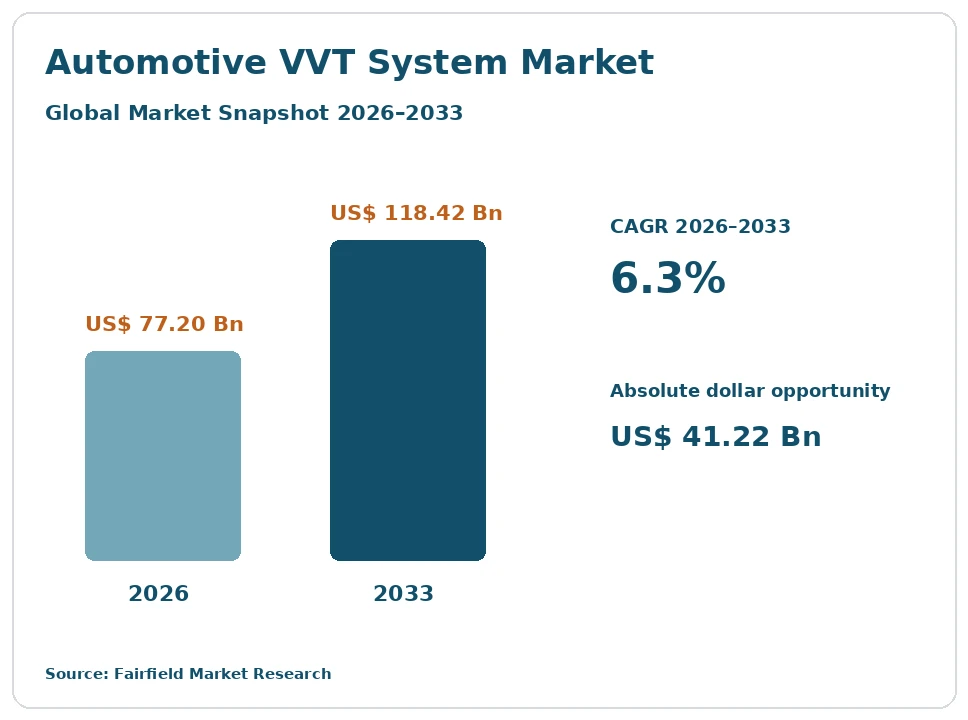
The global automotive VVT system market size is expected to be valued at US$ 77.20 billion in 2026 and projected to reach US$ 118.42 billion by 2033, growing at a CAGR of 6.3% between 2026 and 2033.
Between 2020 and 2025, the market grew at a CAGR of about 4.2%, as chip shortages cut output in 2020 and 2021, followed by a recovery in production and a strong rise in hybrid vehicles, which use advanced engines with variable valve timing. The automotive VVT system market covers systems that change when engine valves open and close, including cam phaser units, oil control valves, electric camshaft actuators, variable valve lift systems, sensors, and control software, in single and dual VVT designs for petrol and diesel engines. VVT improves power, fuel economy, and emissions across engine speeds, and it is now standard on most new petrol engines. Growth comes from stricter fuel economy and emission rules, rising hybrid sales, turbocharged small engines, and growing car production in Asia Pacific. The market is shifting toward electric VVT, which reacts faster and works at engine start. In February 2025, BorgWarner agreed to supply variable cam timing to a major East Asian carmaker.
Key Report Takeaways
- By Technology: Hydraulic held about 72% share in 2025, while Electric VVT is projected to expand at a 9.4% CAGR through 2033, driven by hybrid engines that start and stop often, faster response at low oil pressure, and tighter emission control at cold start.
- By Vehicle Type: Passenger Cars held 63% share in 2025, while Light Commercial Vehicles are projected to expand at a 6.8% CAGR through 2033, driven by delivery vans and pickups with efficient turbocharged petrol and hybrid engines that must meet tougher emission standards.
- By Sales Channel: OEM held 74.1% share in 2025, while Aftermarket is projected to expand at a 7.1% CAGR through 2033, driven by aging vehicle fleets, worn cam phasers and solenoids, and wide parts programs from aftermarket suppliers.
- By Region: North America held 36.9% share in 2025, while Asia Pacific is projected to expand at a 7.6% CAGR through 2033, driven by large car and two-wheeler production in China, India, and Japan, and rising hybrid vehicle output.
Global Automotive VVT System Market Trends and Insights
Drivers Impact Analysis
Two drivers carry the strongest influence on automotive VVT system market demand during the forecast period.
| Driver | Impact on CAGR Forecast | Geographic Relevance | Impact Timeline |
| Stricter fuel economy and emission standards | High | Global, strongest in Europe, North America, and Asia Pacific | Long term (≥4 years) |
| Rising hybrid vehicle production | High | Asia Pacific, North America, Europe | Medium term (2-4 years) |
Emission Standards Are Driving the Automotive VVT System Market
Stricter fuel economy and emission standards are the strongest driver of the automotive VVT system market. Engines must burn less fuel.
The mechanism is regulation that forces carmakers to raise engine efficiency. Rules such as Euro 7 in Europe, CAFE and EPA standards in the United States, China 6b, and Bharat Stage VI in India limit carbon dioxide and pollutant emissions. VVT lets an engine adjust valve timing for each driving condition, improving combustion, cutting pumping losses, and allowing techniques such as the Atkinson and Miller cycles that save fuel. Dual VVT on both intake and exhaust camshafts gives even more control, and variable valve lift adds further gains. Turbocharged small engines depend on VVT to deliver power while meeting rules. These standards make VVT standard equipment on nearly all new petrol engines worldwide.
Hybrid Growth Is Expanding the Automotive VVT System Market
Rising hybrid vehicle production is expanding the automotive VVT system market. Hybrids still use efficient engines.
The cause is strong demand for hybrid cars as a bridge between petrol and electric vehicles. Toyota, Honda, Hyundai, and Chinese brands are expanding hybrid ranges, and hybrid sales have grown quickly in North America, Japan, and Europe. Hybrid engines run Atkinson cycles and start and stop many times per trip, which requires advanced VVT, often electric. Plug-in hybrids and range extenders also use VVT engines. Carmakers that once planned to stop engine development are now extending engine programs because hybrid demand is strong. New hybrid engines from Chinese brands such as BYD and Geely reach very high efficiency using advanced valve timing. These trends support demand even as battery electric vehicles grow.
Restraints Impact Analysis
Two restraints limit how quickly the automotive VVT system market grows.
| Restraint | Impact on CAGR Forecast | Geographic Relevance | Impact Timeline |
| Shift to battery electric vehicles | High | Europe, Asia Pacific, North America | Long term (≥4 years) |
| Cost pressure and system complexity | Medium | Global | Medium term (2-4 years) |
EV Adoption Slows the Automotive VVT System Market
The shift to battery electric vehicles slows the automotive VVT system market. Electric cars have no engine valves.
The specific causes are electrification targets and falling battery costs. Each battery electric vehicle sold removes demand for VVT systems, and EV sales are rising quickly in China, Europe, and parts of North America. Several governments plan to end sales of new petrol and diesel cars in the 2030s, although some have softened these plans. Carmakers are shifting research budgets from engines to batteries and software, and some have stopped developing new engines. Suppliers must balance investment between engine parts and EV products. The effect is softened by strong hybrid sales and slower EV adoption in many markets, but it limits long-term growth. These factors cap the market’s growth rate.
Cost Pressure Restricts the Automotive VVT System Market
Cost pressure and system complexity restrict the automotive VVT system market. Carmakers want lower part prices.
The underlying causes are carmaker cost targets and complex designs. Electric VVT and variable valve lift systems cost much more than basic hydraulic phasers. Carmakers demand yearly price cuts of a few percent on most parts. Complex systems need very precise manufacturing, clean oil, and advanced control software, and failures can lead to costly warranty claims and recalls. Chinese suppliers offer low prices that pressure global firms in every region. Raw material, steel, and energy costs rose sharply after 2021. Smaller suppliers struggle to invest in electric VVT while engine volumes are uncertain, and some have merged or exited, reducing local supply options for carmakers. These factors restrict margins and slow investment in new designs.
Market Opportunities
Electric VVT for Hybrids Opens a Fast-Growth Revenue Pool
Electric VVT for hybrids opens a fast-growth revenue pool in the automotive VVT system market. Hybrid engines need fast, precise timing.
Suppliers can capture this opportunity. Electric cam phasers use motors instead of oil pressure, so they can adjust timing at engine start, at idle, and during frequent stop-start cycles, cutting emissions and improving efficiency. BorgWarner, Denso, Aisin, and Hitachi Astemo offer electric systems. Hybrid and plug-in hybrid production is rising sharply in China, Japan, and North America. Electric systems also reduce engine friction and allow more extreme valve timing strategies that improve efficiency. Range extender engines in electric vehicles use them too. Carmakers in China are launching many new hybrid engines each year. Companies with proven electric VVT products can win.
Aftermarket Replacement Creates a Growth Revenue Pool
Aftermarket replacement creates a growth revenue pool in the automotive VVT system market. Old engines need new parts.
Suppliers can capture this opportunity. Cam phasers, oil control solenoids, and timing sensors wear out over time. Failures often cause rough idle, check-engine lights, and noise, prompting repairs. The average car in the United States and Europe is more than 12 years old, and many have high mileage. Standard Motor Products launched a VVT program with over 600 parts, and Dorman and Schaeffler’s aftermarket arm also sell replacement units. Online parts sales are growing, and do-it-yourself repairs are common for older cars. Fleets of taxis and delivery vans with high mileage need frequent replacements, and timing parts are often replaced together. Companies with wide catalogs and reliable quality can grow.
Segment Analysis
By Technology: Hydraulic Leads While Electric VVT Grows Fastest
Hydraulic held about 72% share in 2025. Oil-pressure-driven cam phasers and oil control valves are proven, low-cost, and fitted to most petrol engines worldwide, from small city cars to large pickup engines. Their simple design and mass production keep prices low, which matters to carmakers in price-sensitive markets such as India, Brazil, and Indonesia. Continuous improvements in valve design and oil control have extended their life and performance.
Electric VVT is the fastest-growing technology, expanding at a 9.4% CAGR through 2033. Electric phasers respond faster and work when oil pressure is low, which suits hybrids with frequent engine starts. They also allow timing changes before the engine fires, which cuts cold-start emissions. Cam-changing and variable valve lift systems form other technologies. For the market, electric growth raises value per engine.
By Vehicle Type: Passenger Cars Lead While Light Commercial Vehicles Grow Fastest
Passenger Cars held 63% share in 2025. Cars, SUVs, and crossovers make up most engine production, and nearly all new petrol car engines use VVT, often on both camshafts. Hybrid cars add more advanced systems, and many modern engines now use dual VVT, which held 43.8% of the market by valve train type. SUVs and crossovers keep growing as a share of sales.
Light Commercial Vehicles are the fastest-growing vehicle type, expanding at a 6.8% CAGR through 2033. Delivery vans and pickups are moving to efficient turbocharged and hybrid engines to meet tougher rules. Heavy commercial vehicles and two-wheelers form other segments, with two-wheeler VVT growing in India and Japan. For the market, LCV growth adds volume.
By Sales Channel: OEM Leads While Aftermarket Grows Fastest
OEM held 74.1% share in 2025. Carmakers buy VVT systems for new engines under long supply contracts, often lasting the full life of an engine platform of seven years or more. Suppliers work with carmakers for years before production starts, testing designs for durability, noise, and emissions. High volumes in China, Japan, and the United States support this channel, and new hybrid engines add content.
Aftermarket is the fastest-growing channel, expanding at a 7.1% CAGR through 2033. Aging fleets need replacement phasers, solenoids, and timing sensors, especially in high-mileage vehicles. Independent garages, dealers, and retailers sell many aftermarket parts, often in kits with timing chains. For the market, aftermarket growth adds steady, high-margin revenue.
Geography Analysis
Which Region Is Leading the Automotive VVT System Market?
North America is leading the automotive VVT system market with a 36.9% share in 2025. The United States has strong demand for pickups and SUVs with large petrol engines, many of which use dual VVT and cylinder deactivation, and hybrid sales are rising quickly. BorgWarner, Eaton, and Standard Motor Products are based there, and Japanese suppliers run large plants in the region. Mexico builds many engines for export, and Canada adds engine and parts production. A large aging fleet of high-mileage cars supports aftermarket sales. Key barriers include EV policies. One change shaping the region is hybrid growth.
Europe Shapes the Automotive VVT System Market Through Euro 7
Europe is a major automotive VVT system market. Germany hosts Schaeffler, Bosch, and major carmakers such as Volkswagen, BMW, and Mercedes-Benz, while France, Italy, Spain, and the Czech Republic build many engines. Euro 7 rules push further efficiency gains, and plug-in hybrids remain popular with company car buyers. Many European carmakers have delayed full EV switches, keeping engine and hybrid programs alive much longer than planned. Aftermarket demand is strong across the region for older diesel and petrol cars. Key barriers include fast EV adoption. One opportunity is hybrid engines.
Which Region Is Growing Fastest in the Automotive VVT System Market?
Asia Pacific is growing fastest in the automotive VVT system market, expanding at a 7.6% CAGR through 2033. China, Japan, India, South Korea, Thailand, and Indonesia lead. China produces the most cars in the world and is launching many new hybrid engines, while Japan hosts Aisin, Denso, Hitachi Astemo, and Mitsubishi Electric. India has large car and two-wheeler output, and new emission rules are bringing VVT to many small engines. Thailand is a major pickup production hub. Key barriers include EV growth in China. One change shaping the region is hybrid production.
Latin America Grows the Automotive VVT System Market Through Vehicle Assembly
Latin America is a growing automotive VVT system market. Brazil and Mexico lead, with Argentina adding demand. Mexico produces engines and vehicles for export to the United States, and Brazil builds flex-fuel engines that run on ethanol and petrol, which benefit from VVT. Global suppliers run plants in both countries, and Chinese carmakers are building new plants in Brazil and Mexico. Aging fleets support aftermarket demand across the region, and many cars run on lower-grade fuel that wears parts. Key barriers include economic volatility, currency swings, and high tariffs. One opportunity is efficient flex-fuel engines.
Middle East & Africa Develops the Automotive VVT System Market Through Imports
Middle East & Africa is a developing automotive VVT system market. South Africa and Morocco assemble cars for export to Europe, and Egypt and Saudi Arabia are building assembly plants. Most vehicles in the region are imported with engines already fitted, so local VVT demand comes mainly from the aftermarket. Hot climates and dusty roads can shorten part life, and poor oil quality can damage cam phasers. Workshops rely on imported spare parts from Asia Pacific and Europe, and vehicle fleets are growing steadily. Key barriers include small local production. One change shaping the region is assembly growth.
Competitive Landscape
The automotive VVT system market is moderately consolidated. Aisin, Denso, Schaeffler, BorgWarner, and Hitachi Astemo are leading players, while Mitsubishi Electric, Eaton, Bosch, Hyundai Mobis, Mikuni, Standard Motor Products, and Hilite International compete strongly. Japanese suppliers are closely tied to Toyota, Honda, and Nissan, while Schaeffler and BorgWarner supply many European, American, and Chinese carmakers. Chinese suppliers are growing quickly with domestic carmakers.
Companies compete on response speed, durability, noise, weight, oil consumption, cost, and close engineering support during engine development. Winning a new engine platform brings years of steady orders, so suppliers invest heavily in testing and co-design with carmakers. Electric VVT know-how, software, and sensor integration are becoming important advantages as hybrids grow. Aftermarket suppliers compete on catalog coverage, availability, and price.
Strategic moves show how competition is changing. In June 2024, Standard Motor Products launched a VVT aftermarket program with more than 600 parts. In February 2025, BorgWarner won a variable cam timing supply deal with a major East Asian carmaker, with production starting in 2026. In May 2025, Suzuki added VVT to a 249cc motorcycle engine, showing spread into two-wheelers. These moves show competition shifting toward hybrids, Asian carmakers, and aftermarket parts.
Three themes shape vendor strategy. First, companies are growing electric VVT for hybrid engines. Second, they are winning contracts with fast-growing carmakers in China and India. Third, they are expanding aftermarket programs as vehicle fleets age, while preparing EV products to offset long-term declines.
Automotive VVT System Market Industry Leaders
- Aisin
- Denso
- Schaeffler
- BorgWarner
- Hitachi Astemo
Recent Industry Developments
- May 2025: Suzuki launched a variable valve timing system for a 249cc single-cylinder motorcycle engine - extends VVT technology to two-wheelers in Asia Pacific.
- February 2025: BorgWarner agreed to supply variable cam timing technology to a major East Asian carmaker, with production starting in early 2026 - adds demand in the automotive VVT system market.
- June 2024: Standard Motor Products launched a VVT parts program covering more than 600 part numbers - expands aftermarket cam phaser and solenoid supply.
Companies Covered in the Report
- Aisin
- Denso
- Schaeffler
- BorgWarner
- Hitachi Astemo
- Mitsubishi Electric
- Eaton
- Bosch
- Hyundai Mobis
- Mikuni
- Standard Motor Products
- Hilite International
Automotive VVT System Market Scope
This report covers the automotive VVT system market, including single and dual VVT, hydraulic and electric technologies, cam phasers, oil control valves, actuators, and sensors, used in petrol and diesel engines of passenger cars, light commercial vehicles, heavy commercial vehicles, and two-wheelers, sold through OEM and aftermarket channels. The base year is 2025, and the forecast period runs from 2026 to 2033. All values are expressed in US$ Billion.
| Metric | Value |
| Study Period | 2020-2033 |
| Market Size 2026 | US$ 77.20 Billion |
| Market Size 2033 | US$ 118.42 Billion |
| CAGR 2026-2033 | 6.3% |
| Absolute Dollar Opportunity | US$ 41.22 Billion |
| Largest Market | North America |
| Fastest-Growing Market | Asia Pacific |
| Market Concentration | Moderately Consolidated |
| Major Players | Aisin, Denso, Schaeffler, BorgWarner, Hitachi Astemo |
Technology
- Hydraulic
- Electric VVT
- Cam-changing and Variable Lift
Valve Train
- Single VVT
- Dual VVT
Vehicle Type
- Passenger Cars
- Light Commercial Vehicles
- Heavy Commercial Vehicles
- Two-Wheelers
Sales Channel
- OEM
- Aftermarket
Regions
- North America
- Europe
- Asia Pacific
- Latin America
- Middle East & Africa
1. Executive Summary
1.1. Global Automotive VVT System Market Snapshot
1.2. Future Projections, 2026-2033
1.3. Key Market Trends
1.4. Regional Snapshot
2. Market Overview
2.1. Market Definition and Scope
2.2. Historical Market Trends, 2020-2025
2.3. Market Dynamics
2.3.1. Drivers Impact Analysis
2.3.1.1. Emission Standards Are Driving the Automotive VVT System Market
2.3.1.2. Hybrid Growth Is Expanding the Automotive VVT System Market
2.3.2. Restraints Impact Analysis
2.3.2.1. EV Adoption Slows the Automotive VVT System Market
2.3.2.2. Cost Pressure Restricts the Automotive VVT System Market
2.3.3. Market Opportunities
2.3.3.1. Electric VVT for Hybrids Opens a Fast-Growth Revenue Pool
2.3.3.2. Aftermarket Replacement Creates a Growth Revenue Pool
3. Global Automotive VVT System Market Outlook, 2020-2033
3.1. Global Automotive VVT System Market Outlook, by Technology, Value (US$ Billion), 2020-2033
3.1.1. Hydraulic
3.1.2. Electric VVT
3.1.3. Cam-changing and Variable Lift
3.2. Global Automotive VVT System Market Outlook, by Valve Train, Value (US$ Billion), 2020-2033
3.2.1. Single VVT
3.2.2. Dual VVT
3.3. Global Automotive VVT System Market Outlook, by Vehicle Type, Value (US$ Billion), 2020-2033
3.3.1. Passenger Cars
3.3.2. Light Commercial Vehicles
3.3.3. Heavy Commercial Vehicles
3.3.4. Two-Wheelers
3.4. Global Automotive VVT System Market Outlook, by Sales Channel, Value (US$ Billion), 2020-2033
3.4.1. OEM
3.4.2. Aftermarket
3.5. Global Automotive VVT System Market Outlook, by Region, Value (US$ Billion), 2020-2033
3.5.1. North America
3.5.2. Europe
3.5.3. Asia Pacific
3.5.4. Latin America
3.5.5. Middle East & Africa
4. North America Automotive VVT System Market Outlook, 2020-2033
4.1. North America Automotive VVT System Market Outlook, by Technology, Value (US$ Billion), 2020-2033
4.1.1. Hydraulic
4.1.2. Electric VVT
4.1.3. Cam-changing and Variable Lift
4.2. North America Automotive VVT System Market Outlook, by Valve Train, Value (US$ Billion), 2020-2033
4.2.1. Single VVT
4.2.2. Dual VVT
4.3. North America Automotive VVT System Market Outlook, by Vehicle Type, Value (US$ Billion), 2020-2033
4.3.1. Passenger Cars
4.3.2. Light Commercial Vehicles
4.3.3. Heavy Commercial Vehicles
4.3.4. Two-Wheelers
4.4. North America Automotive VVT System Market Outlook, by Sales Channel, Value (US$ Billion), 2020-2033
4.4.1. OEM
4.4.2. Aftermarket
4.5. North America Automotive VVT System Market Outlook, by Country, Value (US$ Billion), 2020-2033
4.5.1. United States Automotive VVT System Market Outlook, by Technology, 2020-2033
4.5.2. United States Automotive VVT System Market Outlook, by Valve Train, 2020-2033
4.5.3. United States Automotive VVT System Market Outlook, by Vehicle Type, 2020-2033
4.5.4. United States Automotive VVT System Market Outlook, by Sales Channel, 2020-2033
4.5.5. Mexico Automotive VVT System Market Outlook, by Technology, 2020-2033
4.5.6. Mexico Automotive VVT System Market Outlook, by Valve Train, 2020-2033
4.5.7. Mexico Automotive VVT System Market Outlook, by Vehicle Type, 2020-2033
4.5.8. Mexico Automotive VVT System Market Outlook, by Sales Channel, 2020-2033
4.5.9. Canada Automotive VVT System Market Outlook, by Technology, 2020-2033
4.5.10. Canada Automotive VVT System Market Outlook, by Valve Train, 2020-2033
4.5.11. Canada Automotive VVT System Market Outlook, by Vehicle Type, 2020-2033
4.5.12. Canada Automotive VVT System Market Outlook, by Sales Channel, 2020-2033
5. Europe Automotive VVT System Market Outlook, 2020-2033
5.1. Europe Automotive VVT System Market Outlook, by Technology, Value (US$ Billion), 2020-2033
5.1.1. Hydraulic
5.1.2. Electric VVT
5.1.3. Cam-changing and Variable Lift
5.2. Europe Automotive VVT System Market Outlook, by Valve Train, Value (US$ Billion), 2020-2033
5.2.1. Single VVT
5.2.2. Dual VVT
5.3. Europe Automotive VVT System Market Outlook, by Vehicle Type, Value (US$ Billion), 2020-2033
5.3.1. Passenger Cars
5.3.2. Light Commercial Vehicles
5.3.3. Heavy Commercial Vehicles
5.3.4. Two-Wheelers
5.4. Europe Automotive VVT System Market Outlook, by Sales Channel, Value (US$ Billion), 2020-2033
5.4.1. OEM
5.4.2. Aftermarket
5.5. Europe Automotive VVT System Market Outlook, by Country, Value (US$ Billion), 2020-2033
5.5.1. Germany Automotive VVT System Market Outlook, by Technology, 2020-2033
5.5.2. Germany Automotive VVT System Market Outlook, by Valve Train, 2020-2033
5.5.3. Germany Automotive VVT System Market Outlook, by Vehicle Type, 2020-2033
5.5.4. Germany Automotive VVT System Market Outlook, by Sales Channel, 2020-2033
5.5.5. France Automotive VVT System Market Outlook, by Technology, 2020-2033
5.5.6. France Automotive VVT System Market Outlook, by Valve Train, 2020-2033
5.5.7. France Automotive VVT System Market Outlook, by Vehicle Type, 2020-2033
5.5.8. France Automotive VVT System Market Outlook, by Sales Channel, 2020-2033
5.5.9. Italy Automotive VVT System Market Outlook, by Technology, 2020-2033
5.5.10. Italy Automotive VVT System Market Outlook, by Valve Train, 2020-2033
5.5.11. Italy Automotive VVT System Market Outlook, by Vehicle Type, 2020-2033
5.5.12. Italy Automotive VVT System Market Outlook, by Sales Channel, 2020-2033
5.5.13. Spain Automotive VVT System Market Outlook, by Technology, 2020-2033
5.5.14. Spain Automotive VVT System Market Outlook, by Valve Train, 2020-2033
5.5.15. Spain Automotive VVT System Market Outlook, by Vehicle Type, 2020-2033
5.5.16. Spain Automotive VVT System Market Outlook, by Sales Channel, 2020-2033
5.5.17. Czech Republic Automotive VVT System Market Outlook, by Technology, 2020-2033
5.5.18. Czech Republic Automotive VVT System Market Outlook, by Valve Train, 2020-2033
5.5.19. Czech Republic Automotive VVT System Market Outlook, by Vehicle Type, 2020-2033
5.5.20. Czech Republic Automotive VVT System Market Outlook, by Sales Channel, 2020-2033
6. Asia Pacific Automotive VVT System Market Outlook, 2020-2033
6.1. Asia Pacific Automotive VVT System Market Outlook, by Technology, Value (US$ Billion), 2020-2033
6.1.1. Hydraulic
6.1.2. Electric VVT
6.1.3. Cam-changing and Variable Lift
6.2. Asia Pacific Automotive VVT System Market Outlook, by Valve Train, Value (US$ Billion), 2020-2033
6.2.1. Single VVT
6.2.2. Dual VVT
6.3. Asia Pacific Automotive VVT System Market Outlook, by Vehicle Type, Value (US$ Billion), 2020-2033
6.3.1. Passenger Cars
6.3.2. Light Commercial Vehicles
6.3.3. Heavy Commercial Vehicles
6.3.4. Two-Wheelers
6.4. Asia Pacific Automotive VVT System Market Outlook, by Sales Channel, Value (US$ Billion), 2020-2033
6.4.1. OEM
6.4.2. Aftermarket
6.5. Asia Pacific Automotive VVT System Market Outlook, by Country, Value (US$ Billion), 2020-2033
6.5.1. China Automotive VVT System Market Outlook, by Technology, 2020-2033
6.5.2. China Automotive VVT System Market Outlook, by Valve Train, 2020-2033
6.5.3. China Automotive VVT System Market Outlook, by Vehicle Type, 2020-2033
6.5.4. China Automotive VVT System Market Outlook, by Sales Channel, 2020-2033
6.5.5. Japan Automotive VVT System Market Outlook, by Technology, 2020-2033
6.5.6. Japan Automotive VVT System Market Outlook, by Valve Train, 2020-2033
6.5.7. Japan Automotive VVT System Market Outlook, by Vehicle Type, 2020-2033
6.5.8. Japan Automotive VVT System Market Outlook, by Sales Channel, 2020-2033
6.5.9. India Automotive VVT System Market Outlook, by Technology, 2020-2033
6.5.10. India Automotive VVT System Market Outlook, by Valve Train, 2020-2033
6.5.11. India Automotive VVT System Market Outlook, by Vehicle Type, 2020-2033
6.5.12. India Automotive VVT System Market Outlook, by Sales Channel, 2020-2033
6.5.13. South Korea Automotive VVT System Market Outlook, by Technology, 2020-2033
6.5.14. South Korea Automotive VVT System Market Outlook, by Valve Train, 2020-2033
6.5.15. South Korea Automotive VVT System Market Outlook, by Vehicle Type, 2020-2033
6.5.16. South Korea Automotive VVT System Market Outlook, by Sales Channel, 2020-2033
6.5.17. Thailand Automotive VVT System Market Outlook, by Technology, 2020-2033
6.5.18. Thailand Automotive VVT System Market Outlook, by Valve Train, 2020-2033
6.5.19. Thailand Automotive VVT System Market Outlook, by Vehicle Type, 2020-2033
6.5.20. Thailand Automotive VVT System Market Outlook, by Sales Channel, 2020-2033
6.5.21. Indonesia Automotive VVT System Market Outlook, by Technology, 2020-2033
6.5.22. Indonesia Automotive VVT System Market Outlook, by Valve Train, 2020-2033
6.5.23. Indonesia Automotive VVT System Market Outlook, by Vehicle Type, 2020-2033
6.5.24. Indonesia Automotive VVT System Market Outlook, by Sales Channel, 2020-2033
7. Latin America Automotive VVT System Market Outlook, 2020-2033
7.1. Latin America Automotive VVT System Market Outlook, by Technology, Value (US$ Billion), 2020-2033
7.1.1. Hydraulic
7.1.2. Electric VVT
7.1.3. Cam-changing and Variable Lift
7.2. Latin America Automotive VVT System Market Outlook, by Valve Train, Value (US$ Billion), 2020-2033
7.2.1. Single VVT
7.2.2. Dual VVT
7.3. Latin America Automotive VVT System Market Outlook, by Vehicle Type, Value (US$ Billion), 2020-2033
7.3.1. Passenger Cars
7.3.2. Light Commercial Vehicles
7.3.3. Heavy Commercial Vehicles
7.3.4. Two-Wheelers
7.4. Latin America Automotive VVT System Market Outlook, by Sales Channel, Value (US$ Billion), 2020-2033
7.4.1. OEM
7.4.2. Aftermarket
7.5. Latin America Automotive VVT System Market Outlook, by Country, Value (US$ Billion), 2020-2033
7.5.1. Brazil Automotive VVT System Market Outlook, by Technology, 2020-2033
7.5.2. Brazil Automotive VVT System Market Outlook, by Valve Train, 2020-2033
7.5.3. Brazil Automotive VVT System Market Outlook, by Vehicle Type, 2020-2033
7.5.4. Brazil Automotive VVT System Market Outlook, by Sales Channel, 2020-2033
7.5.5. Mexico Automotive VVT System Market Outlook, by Technology, 2020-2033
7.5.6. Mexico Automotive VVT System Market Outlook, by Valve Train, 2020-2033
7.5.7. Mexico Automotive VVT System Market Outlook, by Vehicle Type, 2020-2033
7.5.8. Mexico Automotive VVT System Market Outlook, by Sales Channel, 2020-2033
7.5.9. Argentina Automotive VVT System Market Outlook, by Technology, 2020-2033
7.5.10. Argentina Automotive VVT System Market Outlook, by Valve Train, 2020-2033
7.5.11. Argentina Automotive VVT System Market Outlook, by Vehicle Type, 2020-2033
7.5.12. Argentina Automotive VVT System Market Outlook, by Sales Channel, 2020-2033
8. Middle East & Africa Automotive VVT System Market Outlook, 2020-2033
8.1. Middle East & Africa Automotive VVT System Market Outlook, by Technology, Value (US$ Billion), 2020-2033
8.1.1. Hydraulic
8.1.2. Electric VVT
8.1.3. Cam-changing and Variable Lift
8.2. Middle East & Africa Automotive VVT System Market Outlook, by Valve Train, Value (US$ Billion), 2020-2033
8.2.1. Single VVT
8.2.2. Dual VVT
8.3. Middle East & Africa Automotive VVT System Market Outlook, by Vehicle Type, Value (US$ Billion), 2020-2033
8.3.1. Passenger Cars
8.3.2. Light Commercial Vehicles
8.3.3. Heavy Commercial Vehicles
8.3.4. Two-Wheelers
8.4. Middle East & Africa Automotive VVT System Market Outlook, by Sales Channel, Value (US$ Billion), 2020-2033
8.4.1. OEM
8.4.2. Aftermarket
8.5. Middle East & Africa Automotive VVT System Market Outlook, by Country, Value (US$ Billion), 2020-2033
8.5.1. South Africa Automotive VVT System Market Outlook, by Technology, 2020-2033
8.5.2. South Africa Automotive VVT System Market Outlook, by Valve Train, 2020-2033
8.5.3. South Africa Automotive VVT System Market Outlook, by Vehicle Type, 2020-2033
8.5.4. South Africa Automotive VVT System Market Outlook, by Sales Channel, 2020-2033
8.5.5. Morocco Automotive VVT System Market Outlook, by Technology, 2020-2033
8.5.6. Morocco Automotive VVT System Market Outlook, by Valve Train, 2020-2033
8.5.7. Morocco Automotive VVT System Market Outlook, by Vehicle Type, 2020-2033
8.5.8. Morocco Automotive VVT System Market Outlook, by Sales Channel, 2020-2033
8.5.9. Egypt Automotive VVT System Market Outlook, by Technology, 2020-2033
8.5.10. Egypt Automotive VVT System Market Outlook, by Valve Train, 2020-2033
8.5.11. Egypt Automotive VVT System Market Outlook, by Vehicle Type, 2020-2033
8.5.12. Egypt Automotive VVT System Market Outlook, by Sales Channel, 2020-2033
8.5.13. Saudi Arabia Automotive VVT System Market Outlook, by Technology, 2020-2033
8.5.14. Saudi Arabia Automotive VVT System Market Outlook, by Valve Train, 2020-2033
8.5.15. Saudi Arabia Automotive VVT System Market Outlook, by Vehicle Type, 2020-2033
8.5.16. Saudi Arabia Automotive VVT System Market Outlook, by Sales Channel, 2020-2033
9. Competitive Landscape
9.1. Industry Leaders
9.2. Recent Industry Developments
9.3. Company Profiles
9.3.1. Aisin
9.3.2. Denso
9.3.3. Schaeffler
9.3.4. BorgWarner
9.3.5. Hitachi Astemo
9.3.6. Mitsubishi Electric
9.3.7. Eaton
9.3.8. Bosch
9.3.9. Hyundai Mobis
9.3.10. Mikuni
9.3.11. Standard Motor Products
9.3.12. Hilite International
10. Appendix
10.1. Research Methodology
10.2. Report Assumptions
10.3. Acronyms and Abbreviations
| Segment | Categories |
| Technology | Hydraulic, Electric VVT, Cam-changing and Variable Lift |
| Valve Train | Single VVT, Dual VVT |
| Vehicle Type | Passenger Cars, Light Commercial Vehicles, Heavy Commercial Vehicles, Two-Wheelers |
| Sales Channel | OEM, Aftermarket |
| Regions | North America, Europe, Asia Pacific, Latin America, Middle East & Africa |
Our Research Methodology
Considering the volatility of business today, traditional approaches to strategizing a game plan can be unfruitful if not detrimental. True ambiguity is no way to determine a forecast. A myriad of predetermined factors must be accounted for such as the degree of risk involved, the magnitude of circumstances, as well as conditions or consequences that are not known or unpredictable. To circumvent binary views that cast uncertainty, the application of market research intelligence to strategically posture, move, and enable actionable outcomes is necessary.
View Methodology
Quality Assured
Rigorous Validation Process

Confidentiality Assured
End-to-end Data Security

Custom Research Services
Tailored To Your Objectives
FAQs
The automotive VVT system market is valued at US$ 77.20 billion in 2026, led by hydraulic systems and North America.
The market is projected to reach US$ 118.42 billion by 2033, growing at a 6.3% CAGR and adding US$ 41.22 billion.
Electric VVT is growing fastest at a 9.4% CAGR through 2033, driven by hybrid engines, faster response, and cleaner cold starts.
Asia Pacific is growing fastest at a 7.6% CAGR through 2033, driven by large car and two-wheeler production and rising hybrid output.
North America holds the largest share at 36.9% in 2025, supported by strong pickup and SUV demand and rising hybrid sales.
Related Reports
Leisure Boat Market Size, Share, Insights, Competitive Landscape, and Forecast 2026 to 2033
The leisure boat market is projected to grow from US$ 53.90 billion in 2026 to US$ 81.04 billion by 2033 at a 6.0% CAGR.
Hydrogen Aircraft Market Size, Share, Insights, Competitive Landscape, and Forecast 2026 to 2033
The hydrogen aircraft market is forecast to grow from US$ 1.20 billion in 2026 to US$ 7.60 billion by 2033 at a 33.6% CAGR.
Exhaust Flexible Couplings Market Size, Share, Insights, Competitive Landscape, and Forecast 2026 to 2033
The exhaust flexible couplings market is projected to grow from US$ 756.4 million in 2026 to US$ 1,057.3 million by 2033 at a 4.9% CAGR.
Used Vehicle Market Size, Share, Insights, Competitive Landscape, and Forecast 2026 to 2033
The global used vehicle market is valued at US$1.7 trillion in 2026, reaching US$2.6 trillion by 2033, growing at a 6.3% CAGR
Logistics Market Size, Share, Insights, Competitive Landscape, and Forecast 2026 to 2033
The global logistics market is valued at US$3.7 trillion in 2026, reaching US$6.1 trillion by 2033, growing at a 7.4% CAGR
Hypercar Market Size, Share, Insights, Competitive Landscape, and Forecast 2026 to 2033
The global hypercar market is valued at US$18.1 billion in 2026, reaching US$60.8 billion by 2033, growing at an 18.9% CAGR