



Leisure Boat Market
Leisure Boat Market Size, Share, Insights, Competitive Landscape, and Forecast 2026 to 2033
How Fast Is the Leisure Boat Market Growing?
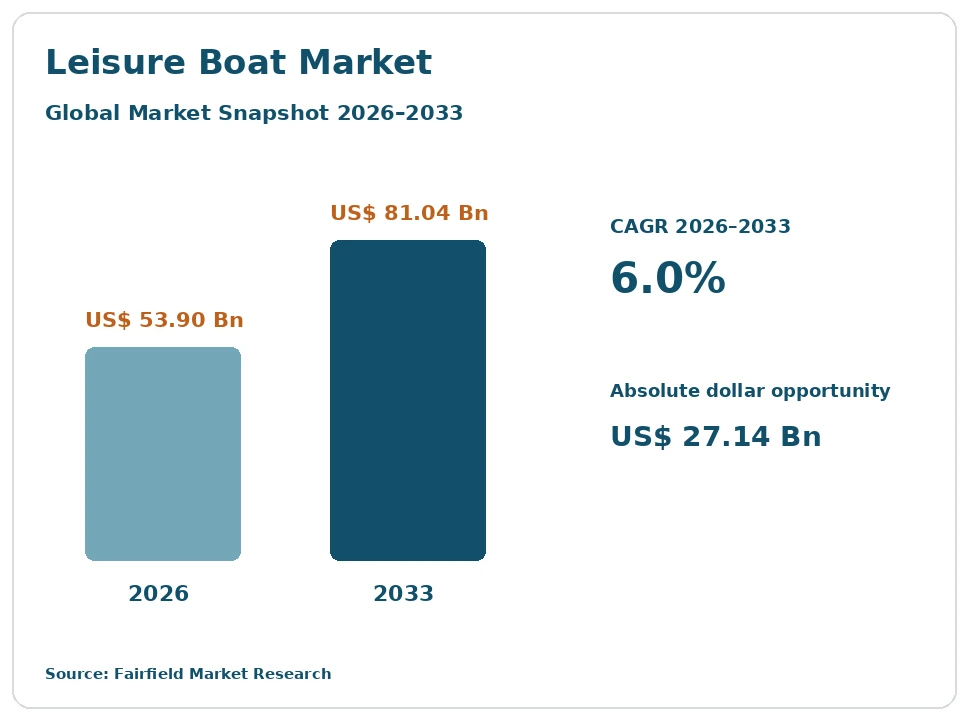
The global leisure boat market size is expected to be valued at US$ 53.90 billion in 2026 and projected to reach US$ 81.04 billion by 2033, growing at a CAGR of 6.0% between 2026 and 2033.
Between 2020 and 2025, the market grew at a CAGR of about 4.6%, as the pandemic drove record boat buying in 2020 and 2021 when families sought safe outdoor activities, followed by a slowdown in 2023 and 2024 as interest rates rose and dealers cut inventory. The leisure boat market covers new and used leisure boats used for recreation, including powerboats, bowriders, pontoons, ski and wake boats, fishing boats, sailboats, yachts, personal watercraft, inflatable boats, and non-motorized craft such as kayaks and canoes, along with the engines and electronics that power them. Boats are used for fishing, water sports, cruising, and entertaining on lakes, rivers, and coasts. Growth comes from rising wealth, interest in outdoor recreation, boat clubs, and new marinas. The market is shifting toward pontoons, connected boats, and electric boats from makers such as Candela and X Shore. In July 2026, Brunswick reported second-quarter sales up 8% to US$ 1.56 billion.
Key Report Takeaways
- By Type: Used held 75.88% share in 2025, while New is projected to expand at a 6.9% CAGR through 2033, driven by new models with better fuel efficiency, connected electronics, and electric drives, along with recovering dealer orders as interest rates ease.
- By Product: Motorized held about 82% share in 2025, while Non-motorized is projected to expand at a 6.6% CAGR through 2033, driven by low-cost kayaks, paddleboards, and canoes that attract younger buyers and families seeking simple, active water recreation.
- By Propulsion: ICE held about 95% share in 2025, while Electric is projected to expand at a 14.0% CAGR through 2033, driven by quiet, clean electric motors, foiling boats, and lake rules in Europe that limit or ban petrol engines.
- By Region: North America held 43.56% share in 2025, while Asia Pacific is projected to expand at a 7.4% CAGR through 2033, driven by rising wealth, new marinas, and growing yachting and water sports culture in China, Australia, Japan, and Thailand.
Global Leisure Boat Market Trends and Insights
Drivers Impact Analysis
Two drivers carry the strongest influence on leisure boat market demand during the forecast period.
| Driver | Impact on CAGR Forecast | Geographic Relevance | Impact Timeline |
| Rising interest in outdoor and water recreation | High | Global, strongest in North America and Europe | Long term (≥4 years) |
| Growing wealth and boat club and rental models | Medium | North America, Europe, Asia Pacific | Medium term (2-4 years) |
Water Recreation Demand Is Driving the Leisure Boat Market
Rising interest in outdoor and water recreation is the strongest driver of the leisure boat market. More people want to spend time on the water.
The mechanism is a lasting change in how families spend leisure time. The pandemic introduced millions of new people to boating, and many kept their boats because boating offers family time, fishing, water sports, and relaxation away from crowds. In the United States, about 100 million people go boating each year, and boating is closely tied to fishing and lake culture. Younger buyers are drawn to wake surfing, pontoons, and personal watercraft, while retirees buy larger cruisers and yachts. Coastal tourism in the Mediterranean, Florida, and Australia supports yacht and charter demand. These trends support steady demand for new and used boats.
Wealth and Boat Clubs Are Expanding the Leisure Boat Market
Growing wealth and boat club and rental models are expanding the leisure boat market. More people can access boats.
The cause is rising wealth among high-income households and new ways to use boats without owning them. The number of millionaires has grown in the United States, Europe, China, and Middle East & Africa, supporting yacht sales. Boat clubs such as Brunswick’s Freedom Boat Club let members use boats for a monthly fee, and peer-to-peer rental platforms reach new users. Many club members later buy boats, and clubs buy large numbers of new boats each year to refresh fleets. Charter companies in the Mediterranean, the Greek islands, and Croatia also buy many sailboats and catamarans. Rising use of financing and leasing options helps buyers spread costs. These models widen the customer base and support sales.
Restraints Impact Analysis
Two restraints limit how quickly the leisure boat market grows.
| Restraint | Impact on CAGR Forecast | Geographic Relevance | Impact Timeline |
| High prices, interest rates, and ownership costs | High | North America, Europe | Medium term (2-4 years) |
| Environmental rules and limited marina space | Medium | Europe, North America | Long term (≥4 years) |
Ownership Costs Slow the Leisure Boat Market
High prices, interest rates, and ownership costs slow the leisure boat market. Boats are expensive to buy and keep.
The specific causes are rising boat prices and borrowing costs. New boat prices rose sharply after 2020 because of higher material, engine, and labor costs, and most buyers finance purchases, so higher interest rates have raised monthly payments. Tariffs in 2025 added costs for imported engines and parts. Owners also pay for fuel, insurance, storage, maintenance, docking, and winterizing, which can add thousands of dollars a year. Brunswick noted that value-segment boat demand stayed weak in 2026. When budgets tighten, buyers delay purchases or buy used boats, and dealers must offer discounts to move stock. Many owners use boats only a few weeks each year, which makes the cost feel high. These factors slow new boat sales and pressure dealer margins.
Environmental Rules Restrict the Leisure Boat Market
Environmental rules and limited marina space restrict the leisure boat market. Some waters limit engines and boat numbers.
The underlying causes are concerns about pollution, noise, and crowding. Many lakes in Europe ban or restrict petrol engines, and emission rules for marine engines are tightening. Marinas in popular areas have long waiting lists and high fees, and dry storage space near cities is scarce. Rules on invasive species require boat cleaning between lakes, adding effort for owners. Fuel spills and antifouling paints face stricter rules, and some cities limit fast boats in harbors. Building new marinas faces long permit processes and local opposition. Climate change can lower lake levels and shorten seasons in some places, and stronger storms can damage marinas and boats. These factors restrict growth in some regions.
Market Opportunities
Electric and Connected Boats Open a Fast-Growth Revenue Pool
Electric and connected boats open a fast-growth revenue pool in the leisure boat market. Buyers want quiet, clean, smart boats.
Boat makers can capture this opportunity. Electric outboards and inboard motors from Vision Marine, Flux Marine, and Torqeedo, and foiling electric boats from Candela, offer silent cruising and lower running costs. Lake restrictions in Europe favor electric boats over petrol models. Connected systems such as Brunswick’s Navico electronics let owners monitor boats from phones. Battery prices are falling, and charging points are appearing in marinas in Norway, Sweden, and the Netherlands. Younger buyers value sustainability, low noise, clean water, and app-based features. Software can also support remote diagnostics, docking assistance, and theft protection. Companies leading in electric and digital features can win.
Asia Pacific Yachting Growth Creates a Growth Revenue Pool
Asia Pacific yachting growth creates a growth revenue pool in the leisure boat market. New marinas open new markets.
Makers can capture this opportunity. China, Thailand, Australia, and Japan are building marinas and promoting boating tourism. Wealthy buyers in China, Singapore, and Hong Kong want yachts for entertaining and status, and charter tourism in Thailand and Indonesia is growing. Australia has strong demand for fishing boats and trailer boats. Governments are easing rules for foreign yachts and visiting charter boats, which helps tourism. New marinas in Phuket, Bali, and southern China need boats for rental and sale, and boat shows in Shanghai and Singapore attract new buyers each year. Local builders in China are also expanding their ranges and export sales. Companies with regional dealers and service networks can grow.
Segment Analysis
By Type: Used Leads While New Grows Fastest
Used held 75.88% share in 2025. Most boats sold each year are pre-owned, because boats last for decades and used boats cost much less than new ones. Many first-time buyers start with a used boat, and the large fleet of boats bought during the pandemic has added supply. Online marketplaces such as Boat Trader and YachtWorld make it easier to buy and sell used boats.
New is the fastest-growing type, expanding at a 6.9% CAGR through 2033. New boats offer better fuel efficiency, modern electronics, comfort features, and warranties, and dealers expect orders to recover as interest rates ease. Monitoring equipment such as sensors, trackers, and alarms forms another segment. For the market, new boat growth raises average spending.
By Product: Motorized Leads While Non-motorized Grows Fastest
Motorized held about 82% share in 2025. Powerboats, pontoons, fishing boats, wake boats, cruisers, yachts, and personal watercraft make up most spending, because they cost much more than unpowered craft. Pontoons are among the fastest-growing powerboat types in North America, valued for space, comfort, and stability. Wake boats and center console fishing boats also sell well, and personal watercraft attract first-time buyers with lower prices.
Non-motorized is the fastest-growing product, expanding at a 6.6% CAGR through 2033. Kayaks, canoes, paddleboards, and small sailboats are affordable, easy to store, and popular with younger buyers. Sailboats form a key part of this segment in Europe, where sailing schools and clubs are common. For the market, non-motorized growth brings new people into boating.
By Propulsion: ICE Leads While Electric Grows Fastest
ICE held about 95% share in 2025. Petrol outboard and inboard engines from Mercury Marine, Yamaha, Suzuki, and Volvo Penta power most boats, offering long range and fast refueling. Outboards have grown more powerful, with some exceeding 600 horsepower, and diesel engines remain common on larger yachts.
Electric is the fastest-growing propulsion type, expanding at a 14.0% CAGR through 2033. Electric motors are quiet, need little maintenance, and suit lakes with engine bans. Battery costs still limit range and speed, but foiling designs from Candela cut energy use sharply. Hybrid systems on yachts are also growing, letting owners cruise quietly into harbors and anchor without running generators. For the market, electric growth adds new technology.
Geography Analysis
Which Region Is Leading the Leisure Boat Market?
North America is leading the leisure boat market with a 43.56% share in 2025. The United States is the world’s largest boating market, with about 12 million registered boats and strong demand for pontoons, fishing boats, wake boats, and center consoles. Brunswick, Malibu Boats, MasterCraft, and many other builders are based there. Canada adds lake and coastal boating, and many lakes in Ontario and Quebec are popular. Boat clubs and online sales are growing, and fishing tournaments drive demand for bass and saltwater boats in southern states. Key barriers include high interest rates. One change shaping the region is boat club growth.
Europe Shapes the Leisure Boat Market Through Yachts and Sailboats
Europe is a major leisure boat market. Italy, France, the United Kingdom, Germany, the Netherlands, Spain, and Croatia have strong yacht, sailboat, and charter industries, and the Mediterranean is the world’s leading yachting area. Groupe Beneteau, Ferretti Group, Azimut Benetti, Sanlorenzo, Princess Yachts, and Sunseeker are based in the region. Superyacht building in Italy and the Netherlands leads the world, and many orders come from buyers in North America and Middle East & Africa. Charter fleets are large. Key barriers include environmental rules. One opportunity is electric boats on lakes.
Which Region Is Growing Fastest in the Leisure Boat Market?
Asia Pacific is growing fastest in the leisure boat market, expanding at a 7.4% CAGR through 2033. Australia and New Zealand have strong boating cultures, China is building marinas and growing its luxury yacht market, and Japan has many fishing boats. Thailand, Indonesia, and the Philippines promote yacht tourism, and Taiwan is a major builder of yachts for export. Rising incomes in China and India create new buyers, though boating culture is still young in many countries and marinas are few. Key barriers include few marinas and high import taxes. One change shaping the region is wealth growth.
Latin America Grows the Leisure Boat Market Through Coastal Tourism
Latin America is a growing leisure boat market. Brazil has a large boatbuilding industry and long coastline, and Mexico attracts yacht tourism in Cancún and Los Cabos. Argentina and Chile have sailing traditions, and many lakes in Brazil support fishing and leisure boating. Local builders such as Schaefer Yachts export boats. Wealthy buyers often buy yachts abroad and keep them in Florida or in the waters of Mexico. Charter tourism along the coasts of Brazil and Mexico is growing, and fishing lodges add demand for small boats. Key barriers include high import duties. One opportunity is charter tourism.
Middle East & Africa Develops the Leisure Boat Market Through Luxury Yachting
Middle East & Africa is a developing leisure boat market. The United Arab Emirates and Saudi Arabia invest in marinas and superyacht tourism, while South Africa has a strong catamaran building industry that exports worldwide. Dubai hosts a major boat show, and Saudi Arabia’s Red Sea projects plan large marinas. Hot weather allows boating all year, and wealthy residents in Qatar and Kuwait also buy yachts and personal watercraft. Waterfront developments with private marinas are common, and many luxury hotels offer boat tours to guests. Key barriers include small markets and heat. One change shaping the region is marina development.
Competitive Landscape
The leisure boat market is moderately fragmented. Brunswick, Groupe Beneteau, Ferretti Group, Azimut Benetti, and Malibu Boats are leading players, while MasterCraft Boat Holdings, Sanlorenzo, Princess Yachts, Sunseeker, Yamaha Motor, Bavaria Yachtbau, and Candela compete strongly. Hundreds of smaller builders serve local markets with fishing boats, pontoons, sailboats, and custom yachts, and engine makers such as Mercury Marine, part of Brunswick, Yamaha, Suzuki, and Volvo Penta play a central role. Used boats are sold mainly through dealers, brokers, and online marketplaces.
Companies compete on design, quality, performance, brand prestige, features, dealer networks, financing, and after-sales service. Large groups offer many brands across price points, from small fishing boats to superyachts, and use shared engines, electronics, and dealer networks to cut costs. Boat shows such as Miami, Cannes, Düsseldorf, and Fort Lauderdale are key sales events. Electric and connected features are becoming important differentiators.
Strategic moves show how competition is changing. In February 2026, MasterCraft agreed to acquire Marine Products Corporation for about US$ 232.2 million. In March 2026, Malibu Boats completed its acquisition of Saxdor Yachts in Finland, adding a fast-growing premium brand. In July 2026, Brunswick reported sales growth across all segments and bought more Freedom Boat Club franchise operations. These moves show competition shifting toward consolidation and premium brands.
Three themes shape vendor strategy. First, companies are buying brands to broaden product ranges and reach new regions. Second, they are expanding boat clubs, electronics, and electric propulsion. Third, they are growing in Europe and Asia Pacific to balance demand in North America.
Leisure Boat Market Industry Leaders
- Brunswick
- Groupe Beneteau
- Ferretti Group
- Azimut Benetti
- Malibu Boats
Recent Industry Developments
- July 2026: Brunswick reported second-quarter net sales up 8% to about US$ 1.56 billion, with growth in all segments, and raised its 2026 outlook, while noting weak value-segment demand - shows recovery in the leisure boat market.
- March 2026: Malibu Boats completed its acquisition of Finnish builder Saxdor Yachts, valued at about €150 million - expands its premium dayboat range in Europe and North America.
- February 2026: MasterCraft Boat Holdings agreed to acquire Marine Products Corporation for about US$ 232.2 million in cash and stock, creating pro forma sales of about US$ 560 million - consolidates powerboat brands.
Companies Covered in the Report
- Brunswick
- Groupe Beneteau
- Ferretti Group
- Azimut Benetti
- Malibu Boats
- MasterCraft Boat Holdings
- Sanlorenzo
- Princess Yachts
- Sunseeker
- Yamaha Motor
- Bavaria Yachtbau
- Candela
Leisure Boat Market Scope
This report covers the leisure boat market, including new and used leisure boats and monitoring equipment, across motorized products such as powerboats, yachts, pontoons, and personal watercraft, and non-motorized products such as sailboats, kayaks, and canoes, powered by internal combustion and electric propulsion. The base year is 2025, and the forecast period runs from 2026 to 2033. All values are expressed in US$ Billion.
| Metric | Value |
| Study Period | 2020-2033 |
| Market Size 2026 | US$ 53.90 Billion |
| Market Size 2033 | US$ 81.04 Billion |
| CAGR 2026-2033 | 6.0% |
| Absolute Dollar Opportunity | US$ 27.14 Billion |
| Largest Market | North America |
| Fastest-Growing Market | Asia Pacific |
| Market Concentration | Moderately Fragmented |
| Major Players | Brunswick, Groupe Beneteau, Ferretti Group, Azimut Benetti, Malibu Boats |
Type
- New
- Used
- Monitoring Equipment
Product
- Motorized
- Non-motorized
Propulsion
- ICE
- Electric
Regions
- North America
- Europe
- Asia Pacific
- Latin America
- Middle East & Africa
1. Executive Summary
1.1. Global Leisure Boat Market Snapshot
1.2. Future Projections, 2026-2033
1.3. Key Market Trends
1.4. Regional Snapshot
2. Market Overview
2.1. Market Definition and Scope
2.2. Historical Market Trends, 2020-2025
2.3. Market Dynamics
2.3.1. Drivers Impact Analysis
2.3.1.1. Water Recreation Demand Is Driving the Leisure Boat Market
2.3.1.2. Wealth and Boat Clubs Are Expanding the Leisure Boat Market
2.3.2. Restraints Impact Analysis
2.3.2.1. Ownership Costs Slow the Leisure Boat Market
2.3.2.2. Environmental Rules Restrict the Leisure Boat Market
2.3.3. Market Opportunities
2.3.3.1. Electric and Connected Boats Open a Fast-Growth Revenue Pool
2.3.3.2. Asia Pacific Yachting Growth Creates a Growth Revenue Pool
3. Global Leisure Boat Market Outlook, 2020-2033
3.1. Global Leisure Boat Market Outlook, by Type, Value (US$ Billion), 2020-2033
3.1.1. New
3.1.2. Used
3.1.3. Monitoring Equipment
3.2. Global Leisure Boat Market Outlook, by Product, Value (US$ Billion), 2020-2033
3.2.1. Motorized
3.2.2. Non-motorized
3.3. Global Leisure Boat Market Outlook, by Propulsion, Value (US$ Billion), 2020-2033
3.3.1. ICE
3.3.2. Electric
3.4. Global Leisure Boat Market Outlook, by Region, Value (US$ Billion), 2020-2033
3.4.1. North America
3.4.2. Europe
3.4.3. Asia Pacific
3.4.4. Latin America
3.4.5. Middle East & Africa
4. North America Leisure Boat Market Outlook, 2020-2033
4.1. North America Leisure Boat Market Outlook, by Type, Value (US$ Billion), 2020-2033
4.1.1. New
4.1.2. Used
4.1.3. Monitoring Equipment
4.2. North America Leisure Boat Market Outlook, by Product, Value (US$ Billion), 2020-2033
4.2.1. Motorized
4.2.2. Non-motorized
4.3. North America Leisure Boat Market Outlook, by Propulsion, Value (US$ Billion), 2020-2033
4.3.1. ICE
4.3.2. Electric
4.4. North America Leisure Boat Market Outlook, by Country, Value (US$ Billion), 2020-2033
4.4.1. United States Leisure Boat Market Outlook, by Type, 2020-2033
4.4.2. United States Leisure Boat Market Outlook, by Product, 2020-2033
4.4.3. United States Leisure Boat Market Outlook, by Propulsion, 2020-2033
4.4.4. Canada Leisure Boat Market Outlook, by Type, 2020-2033
4.4.5. Canada Leisure Boat Market Outlook, by Product, 2020-2033
4.4.6. Canada Leisure Boat Market Outlook, by Propulsion, 2020-2033
5. Europe Leisure Boat Market Outlook, 2020-2033
5.1. Europe Leisure Boat Market Outlook, by Type, Value (US$ Billion), 2020-2033
5.1.1. New
5.1.2. Used
5.1.3. Monitoring Equipment
5.2. Europe Leisure Boat Market Outlook, by Product, Value (US$ Billion), 2020-2033
5.2.1. Motorized
5.2.2. Non-motorized
5.3. Europe Leisure Boat Market Outlook, by Propulsion, Value (US$ Billion), 2020-2033
5.3.1. ICE
5.3.2. Electric
5.4. Europe Leisure Boat Market Outlook, by Country, Value (US$ Billion), 2020-2033
5.4.1. Italy Leisure Boat Market Outlook, by Type, 2020-2033
5.4.2. Italy Leisure Boat Market Outlook, by Product, 2020-2033
5.4.3. Italy Leisure Boat Market Outlook, by Propulsion, 2020-2033
5.4.4. France Leisure Boat Market Outlook, by Type, 2020-2033
5.4.5. France Leisure Boat Market Outlook, by Product, 2020-2033
5.4.6. France Leisure Boat Market Outlook, by Propulsion, 2020-2033
5.4.7. United Kingdom Leisure Boat Market Outlook, by Type, 2020-2033
5.4.8. United Kingdom Leisure Boat Market Outlook, by Product, 2020-2033
5.4.9. United Kingdom Leisure Boat Market Outlook, by Propulsion, 2020-2033
5.4.10. Germany Leisure Boat Market Outlook, by Type, 2020-2033
5.4.11. Germany Leisure Boat Market Outlook, by Product, 2020-2033
5.4.12. Germany Leisure Boat Market Outlook, by Propulsion, 2020-2033
5.4.13. Netherlands Leisure Boat Market Outlook, by Type, 2020-2033
5.4.14. Netherlands Leisure Boat Market Outlook, by Product, 2020-2033
5.4.15. Netherlands Leisure Boat Market Outlook, by Propulsion, 2020-2033
5.4.16. Spain Leisure Boat Market Outlook, by Type, 2020-2033
5.4.17. Spain Leisure Boat Market Outlook, by Product, 2020-2033
5.4.18. Spain Leisure Boat Market Outlook, by Propulsion, 2020-2033
5.4.19. Croatia Leisure Boat Market Outlook, by Type, 2020-2033
5.4.20. Croatia Leisure Boat Market Outlook, by Product, 2020-2033
5.4.21. Croatia Leisure Boat Market Outlook, by Propulsion, 2020-2033
6. Asia Pacific Leisure Boat Market Outlook, 2020-2033
6.1. Asia Pacific Leisure Boat Market Outlook, by Type, Value (US$ Billion), 2020-2033
6.1.1. New
6.1.2. Used
6.1.3. Monitoring Equipment
6.2. Asia Pacific Leisure Boat Market Outlook, by Product, Value (US$ Billion), 2020-2033
6.2.1. Motorized
6.2.2. Non-motorized
6.3. Asia Pacific Leisure Boat Market Outlook, by Propulsion, Value (US$ Billion), 2020-2033
6.3.1. ICE
6.3.2. Electric
6.4. Asia Pacific Leisure Boat Market Outlook, by Country, Value (US$ Billion), 2020-2033
6.4.1. Australia Leisure Boat Market Outlook, by Type, 2020-2033
6.4.2. Australia Leisure Boat Market Outlook, by Product, 2020-2033
6.4.3. Australia Leisure Boat Market Outlook, by Propulsion, 2020-2033
6.4.4. New Zealand Leisure Boat Market Outlook, by Type, 2020-2033
6.4.5. New Zealand Leisure Boat Market Outlook, by Product, 2020-2033
6.4.6. New Zealand Leisure Boat Market Outlook, by Propulsion, 2020-2033
6.4.7. China Leisure Boat Market Outlook, by Type, 2020-2033
6.4.8. China Leisure Boat Market Outlook, by Product, 2020-2033
6.4.9. China Leisure Boat Market Outlook, by Propulsion, 2020-2033
6.4.10. Japan Leisure Boat Market Outlook, by Type, 2020-2033
6.4.11. Japan Leisure Boat Market Outlook, by Product, 2020-2033
6.4.12. Japan Leisure Boat Market Outlook, by Propulsion, 2020-2033
6.4.13. Thailand Leisure Boat Market Outlook, by Type, 2020-2033
6.4.14. Thailand Leisure Boat Market Outlook, by Product, 2020-2033
6.4.15. Thailand Leisure Boat Market Outlook, by Propulsion, 2020-2033
6.4.16. Indonesia Leisure Boat Market Outlook, by Type, 2020-2033
6.4.17. Indonesia Leisure Boat Market Outlook, by Product, 2020-2033
6.4.18. Indonesia Leisure Boat Market Outlook, by Propulsion, 2020-2033
6.4.19. Philippines Leisure Boat Market Outlook, by Type, 2020-2033
6.4.20. Philippines Leisure Boat Market Outlook, by Product, 2020-2033
6.4.21. Philippines Leisure Boat Market Outlook, by Propulsion, 2020-2033
6.4.22. Taiwan Leisure Boat Market Outlook, by Type, 2020-2033
6.4.23. Taiwan Leisure Boat Market Outlook, by Product, 2020-2033
6.4.24. Taiwan Leisure Boat Market Outlook, by Propulsion, 2020-2033
6.4.25. India Leisure Boat Market Outlook, by Type, 2020-2033
6.4.26. India Leisure Boat Market Outlook, by Product, 2020-2033
6.4.27. India Leisure Boat Market Outlook, by Propulsion, 2020-2033
7. Latin America Leisure Boat Market Outlook, 2020-2033
7.1. Latin America Leisure Boat Market Outlook, by Type, Value (US$ Billion), 2020-2033
7.1.1. New
7.1.2. Used
7.1.3. Monitoring Equipment
7.2. Latin America Leisure Boat Market Outlook, by Product, Value (US$ Billion), 2020-2033
7.2.1. Motorized
7.2.2. Non-motorized
7.3. Latin America Leisure Boat Market Outlook, by Propulsion, Value (US$ Billion), 2020-2033
7.3.1. ICE
7.3.2. Electric
7.4. Latin America Leisure Boat Market Outlook, by Country, Value (US$ Billion), 2020-2033
7.4.1. Brazil Leisure Boat Market Outlook, by Type, 2020-2033
7.4.2. Brazil Leisure Boat Market Outlook, by Product, 2020-2033
7.4.3. Brazil Leisure Boat Market Outlook, by Propulsion, 2020-2033
7.4.4. Mexico Leisure Boat Market Outlook, by Type, 2020-2033
7.4.5. Mexico Leisure Boat Market Outlook, by Product, 2020-2033
7.4.6. Mexico Leisure Boat Market Outlook, by Propulsion, 2020-2033
7.4.7. Argentina Leisure Boat Market Outlook, by Type, 2020-2033
7.4.8. Argentina Leisure Boat Market Outlook, by Product, 2020-2033
7.4.9. Argentina Leisure Boat Market Outlook, by Propulsion, 2020-2033
7.4.10. Chile Leisure Boat Market Outlook, by Type, 2020-2033
7.4.11. Chile Leisure Boat Market Outlook, by Product, 2020-2033
7.4.12. Chile Leisure Boat Market Outlook, by Propulsion, 2020-2033
8. Middle East & Africa Leisure Boat Market Outlook, 2020-2033
8.1. Middle East & Africa Leisure Boat Market Outlook, by Type, Value (US$ Billion), 2020-2033
8.1.1. New
8.1.2. Used
8.1.3. Monitoring Equipment
8.2. Middle East & Africa Leisure Boat Market Outlook, by Product, Value (US$ Billion), 2020-2033
8.2.1. Motorized
8.2.2. Non-motorized
8.3. Middle East & Africa Leisure Boat Market Outlook, by Propulsion, Value (US$ Billion), 2020-2033
8.3.1. ICE
8.3.2. Electric
8.4. Middle East & Africa Leisure Boat Market Outlook, by Country, Value (US$ Billion), 2020-2033
8.4.1. United Arab Emirates Leisure Boat Market Outlook, by Type, 2020-2033
8.4.2. United Arab Emirates Leisure Boat Market Outlook, by Product, 2020-2033
8.4.3. United Arab Emirates Leisure Boat Market Outlook, by Propulsion, 2020-2033
8.4.4. Saudi Arabia Leisure Boat Market Outlook, by Type, 2020-2033
8.4.5. Saudi Arabia Leisure Boat Market Outlook, by Product, 2020-2033
8.4.6. Saudi Arabia Leisure Boat Market Outlook, by Propulsion, 2020-2033
8.4.7. South Africa Leisure Boat Market Outlook, by Type, 2020-2033
8.4.8. South Africa Leisure Boat Market Outlook, by Product, 2020-2033
8.4.9. South Africa Leisure Boat Market Outlook, by Propulsion, 2020-2033
8.4.10. Qatar Leisure Boat Market Outlook, by Type, 2020-2033
8.4.11. Qatar Leisure Boat Market Outlook, by Product, 2020-2033
8.4.12. Qatar Leisure Boat Market Outlook, by Propulsion, 2020-2033
8.4.13. Kuwait Leisure Boat Market Outlook, by Type, 2020-2033
8.4.14. Kuwait Leisure Boat Market Outlook, by Product, 2020-2033
8.4.15. Kuwait Leisure Boat Market Outlook, by Propulsion, 2020-2033
9. Competitive Landscape
9.1. Industry Leaders
9.2. Recent Industry Developments
9.3. Company Profiles
9.3.1. Brunswick
9.3.2. Groupe Beneteau
9.3.3. Ferretti Group
9.3.4. Azimut Benetti
9.3.5. Malibu Boats
9.3.6. MasterCraft Boat Holdings
9.3.7. Sanlorenzo
9.3.8. Princess Yachts
9.3.9. Sunseeker
9.3.10. Yamaha Motor
9.3.11. Bavaria Yachtbau
9.3.12. Candela
10. Appendix
10.1. Research Methodology
10.2. Report Assumptions
10.3. Acronyms and Abbreviations
| Segment | Categories |
| Type | New, Used, Monitoring Equipment |
| Product | Motorized, Non-motorized |
| Propulsion | ICE, Electric |
| Regions | North America, Europe, Asia Pacific, Latin America, Middle East & Africa |
Our Research Methodology
Considering the volatility of business today, traditional approaches to strategizing a game plan can be unfruitful if not detrimental. True ambiguity is no way to determine a forecast. A myriad of predetermined factors must be accounted for such as the degree of risk involved, the magnitude of circumstances, as well as conditions or consequences that are not known or unpredictable. To circumvent binary views that cast uncertainty, the application of market research intelligence to strategically posture, move, and enable actionable outcomes is necessary.
View Methodology
Quality Assured
Rigorous Validation Process

Confidentiality Assured
End-to-end Data Security

Custom Research Services
Tailored To Your Objectives
FAQs
The leisure boat market is valued at US$ 53.90 billion in 2026, led by used boat sales and North America.
The market is projected to reach US$ 81.04 billion by 2033, growing at a 6.0% CAGR and adding US$ 27.14 billion.
Electric is growing fastest at a 14.0% CAGR through 2033, driven by quiet motors, foiling boats, and lake engine bans in Europe.
Asia Pacific is growing fastest at a 7.4% CAGR through 2033, driven by rising wealth, new marinas, and growing yachting culture.
North America holds the largest share at 43.56% in 2025, supported by about 12 million registered boats in the United States.
Related Reports
Hydrogen Aircraft Market Size, Share, Insights, Competitive Landscape, and Forecast 2026 to 2033
The hydrogen aircraft market is forecast to grow from US$ 1.20 billion in 2026 to US$ 7.60 billion by 2033 at a 33.6% CAGR.
Exhaust Flexible Couplings Market Size, Share, Insights, Competitive Landscape, and Forecast 2026 to 2033
The exhaust flexible couplings market is projected to grow from US$ 756.4 million in 2026 to US$ 1,057.3 million by 2033 at a 4.9% CAGR.
Automotive VVT System Market Size, Share, Insights, Competitive Landscape, and Forecast 2026 to 2033
The automotive VVT system market is projected to grow from US$ 77.20 billion in 2026 to US$ 118.42 billion by 2033 at a 6.3% CAGR.
Used Vehicle Market Size, Share, Insights, Competitive Landscape, and Forecast 2026 to 2033
The global used vehicle market is valued at US$1.7 trillion in 2026, reaching US$2.6 trillion by 2033, growing at a 6.3% CAGR
Logistics Market Size, Share, Insights, Competitive Landscape, and Forecast 2026 to 2033
The global logistics market is valued at US$3.7 trillion in 2026, reaching US$6.1 trillion by 2033, growing at a 7.4% CAGR
Hypercar Market Size, Share, Insights, Competitive Landscape, and Forecast 2026 to 2033
The global hypercar market is valued at US$18.1 billion in 2026, reaching US$60.8 billion by 2033, growing at an 18.9% CAGR