



Hydrogen Aircraft Market
Hydrogen Aircraft Market Size, Share, Insights, Competitive Landscape, and Forecast 2026 to 2033
How Fast Is the Hydrogen Aircraft Market Growing?
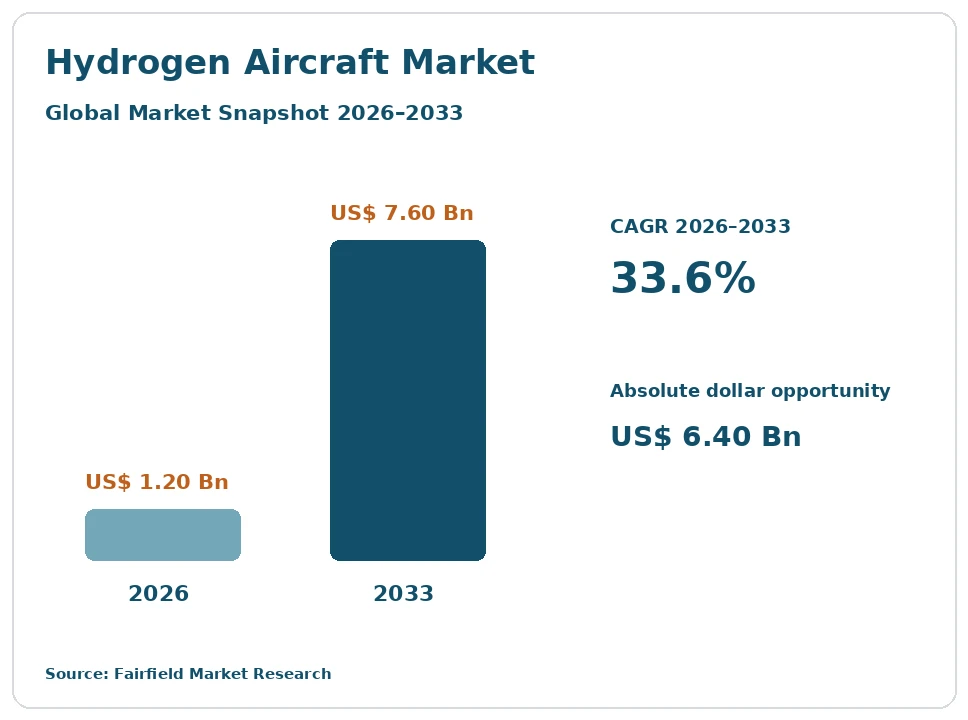
The global hydrogen aircraft market size is expected to be valued at US$ 1.20 billion in 2026 and projected to reach US$ 7.60 billion by 2033, growing at a CAGR of 33.6% between 2026 and 2033.
Between 2020 and 2025, the market grew at a CAGR of about 28.4%, from a small base, as governments in Europe and the United Kingdom funded hydrogen flight research, startups flew the first hydrogen-electric demonstrators, and airlines signed conditional engine orders. The hydrogen aircraft market covers aircraft, powertrains, fuel cell systems, hydrogen combustion engines, cryogenic tanks, and related development and demonstration programs for planes that use hydrogen instead of jet fuel, from small drones and air taxis to regional and future short-haul airliners. Current revenue comes mainly from research contracts, prototypes, retrofit programs, and component development rather than airline deliveries. Hydrogen-electric propulsion produces only water vapor at the point of use, offering a path to zero-emission aviation. Growth comes from climate targets, public funding, and progress in fuel cells and tanks. The market is shifting toward certification and larger power systems. In April 2026, the FAA published special conditions for ZeroAvia’s electric engine.
Key Report Takeaways
- By Propulsion: Hydrogen Fuel Cell held 55.6% share in 2025, while Hydrogen Combustion is projected to expand at a 34.4% CAGR through 2033, driven by engine makers adapting gas turbines to burn hydrogen for larger aircraft that need high power and longer range.
- By Range: Short Haul held about 48.8% share in 2025, while Medium Haul is projected to expand at a 34.5% CAGR through 2033, driven by regional jet concepts, improved liquid hydrogen tanks, and airline plans for routes of up to 1,000 nautical miles.
- By Application: Commercial Aviation held 52% share in 2025, while Military Aviation is projected to expand at a 34.8% CAGR through 2033, driven by defense research into quiet, low-signature drones and fuel cell vertical take-off demonstrators funded by air forces.
- By Region: Europe held about 40% share in 2025, while Asia Pacific is projected to expand at a 35.5% CAGR through 2033, driven by hydrogen strategies in Japan, South Korea, China, and Australia and new airport hydrogen partnerships.
Global Hydrogen Aircraft Market Trends and Insights
Drivers Impact Analysis
Two drivers carry the strongest influence on hydrogen aircraft market demand during the forecast period.
| Driver | Impact on CAGR Forecast | Geographic Relevance | Impact Timeline |
| Aviation decarbonization targets and policy support | High | Europe, North America, Asia Pacific | Long term (≥4 years) |
| Advances in fuel cells, tanks, and electric motors | Medium | Global | Medium term (2-4 years) |
Decarbonization Targets Are Driving the Hydrogen Aircraft Market
Aviation decarbonization targets and policy support are the strongest driver of the hydrogen aircraft market. Airlines must cut emissions.
The mechanism is pressure on aviation to reach net zero by 2050. Aviation produces about 2.5% of global carbon dioxide emissions and more when other effects are included, and the International Civil Aviation Organization has set a long-term net-zero goal. The European Union and the United Kingdom fund hydrogen flight through programs such as Clean Aviation and the Aerospace Technology Institute, and hydrogen strategies in Japan, South Korea, and Australia include aviation. Sustainable aviation fuel alone may not scale fast enough, so hydrogen is seen as an important option for regional flights. Airlines such as American Airlines, Alaska Airlines, and United Airlines have signed conditional orders or investments with hydrogen startups. These policies support steady funding for development and demonstrators.
Technology Advances Are Expanding the Hydrogen Aircraft Market
Advances in fuel cells, tanks, and electric motors are expanding the hydrogen aircraft market. Better parts make hydrogen flight practical.
The cause is fast progress in key technologies. Fuel cell stacks are becoming lighter and more powerful, and the Aerostack joint venture reportedly cut stack mass by 30% since 2024. Liquid hydrogen tanks made of composites reduce weight. Megawatt-class electric motors and power electronics are being flight tested. Airbus is testing a 2 MW hydrogen pod. Combustion research by Rolls-Royce and easyJet has run jet engines on hydrogen in ground tests, and Pratt & Whitney is developing a hydrogen steam-injected engine concept. Digital design tools and new materials help reduce development time. Battery and electric motor know-how from the electric car industry also transfers to aviation. These advances raise confidence and investment across the industry.
Restraints Impact Analysis
Two restraints limit how quickly the hydrogen aircraft market grows.
| Restraint | Impact on CAGR Forecast | Geographic Relevance | Impact Timeline |
| Lack of hydrogen airport infrastructure and supply | High | Global | Long term (≥4 years) |
| Certification challenges and long development timelines | High | Europe, North America | Long term (≥4 years) |
Infrastructure Gaps Slow the Hydrogen Aircraft Market
A lack of hydrogen airport infrastructure and supply slows the hydrogen aircraft market. Airports cannot yet fuel hydrogen planes.
The specific causes are the cost of producing, storing, and delivering green hydrogen. Liquid hydrogen must be kept at minus 253°C, requiring new storage, pipelines, and refueling equipment at airports. Green hydrogen made from renewable power remains expensive and scarce. Airports need years to plan and build facilities, and safety rules for handling hydrogen near aircraft are still being written. Without fuel supply, airlines hesitate to commit to aircraft, and hydrogen producers hesitate to build supply without aircraft demand, creating a chicken-and-egg problem. Some airports in Europe, Japan, and the United States have started hydrogen hub studies, but few have firm investment plans. Gaseous hydrogen for small aircraft can be trucked in, but large aircraft need liquid hydrogen at scale. These factors slow adoption.
Certification Challenges Restrict the Hydrogen Aircraft Market
Certification challenges and long development timelines restrict the hydrogen aircraft market. New technology takes years to approve.
The underlying causes are the novelty of hydrogen propulsion. Regulators must write new rules for fuel cells, tanks, and electric engines. Airbus has pushed entry into service of its hydrogen airliner to 2040 to 2045. Several startups have struggled to raise funds, and Universal Hydrogen shut down in 2024 after failing to secure new investment. Investors worry about long timelines before revenue, and some airlines have shifted focus to sustainable aviation fuel. Testing and certifying a new propulsion system can cost hundreds of millions of dollars. Public funding may change with political priorities, and support programs can end before products reach the market. These factors restrict growth and raise risk for developers.
Market Opportunities
Regional Retrofit Programs Open a Fast-Growth Revenue Pool
Regional retrofit programs open a fast-growth revenue pool in the hydrogen aircraft market. Existing planes can be converted.
Powertrain makers can capture this opportunity. ZeroAvia is developing hydrogen-electric powertrains for aircraft such as the Cessna Caravan, Dornier 228, and ATR 72. Retrofits avoid designing new airframes and can enter service years earlier than all-new aircraft. Regional airlines operate thousands of turboprops that could be converted, and American Airlines has signed a conditional order for up to 100 hydrogen-electric engines from ZeroAvia. Short, busy regional routes with frequent flights in Scotland, Norway, and New Zealand are early targets. Public grants in the United Kingdom and the European Union support flight testing. Companies with certified powertrains and airline partners can win orders.
Hydrogen Drones and Air Taxis Create a Growth Revenue Pool
Hydrogen drones and air taxis create a growth revenue pool in the hydrogen aircraft market. Fuel cells extend flight time.
Developers can capture this opportunity. Hydrogen drones fly several times longer than battery drones, making them useful for pipeline inspection, mapping, search and rescue, and cargo delivery. Joby Aviation flew a hydrogen-electric air taxi demonstrator over 500 miles, and Piasecki Aircraft is developing a hydrogen fuel cell VTOL aircraft under a US$ 37 million AFWERX contract. Small aircraft are easier to certify, need less hydrogen, and can use gaseous fuel from simple refueling trailers. Many logistics and energy companies want drones that can fly for hours over remote sites. Military users value quiet operation and low heat signatures for long missions. Companies serving cargo, inspection, and defense users can grow quickly.
Segment Analysis
By Propulsion: Hydrogen Fuel Cell Leads While Hydrogen Combustion Grows Fastest
Hydrogen Fuel Cell held 55.6% share in 2025. Fuel cells convert hydrogen to electricity that drives motors and propellers, producing only water and offering high efficiency and quiet operation. They suit small and regional aircraft, drones, and air taxis, and most current demonstrators, including those from ZeroAvia, H2FLY, and Airbus, use fuel cells.
Hydrogen Combustion is the fastest-growing propulsion type, expanding at a 34.4% CAGR through 2033. Engine makers such as Rolls-Royce, GE Aerospace, and Pratt & Whitney are adapting gas turbines to burn hydrogen, which offers high power for larger aircraft and longer routes. Combustion avoids heavy fuel cell systems but produces some nitrogen oxides. For the market, combustion growth supports larger aircraft.
By Range: Short Haul Leads While Medium Haul Grows Fastest
Short Haul held about 48.8% share in 2025. Most demonstrators and early commercial plans focus on short routes of a few hundred kilometers, where hydrogen tanks and fuel cells are most practical. Island hops, regional connections, and cargo routes are early targets, and small aircraft such as the Dornier 228 and Cessna Caravan fit this range.
Medium Haul is the fastest-growing range, expanding at a 34.5% CAGR through 2033. Regional jet concepts such as Airbus’s 100-seat design target routes of up to about 1,000 nautical miles, and better liquid hydrogen tanks make longer range possible. Long-haul flights remain far off because hydrogen takes up much more space than jet fuel. For the market, medium-haul growth adds value.
By Application: Commercial Aviation Leads While Military Aviation Grows Fastest
Commercial Aviation held 52% share in 2025. Airlines, airframers, and engine makers fund most programs, aiming at passenger services on regional routes. Commercial aviation faces the strongest pressure to cut emissions, and airline orders and investments support startups. Paid passenger services on short routes are expected to be the first paid hydrogen flights, starting with small regional planes and later moving to larger aircraft.
Military Aviation is the fastest-growing application, expanding at a 34.8% CAGR through 2033. Air forces fund demonstrators for quiet, long-endurance drones and vertical take-off aircraft, and hydrogen offers low heat and noise signatures for these missions. Cargo and freight and general aviation form other applications. For the market, military growth adds funding.
Geography Analysis
Hydrogen Aircraft Market in North America Is Driven by Startups and Defense
North America held 32.7% share in 2025. The United States hosts startups such as ZeroAvia, which also operates in the United Kingdom, and Joby Aviation, along with Boeing, GE Aerospace, and Pratt & Whitney. NASA and the U.S. Air Force fund hydrogen research, and Alaska Airlines and American Airlines have partnered with startups. Several states offer clean fuel incentives, and the FAA is writing rules for hydrogen-electric engines. Universities and national labs research fuel cells and tanks. Key barriers include fuel supply and a lack of airport refueling sites. One change shaping the region is FAA rulemaking.
Which Region Is Leading the Hydrogen Aircraft Market?
Europe is leading the hydrogen aircraft market with about 40% share in 2025. Airbus, Rolls-Royce, GKN Aerospace, H2FLY, and Pipistrel lead research and flight testing. The European Union’s Clean Aviation program and the United Kingdom’s Aerospace Technology Institute provide large grants, and airports in Germany, France, and the Netherlands study hydrogen hubs. Airlines such as easyJet support research and set climate goals. Many universities across the region run hydrogen research centers and test sites. Key barriers include delays to large aircraft programs. One change shaping the region is Clean Aviation funding.
Which Region Is Growing Fastest in the Hydrogen Aircraft Market?
Asia Pacific is growing fastest in the hydrogen aircraft market, expanding at a 35.5% CAGR through 2033. Japan, China, South Korea, Australia, and New Zealand invest in hydrogen aviation. Airbus has partnered with Kansai Airports in Japan on hydrogen, and China is building green hydrogen and aviation fuel projects. Air New Zealand plans zero-emission regional flights. Governments see hydrogen as a key part of their energy plans, and large industrial groups are building production capacity. Key barriers include infrastructure gaps and high hydrogen costs at airports. One change shaping the region is airport partnerships.
Latin America Grows the Hydrogen Aircraft Market Through Green Hydrogen Potential
Latin America is a small hydrogen aircraft market. Brazil and Chile have strong green hydrogen potential from cheap solar and wind power, and Embraer in Brazil studies hydrogen and electric aircraft concepts through its Energia program. Regional routes in remote areas could suit small hydrogen aircraft. Large distances and many small airports make regional aviation important in the region. Some airlines are studying cleaner aircraft for short routes, and research groups work with partners in Europe. Green hydrogen export projects could later supply fuel to local airports. Key barriers include funding and weak policy support. One opportunity is green hydrogen.
Middle East & Africa Develops the Hydrogen Aircraft Market Through Hydrogen Hubs
Middle East & Africa is a developing hydrogen aircraft market. Saudi Arabia and the United Arab Emirates build large green hydrogen hubs, such as NEOM in Saudi Arabia, that could supply aviation in the future. South Africa and Morocco have renewable energy potential for hydrogen exports. Airlines in the region focus on sustainable aviation fuel. Large airlines in the region are growing fast and want cleaner fuels over time. Airports in the region are building new terminals that could include future hydrogen facilities. Key barriers include few programs and limited local research. One change shaping the region is hub investment.
Competitive Landscape
The hydrogen aircraft market is highly consolidated. Airbus, Boeing, ZeroAvia, Rolls-Royce, and GE Aerospace are leading players, holding about 79% of the market together, with Airbus alone at about 34.3%. Pratt & Whitney, GKN Aerospace, Intelligent Energy, ElringKlinger, H2FLY, owned by Joby Aviation, Pipistrel, part of Textron, and Piasecki Aircraft compete strongly, and startups such as Universal Hydrogen showed both the promise and the funding risks of the sector before closing in 2024. Universities and research centers in Germany, the United Kingdom, and the Netherlands play a large role.
Companies compete on power density, fuel cell efficiency, tank weight, safety, certification progress, partnerships with airlines and airports, and access to public funding. Large airframers and engine makers bring certification experience and deep budgets, while startups move faster with retrofit powertrains for small and regional aircraft. Liquid hydrogen storage and thermal management are key technical battlegrounds, and partnerships with hydrogen producers and airports are increasingly important.
Strategic moves show how competition is changing. In July 2024, GKN Aerospace launched the H2FlyGHT project to build a 2 MW cryogenic hydrogen-electric system. In March 2026, Airbus confirmed feasibility of a 100-seat fuel cell concept and began flight testing a hydrogen pod, while pushing entry into service toward 2040 to 2045. In April 2026, the FAA published special conditions for ZeroAvia’s electric engine. These moves show competition shifting from concept studies to certification and flight testing.
Three themes shape vendor strategy. First, companies are pursuing certification of megawatt-class hydrogen-electric powertrains. Second, they are partnering with airports and energy companies to build hydrogen supply. Third, they are expanding in Asia Pacific, where Japan, South Korea, and China fund hydrogen aviation programs.
Hydrogen Aircraft Market Industry Leaders
- Airbus
- Boeing
- ZeroAvia
- Rolls-Royce
- GE Aerospace
Recent Industry Developments
- April 2026: The U.S. Federal Aviation Administration published special conditions for ZeroAvia’s 600 kW electric engine as a final rule, a major step toward type certification - advances hydrogen-electric propulsion toward commercial service.
- March 2026: Airbus confirmed feasibility of a 100-seat hydrogen fuel cell regional concept with four 2 MW pods and began a flight campaign with a hydrogen pod on its A380 testbed, while targeting entry into service around 2040 to 2045 - sets the long-term path for the hydrogen aircraft market.
- July 2024: GKN Aerospace started the H2FlyGHT project, valued at about US$ 54.5 million, to design a 2 MW cryogenic hydrogen-electric propulsion system - supports zero-emission aviation technology.
Companies Covered in the Report
- Airbus
- Boeing
- ZeroAvia
- Rolls-Royce
- GE Aerospace
- Pratt & Whitney
- GKN Aerospace
- Intelligent Energy
- ElringKlinger
- H2FLY (Joby Aviation)
- Pipistrel (Textron)
- Piasecki Aircraft
Hydrogen Aircraft Market Scope
This report covers the hydrogen aircraft market, including hydrogen fuel cell and hydrogen combustion propulsion, for short-haul, medium-haul, and long-haul aircraft, used in commercial aviation, cargo and freight aviation, military aviation, and general aviation, including powertrains, tanks, demonstrators, and retrofit programs. The base year is 2025, and the forecast period runs from 2026 to 2033. All values are expressed in US$ Billion.
| Metric | Value |
| Study Period | 2020-2033 |
| Market Size 2026 | US$ 1.20 Billion |
| Market Size 2033 | US$ 7.60 Billion |
| CAGR 2026-2033 | 33.6% |
| Absolute Dollar Opportunity | US$ 6.40 Billion |
| Largest Market | Europe |
| Fastest-Growing Market | Asia Pacific |
| Market Concentration | Highly Consolidated |
| Major Players | Airbus, Boeing, ZeroAvia, Rolls-Royce, GE Aerospace |
Propulsion
- Hydrogen Fuel Cell
- Hydrogen Combustion
Range
- Short Haul
- Medium Haul
- Long Haul
Application
- Commercial Aviation
- Cargo and Freight Aviation
- Military Aviation
- General Aviation
Regions
- North America
- Europe
- Asia Pacific
- Latin America
- Middle East & Africa
1. Executive Summary
1.1. Global Hydrogen Aircraft Market Snapshot
1.2. Future Projections, 2026-2033
1.3. Key Market Trends
1.4. Regional Snapshot
2. Market Overview
2.1. Market Definition and Scope
2.2. Historical Market Trends, 2020-2025
2.3. Market Dynamics
2.3.1. Drivers Impact Analysis
2.3.1.1. Decarbonization Targets Are Driving the Hydrogen Aircraft Market
2.3.1.2. Technology Advances Are Expanding the Hydrogen Aircraft Market
2.3.2. Restraints Impact Analysis
2.3.2.1. Infrastructure Gaps Slow the Hydrogen Aircraft Market
2.3.2.2. Certification Challenges Restrict the Hydrogen Aircraft Market
2.3.3. Market Opportunities
2.3.3.1. Regional Retrofit Programs Open a Fast-Growth Revenue Pool
2.3.3.2. Hydrogen Drones and Air Taxis Create a Growth Revenue Pool
3. Global Hydrogen Aircraft Market Outlook, 2020-2033
3.1. Global Hydrogen Aircraft Market Outlook, by Propulsion, Value (US$ Billion), 2020-2033
3.1.1. Hydrogen Fuel Cell
3.1.2. Hydrogen Combustion
3.2. Global Hydrogen Aircraft Market Outlook, by Range, Value (US$ Billion), 2020-2033
3.2.1. Short Haul
3.2.2. Medium Haul
3.2.3. Long Haul
3.3. Global Hydrogen Aircraft Market Outlook, by Application, Value (US$ Billion), 2020-2033
3.3.1. Commercial Aviation
3.3.2. Cargo and Freight Aviation
3.3.3. Military Aviation
3.3.4. General Aviation
3.4. Global Hydrogen Aircraft Market Outlook, by Region, Value (US$ Billion), 2020-2033
3.4.1. North America
3.4.2. Europe
3.4.3. Asia Pacific
3.4.4. Latin America
3.4.5. Middle East & Africa
4. North America Hydrogen Aircraft Market Outlook, 2020-2033
4.1. North America Hydrogen Aircraft Market Outlook, by Propulsion, Value (US$ Billion), 2020-2033
4.1.1. Hydrogen Fuel Cell
4.1.2. Hydrogen Combustion
4.2. North America Hydrogen Aircraft Market Outlook, by Range, Value (US$ Billion), 2020-2033
4.2.1. Short Haul
4.2.2. Medium Haul
4.2.3. Long Haul
4.3. North America Hydrogen Aircraft Market Outlook, by Application, Value (US$ Billion), 2020-2033
4.3.1. Commercial Aviation
4.3.2. Cargo and Freight Aviation
4.3.3. Military Aviation
4.3.4. General Aviation
4.4. North America Hydrogen Aircraft Market Outlook, by Country, Value (US$ Billion), 2020-2033
4.4.1. United States Hydrogen Aircraft Market Outlook, by Propulsion, 2020-2033
4.4.2. United States Hydrogen Aircraft Market Outlook, by Range, 2020-2033
4.4.3. United States Hydrogen Aircraft Market Outlook, by Application, 2020-2033
5. Europe Hydrogen Aircraft Market Outlook, 2020-2033
5.1. Europe Hydrogen Aircraft Market Outlook, by Propulsion, Value (US$ Billion), 2020-2033
5.1.1. Hydrogen Fuel Cell
5.1.2. Hydrogen Combustion
5.2. Europe Hydrogen Aircraft Market Outlook, by Range, Value (US$ Billion), 2020-2033
5.2.1. Short Haul
5.2.2. Medium Haul
5.2.3. Long Haul
5.3. Europe Hydrogen Aircraft Market Outlook, by Application, Value (US$ Billion), 2020-2033
5.3.1. Commercial Aviation
5.3.2. Cargo and Freight Aviation
5.3.3. Military Aviation
5.3.4. General Aviation
5.4. Europe Hydrogen Aircraft Market Outlook, by Country, Value (US$ Billion), 2020-2033
5.4.1. United Kingdom Hydrogen Aircraft Market Outlook, by Propulsion, 2020-2033
5.4.2. United Kingdom Hydrogen Aircraft Market Outlook, by Range, 2020-2033
5.4.3. United Kingdom Hydrogen Aircraft Market Outlook, by Application, 2020-2033
5.4.4. Germany Hydrogen Aircraft Market Outlook, by Propulsion, 2020-2033
5.4.5. Germany Hydrogen Aircraft Market Outlook, by Range, 2020-2033
5.4.6. Germany Hydrogen Aircraft Market Outlook, by Application, 2020-2033
5.4.7. France Hydrogen Aircraft Market Outlook, by Propulsion, 2020-2033
5.4.8. France Hydrogen Aircraft Market Outlook, by Range, 2020-2033
5.4.9. France Hydrogen Aircraft Market Outlook, by Application, 2020-2033
5.4.10. Netherlands Hydrogen Aircraft Market Outlook, by Propulsion, 2020-2033
5.4.11. Netherlands Hydrogen Aircraft Market Outlook, by Range, 2020-2033
5.4.12. Netherlands Hydrogen Aircraft Market Outlook, by Application, 2020-2033
6. Asia Pacific Hydrogen Aircraft Market Outlook, 2020-2033
6.1. Asia Pacific Hydrogen Aircraft Market Outlook, by Propulsion, Value (US$ Billion), 2020-2033
6.1.1. Hydrogen Fuel Cell
6.1.2. Hydrogen Combustion
6.2. Asia Pacific Hydrogen Aircraft Market Outlook, by Range, Value (US$ Billion), 2020-2033
6.2.1. Short Haul
6.2.2. Medium Haul
6.2.3. Long Haul
6.3. Asia Pacific Hydrogen Aircraft Market Outlook, by Application, Value (US$ Billion), 2020-2033
6.3.1. Commercial Aviation
6.3.2. Cargo and Freight Aviation
6.3.3. Military Aviation
6.3.4. General Aviation
6.4. Asia Pacific Hydrogen Aircraft Market Outlook, by Country, Value (US$ Billion), 2020-2033
6.4.1. Japan Hydrogen Aircraft Market Outlook, by Propulsion, 2020-2033
6.4.2. Japan Hydrogen Aircraft Market Outlook, by Range, 2020-2033
6.4.3. Japan Hydrogen Aircraft Market Outlook, by Application, 2020-2033
6.4.4. China Hydrogen Aircraft Market Outlook, by Propulsion, 2020-2033
6.4.5. China Hydrogen Aircraft Market Outlook, by Range, 2020-2033
6.4.6. China Hydrogen Aircraft Market Outlook, by Application, 2020-2033
6.4.7. South Korea Hydrogen Aircraft Market Outlook, by Propulsion, 2020-2033
6.4.8. South Korea Hydrogen Aircraft Market Outlook, by Range, 2020-2033
6.4.9. South Korea Hydrogen Aircraft Market Outlook, by Application, 2020-2033
6.4.10. Australia Hydrogen Aircraft Market Outlook, by Propulsion, 2020-2033
6.4.11. Australia Hydrogen Aircraft Market Outlook, by Range, 2020-2033
6.4.12. Australia Hydrogen Aircraft Market Outlook, by Application, 2020-2033
6.4.13. New Zealand Hydrogen Aircraft Market Outlook, by Propulsion, 2020-2033
6.4.14. New Zealand Hydrogen Aircraft Market Outlook, by Range, 2020-2033
6.4.15. New Zealand Hydrogen Aircraft Market Outlook, by Application, 2020-2033
7. Latin America Hydrogen Aircraft Market Outlook, 2020-2033
7.1. Latin America Hydrogen Aircraft Market Outlook, by Propulsion, Value (US$ Billion), 2020-2033
7.1.1. Hydrogen Fuel Cell
7.1.2. Hydrogen Combustion
7.2. Latin America Hydrogen Aircraft Market Outlook, by Range, Value (US$ Billion), 2020-2033
7.2.1. Short Haul
7.2.2. Medium Haul
7.2.3. Long Haul
7.3. Latin America Hydrogen Aircraft Market Outlook, by Application, Value (US$ Billion), 2020-2033
7.3.1. Commercial Aviation
7.3.2. Cargo and Freight Aviation
7.3.3. Military Aviation
7.3.4. General Aviation
7.4. Latin America Hydrogen Aircraft Market Outlook, by Country, Value (US$ Billion), 2020-2033
7.4.1. Brazil Hydrogen Aircraft Market Outlook, by Propulsion, 2020-2033
7.4.2. Brazil Hydrogen Aircraft Market Outlook, by Range, 2020-2033
7.4.3. Brazil Hydrogen Aircraft Market Outlook, by Application, 2020-2033
7.4.4. Chile Hydrogen Aircraft Market Outlook, by Propulsion, 2020-2033
7.4.5. Chile Hydrogen Aircraft Market Outlook, by Range, 2020-2033
7.4.6. Chile Hydrogen Aircraft Market Outlook, by Application, 2020-2033
8. Middle East & Africa Hydrogen Aircraft Market Outlook, 2020-2033
8.1. Middle East & Africa Hydrogen Aircraft Market Outlook, by Propulsion, Value (US$ Billion), 2020-2033
8.1.1. Hydrogen Fuel Cell
8.1.2. Hydrogen Combustion
8.2. Middle East & Africa Hydrogen Aircraft Market Outlook, by Range, Value (US$ Billion), 2020-2033
8.2.1. Short Haul
8.2.2. Medium Haul
8.2.3. Long Haul
8.3. Middle East & Africa Hydrogen Aircraft Market Outlook, by Application, Value (US$ Billion), 2020-2033
8.3.1. Commercial Aviation
8.3.2. Cargo and Freight Aviation
8.3.3. Military Aviation
8.3.4. General Aviation
8.4. Middle East & Africa Hydrogen Aircraft Market Outlook, by Country, Value (US$ Billion), 2020-2033
8.4.1. Saudi Arabia Hydrogen Aircraft Market Outlook, by Propulsion, 2020-2033
8.4.2. Saudi Arabia Hydrogen Aircraft Market Outlook, by Range, 2020-2033
8.4.3. Saudi Arabia Hydrogen Aircraft Market Outlook, by Application, 2020-2033
8.4.4. United Arab Emirates Hydrogen Aircraft Market Outlook, by Propulsion, 2020-2033
8.4.5. United Arab Emirates Hydrogen Aircraft Market Outlook, by Range, 2020-2033
8.4.6. United Arab Emirates Hydrogen Aircraft Market Outlook, by Application, 2020-2033
8.4.7. South Africa Hydrogen Aircraft Market Outlook, by Propulsion, 2020-2033
8.4.8. South Africa Hydrogen Aircraft Market Outlook, by Range, 2020-2033
8.4.9. South Africa Hydrogen Aircraft Market Outlook, by Application, 2020-2033
8.4.10. Morocco Hydrogen Aircraft Market Outlook, by Propulsion, 2020-2033
8.4.11. Morocco Hydrogen Aircraft Market Outlook, by Range, 2020-2033
8.4.12. Morocco Hydrogen Aircraft Market Outlook, by Application, 2020-2033
9. Competitive Landscape
9.1. Industry Leaders
9.2. Recent Industry Developments
9.3. Company Profiles
9.3.1. Airbus
9.3.2. Boeing
9.3.3. ZeroAvia
9.3.4. Rolls-Royce
9.3.5. GE Aerospace
9.3.6. Pratt & Whitney
9.3.7. GKN Aerospace
9.3.8. Intelligent Energy
9.3.9. ElringKlinger
9.3.10. H2FLY (Joby Aviation)
9.3.11. Pipistrel (Textron)
9.3.12. Piasecki Aircraft
10. Appendix
10.1. Research Methodology
10.2. Report Assumptions
10.3. Acronyms and Abbreviations
| Segment | Categories |
| Propulsion | Hydrogen Fuel Cell, Hydrogen Combustion |
| Range | Short Haul, Medium Haul, Long Haul |
| Application | Commercial Aviation, Cargo and Freight Aviation, Military Aviation, General Aviation |
| Regions | North America, Europe, Asia Pacific, Latin America, Middle East & Africa |
Our Research Methodology
Considering the volatility of business today, traditional approaches to strategizing a game plan can be unfruitful if not detrimental. True ambiguity is no way to determine a forecast. A myriad of predetermined factors must be accounted for such as the degree of risk involved, the magnitude of circumstances, as well as conditions or consequences that are not known or unpredictable. To circumvent binary views that cast uncertainty, the application of market research intelligence to strategically posture, move, and enable actionable outcomes is necessary.
View Methodology
Quality Assured
Rigorous Validation Process

Confidentiality Assured
End-to-end Data Security

Custom Research Services
Tailored To Your Objectives
FAQs
The hydrogen aircraft market is valued at US$ 1.20 billion in 2026, led by fuel cell propulsion and Europe.
The market is projected to reach US$ 7.60 billion by 2033, growing at a 33.6% CAGR and adding US$ 6.40 billion.
Hydrogen combustion is growing fastest at a 34.4% CAGR through 2033, driven by turbine makers adapting engines for larger aircraft.
Asia Pacific is growing fastest at a 35.5% CAGR through 2033, driven by national hydrogen strategies and airport hydrogen partnerships.
Europe holds the largest share at about 40% in 2025, supported by Airbus, Rolls-Royce, and strong public research funding.
Related Reports
Leisure Boat Market Size, Share, Insights, Competitive Landscape, and Forecast 2026 to 2033
The leisure boat market is projected to grow from US$ 53.90 billion in 2026 to US$ 81.04 billion by 2033 at a 6.0% CAGR.
Exhaust Flexible Couplings Market Size, Share, Insights, Competitive Landscape, and Forecast 2026 to 2033
The exhaust flexible couplings market is projected to grow from US$ 756.4 million in 2026 to US$ 1,057.3 million by 2033 at a 4.9% CAGR.
Automotive VVT System Market Size, Share, Insights, Competitive Landscape, and Forecast 2026 to 2033
The automotive VVT system market is projected to grow from US$ 77.20 billion in 2026 to US$ 118.42 billion by 2033 at a 6.3% CAGR.
Used Vehicle Market Size, Share, Insights, Competitive Landscape, and Forecast 2026 to 2033
The global used vehicle market is valued at US$1.7 trillion in 2026, reaching US$2.6 trillion by 2033, growing at a 6.3% CAGR
Logistics Market Size, Share, Insights, Competitive Landscape, and Forecast 2026 to 2033
The global logistics market is valued at US$3.7 trillion in 2026, reaching US$6.1 trillion by 2033, growing at a 7.4% CAGR
Hypercar Market Size, Share, Insights, Competitive Landscape, and Forecast 2026 to 2033
The global hypercar market is valued at US$18.1 billion in 2026, reaching US$60.8 billion by 2033, growing at an 18.9% CAGR