



In-Vehicle Payment Services Market
In-Vehicle Payment Services Market Size, Share, Insights, Competitive Landscape, and Forecast 2026 to 2033
In-Vehicle Payment Services Market Snapshot
How Fast Is the In-vehicle Payment Services Market Growing?
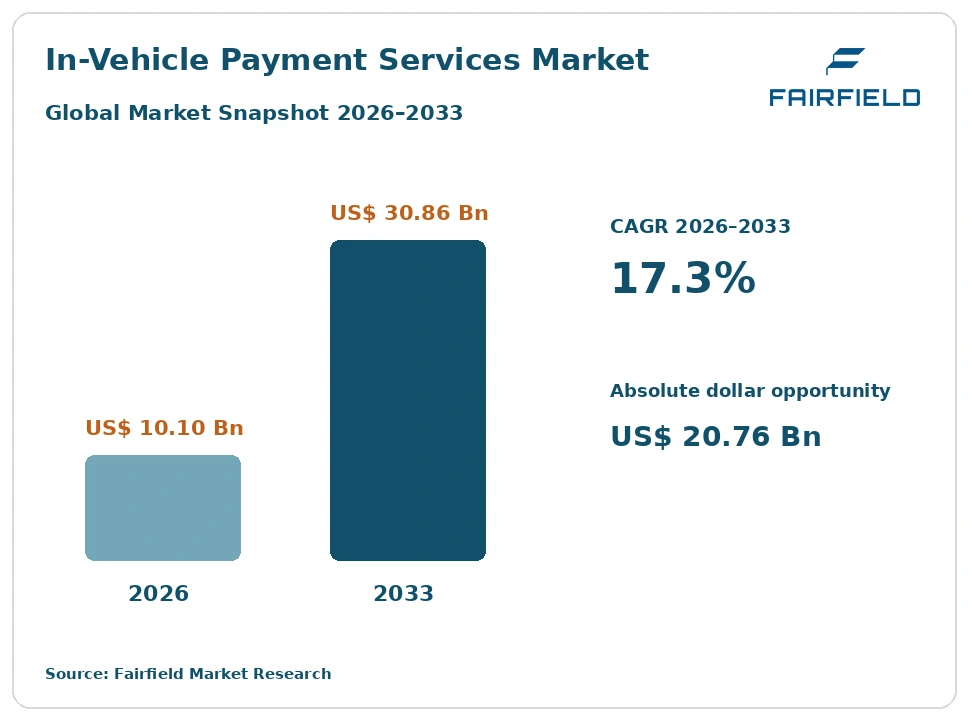
The global in-vehicle payment services market size is expected to be valued at US$ 10.10 billion in 2026 and projected to reach US$ 30.86 billion by 2033, growing at a CAGR of 17.3% between 2026 and 2033.
Between 2020 and 2025, the market grew at a CAGR of about 15.8%, as car sales dipped in 2020 but contactless payments surged, and automakers then rolled out connected infotainment systems that support built-in payments. The in-vehicle payment services market covers services that let drivers pay for fuel, electric vehicle charging, parking, tolls, food, coffee, and shopping directly from the car’s dashboard, using stored cards, digital wallets, NFC, QR codes, RFID tags, or fingerprint authorization. It includes payment platforms, apps, tokenization, and partnerships between automakers, card networks, technology companies, and merchants. These connected car payments reduce stops at counters and make in-car commerce part of the driving experience. Growth comes from connected car adoption, contactless payment habits, and electric vehicle charging networks. In June 2026, Parkopedia and BYD unveiled an in-car parking payment service for drivers in Europe.
Key Report Takeaways
- By Mode of Payment: Credit and Debit Cards held about 36% share in 2025, while App and E-Wallet is projected to expand at a 20.1% CAGR through 2033, driven by smartphone wallet habits, tokenized payments, and apps built into car infotainment systems.
- By Application: Gas and Charging Stations held about 31% share in 2025, while Parking is projected to expand at a 19.4% CAGR through 2033, driven by city parking apps, in-car notifications, and automaker partnerships with parking platforms.
- By Vehicle Type: Passenger Cars held about 79% share in 2025, while Commercial Vehicles is projected to expand at an 18.6% CAGR through 2033, driven by fleet fuel cards, tolling, and charging payments managed through connected fleet platforms.
- By Region: North America held about 38% share in 2025, while Asia Pacific is projected to expand at a 19.6% CAGR through 2033, driven by connected car growth, digital wallets, and electric vehicle adoption in China, India, and South Korea.
Global In-vehicle Payment Services Market Trends and Insights
Drivers Impact Analysis
Two drivers carry the strongest influence on in-vehicle payment services market demand during the forecast period.
| Driver | Impact on CAGR Forecast | Geographic Relevance | Impact Timeline |
| Rising connected car adoption and built-in infotainment | High | Global | Long term (≥4 years) |
| Growth of electric vehicle charging and contactless payments | Medium | Europe, Asia Pacific, North America | Medium term (2-4 years) |
Connected Cars Are Driving the In-vehicle Payment Services Market
Rising connected car adoption and built-in infotainment are the strongest driver of the in-vehicle payment services market. Cars are becoming payment devices.
The mechanism is the spread of always-online vehicles. Most new cars in North America, Europe, and China now ship with mobile connections, large touchscreens, and operating systems such as Android Automotive that can run payment apps. Automakers see payments as a way to earn recurring revenue from services and subscriptions after the sale, and to keep drivers inside their own apps. Card networks and technology companies provide tokenization and secure authentication, so stored cards can be used safely from the dashboard. Fingerprint sensors make paying quick. Over-the-air updates let automakers add payment features to cars already on the road. As connected cars replace older models, the number of payment-ready vehicles rises, supporting long-term demand.
Charging and Contactless Habits Are Expanding the In-vehicle Payment Services Market
Growth of electric vehicle charging and contactless payments is expanding the in-vehicle payment services market. Drivers want easier ways to pay.
The cause is a shift in how drivers buy energy and services. Electric vehicle drivers often deal with many charging networks, apps, and cards, which is frustrating. Plug-and-charge and in-car payment let the car identify itself and pay automatically, removing extra steps. Electric vehicle sales are rising quickly in China, Europe, and the United States, and public charging networks are expanding. At the same time, the pandemic made contactless payments normal, and younger drivers expect to pay with a tap or a fingerprint. Fuel stations, parking operators, toll roads, and drive-through restaurants are adding digital payment links to attract drivers. These trends expand sales across major markets.
Restraints Impact Analysis
Two restraints limit how quickly the in-vehicle payment services market grows.
| Restraint | Impact on CAGR Forecast | Geographic Relevance | Impact Timeline |
| Data security, privacy, and fraud concerns | High | Global | Long term (≥4 years) |
| Fragmented platforms and limited merchant acceptance | Medium | Asia Pacific, Latin America, Middle East & Africa | Medium term (2-4 years) |
Security Concerns Slow the In-vehicle Payment Services Market
Data security, privacy, and fraud concerns slow the in-vehicle payment services market. Drivers worry about cars storing payment data.
The specific causes are cyber risks and data rules. Connected cars collect location, driving behavior, and payment information, making them targets for hackers. A security breach could expose card data or allow unauthorized purchases. Regulators are tightening rules on vehicle cybersecurity and data protection, such as the UN vehicle cybersecurity regulation and privacy laws in Europe and the United States, which add costs for automakers and service providers. Payment systems must meet strict card industry standards and strong customer authentication rules. Surveys show some drivers distrust automakers with financial data, and shared or rented cars raise questions about who is paying. These factors slow adoption, especially among older drivers and in markets with low trust in digital payments.
Fragmentation Restricts the In-vehicle Payment Services Market
Fragmented platforms and limited merchant acceptance restrict the in-vehicle payment services market. Each automaker builds its own system.
The underlying causes are a lack of common standards. Different automakers use different apps, wallets, and partners, so a service available in one brand may not work in another. Merchants such as fuel stations and parking operators must connect to many platforms, which is costly. Many smaller merchants are not connected at all, limiting where drivers can pay. In India, Brazil, Indonesia, and Nigeria, connected car rates are lower and local payment methods differ. Drivers often find using their phone easier, especially with phone mirroring systems such as Apple CarPlay and Android Auto, which bypass automaker apps. Revenue sharing between automakers, card networks, and merchants is also hard to agree. These factors restrict growth.
Market Opportunities
Electric Vehicle Charging Payments Open a Fast-Growth Revenue Pool
Electric vehicle charging payments open a fast-growth revenue pool in the in-vehicle payment services market. Every charge is a transaction.
Providers can capture this opportunity. Electric vehicle drivers charge many times a month, often at networks run by different companies, and want one simple way to pay. In-car payment systems that find chargers, start sessions, and pay automatically can solve this problem. Standards such as plug-and-charge, along with partnerships between automakers and charging networks in Europe, North America, and China, are spreading. Fleet operators also need simple charging payment and reporting for electric vans and trucks. Charging payments can be bundled with parking and route planning. Companies that offer seamless charging payments across many networks can earn transaction fees and build loyal customers.
Fleet and Commercial Payments Create a Growth Revenue Pool
Fleet and commercial payments create a growth revenue pool in the in-vehicle payment services market. Fleets need control over spending.
Providers can capture this opportunity. Delivery, logistics, ride-hailing, and service fleets pay for fuel, charging, tolls, parking, and maintenance every day, and managers need to track and control these costs. Vehicle-based payments linked to telematics can confirm that the right vehicle is buying the right fuel at the right place, reducing fraud. Fleet growth from online shopping in North America, Europe, and Asia Pacific supports demand. Electric fleets add charging payments at depots and public stations, which must be tracked by vehicle and driver. Fuel card companies are partnering with automakers to move their cards into the dashboard. Companies offering vehicle wallets, fleet controls, and reporting can win long contracts.
Segment Analysis
By Mode of Payment: Credit and Debit Cards Lead While App and E-Wallet Grows Fastest
Credit and Debit Cards held about 36% share in 2025. Most in-car payment services link to a stored card in the driver’s profile, using tokenization from Visa and Mastercard to keep card numbers safe. Card payments are widely accepted by fuel stations, parking operators, and toll roads, and drivers trust them. Automakers such as Mercedes-Benz use card-on-file technology with fingerprint confirmation on the dashboard.
App and E-Wallet is the fastest-growing mode, expanding at a 20.1% CAGR through 2033. Digital wallets such as Google Pay, Alipay, and automaker-branded wallets are being built into car infotainment systems, and drivers who already use wallets on phones expect the same in cars. China has very high wallet use. NFC, QR code, and RFID methods form other segments, with RFID widely used for tolls. For the market, wallet growth adds users.
By Application: Gas and Charging Stations Lead While Parking Grows Fastest
Gas and Charging Stations held about 31% share in 2025. Fuel purchases are frequent and high in value, and automakers have partnered with fuel networks to let drivers pay at the pump from the car. Electric vehicle charging is a fast-rising share of this segment as charging networks add in-car payment and plug-and-charge features. Toll collection also forms a large application.
Parking is the fastest-growing application, expanding at a 19.4% CAGR through 2033. Drivers struggle to find and pay for parking in cities, and services that detect parking locations and invite payment on screen save time. Partnerships between automakers and parking platforms such as Parkopedia are spreading. Food and coffee, shopping, and other uses form further applications. For the market, parking growth adds transaction volume.
By Vehicle Type: Passenger Cars Lead While Commercial Vehicles Grow Fastest
Passenger Cars held about 79% share in 2025. Most connected cars with large touchscreens and payment features are passenger vehicles, and premium brands such as Mercedes-Benz, BMW, Audi, and Tesla were early adopters. Mass-market brands such as Hyundai, Kia, General Motors, and BYD are adding payment services, spreading them to more drivers.
Commercial Vehicles is the fastest-growing vehicle type, expanding at an 18.6% CAGR through 2033. Trucks, vans, buses, and ride-hailing vehicles pay for fuel, charging, tolls, and parking daily, and fleet managers want automatic payments with spending controls and reports linked to telematics. Electric delivery vans need simple charging payments. For the market, commercial growth adds high-frequency transactions.
Geography Analysis
Which Region Is Leading the In-vehicle Payment Services Market?
North America is leading the in-vehicle payment services market with about 38% share in 2025. The United States has high connected car rates, widespread card and wallet use, and major technology and payment companies such as Google, Amazon, Apple, Visa, and Mastercard. Automakers such as General Motors, Ford, and Hyundai offer in-car payment for fuel, parking, and food, and parking platforms cover thousands of locations. Electric vehicle charging networks are expanding across the country. Canada adds connected car and charging demand. Key barriers include privacy concerns and fragmented automaker platforms. One change shaping the region is the spread of Android Automotive and built-in wallets.
Europe Shapes the In-vehicle Payment Services Market Through Premium Automakers
Europe is a major in-vehicle payment services market. Germany, the United Kingdom, France, Belgium, the Netherlands, and Norway have high connected car and electric vehicle adoption. Mercedes-Benz, BMW, Volkswagen, and Audi offer in-car payments for fuel, parking, and charging, and in August 2025, Mercedes-Benz launched fingerprint-based fuel payments with Mastercard in Belgium. Parking platforms such as EasyPark and RingGo operate widely. Strong authentication rules raise security. Key barriers include strict data protection rules and many different payment systems across countries. One opportunity is cross-border charging and parking payments.
Which Region Is Growing Fastest in the In-vehicle Payment Services Market?
Asia Pacific is growing fastest in the in-vehicle payment services market, expanding at a 19.6% CAGR through 2033. China is the largest car market in the world, with very high digital wallet use and fast electric vehicle growth, and automakers such as BYD and Tesla have added in-car payments through Alipay and other platforms. South Korea’s Hyundai and Kia, and Japan’s Toyota and Honda, are adding connected services. India has fast-growing digital payments and electronic toll tags. Key barriers include different local payment systems and lower connected car rates in some countries. One change shaping the region is electric vehicle charging growth.
Latin America Grows the In-vehicle Payment Services Market Through Digital Payments
Latin America is a growing in-vehicle payment services market. Brazil and Mexico have large car markets and fast-growing digital payment systems, including Brazil’s Pix instant payment system and electronic toll tags used on highways. Chile, Colombia, and Argentina add connected car demand. Global automakers are bringing connected services to new models, and fuel retailers are adding digital payment apps. Key barriers include lower connected car rates, older vehicles, currency swings, and security concerns. Ride-hailing and delivery fleets in São Paulo and Mexico City are growing. One opportunity is linking in-car payments to toll tags and fuel retailer apps that drivers already use.
Middle East & Africa Builds the In-vehicle Payment Services Market Through Smart Cities
Middle East & Africa is an emerging in-vehicle payment services market. The United Arab Emirates and Saudi Arabia are building smart city projects, digital toll systems, smart parking, and electric vehicle charging networks, and drivers buy many premium connected cars. Qatar and Israel add technology adoption. South Africa has growing digital payments and toll systems. Key barriers include limited merchant connections, lower connected car rates in many countries, and different payment rules. One opportunity is smart city parking and charging payments in Dubai, Abu Dhabi, and Riyadh.
Competitive Landscape
The in-vehicle payment services market is moderately fragmented. Mercedes-Benz, General Motors, Visa, Mastercard, and Google are leading players, while Amazon, PayPal, BMW, Volkswagen, Hyundai Motor, Ford Motor, and Parkopedia compete strongly. The market brings together automakers that control the dashboard, card networks and wallets that handle security and settlement, technology companies that supply operating systems, and service platforms that connect merchants such as parking operators, fuel stations, and charging networks.
Companies compete on ease of use, security, merchant coverage, integration with infotainment systems, and the range of services offered. Automakers want to own the customer relationship and earn recurring revenue, while technology companies want their wallets and operating systems in as many cars as possible. Partnerships are essential, because no single company controls the whole payment chain.
Strategic moves show how competition is changing. In October 2024, General Motors expanded its work with Google to bring Android Automotive and built-in features across its lineup. In August 2025, Mercedes-Benz launched fingerprint-based fuel payments with Mastercard in Belgium. In June 2026, Parkopedia and BYD unveiled ParkPay for drivers in Europe, with charging and tolling to follow. These moves show competition focused on partnerships and wider service coverage.
Three themes shape vendor strategy. First, companies are building payments into car operating systems rather than separate apps. Second, they are adding electric vehicle charging, parking, and tolling to one wallet. Third, they are expanding in Asia Pacific and Europe, where connected cars and electric vehicles are growing fastest.
In-vehicle Payment Services Market Industry Leaders
- Mercedes-Benz
- General Motors
- Visa
- Mastercard
Recent Industry Developments
- June 2026: Parkopedia and BYD unveiled ParkPay, an in-car parking payment service on Android Automotive for BYD drivers in Europe, with charging and tolling planned - expands connected car payments in the in-vehicle payment services market.
- August 2025: Mercedes-Benz launched in-car fuel payments with Mastercard in Belgium, letting drivers pay at the pump with a fingerprint on the dashboard - widens in-car commerce across Europe.
- October 2024: General Motors expanded its work with Google to bring Android Automotive with built-in payment features across its lineup - supports wider in-car payments in North America.
Companies Covered in the Report
- Mercedes-Benz
- General Motors
- Visa
- Mastercard
- Amazon
- PayPal
- BMW
- Volkswagen
- Hyundai Motor
- Ford Motor
- Parkopedia
In-vehicle Payment Services Market Scope
This report covers the in-vehicle payment services market, including payments made through credit and debit cards, apps and e-wallets, NFC, QR codes, and RFID, for gas and charging stations, parking, toll collection, food and coffee, shopping, and other uses, across passenger cars and commercial vehicles. The base year is 2025, and the forecast period runs from 2026 to 2033. All values are expressed in US$ Billion.
| Metric | Value |
| Study Period | 2020-2033 |
| Market Size 2026 | US$ 10.10 Billion |
| Market Size 2033 | US$ 30.86 Billion |
| CAGR 2026-2033 | 17.3% |
| Absolute Dollar Opportunity | US$ 20.76 Billion |
| Largest Market | North America |
| Fastest-Growing Market | Asia Pacific |
| Market Concentration | Moderately Fragmented |
| Major Players | Mercedes-Benz, General Motors, Visa, Mastercard, Google |
Mode of Payment
- Credit and Debit Cards
- App and E-Wallet
- NFC
- QR Code and RFID
Application
- Gas and Charging Stations
- Parking
- Toll Collection
- Food and Coffee
- Shopping
- Others
Vehicle Type
- Passenger Cars
- Commercial Vehicles
Regions
- North America
- Europe
- Asia Pacific
- Latin America
- Middle East & Africa
1. Executive Summary
1.1 Global In-vehicle Payment Services Market Snapshot
1.2 Future Projections, 2026-2033
1.3 Key Market Trends
1.4 Regional Snapshot
2. Market Overview
2.1 Market Definition and Report Scope
2.2 Historical Market Trends
2.3 Market Dynamics
2.3.1 Drivers Impact Analysis
2.3.1.1 Connected Cars Are Driving the In-vehicle Payment Services Market
2.3.1.2 Charging and Contactless Habits Are Expanding the In-vehicle Payment Services Market
2.3.2 Restraints Impact Analysis
2.3.2.1 Security Concerns Slow the In-vehicle Payment Services Market
2.3.2.2 Fragmentation Restricts the In-vehicle Payment Services Market
2.3.3 Market Opportunities
2.3.3.1 Electric Vehicle Charging Payments Open a Fast-Growth Revenue Pool
2.3.3.2 Fleet and Commercial Payments Create a Growth Revenue Pool
3. Global In-vehicle Payment Services Market Outlook, 2020-2033
3.1 Global In-vehicle Payment Services Market Outlook, by Mode of Payment, Value (US$ Billion), 2020-2033
3.1.1 Credit and Debit Cards
3.1.2 App and E-Wallet
3.1.3 NFC
3.1.4 QR Code and RFID
3.2 Global In-vehicle Payment Services Market Outlook, by Application, Value (US$ Billion), 2020-2033
3.2.1 Gas and Charging Stations
3.2.2 Parking
3.2.3 Toll Collection
3.2.4 Food and Coffee
3.2.5 Shopping
3.2.6 Others
3.3 Global In-vehicle Payment Services Market Outlook, by Vehicle Type, Value (US$ Billion), 2020-2033
3.3.1 Passenger Cars
3.3.2 Commercial Vehicles
3.4 Global In-vehicle Payment Services Market Outlook, by Region, Value (US$ Billion), 2020-2033
3.4.1 North America
3.4.2 Europe
3.4.3 Asia Pacific
3.4.4 Latin America
3.4.5 Middle East & Africa
4. North America In-vehicle Payment Services Market Outlook, 2020-2033
4.1 North America In-vehicle Payment Services Market Outlook, by Mode of Payment, Value (US$ Billion), 2020-2033
4.1.1 Credit and Debit Cards
4.1.2 App and E-Wallet
4.1.3 NFC
4.1.4 QR Code and RFID
4.2 North America In-vehicle Payment Services Market Outlook, by Application, Value (US$ Billion), 2020-2033
4.2.1 Gas and Charging Stations
4.2.2 Parking
4.2.3 Toll Collection
4.2.4 Food and Coffee
4.2.5 Shopping
4.2.6 Others
4.3 North America In-vehicle Payment Services Market Outlook, by Vehicle Type, Value (US$ Billion), 2020-2033
4.3.1 Passenger Cars
4.3.2 Commercial Vehicles
4.4 North America In-vehicle Payment Services Market Outlook, by Country, Value (US$ Billion), 2020-2033
4.4.1 United States In-vehicle Payment Services Market Outlook, by Mode of Payment, 2020-2033
4.4.2 United States In-vehicle Payment Services Market Outlook, by Application, 2020-2033
4.4.3 United States In-vehicle Payment Services Market Outlook, by Vehicle Type, 2020-2033
4.4.4 Canada In-vehicle Payment Services Market Outlook, by Mode of Payment, 2020-2033
4.4.5 Canada In-vehicle Payment Services Market Outlook, by Application, 2020-2033
4.4.6 Canada In-vehicle Payment Services Market Outlook, by Vehicle Type, 2020-2033
5. Europe In-vehicle Payment Services Market Outlook, 2020-2033
5.1 Europe In-vehicle Payment Services Market Outlook, by Mode of Payment, Value (US$ Billion), 2020-2033
5.1.1 Credit and Debit Cards
5.1.2 App and E-Wallet
5.1.3 NFC
5.1.4 QR Code and RFID
5.2 Europe In-vehicle Payment Services Market Outlook, by Application, Value (US$ Billion), 2020-2033
5.2.1 Gas and Charging Stations
5.2.2 Parking
5.2.3 Toll Collection
5.2.4 Food and Coffee
5.2.5 Shopping
5.2.6 Others
5.3 Europe In-vehicle Payment Services Market Outlook, by Vehicle Type, Value (US$ Billion), 2020-2033
5.3.1 Passenger Cars
5.3.2 Commercial Vehicles
5.4 Europe In-vehicle Payment Services Market Outlook, by Country, Value (US$ Billion), 2020-2033
5.4.1 Germany In-vehicle Payment Services Market Outlook, by Mode of Payment, 2020-2033
5.4.2 Germany In-vehicle Payment Services Market Outlook, by Application, 2020-2033
5.4.3 Germany In-vehicle Payment Services Market Outlook, by Vehicle Type, 2020-2033
5.4.4 United Kingdom In-vehicle Payment Services Market Outlook, by Mode of Payment, 2020-2033
5.4.5 United Kingdom In-vehicle Payment Services Market Outlook, by Application, 2020-2033
5.4.6 United Kingdom In-vehicle Payment Services Market Outlook, by Vehicle Type, 2020-2033
5.4.7 France In-vehicle Payment Services Market Outlook, by Mode of Payment, 2020-2033
5.4.8 France In-vehicle Payment Services Market Outlook, by Application, 2020-2033
5.4.9 France In-vehicle Payment Services Market Outlook, by Vehicle Type, 2020-2033
5.4.10 Belgium In-vehicle Payment Services Market Outlook, by Mode of Payment, 2020-2033
5.4.11 Belgium In-vehicle Payment Services Market Outlook, by Application, 2020-2033
5.4.12 Belgium In-vehicle Payment Services Market Outlook, by Vehicle Type, 2020-2033
5.4.13 Netherlands In-vehicle Payment Services Market Outlook, by Mode of Payment, 2020-2033
5.4.14 Netherlands In-vehicle Payment Services Market Outlook, by Application, 2020-2033
5.4.15 Netherlands In-vehicle Payment Services Market Outlook, by Vehicle Type, 2020-2033
5.4.16 Norway In-vehicle Payment Services Market Outlook, by Mode of Payment, 2020-2033
5.4.17 Norway In-vehicle Payment Services Market Outlook, by Application, 2020-2033
5.4.18 Norway In-vehicle Payment Services Market Outlook, by Vehicle Type, 2020-2033
6. Asia Pacific In-vehicle Payment Services Market Outlook, 2020-2033
6.1 Asia Pacific In-vehicle Payment Services Market Outlook, by Mode of Payment, Value (US$ Billion), 2020-2033
6.1.1 Credit and Debit Cards
6.1.2 App and E-Wallet
6.1.3 NFC
6.1.4 QR Code and RFID
6.2 Asia Pacific In-vehicle Payment Services Market Outlook, by Application, Value (US$ Billion), 2020-2033
6.2.1 Gas and Charging Stations
6.2.2 Parking
6.2.3 Toll Collection
6.2.4 Food and Coffee
6.2.5 Shopping
6.2.6 Others
6.3 Asia Pacific In-vehicle Payment Services Market Outlook, by Vehicle Type, Value (US$ Billion), 2020-2033
6.3.1 Passenger Cars
6.3.2 Commercial Vehicles
6.4 Asia Pacific In-vehicle Payment Services Market Outlook, by Country, Value (US$ Billion), 2020-2033
6.4.1 China In-vehicle Payment Services Market Outlook, by Mode of Payment, 2020-2033
6.4.2 China In-vehicle Payment Services Market Outlook, by Application, 2020-2033
6.4.3 China In-vehicle Payment Services Market Outlook, by Vehicle Type, 2020-2033
6.4.4 South Korea In-vehicle Payment Services Market Outlook, by Mode of Payment, 2020-2033
6.4.5 South Korea In-vehicle Payment Services Market Outlook, by Application, 2020-2033
6.4.6 South Korea In-vehicle Payment Services Market Outlook, by Vehicle Type, 2020-2033
6.4.7 Japan In-vehicle Payment Services Market Outlook, by Mode of Payment, 2020-2033
6.4.8 Japan In-vehicle Payment Services Market Outlook, by Application, 2020-2033
6.4.9 Japan In-vehicle Payment Services Market Outlook, by Vehicle Type, 2020-2033
6.4.10 India In-vehicle Payment Services Market Outlook, by Mode of Payment, 2020-2033
6.4.11 India In-vehicle Payment Services Market Outlook, by Application, 2020-2033
6.4.12 India In-vehicle Payment Services Market Outlook, by Vehicle Type, 2020-2033
7. Latin America In-vehicle Payment Services Market Outlook, 2020-2033
7.1 Latin America In-vehicle Payment Services Market Outlook, by Mode of Payment, Value (US$ Billion), 2020-2033
7.1.1 Credit and Debit Cards
7.1.2 App and E-Wallet
7.1.3 NFC
7.1.4 QR Code and RFID
7.2 Latin America In-vehicle Payment Services Market Outlook, by Application, Value (US$ Billion), 2020-2033
7.2.1 Gas and Charging Stations
7.2.2 Parking
7.2.3 Toll Collection
7.2.4 Food and Coffee
7.2.5 Shopping
7.2.6 Others
7.3 Latin America In-vehicle Payment Services Market Outlook, by Vehicle Type, Value (US$ Billion), 2020-2033
7.3.1 Passenger Cars
7.3.2 Commercial Vehicles
7.4 Latin America In-vehicle Payment Services Market Outlook, by Country, Value (US$ Billion), 2020-2033
7.4.1 Brazil In-vehicle Payment Services Market Outlook, by Mode of Payment, 2020-2033
7.4.2 Brazil In-vehicle Payment Services Market Outlook, by Application, 2020-2033
7.4.3 Brazil In-vehicle Payment Services Market Outlook, by Vehicle Type, 2020-2033
7.4.4 Mexico In-vehicle Payment Services Market Outlook, by Mode of Payment, 2020-2033
7.4.5 Mexico In-vehicle Payment Services Market Outlook, by Application, 2020-2033
7.4.6 Mexico In-vehicle Payment Services Market Outlook, by Vehicle Type, 2020-2033
7.4.7 Chile In-vehicle Payment Services Market Outlook, by Mode of Payment, 2020-2033
7.4.8 Chile In-vehicle Payment Services Market Outlook, by Application, 2020-2033
7.4.9 Chile In-vehicle Payment Services Market Outlook, by Vehicle Type, 2020-2033
7.4.10 Colombia In-vehicle Payment Services Market Outlook, by Mode of Payment, 2020-2033
7.4.11 Colombia In-vehicle Payment Services Market Outlook, by Application, 2020-2033
7.4.12 Colombia In-vehicle Payment Services Market Outlook, by Vehicle Type, 2020-2033
7.4.13 Argentina In-vehicle Payment Services Market Outlook, by Mode of Payment, 2020-2033
7.4.14 Argentina In-vehicle Payment Services Market Outlook, by Application, 2020-2033
7.4.15 Argentina In-vehicle Payment Services Market Outlook, by Vehicle Type, 2020-2033
8. Middle East & Africa In-vehicle Payment Services Market Outlook, 2020-2033
8.1 Middle East & Africa In-vehicle Payment Services Market Outlook, by Mode of Payment, Value (US$ Billion), 2020-2033
8.1.1 Credit and Debit Cards
8.1.2 App and E-Wallet
8.1.3 NFC
8.1.4 QR Code and RFID
8.2 Middle East & Africa In-vehicle Payment Services Market Outlook, by Application, Value (US$ Billion), 2020-2033
8.2.1 Gas and Charging Stations
8.2.2 Parking
8.2.3 Toll Collection
8.2.4 Food and Coffee
8.2.5 Shopping
8.2.6 Others
8.3 Middle East & Africa In-vehicle Payment Services Market Outlook, by Vehicle Type, Value (US$ Billion), 2020-2033
8.3.1 Passenger Cars
8.3.2 Commercial Vehicles
8.4 Middle East & Africa In-vehicle Payment Services Market Outlook, by Country, Value (US$ Billion), 2020-2033
8.4.1 United Arab Emirates In-vehicle Payment Services Market Outlook, by Mode of Payment, 2020-2033
8.4.2 United Arab Emirates In-vehicle Payment Services Market Outlook, by Application, 2020-2033
8.4.3 United Arab Emirates In-vehicle Payment Services Market Outlook, by Vehicle Type, 2020-2033
8.4.4 Saudi Arabia In-vehicle Payment Services Market Outlook, by Mode of Payment, 2020-2033
8.4.5 Saudi Arabia In-vehicle Payment Services Market Outlook, by Application, 2020-2033
8.4.6 Saudi Arabia In-vehicle Payment Services Market Outlook, by Vehicle Type, 2020-2033
8.4.7 Qatar In-vehicle Payment Services Market Outlook, by Mode of Payment, 2020-2033
8.4.8 Qatar In-vehicle Payment Services Market Outlook, by Application, 2020-2033
8.4.9 Qatar In-vehicle Payment Services Market Outlook, by Vehicle Type, 2020-2033
8.4.10 Israel In-vehicle Payment Services Market Outlook, by Mode of Payment, 2020-2033
8.4.11 Israel In-vehicle Payment Services Market Outlook, by Application, 2020-2033
8.4.12 Israel In-vehicle Payment Services Market Outlook, by Vehicle Type, 2020-2033
8.4.13 South Africa In-vehicle Payment Services Market Outlook, by Mode of Payment, 2020-2033
8.4.14 South Africa In-vehicle Payment Services Market Outlook, by Application, 2020-2033
8.4.15 South Africa In-vehicle Payment Services Market Outlook, by Vehicle Type, 2020-2033
9. Competitive Landscape
9.1 Industry Leaders
9.2 Recent Industry Developments
9.3 Company Profiles
9.3.1 Mercedes-Benz
9.3.2 General Motors
9.3.3 Visa
9.3.4 Mastercard
9.3.5 Google
9.3.6 Amazon
9.3.7 PayPal
9.3.8 BMW
9.3.9 Volkswagen
9.3.10 Hyundai Motor
9.3.11 Ford Motor
9.3.12 Parkopedia
10. Appendix
10.1 Research Methodology
10.2 Report Assumptions
10.3 Acronyms and Abbreviations
| Segment | Categories |
|---|---|
| Mode of Payment | Credit and Debit Cards, App and E-Wallet, NFC, QR Code and RFID |
| Application | Gas and Charging Stations, Parking, Toll Collection, Food and Coffee, Shopping, Others |
| Vehicle Type | Passenger Cars, Commercial Vehicles |
| Regions | North America, Europe, Asia Pacific, Latin America, Middle East & Africa |
Our Research Methodology
Considering the volatility of business today, traditional approaches to strategizing a game plan can be unfruitful if not detrimental. True ambiguity is no way to determine a forecast. A myriad of predetermined factors must be accounted for such as the degree of risk involved, the magnitude of circumstances, as well as conditions or consequences that are not known or unpredictable. To circumvent binary views that cast uncertainty, the application of market research intelligence to strategically posture, move, and enable actionable outcomes is necessary.
View Methodology
Quality Assured
Rigorous Validation Process

Confidentiality Assured
End-to-end Data Security

Custom Research Services
Tailored To Your Objectives
FAQs
The in-vehicle payment services market is valued at US$ 10.10 billion in 2026, led by card payments, fuel and charging, and North America.
The market is projected to reach US$ 30.86 billion by 2033, growing at a 17.3% CAGR and adding US$ 20.76 billion.
Parking is growing fastest at a 19.4% CAGR through 2033, driven by in-car notifications and automaker partnerships with parking platforms.
Asia Pacific is growing fastest at a 19.6% CAGR through 2033, driven by digital wallets and electric vehicle growth in China.
North America holds the largest share at about 38% in 2025, supported by connected cars and leading technology and payment companies.
Related Reports
Automotive TIC Services Market Size, Share, Insights, Competitive Landscape, and Forecast 2026 to 2033
The global automotive TIC services market is valued at US$25.30 billion in 2026, reaching US$37.79 billion by 2033, growing at a 5.9% CAGR
Recreational Vehicle Market Size, Share, Insights, Competitive Landscape, and Forecast 2026 to 2033
The global recreational vehicle market is valued at US$78.3 billion in 2026, reaching US$168.3 billion by 2033, growing at an 11.6% CAGR
Off-highway Electric Vehicle Market Size, Share, Insights, Competitive Landscape, and Forecast 2026 to 2033
The global off-highway electric vehicle market is valued at US$3.64 billion in 2026, reaching US$10.11 billion by 2033, growing at a 15.7% CAGR
Leisure Boat Market Size, Share, Insights, Competitive Landscape, and Forecast 2026 to 2033
The leisure boat market is projected to grow from US$ 53.90 billion in 2026 to US$ 81.04 billion by 2033 at a 6.0% CAGR.
Hydrogen Aircraft Market Size, Share, Insights, Competitive Landscape, and Forecast 2026 to 2033
The hydrogen aircraft market is forecast to grow from US$ 1.20 billion in 2026 to US$ 7.60 billion by 2033 at a 33.6% CAGR.
Exhaust Flexible Couplings Market Size, Share, Insights, Competitive Landscape, and Forecast 2026 to 2033
The exhaust flexible couplings market is projected to grow from US$ 756.4 million in 2026 to US$ 1,057.3 million by 2033 at a 4.9% CAGR.