



Airport Security Market
Airport Security Market Insights, Competitive Landscape, and Market Forecast - 2033
Airport Security Market Size, Share, and Growth Forecast 2026 - 2033
Key Market Highlights
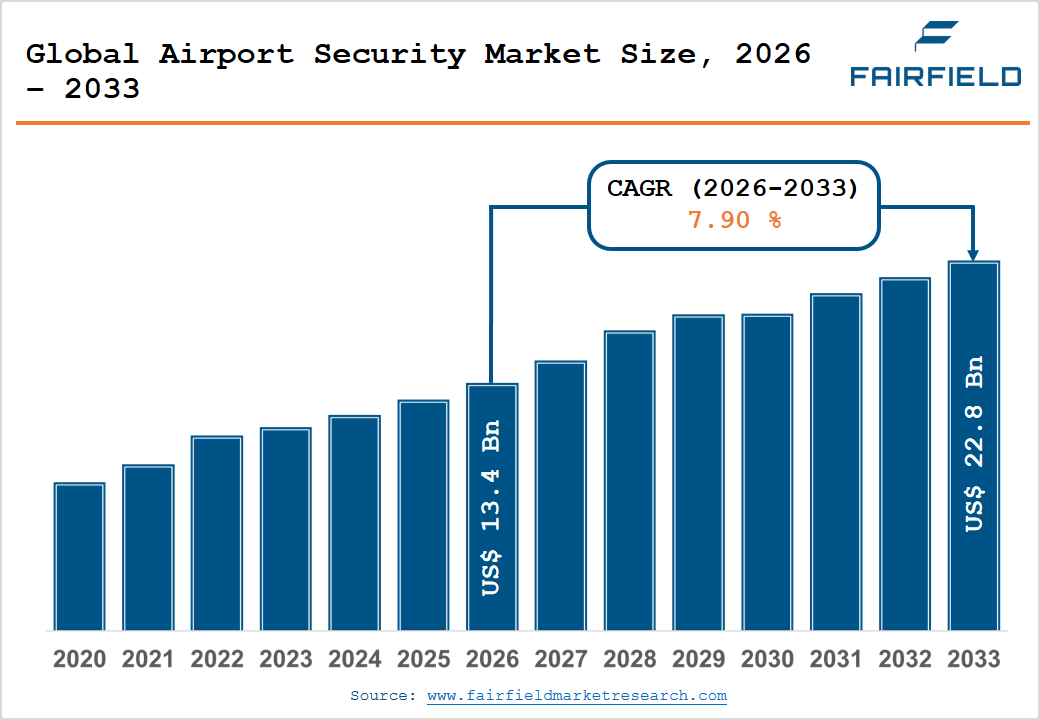
- The global Airport Security Market size is likely to be valued at USD 13.4 billion in 2026 and is expected to reach USD 22.8 billion by 2033, growing at a CAGR of 7.90% during the forecast period from 2026 to 2033.
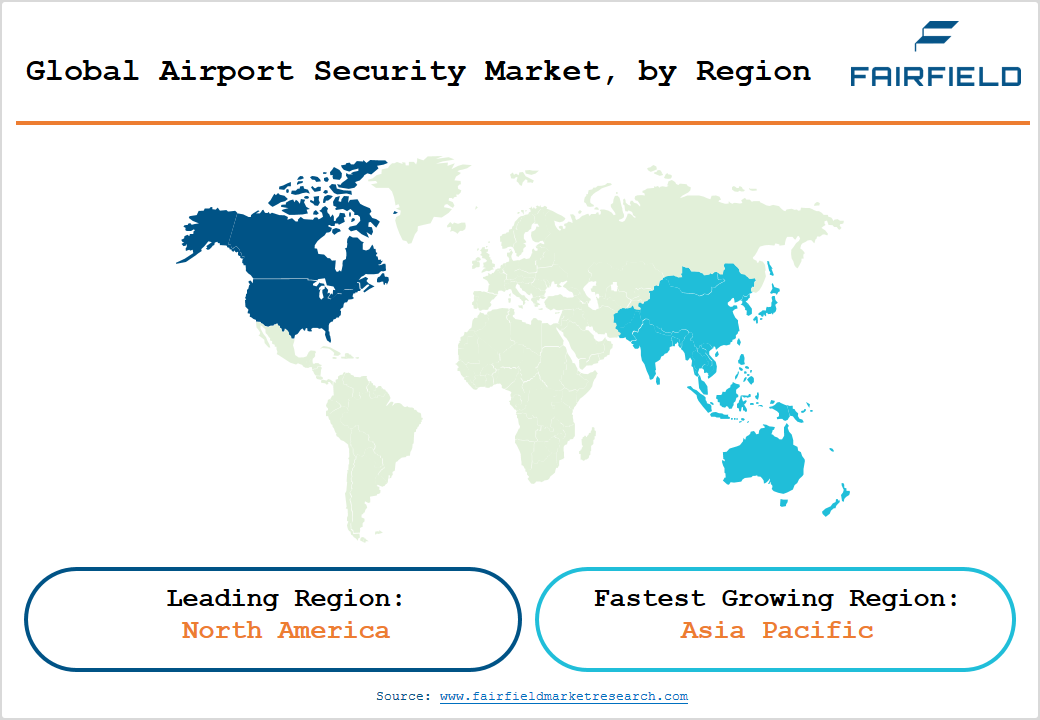
- Leading Region: North America leads the global Airport Security Market with approximately 36% market share in 2026, driven by the TSA's substantial budget, mandatory CT scanner upgrades across numerous US airports, and CATSA's major reinvestment plan in Canada.
- Fastest Growing Region: Asia Pacific is the fastest-growing region, powered by China's 14th Five-Year Plan airport construction targeting 30+ new airports, India's expansion to 220+ airports under UDAN, and IATA's projection of 50%+ of global passenger growth through 2040 originating from the region.
- Dominant Security Type Segment: The Screening segment leads with approximately 31% market share in 2026, underpinned by ICAO Annex 17, TSA, and EASA mandates, with CT scanner upgrade programs simultaneously expanding per-unit values and total procurement volumes across North American and European airports.
- Fastest Growing Airport Model Segment: Airport 4.0 is the fastest-growing model segment, integrating AI, IoT, digital twins, and autonomous security systems. Leading deployments at Beijing Daxing, Singapore Changi Terminal 5, and King Salman International Airport are establishing global benchmarks for next-generation airport security architecture.
- Key Market Opportunity: AI-powered biometric screening aligned with TSA's Biometric Technology Roadmap and IATA One ID, combined with greenfield airport programs in Saudi Arabia, India, and Southeast Asia, represent the highest-value growth opportunity across the forecast period.
Market Dynamics
Market Growth Drivers
- Largest Aviation Security Budget and Mandatory Tech Modernization
The Transportation Security Administration (TSA) stands as the world's most influential procurement authority in global airport security, backed by a substantial FY 2024 budget. A substantial portion is directed toward the technology modernization of passenger checkpoints, including the deployment of Computed Tomography (CT) cabin baggage scanners under the Checkpoint Property Screening System (CPSS) program, Credential Authentication Technology (CAT) units, and Advanced Imaging Technology (AIT) systems. Canada's Canadian Air Transport Security Authority (CATSA) is executing a parallel CAD 3.5 billion multi-year reinvestment plan for checkpoint and hold baggage screening upgrades. These non-discretionary, government-mandated expenditure programs create a stable, predictable revenue pipeline for airport security technology vendors operating in the North American market.
- Unprecedented Airport Construction and Expansion Across the Region
The region's rapid emergence as the world's largest aviation market by passenger volume is generating massive, multi-year airport security procurement pipelines. The International Air Transport Association (IATA) projects that Asia Pacific will account for over 50% of total global passenger growth through 2040. China's Civil Aviation Administration of China (CAAC) is overseeing the construction and upgrade of over 30 airports under the 14th Five-Year Plan. India's Ministry of Civil Aviation is targeting expansion from 148 to over 220 operational airports by 2025 under the UDAN scheme. Each new facility requires comprehensive integrated security system deployment across all major categories, delivering sustained high-value contracts to leading airport security equipment and solutions providers.
Market Restraints
- Substantial Capital Requirements and Extended Procurement Lead Times
Advanced airport security systems including CT-based baggage scanners, biometric access control infrastructure, and integrated command center platforms require substantial upfront capital investment and lengthy multi-stage procurement processes. The Airports Council International (ACI) reported global airport capital expenditure exceeded US$ 37 billion in 2022, with security technology representing a meaningful share. For Class B and Class C airports operating on constrained public-sector budgets, the cost of acquiring, installing, and maintaining next-generation security platforms often delays adoption, slowing overall market penetration for premium technology vendors in these segments.
- Evolving Cybersecurity Threats Targeting Networked Airport Systems
The progressive digitization and interconnection of airport security infrastructure across baggage handling, biometric databases, perimeter sensors, and air traffic management platforms creates expanding cyber-attack surfaces. The European Union Agency for Cybersecurity (ENISA) documented a material rise in cyberattacks targeting the aviation sector in its ENISA Threat Landscape 2023 report. Operational technology (OT) environments at airports frequently run legacy software ill-equipped for modern threat profiles, making comprehensive cyber hardening both technically complex and costly. These challenges add substantially to total system ownership costs, creating an adoption barrier particularly for budget-constrained regional airport operators.
Market Opportunities
- AI-Powered Biometric Security and Touchless Passenger Processing
The convergence of artificial intelligence (AI), machine learning, and biometric identification within airport security workflows represents the most transformative commercial opportunity in the forecast period. TSA's Biometric Technology Roadmap commits to deploying facial recognition-based touchless identity verification at the nation's highest-traffic airports through 2027. IATA's One ID initiative is advancing the global adoption of digital travel credentials linked to biometric identifiers, creating an interoperable framework for frictionless, secure passenger processing across international gateways. AI-powered automated threat recognition (ATR) in baggage scanning reduces false alarm rates and manual review burdens, enhancing throughput at high-volume checkpoints. Thales Group, Safran Group, and SITA are among the leading solution providers positioned to capture this high-growth opportunity.
- Rapid Greenfield Airport Development in Asia Pacific and the Middle East
Large-scale greenfield airport construction programs across Asia Pacific and the Middle East & Africa are creating sustained long-cycle, high-value procurement opportunities for the full spectrum of airport security technologies. In Saudi Arabia, the General Authority of Civil Aviation (GACA) is overseeing the development of King Salman International Airport projected to become the world's largest airport upon completion as part of Vision 2030's ambition to make the Kingdom a global aviation hub. In India, over 70 new airports are at various stages of planning and construction. Singapore's Changi Airport Group is expanding with Terminal 5, requiring comprehensive security infrastructure integration. Each of these programs delivers multi-year integrated security system contracts spanning screening, surveillance, access control, and perimeter protection to leading vendors.
Segmental Insights
- By Security Type Analysis
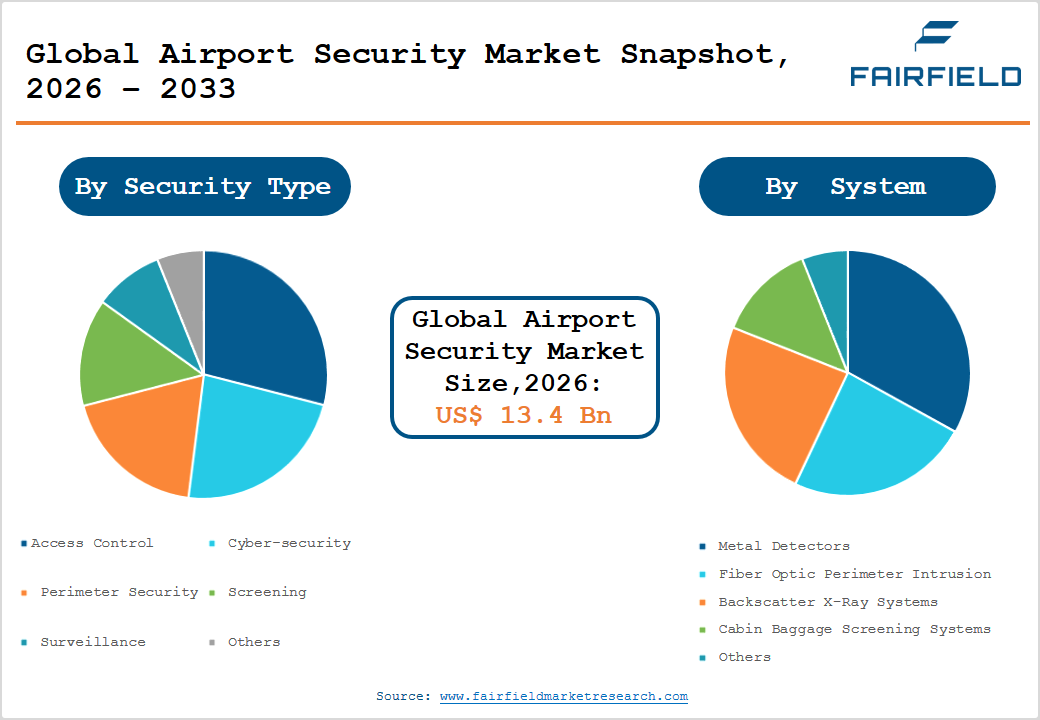
The Screening segment leads the By Security Type category, accounting for 31% of share market in 2026. Passenger and baggage screening is the highest-volume, highest-unit-value security function mandated at every commercial airport globally under ICAO Annex 17, TSA, and EASA requirements. The technology transition from legacy dual-view X-ray to next-generation CT-based baggage scanners is driving a significant average unit value increase per checkpoint. The TSA CPSS program and ECAC Standard 3 certification mandates in Europe are creating simultaneous replacement waves across thousands of North American and European airport checkpoints, ensuring the Screening segment retains its revenue dominance throughout the forecast period.
- By System Analysis
The Cabin Baggage Screening Systems segment dominates the By System category, accounting 29% of market share in 2026. The volume and criticality of carry-on baggage inspection at every commercial airport checkpoint worldwide mandated under ICAO Annex 17 ensures consistent high procurement demand for this equipment category. The TSA's commitment to replacing legacy X-ray units with CT-based cabin baggage scanners across 440+ U.S. airports, coupled with ECAC Standard 3 compliance requirements for European airports, is triggering simultaneous technology refresh cycles across two of the world's largest aviation markets. These programs significantly expand per-unit revenue and extend procurement timelines, reinforcing the segment's market leadership.
- By Airport Model Analysis
The Airport 3.0 model segment holds the dominant share within the By Airport Model category, accounting for 44% of market share in 2026. Airport 3.0 defines the current-generation smart airport paradigm integrated digital operations, biometric passenger processing, centralized security operations centers, IP-based surveillance networks, and advanced access control management. The world's major international hub airports operated by Fraport AG, Heathrow Airport Holdings, Changi Airport Group, and Airport Authority Hong Kong fall within this model and are actively upgrading security technology to align with Airport 3.0 standards. Meanwhile, Airport 4.0 leveraging AI, IoT, digital twins, and autonomous security systems is the fastest-growing model, representing the market's near-term innovation frontier.
- By Airport Class Analysis
The Class A airport segment is the undisputed revenue leader in the By Airport Class category, accounting 52% market share in 2026. Class A international hub airports handling tens of millions of passengers annually deploy the most complex and comprehensive multi-layer security ecosystems, encompassing advanced screening, AI-powered surveillance, biometric access control, and integrated cybersecurity platforms. Airports such as Hartsfield-Jackson Atlanta, Los Angeles International, London Heathrow, Dubai International, and Beijing Daxing International each processing 60+ million passengers annually operate under the highest ICAO, TSA, and EASA security mandates, ensuring continuous multi-year capital deployment in this segment.
Regional Insights
- North America Airport Security Market Trends
North America leads the global airport security market with approximately 36% market share in 2026, underpinned by the world's largest aviation security authority budget, a mature technology ecosystem, and the highest absolute concentration of international hub airports globally. The TSA is executing a multi-program modernization agenda covering CT baggage scanner deployment, Credential Authentication Technology (CAT) rollout, and the Biometric Technology Roadmap targeting facial recognition at the 25 busiest U.S. airports by 2027. The FAA Reauthorization Act of 2024 further reinforces federal commitment to aviation security technology investment.
Canada's CATSA's CAD 3.5 billion multi-year checkpoint reinvestment plan complements U.S. programs, driving demand for CT screening and biometric identity verification across major Canadian international airports. The region's deep defense-technology industrial base anchored by Leidos, Inc., Rapiscan Systems, Honeywell, and IBM Corporation sustains a continuous product development pipeline, reinforcing North America's dual role as the world's leading consumer and exporter of advanced airport security technology.
- Europe Airport Security Market Trends
Europe's airport security market is governed by a harmonized and continuously evolving regulatory framework anchored in European Commission Regulation (EC) No 300/2008, which establishes common security standards across all EU member state airports. Germany home to Europe's busiest airport, Frankfurt Airport operated by Fraport AG is a leading deployer of advanced integrated security operations center technology, with Siemens AG and Bosch Security Systems supplying major system components. The European Civil Aviation Conference (ECAC)'s Standard 3 mandate is driving a CT scanner replacement wave across European airports.
The United Kingdom's Department for Transport is overseeing security technology upgrades at Heathrow, Gatwick, and Manchester Airport ahead of the 2030 compliance deadline. In France, Aeroports de Paris (ADP) is deploying Thales Group- and Safran Group-powered biometric passenger processing across Charles de Gaulle and Orly. Spain's AENA operating Europe's third-largest airport network is implementing AI-powered surveillance across its 46-airport network, creating sustained multi-year security system procurement programs.
- Asia Pacific Airport Security Market Trends
Asia Pacific is the fastest-growing regional market for airport security, propelled by the world's most active airport construction pipeline and the region's emergence as the dominant global aviation market by passenger volume. China's CAAC is overseeing the construction and upgrade of over 30 airports through 2025 under the 14th Five-Year Plan, with Beijing Daxing International Airport representing a global benchmark for integrated AI-driven airport security deployment. The IATA projects that Asia Pacific will generate over 50% of global passenger growth through 2040, ensuring a structural multi-decade demand runway for security technology.
India's Bureau of Civil Aviation Security (BCAS) enforces rigorous standards across 148 operational airports, with the government's rapid expansion program creating substantial incremental security procurement demand. Japan's precision-engineering culture drives adoption of advanced biometric and AI-assisted screening at Narita and Haneda. Singapore's Changi Airport Terminal 5 expansion is embedding next-generation security infrastructure throughout. ASEAN markets including Thailand, Indonesia, and Vietnam are scaling airport capacity to capture resurgent tourism, generating active security technology procurement across all major system and security type categories.
Competitive Landscape
The global airport security market is moderately consolidated, with large defense and technology conglomerates Thales Group, Smiths Detection, Leidos, Inc., Safran Group, and Rapiscan Systems (OSI Systems) holding dominant revenue share through proprietary detection technology portfolios, deep government procurement relationships, and global service networks. Key competitive differentiators include certified screening system performance benchmarks, AI and biometric platform capabilities, multi-vendor integration expertise, and cybersecurity resilience. Growth strategies center on government contract renewals, targeted acquisitions of AI and biometric technology specialists, and transition toward platform-based managed security service models that generate recurring, long-term revenue from airport operators.
Key Market Developments
- February 2025: Thales Group was awarded a contract by Aeroports de Paris (ADP) to deploy its COGITO™ AI-powered security intelligence platform across Paris Charles de Gaulle and Orly airports, integrating real-time analytics with centralized security operations management.
- September 2024: Leidos, Inc. secured a US$ 1.8 billion contract extension from the TSA for continued deployment and maintenance of CT-based cabin baggage screening systems across major U.S. airports under the CPSS
- May 2024: Smiths Detection launched the HI-SCAN 6040 CTiX, a next-generation CT cabin baggage scanner achieving ECAC Standard 3 certification, targeting European airports executing mandatory CT upgrade programs ahead of the 2027 compliance deadline.
Companies Covered in Airport Security Market
- Thales Group
- Smiths Detection (Smiths Group plc)
- Leidos, Inc.
- Rapiscan Systems (OSI Systems, Inc.)
- Honeywell International Inc.
- Siemens AG
- Bosch Security Systems (Robert Bosch GmbH)
- SITA
- IBM Corporation
- Amadeus IT Group SA
- Axis Communications AB
- Elbit Systems Ltd.
- Teledyne FLIR LLC
- Safran Group
- Genetec Inc.
- L3Harris Technologies, Inc.
- Nuctech Company Limited
- Analogic Corporation
- Vanderlande Industries BV
Market Segmentation
By Security Type
- Access Control
- Cyber-security
- Perimeter Security
- Screening
- Surveillance
- Others
By System
- Metal Detectors
- Fiber Optic Perimeter Intrusion
- Backscatter X-Ray Systems
- Cabin Baggage Screening Systems
- Others
By Airport Model
- Airport 2.0
- Airport 3.0
- Airport 4.0
By Airport Class
- Class A
- Class B
- Class C
By Region
- North America
- Europe
- Asia Pacific
- Latin America
- Middle East & Africa
- Executive Summary
- Global Airport Security Market Snapshot
- Future Projections
- Key Market Trends
- Regional Snapshot, by Value, 2026
- Analyst Recommendations
- Market Overview
- Market Definitions and Segmentations
- Market Dynamics
- Drivers
- Restraints
- Market Opportunities
- Value Chain Analysis
- COVID-19 Impact Analysis
- Porter's Five Forces Analysis
- Impact of Russia-Ukraine Conflict
- PESTLE Analysis
- Regulatory Analysis
- Price Trend Analysis
- Current Prices and Future Projections, 2025-2033
- Price Impact Factors
- Global Airport Security Market Outlook, 2020 - 2033
- Global Airport Security Market Outlook, by Security Type, Value (US$ Bn), 2020-2033
- Access Control
- Cyber-security
- Perimeter Security
- Screening
- Surveillance
- Others
- Global Airport Security Market Outlook, by System, Value (US$ Bn), 2020-2033
- Metal Detectors
- Fiber Optic Perimeter Intrusion
- Backscatter X-Ray Systems
- Cabin Baggage Screening Systems
- Others
- Global Airport Security Market Outlook, by Airport Model, Value (US$ Bn), 2020-2033
- Airport 2.0
- Airport 3.0
- Airport 4.0
- Global Airport Security Market Outlook, by Airport Class, Value (US$ Bn), 2020-2033
- Class A
- Class B
- Class C
- Global Airport Security Market Outlook, by Region, Value (US$ Bn), 2020-2033
- North America
- Europe
- Asia Pacific
- Latin America
- Middle East & Africa
- Global Airport Security Market Outlook, by Security Type, Value (US$ Bn), 2020-2033
- North America Airport Security Market Outlook, 2020 - 2033
- North America Airport Security Market Outlook, by Security Type, Value (US$ Bn), 2020-2033
- Access Control
- Cyber-security
- Perimeter Security
- Screening
- Surveillance
- Others
- North America Airport Security Market Outlook, by System, Value (US$ Bn), 2020-2033
- Metal Detectors
- Fiber Optic Perimeter Intrusion
- Backscatter X-Ray Systems
- Cabin Baggage Screening Systems
- Others
- North America Airport Security Market Outlook, by Airport Model, Value (US$ Bn), 2020-2033
- Airport 2.0
- Airport 3.0
- Airport 4.0
- North America Airport Security Market Outlook, by Airport Class, Value (US$ Bn), 2020-2033
- Class A
- Class B
- Class C
- North America Airport Security Market Outlook, by Country, Value (US$ Bn), 2020-2033
- S. Airport Security Market Outlook, by Security Type, 2020-2033
- S. Airport Security Market Outlook, by System, 2020-2033
- S. Airport Security Market Outlook, by Airport Model, 2020-2033
- S. Airport Security Market Outlook, by Airport Class, 2020-2033
- Canada Airport Security Market Outlook, by Security Type, 2020-2033
- Canada Airport Security Market Outlook, by System, 2020-2033
- Canada Airport Security Market Outlook, by Airport Model, 2020-2033
- Canada Airport Security Market Outlook, by Airport Class, 2020-2033
- BPS Analysis/Market Attractiveness Analysis
- North America Airport Security Market Outlook, by Security Type, Value (US$ Bn), 2020-2033
- Europe Airport Security Market Outlook, 2020 - 2033
- Europe Airport Security Market Outlook, by Security Type, Value (US$ Bn), 2020-2033
- Access Control
- Cyber-security
- Perimeter Security
- Screening
- Surveillance
- Others
- Europe Airport Security Market Outlook, by System, Value (US$ Bn), 2020-2033
- Metal Detectors
- Fiber Optic Perimeter Intrusion
- Backscatter X-Ray Systems
- Cabin Baggage Screening Systems
- Others
- Europe Airport Security Market Outlook, by Airport Model, Value (US$ Bn), 2020-2033
- Airport 2.0
- Airport 3.0
- Airport 4.0
- Europe Airport Security Market Outlook, by Airport Class, Value (US$ Bn), 2020-2033
- Class A
- Class B
- Class C
- Europe Airport Security Market Outlook, by Country, Value (US$ Bn), 2020-2033
- Germany Airport Security Market Outlook, by Security Type, 2020-2033
- Germany Airport Security Market Outlook, by System, 2020-2033
- Germany Airport Security Market Outlook, by Airport Model, 2020-2033
- Germany Airport Security Market Outlook, by Airport Class, 2020-2033
- Italy Airport Security Market Outlook, by Security Type, 2020-2033
- Italy Airport Security Market Outlook, by System, 2020-2033
- Italy Airport Security Market Outlook, by Airport Model, 2020-2033
- Italy Airport Security Market Outlook, by Airport Class, 2020-2033
- France Airport Security Market Outlook, by Security Type, 2020-2033
- France Airport Security Market Outlook, by System, 2020-2033
- France Airport Security Market Outlook, by Airport Model, 2020-2033
- France Airport Security Market Outlook, by Airport Class, 2020-2033
- K. Airport Security Market Outlook, by Security Type, 2020-2033
- K. Airport Security Market Outlook, by System, 2020-2033
- K. Airport Security Market Outlook, by Airport Model, 2020-2033
- K. Airport Security Market Outlook, by Airport Class, 2020-2033
- Spain Airport Security Market Outlook, by Security Type, 2020-2033
- Spain Airport Security Market Outlook, by System, 2020-2033
- Spain Airport Security Market Outlook, by Airport Model, 2020-2033
- Spain Airport Security Market Outlook, by Airport Class, 2020-2033
- Russia Airport Security Market Outlook, by Security Type, 2020-2033
- Russia Airport Security Market Outlook, by System, 2020-2033
- Russia Airport Security Market Outlook, by Airport Model, 2020-2033
- Russia Airport Security Market Outlook, by Airport Class, 2020-2033
- Rest of Europe Airport Security Market Outlook, by Security Type, 2020-2033
- Rest of Europe Airport Security Market Outlook, by System, 2020-2033
- Rest of Europe Airport Security Market Outlook, by Airport Model, 2020-2033
- Rest of Europe Airport Security Market Outlook, by Airport Class, 2020-2033
- BPS Analysis/Market Attractiveness Analysis
- Europe Airport Security Market Outlook, by Security Type, Value (US$ Bn), 2020-2033
- Asia Pacific Airport Security Market Outlook, 2020 - 2033
- Asia Pacific Airport Security Market Outlook, by Security Type, Value (US$ Bn), 2020-2033
- Access Control
- Cyber-security
- Perimeter Security
- Screening
- Surveillance
- Others
- Asia Pacific Airport Security Market Outlook, by System, Value (US$ Bn), 2020-2033
- Metal Detectors
- Fiber Optic Perimeter Intrusion
- Backscatter X-Ray Systems
- Cabin Baggage Screening Systems
- Others
- Asia Pacific Airport Security Market Outlook, by Airport Model, Value (US$ Bn), 2020-2033
- Airport 2.0
- Airport 3.0
- Airport 4.0
- Asia Pacific Airport Security Market Outlook, by Airport Class, Value (US$ Bn), 2020-2033
- Class A
- Class B
- Class C
- Asia Pacific Airport Security Market Outlook, by Country, Value (US$ Bn), 2020-2033
- China Airport Security Market Outlook, by Security Type, 2020-2033
- China Airport Security Market Outlook, by System, 2020-2033
- China Airport Security Market Outlook, by Airport Model, 2020-2033
- China Airport Security Market Outlook, by Airport Class, 2020-2033
- Japan Airport Security Market Outlook, by Security Type, 2020-2033
- Japan Airport Security Market Outlook, by System, 2020-2033
- Japan Airport Security Market Outlook, by Airport Model, 2020-2033
- Japan Airport Security Market Outlook, by Airport Class, 2020-2033
- South Korea Airport Security Market Outlook, by Security Type, 2020-2033
- South Korea Airport Security Market Outlook, by System, 2020-2033
- South Korea Airport Security Market Outlook, by Airport Model, 2020-2033
- South Korea Airport Security Market Outlook, by Airport Class, 2020-2033
- India Airport Security Market Outlook, by Security Type, 2020-2033
- India Airport Security Market Outlook, by System, 2020-2033
- India Airport Security Market Outlook, by Airport Model, 2020-2033
- India Airport Security Market Outlook, by Airport Class, 2020-2033
- Southeast Asia Airport Security Market Outlook, by Security Type, 2020-2033
- Southeast Asia Airport Security Market Outlook, by System, 2020-2033
- Southeast Asia Airport Security Market Outlook, by Airport Model, 2020-2033
- Southeast Asia Airport Security Market Outlook, by Airport Class, 2020-2033
- Rest of SAO Airport Security Market Outlook, by Security Type, 2020-2033
- Rest of SAO Airport Security Market Outlook, by System, 2020-2033
- Rest of SAO Airport Security Market Outlook, by Airport Model, 2020-2033
- Rest of SAO Airport Security Market Outlook, by Airport Class, 2020-2033
- BPS Analysis/Market Attractiveness Analysis
- Asia Pacific Airport Security Market Outlook, by Security Type, Value (US$ Bn), 2020-2033
- Latin America Airport Security Market Outlook, 2020 - 2033
- Latin America Airport Security Market Outlook, by Security Type, Value (US$ Bn), 2020-2033
- Access Control
- Cyber-security
- Perimeter Security
- Screening
- Surveillance
- Others
- Latin America Airport Security Market Outlook, by System, Value (US$ Bn), 2020-2033
- Metal Detectors
- Fiber Optic Perimeter Intrusion
- Backscatter X-Ray Systems
- Cabin Baggage Screening Systems
- Others
- Latin America Airport Security Market Outlook, by Airport Model, Value (US$ Bn), 2020-2033
- Airport 2.0
- Airport 3.0
- Airport 4.0
- Latin America Airport Security Market Outlook, by Airport Class, Value (US$ Bn), 2020-2033
- Class A
- Class B
- Class C
- Latin America Airport Security Market Outlook, by Country, Value (US$ Bn), 2020-2033
- Brazil Airport Security Market Outlook, by Security Type, 2020-2033
- Brazil Airport Security Market Outlook, by System, 2020-2033
- Brazil Airport Security Market Outlook, by Airport Model, 2020-2033
- Brazil Airport Security Market Outlook, by Airport Class, 2020-2033
- Mexico Airport Security Market Outlook, by Security Type, 2020-2033
- Mexico Airport Security Market Outlook, by System, 2020-2033
- Mexico Airport Security Market Outlook, by Airport Model, 2020-2033
- Mexico Airport Security Market Outlook, by Airport Class, 2020-2033
- Argentina Airport Security Market Outlook, by Security Type, 2020-2033
- Argentina Airport Security Market Outlook, by System, 2020-2033
- Argentina Airport Security Market Outlook, by Airport Model, 2020-2033
- Argentina Airport Security Market Outlook, by Airport Class, 2020-2033
- Rest of LATAM Airport Security Market Outlook, by Security Type, 2020-2033
- Rest of LATAM Airport Security Market Outlook, by System, 2020-2033
- Rest of LATAM Airport Security Market Outlook, by Airport Model, 2020-2033
- Rest of LATAM Airport Security Market Outlook, by Airport Class, 2020-2033
- BPS Analysis/Market Attractiveness Analysis
- Latin America Airport Security Market Outlook, by Security Type, Value (US$ Bn), 2020-2033
- Middle East & Africa Airport Security Market Outlook, 2020 - 2033
- Middle East & Africa Airport Security Market Outlook, by Security Type, Value (US$ Bn), 2020-2033
- Access Control
- Cyber-security
- Perimeter Security
- Screening
- Surveillance
- Others
- Middle East & Africa Airport Security Market Outlook, by System, Value (US$ Bn), 2020-2033
- Metal Detectors
- Fiber Optic Perimeter Intrusion
- Backscatter X-Ray Systems
- Cabin Baggage Screening Systems
- Others
- Middle East & Africa Airport Security Market Outlook, by Airport Model, Value (US$ Bn), 2020-2033
- Airport 2.0
- Airport 3.0
- Airport 4.0
- Middle East & Africa Airport Security Market Outlook, by Airport Class, Value (US$ Bn), 2020-2033
- Class A
- Class B
- Class C
- Middle East & Africa Airport Security Market Outlook, by Country, Value (US$ Bn), 2020-2033
- GCC Airport Security Market Outlook, by Security Type, 2020-2033
- GCC Airport Security Market Outlook, by System, 2020-2033
- GCC Airport Security Market Outlook, by Airport Model, 2020-2033
- GCC Airport Security Market Outlook, by Airport Class, 2020-2033
- South Africa Airport Security Market Outlook, by Security Type, 2020-2033
- South Africa Airport Security Market Outlook, by System, 2020-2033
- South Africa Airport Security Market Outlook, by Airport Model, 2020-2033
- South Africa Airport Security Market Outlook, by Airport Class, 2020-2033
- Egypt Airport Security Market Outlook, by Security Type, 2020-2033
- Egypt Airport Security Market Outlook, by System, 2020-2033
- Egypt Airport Security Market Outlook, by Airport Model, 2020-2033
- Egypt Airport Security Market Outlook, by Airport Class, 2020-2033
- Nigeria Airport Security Market Outlook, by Security Type, 2020-2033
- Nigeria Airport Security Market Outlook, by System, 2020-2033
- Nigeria Airport Security Market Outlook, by Airport Model, 2020-2033
- Nigeria Airport Security Market Outlook, by Airport Class, 2020-2033
- Rest of Middle East Airport Security Market Outlook, by Security Type, 2020-2033
- Rest of Middle East Airport Security Market Outlook, by System, 2020-2033
- Rest of Middle East Airport Security Market Outlook, by Airport Model, 2020-2033
- Rest of Middle East Airport Security Market Outlook, by Airport Class, 2020-2033
- BPS Analysis/Market Attractiveness Analysis
- Middle East & Africa Airport Security Market Outlook, by Security Type, Value (US$ Bn), 2020-2033
- Competitive Landscape
- Company Vs Segment Heatmap
- Company Market Share Analysis, 2025
- Competitive Dashboard
- Company Profiles
- Thales Group
- Company Overview
- Product Portfolio
- Financial Overview
- Business Strategies and Developments
- Smiths Detection (Smiths Group plc)
- Leidos, Inc.
- Rapiscan Systems (OSI Systems, Inc.)
- Honeywell International Inc.
- Siemens AG
- Bosch Security Systems (Robert Bosch GmbH)
- SITA
- IBM Corporation
- Amadeus IT Group SA
- Axis Communications AB
- Elbit Systems Ltd.
- Teledyne FLIR LLC
- Safran Group
- Genetec Inc.
- Thales Group
- Appendix
- Research Methodology
- Report Assumptions
- Acronyms and Abbreviations
|
BASE YEAR |
HISTORICAL DATA |
FORECAST PERIOD |
UNITS |
|||
 |
2025 |
 |
2019 - 2024 |
 |
2026 - 2033 |
Value: US$ Million |
|
REPORT FEATURES |
DETAILS |
|
By Security Type Coverage |
|
|
By System Coverage |
|
|
Geographical Coverage |
|
|
Leading Companies |
|
|
Report Highlights |
Key Market Indicators, Macro-micro economic impact analysis, Technological Roadmap, Key Trends, Driver, Restraints, and Future Opportunities & Revenue Pockets, Porter’s 5 Forces Analysis, Historical Trend (2019-2024), Market Estimates and Forecast, Market Dynamics, Industry Trends, Competition Landscape, Category, Region, Country-wise Trends & Analysis, COVID-19 Impact Analysis (Demand and Supply Chain) |
Our Research Methodology
Considering the volatility of business today, traditional approaches to strategizing a game plan can be unfruitful if not detrimental. True ambiguity is no way to determine a forecast. A myriad of predetermined factors must be accounted for such as the degree of risk involved, the magnitude of circumstances, as well as conditions or consequences that are not known or unpredictable. To circumvent binary views that cast uncertainty, the application of market research intelligence to strategically posture, move, and enable actionable outcomes is necessary.
View Methodology
Quality Assured
Rigorous Validation Process

Confidentiality Assured
End-to-end Data Security

Custom Research Services
Tailored To Your Objectives
FAQs
The Airport Security market size is US$ 13.4 Billion in 2026.
The Airport Security market is projected to grow at a CAGR of 7.90% by 2033.
The Airport Security market growth drivers include government-mandated security upgrades, rising airport construction, and adoption of AI-powered biometric technologies.
North America is the dominating region for the Airport Security market.
Thales Group, Smiths Detection, Leidos, Inc., Safran Group, and Rapiscan Systems are some leading industry players in the Airport Security market.
Related Reports
Foldable Electric Scooter Market Size, Share, Insights, Competitive Landscape, and Forecast 2026 to 2033
Explore the foldable electric scooter market, reaching US$ 6.9 billion by 2033 at 6.3% CAGR, with range, price tier and regional insights.
In-car Audio System Market Size, Share, Insights, Competitive Landscape, and Forecast 2026 to 2033
Explore the in-car audio system market, reaching US$ 21.8 billion by 2033 at 6.0% CAGR, with component, system tier and regional insights.
Electric Brake Booster Market Size, Share, Insights, Competitive Landscape, and Forecast 2026 to 2033
Explore the electric brake booster market, reaching US$ 12.6 billion by 2033 at 13.5% CAGR, with architecture, vehicle and regional insights.
Axial Flux Motor Market Size, Share, Insights, Competitive Landscape, and Forecast 2026 to 2033
Explore the axial flux motor market, reaching US$ 3.6 billion by 2033 at 29.2% CAGR, with topology, application and regional insights.
Automotive Fuel System Market Size, Share, Insights, Competitive Landscape, and Forecast 2026 to 2033
Explore the automotive fuel system market, reaching US$ 134.0 billion by 2033 at 2.6% CAGR, with component, regional and competitive insights.
Railway Sleepers Market Size, Share, Insights, Competitive Landscape, and Forecast 2026 to 2033
Explore the railway sleepers market, reaching US$ 6.1 billion by 2033 at 4.1% CAGR, with material, regional and competitive insights.