



Automotive Defroster Market
Automotive Defroster Market Size, Share, Insights, Competitive Landscape, and Forecast 2026 to 2033
Automotive Defroster Market Size and Trend Analysis
How Fast Is the Automotive Defroster Market Growing?
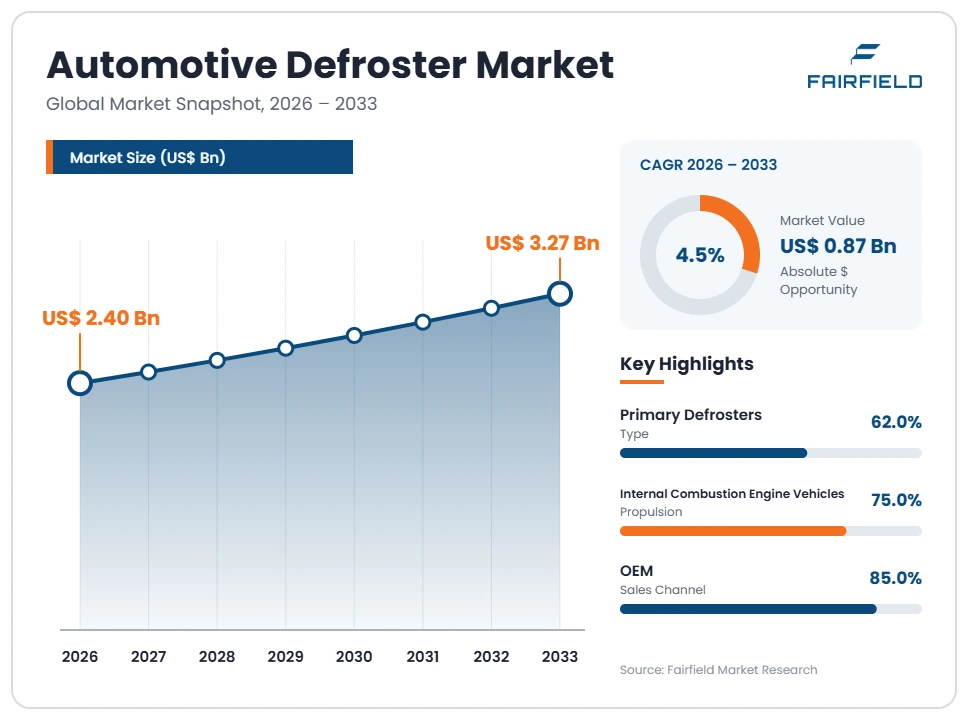
The global automotive defroster market size is expected to be valued at US$ 2.40 billion in 2026 and projected to reach US$ 3.27 billion by 2033, growing at a CAGR of 4.5% between 2026 and 2033.
Between 2020 and 2025, the market grew at a CAGR of about 3.4%, rising from roughly US$ 1.95 billion to about US$ 2.30 billion, as vehicle production recovered after the pandemic, automakers added more comfort and safety features as standard, and electric vehicles began using heated glass to save battery energy. The automotive defroster market covers systems that clear frost, ice, fog, and condensation from vehicle windows to give drivers clear visibility. Primary defrosters use the heating, ventilation, and air conditioning system to blow warm, dry air onto the windshield and front side windows. Secondary defrosters use thin printed conductive lines or wire grids on the rear window, and sometimes the windshield and mirrors, which heat up when electric current passes through them. Newer systems include heated coated windshields, heated camera and sensor zones, and automatic fog detection. In February 2026, Saint-Gobain Sekurit joined the QuadAlliance consortium to develop next-generation smart windshields.
Key Report Takeaways
- By Type: Primary Defrosters held about 62% share in 2025, while Secondary Defrosters are projected to expand at a 5.2% CAGR through 2033, driven by heated rear windows, heated windshields in premium and electric vehicles, and rising demand for heated sensor areas.
- By Propulsion: Internal Combustion Engine Vehicles held about 75% share in 2025, while Electric Vehicles are projected to expand at a 12.0% CAGR through 2033, driven by heated glass that clears windows using less energy than cabin heating and extends driving range.
- By Sales Channel: OEM held about 85% share in 2025, while Aftermarket is projected to expand at a 5.0% CAGR through 2033, driven by windshield replacement, repair of damaged heating grids, and an ageing global vehicle fleet needing replacement parts.
- By Region: Asia Pacific held about 38% share in 2025, while India is projected to expand at a 6.5% CAGR through 2033, driven by rising vehicle production, growing demand for comfort features, and more standard safety equipment in new cars.
Global Automotive Defroster Market Trends and Insights
Drivers Impact Analysis
Two drivers carry the strongest influence on automotive defroster market demand during the forecast period.
| Driver | Impact on CAGR Forecast | Geographic Relevance | Impact Timeline |
| Vehicle production and safety regulations | High | Global | Long term (≥4 years) |
| Electric vehicles and heated glass adoption | Medium | Europe, Asia Pacific, North America | Medium term (2-4 years) |
Vehicle Production and Safety Rules Are Driving the Automotive Defroster Market
Vehicle production and safety regulations are the strongest driver of the automotive defroster market. Every car needs clear windows.
The mechanism is that safety regulations in the United States, Europe, and many other countries require vehicles to have windshield defrosting and defogging systems that meet minimum performance standards, so nearly every new passenger car and commercial vehicle includes a primary defroster. Most cars also include a heated rear window as standard equipment. Global vehicle production of more than 90 million units a year creates steady demand. Rising sales in India, Indonesia, and Latin America add volume, while drivers in cold and humid climates value fast defrosting for safety. Advanced driver assistance cameras and sensors behind the windshield also need clear glass, adding demand for heated sensor zones. These trends create steady, long-term demand.
Electric Vehicles Are Expanding the Automotive Defroster Market
Electric vehicles and heated glass adoption are expanding the automotive defroster market. EVs need energy-efficient defrosting.
The cause is that electric vehicles do not have engine waste heat to warm the cabin, so heating the air to defrost windows uses battery power and can reduce driving range in winter. Heated windshields and rear windows clear ice and fog directly on the glass surface, using less energy than blowing hot air through the cabin. Automakers in Europe, China, and North America are adding heated coated windshields, heat pumps, and smart climate controls to premium and mainstream EVs. Larger glass areas, panoramic roofs, and head-up displays also increase the need for advanced glazing. Suppliers such as Saint-Gobain Sekurit, AGC, and Fuyao offer heated glass that works with sensors and antennas. These factors raise defroster value per vehicle.
Restraints Impact Analysis
Two restraints limit how quickly the automotive defroster market grows.
| Restraint | Impact on CAGR Forecast | Geographic Relevance | Impact Timeline |
| High cost of heated windshields | Medium | Global | Medium term (2-4 years) |
| Vehicle production swings and signal interference | Medium | Global | Long term (≥4 years) |
High Costs Slow the Automotive Defroster Market
High cost of heated windshields slows the automotive defroster market. Advanced glass adds expense.
The problem is that heated coated windshields and fine-wire heated glass cost much more to make than standard laminated glass, requiring special coatings, silver busbars, wiring, and testing. Automakers working on tight budgets, especially for small and entry-level cars, often offer heated windshields only as an option or on premium trims. Replacement costs for heated windshields are also higher, which can increase insurance claims and discourage some buyers. In price-sensitive markets in Asia Pacific, Latin America, and Middle East & Africa, many buyers skip optional comfort features. Production of coated glass requires large investments in coating lines and quality control. These factors limit adoption of high-value products outside premium vehicles.
Production Swings and Interference Restrict the Automotive Defroster Market
Vehicle production swings and signal interference restrict the automotive defroster market. Demand and design face challenges.
The constraint is that defroster sales depend on new vehicle production, which can fall sharply because of economic slowdowns, chip shortages, trade disputes, or tariffs. Supplier margins are thin, and automakers push for annual price cuts. Metallic coatings in heated windshields can also block radio, GPS, mobile, and vehicle-to-everything signals, forcing designers to create special communication windows and adding testing time. Heated wires can affect visibility and camera image quality if not designed carefully. Raw material costs for glass, silver, and copper can rise quickly, and energy-intensive float glass furnaces face high fuel and power bills, especially in Europe. These factors raise costs, extend development timelines, and limit growth for suppliers.
Market Opportunities
Smart and Sensor-Ready Glass Opens a Fast-Growth Revenue Pool
Smart and sensor-ready glass opens a fast-growth revenue pool. Modern vehicles need clear sensors.
The opportunity comes from advanced driver assistance systems and autonomous driving features that rely on cameras, lidar, and radar placed behind the windshield, which must stay free of ice, fog, and condensation. Heated camera zones, transparent conductive films, and automatic fog detection sensors improve reliability and safety. In February 2026, Saint-Gobain Sekurit joined ZEISS, Hyundai Mobis, and tesa in the QuadAlliance to industrialize holographic windshield display technology. Combining heating with head-up displays, acoustic layers, and solar control adds value, and automakers increasingly buy complete glazing modules rather than separate parts. Companies that offer integrated smart glazing with low power use and signal compatibility can win premium contracts with automakers.
Sustainable Glass and Emerging Markets Create a Growth Revenue Pool
Sustainable glass and emerging markets create a growth revenue pool. Automakers want greener parts and new customers.
The opportunity reflects automaker targets to cut carbon emissions across the supply chain, including glass, which is energy-intensive to produce. In June 2026, AGC Glass Europe and Reiling demonstrated industrial-scale recycling of laminated windshields into new automotive glass, and in November 2026, Saint-Gobain Sekurit and Maltha used 15 metric tons of recycled windshield glass in a float furnace in France. At the same time, rising vehicle sales in India, Indonesia, Brazil, and Mexico increase demand for defrosters and heated rear windows. Companies that offer low-carbon glass, affordable heated products, local production, and strong automaker relationships can capture growth across these regions over the forecast period.
Segment Analysis
- By Type: Primary Defrosters Lead While Secondary Defrosters Grow Fastest
Primary Defrosters held about 62% share in 2025. These systems use the vehicle's heating and air conditioning unit to blow warm, dry air through vents onto the windshield and front side windows, and they are required by safety rules in most countries. Every passenger car and commercial vehicle includes a primary defroster, giving this segment the largest share.
Secondary Defrosters are the fastest-growing type, expanding at a 5.2% CAGR through 2033. Heated rear windows are standard on most cars, and heated windshields, side mirrors, and sensor zones are spreading from premium to mainstream models. These electric systems clear glass quickly without waiting for the engine or cabin to warm up. For the market, secondary defroster growth raises value per vehicle and supports demand for advanced glass.
- By Propulsion: Internal Combustion Engine Vehicles Lead While Electric Vehicles Grow Fastest
Internal Combustion Engine Vehicles held about 75% share in 2025. Petrol and diesel vehicles still make up most global production, and they use engine heat for primary defrosting alongside heated rear windows. Hybrid vehicles are included in this segment, and their engines also provide waste heat for cabin and windshield warming, although many hybrids now add electric heaters for faster defrosting.
Electric Vehicles are the fastest-growing propulsion type, expanding at a 12.0% CAGR through 2033. EVs increasingly use heated windshields and rear glass to defrost efficiently and protect driving range, especially in cold markets such as Norway, Canada, and northern China. Heat pumps and smart climate software work alongside heated glass to manage energy use. For the market, EV growth shifts demand toward higher-value electric defrosting solutions and closer cooperation between glass and thermal suppliers.
- By Sales Channel: OEM Leads While Aftermarket Grows Fastest
OEM held about 85% share in 2025. Defrosters are built into vehicles during production, with HVAC systems supplied by thermal management companies and heated glass supplied by glass makers. Long supply contracts tie suppliers to vehicle programs that often run for five to seven years, and suppliers must meet strict quality, safety, and delivery requirements set by each automaker.
Aftermarket is the fastest-growing channel, expanding at a 5.0% CAGR through 2033. Windshield and rear glass replacement after damage, repair kits for broken heating lines, and HVAC repairs drive demand. Replacement heated windshields must be calibrated with driver assistance cameras, increasing service value. For the market, aftermarket growth follows the ageing vehicle fleet and rising use of advanced glass in older cars.
Geography Analysis
- Why Is North America Important to the Automotive Defroster Market?
North America is a major automotive defroster market. The United States and Canada have cold winters in many regions, high consumer demand for comfort features, and federal safety standards that require windshield defrosting and defogging performance. Pickups, SUVs, and premium vehicles often offer heated windshields, mirrors, and wiper zones. Gentex, Gentherm, and glass makers such as Fuyao and Vitro operate plants in the region, and Mexico is a major vehicle production hub. Key barriers include tariffs, supply chain shifts, and cost pressure. One change shaping the region is heated glass in electric pickups and SUVs and heated camera zones for driver assistance.
- Europe Shapes the Automotive Defroster Market Through Premium Vehicle Demand
Europe is a major automotive defroster market. Germany, France, the United Kingdom, Sweden, and Norway have cold, damp climates and high sales of premium and electric vehicles that use heated windshields. Valeo, MAHLE, Webasto, and Saint-Gobain Sekurit are based in the region, and AGC Glass Europe is a key supplier of heated glass to European automakers. Strict safety rules and high EV adoption in northern countries support advanced defrosting. Key barriers include slow car sales, Chinese competition, and high energy costs. One opportunity is recycled and low-carbon glass, supported by European Union sustainability rules.
- Which Region Is Leading the Automotive Defroster Market?
Asia Pacific is leading the automotive defroster market with about 38% share in 2025, while India is the fastest-growing country, expanding at a 6.5% CAGR through 2033. China is the world's largest vehicle producer and EV market, and Fuyao and Xinyi are major glass makers. Japan is home to Denso, AGC, and Nippon Sheet Glass, while South Korea has Hanon Systems. India's rising car sales and humid monsoon climate drive demand for fast defogging. Key barriers include price pressure and fragmented suppliers. One change shaping the region is heated glass in Chinese EVs.
- Latin America Grows the Automotive Defroster Market Through Vehicle Production
Latin America is a growing automotive defroster market. Brazil, Mexico, Argentina, Colombia, and Chile have significant vehicle production and sales, and humid tropical climates in many areas create frequent window fogging. Mexico exports vehicles to North America, while Brazil has a large domestic automotive industry with many global brands. Colder southern areas of Argentina and Chile need effective defrosting during winter months. Key barriers include price sensitivity, currency swings, and economic cycles. One opportunity is affordable heated rear windows and HVAC upgrades, supported by rising safety equipment in new cars and growing vehicle exports from the region.
- Middle East & Africa Builds the Automotive Defroster Market Through Vehicle Assembly
Middle East & Africa is an emerging automotive defroster market. Saudi Arabia, the United Arab Emirates, and Morocco are expanding vehicle assembly, and South Africa is a major vehicle exporter. Hot and humid climates make air conditioning essential, which creates condensation and fogging that defrosters clear. Egypt has growing car assembly, and Saudi Arabia is building an electric vehicle industry with new plants. Key barriers include low local production, reliance on imported vehicles, and price sensitivity. One opportunity is supply for new assembly plants, supported by national industrial strategies, rising vehicle ownership, and growing aftermarket demand in large cities.
Competitive Landscape
The automotive defroster market is moderately consolidated. Denso Corporation, Valeo SA, MAHLE GmbH, Saint-Gobain Sekurit, and AGC Inc. are leading players, while Hanon Systems, Fuyao Glass, Nippon Sheet Glass, Xinyi Glass, Gentherm, Webasto, and Gentex compete strongly. The market has two main supplier groups: thermal management companies that build HVAC modules for primary defrosting, and automotive glass makers that produce heated rear windows and heated windshields for secondary defrosting. A few large glass makers supply most of the world's automotive glass, giving them a strong position in heated glazing.
Companies compete on defrosting speed, energy efficiency, integration with HVAC and sensors, optical quality, signal compatibility, weight, durability, cost, and the ability to supply global vehicle platforms. Long-term contracts with automakers and close engineering partnerships are essential to win new vehicle programs, often years before production starts.
Strategic moves show how competition is changing. In February 2026, Saint-Gobain Sekurit joined the QuadAlliance for holographic windshields. In June 2026, AGC Glass Europe and Reiling demonstrated windshield recycling, and in November 2026, Saint-Gobain Sekurit and Maltha made new glass from recycled windshields. Fuyao also expanded two plants to 3 million sets of annual capacity each.
Three themes shape vendor strategy. First, suppliers are developing heated glass that works with cameras, lidar, and antennas. Second, they are improving energy efficiency for electric vehicles. Third, they are cutting carbon through recycled glass and expanding production in Asia Pacific.
Automotive Defroster Market Industry Leaders
- Denso Corporation
- Valeo SA
- MAHLE GmbH
- Saint-Gobain Sekurit
- AGC Inc.
Recent Industry Developments
- November 2026: Saint-Gobain Sekurit and Maltha Glass Recycling introduced 15 metric tons of glass recovered from discarded windshields into a float furnace in France, producing new automotive glazing that met quality standards - supports lower-carbon glass for the automotive defroster market.
- June 2026: AGC Glass Europe and Reiling demonstrated industrial-scale flat-to-flat recycling of laminated automotive windshields into new automotive glass - advances circular supply of windshield glass.
- February 2026: Saint-Gobain Sekurit joined the QuadAlliance consortium with ZEISS, Hyundai Mobis, and tesa to accelerate industrialization of holographic windshield display technology - points to more integrated smart windshields.
Companies Covered in the Report
- Denso Corporation
- Valeo SA
- MAHLE GmbH
- Saint-Gobain Sekurit
- AGC Inc.
- Hanon Systems
- Fuyao Glass Industry Group Co., Ltd.
- Nippon Sheet Glass Co., Ltd.
- Xinyi Glass Holdings Limited
- Gentherm Incorporated
- Webasto SE
- Gentex Corporation
Automotive Defroster Market Report Scope
| Metric | Value |
| Study Period | 2020-2033 |
| Market Size 2026 | US$ 2.40 Billion |
| Market Size 2033 | US$ 3.27 Billion |
| CAGR 2026-2033 | 4.5% |
| Absolute Dollar Opportunity | US$ 0.87 Billion |
| Largest Market | Asia Pacific |
| Fastest-Growing Market | India |
| Market Concentration | Moderately Consolidated |
| Major Players | Denso Corporation, Valeo SA, MAHLE GmbH, Saint-Gobain Sekurit, AGC Inc. |
Automotive Defroster Market Segmentation
- Executive Summary
- Automotive Defroster Market Snapshot
- Future Projections
- Key Market Trends
- Regional Snapshot
- Market Overview
- Market Definition and Report Scope
- Historical Market Trends
- Market Dynamics
- Drivers
- Vehicle Production and Safety Rules Are Driving the Automotive Defroster Market
- Electric Vehicles Are Expanding the Automotive Defroster Market
- Restraints
- High Costs Slow the Automotive Defroster Market
- Production Swings and Interference Restrict the Automotive Defroster Market
- Market Opportunities
- Smart and Sensor-Ready Glass Opens a Fast-Growth Revenue Pool
- Sustainable Glass and Emerging Markets Create a Growth Revenue Pool
- Drivers
- Global Automotive Defroster Market Outlook, 2020–2033
- Global Automotive Defroster Market Outlook, by Type, Value (US$ Billion), 2020–2033
- Primary Defrosters
- Secondary Defrosters
- Global Automotive Defroster Market Outlook, by Propulsion, Value (US$ Billion), 2020–2033
- Internal Combustion Engine Vehicles
- Electric Vehicles
- Global Automotive Defroster Market Outlook, by Sales Channel, Value (US$ Billion), 2020–2033
- OEM
- Aftermarket
- Global Automotive Defroster Market Outlook, by Region, Value (US$ Billion), 2020–2033
- North America
- Europe
- Asia Pacific
- Latin America
- Middle East & Africa
- Global Automotive Defroster Market Outlook, by Type, Value (US$ Billion), 2020–2033
- North America Automotive Defroster Market Outlook, 2020–2033
- North America Automotive Defroster Market Outlook, by Type, Value (US$ Billion), 2020–2033
- Primary Defrosters
- Secondary Defrosters
- North America Automotive Defroster Market Outlook, by Propulsion, Value (US$ Billion), 2020–2033
- Internal Combustion Engine Vehicles
- Electric Vehicles
- North America Automotive Defroster Market Outlook, by Sales Channel, Value (US$ Billion), 2020–2033
- OEM
- Aftermarket
- North America Automotive Defroster Market Outlook, by Country, Value (US$ Billion), 2020–2033
- United States Automotive Defroster Market Outlook, by Type, 2020–2033
- United States Automotive Defroster Market Outlook, by Propulsion, 2020–2033
- United States Automotive Defroster Market Outlook, by Sales Channel, 2020–2033
- Canada Automotive Defroster Market Outlook, by Type, 2020–2033
- Canada Automotive Defroster Market Outlook, by Propulsion, 2020–2033
- Canada Automotive Defroster Market Outlook, by Sales Channel, 2020–2033
- Mexico Automotive Defroster Market Outlook, by Type, 2020–2033
- Mexico Automotive Defroster Market Outlook, by Propulsion, 2020–2033
- Mexico Automotive Defroster Market Outlook, by Sales Channel, 2020–2033
- North America Automotive Defroster Market Outlook, by Type, Value (US$ Billion), 2020–2033
- Europe Automotive Defroster Market Outlook, 2020–2033
- Europe Automotive Defroster Market Outlook, by Type, Value (US$ Billion), 2020–2033
- Primary Defrosters
- Secondary Defrosters
- Europe Automotive Defroster Market Outlook, by Propulsion, Value (US$ Billion), 2020–2033
- Internal Combustion Engine Vehicles
- Electric Vehicles
- Europe Automotive Defroster Market Outlook, by Sales Channel, Value (US$ Billion), 2020–2033
- OEM
- Aftermarket
- Europe Automotive Defroster Market Outlook, by Country, Value (US$ Billion), 2020–2033
- Germany Automotive Defroster Market Outlook, by Type, 2020–2033
- Germany Automotive Defroster Market Outlook, by Propulsion, 2020–2033
- Germany Automotive Defroster Market Outlook, by Sales Channel, 2020–2033
- France Automotive Defroster Market Outlook, by Type, 2020–2033
- France Automotive Defroster Market Outlook, by Propulsion, 2020–2033
- France Automotive Defroster Market Outlook, by Sales Channel, 2020–2033
- United Kingdom Automotive Defroster Market Outlook, by Type, 2020–2033
- United Kingdom Automotive Defroster Market Outlook, by Propulsion, 2020–2033
- United Kingdom Automotive Defroster Market Outlook, by Sales Channel, 2020–2033
- Sweden Automotive Defroster Market Outlook, by Type, 2020–2033
- Sweden Automotive Defroster Market Outlook, by Propulsion, 2020–2033
- Sweden Automotive Defroster Market Outlook, by Sales Channel, 2020–2033
- Norway Automotive Defroster Market Outlook, by Type, 2020–2033
- Norway Automotive Defroster Market Outlook, by Propulsion, 2020–2033
- Norway Automotive Defroster Market Outlook, by Sales Channel, 2020–2033
- Europe Automotive Defroster Market Outlook, by Type, Value (US$ Billion), 2020–2033
- Asia Pacific Automotive Defroster Market Outlook, 2020–2033
- Asia Pacific Automotive Defroster Market Outlook, by Type, Value (US$ Billion), 2020–2033
- Primary Defrosters
- Secondary Defrosters
- Asia Pacific Automotive Defroster Market Outlook, by Propulsion, Value (US$ Billion), 2020–2033
- Internal Combustion Engine Vehicles
- Electric Vehicles
- Asia Pacific Automotive Defroster Market Outlook, by Sales Channel, Value (US$ Billion), 2020–2033
- OEM
- Aftermarket
- Asia Pacific Automotive Defroster Market Outlook, by Country, Value (US$ Billion), 2020–2033
- India Automotive Defroster Market Outlook, by Type, 2020–2033
- India Automotive Defroster Market Outlook, by Propulsion, 2020–2033
- India Automotive Defroster Market Outlook, by Sales Channel, 2020–2033
- China Automotive Defroster Market Outlook, by Type, 2020–2033
- China Automotive Defroster Market Outlook, by Propulsion, 2020–2033
- China Automotive Defroster Market Outlook, by Sales Channel, 2020–2033
- Japan Automotive Defroster Market Outlook, by Type, 2020–2033
- Japan Automotive Defroster Market Outlook, by Propulsion, 2020–2033
- Japan Automotive Defroster Market Outlook, by Sales Channel, 2020–2033
- South Korea Automotive Defroster Market Outlook, by Type, 2020–2033
- South Korea Automotive Defroster Market Outlook, by Propulsion, 2020–2033
- South Korea Automotive Defroster Market Outlook, by Sales Channel, 2020–2033
- Asia Pacific Automotive Defroster Market Outlook, by Type, Value (US$ Billion), 2020–2033
- Latin America Automotive Defroster Market Outlook, 2020–2033
- Latin America Automotive Defroster Market Outlook, by Type, Value (US$ Billion), 2020–2033
- Primary Defrosters
- Secondary Defrosters
- Latin America Automotive Defroster Market Outlook, by Propulsion, Value (US$ Billion), 2020–2033
- Internal Combustion Engine Vehicles
- Electric Vehicles
- Latin America Automotive Defroster Market Outlook, by Sales Channel, Value (US$ Billion), 2020–2033
- OEM
- Aftermarket
- Latin America Automotive Defroster Market Outlook, by Country, Value (US$ Billion), 2020–2033
- Brazil Automotive Defroster Market Outlook, by Type, 2020–2033
- Brazil Automotive Defroster Market Outlook, by Propulsion, 2020–2033
- Brazil Automotive Defroster Market Outlook, by Sales Channel, 2020–2033
- Mexico Automotive Defroster Market Outlook, by Type, 2020–2033
- Mexico Automotive Defroster Market Outlook, by Propulsion, 2020–2033
- Mexico Automotive Defroster Market Outlook, by Sales Channel, 2020–2033
- Argentina Automotive Defroster Market Outlook, by Type, 2020–2033
- Argentina Automotive Defroster Market Outlook, by Propulsion, 2020–2033
- Argentina Automotive Defroster Market Outlook, by Sales Channel, 2020–2033
- Colombia Automotive Defroster Market Outlook, by Type, 2020–2033
- Colombia Automotive Defroster Market Outlook, by Propulsion, 2020–2033
- Colombia Automotive Defroster Market Outlook, by Sales Channel, 2020–2033
- Chile Automotive Defroster Market Outlook, by Type, 2020–2033
- Chile Automotive Defroster Market Outlook, by Propulsion, 2020–2033
- Chile Automotive Defroster Market Outlook, by Sales Channel, 2020–2033
- Latin America Automotive Defroster Market Outlook, by Type, Value (US$ Billion), 2020–2033
- Middle East & Africa Automotive Defroster Market Outlook, 2020–2033
- Middle East & Africa Automotive Defroster Market Outlook, by Type, Value (US$ Billion), 2020–2033
- Primary Defrosters
- Secondary Defrosters
- Middle East & Africa Automotive Defroster Market Outlook, by Propulsion, Value (US$ Billion), 2020–2033
- Internal Combustion Engine Vehicles
- Electric Vehicles
- Middle East & Africa Automotive Defroster Market Outlook, by Sales Channel, Value (US$ Billion), 2020–2033
- OEM
- Aftermarket
- Middle East & Africa Automotive Defroster Market Outlook, by Country, Value (US$ Billion), 2020–2033
- Saudi Arabia Automotive Defroster Market Outlook, by Type, 2020–2033
- Saudi Arabia Automotive Defroster Market Outlook, by Propulsion, 2020–2033
- Saudi Arabia Automotive Defroster Market Outlook, by Sales Channel, 2020–2033
- United Arab Emirates Automotive Defroster Market Outlook, by Type, 2020–2033
- United Arab Emirates Automotive Defroster Market Outlook, by Propulsion, 2020–2033
- United Arab Emirates Automotive Defroster Market Outlook, by Sales Channel, 2020–2033
- Morocco Automotive Defroster Market Outlook, by Type, 2020–2033
- Morocco Automotive Defroster Market Outlook, by Propulsion, 2020–2033
- Morocco Automotive Defroster Market Outlook, by Sales Channel, 2020–2033
- South Africa Automotive Defroster Market Outlook, by Type, 2020–2033
- South Africa Automotive Defroster Market Outlook, by Propulsion, 2020–2033
- South Africa Automotive Defroster Market Outlook, by Sales Channel, 2020–2033
- Egypt Automotive Defroster Market Outlook, by Type, 2020–2033
- Egypt Automotive Defroster Market Outlook, by Propulsion, 2020–2033
- Egypt Automotive Defroster Market Outlook, by Sales Channel, 2020–2033
- Middle East & Africa Automotive Defroster Market Outlook, by Type, Value (US$ Billion), 2020–2033
- Competitive Landscape
- Automotive Defroster Market Industry Leaders
- Recent Industry Developments
- Company Profiles
- Denso Corporation
- Valeo SA
- MAHLE GmbH
- Saint-Gobain Sekurit
- AGC Inc.
- Hanon Systems
- Fuyao Glass Industry Group Co., Ltd.
- Nippon Sheet Glass Co., Ltd.
- Xinyi Glass Holdings Limited
- Gentherm Incorporated
- Webasto SE
- Gentex Corporation
- Appendix
- Research Methodology
- Report Assumptions
- Acronyms and Abbreviations
Type
- Primary Defrosters
- Secondary Defrosters
Propulsion
- Internal Combustion Engine Vehicles
- Electric Vehicles
Sales Channel
- OEM
- Aftermarket
Regions
- North America
- Europe
- Asia Pacific
- Latin America
- Middle East & Africa
Our Research Methodology
Considering the volatility of business today, traditional approaches to strategizing a game plan can be unfruitful if not detrimental. True ambiguity is no way to determine a forecast. A myriad of predetermined factors must be accounted for such as the degree of risk involved, the magnitude of circumstances, as well as conditions or consequences that are not known or unpredictable. To circumvent binary views that cast uncertainty, the application of market research intelligence to strategically posture, move, and enable actionable outcomes is necessary.
View Methodology
Quality Assured
Rigorous Validation Process

Confidentiality Assured
End-to-end Data Security

Custom Research Services
Tailored To Your Objectives
FAQs
The global automotive defroster market is expected to be valued at US$ 2.40 billion in 2026, driven by vehicle production and safety rules.
The market is projected to grow at a 4.5% CAGR from 2026 to 2033, reaching about US$ 3.27 billion by 2033.
Asia Pacific leads with about 38% share, supported by large vehicle production in China, Japan, and India and strong glass makers.
India is growing fastest at a 6.5% CAGR, driven by rising car sales, humid climate, and more standard comfort features.
Key players include Denso, Valeo, MAHLE, Saint-Gobain Sekurit, and AGC, competing on efficiency, integration, glass technology, and cost.
Related Reports
Automotive Tools Market Size, Share, Insights, Competitive Landscape, and Forecast 2026 to 2033
The global automotive tools market is valued at US$53.58 billion in 2026, reaching US$77.53 billion by 2033, growing at a 5.4% CAGR
Automobile E-Axle Market Size, Share, Insights, Competitive Landscape, and Forecast 2026 to 2033
The global automobile e-axle market is valued at US$7.10 billion in 2026, reaching US$20.08 billion by 2033, growing at a 16.0% CAGR
Automated Front Load Garbage Trucks Market Size, Share, Insights, Competitive Landscape, and Forecast 2026 to 2033
The global automated front load garbage trucks market is valued at US$8.24 billion in 2026, reaching US$12.60 billion by 2033, growing at a 6.3% CAGR
Off-the-road Tire (OTR) Market Insights, Competitive Landscape, and Market Forecast - 2033
Off-the-road tire market driven by rising industrial activity, agricultural expansion in Asia Pacific, and robust demand from the mining sector post-COVID.
Light Commercial Vehicles Market Insights, Competitive Landscape, and Market Forecast - 2033
Light commercial vehicles market grows on rising urban demand, regulation shifts, and preference for compact, efficient transport in metro and suburban areas.
Fuel Cell Powertrain Market Size, Share, Insights, Competitive Landscape, and Forecast 2026 to 2033
The fuel cell powertrain market is projected to reach US$ 76.8 billion by 2033, growing at 79.1% CAGR from US$ 1.3 billion in 2026.