



Automobile E-Axle Market
Automobile E-Axle Market Size, Share, Insights, Competitive Landscape, and Forecast 2026 to 2033
Automobile E-Axle Market Size and Trend Analysis
How Fast Is the Automobile E-Axle Market Growing?
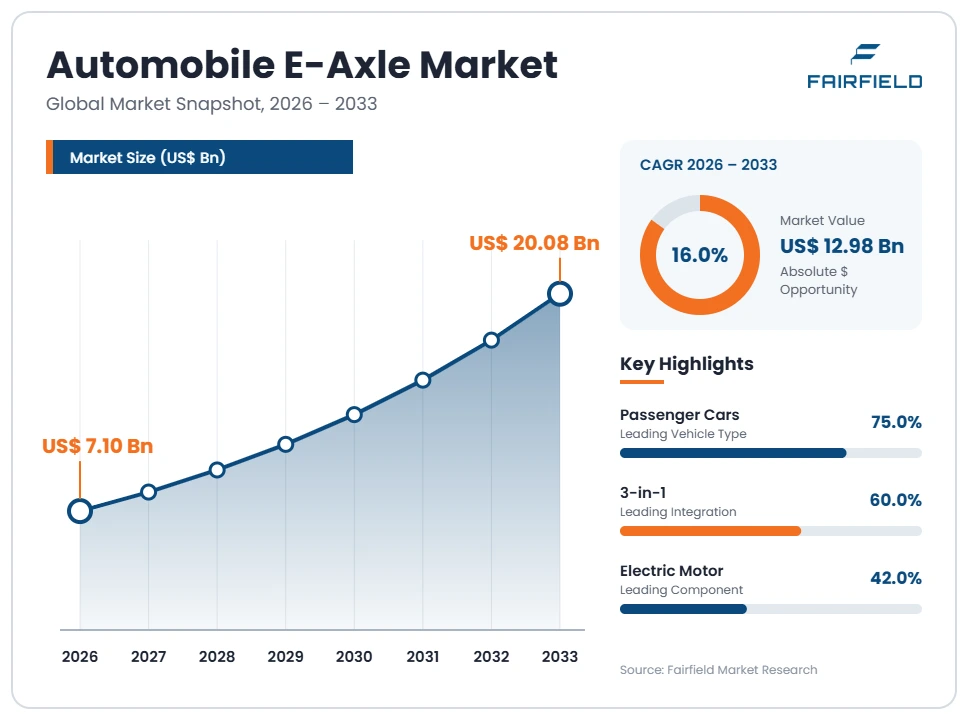
The global automobile e-axle market size is expected to be valued at US$ 7.10 billion in 2026 and projected to reach US$ 20.08 billion by 2033, growing at a CAGR of 16.0% between 2026 and 2033.
Between 2020 and 2025, the market grew at a CAGR of about 31.5%, rising from roughly US$ 1.50 billion to about US$ 5.90 billion, as electric car sales surged in China and Europe, automakers launched dedicated EV platforms, and suppliers moved from separate motors and gearboxes to compact integrated drive units. The automobile e-axle market covers integrated electric drive units that combine an electric motor, power electronics such as the inverter, and a reduction gearbox and differential in one compact housing mounted directly on the axle. E-axles replace the engine, transmission, and driveshaft in electric vehicles. Main configurations include 2-in-1 and 3-in-1 units, and newer multi-in-one systems that add the onboard charger and DC converter. E-axles are used in passenger cars, light commercial vehicles, buses, and trucks. In September 2026, Bosch presented a new rigid e-axle for heavy trucks at IAA Transportation 2026.
Key Report Takeaways
- By Component: Electric Motor held about 42% share in 2025, while Power Electronics are projected to expand at an 18.5% CAGR through 2033, driven by silicon carbide inverters, 800-volt architectures, and demand for higher efficiency and longer driving range.
- By Integration: 3-in-1 held about 60% share in 2025, while Multi-in-One is projected to expand at a 20.0% CAGR through 2033, driven by automakers seeking lower cost, smaller size, and fewer parts by combining chargers and converters with the drive unit.
- By Vehicle Type: Passenger Cars held about 75% share in 2025, while Commercial Vehicles are projected to expand at a 19.0% CAGR through 2033, driven by electric buses, delivery vans, and heavy trucks adopting integrated e-axles to save space for batteries.
- By Region: Asia Pacific held about 55% share in 2025, while India is projected to expand at a 22.0% CAGR through 2033, driven by government EV incentives, electric bus programs, local e-axle production, and rising electric car launches by domestic automakers.
Global Automobile E-Axle Market Trends and Insights
Drivers Impact Analysis
Two drivers carry the strongest influence on automobile e-axle market demand during the forecast period.
| Driver | Impact on CAGR Forecast | Geographic Relevance | Impact Timeline |
| Rising electric vehicle production | High | Global | Long term (≥4 years) |
| Demand for compact, efficient powertrains | High | Asia Pacific, Europe, North America | Medium term (2-4 years) |
EV Production Is Driving the Automobile E-Axle Market
Rising electric vehicle production is the strongest driver of the automobile e-axle market. Every electric vehicle needs at least one electric drive unit.
The mechanism is that governments are pushing automakers toward zero-emission vehicles through fuel economy rules, carbon dioxide targets, sales mandates, and purchase incentives, while battery prices have fallen sharply. China produces more than half of the world's electric cars, and Europe, India, South Korea, and North America continue to expand EV production. Most battery-electric cars use one e-axle for two-wheel drive or two e-axles for all-wheel drive, so rising EV volumes directly raise e-axle demand. Electric buses, vans, and trucks are also growing quickly. Automakers prefer e-axles because they shorten development time and simplify vehicle assembly. These trends support strong, long-term demand.
Compact Powertrains Are Expanding the Automobile E-Axle Market
Demand for compact, efficient powertrains is expanding the automobile e-axle market. Automakers want more space and range.
The cause is that integrating the motor, inverter, and gearbox in one housing removes cables, connectors, and mounting brackets, reducing weight, cost, and energy losses. A smaller drive unit leaves more room for batteries, passengers, and luggage, and it allows flat floor designs on dedicated EV platforms. Silicon carbide inverters and 800-volt systems raise efficiency, enabling faster charging and longer range. Suppliers such as Bosch, ZF, Nidec, and Aisin offer scalable e-axle families that automakers can adapt across many models. In commercial vehicles, e-axles like ZF's AxTrax 2 replace the engine, transmission, and driveshaft entirely, freeing space for larger battery packs, low floors, and more passengers.
Restraints Impact Analysis
Two restraints limit how quickly the automobile e-axle market grows.
| Restraint | Impact on CAGR Forecast | Geographic Relevance | Impact Timeline |
| Slower EV adoption in some markets | High | North America, Europe | Medium term (2-4 years) |
| Price pressure and rare earth supply risks | Medium | Global | Long term (≥4 years) |
Slower EV Adoption Slows the Automobile E-Axle Market
Slower EV adoption in some markets slows the automobile e-axle market. Demand depends on electric vehicle sales.
The problem is that EV sales growth has slowed in parts of North America and Europe because of high vehicle prices, reduced or ended purchase incentives, limited charging networks, and consumer concerns about range and resale values. Some automakers have delayed EV launches, cut production targets, or shifted investment back toward hybrids, reducing near-term orders for e-axles. Policy changes in the United States, including the end of federal EV tax credits, have added uncertainty. Suppliers that built new e-axle plants based on earlier forecasts face low utilization and losses. Several suppliers have restructured or cut jobs in their electric drive units. These factors slow growth and pressure margins outside Asia Pacific.
Price Pressure and Supply Risks Restrict the Automobile E-Axle Market
Price pressure and rare earth supply risks restrict the automobile e-axle market. Costs and supply chains are under strain.
The constraint is that intense competition, especially from Chinese suppliers and vertically integrated automakers such as BYD and Tesla, has pushed e-axle prices down quickly, squeezing margins for independent suppliers. Many automakers build their own drive units in-house to control cost and technology, reducing the market open to suppliers. Permanent magnet motors depend on rare earth elements such as neodymium and dysprosium, and supply is concentrated in China, which has introduced export controls. Silicon carbide chips, copper, and steel prices can also rise sharply. Suppliers are developing rare-earth-free motors, but these may reduce efficiency. These factors raise risks and restrict profitability for many suppliers.
Market Opportunities
Commercial Vehicle E-Axles Open a Fast-Growth Revenue Pool
Commercial vehicle e-axles open a fast-growth revenue pool. Buses and trucks are electrifying quickly.
The opportunity comes from electric city buses, delivery vans, refuse trucks, and heavy-duty trucks, which need powerful, durable e-axles that replace the engine and driveline. In February 2026, ZF won a major multi-year order from an Indian bus maker for several thousand AxTrax 2 LF electric portal axles, and in September 2026, it announced plans to localize AxTrax 2 production in the United States. Bosch launched a rigid e-axle for trucks of 18 to 49 metric tons. Commercial e-axles carry higher prices per unit, longer service lives, and multi-year supply contracts. Companies with proven durability, high torque, and service support can win large fleet programs.
Next-Generation Integration and India Create a Growth Revenue Pool
Next-generation integration and India create a growth revenue pool. New technology and markets are opening.
The opportunity reflects multi-in-one drive units that combine the motor, inverter, gearbox, onboard charger, DC converter, and thermal management in one module, cutting cost and size further. Silicon carbide power electronics, oil-cooled motors, and software-controlled torque vectoring improve efficiency and performance. At the same time, India is expanding EV production under its production-linked incentive scheme and electric bus programs, and global suppliers such as Valeo and Bosch are building local e-axle lines for domestic automakers. Electric two-wheelers and three-wheelers in India also use small integrated drive units, building local supply chains. Companies that offer affordable, scalable platforms, strong engineering support, and local production can capture strong growth in these fast-growing segments and markets.
Segment Analysis
- By Component: Electric Motor Leads While Power Electronics Grow Fastest
Electric Motor held about 42% share in 2025. The motor converts electrical energy into motion and is the largest and most valuable mechanical part of the e-axle, using copper windings, steel laminations, and often rare earth magnets. Permanent magnet synchronous motors dominate passenger cars because of their high efficiency and power density.
Power Electronics are the fastest-growing component, expanding at an 18.5% CAGR through 2033. Inverters control motor speed and torque, and new silicon carbide designs raise efficiency and support 800-volt systems for faster charging. Gearbox and Other Components, including the differential, housing, and cooling system, form other segments. For the market, power electronics growth reflects the importance of efficiency and range in electric vehicles.
- By Integration: 3-in-1 Leads While Multi-in-One Grows Fastest
3-in-1 held about 60% share in 2025. Combining the motor, inverter, and gearbox in one unit is now the standard design for most new battery-electric cars, offering a good balance of compact size, cost, and serviceability. Most major suppliers sell scalable 3-in-1 platforms that cover small cars to large SUVs, and automakers can choose different power levels from the same basic design, reducing engineering cost.
Multi-in-One is the fastest-growing integration level, expanding at a 20.0% CAGR through 2033. Units that add the charger, converter, and power distribution reduce parts and wiring further, and Chinese automakers lead adoption. 2-in-1 forms another segment, often used in hybrids and where automakers want flexibility in gearbox choice. For the market, deeper integration lowers cost per vehicle and raises supplier content per unit.
- By Vehicle Type: Passenger Cars Lead While Commercial Vehicles Grow Fastest
Passenger Cars held about 75% share in 2025. Battery-electric and plug-in hybrid cars, SUVs, and crossovers make up most electric vehicle production worldwide, and many premium models use two e-axles for all-wheel drive. High volumes give passenger cars the largest share, and new affordable electric models in China, Europe, and India are expanding the customer base.
Commercial Vehicles are the fastest-growing vehicle type, expanding at a 19.0% CAGR through 2033. Electric buses, vans, refuse trucks, and heavy trucks use powerful e-axles that free space for batteries and lower floors. Fleet operators value lower energy and maintenance costs over the vehicle's life. For the market, commercial growth adds higher-value, longer-life units and long supply contracts with bus and truck makers.
Geography Analysis
- Why Is North America Important to the Automobile E-Axle Market?
North America is a major automobile e-axle market. The United States has large electric pickup, SUV, and commercial vehicle programs, and automakers such as Tesla, General Motors, Ford, and Rivian build electric drive units locally. Dana, BorgWarner, American Axle, and Allison Transmission develop e-axles for cars and trucks, and ZF plans to localize AxTrax 2 production in the United States. Canada and Mexico add EV and parts production for the integrated regional supply chain. Key barriers include policy uncertainty and slower EV sales. One change shaping the region is localization for trade compliance.
- Europe Shapes the Automobile E-Axle Market Through Supplier Leadership
Europe is a major automobile e-axle market. Germany, France, the United Kingdom, Sweden, and Hungary host large EV and e-axle production, and strict carbon dioxide targets push automakers toward electric vehicles. Bosch, ZF, Schaeffler, Valeo, and GKN are based in the region, and ZF Foxconn assembles e-axles in Hungary for BMW's Neue Klasse. Key barriers include high energy costs, slower EV sales, and Chinese competition. One opportunity is electric buses and trucks, supported by zero-emission rules for heavy vehicles and European Union carbon dioxide targets for trucks.
- Which Region Is Leading the Automobile E-Axle Market?
Asia Pacific is leading the automobile e-axle market with about 55% share in 2025, while India is the fastest-growing country, expanding at a 22.0% CAGR through 2033. China is the world's largest EV producer, with BYD's FinDreams Powertrain, Huawei, Inovance, and many local suppliers. Japan is home to Nidec, Aisin, and Denso, while South Korea has Hyundai Mobis. India is building local e-axle lines with Valeo and Bosch. Key barriers include price wars. One change shaping the region is rapid adoption of multi-in-one units.
- Latin America Grows the Automobile E-Axle Market Through EV Imports and Buses
Latin America is a growing automobile e-axle market. Brazil, Mexico, Chile, Colombia, and Argentina are adopting electric buses for public transport, and Chile and Colombia operate some of the largest electric bus fleets outside China. Brazil is attracting new EV assembly plants from Chinese automakers such as BYD, while Mexico is a major vehicle and parts production hub serving North America. Key barriers include high EV prices, import duties, and limited charging networks. One opportunity is e-axles for electric buses, supported by city transport programs, development bank funding, and local bus body makers.
- Middle East & Africa Builds the Automobile E-Axle Market Through New EV Projects
Middle East & Africa is an emerging automobile e-axle market. Saudi Arabia and the United Arab Emirates are investing in local EV production, such as Ceer and Lucid's plant in Saudi Arabia, and expanding charging networks. Egypt and Morocco have growing vehicle assembly and parts exports to Europe, while South Africa produces vehicles for export. Key barriers include low EV adoption, high vehicle prices, and limited charging outside large cities. One opportunity is local EV assembly and electric bus fleets, supported by national industrial plans, sovereign wealth fund investment, and partnerships with global automakers and suppliers.
Competitive Landscape
The automobile e-axle market is moderately consolidated. Robert Bosch GmbH, ZF Friedrichshafen AG, Nidec Corporation, Aisin Corporation, and BYD Company Ltd. (FinDreams Powertrain) are leading players, while Schaeffler, BorgWarner, Dana, Magna, Valeo, Hyundai Mobis, and GKN Automotive compete strongly. The market includes independent suppliers that sell e-axles to many automakers and vertically integrated automakers that build drive units in-house. BYD produces e-axles mainly for its own vehicles at very high volumes, while Nidec and Aisin supply Japanese and Chinese automakers, and European suppliers serve European, North American, and Asian customers.
Companies compete on efficiency, power density, weight, noise, integration level, cost per unit, software control, production scale, and the ability to support global vehicle platforms. Price competition is intense in China, where many local suppliers offer low-cost, highly integrated units.
Strategic moves show how competition is changing. In February 2026, ZF won a large order in India for AxTrax 2 LF bus axles. In September 2026, Bosch launched a rigid heavy-truck e-axle, and ZF announced plans to localize AxTrax 2 production in the United States. Valeo opened an e-axle line in India for Mahindra, and ZF Foxconn began e-axle assembly in Hungary for BMW.
Three themes shape vendor strategy. First, suppliers are moving to multi-in-one units with silicon carbide power electronics. Second, they are expanding into commercial vehicle e-axles. Third, they are localizing production near customers to cut costs and meet trade rules.
Automobile E-Axle Market Industry Leaders
- Robert Bosch GmbH
- ZF Friedrichshafen AG
- Nidec Corporation
- Aisin Corporation
- BYD Company Ltd. (FinDreams Powertrain)
Recent Industry Developments
- September 2026: Bosch presented a new rigid e-axle integrating the electric motor and transmission for commercial vehicles of 18 to 49 metric tons at IAA Transportation 2026, paired with silicon carbide inverters of up to 99% efficiency - expands heavy-duty options in the automobile e-axle market.
- September 2026: ZF said it is working to localize production of its AxTrax 2 electric axle in the United States, targeting compliance with USMCA rules by 2031 - strengthens its position in North America.
- February 2026: ZF won a multi-year order from a leading Indian bus maker for several thousand AxTrax 2 LF electric portal axles for 11-meter and 18-meter city buses, with deliveries starting in 2026 - supports electric bus growth in India.
Companies Covered in the Report
- Robert Bosch GmbH
- ZF Friedrichshafen AG
- Nidec Corporation
- Aisin Corporation
- BYD Company Ltd. (FinDreams Powertrain)
- Schaeffler AG
- BorgWarner Inc.
- Dana Incorporated
- Magna International Inc.
- Valeo
- Hyundai Mobis
- GKN Automotive
Automobile E-Axle Market Report Scope
| Metric | Value |
| Study Period | 2020-2033 |
| Market Size 2026 | US$ 7.10 Billion |
| Market Size 2033 | US$ 20.08 Billion |
| CAGR 2026-2033 | 16.0% |
| Absolute Dollar Opportunity | US$ 12.98 Billion |
| Largest Market | Asia Pacific |
| Fastest-Growing Market | India |
| Market Concentration | Moderately Consolidated |
| Major Players | Robert Bosch GmbH, ZF Friedrichshafen AG, Nidec Corporation, Aisin Corporation, BYD Company Ltd. (FinDreams Powertrain) |
Automobile E-Axle Market Segmentation
- Executive Summary
- Automobile E-Axle Market Snapshot
- Future Projections
- Key Market Trends
- Regional Snapshot
- Market Overview
- Market Definition and Report Scope
- Historical Market Trends
- Market Dynamics
- Drivers
- EV Production Is Driving the Automobile E-Axle Market
- Compact Powertrains Are Expanding the Automobile E-Axle Market
- Restraints
- Slower EV Adoption Slows the Automobile E-Axle Market
- Price Pressure and Supply Risks Restrict the Automobile E-Axle Market
- Market Opportunities
- Commercial Vehicle E-Axles Open a Fast-Growth Revenue Pool
- Next-Generation Integration and India Create a Growth Revenue Pool
- Drivers
- Global Automobile E-Axle Market Outlook, 2020–2033
- Global Automobile E-Axle Market Outlook, by Component, Value (US$ Billion), 2020–2033
- Electric Motor
- Power Electronics
- Gearbox and Other Components
- Global Automobile E-Axle Market Outlook, by Integration, Value (US$ Billion), 2020–2033
- 2-in-1
- 3-in-1
- Multi-in-One
- Global Automobile E-Axle Market Outlook, by Vehicle Type, Value (US$ Billion), 2020–2033
- Passenger Cars
- Commercial Vehicles
- Global Automobile E-Axle Market Outlook, by Region, Value (US$ Billion), 2020–2033
- North America
- Europe
- Asia Pacific
- Latin America
- Middle East & Africa
- Global Automobile E-Axle Market Outlook, by Component, Value (US$ Billion), 2020–2033
- North America Automobile E-Axle Market Outlook, 2020–2033
- North America Automobile E-Axle Market Outlook, by Component, Value (US$ Billion), 2020–2033
- Electric Motor
- Power Electronics
- Gearbox and Other Components
- North America Automobile E-Axle Market Outlook, by Integration, Value (US$ Billion), 2020–2033
- 2-in-1
- 3-in-1
- Multi-in-One
- North America Automobile E-Axle Market Outlook, by Vehicle Type, Value (US$ Billion), 2020–2033
- Passenger Cars
- Commercial Vehicles
- North America Automobile E-Axle Market Outlook, by Country, Value (US$ Billion), 2020–2033
- United States Automobile E-Axle Market Outlook, by Component, 2020–2033
- United States Automobile E-Axle Market Outlook, by Integration, 2020–2033
- United States Automobile E-Axle Market Outlook, by Vehicle Type, 2020–2033
- Canada Automobile E-Axle Market Outlook, by Component, 2020–2033
- Canada Automobile E-Axle Market Outlook, by Integration, 2020–2033
- Canada Automobile E-Axle Market Outlook, by Vehicle Type, 2020–2033
- Mexico Automobile E-Axle Market Outlook, by Component, 2020–2033
- Mexico Automobile E-Axle Market Outlook, by Integration, 2020–2033
- Mexico Automobile E-Axle Market Outlook, by Vehicle Type, 2020–2033
- North America Automobile E-Axle Market Outlook, by Component, Value (US$ Billion), 2020–2033
- Europe Automobile E-Axle Market Outlook, 2020–2033
- Europe Automobile E-Axle Market Outlook, by Component, Value (US$ Billion), 2020–2033
- Electric Motor
- Power Electronics
- Gearbox and Other Components
- Europe Automobile E-Axle Market Outlook, by Integration, Value (US$ Billion), 2020–2033
- 2-in-1
- 3-in-1
- Multi-in-One
- Europe Automobile E-Axle Market Outlook, by Vehicle Type, Value (US$ Billion), 2020–2033
- Passenger Cars
- Commercial Vehicles
- Europe Automobile E-Axle Market Outlook, by Country, Value (US$ Billion), 2020–2033
- Germany Automobile E-Axle Market Outlook, by Component, 2020–2033
- Germany Automobile E-Axle Market Outlook, by Integration, 2020–2033
- Germany Automobile E-Axle Market Outlook, by Vehicle Type, 2020–2033
- France Automobile E-Axle Market Outlook, by Component, 2020–2033
- France Automobile E-Axle Market Outlook, by Integration, 2020–2033
- France Automobile E-Axle Market Outlook, by Vehicle Type, 2020–2033
- United Kingdom Automobile E-Axle Market Outlook, by Component, 2020–2033
- United Kingdom Automobile E-Axle Market Outlook, by Integration, 2020–2033
- United Kingdom Automobile E-Axle Market Outlook, by Vehicle Type, 2020–2033
- Sweden Automobile E-Axle Market Outlook, by Component, 2020–2033
- Sweden Automobile E-Axle Market Outlook, by Integration, 2020–2033
- Sweden Automobile E-Axle Market Outlook, by Vehicle Type, 2020–2033
- Hungary Automobile E-Axle Market Outlook, by Component, 2020–2033
- Hungary Automobile E-Axle Market Outlook, by Integration, 2020–2033
- Hungary Automobile E-Axle Market Outlook, by Vehicle Type, 2020–2033
- Europe Automobile E-Axle Market Outlook, by Component, Value (US$ Billion), 2020–2033
- Asia Pacific Automobile E-Axle Market Outlook, 2020–2033
- Asia Pacific Automobile E-Axle Market Outlook, by Component, Value (US$ Billion), 2020–2033
- Electric Motor
- Power Electronics
- Gearbox and Other Components
- Asia Pacific Automobile E-Axle Market Outlook, by Integration, Value (US$ Billion), 2020–2033
- 2-in-1
- 3-in-1
- Multi-in-One
- Asia Pacific Automobile E-Axle Market Outlook, by Vehicle Type, Value (US$ Billion), 2020–2033
- Passenger Cars
- Commercial Vehicles
- Asia Pacific Automobile E-Axle Market Outlook, by Country, Value (US$ Billion), 2020–2033
- India Automobile E-Axle Market Outlook, by Component, 2020–2033
- India Automobile E-Axle Market Outlook, by Integration, 2020–2033
- India Automobile E-Axle Market Outlook, by Vehicle Type, 2020–2033
- China Automobile E-Axle Market Outlook, by Component, 2020–2033
- China Automobile E-Axle Market Outlook, by Integration, 2020–2033
- China Automobile E-Axle Market Outlook, by Vehicle Type, 2020–2033
- Japan Automobile E-Axle Market Outlook, by Component, 2020–2033
- Japan Automobile E-Axle Market Outlook, by Integration, 2020–2033
- Japan Automobile E-Axle Market Outlook, by Vehicle Type, 2020–2033
- South Korea Automobile E-Axle Market Outlook, by Component, 2020–2033
- South Korea Automobile E-Axle Market Outlook, by Integration, 2020–2033
- South Korea Automobile E-Axle Market Outlook, by Vehicle Type, 2020–2033
- Asia Pacific Automobile E-Axle Market Outlook, by Component, Value (US$ Billion), 2020–2033
- Latin America Automobile E-Axle Market Outlook, 2020–2033
- Latin America Automobile E-Axle Market Outlook, by Component, Value (US$ Billion), 2020–2033
- Electric Motor
- Power Electronics
- Gearbox and Other Components
- Latin America Automobile E-Axle Market Outlook, by Integration, Value (US$ Billion), 2020–2033
- 2-in-1
- 3-in-1
- Multi-in-One
- Latin America Automobile E-Axle Market Outlook, by Vehicle Type, Value (US$ Billion), 2020–2033
- Passenger Cars
- Commercial Vehicles
- Latin America Automobile E-Axle Market Outlook, by Country, Value (US$ Billion), 2020–2033
- Brazil Automobile E-Axle Market Outlook, by Component, 2020–2033
- Brazil Automobile E-Axle Market Outlook, by Integration, 2020–2033
- Brazil Automobile E-Axle Market Outlook, by Vehicle Type, 2020–2033
- Mexico Automobile E-Axle Market Outlook, by Component, 2020–2033
- Mexico Automobile E-Axle Market Outlook, by Integration, 2020–2033
- Mexico Automobile E-Axle Market Outlook, by Vehicle Type, 2020–2033
- Chile Automobile E-Axle Market Outlook, by Component, 2020–2033
- Chile Automobile E-Axle Market Outlook, by Integration, 2020–2033
- Chile Automobile E-Axle Market Outlook, by Vehicle Type, 2020–2033
- Colombia Automobile E-Axle Market Outlook, by Component, 2020–2033
- Colombia Automobile E-Axle Market Outlook, by Integration, 2020–2033
- Colombia Automobile E-Axle Market Outlook, by Vehicle Type, 2020–2033
- Argentina Automobile E-Axle Market Outlook, by Component, 2020–2033
- Argentina Automobile E-Axle Market Outlook, by Integration, 2020–2033
- Argentina Automobile E-Axle Market Outlook, by Vehicle Type, 2020–2033
- China Automobile E-Axle Market Outlook, by Component, 2020–2033
- China Automobile E-Axle Market Outlook, by Integration, 2020–2033
- China Automobile E-Axle Market Outlook, by Vehicle Type, 2020–2033
- Latin America Automobile E-Axle Market Outlook, by Component, Value (US$ Billion), 2020–2033
- Middle East & Africa Automobile E-Axle Market Outlook, 2020–2033
- Middle East & Africa Automobile E-Axle Market Outlook, by Component, Value (US$ Billion), 2020–2033
- Electric Motor
- Power Electronics
- Gearbox and Other Components
- Middle East & Africa Automobile E-Axle Market Outlook, by Integration, Value (US$ Billion), 2020–2033
- 2-in-1
- 3-in-1
- Multi-in-One
- Middle East & Africa Automobile E-Axle Market Outlook, by Vehicle Type, Value (US$ Billion), 2020–2033
- Passenger Cars
- Commercial Vehicles
- Middle East & Africa Automobile E-Axle Market Outlook, by Country, Value (US$ Billion), 2020–2033
- Saudi Arabia Automobile E-Axle Market Outlook, by Component, 2020–2033
- Saudi Arabia Automobile E-Axle Market Outlook, by Integration, 2020–2033
- Saudi Arabia Automobile E-Axle Market Outlook, by Vehicle Type, 2020–2033
- United Arab Emirates Automobile E-Axle Market Outlook, by Component, 2020–2033
- United Arab Emirates Automobile E-Axle Market Outlook, by Integration, 2020–2033
- United Arab Emirates Automobile E-Axle Market Outlook, by Vehicle Type, 2020–2033
- Egypt Automobile E-Axle Market Outlook, by Component, 2020–2033
- Egypt Automobile E-Axle Market Outlook, by Integration, 2020–2033
- Egypt Automobile E-Axle Market Outlook, by Vehicle Type, 2020–2033
- Morocco Automobile E-Axle Market Outlook, by Component, 2020–2033
- Morocco Automobile E-Axle Market Outlook, by Integration, 2020–2033
- Morocco Automobile E-Axle Market Outlook, by Vehicle Type, 2020–2033
- South Africa Automobile E-Axle Market Outlook, by Component, 2020–2033
- South Africa Automobile E-Axle Market Outlook, by Integration, 2020–2033
- South Africa Automobile E-Axle Market Outlook, by Vehicle Type, 2020–2033
- Middle East & Africa Automobile E-Axle Market Outlook, by Component, Value (US$ Billion), 2020–2033
- Competitive Landscape
- Automobile E-Axle Market Industry Leaders
- Recent Industry Developments
- Company Profiles
- Robert Bosch GmbH
- ZF Friedrichshafen AG
- Nidec Corporation
- Aisin Corporation
- BYD Company Ltd. (FinDreams Powertrain)
- Schaeffler AG
- BorgWarner Inc.
- Dana Incorporated
- Magna International Inc.
- Valeo
- Hyundai Mobis
- GKN Automotive
- Appendix
- Research Methodology
- Report Assumptions
- Acronyms and Abbreviations
Component
- Electric Motor
- Power Electronics
- Gearbox and Other Components
Integration
- 2-in-1
- 3-in-1
- Multi-in-One
Vehicle Type
- Passenger Cars
- Commercial Vehicles
Regions
- North America
- Europe
- Asia Pacific
- Latin America
- Middle East & Africa
Our Research Methodology
Considering the volatility of business today, traditional approaches to strategizing a game plan can be unfruitful if not detrimental. True ambiguity is no way to determine a forecast. A myriad of predetermined factors must be accounted for such as the degree of risk involved, the magnitude of circumstances, as well as conditions or consequences that are not known or unpredictable. To circumvent binary views that cast uncertainty, the application of market research intelligence to strategically posture, move, and enable actionable outcomes is necessary.
View Methodology
Quality Assured
Rigorous Validation Process

Confidentiality Assured
End-to-end Data Security

Custom Research Services
Tailored To Your Objectives
FAQs
The global automobile e-axle market is expected to be valued at US$ 7.10 billion in 2026, driven by rising electric vehicle production worldwide.
The market is projected to grow at a 16.0% CAGR from 2026 to 2033, reaching about US$ 20.08 billion by 2033.
Asia Pacific leads with about 55% share, supported by massive EV production in China and strong suppliers in Japan and South Korea.
India is growing fastest at a 22.0% CAGR, driven by EV incentives, electric bus programs, and new local e-axle production lines.
Key players include Bosch, ZF, Nidec, Aisin, and BYD, competing on efficiency, integration, cost, power density, and scale.
Related Reports
Automotive Tools Market Size, Share, Insights, Competitive Landscape, and Forecast 2026 to 2033
The global automotive tools market is valued at US$53.58 billion in 2026, reaching US$77.53 billion by 2033, growing at a 5.4% CAGR
Automotive Defroster Market Size, Share, Insights, Competitive Landscape, and Forecast 2026 to 2033
The global automotive defroster market is valued at US$2.40 billion in 2026, reaching US$3.27 billion by 2033, growing at a 4.5% CAGR
Automated Front Load Garbage Trucks Market Size, Share, Insights, Competitive Landscape, and Forecast 2026 to 2033
The global automated front load garbage trucks market is valued at US$8.24 billion in 2026, reaching US$12.60 billion by 2033, growing at a 6.3% CAGR
Off-the-road Tire (OTR) Market Insights, Competitive Landscape, and Market Forecast - 2033
Off-the-road tire market driven by rising industrial activity, agricultural expansion in Asia Pacific, and robust demand from the mining sector post-COVID.
Light Commercial Vehicles Market Insights, Competitive Landscape, and Market Forecast - 2033
Light commercial vehicles market grows on rising urban demand, regulation shifts, and preference for compact, efficient transport in metro and suburban areas.
Fuel Cell Powertrain Market Size, Share, Insights, Competitive Landscape, and Forecast 2026 to 2033
The fuel cell powertrain market is projected to reach US$ 76.8 billion by 2033, growing at 79.1% CAGR from US$ 1.3 billion in 2026.