



Automotive Tools Market
Automotive Tools Market Size, Share, Insights, Competitive Landscape, and Forecast 2026 to 2033
Automotive Tools Market Size and Trend Analysis
How Fast Is the Automotive Tools Market Growing?
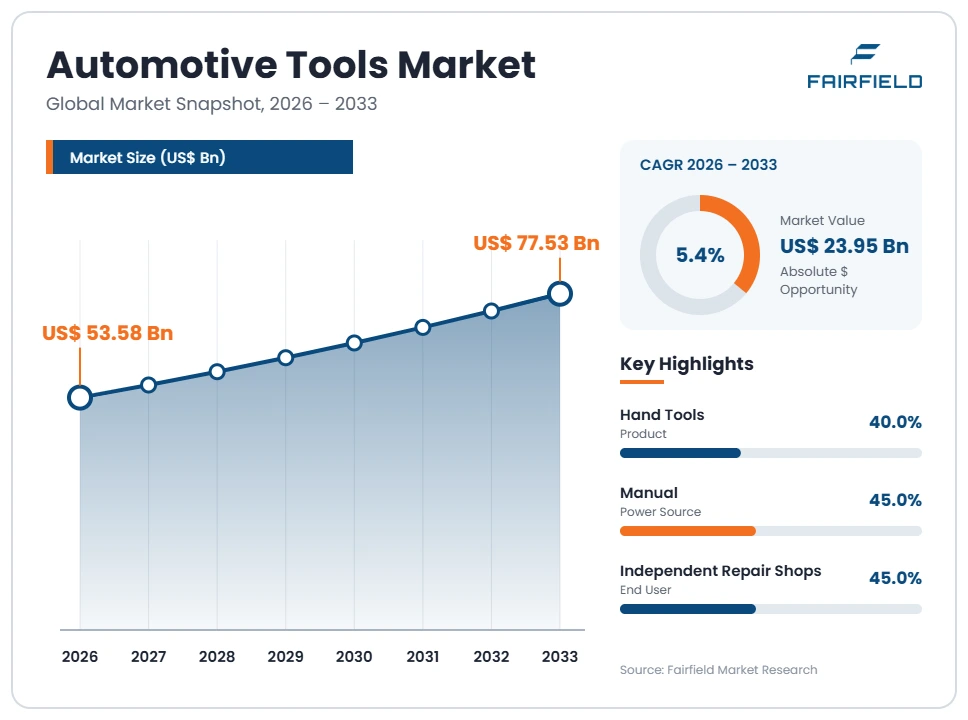
The global automotive tools market size is expected to be valued at US$ 53.58 billion in 2026 and projected to reach US$ 77.53 billion by 2033, growing at a CAGR of 5.4% between 2026 and 2033.
Between 2020 and 2025, the market grew at a CAGR of about 4.9%, rising from roughly US$ 40.00 billion to about US$ 50.83 billion, as the global vehicle fleet aged, people kept cars longer, repair shops invested in cordless and diagnostic equipment, and electric vehicles created demand for new insulated and high-voltage service tools. The automotive tools market covers the hand tools, power tools, diagnostic equipment, and specialty tools used to build, maintain, and repair cars, trucks, buses, and motorcycles. Main products include wrenches, sockets, ratchets, pliers, and screwdrivers, impact wrenches, drills, grinders, and polishers, OBD scan tools, multimeters, and ADAS calibration systems. Buyers include vehicle manufacturers, dealerships, independent repair shops, fleets, collision centers, and do-it-yourself owners. In June 2026, Snap-on acquired heavy-duty diagnostics provider Diesel Laptops for about US$ 100 million.
Key Report Takeaways
- By Product: Hand Tools held about 40% share in 2025, while Diagnostic and Testing Tools are projected to expand at a 7.5% CAGR through 2033, driven by more electronics in vehicles, ADAS calibration needs, EV battery testing, and software-based repair procedures.
- By Power Source: Manual held about 45% share in 2025, while Cordless Electric is projected to expand at an 8.0% CAGR through 2033, driven by better lithium-ion batteries, brushless motors, and technicians replacing air-powered tools with portable cordless models.
- By End User: Independent Repair Shops held about 45% share in 2025, while Do-It-Yourself Consumers are projected to expand at a 6.5% CAGR through 2033, driven by online tool sales, repair videos, rising repair costs, and right-to-repair laws.
- By Region: Asia Pacific held about 38% share in 2025, while India is projected to expand at an 8.1% CAGR through 2033, driven by fast growth in vehicle ownership, new service centers, rising two-wheeler and car repair demand, and local tool manufacturing.
Global Automotive Tools Market Trends and Insights
Drivers Impact Analysis
Two drivers carry the strongest influence on automotive tools market demand during the forecast period.
| Driver | Impact on CAGR Forecast | Geographic Relevance | Impact Timeline |
| Ageing vehicle fleet and rising repair demand | High | Global | Long term (≥4 years) |
| Vehicle electrification and electronic complexity | High | North America, Europe, Asia Pacific | Medium term (2-4 years) |
Ageing Fleets Are Driving the Automotive Tools Market
Ageing vehicle fleet and rising repair demand are the strongest driver of the automotive tools market. Older cars need more maintenance.
The mechanism is that people are keeping vehicles longer because new cars are expensive and vehicles are built to last, pushing the average age of cars and light trucks in the United States above 12 years, with similar trends in Europe and Japan. Older vehicles need more brake jobs, suspension work, engine repairs, and part replacements, which keeps repair shops busy and drives purchases of hand tools, power tools, and lifts. The global vehicle fleet is also growing, especially in China, India, and Indonesia, adding millions of new vehicles that will need service. Fleet operators and ride-hailing drivers put high mileage on vehicles. These trends create steady, recurring demand for automotive tools across all regions.
Electrification and Complexity Are Expanding the Automotive Tools Market
Vehicle electrification and electronic complexity are expanding the automotive tools market. Modern vehicles need new tools.
The cause is that today's vehicles contain dozens of electronic control units, sensors, cameras, and radar systems, and repairing them requires scan tools, software updates, and calibration equipment. After a windshield replacement or collision repair, driver assistance cameras and radars must be recalibrated with specialized targets and frames. Electric and hybrid vehicles need insulated hand tools, high-voltage testers, battery lifting tables, and safety equipment rated for 1,000 volts. Repair information platforms and guided diagnostics help technicians fix complex faults faster. These new requirements raise spending per repair shop and shift demand toward higher-value tools. Suppliers such as Snap-on, Autel, Bosch, and Launch Tech are expanding diagnostic and EV service offerings to meet this demand.
Restraints Impact Analysis
Two restraints limit how quickly the automotive tools market grows.
| Restraint | Impact on CAGR Forecast | Geographic Relevance | Impact Timeline |
| High cost of advanced diagnostic equipment | Medium | Global | Medium term (2-4 years) |
| Technician shortages and low-cost competition | Medium | Global | Long term (≥4 years) |
High Equipment Costs Slow the Automotive Tools Market
High cost of advanced diagnostic equipment slows the automotive tools market. Shops face large investments.
The problem is that advanced scan tools, ADAS calibration systems, EV battery service equipment, and software subscriptions can cost tens of thousands of dollars, which is a heavy burden for small independent repair shops. Many tools also need annual software updates and licenses to cover new vehicle models, adding recurring costs. Some automakers restrict access to repair data and security gateways, forcing shops to pay for additional access or send work to dealerships. Higher interest rates have increased the cost of financing equipment and tool truck purchases. In price-sensitive markets in Asia Pacific, Latin America, and Middle East & Africa, many workshops rely on basic tools. These factors slow adoption of high-value equipment.
Labor Shortages and Low-Cost Imports Restrict the Automotive Tools Market
Technician shortages and low-cost competition restrict the automotive tools market. The industry faces people and price pressures.
The constraint is that many countries face a shortage of qualified automotive technicians as older workers retire and fewer young people join the trade, which limits the number of tool buyers and the volume of repairs shops can handle. Technicians often buy their own tools, so fewer technicians means fewer premium tool purchases. At the same time, low-cost hand and power tools from manufacturers in China and other countries compete strongly on price through online marketplaces and big-box retailers. Electric vehicles also need less routine maintenance, such as oil changes, which may reduce some tool demand over time. Tariffs on imported tools and components can raise prices. These factors restrict growth for premium brands.
Market Opportunities
Cordless and Smart Tools Open a Fast-Growth Revenue Pool
Cordless and smart tools open a fast-growth revenue pool. Technicians want portable and connected equipment.
The opportunity comes from rapid improvements in lithium-ion batteries and brushless motors, which let cordless impact wrenches, ratchets, and grinders match or beat air-powered tools while removing hoses and compressors. In August 2026, Milwaukee Tool unveiled more than 90 new tools and solutions for vehicle repair and other trades at its PIPELINE event, focusing on cordless products that replace pneumatic tools. Smart torque wrenches, connected tool storage, and tool tracking apps help shops control quality and reduce losses. Battery platforms also lock in customers, since technicians tend to buy more tools that share the same battery. Companies that build strong battery platforms, durable designs, and connected features can win loyal technicians and premium pricing across every region.
Diagnostics and Heavy-Duty Repair Create a Growth Revenue Pool
Diagnostics and heavy-duty repair create a growth revenue pool. Data-driven repair is expanding.
The opportunity reflects growing demand for diagnostic tools, repair information, and calibration systems across cars, trucks, buses, and off-highway equipment. In June 2026, Snap-on acquired Diesel Laptops, adding diagnostics and repair information for commercial trucks and equipment used in mining, agriculture, and infrastructure, and in April 2026, it bought Hi-Force Hydraulic Tools for about US$ 58 million. Right-to-repair rules in the United States and Europe are improving access to vehicle data for independent shops. Fleet operators also want predictive maintenance tools that reduce downtime. Companies that combine hardware, software subscriptions, training, and repair data can earn recurring revenue and build long-term relationships with shops and fleets.
Segment Analysis
- By Product: Hand Tools Lead While Diagnostic and Testing Tools Grow Fastest
Hand Tools held about 40% share in 2025. Wrenches, sockets, ratchets, pliers, screwdrivers, hammers, and torque wrenches are used in almost every repair job, from simple maintenance to engine rebuilds. Technicians buy large sets and replace worn or lost tools regularly, and premium brands sold through tool trucks offer lifetime warranties that build loyalty.
Diagnostic and Testing Tools are the fastest-growing product, expanding at a 7.5% CAGR through 2033. Scan tools, multimeters, oscilloscopes, battery testers, ADAS calibration frames, and EV insulation testers are essential for modern electronic vehicles. Power Tools, Lifting and Garage Equipment, and Specialty Tools form other segments, each serving key repair tasks. For the market, diagnostic growth raises spending per shop and adds recurring software revenue for suppliers.
- By Power Source: Manual Leads While Cordless Electric Grows Fastest
Manual held about 45% share in 2025. Hand-operated tools remain the foundation of every technician's toolbox because they are simple, reliable, affordable, and suitable for precise work in tight spaces. Large numbers of manual tools are sold to professionals, students in vocational schools, and home users, and many sets are bought as gifts during holiday seasons.
Cordless Electric is the fastest-growing power source, expanding at an 8.0% CAGR through 2033. Battery-powered impact wrenches, ratchets, drills, and lights from Milwaukee, DeWalt, Snap-on, and Makita are replacing pneumatic and corded tools. Pneumatic and Corded Electric form other segments, and air tools remain common in heavy-duty and body shops. For the market, cordless growth supports higher-value platform sales and repeat battery purchases.
- By End User: Independent Repair Shops Lead While Do-It-Yourself Consumers Grow Fastest
Independent Repair Shops held about 45% share in 2025. Independent garages handle the majority of out-of-warranty repairs on older vehicles and buy a wide range of hand, power, and diagnostic tools. Their technicians are core customers for tool truck brands, often buying tools on weekly payment plans, and shop owners invest in lifts, diagnostics, and alignment equipment.
Do-It-Yourself Consumers are the fastest-growing end user, expanding at a 6.5% CAGR through 2033. Online sales, repair videos, and rising labor rates encourage owners to do basic repairs. Dealerships, OEM Manufacturing Plants, and Fleets form other segments, with dealerships buying brand-specific tools required by automakers. For the market, DIY growth expands retail and online sales of mid-priced tool sets.
Geography Analysis
- Why Is North America Important to the Automotive Tools Market?
North America is a major automotive tools market. The United States has one of the oldest and largest vehicle fleets in the world, a large network of independent repair shops and dealerships, and a strong tool truck distribution model used by Snap-on, Matco, and Cornwell. Stanley Black & Decker, Milwaukee Tool, and Snap-on are based in the region. Canada and Mexico add demand from vehicle production, fleets, and repair. Key barriers include technician shortages and tariffs. One change shaping the region is fast adoption of cordless tools, ADAS calibration, and EV service equipment.
- Europe Shapes the Automotive Tools Market Through Engineering Quality
Europe is a major automotive tools market. Germany, France, the United Kingdom, Italy, and Spain have large vehicle fleets, strong automotive manufacturing, and many independent workshops. Bosch, Würth, Hazet, Gedore, and Wera are based in the region, and European brands are known for precision and quality. The European Union's rules on repair information support independent shops and give them access to vehicle data. Key barriers include slow vehicle sales and price competition. One opportunity is EV service tools, supported by rapid electric vehicle adoption and strict workplace safety rules for high-voltage work.
- Which Region Is Leading the Automotive Tools Market?
Asia Pacific is leading the automotive tools market with about 38% share in 2025, while India is the fastest-growing country, expanding at an 8.1% CAGR through 2033. China has the world's largest vehicle production and a huge tool manufacturing base, while Japan is home to Makita and KTC. Hong Kong-based Techtronic Industries owns Milwaukee Tool, and Autel and Launch Tech are based in China. India has a fast-growing vehicle fleet and expanding service network. Key barriers include low-cost competition. One change shaping the region is fast growth of affordable diagnostic tools.
- Latin America Grows the Automotive Tools Market Through Fleet Growth
Latin America is a growing automotive tools market. Brazil, Mexico, Argentina, Colombia, and Chile have large, growing, and ageing vehicle fleets and many independent workshops that keep older cars running. Mexico is a major vehicle production hub for North America, and Brazil has a large domestic automotive industry with a big motorcycle fleet that also needs service tools. Key barriers include currency swings, high import costs, informal workshops, and price sensitivity. One opportunity is affordable diagnostic and cordless tools, supported by online retail growth, technical training programs, and rising vehicle ownership in large and mid-sized cities.
- Middle East & Africa Builds the Automotive Tools Market Through Vehicle Ownership
Middle East & Africa is an emerging automotive tools market. Saudi Arabia and the United Arab Emirates have high vehicle ownership, large fleets of SUVs, and growing service centers, while South Africa has strong vehicle production, export, and repair industries. Egypt, Morocco, and Nigeria have growing fleets of cars, motorcycles, and commercial vehicles, many of them older imported vehicles that need regular repair. Key barriers include counterfeit tools, informal workshops, and price sensitivity. One opportunity is professional tools for new service centers, supported by dealership expansion, technical training institutes, and growing online tool sales in large and mid-sized cities.
Competitive Landscape
The automotive tools market is fragmented. Snap-on Incorporated, Stanley Black & Decker, Inc., Techtronic Industries (Milwaukee Tool), Robert Bosch GmbH, and Makita Corporation are leading players, while Matco Tools, Würth Group, Hazet-Werk, Autel, Launch Tech, Ingersoll Rand, and Cornwell Quality Tools compete strongly. The market includes premium tool truck brands that sell directly to technicians at their workplaces, power tool makers that sell through distributors and retailers, diagnostic specialists that sell hardware and software subscriptions, and thousands of regional and low-cost manufacturers. No single company covers every product category in every region.
Companies compete on durability, warranties, ergonomics, battery platforms, diagnostic coverage, software updates, repair data, distribution reach, financing for technicians, after-sales service, and price. Tool truck networks and strong brand loyalty among professional technicians give premium brands an advantage.
Strategic moves show how competition is changing. In April 2026, Snap-on acquired Hi-Force Hydraulic Tools, and in June 2026, it bought Diesel Laptops to expand heavy-duty diagnostics. In August 2026, Milwaukee Tool launched more than 90 new products at PIPELINE. Matco Tools also launched its Maximus Plus 2.0 scan tool in July 2026, and Autel added new ADAS and HVAC diagnostic systems.
Three themes shape vendor strategy. First, companies are replacing pneumatic tools with cordless platforms. Second, they are building diagnostics, repair data, and software subscriptions. Third, they are adding EV service and heavy-duty tools through new products and acquisitions.
Automotive Tools Market Industry Leaders
- Snap-on Incorporated
- Stanley Black & Decker, Inc.
- Techtronic Industries (Milwaukee Tool)
- Robert Bosch GmbH
- Makita Corporation
Recent Industry Developments
- August 2026: Milwaukee Tool unveiled more than 90 new tools, gear, and solutions for the vehicle repair sector and other trades at its annual PIPELINE event, including new batteries, chargers, sockets, and its first welding products - expands cordless options in the automotive tools market.
- June 2026: Snap-on acquired Diesel Laptops, a provider of diagnostics and repair information for commercial trucks and off-highway equipment, for about US$ 100 million in cash - extends its diagnostics into heavy-duty markets.
- April 2026: Snap-on acquired United Kingdom-based Hi-Force Hydraulic Tools for about US$ 58 million in cash - adds high-force hydraulic tools to its portfolio.
Companies Covered in the Report
- Snap-on Incorporated
- Stanley Black & Decker, Inc.
- Techtronic Industries (Milwaukee Tool)
- Robert Bosch GmbH
- Makita Corporation
- Matco Tools
- Würth Group
- Hazet-Werk
- Autel Intelligent Technology
- Launch Tech Co., Ltd.
- Ingersoll Rand Inc.
- Cornwell Quality Tools
Automotive Tools Market Report Scope
| Metric | Value |
| Study Period | 2020-2033 |
| Market Size 2026 | US$ 53.58 Billion |
| Market Size 2033 | US$ 77.53 Billion |
| CAGR 2026-2033 | 5.4% |
| Absolute Dollar Opportunity | US$ 23.95 Billion |
| Largest Market | Asia Pacific |
| Fastest-Growing Market | India |
| Market Concentration | Fragmented |
| Major Players | Snap-on Incorporated, Stanley Black & Decker, Inc., Techtronic Industries (Milwaukee Tool), Robert Bosch GmbH, Makita Corporation |
Automotive Tools Market Segmentation
- Executive Summary
- Automotive Tools Market Snapshot
- Future Projections
- Key Market Trends
- Regional Snapshot
- Market Overview
- Market Definition and Report Scope
- Historical Market Trends
- Market Dynamics
- Drivers
- Ageing Fleets Are Driving the Automotive Tools Market
- Electrification and Complexity Are Expanding the Automotive Tools Market
- Restraints
- High Equipment Costs Slow the Automotive Tools Market
- Labor Shortages and Low-Cost Imports Restrict the Automotive Tools Market
- Market Opportunities
- Cordless and Smart Tools Open a Fast-Growth Revenue Pool
- Diagnostics and Heavy-Duty Repair Create a Growth Revenue Pool
- Drivers
- Global Automotive Tools Market Outlook, 2020–2033
- Global Automotive Tools Market Outlook, by Product, Value (US$ Billion), 2020–2033
- Hand Tools
- Power Tools
- Diagnostic and Testing Tools
- Lifting and Garage Equipment
- Specialty Tools
- Global Automotive Tools Market Outlook, by Power Source, Value (US$ Billion), 2020–2033
- Manual
- Cordless Electric
- Pneumatic
- Corded Electric
- Global Automotive Tools Market Outlook, by End User, Value (US$ Billion), 2020–2033
- Independent Repair Shops
- Dealerships
- OEM Manufacturing Plants
- Fleets
- Do-It-Yourself Consumers
- Global Automotive Tools Market Outlook, by Region, Value (US$ Billion), 2020–2033
- North America
- Europe
- Asia Pacific
- Latin America
- Middle East & Africa
- Global Automotive Tools Market Outlook, by Product, Value (US$ Billion), 2020–2033
- North America Automotive Tools Market Outlook, 2020–2033
- North America Automotive Tools Market Outlook, by Product, Value (US$ Billion), 2020–2033
- Hand Tools
- Power Tools
- Diagnostic and Testing Tools
- Lifting and Garage Equipment
- Specialty Tools
- North America Automotive Tools Market Outlook, by Power Source, Value (US$ Billion), 2020–2033
- Manual
- Cordless Electric
- Pneumatic
- Corded Electric
- North America Automotive Tools Market Outlook, by End User, Value (US$ Billion), 2020–2033
- Independent Repair Shops
- Dealerships
- OEM Manufacturing Plants
- Fleets
- Do-It-Yourself Consumers
- North America Automotive Tools Market Outlook, by Country, Value (US$ Billion), 2020–2033
- United States Automotive Tools Market Outlook, by Product, 2020–2033
- United States Automotive Tools Market Outlook, by Power Source, 2020–2033
- United States Automotive Tools Market Outlook, by End User, 2020–2033
- Canada Automotive Tools Market Outlook, by Product, 2020–2033
- Canada Automotive Tools Market Outlook, by Power Source, 2020–2033
- Canada Automotive Tools Market Outlook, by End User, 2020–2033
- Mexico Automotive Tools Market Outlook, by Product, 2020–2033
- Mexico Automotive Tools Market Outlook, by Power Source, 2020–2033
- Mexico Automotive Tools Market Outlook, by End User, 2020–2033
- North America Automotive Tools Market Outlook, by Product, Value (US$ Billion), 2020–2033
- Europe Automotive Tools Market Outlook, 2020–2033
- Europe Automotive Tools Market Outlook, by Product, Value (US$ Billion), 2020–2033
- Hand Tools
- Power Tools
- Diagnostic and Testing Tools
- Lifting and Garage Equipment
- Specialty Tools
- Europe Automotive Tools Market Outlook, by Power Source, Value (US$ Billion), 2020–2033
- Manual
- Cordless Electric
- Pneumatic
- Corded Electric
- Europe Automotive Tools Market Outlook, by End User, Value (US$ Billion), 2020–2033
- Independent Repair Shops
- Dealerships
- OEM Manufacturing Plants
- Fleets
- Do-It-Yourself Consumers
- Europe Automotive Tools Market Outlook, by Country, Value (US$ Billion), 2020–2033
- Germany Automotive Tools Market Outlook, by Product, 2020–2033
- Germany Automotive Tools Market Outlook, by Power Source, 2020–2033
- Germany Automotive Tools Market Outlook, by End User, 2020–2033
- France Automotive Tools Market Outlook, by Product, 2020–2033
- France Automotive Tools Market Outlook, by Power Source, 2020–2033
- France Automotive Tools Market Outlook, by End User, 2020–2033
- United Kingdom Automotive Tools Market Outlook, by Product, 2020–2033
- United Kingdom Automotive Tools Market Outlook, by Power Source, 2020–2033
- United Kingdom Automotive Tools Market Outlook, by End User, 2020–2033
- Italy Automotive Tools Market Outlook, by Product, 2020–2033
- Italy Automotive Tools Market Outlook, by Power Source, 2020–2033
- Italy Automotive Tools Market Outlook, by End User, 2020–2033
- Spain Automotive Tools Market Outlook, by Product, 2020–2033
- Spain Automotive Tools Market Outlook, by Power Source, 2020–2033
- Spain Automotive Tools Market Outlook, by End User, 2020–2033
- Europe Automotive Tools Market Outlook, by Product, Value (US$ Billion), 2020–2033
- Asia Pacific Automotive Tools Market Outlook, 2020–2033
- Asia Pacific Automotive Tools Market Outlook, by Product, Value (US$ Billion), 2020–2033
- Hand Tools
- Power Tools
- Diagnostic and Testing Tools
- Lifting and Garage Equipment
- Specialty Tools
- Asia Pacific Automotive Tools Market Outlook, by Power Source, Value (US$ Billion), 2020–2033
- Manual
- Cordless Electric
- Pneumatic
- Corded Electric
- Asia Pacific Automotive Tools Market Outlook, by End User, Value (US$ Billion), 2020–2033
- Independent Repair Shops
- Dealerships
- OEM Manufacturing Plants
- Fleets
- Do-It-Yourself Consumers
- Asia Pacific Automotive Tools Market Outlook, by Country, Value (US$ Billion), 2020–2033
- India Automotive Tools Market Outlook, by Product, 2020–2033
- India Automotive Tools Market Outlook, by Power Source, 2020–2033
- India Automotive Tools Market Outlook, by End User, 2020–2033
- China Automotive Tools Market Outlook, by Product, 2020–2033
- China Automotive Tools Market Outlook, by Power Source, 2020–2033
- China Automotive Tools Market Outlook, by End User, 2020–2033
- Japan Automotive Tools Market Outlook, by Product, 2020–2033
- Japan Automotive Tools Market Outlook, by Power Source, 2020–2033
- Japan Automotive Tools Market Outlook, by End User, 2020–2033
- Asia Pacific Automotive Tools Market Outlook, by Product, Value (US$ Billion), 2020–2033
- Latin America Automotive Tools Market Outlook, 2020–2033
- Latin America Automotive Tools Market Outlook, by Product, Value (US$ Billion), 2020–2033
- Hand Tools
- Power Tools
- Diagnostic and Testing Tools
- Lifting and Garage Equipment
- Specialty Tools
- Latin America Automotive Tools Market Outlook, by Power Source, Value (US$ Billion), 2020–2033
- Manual
- Cordless Electric
- Pneumatic
- Corded Electric
- Latin America Automotive Tools Market Outlook, by End User, Value (US$ Billion), 2020–2033
- Independent Repair Shops
- Dealerships
- OEM Manufacturing Plants
- Fleets
- Do-It-Yourself Consumers
- Latin America Automotive Tools Market Outlook, by Country, Value (US$ Billion), 2020–2033
- Brazil Automotive Tools Market Outlook, by Product, 2020–2033
- Brazil Automotive Tools Market Outlook, by Power Source, 2020–2033
- Brazil Automotive Tools Market Outlook, by End User, 2020–2033
- Mexico Automotive Tools Market Outlook, by Product, 2020–2033
- Mexico Automotive Tools Market Outlook, by Power Source, 2020–2033
- Mexico Automotive Tools Market Outlook, by End User, 2020–2033
- Argentina Automotive Tools Market Outlook, by Product, 2020–2033
- Argentina Automotive Tools Market Outlook, by Power Source, 2020–2033
- Argentina Automotive Tools Market Outlook, by End User, 2020–2033
- Colombia Automotive Tools Market Outlook, by Product, 2020–2033
- Colombia Automotive Tools Market Outlook, by Power Source, 2020–2033
- Colombia Automotive Tools Market Outlook, by End User, 2020–2033
- Chile Automotive Tools Market Outlook, by Product, 2020–2033
- Chile Automotive Tools Market Outlook, by Power Source, 2020–2033
- Chile Automotive Tools Market Outlook, by End User, 2020–2033
- Latin America Automotive Tools Market Outlook, by Product, Value (US$ Billion), 2020–2033
- Middle East & Africa Automotive Tools Market Outlook, 2020–2033
- Middle East & Africa Automotive Tools Market Outlook, by Product, Value (US$ Billion), 2020–2033
- Hand Tools
- Power Tools
- Diagnostic and Testing Tools
- Lifting and Garage Equipment
- Specialty Tools
- Middle East & Africa Automotive Tools Market Outlook, by Power Source, Value (US$ Billion), 2020–2033
- Manual
- Cordless Electric
- Pneumatic
- Corded Electric
- Middle East & Africa Automotive Tools Market Outlook, by End User, Value (US$ Billion), 2020–2033
- Independent Repair Shops
- Dealerships
- OEM Manufacturing Plants
- Fleets
- Do-It-Yourself Consumers
- Middle East & Africa Automotive Tools Market Outlook, by Country, Value (US$ Billion), 2020–2033
- Saudi Arabia Automotive Tools Market Outlook, by Product, 2020–2033
- Saudi Arabia Automotive Tools Market Outlook, by Power Source, 2020–2033
- Saudi Arabia Automotive Tools Market Outlook, by End User, 2020–2033
- United Arab Emirates Automotive Tools Market Outlook, by Product, 2020–2033
- United Arab Emirates Automotive Tools Market Outlook, by Power Source, 2020–2033
- United Arab Emirates Automotive Tools Market Outlook, by End User, 2020–2033
- South Africa Automotive Tools Market Outlook, by Product, 2020–2033
- South Africa Automotive Tools Market Outlook, by Power Source, 2020–2033
- South Africa Automotive Tools Market Outlook, by End User, 2020–2033
- Egypt Automotive Tools Market Outlook, by Product, 2020–2033
- Egypt Automotive Tools Market Outlook, by Power Source, 2020–2033
- Egypt Automotive Tools Market Outlook, by End User, 2020–2033
- Morocco Automotive Tools Market Outlook, by Product, 2020–2033
- Morocco Automotive Tools Market Outlook, by Power Source, 2020–2033
- Morocco Automotive Tools Market Outlook, by End User, 2020–2033
- Nigeria Automotive Tools Market Outlook, by Product, 2020–2033
- Nigeria Automotive Tools Market Outlook, by Power Source, 2020–2033
- Nigeria Automotive Tools Market Outlook, by End User, 2020–2033
- Middle East & Africa Automotive Tools Market Outlook, by Product, Value (US$ Billion), 2020–2033
- Competitive Landscape
- Automotive Tools Market Industry Leaders
- Recent Industry Developments
- Company Profiles
- Snap-on Incorporated
- Stanley Black & Decker, Inc.
- Techtronic Industries (Milwaukee Tool)
- Robert Bosch GmbH
- Makita Corporation
- Matco Tools
- Würth Group
- Hazet-Werk
- Autel Intelligent Technology
- Launch Tech Co., Ltd.
- Ingersoll Rand Inc.
- Cornwell Quality Tools
- Appendix
- Research Methodology
- Report Assumptions
- Acronyms and Abbreviations
Product
- Hand Tools
- Power Tools
- Diagnostic and Testing Tools
- Lifting and Garage Equipment
- Specialty Tools
Power Source
- Manual
- Cordless Electric
- Pneumatic
- Corded Electric
End User
- Independent Repair Shops
- Dealerships
- OEM Manufacturing Plants
- Fleets
- Do-It-Yourself Consumers
Regions
- North America
- Europe
- Asia Pacific
- Latin America
- Middle East & Africa
Our Research Methodology
Considering the volatility of business today, traditional approaches to strategizing a game plan can be unfruitful if not detrimental. True ambiguity is no way to determine a forecast. A myriad of predetermined factors must be accounted for such as the degree of risk involved, the magnitude of circumstances, as well as conditions or consequences that are not known or unpredictable. To circumvent binary views that cast uncertainty, the application of market research intelligence to strategically posture, move, and enable actionable outcomes is necessary.
View Methodology
Quality Assured
Rigorous Validation Process

Confidentiality Assured
End-to-end Data Security

Custom Research Services
Tailored To Your Objectives
FAQs
The global automotive tools market is expected to be valued at US$ 53.58 billion in 2026, driven by ageing vehicle fleets.
The market is projected to grow at a 5.4% CAGR from 2026 to 2033, reaching about US$ 77.53 billion by 2033.
Asia Pacific leads with about 38% share, supported by large vehicle production in China, strong tool manufacturing, and growing fleets.
India is growing fastest at an 8.1% CAGR, driven by rising vehicle ownership, new service centers, and local tool production.
Key players include Snap-on, Stanley Black & Decker, Milwaukee Tool, Bosch, and Makita, competing on durability, innovation, and price.
Related Reports
Automotive Defroster Market Size, Share, Insights, Competitive Landscape, and Forecast 2026 to 2033
The global automotive defroster market is valued at US$2.40 billion in 2026, reaching US$3.27 billion by 2033, growing at a 4.5% CAGR
Automobile E-Axle Market Size, Share, Insights, Competitive Landscape, and Forecast 2026 to 2033
The global automobile e-axle market is valued at US$7.10 billion in 2026, reaching US$20.08 billion by 2033, growing at a 16.0% CAGR
Automated Front Load Garbage Trucks Market Size, Share, Insights, Competitive Landscape, and Forecast 2026 to 2033
The global automated front load garbage trucks market is valued at US$8.24 billion in 2026, reaching US$12.60 billion by 2033, growing at a 6.3% CAGR
Off-the-road Tire (OTR) Market Insights, Competitive Landscape, and Market Forecast - 2033
Off-the-road tire market driven by rising industrial activity, agricultural expansion in Asia Pacific, and robust demand from the mining sector post-COVID.
Light Commercial Vehicles Market Insights, Competitive Landscape, and Market Forecast - 2033
Light commercial vehicles market grows on rising urban demand, regulation shifts, and preference for compact, efficient transport in metro and suburban areas.
Fuel Cell Powertrain Market Size, Share, Insights, Competitive Landscape, and Forecast 2026 to 2033
The fuel cell powertrain market is projected to reach US$ 76.8 billion by 2033, growing at 79.1% CAGR from US$ 1.3 billion in 2026.