



Automated Front Load Garbage Trucks Market
Automated Front Load Garbage Trucks Market Size, Share, Insights, Competitive Landscape, and Forecast 2026 to 2033
Automated Front Load Garbage Trucks Market Size and Trend Analysis
How Fast Is the Automated Front Load Garbage Trucks Market Growing?
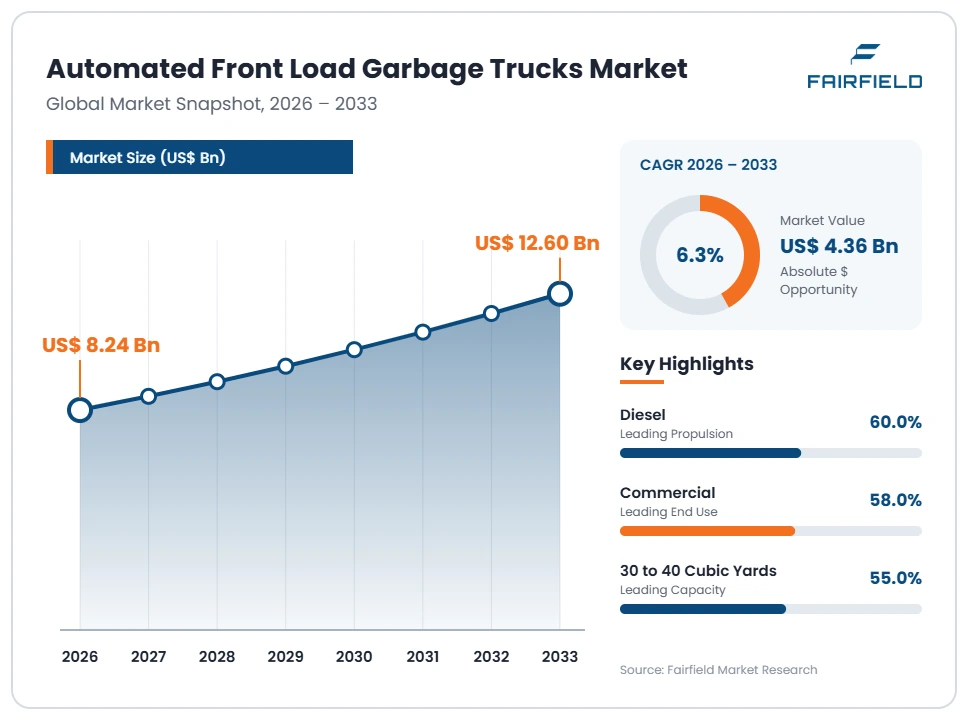
The global automated front load garbage trucks market size is expected to be valued at US$ 8.24 billion in 2026 and projected to reach US$ 12.60 billion by 2033, growing at a CAGR of 6.3% between 2026 and 2033.
Between 2020 and 2025, the market grew at a CAGR of about 5.6%, rising from roughly US$ 5.90 billion to about US$ 7.75 billion, as waste volumes from businesses recovered after the pandemic, haulers replaced ageing fleets, and driver shortages pushed operators toward automated collection. The automated front load garbage trucks market covers refuse collection vehicles that use hydraulic forks mounted in front of the cab to lift large commercial dumpsters over the truck and empty them into a hopper, where a packer blade compacts the waste. The driver controls the arms from the cab using joysticks and cameras. Main configurations include standard front loaders, front loaders with automated carry cans for residential carts, and electric, CNG, and diesel models. These trucks serve restaurants, offices, retail stores, apartment complexes, factories, and construction sites. In April 2026, Heil, Autocar, and Recology announced a fully integrated electric refuse truck.
Key Report Takeaways
- By Capacity: 30 to 40 Cubic Yards held about 55% share in 2025, while More Than 40 Cubic Yards is projected to expand at a 7.0% CAGR through 2033, driven by longer routes, fewer trips to landfills and transfer stations, and haulers seeking higher payload per route.
- By Propulsion: Diesel held about 60% share in 2025, while Electric is projected to expand at an 18.0% CAGR through 2033, driven by city emission rules, government vouchers, lower fuel and maintenance costs, and quieter operation for early morning collection.
- By End Use: Commercial held about 58% share in 2025, while Industrial is projected to expand at a 7.0% CAGR through 2033, driven by manufacturing growth, warehouse and logistics construction, and demand for scheduled dumpster service at large industrial sites.
- By Region: North America held about 50% share in 2025, while Asia Pacific is projected to expand at an 8.0% CAGR through 2033, driven by fast urbanization, new waste management rules, and fleet modernization in China, India, and Australia.
Global Automated Front Load Garbage Trucks Market Trends and Insights
Drivers Impact Analysis
Two drivers carry the strongest influence on automated front load garbage trucks market demand during the forecast period.
| Driver | Impact on CAGR Forecast | Geographic Relevance | Impact Timeline |
| Rising commercial waste and driver shortages | High | Global | Long term (≥4 years) |
| Emission rules and fleet electrification | High | North America, Europe | Medium term (2-4 years) |
Waste Growth and Driver Shortages Are Driving the Automated Front Load Garbage Trucks Market
Rising commercial waste and driver shortages are the strongest driver of the automated front load garbage trucks market. Haulers must collect more waste with fewer workers.
The mechanism is that growing cities, restaurants, retail centers, offices, and apartment complexes produce large and steady volumes of commercial waste stored in dumpsters, which front loaders empty quickly and efficiently. At the same time, waste companies struggle to hire and keep drivers and helpers because the work is physically hard, starts early, and carries injury risks. Automated front loaders let one driver complete a full route from the cab, cutting labor needs and injuries from lifting and climbing. Safety systems such as cameras, sensors, and collision warnings further protect workers and the public. Large haulers such as Waste Management, Republic Services, and Waste Connections continue to replace older trucks. These trends support steady orders for new automated front loaders.
Emission Rules Are Expanding the Automated Front Load Garbage Trucks Market
Emission rules and fleet electrification are expanding the automated front load garbage trucks market. Cities want cleaner waste fleets.
The cause is that garbage trucks make hundreds of stops a day, idle often, and run in dense neighborhoods, making them a priority for local air quality and climate programs. California's clean truck rules, New York's voucher incentive program, and city climate plans across North America and Europe encourage operators to switch to electric and natural gas trucks. Battery-electric refuse trucks save fuel and brake wear thanks to regenerative braking on stop-and-go routes. In February 2026, Royal Waste Services ordered three more Mack LR Electric refuse trucks for New York City, after its first truck collected more than 600 tons of waste with zero downtime. Rising orders for cleaner models lift the value of each truck sold.
Restraints Impact Analysis
Two restraints limit how quickly the automated front load garbage trucks market grows.
| Restraint | Impact on CAGR Forecast | Geographic Relevance | Impact Timeline |
| High purchase cost of new and electric trucks | High | Global | Medium term (2-4 years) |
| Charging infrastructure and maintenance complexity | Medium | North America, Europe | Long term (≥4 years) |
High Costs Slow the Automated Front Load Garbage Trucks Market
High purchase cost of new and electric trucks slows the automated front load garbage trucks market. Fleets must spend heavily on each truck.
The problem is that a new automated front loader with a heavy-duty chassis, hydraulic arms, compaction body, and safety systems can cost several hundred thousand dollars, and battery-electric versions often cost much more than diesel models. Smaller private haulers and municipal fleets with tight budgets may keep older trucks running longer or buy used vehicles instead. Higher interest rates have increased financing costs. Steel prices, chassis supply delays, and component shortages have raised production costs and lead times for body makers. Government incentive programs help, but funding is limited and often oversubscribed. In Asia Pacific, Latin America, and Middle East & Africa, many cities still rely on cheaper manual collection. These factors slow fleet replacement.
Infrastructure Gaps Restrict the Automated Front Load Garbage Trucks Market
Charging infrastructure and maintenance complexity restrict the automated front load garbage trucks market. New technology needs new support.
The constraint is that electric refuse trucks need high-power chargers at depots, and many yards lack the electrical capacity, requiring costly utility upgrades that can take years. Heavy front loaders consume a lot of energy lifting containers and compacting waste, so operators worry about range on long or hilly routes and in cold weather. Hydraulic systems, sensors, cameras, and software on modern trucks require trained technicians, and many fleets face shortages of skilled mechanics. Downtime for repairs directly affects collection schedules and customer service. Natural gas trucks also need dedicated fueling stations at depots. These factors make some fleets cautious about adopting new technology quickly and slow the transition to higher-value models.
Market Opportunities
Electric and Smart Front Loaders Open a Fast-Growth Revenue Pool
Electric and smart front loaders open a fast-growth revenue pool. Fleets want cleaner and more connected trucks.
The opportunity comes from battery-electric chassis, electric bodies that run hydraulics from the battery, and telematics systems that track every lift, route, and container. In January 2025, McNeilus unveiled its Volterra ZFL, a fully electric front loader with advanced safety features and overnight charging. Mack has also launched a next-generation LR Electric with a 376 kWh battery and 42% more energy than the earlier model. Onboard scales, artificial intelligence cameras for contamination detection, and cloud-based route optimization software help haulers bill accurately, improve recycling quality, and cut fuel use. Companies that combine electric drivetrains, reliable hydraulics, and smart software can win long-term fleet contracts and premium pricing.
Asia Pacific and Emerging Markets Create a Growth Revenue Pool
Asia Pacific and emerging markets create a growth revenue pool. Modern waste systems are spreading worldwide.
The opportunity reflects rapid urbanization and stricter waste rules in China, India, Indonesia, Vietnam, Australia, and the Middle East & Africa, where cities are moving from manual collection toward containerized systems. Commercial districts, shopping malls, airports, and industrial parks increasingly use large bins that suit front loaders. Governments are funding smart city and clean city programs, and private waste concessions bring in professional operators that buy modern fleets. Saudi Arabia and the United Arab Emirates are investing in waste management for new cities. Many cities also need training and maintenance support. Companies that offer affordable models, local assembly, operator training, and strong service networks can capture strong growth in these developing markets.
Segment Analysis
- By Capacity: 30 to 40 Cubic Yards Leads While More Than 40 Cubic Yards Grows Fastest
30 to 40 Cubic Yards held about 55% share in 2025. This capacity range offers a good balance between payload, maneuverability, and legal axle weights, making it the standard choice for commercial routes in cities and suburbs. Most major body makers build their main front loader models in this range, and haulers can use them across many different routes.
More Than 40 Cubic Yards is the fastest-growing capacity, expanding at a 7.0% CAGR through 2033. Larger bodies reduce trips to distant landfills and transfer stations, which saves fuel, time, and driver hours. Less Than 30 Cubic Yards forms another segment used for tight downtown areas and smaller towns. For the market, larger bodies support higher-value truck sales and better route productivity for haulers.
- By Propulsion: Diesel Leads While Electric Grows Fastest
Diesel held about 60% share in 2025. Diesel trucks offer proven reliability, long range, and wide service support, and they remain the default choice for many private haulers and smaller municipalities. Modern engines meet strict emission standards, and fueling is simple at any location, which matters for long rural and suburban routes.
Electric is the fastest-growing propulsion, expanding at an 18.0% CAGR through 2033. Battery-electric front loaders from Mack, McNeilus, Peterbilt, and Autocar are entering service in cities with zero-emission goals and voucher programs. Compressed Natural Gas forms another major segment, widely used by large haulers in North America. For the market, electric growth increases average truck value and creates demand for charging and service.
- By End Use: Commercial Leads While Industrial Grows Fastest
Commercial held about 58% share in 2025. Restaurants, offices, retail stores, hotels, schools, and apartment buildings use dumpsters that need frequent emptying, making front loaders the main tool for commercial routes. Private haulers compete for these contracts and invest in efficient trucks to keep costs low.
Industrial is the fastest-growing end use, expanding at a 7.0% CAGR through 2033. Factories, warehouses, distribution centers, and construction sites produce large volumes of waste and recyclables that need regular collection. Municipal forms another segment, covering city-run collection of public buildings, parks, and multi-family housing bins. For the market, industrial growth supports demand for larger, durable front loaders with strong arms that can lift heavy containers filled with dense materials such as wood, metal, and concrete scraps.
Geography Analysis
- Which Region Is Leading the Automated Front Load Garbage Trucks Market?
North America is leading the automated front load garbage trucks market with about 50% share in 2025. The United States has a mature, privatized commercial waste industry that relies heavily on front loaders, and large haulers such as Waste Management, Republic Services, and Waste Connections operate huge fleets. Heil, McNeilus, Wayne Engineering, New Way, Mack, and Autocar are based in the region, and Canada's Labrie is a leading body maker. Key barriers include high costs and charging gaps. One change shaping the region is rapid growth of electric and CNG refuse trucks.
- Europe Shapes the Automated Front Load Garbage Trucks Market Through Clean Fleet Rules
Europe is a major automated front load garbage trucks market. Germany, the United Kingdom, France, the Netherlands, and Spain have strict emission rules and clean vehicle procurement laws that push cities toward electric refuse trucks. Rear and side loaders are more common in European cities, but front loaders are used for commercial bins and industrial waste. Dennis Eagle, Kirchhoff, and Geesinknorba are key regional players. Key barriers include narrow streets, high costs, and a preference for rear and side loaders. One opportunity is electric front loaders for commercial waste, supported by zero-emission zones in large cities and European Union clean vehicle targets.
- Which Region Is Growing Fastest in the Automated Front Load Garbage Trucks Market?
Asia Pacific is the fastest-growing automated front load garbage trucks market, expanding at an 8.0% CAGR through 2033. China is modernizing waste collection with containerized systems and electric sanitation vehicles from makers such as Fulongma, while India is investing through its Swachh Bharat Mission and smart city programs. Australia has a mature commercial waste industry that uses front loaders widely, and Japan and South Korea have advanced fleets. Key barriers include low labor costs, budget limits, and manual collection habits. One change shaping the region is growing use of electric sanitation trucks and containerized commercial waste systems.
- Latin America Grows the Automated Front Load Garbage Trucks Market Through Urban Waste Programs
Latin America is a growing automated front load garbage trucks market. Brazil, Mexico, Argentina, Colombia, and Chile have large cities with rising commercial waste and are moving toward containerized collection through private concessions and public-private partnerships. Mexico and Brazil host large waste companies that buy modern fleets, and Chile has introduced recycling and producer responsibility laws. Key barriers include tight municipal budgets, currency swings, and reliance on imported trucks. One opportunity is automated fleets for commercial districts, supported by concession contracts, development bank funding for urban services, and growing recycling programs in large and fast-growing cities.
- Middle East & Africa Builds the Automated Front Load Garbage Trucks Market Through New City Investment
Middle East & Africa is an emerging automated front load garbage trucks market. Saudi Arabia, the United Arab Emirates, and Qatar are building new cities, tourism projects, and commercial districts with modern waste systems, often managed by international operators. Egypt and Morocco are expanding urban waste services, while South Africa has private haulers using front loaders for shopping centers, offices, and industrial sites. Key barriers include limited budgets outside large cities, informal waste collection, and reliance on imported trucks. One opportunity is modern fleets for mega projects and commercial zones, supported by government sustainability plans and long-term waste service contracts.
Competitive Landscape
The automated front load garbage trucks market is moderately consolidated. Terex Corporation (Heil), Oshkosh Corporation (McNeilus), Labrie Environmental Group, Wayne Engineering, and New Way Trucks are leading body makers, while chassis makers Mack Trucks, Autocar, and PACCAR (Peterbilt), along with Dennis Eagle, Kirchhoff Group, Bridgeport Manufacturing, and Fulongma, compete strongly. In North America, a few body makers supply most front loader bodies, which are mounted on heavy-duty chassis from truck makers, while regional manufacturers lead in Europe and Asia Pacific. Large national haulers buy in high volumes and negotiate multi-year fleet agreements.
Companies compete on body durability, lift speed, compaction performance, payload, fuel efficiency, electric options, safety technology, telematics, dealer service networks, parts availability, and total cost of ownership. Fast service support matters because a truck out of service disrupts daily collection routes.
Strategic moves show how competition is changing. In January 2025, McNeilus unveiled the electric Volterra ZFL front loader. In February 2026, Royal Waste Services ordered more Mack LR Electric trucks, and in April 2026, Heil, Autocar, and Recology announced an integrated electric refuse truck. Mack also launched a next-generation LR Electric with a larger 376 kWh battery.
Three themes shape vendor strategy. First, companies are developing electric bodies and chassis together for better efficiency. Second, they are adding cameras, sensors, and telematics to improve safety and productivity. Third, they are expanding service and parts networks to support large fleet customers.
Automated Front Load Garbage Trucks Market Industry Leaders
- Terex Corporation (Heil)
- Oshkosh Corporation (McNeilus)
- Labrie Environmental Group
- Wayne Engineering
- New Way Trucks
Recent Industry Developments
- April 2026: Heil, Autocar, and Recology announced the upcoming delivery of a fully electric refuse collection vehicle jointly developed by Heil and Autocar for service in Issaquah, Washington - shows body and chassis makers integrating electric systems in the automated front load garbage trucks market.
- February 2026: Royal Waste Services, a Waste Connections subsidiary, ordered three more Mack LR Electric refuse trucks funded through the New York Truck Voucher Incentive Program - expands electric refuse operations in New York City.
- January 2025: McNeilus unveiled the Volterra ZFL, a fully electric front loader with technology-driven safety features and overnight charging, at CES 2025 - adds a battery-electric front loading option for refuse and recycling fleets.
Companies Covered in the Report
- Terex Corporation (Heil)
- Oshkosh Corporation (McNeilus)
- Labrie Environmental Group
- Wayne Engineering
- New Way Trucks
- Mack Trucks
- Autocar, LLC
- PACCAR Inc. (Peterbilt)
- Dennis Eagle
- Kirchhoff Group
- Bridgeport Manufacturing
- Fulongma Group
Automated Front Load Garbage Trucks Market Report Scope
| Metric | Value |
| Study Period | 2020-2033 |
| Market Size 2026 | US$ 8.24 Billion |
| Market Size 2033 | US$ 12.60 Billion |
| CAGR 2026-2033 | 6.3% |
| Absolute Dollar Opportunity | US$ 4.36 Billion |
| Largest Market | North America |
| Fastest-Growing Market | Asia Pacific |
| Market Concentration | Moderately Consolidated |
| Major Players | Terex Corporation (Heil), Oshkosh Corporation (McNeilus), Labrie Environmental Group, Wayne Engineering, New Way Trucks |
Automated Front Load Garbage Trucks Market Segmentation
- Executive Summary
- Automated Front Load Garbage Trucks Market Snapshot
- Future Projections
- Key Market Trends
- Regional Snapshot
- Market Overview
- Market Definition and Report Scope
- Historical Market Trends
- Market Dynamics
- Drivers
- Waste Growth and Driver Shortages Are Driving the Automated Front Load Garbage Trucks Market
- Emission Rules Are Expanding the Automated Front Load Garbage Trucks Market
- Restraints
- High Costs Slow the Automated Front Load Garbage Trucks Market
- Infrastructure Gaps Restrict the Automated Front Load Garbage Trucks Market
- Market Opportunities
- Electric and Smart Front Loaders Open a Fast-Growth Revenue Pool
- Asia Pacific and Emerging Markets Create a Growth Revenue Pool
- Drivers
- Global Automated Front Load Garbage Trucks Market Outlook, 2020–2033
- Global Automated Front Load Garbage Trucks Market Outlook, by Capacity, Value (US$ Billion), 2020–2033
- Less Than 30 Cubic Yards
- 30 to 40 Cubic Yards
- More Than 40 Cubic Yards
- Global Automated Front Load Garbage Trucks Market Outlook, by Propulsion, Value (US$ Billion), 2020–2033
- Diesel
- Compressed Natural Gas
- Electric
- Global Automated Front Load Garbage Trucks Market Outlook, by End Use, Value (US$ Billion), 2020–2033
- Commercial
- Industrial
- Municipal
- Global Automated Front Load Garbage Trucks Market Outlook, by Region, Value (US$ Billion), 2020–2033
- North America
- Europe
- Asia Pacific
- Latin America
- Middle East & Africa
- Global Automated Front Load Garbage Trucks Market Outlook, by Capacity, Value (US$ Billion), 2020–2033
- North America Automated Front Load Garbage Trucks Market Outlook, 2020–2033
- North America Automated Front Load Garbage Trucks Market Outlook, by Capacity, Value (US$ Billion), 2020–2033
- Less Than 30 Cubic Yards
- 30 to 40 Cubic Yards
- More Than 40 Cubic Yards
- North America Automated Front Load Garbage Trucks Market Outlook, by Propulsion, Value (US$ Billion), 2020–2033
- Diesel
- Compressed Natural Gas
- Electric
- North America Automated Front Load Garbage Trucks Market Outlook, by End Use, Value (US$ Billion), 2020–2033
- Commercial
- Industrial
- Municipal
- North America Automated Front Load Garbage Trucks Market Outlook, by Country, Value (US$ Billion), 2020–2033
- United States Automated Front Load Garbage Trucks Market Outlook, by Capacity, 2020–2033
- United States Automated Front Load Garbage Trucks Market Outlook, by Propulsion, 2020–2033
- United States Automated Front Load Garbage Trucks Market Outlook, by End Use, 2020–2033
- Canada Automated Front Load Garbage Trucks Market Outlook, by Capacity, 2020–2033
- Canada Automated Front Load Garbage Trucks Market Outlook, by Propulsion, 2020–2033
- Canada Automated Front Load Garbage Trucks Market Outlook, by End Use, 2020–2033
- North America Automated Front Load Garbage Trucks Market Outlook, by Capacity, Value (US$ Billion), 2020–2033
- Europe Automated Front Load Garbage Trucks Market Outlook, 2020–2033
- Europe Automated Front Load Garbage Trucks Market Outlook, by Capacity, Value (US$ Billion), 2020–2033
- Less Than 30 Cubic Yards
- 30 to 40 Cubic Yards
- More Than 40 Cubic Yards
- Europe Automated Front Load Garbage Trucks Market Outlook, by Propulsion, Value (US$ Billion), 2020–2033
- Diesel
- Compressed Natural Gas
- Electric
- Europe Automated Front Load Garbage Trucks Market Outlook, by End Use, Value (US$ Billion), 2020–2033
- Commercial
- Industrial
- Municipal
- Europe Automated Front Load Garbage Trucks Market Outlook, by Country, Value (US$ Billion), 2020–2033
- Germany Automated Front Load Garbage Trucks Market Outlook, by Capacity, 2020–2033
- Germany Automated Front Load Garbage Trucks Market Outlook, by Propulsion, 2020–2033
- Germany Automated Front Load Garbage Trucks Market Outlook, by End Use, 2020–2033
- United Kingdom Automated Front Load Garbage Trucks Market Outlook, by Capacity, 2020–2033
- United Kingdom Automated Front Load Garbage Trucks Market Outlook, by Propulsion, 2020–2033
- United Kingdom Automated Front Load Garbage Trucks Market Outlook, by End Use, 2020–2033
- France Automated Front Load Garbage Trucks Market Outlook, by Capacity, 2020–2033
- France Automated Front Load Garbage Trucks Market Outlook, by Propulsion, 2020–2033
- France Automated Front Load Garbage Trucks Market Outlook, by End Use, 2020–2033
- Netherlands Automated Front Load Garbage Trucks Market Outlook, by Capacity, 2020–2033
- Netherlands Automated Front Load Garbage Trucks Market Outlook, by Propulsion, 2020–2033
- Netherlands Automated Front Load Garbage Trucks Market Outlook, by End Use, 2020–2033
- Spain Automated Front Load Garbage Trucks Market Outlook, by Capacity, 2020–2033
- Spain Automated Front Load Garbage Trucks Market Outlook, by Propulsion, 2020–2033
- Spain Automated Front Load Garbage Trucks Market Outlook, by End Use, 2020–2033
- Europe Automated Front Load Garbage Trucks Market Outlook, by Capacity, Value (US$ Billion), 2020–2033
- Asia Pacific Automated Front Load Garbage Trucks Market Outlook, 2020–2033
- Asia Pacific Automated Front Load Garbage Trucks Market Outlook, by Capacity, Value (US$ Billion), 2020–2033
- Less Than 30 Cubic Yards
- 30 to 40 Cubic Yards
- More Than 40 Cubic Yards
- Asia Pacific Automated Front Load Garbage Trucks Market Outlook, by Propulsion, Value (US$ Billion), 2020–2033
- Diesel
- Compressed Natural Gas
- Electric
- Asia Pacific Automated Front Load Garbage Trucks Market Outlook, by End Use, Value (US$ Billion), 2020–2033
- Commercial
- Industrial
- Municipal
- Asia Pacific Automated Front Load Garbage Trucks Market Outlook, by Country, Value (US$ Billion), 2020–2033
- China Automated Front Load Garbage Trucks Market Outlook, by Capacity, 2020–2033
- China Automated Front Load Garbage Trucks Market Outlook, by Propulsion, 2020–2033
- China Automated Front Load Garbage Trucks Market Outlook, by End Use, 2020–2033
- India Automated Front Load Garbage Trucks Market Outlook, by Capacity, 2020–2033
- India Automated Front Load Garbage Trucks Market Outlook, by Propulsion, 2020–2033
- India Automated Front Load Garbage Trucks Market Outlook, by End Use, 2020–2033
- Australia Automated Front Load Garbage Trucks Market Outlook, by Capacity, 2020–2033
- Australia Automated Front Load Garbage Trucks Market Outlook, by Propulsion, 2020–2033
- Australia Automated Front Load Garbage Trucks Market Outlook, by End Use, 2020–2033
- Japan Automated Front Load Garbage Trucks Market Outlook, by Capacity, 2020–2033
- Japan Automated Front Load Garbage Trucks Market Outlook, by Propulsion, 2020–2033
- Japan Automated Front Load Garbage Trucks Market Outlook, by End Use, 2020–2033
- South Korea Automated Front Load Garbage Trucks Market Outlook, by Capacity, 2020–2033
- South Korea Automated Front Load Garbage Trucks Market Outlook, by Propulsion, 2020–2033
- South Korea Automated Front Load Garbage Trucks Market Outlook, by End Use, 2020–2033
- Asia Pacific Automated Front Load Garbage Trucks Market Outlook, by Capacity, Value (US$ Billion), 2020–2033
- Latin America Automated Front Load Garbage Trucks Market Outlook, 2020–2033
- Latin America Automated Front Load Garbage Trucks Market Outlook, by Capacity, Value (US$ Billion), 2020–2033
- Less Than 30 Cubic Yards
- 30 to 40 Cubic Yards
- More Than 40 Cubic Yards
- Latin America Automated Front Load Garbage Trucks Market Outlook, by Propulsion, Value (US$ Billion), 2020–2033
- Diesel
- Compressed Natural Gas
- Electric
- Latin America Automated Front Load Garbage Trucks Market Outlook, by End Use, Value (US$ Billion), 2020–2033
- Commercial
- Industrial
- Municipal
- Latin America Automated Front Load Garbage Trucks Market Outlook, by Country, Value (US$ Billion), 2020–2033
- Brazil Automated Front Load Garbage Trucks Market Outlook, by Capacity, 2020–2033
- Brazil Automated Front Load Garbage Trucks Market Outlook, by Propulsion, 2020–2033
- Brazil Automated Front Load Garbage Trucks Market Outlook, by End Use, 2020–2033
- Mexico Automated Front Load Garbage Trucks Market Outlook, by Capacity, 2020–2033
- Mexico Automated Front Load Garbage Trucks Market Outlook, by Propulsion, 2020–2033
- Mexico Automated Front Load Garbage Trucks Market Outlook, by End Use, 2020–2033
- Argentina Automated Front Load Garbage Trucks Market Outlook, by Capacity, 2020–2033
- Argentina Automated Front Load Garbage Trucks Market Outlook, by Propulsion, 2020–2033
- Argentina Automated Front Load Garbage Trucks Market Outlook, by End Use, 2020–2033
- Colombia Automated Front Load Garbage Trucks Market Outlook, by Capacity, 2020–2033
- Colombia Automated Front Load Garbage Trucks Market Outlook, by Propulsion, 2020–2033
- Colombia Automated Front Load Garbage Trucks Market Outlook, by End Use, 2020–2033
- Chile Automated Front Load Garbage Trucks Market Outlook, by Capacity, 2020–2033
- Chile Automated Front Load Garbage Trucks Market Outlook, by Propulsion, 2020–2033
- Chile Automated Front Load Garbage Trucks Market Outlook, by End Use, 2020–2033
- Latin America Automated Front Load Garbage Trucks Market Outlook, by Capacity, Value (US$ Billion), 2020–2033
- Middle East & Africa Automated Front Load Garbage Trucks Market Outlook, 2020–2033
- Middle East & Africa Automated Front Load Garbage Trucks Market Outlook, by Capacity, Value (US$ Billion), 2020–2033
- Less Than 30 Cubic Yards
- 30 to 40 Cubic Yards
- More Than 40 Cubic Yards
- Middle East & Africa Automated Front Load Garbage Trucks Market Outlook, by Propulsion, Value (US$ Billion), 2020–2033
- Diesel
- Compressed Natural Gas
- Electric
- Middle East & Africa Automated Front Load Garbage Trucks Market Outlook, by End Use, Value (US$ Billion), 2020–2033
- Commercial
- Industrial
- Municipal
- Middle East & Africa Automated Front Load Garbage Trucks Market Outlook, by Country, Value (US$ Billion), 2020–2033
- Saudi Arabia Automated Front Load Garbage Trucks Market Outlook, by Capacity, 2020–2033
- Saudi Arabia Automated Front Load Garbage Trucks Market Outlook, by Propulsion, 2020–2033
- Saudi Arabia Automated Front Load Garbage Trucks Market Outlook, by End Use, 2020–2033
- United Arab Emirates Automated Front Load Garbage Trucks Market Outlook, by Capacity, 2020–2033
- United Arab Emirates Automated Front Load Garbage Trucks Market Outlook, by Propulsion, 2020–2033
- United Arab Emirates Automated Front Load Garbage Trucks Market Outlook, by End Use, 2020–2033
- Qatar Automated Front Load Garbage Trucks Market Outlook, by Capacity, 2020–2033
- Qatar Automated Front Load Garbage Trucks Market Outlook, by Propulsion, 2020–2033
- Qatar Automated Front Load Garbage Trucks Market Outlook, by End Use, 2020–2033
- Egypt Automated Front Load Garbage Trucks Market Outlook, by Capacity, 2020–2033
- Egypt Automated Front Load Garbage Trucks Market Outlook, by Propulsion, 2020–2033
- Egypt Automated Front Load Garbage Trucks Market Outlook, by End Use, 2020–2033
- Morocco Automated Front Load Garbage Trucks Market Outlook, by Capacity, 2020–2033
- Morocco Automated Front Load Garbage Trucks Market Outlook, by Propulsion, 2020–2033
- Morocco Automated Front Load Garbage Trucks Market Outlook, by End Use, 2020–2033
- South Africa Automated Front Load Garbage Trucks Market Outlook, by Capacity, 2020–2033
- South Africa Automated Front Load Garbage Trucks Market Outlook, by Propulsion, 2020–2033
- South Africa Automated Front Load Garbage Trucks Market Outlook, by End Use, 2020–2033
- Middle East & Africa Automated Front Load Garbage Trucks Market Outlook, by Capacity, Value (US$ Billion), 2020–2033
- Competitive Landscape
- Automated Front Load Garbage Trucks Market Industry Leaders
- Recent Industry Developments
- Company Profiles
- Terex Corporation (Heil)
- Oshkosh Corporation (McNeilus)
- Labrie Environmental Group
- Wayne Engineering
- New Way Trucks
- Mack Trucks
- Autocar, LLC
- PACCAR Inc. (Peterbilt)
- Dennis Eagle
- Kirchhoff Group
- Bridgeport Manufacturing
- Fulongma Group
- Appendix
- Research Methodology
- Report Assumptions
- Acronyms and Abbreviations
Capacity
- Less Than 30 Cubic Yards
- 30 to 40 Cubic Yards
- More Than 40 Cubic Yards
Propulsion
- Diesel
- Compressed Natural Gas
- Electric
End Use
- Commercial
- Industrial
- Municipal
Regions
- North America
- Europe
- Asia Pacific
- Latin America
- Middle East & Africa
Our Research Methodology
Considering the volatility of business today, traditional approaches to strategizing a game plan can be unfruitful if not detrimental. True ambiguity is no way to determine a forecast. A myriad of predetermined factors must be accounted for such as the degree of risk involved, the magnitude of circumstances, as well as conditions or consequences that are not known or unpredictable. To circumvent binary views that cast uncertainty, the application of market research intelligence to strategically posture, move, and enable actionable outcomes is necessary.
View Methodology
Quality Assured
Rigorous Validation Process

Confidentiality Assured
End-to-end Data Security

Custom Research Services
Tailored To Your Objectives
FAQs
The global automated front load garbage trucks market is expected to be valued at US$ 8.24 billion in 2026, driven by commercial waste growth.
The market is projected to grow at a 6.3% CAGR from 2026 to 2033, reaching about US$ 12.60 billion by 2033.
North America leads with about 50% share, supported by a large private waste industry, big hauler fleets, and major truck makers.
Electric is growing fastest at an 18.0% CAGR, driven by city emission rules, voucher programs, and lower fuel and maintenance costs.
Key players include Heil, McNeilus, Labrie, Wayne Engineering, and New Way, competing on durability, automation, electrification, and service.
Related Reports
Automotive Tools Market Size, Share, Insights, Competitive Landscape, and Forecast 2026 to 2033
The global automotive tools market is valued at US$53.58 billion in 2026, reaching US$77.53 billion by 2033, growing at a 5.4% CAGR
Automotive Defroster Market Size, Share, Insights, Competitive Landscape, and Forecast 2026 to 2033
The global automotive defroster market is valued at US$2.40 billion in 2026, reaching US$3.27 billion by 2033, growing at a 4.5% CAGR
Automobile E-Axle Market Size, Share, Insights, Competitive Landscape, and Forecast 2026 to 2033
The global automobile e-axle market is valued at US$7.10 billion in 2026, reaching US$20.08 billion by 2033, growing at a 16.0% CAGR
Off-the-road Tire (OTR) Market Insights, Competitive Landscape, and Market Forecast - 2033
Off-the-road tire market driven by rising industrial activity, agricultural expansion in Asia Pacific, and robust demand from the mining sector post-COVID.
Light Commercial Vehicles Market Insights, Competitive Landscape, and Market Forecast - 2033
Light commercial vehicles market grows on rising urban demand, regulation shifts, and preference for compact, efficient transport in metro and suburban areas.
Fuel Cell Powertrain Market Size, Share, Insights, Competitive Landscape, and Forecast 2026 to 2033
The fuel cell powertrain market is projected to reach US$ 76.8 billion by 2033, growing at 79.1% CAGR from US$ 1.3 billion in 2026.