



Aviation Fuel Additives Market
Aviation Fuel Additives Market Insights, Competitive Landscape, and Market Forecast - 2033
Global Aviation Fuel Additives Market Forecast
- The Aviation Fuel Additives Market is valued at USD 941.4 Mn in 2026 and is projected to reach USD 1492 Mn, growing at a CAGR of 7% by 2033.
Quick Report Digest
A Look Back and a Look Forward – Comparative Analysis
The technological advancements, additives manufacturers may now provide solutions specifically for kinds of aviation fuel and aircraft engines. Customised additives can satisfy the specific needs of various aircraft and operational circumstances. The development of Avgas additives that support environmental sustainability depends heavily on technology. Additives are created to enhance the environmental performance of aviation fuels overall and cut emissions and carbon footprints.
The market witnessed staggered growth during the historical period 2018 – 2022. Military aircraft frequently operated in difficult weather, necessitating improved engine performance and fuel economy. Avgas additives increase combustion efficiency by increasing thrust, power, and fuel efficiency. For military forces, aviation fuel additives were strategically important because they improved military aircraft's overall effectiveness and usability.
Modern military aircraft need to have long-range and endurance abilities. Longer missions and fewer refuelling stops are made possible by the increased fuel efficiency of aviation fuel in the coming years. Additionally, alternative aviation fuels, including biofuels and synthetic fuels, are being developed, creating the potential for additives that guarantee compatibility, stability, and performance in these new fuel types. Furthermore, increased safety concerns in aircraft operations during the next five years will drive the demand for gasoline additives that prevent problems with icing, corrosion, and microbial contamination.
Key Growth Determinants
- Rising Demand for Aviation Fuel
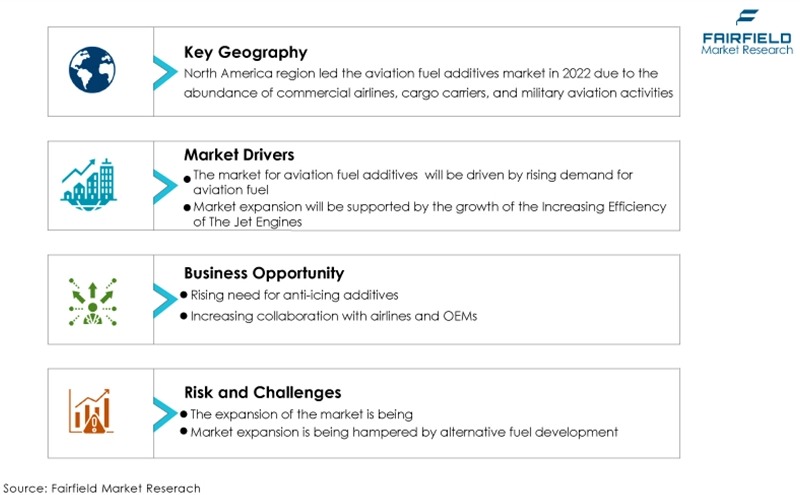
The market for aviation fuel additives is growing due to the increasing demand for aviation fuel. Increasing disposable income, urbanisation, and a rising global middle class are some of the causes that have propelled the aviation industry's steady rise throughout the years.
The demand for air travel has increased because of this expansion, and this is directly related to the surge in demand for aviation fuel. As demand for air travel rises, airlines are continually growing their fleets to meet it. To maximize the quality and performance of the power, additives are added, resulting in the need for a bigger supply of Avgas.
Airlines are constantly seeking ways to increase fuel efficiency to cut down on expenses and the environmental impact of operations. By increasing the fuel's energy content, aviation fuel additives can be extremely important in helping to accomplish this.
- Increasing Efficiency of Jet Engines
Jet engine combustion can be improved by adding aviation fuel additives. These additives contribute to more complete and effective fuel combustion, which helps raise the engine's overall efficiency. Lower fuel consumption and emissions result from improved combustion efficiency. Extreme operating conditions, including parts moving quickly and at high temperatures, are present in jet engines.
Lubricity agents can be found in aviation fuel additives, which lessen friction and wear on engine parts. This increases the engine's lifespan and guarantees it runs as efficiently as possible. Fouling and deposits on engine parts can lower performance and raise fuel consumption. Detergents and dispersants are instances of fuel additives that assist in keeping the engine clean and prevent the buildup of deposits, which increases engine efficiency.
- Growing Advancements in Aircraft Technology
Modern aircraft engines, such as geared turbofan engines and high-bypass turbofan engines, are made to use less fuel. Aviation fuel additives are necessary to ensure the energy used in these engines is compatible with their sophisticated designs, resulting in better combustion efficiency and decreased fuel usage.
Higher compression ratios are common in advanced engine designs, requiring specialised aviation fuel compositions to avoid knocking and preserve engine performance. Fuel additives can aid by raising the fuel's octane rating and reducing engine damage to help with these issues.
Advanced digital engine control systems (FADEC) on modern airplanes require accurate fuel quality and performance. The stability and consistency of fuel qualities, essential for the dependability and effectiveness of FADEC systems, can be maintained using aviation fuel additives.
Major Growth Barriers
- Aircraft Fleet Age
Airlines with aging aircraft fleets can put cost savings ahead of improved performance. Airlines may be more concerned with limiting operating expenses than investing in high-end aviation fuel additives because older aircraft are frequently less fuel-efficient and have higher maintenance requirements. This may impede market expansion, particularly if airlines put off fleet modernisation.
Older aircraft could need maintenance and repairs more frequently, and using aviation fuel additives might not completely solve their performance difficulties. Instead of spending money on additives, airlines may prioritize maintenance and overhauls to increase the lifespan of their older aircraft. This may reduce market demand for additives.
- Alternative Fuel Development
The market for traditional aviation fuel additives made for conventional jet fuels may decline as the aviation industry adopts alternative fuels like Sustainable Aviation Fuel (SAF), which have distinct environmental qualities and advantages. SAFs frequently include benefits, such as lower greenhouse gas emissions and reduced sulfur content, which may eliminate the need for some additives.
Alternative aviation fuels may differ chemically and in terms of their physical and functional characteristics from conventional jet fuels. Conflicts with currently used Avgas additives may emerge from this. It can be technically challenging to create additives compatible with alternative fuels, and failing to do so could limit their use in SAFs or other alternative fuels.
Key Trends and Opportunities to Look at
The aviation sector is aggressively investing in SAF because it has lower carbon emissions than conventional jet fuel and is made from renewable resources. Aviation fuel additives are essential for ensuring that SAF complies with strict quality and performance criteria, stimulating the market for specialised additives made specifically for SAF.
Sustainable aviation fuels frequently include less sulfur than regular jet fuel. The lower sulfur concentration may present certain potential problems, but aviation fuel additives may take care of them, ensuring that engines run smoothly and adhere to environmental regulations.
- Rising Need for Anti-icing Additives
- Increasing Collaboration with Airlines and OEMs
Aircraft safety during flights in chilly and icy conditions depends on anti-icing chemicals. Due to these additives, the gasoline system, fuel lines, and tanks are kept free of ice. By preventing ice buildup, they aid in maintaining continuous fuel flow to the engines, preventing engine failure, and guaranteeing the aircraft's and its occupants' safety.
Anti-icing additives help keep the overall dependability of the aircraft's fuel system and avoid ice creation. This lowers maintenance costs and ensures a great passenger experience while also assisting in the effective and safe functioning of the aircraft.
New aviation fuel additives must be validated and certified by OEMs and airlines. By working together, additive producers may conduct thorough testing and acquire the required certifications, proving the reliability and efficiency of their products. The market's reputation is increased by this certification, which promotes the use of these chemicals more widely.
How Does the Regulatory Scenario Shape this Industry?
Over the last three years, a strict regulatory structure has governed the aviation fuel additives market to guarantee the performance, quality, and safety of aviation fuels and additives. The Federal Aviation Administration (FAA) is an important regulatory body in the US that manages aviation safety and standards. They publish guidelines and standards for the nation's usage of aviation fuels and additives. Aviation fuel additive producers must adhere to Federal Aviation Administration (FAA) regulations to do business in the United States.
In the European Union, civil aviation safety is governed by the European Union Aviation Safety Agency (EASA). It establishes the rules and specifications for European aviation fuels and additives. Market access in European nations requires adherence to European Union Aviation Safety Agency (EASA) requirements. The International Air Transport Association (IATA) represents airlines globally and offers recommendations and criteria for aviation fuels.
The choice and application of Avgas additives are influenced by the fact that many airlines operate by International Air Transport Association (IATA) guidelines. Aviation fuel additives' safety, quality, and environmental performance are crucially ensured by regulating organisations, including the FAA, EASA, and IATA. Their laws impact additives' creation, production, and application in the aviation fuel additives market.
Fairfield’s Ranking Board
Top Segments
In 2022, the category of dispersants aviation fuel additives dominated the market. To ensure that aircraft engines burn fuel effectively, they must be clean. Dispersants assist in maintaining the fuel's cleanliness, ensuring that the energy contained in the power is effectively transformed into thrust, and enhancing engine performance and fuel efficiency.
Dispersants help airlines cut maintenance expenses by minimising corrosion, blockages, and deposits in the fuel system. This greatly helps the dependability and affordability of aircraft operations.
Furthermore, the antioxidants category is anticipated to grow significantly throughout the forecast period. Peroxides and other reactive substances may be created when aviation fuel oxidizes and oxidizes. Antioxidants prevent oxidation by dissipating oxygen radicals and lowering the likelihood of chemical reactions compromising the fuel's characteristics.
- Jet Fuel Category Leads
- The Commercial Aircraft Segment Spearheads
The jet fuel category dominated the market in 2022. Jet fuel is a specialised aviation fuel specifically designed for use in jet engines, such as the turbofan and turbojet ones commonly found in commercial and military aircraft.
Due to its high energy density, jet fuel can supply the necessary power for long-distance flights and high-speed trips. To meet stringent industrial and governmental standards for safety, performance, and environmental effects, jet fuel is put through rigorous quality control and testing.
The Avgas category is expected to grow significantly during the forecast period. Avgas is a high-octane, leaded, or unleaded petrol, especially for airplanes with piston engines. General aviation and smaller private planes are among these aircraft.
The commercial aircraft category dominated the market in 2022. Commercial aircraft are further segmented into passenger aircraft and cargo aircraft. Aviation fuel additives increase the dependability and safety of commercial aircraft by preventing issues, including icing, corrosion, and fuel system blockages. These additives lessen the possibility of operational delays while also improving flight safety overall.
Commercial airlines fly long- and ultra-long-distance routes, necessitating optimised fuel performance over considerable distances. These lengthy flights are more effective and reliable because of Avgas additives.
The military aircraft category is expected to grow the fastest. Military aircraft frequently need high-performance engines for manoeuvrability, speed, and operational efficiency. Aeronautical fuel additives enhance power output, combustion efficiency, and engine performance, guaranteeing that military aircraft can complete their missions.
Regional Frontrunners
North America Retains Dominance
North America is expected to dominate the aviation fuel additives market during the forecast period. The aviation industry in North America is among the biggest and busiest in the world. Due to the large number of commercial airlines, cargo carriers, and military aviation activities, aviation fuel additives are crucial to maintaining safe, efficient, and legal aircraft operations.
Commercial and military jets, as well as more recent and technologically sophisticated aircraft, are all part of the US aviation fleet. Specialised aviation fuel additives made to fulfil the specific needs of these aircraft are required due to the usage of modern engines and fuel systems.
Asia Pacific All Set for the Fastest Growth
Asia Pacific is expected to be the fastest-growing aviation fuel additives market region. Investments have aided the growth of the aviation industry in airport infrastructure and the building of new airports throughout the Asia Pacific area.
Due to these advancements, the demand for aviation fuel additives is rising to achieve contemporary airports' quality and performance standards. In many Asia Pacific countries, the expansion of the middle class and rising disposable incomes have increased air travel.
The demand for aviation fuel additives to enhance aircraft performance and safety is fuelled by the growth of commercial aviation. India's military aviation industry is significant. The market for aviation fuel additives is expanding because they are essential for the security and readiness of military aircraft.
Fairfield’s Competitive Landscape Analysis
The global market for aviation fuel additives is concentrated and has several prominent players operating there. To improve their presence on a global scale, the big companies are introducing new products and enhancing their distribution networks. According to Fairfield Market Research, additional market consolidation is also anticipated in the upcoming years.
Who are the Leaders in the Global Aviation Fuel Additives Space?
- Afton Chemical Corporation
- BASF SE
- Dorf-Ketal Chemicals India Pvt., Ltd.
- Meridian Fuels
- Shell Chemicals LP
- Clariant AG
- Biobor Fuel Additives
- Innospec Chemical Company
- Albemarle Corporation
- QAFAC (Industries Qatar)
- Lubrizol Corporation
- TotalEnergies
- VeryOne SaS (EURENCO)
- Xinxiang Richful Lube Additive Co., Ltd.
- Croda International Plc
Global Aviation Fuel Additives Market is Segmented as Below:
By Additive Type:
- Dispersants
- Antioxidants
- Anti-icing
- Corrosion Inhibitors
- Antiknock
- Metal Deactivators
- Miscellaneous
By Fuel Type:
- Avgas
- Jet Fuel
By Application:
- Commercial Aircraft
- Military Aircraft
- Miscellaneous
By Geographic Coverage:
- North America
- Europe
- Asia Pacific
- Latin America
- Middle East & Africa
- Executive Summary
- Global Aviation Fuel Additives Market Snapshot
- Future Projections
- Key Market Trends
- Regional Snapshot, by Value, 2026
- Analyst Recommendations
- Market Overview
- Market Definitions and Segmentations
- Market Dynamics
- Drivers
- Restraints
- Market Opportunities
- Value Chain Analysis
- COVID-19 Impact Analysis
- Porter's Five Forces Analysis
- Impact of Russia-Ukraine Conflict
- PESTLE Analysis
- Regulatory Analysis
- Price Trend Analysis
- Current Prices and Future Projections, 2025-2033
- Price Impact Factors
- Global Aviation Fuel Additives Market Outlook, 2020 - 2033
- Global Aviation Fuel Additives Market Outlook, by Additive Type, Value (US$ Mn), 2020-2033
- Dispersants
- Antioxidants
- Anti-icing
- Corrosion Inhibitors
- Antiknock
- Metal Deactivators
- Miscellaneous
- Global Aviation Fuel Additives Market Outlook, by Fuel Type, Value (US$ Mn), 2020-2033
- Avgas
- Jet Fuel
- Global Aviation Fuel Additives Market Outlook, by Application, Value (US$ Mn), 2020-2033
- Commercial Aircraft
- Military Aircraft
- Miscellaneous
- Global Aviation Fuel Additives Market Outlook, by Region, Value (US$ Mn), 2020-2033
- North America
- Europe
- Asia Pacific
- Latin America
- Middle East & Africa
- Global Aviation Fuel Additives Market Outlook, by Additive Type, Value (US$ Mn), 2020-2033
- North America Aviation Fuel Additives Market Outlook, 2020 - 2033
- North America Aviation Fuel Additives Market Outlook, by Additive Type, Value (US$ Mn), 2020-2033
- Dispersants
- Antioxidants
- Anti-icing
- Corrosion Inhibitors
- Antiknock
- Metal Deactivators
- Miscellaneous
- North America Aviation Fuel Additives Market Outlook, by Fuel Type, Value (US$ Mn), 2020-2033
- Avgas
- Jet Fuel
- North America Aviation Fuel Additives Market Outlook, by Application, Value (US$ Mn), 2020-2033
- Commercial Aircraft
- Military Aircraft
- Miscellaneous
- North America Aviation Fuel Additives Market Outlook, by Country, Value (US$ Mn), 2020-2033
- U.S. Aviation Fuel Additives Market Outlook, by Additive Type, 2020-2033
- U.S. Aviation Fuel Additives Market Outlook, by Fuel Type, 2020-2033
- U.S. Aviation Fuel Additives Market Outlook, by Application, 2020-2033
- Canada Aviation Fuel Additives Market Outlook, by Additive Type, 2020-2033
- Canada Aviation Fuel Additives Market Outlook, by Fuel Type, 2020-2033
- Canada Aviation Fuel Additives Market Outlook, by Application, 2020-2033
- BPS Analysis/Market Attractiveness Analysis
- North America Aviation Fuel Additives Market Outlook, by Additive Type, Value (US$ Mn), 2020-2033
- Europe Aviation Fuel Additives Market Outlook, 2020 - 2033
- Europe Aviation Fuel Additives Market Outlook, by Additive Type, Value (US$ Mn), 2020-2033
- Dispersants
- Antioxidants
- Anti-icing
- Corrosion Inhibitors
- Antiknock
- Metal Deactivators
- Miscellaneous
- Europe Aviation Fuel Additives Market Outlook, by Fuel Type, Value (US$ Mn), 2020-2033
- Avgas
- Jet Fuel
- Europe Aviation Fuel Additives Market Outlook, by Application, Value (US$ Mn), 2020-2033
- Commercial Aircraft
- Military Aircraft
- Miscellaneous
- Europe Aviation Fuel Additives Market Outlook, by Country, Value (US$ Mn), 2020-2033
- Germany Aviation Fuel Additives Market Outlook, by Additive Type, 2020-2033
- Germany Aviation Fuel Additives Market Outlook, by Fuel Type, 2020-2033
- Germany Aviation Fuel Additives Market Outlook, by Application, 2020-2033
- Italy Aviation Fuel Additives Market Outlook, by Additive Type, 2020-2033
- Italy Aviation Fuel Additives Market Outlook, by Fuel Type, 2020-2033
- Italy Aviation Fuel Additives Market Outlook, by Application, 2020-2033
- France Aviation Fuel Additives Market Outlook, by Additive Type, 2020-2033
- France Aviation Fuel Additives Market Outlook, by Fuel Type, 2020-2033
- France Aviation Fuel Additives Market Outlook, by Application, 2020-2033
- U.K. Aviation Fuel Additives Market Outlook, by Additive Type, 2020-2033
- U.K. Aviation Fuel Additives Market Outlook, by Fuel Type, 2020-2033
- U.K. Aviation Fuel Additives Market Outlook, by Application, 2020-2033
- Spain Aviation Fuel Additives Market Outlook, by Additive Type, 2020-2033
- Spain Aviation Fuel Additives Market Outlook, by Fuel Type, 2020-2033
- Spain Aviation Fuel Additives Market Outlook, by Application, 2020-2033
- Russia Aviation Fuel Additives Market Outlook, by Additive Type, 2020-2033
- Russia Aviation Fuel Additives Market Outlook, by Fuel Type, 2020-2033
- Russia Aviation Fuel Additives Market Outlook, by Application, 2020-2033
- Rest of Europe Aviation Fuel Additives Market Outlook, by Additive Type, 2020-2033
- Rest of Europe Aviation Fuel Additives Market Outlook, by Fuel Type, 2020-2033
- Rest of Europe Aviation Fuel Additives Market Outlook, by Application, 2020-2033
- BPS Analysis/Market Attractiveness Analysis
- Europe Aviation Fuel Additives Market Outlook, by Additive Type, Value (US$ Mn), 2020-2033
- Asia Pacific Aviation Fuel Additives Market Outlook, 2020 - 2033
- Asia Pacific Aviation Fuel Additives Market Outlook, by Additive Type, Value (US$ Mn), 2020-2033
- Dispersants
- Antioxidants
- Anti-icing
- Corrosion Inhibitors
- Antiknock
- Metal Deactivators
- Miscellaneous
- Asia Pacific Aviation Fuel Additives Market Outlook, by Fuel Type, Value (US$ Mn), 2020-2033
- Avgas
- Jet Fuel
- Asia Pacific Aviation Fuel Additives Market Outlook, by Application, Value (US$ Mn), 2020-2033
- Commercial Aircraft
- Military Aircraft
- Miscellaneous
- Asia Pacific Aviation Fuel Additives Market Outlook, by Country, Value (US$ Mn), 2020-2033
- China Aviation Fuel Additives Market Outlook, by Additive Type, 2020-2033
- China Aviation Fuel Additives Market Outlook, by Fuel Type, 2020-2033
- China Aviation Fuel Additives Market Outlook, by Application, 2020-2033
- Japan Aviation Fuel Additives Market Outlook, by Additive Type, 2020-2033
- Japan Aviation Fuel Additives Market Outlook, by Fuel Type, 2020-2033
- Japan Aviation Fuel Additives Market Outlook, by Application, 2020-2033
- South Korea Aviation Fuel Additives Market Outlook, by Additive Type, 2020-2033
- South Korea Aviation Fuel Additives Market Outlook, by Fuel Type, 2020-2033
- South Korea Aviation Fuel Additives Market Outlook, by Application, 2020-2033
- India Aviation Fuel Additives Market Outlook, by Additive Type, 2020-2033
- India Aviation Fuel Additives Market Outlook, by Fuel Type, 2020-2033
- India Aviation Fuel Additives Market Outlook, by Application, 2020-2033
- Southeast Asia Aviation Fuel Additives Market Outlook, by Additive Type, 2020-2033
- Southeast Asia Aviation Fuel Additives Market Outlook, by Fuel Type, 2020-2033
- Southeast Asia Aviation Fuel Additives Market Outlook, by Application, 2020-2033
- Rest of SAO Aviation Fuel Additives Market Outlook, by Additive Type, 2020-2033
- Rest of SAO Aviation Fuel Additives Market Outlook, by Fuel Type, 2020-2033
- Rest of SAO Aviation Fuel Additives Market Outlook, by Application, 2020-2033
- BPS Analysis/Market Attractiveness Analysis
- Asia Pacific Aviation Fuel Additives Market Outlook, by Additive Type, Value (US$ Mn), 2020-2033
- Latin America Aviation Fuel Additives Market Outlook, 2020 - 2033
- Latin America Aviation Fuel Additives Market Outlook, by Additive Type, Value (US$ Mn), 2020-2033
- Dispersants
- Antioxidants
- Anti-icing
- Corrosion Inhibitors
- Antiknock
- Metal Deactivators
- Miscellaneous
- Latin America Aviation Fuel Additives Market Outlook, by Fuel Type, Value (US$ Mn), 2020-2033
- Avgas
- Jet Fuel
- Latin America Aviation Fuel Additives Market Outlook, by Application, Value (US$ Mn), 2020-2033
- Commercial Aircraft
- Military Aircraft
- Miscellaneous
- Latin America Aviation Fuel Additives Market Outlook, by Country, Value (US$ Mn), 2020-2033
- Brazil Aviation Fuel Additives Market Outlook, by Additive Type, 2020-2033
- Brazil Aviation Fuel Additives Market Outlook, by Fuel Type, 2020-2033
- Brazil Aviation Fuel Additives Market Outlook, by Application, 2020-2033
- Mexico Aviation Fuel Additives Market Outlook, by Additive Type, 2020-2033
- Mexico Aviation Fuel Additives Market Outlook, by Fuel Type, 2020-2033
- Mexico Aviation Fuel Additives Market Outlook, by Application, 2020-2033
- Argentina Aviation Fuel Additives Market Outlook, by Additive Type, 2020-2033
- Argentina Aviation Fuel Additives Market Outlook, by Fuel Type, 2020-2033
- Argentina Aviation Fuel Additives Market Outlook, by Application, 2020-2033
- Rest of LATAM Aviation Fuel Additives Market Outlook, by Additive Type, 2020-2033
- Rest of LATAM Aviation Fuel Additives Market Outlook, by Fuel Type, 2020-2033
- Rest of LATAM Aviation Fuel Additives Market Outlook, by Application, 2020-2033
- BPS Analysis/Market Attractiveness Analysis
- Latin America Aviation Fuel Additives Market Outlook, by Additive Type, Value (US$ Mn), 2020-2033
- Middle East & Africa Aviation Fuel Additives Market Outlook, 2020 - 2033
- Middle East & Africa Aviation Fuel Additives Market Outlook, by Additive Type, Value (US$ Mn), 2020-2033
- Dispersants
- Antioxidants
- Anti-icing
- Corrosion Inhibitors
- Antiknock
- Metal Deactivators
- Miscellaneous
- Middle East & Africa Aviation Fuel Additives Market Outlook, by Fuel Type, Value (US$ Mn), 2020-2033
- Avgas
- Jet Fuel
- Middle East & Africa Aviation Fuel Additives Market Outlook, by Application, Value (US$ Mn), 2020-2033
- Commercial Aircraft
- Military Aircraft
- Miscellaneous
- Middle East & Africa Aviation Fuel Additives Market Outlook, by Country, Value (US$ Mn), 2020-2033
- GCC Aviation Fuel Additives Market Outlook, by Additive Type, 2020-2033
- GCC Aviation Fuel Additives Market Outlook, by Fuel Type, 2020-2033
- GCC Aviation Fuel Additives Market Outlook, by Application, 2020-2033
- South Africa Aviation Fuel Additives Market Outlook, by Additive Type, 2020-2033
- South Africa Aviation Fuel Additives Market Outlook, by Fuel Type, 2020-2033
- South Africa Aviation Fuel Additives Market Outlook, by Application, 2020-2033
- Egypt Aviation Fuel Additives Market Outlook, by Additive Type, 2020-2033
- Egypt Aviation Fuel Additives Market Outlook, by Fuel Type, 2020-2033
- Egypt Aviation Fuel Additives Market Outlook, by Application, 2020-2033
- Nigeria Aviation Fuel Additives Market Outlook, by Additive Type, 2020-2033
- Nigeria Aviation Fuel Additives Market Outlook, by Fuel Type, 2020-2033
- Nigeria Aviation Fuel Additives Market Outlook, by Application, 2020-2033
- Rest of Middle East Aviation Fuel Additives Market Outlook, by Additive Type, 2020-2033
- Rest of Middle East Aviation Fuel Additives Market Outlook, by Fuel Type, 2020-2033
- Rest of Middle East Aviation Fuel Additives Market Outlook, by Application, 2020-2033
- BPS Analysis/Market Attractiveness Analysis
- Middle East & Africa Aviation Fuel Additives Market Outlook, by Additive Type, Value (US$ Mn), 2020-2033
- Competitive Landscape
- Company Vs Segment Heatmap
- Company Market Share Analysis, 2025
- Competitive Dashboard
- Company Profiles
- Afton Chemical Corporation
- Company Overview
- Product Portfolio
- Financial Overview
- Business Strategies and Developments
- BASF SE
- Dorf-Ketal Chemicals India Pvt., Ltd.
- Meridian Fuels
- Shell Chemicals LP
- Clariant AG
- Biobor Fuel Additives
- Innospec Chemical Company
- Albemarle Corporation
- QAFAC (Industries Qatar)
- Afton Chemical Corporation
- Appendix
- Research Methodology
- Report Assumptions
- Acronyms and Abbreviations
|
BASE YEAR |
HISTORICAL DATA |
FORECAST PERIOD |
UNITS |
|||
 |
2025 |
 |
2019 - 2024 |
 |
2026 - 2033 |
Value: US$ Million |
|
REPORT FEATURES |
DETAILS |
|
Additive Type Coverage |
|
|
Fuel Type Coverage |
|
|
Application Coverage |
|
|
Geographical Coverage |
|
|
Leading Companies |
|
|
Report Highlights |
Key Market Indicators, Macro-micro economic impact analysis, Technological Roadmap, Key Trends, Driver, Restraints, and Future Opportunities & Revenue Pockets, Porter’s 5 Forces Analysis, Historical Trend (2019-2021), Market Estimates and Forecast, Market Dynamics, Industry Trends, Competition Landscape, Category, Region, Country- wise Trends & Analysis, COVID-19 Impact Analysis (Demand and Supply Chain) |
Our Research Methodology
Considering the volatility of business today, traditional approaches to strategizing a game plan can be unfruitful if not detrimental. True ambiguity is no way to determine a forecast. A myriad of predetermined factors must be accounted for such as the degree of risk involved, the magnitude of circumstances, as well as conditions or consequences that are not known or unpredictable. To circumvent binary views that cast uncertainty, the application of market research intelligence to strategically posture, move, and enable actionable outcomes is necessary.
View Methodology
Quality Assured
Rigorous Validation Process

Confidentiality Assured
End-to-end Data Security

Custom Research Services
Tailored To Your Objectives
FAQs
Aviation fuel additives are chemical compounds mixed with aviation fuels to enhance their performance and safety. These additives serve various purposes, including preventing fuel system icing, improving combustion efficiency, and reducing harmful emissions. They play a crucial role in maintaining the reliability and safety of aircraft engines.
Jet fuel type constituted a major share of the global aviation fuel additives market in 2022. Whereas the dispersants aviation fuel additive type category registered the largest share of the market the same year.
Safety is a top priority in aviation industry, and fuel additives play a crucial role in ensuring it. Manufacturers are continually researching and developing additives that prevent fuel system icing, inhibit corrosion, and improve the stability of aviation fuels. Rigorous testing and adherence to aviation industry standards are essential in addressing safety concerns.
North America, and Europe are significant contributors to the global aviation fuel additives market, given their large aviation industries. Asia Pacific is also a growing market due to the expansion of air travel in the region. Emerging markets in Latin America and Africa are expected to show potential for future growth.
BASF SE, Clariant AG, TotalEnergies, Shell Chemicals LP, Meridian Fuels, and Dorf-Ketal Chemicals India Pvt., Ltd. are some of the leading players in the global market for aviation fuel additives.
Related Reports
Hydrogen Cyanide Market
Hydrogen Cyanide Market reaches USD 3.98 Billion by 2033 from USD 2.85 Billion in 2026, growing at 4.9% CAGR, with Chemicals & Plastics leading at 57%.
Seed Treatment Fungicides Market Insights, Competitive Landscape, and Market Forecast 2033
Seed Treatment Fungicides Market to reach USD 5.74 Bn by 2033, growing at 6.9% CAGR, driven by crop protection, disease control, and sustainable farming.
SDHI Fungicide Market Insights, Competitive Landscape, and Market Forecast 2033
SDHI Fungicide Market to reach USD 3.89 Bn by 2033, growing at 7.8% CAGR, driven by crop protection, disease control, and resistance management.
Lithium Manganese Iron Phosphate (LMFP) Battery Market Forecast - 2033
The global lithium manganese iron phosphate (LMFP) battery market is set to reach US$ 7.24 billion by 2033, growing at a 22.0% CAGR from 2026-2033
Ball Clay Market Insights, Competitive Landscape, and Market Forecast - 2033
Ball clay market is valued at USD 1.65 Billion in 2026 and projected to reach USD 2.26 Billion by 2033, expanding at a CAGR of 4.6%.
N-Vinylformamide Market Insights, Competitive Landscape, and Market Forecast - 2033
N-vinylformamide market is valued at USD 420.00 Million in 2026 and projected to reach USD 683.30 Million by 2033, expanding at a CAGR of 7.2%.