



Commodity Plastic Market
Commodity Plastic Market Insights, Competitive Landscape, and Market Forecast - 2033
Commodity Plastic Market Size, Share, and Growth Forecast 2026 - 2033
Key Market Highlights
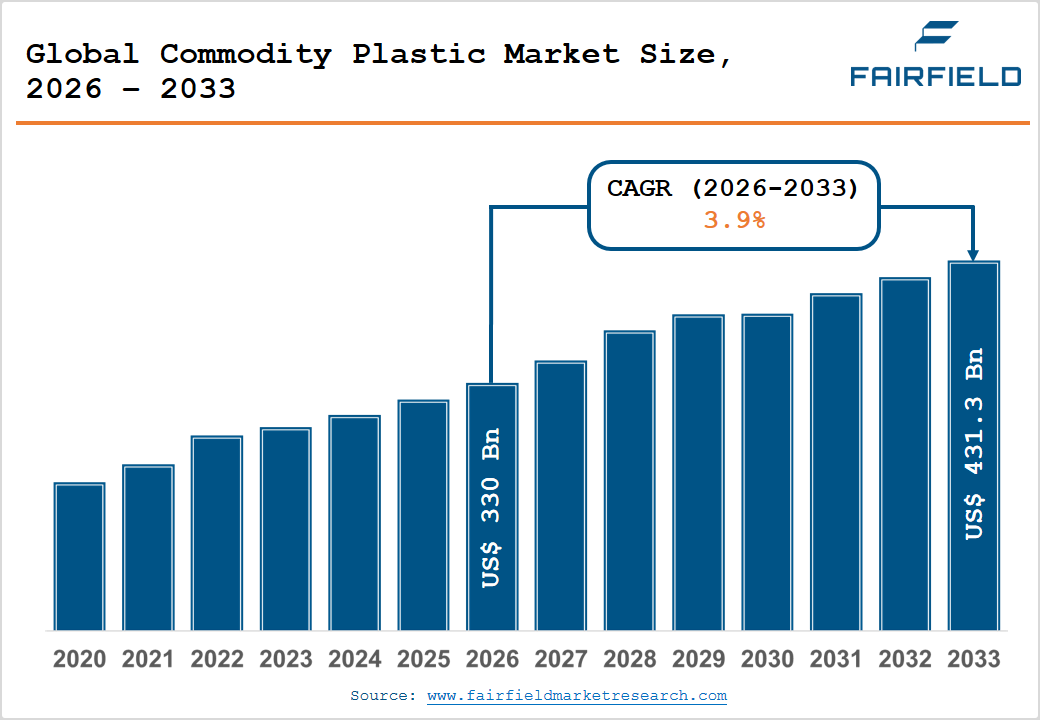
- The global Commodity Plastic Market size is likely to be valued at USD 330 billion in 2026 and is expected to reach USD 431.3 Billion by 2033, growing at a CAGR of 3.90% during the forecast period from 2026 to 2033.
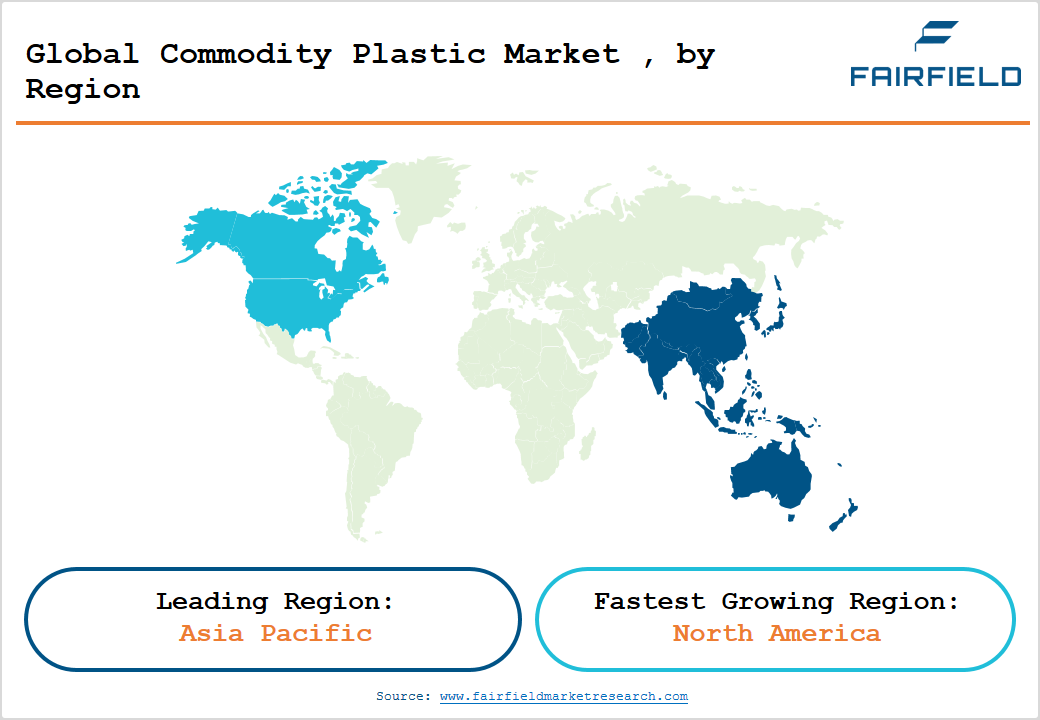
- Asia Pacific leads the global commodity plastic market with approximately 48% of total revenue share in 2026, driven by China's vast petrochemical infrastructure, India's rapid manufacturing expansion, and growing polymer consumption across ASEAN economies.
- North America is the fastest-growing regional market, propelled by the S. Infrastructure Investment and Jobs Act, Gulf Coast ethane cracker expansions, and increasing investments in advanced polymer recycling under EPA national strategies.
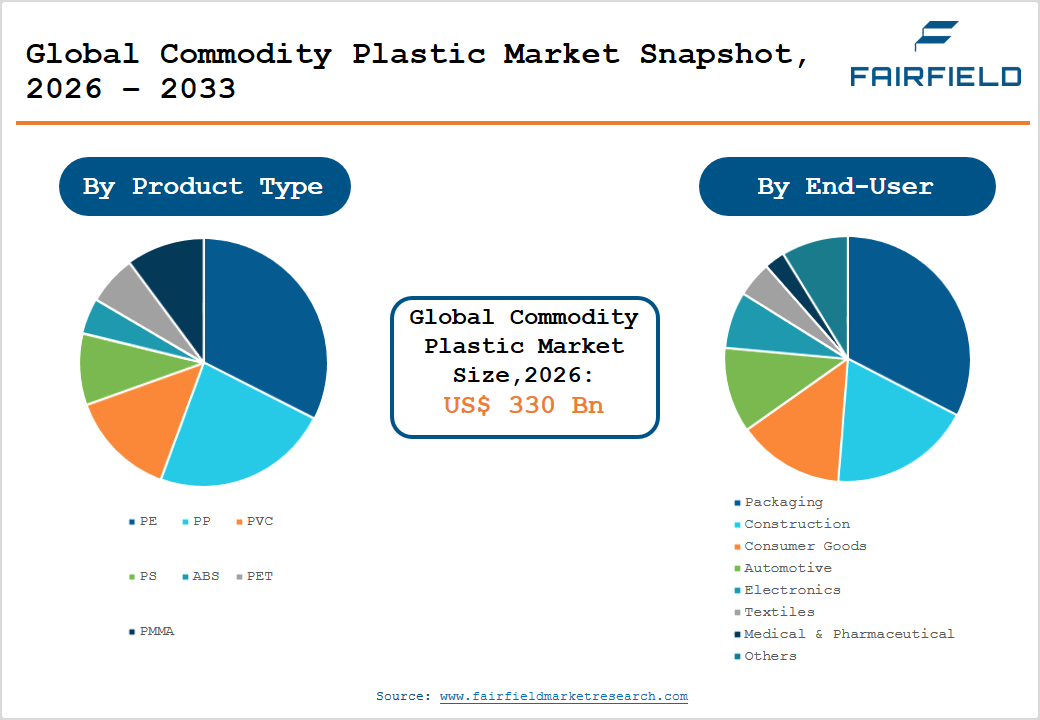
- Polyethylene (PE) dominates the product type segment with approximately 30% market share, supported by multi-grade availability (HDPE, LDPE, LLDPE), broad applicability in packaging and construction, and competitive feedstock economics.
- The Medical & Pharmaceutical segment is the fastest-growing end-user category, fueled by rising global healthcare spending, expanding single-use medical device volumes, and streamlined FDA and EMA regulatory frameworks for medical-grade polymer approvals.
- Key market opportunity lies in the recycled and bio-based commodity plastics space, where EU packaging regulations mandating minimum recycled content by 2030 are creating policy-backed demand, rewarding producers investing in chemical recycling and circular polymer innovation.
Market Dynamics
Market Growth Drivers
- Surging Demand from the Packaging Industry
The packaging sector remains the single largest consumer of commodity plastics globally, representing a dominant share of total polymer consumption. According to European Plastics Converters (EuPC), packaging applications account for more than 40% of all plastic produced annually on a global basis. The exponential growth of e-commerce led by platforms such as Amazon, Alibaba, and Flipkart has dramatically increased demand for flexible and rigid plastic packaging solutions designed to protect goods during transit. Polyethylene (PE) and Polypropylene (PP) are the preferred resins for food-safe, moisture-resistant packaging across food, beverage, personal care, and pharmaceutical segments. As FMCG and retail sectors continue to expand in Asia, Africa, and Latin America, the resulting growth in consumer goods production directly and substantially drives commodity plastic demand across all sub-segments.
- Rapid Infrastructure Development and Construction Activity
Global construction activity continues to be a robust demand driver for commodity plastics, particularly Polyvinyl Chloride (PVC), which is extensively used in pipes, window profiles, flooring, cables, and insulation materials. According to Global Construction Perspectives and Oxford Economics, global construction output is projected to reach US$ 15.2 Trillion by 2030, with significant investments in affordable housing and utilities infrastructure across China, India, and sub-Saharan Africa. The shift toward energy-efficient, low-maintenance construction materials has further reinforced PVC adoption in developed and developing markets alike. Meanwhile, expanding HDPE pipe networks for water supply and gas distribution supported by major government initiatives including India's Jal Jeevan Mission and the U.S. Infrastructure Investment and Jobs Act are generating sustained incremental demand for commodity plastic volumes in the construction end-use sector.
Market Restraints
- Environmental Regulations and the Global Plastic Waste Crisis
Stringent and expanding environmental regulations targeting single-use and non-recyclable plastics represent a significant restraint for the commodity plastic market. The United Nations Environment Programme (UNEP) estimates that approximately 400 million tonnes of plastic waste is generated annually, with less than 10% effectively recycled worldwide. Regulatory responses, including the European Union's Single-Use Plastics Directive (SUPD) enacted in 2021, have banned several high-volume plastic products. The ongoing negotiations toward a Global Plastics Treaty expected for finalization in 2025 threaten to impose further restrictions on plastic production and usage globally, raising compliance costs for manufacturers and prompting brand owners to accelerate substitution with alternative sustainable materials in mature markets.
- Volatility in Crude Oil and Petrochemical Feedstock Prices
The commodity plastic market is highly exposed to fluctuations in crude oil and petrochemical feedstock prices, as the majority of key resins including PE, PP, PVC, and PS are derived from ethylene, propylene, benzene, and other hydrocarbons. According to the International Energy Agency (IEA), Brent crude prices experienced a swing of over US$ 30 per barrel between 2021 and 2023, substantially impacting production economics across the value chain. Such price volatility compresses manufacturer margins and introduces significant pricing uncertainty, particularly for small and mid-sized plastic converters that lack long-term feedstock supply agreements or financial hedging instruments, constraining their ability to plan capital investments and sustain competitive pricing strategies.
Market Opportunities
- Expansion of Medical and Pharmaceutical Applications
The Medical & Pharmaceutical segment represents the fastest-growing end-user category for commodity plastics, driven by rapidly rising global healthcare expenditure and an accelerated post-pandemic emphasis on sterile, single-use, and medical-grade materials. PET (Polyethylene Terephthalate), PMMA (Polymethyl Methacrylate), and ABS (Acrylonitrile Butadiene Styrene) are increasingly being incorporated in medical devices, diagnostic instruments, IV packaging, surgical trays, and drug delivery systems. The World Health Organization (WHO) forecasts global healthcare spending to exceed US$ 10 Trillion annually by 2030. Additionally, the U.S. Food and Drug Administration (FDA) and the European Medicines Agency (EMA) have introduced more streamlined regulatory pathways for medical-grade polymer certifications, reducing market entry timelines and making this a highly attractive, high-margin growth frontier for commodity plastic producers globally.
- Recycled and Bio-Based Commodity Plastics
Growing regulatory mandates and shifting consumer sentiment toward sustainability are opening significant new opportunities in recycled and bio-based commodity plastics. The European Union's Packaging and Packaging Waste Regulation (PPWR), proposed in 2023, mandates minimum recycled content thresholds in plastic packaging by 2030, creating a structured and policy-driven demand pull for certified recycled PE, PP, and PET resins. Producers investing in advanced chemical recycling technologies including pyrolysis, solvent-based purification, and depolymerisation can differentiate their products and access premium-priced markets. The Ellen MacArthur Foundation estimates that circular economy approaches could eliminate over US$ 80 Billion in material losses annually within the global plastics economy, presenting a compelling strategic and commercial case for producers transitioning toward sustainability-driven innovation and circular polymer solutions.
Segmental Insights
- Product Type Analysis
Polyethylene (PE) holds the dominant position in the commodity plastic market by product type, commanding approximately 30% segment share in 2026. PE's market leadership is underpinned by its outstanding versatility, cost-competitiveness, and applicability across flexible and rigid packaging, agricultural films, geomembranes, pipes, and consumer goods. According to the American Chemistry Council (ACC), PE is the single most consumed plastic resin in North America, reflecting its indispensability in the food and beverage packaging and construction sectors. The availability of distinct grades HDPE, LDPE, and LLDPE enables precise material selection for diverse performance requirements. Ongoing capacity additions at U.S. Gulf Coast facilities and across the Middle East continue to ensure globally competitive pricing and stable supply for this leading segment.
- End-User Analysis
Packaging is the leading end-user segment in the commodity plastic market, accounting for approximately 40% segment share in 2026. This dominance reflects the critical and irreplaceable role of plastics in ensuring food safety, extending shelf life, and facilitating efficient supply chain logistics across global retail and e-commerce channels. According to the Flexible Packaging Association (FPA), flexible plastic packaging reduces food waste significantly and requires substantially less material than traditional alternatives, providing both economic and environmental advantages. Rising urban populations, an expanding middle class across Asia Pacific, and the continued proliferation of e-commerce platforms are amplifying demand for diverse packaging formats including stretch films, shrink wraps, pouches, rigid containers, and bottles all of which rely extensively on commodity resins such as PE, PP, and PET.
Regional Insights
- North America Commodity Plastic Market Trends
North America is the fastest-growing region in the commodity plastic market, driven by robust manufacturing activity, large-scale government-backed infrastructure investments, and a dynamic regulatory-innovation ecosystem. The U.S. Infrastructure Investment and Jobs Act (2021), allocating over US$ 1.2 Trillion to transportation, utilities, and digital infrastructure, has substantially elevated demand for plastic piping, conduits, and construction-grade materials. The resurgence of domestic petrochemical manufacturing capacity along the U.S. Gulf Coast where multiple ethane cracker projects reached operational status between 2020 and 2024 has provided American producers with a significant feedstock cost advantage.
The U.S. Environmental Protection Agency (EPA) is advancing its National Recycling Strategy, catalyzing investment in mechanical and advanced chemical recycling technologies and supporting demand for circular economy-compliant plastics. In Canada, requirements under the Canadian Environmental Protection Act for recyclable polymer grades are spurring product innovation. The combined effect of infrastructure-driven volume demand and sustainability-oriented innovation is positioning North America as one of the most dynamic growth regions for commodity plastic producers over the forecast horizon.
- Europe Commodity Plastic Market Trends
Europe represents a mature but strategically significant market for commodity plastics, fundamentally shaped by the European Green Deal and the EU Plastics Strategy, which together mandate substantial investments in plastic recycling infrastructure, bio-based polymer development, and circular economy compliance across member states. Germany leads European polymer production and processing, with Plastics Europe identifying it as home to one of the continent's most sophisticated and technologically advanced plastics industries. France and the Netherlands have made notable strides in chemical recycling investment and bio-based material adoption, respectively.
The United Kingdom has implemented its own Plastic Packaging Tax, introduced in April 2022, imposing a levy of £200 per tonne on plastic packaging with less than 30% recycled content, driving demand for certified recycled resin grades. Spain is witnessing increased commodity plastic adoption in the automotive manufacturing sector, while Italy registers growing consumption in construction and building applications. These regional dynamics collectively sustain a moderate but consistent demand baseline across European commodity plastic segments, complemented by robust export-oriented production capacity.
- Asia Pacific Commodity Plastic Market Trends
Asia Pacific dominates the global commodity plastic market, commanding approximately 48% of the total market share in 2026, underpinned by China's expansive petrochemical infrastructure, India's manufacturing growth momentum, and the expanding consumer base across ASEAN economies. China is the world's largest single producer and consumer of commodity plastics, with PetroChina and Sinopec operating some of the globe's largest ethylene cracking and polymer production complexes. According to China's National Bureau of Statistics, the plastics processing industry employs over 3 million workers and contributes materially to national industrial output.
India has emerged as a high-growth consumption market, supported by landmark government programs including Make in India and Smart Cities Mission, which are driving demand for affordable construction materials, packaging, and consumer goods. ASEAN nations-particularly Vietnam, Thailand, and Indonesia-are attracting growing inflows of foreign direct investment in plastics manufacturing, as global supply chains continue to diversify beyond China following geopolitical realignments. Together, these dynamics cement Asia Pacific's position as the undisputed leader and primary engine of global commodity plastic market growth through 2033.
Competitive Landscape
The global commodity plastic market exhibits a moderately consolidated competitive structure, with a select group of large-scale petrochemical corporations holding substantial market share alongside numerous regional converters and specialty producers. Leading players-including Sinopec, ExxonMobil, LyondellBasell, SABIC, and Dow-leverage vertically integrated operations spanning feedstock procurement, cracking, and polymer production as a core competitive advantage. Strategic priorities among market leaders include geographic capacity expansions in cost-advantaged regions, accelerated investment in chemical recycling and circular polymer solutions, and portfolio diversification into high-margin specialty grades. Mergers, acquisitions, and strategic joint ventures remain prevalent growth mechanisms, while increasing R&D focus on bio-based polymers and certified circular resins is reshaping competitive differentiation globally.
Key Market Developments
- January 2025, LyondellBasell announced the expansion of its advanced recycling capacity at its Houston, Texas facility, targeting over 200,000 tonnes of recycled polymer output annually by 2027, reinforcing its circular economy commitment.
- September 2024, SABIC launched a new portfolio of certified circular polymers under its TRUCIRCLE™ brand, targeting food-contact and medical packaging applications using chemically recycled feedstocks, strengthening its sustainability positioning across European and North American markets.
- March 2023, BASF entered into a long-term supply agreement with Quantafuel for pyrolysis oil derived from mixed plastic waste to produce Ccycled™ brand commodity plastics, marking a significant step in chemically recycled feedstock integration into mainstream polymer production.
Companies Covered in Commodity Plastic Market
- Sinopec
- ExxonMobil
- LyondellBasell
- SABIC
- Dow
- Formosa Plastics
- INEOS
- BASF
- LG Chem
- Sumitomo Chemical
- Mitsubishi Chemical
- Borealis
- PetroChina
- Reliance Industries Limited
- TotalEnergies
- Chevron Phillips Chemical
- Braskem
- Hanwha Solutions
Market Segmentation
By Product Type
- Polyethylene (PE)
- Polypropylene (PP)
- Polyvinyl Chloride (PVC)
- Polystyrene (PS)
- Acrylonitrile Butadiene Styrene (ABS)
- Polyethylene Terephthalate (PET)
- Polymethyl Methacrylate (PMMA)
By End-User
- Packaging
- Construction
- Consumer Goods
- Automotive
- Electronics
- Textiles
- Medical & Pharmaceutical
- Others
Regions
- North America
- Europe
- Asia Pacific
- Latin America
- Middle East & Africa
- Executive Summary
- Global Commodity Plastic Market Snapshot
- Future Projections
- Key Market Trends
- Regional Snapshot, by Value, 2026
- Analyst Recommendations
- Market Overview
- Market Definitions and Segmentations
- Market Dynamics
- Drivers
- Restraints
- Market Opportunities
- Value Chain Analysis
- COVID-19 Impact Analysis
- Porter's Five Forces Analysis
- Impact of Russia-Ukraine Conflict
- PESTLE Analysis
- Regulatory Analysis
- Price Trend Analysis
- Current Prices and Future Projections, 2025-2033
- Price Impact Factors
- Global Commodity Plastic Market Outlook, 2020 - 2033
- Global Commodity Plastic Market Outlook, by Product Type, Value (US$ Bn), 2020-2033
- PE
- PP
- PVC
- PS
- ABS
- PET
- PMMA
- Global Commodity Plastic Market Outlook, by End-User, Value (US$ Bn), 2020-2033
- Packaging
- Construction
- Consumer Goods
- Automotive
- Electronics
- Textiles
- Medical & Pharmaceutical
- Others
- Global Commodity Plastic Market Outlook, by Region, Value (US$ Bn), 2020-2033
- North America
- Europe
- Asia Pacific
- Latin America
- Middle East & Africa
- Global Commodity Plastic Market Outlook, by Product Type, Value (US$ Bn), 2020-2033
- North America Commodity Plastic Market Outlook, 2020 - 2033
- North America Commodity Plastic Market Outlook, by Product Type, Value (US$ Bn), 2020-2033
- PE
- PP
- PVC
- PS
- ABS
- PET
- PMMA
- North America Commodity Plastic Market Outlook, by End-User, Value (US$ Bn), 2020-2033
- Packaging
- Construction
- Consumer Goods
- Automotive
- Electronics
- Textiles
- Medical & Pharmaceutical
- Others
- North America Commodity Plastic Market Outlook, by Country, Value (US$ Bn), 2020-2033
- S. Commodity Plastic Market Outlook, by Product Type, 2020-2033
- S. Commodity Plastic Market Outlook, by End-User, 2020-2033
- Canada Commodity Plastic Market Outlook, by Product Type, 2020-2033
- Canada Commodity Plastic Market Outlook, by End-User, 2020-2033
- BPS Analysis/Market Attractiveness Analysis
- North America Commodity Plastic Market Outlook, by Product Type, Value (US$ Bn), 2020-2033
- Europe Commodity Plastic Market Outlook, 2020 - 2033
- Europe Commodity Plastic Market Outlook, by Product Type, Value (US$ Bn), 2020-2033
- PE
- PP
- PVC
- PS
- ABS
- PET
- PMMA
- Europe Commodity Plastic Market Outlook, by End-User, Value (US$ Bn), 2020-2033
- Packaging
- Construction
- Consumer Goods
- Automotive
- Electronics
- Textiles
- Medical & Pharmaceutical
- Others
- Europe Commodity Plastic Market Outlook, by Country, Value (US$ Bn), 2020-2033
- Germany Commodity Plastic Market Outlook, by Product Type, 2020-2033
- Germany Commodity Plastic Market Outlook, by End-User, 2020-2033
- Italy Commodity Plastic Market Outlook, by Product Type, 2020-2033
- Italy Commodity Plastic Market Outlook, by End-User, 2020-2033
- France Commodity Plastic Market Outlook, by Product Type, 2020-2033
- France Commodity Plastic Market Outlook, by End-User, 2020-2033
- K. Commodity Plastic Market Outlook, by Product Type, 2020-2033
- K. Commodity Plastic Market Outlook, by End-User, 2020-2033
- Spain Commodity Plastic Market Outlook, by Product Type, 2020-2033
- Spain Commodity Plastic Market Outlook, by End-User, 2020-2033
- Russia Commodity Plastic Market Outlook, by Product Type, 2020-2033
- Russia Commodity Plastic Market Outlook, by End-User, 2020-2033
- Rest of Europe Commodity Plastic Market Outlook, by Product Type, 2020-2033
- Rest of Europe Commodity Plastic Market Outlook, by End-User, 2020-2033
- BPS Analysis/Market Attractiveness Analysis
- Europe Commodity Plastic Market Outlook, by Product Type, Value (US$ Bn), 2020-2033
- Asia Pacific Commodity Plastic Market Outlook, 2020 - 2033
- Asia Pacific Commodity Plastic Market Outlook, by Product Type, Value (US$ Bn), 2020-2033
- PE
- PP
- PVC
- PS
- ABS
- PET
- PMMA
- Asia Pacific Commodity Plastic Market Outlook, by End-User, Value (US$ Bn), 2020-2033
- Packaging
- Construction
- Consumer Goods
- Automotive
- Electronics
- Textiles
- Medical & Pharmaceutical
- Others
- Asia Pacific Commodity Plastic Market Outlook, by Country, Value (US$ Bn), 2020-2033
- China Commodity Plastic Market Outlook, by Product Type, 2020-2033
- China Commodity Plastic Market Outlook, by End-User, 2020-2033
- Japan Commodity Plastic Market Outlook, by Product Type, 2020-2033
- Japan Commodity Plastic Market Outlook, by End-User, 2020-2033
- South Korea Commodity Plastic Market Outlook, by Product Type, 2020-2033
- South Korea Commodity Plastic Market Outlook, by End-User, 2020-2033
- India Commodity Plastic Market Outlook, by Product Type, 2020-2033
- India Commodity Plastic Market Outlook, by End-User, 2020-2033
- Southeast Asia Commodity Plastic Market Outlook, by Product Type, 2020-2033
- Southeast Asia Commodity Plastic Market Outlook, by End-User, 2020-2033
- Rest of SAO Commodity Plastic Market Outlook, by Product Type, 2020-2033
- Rest of SAO Commodity Plastic Market Outlook, by End-User, 2020-2033
- BPS Analysis/Market Attractiveness Analysis
- Asia Pacific Commodity Plastic Market Outlook, by Product Type, Value (US$ Bn), 2020-2033
- Latin America Commodity Plastic Market Outlook, 2020 - 2033
- Latin America Commodity Plastic Market Outlook, by Product Type, Value (US$ Bn), 2020-2033
- PE
- PP
- PVC
- PS
- ABS
- PET
- PMMA
- Latin America Commodity Plastic Market Outlook, by End-User, Value (US$ Bn), 2020-2033
- Packaging
- Construction
- Consumer Goods
- Automotive
- Electronics
- Textiles
- Medical & Pharmaceutical
- Others
- Latin America Commodity Plastic Market Outlook, by Country, Value (US$ Bn), 2020-2033
- Brazil Commodity Plastic Market Outlook, by Product Type, 2020-2033
- Brazil Commodity Plastic Market Outlook, by End-User, 2020-2033
- Mexico Commodity Plastic Market Outlook, by Product Type, 2020-2033
- Mexico Commodity Plastic Market Outlook, by End-User, 2020-2033
- Argentina Commodity Plastic Market Outlook, by Product Type, 2020-2033
- Argentina Commodity Plastic Market Outlook, by End-User, 2020-2033
- Rest of LATAM Commodity Plastic Market Outlook, by Product Type, 2020-2033
- Rest of LATAM Commodity Plastic Market Outlook, by End-User, 2020-2033
- BPS Analysis/Market Attractiveness Analysis
- Latin America Commodity Plastic Market Outlook, by Product Type, Value (US$ Bn), 2020-2033
- Middle East & Africa Commodity Plastic Market Outlook, 2020 - 2033
- Middle East & Africa Commodity Plastic Market Outlook, by Product Type, Value (US$ Bn), 2020-2033
- PE
- PP
- PVC
- PS
- ABS
- PET
- PMMA
- Middle East & Africa Commodity Plastic Market Outlook, by End-User, Value (US$ Bn), 2020-2033
- Packaging
- Construction
- Consumer Goods
- Automotive
- Electronics
- Textiles
- Medical & Pharmaceutical
- Others
- Middle East & Africa Commodity Plastic Market Outlook, by Country, Value (US$ Bn), 2020-2033
- GCC Commodity Plastic Market Outlook, by Product Type, 2020-2033
- GCC Commodity Plastic Market Outlook, by End-User, 2020-2033
- South Africa Commodity Plastic Market Outlook, by Product Type, 2020-2033
- South Africa Commodity Plastic Market Outlook, by End-User, 2020-2033
- Egypt Commodity Plastic Market Outlook, by Product Type, 2020-2033
- Egypt Commodity Plastic Market Outlook, by End-User, 2020-2033
- Nigeria Commodity Plastic Market Outlook, by Product Type, 2020-2033
- Nigeria Commodity Plastic Market Outlook, by End-User, 2020-2033
- Rest of Middle East Commodity Plastic Market Outlook, by Product Type, 2020-2033
- Rest of Middle East Commodity Plastic Market Outlook, by End-User, 2020-2033
- BPS Analysis/Market Attractiveness Analysis
- Middle East & Africa Commodity Plastic Market Outlook, by Product Type, Value (US$ Bn), 2020-2033
- Competitive Landscape
- Company Vs Segment Heatmap
- Company Market Share Analysis, 2025
- Competitive Dashboard
- Company Profiles
- Sinopec
- Company Overview
- Product Portfolio
- Financial Overview
- Business Strategies and Developments
- ExxonMobil
- LyondellBasell
- SABIC
- Dow
- Formosa Plastics
- INEOS
- BASF
- LG Chem
- Sumitomo Chemical
- Mitsubishi Chemical
- Borealis
- PetroChina
- Sinopec
- Appendix
- Research Methodology
- Report Assumptions
- Acronyms and Abbreviations
|
BASE YEAR |
HISTORICAL DATA |
FORECAST PERIOD |
UNITS |
|||
 |
2025 |
 |
2019 - 2024 |
 |
2026 - 2033 |
Value: US$ Million |
|
REPORT FEATURES |
DETAILS |
|
By Product Type Coverage |
|
|
By End-User Coverage |
|
|
Geographical Coverage |
|
|
Leading Companies |
|
|
Report Highlights |
Key Market Indicators, Macro-micro economic impact analysis, Technological Roadmap, Key Trends, Driver, Restraints, and Future Opportunities & Revenue Pockets, Porter’s 5 Forces Analysis, Historical Trend (2019-2024), Market Estimates and Forecast, Market Dynamics, Industry Trends, Competition Landscape, Category, Region, Country-wise Trends & Analysis, COVID-19 Impact Analysis (Demand and Supply Chain) |
Our Research Methodology
Considering the volatility of business today, traditional approaches to strategizing a game plan can be unfruitful if not detrimental. True ambiguity is no way to determine a forecast. A myriad of predetermined factors must be accounted for such as the degree of risk involved, the magnitude of circumstances, as well as conditions or consequences that are not known or unpredictable. To circumvent binary views that cast uncertainty, the application of market research intelligence to strategically posture, move, and enable actionable outcomes is necessary.
View Methodology
Quality Assured
Rigorous Validation Process

Confidentiality Assured
End-to-end Data Security

Custom Research Services
Tailored To Your Objectives
FAQs
The Commodity Plastic market size is US$ 330 Billion in 2026.
The Commodity Plastic market is projected to grow at a CAGR of 3.90% by 2033.
The Commodity Plastic market growth drivers include rising packaging demand, infrastructure development, and expanding healthcare applications.
Asia Pacific is the dominating region for the Commodity Plastic market.
Sinopec, ExxonMobil, LyondellBasell, SABIC, and Dow are some leading industry players in the Commodity Plastic market.
Related Reports
Corrosion Resistant Alloys Market Insights, Competitive Landscape, and Market Forecast 2033
Corrosion Resistant Alloys Market is projected to reach US$19.27 billion by 2033, driven by energy, aerospace, and chemical processing.
Reclaimed Rubber Market Insights, Competitive Landscape, and Market Forecast 2033
Reclaimed Rubber Market is projected to reach US$2.99 billion by 2033, driven by circular economy initiatives, and sustainable manufacturing.
Synthetic Rope Market Insights, Competitive Landscape, and Market Forecast 2026–2033
The synthetic rope market will grow from US$1.30 Bn in 2026 to US$2.30 Bn by 2033 at an 8.5% CAGR, driven by offshore energy and industrial applications.
Flexible Paper Packaging Market Insights, Competitive Landscape, and Market Forecast 2026–2033
The flexible paper packaging market will grow from US$138.60 Bn in 2026 to US$216.80 Bn by 2033 at a 6.6% CAGR, driven by recyclable packaging demand.
Ceramic Coating Market Insights, Competitive Landscape, and Market Forecast 2026–2033
Ceramic Coating Market is projected to reach US$24.62 billion by 2033, driven by aerospace, automotive, energy and wear resistance
Cast Elastomers Market Insights, Competitive Landscape, and Forecast 2026–2033
Cast Elastomers Market is projected to reach US$2.71 billion by 2033, driven by rising demand across mining, industrial, heavy equipment, and EV applications.