



Calcium Propionate Market
Calcium Propionate Market Insights, Competitive Landscape, and Market Forecast - 2033
The Calcium Propionate Market is valued at USD 415.6 Mn in 2026 and is projected to reach USD 682.7 Mn, growing at a CAGR of 5% by 2033.
Quick Report Digest
A Look Back and a Look Forward - Comparative Analysis
The market for calcium propionate is now expanding rapidly, mostly due to the rising demand for convenience and processed foods around the world. Because calcium propionate effectively inhibits the growth of mold and extends shelf-life, its use as a preservative in a variety of food applications, including dairy and bread goods, is growing. The current market dynamics are a result of manufacturers reacting to consumers' rising preference for clean-label products and natural preservatives.
Tight food safety laws are impacting consumer expectations and driving innovation in business, as well as market developments. The market for calcium propionate has steadily changed over time in response to shifts in customer tastes, technology developments, and legislative changes.
Due to rising knowledge of food safety and the necessity for extended shelf-lives, the food industry has adopted the product more frequently throughout time, especially in developed nations. The historical data demonstrates how calcium propionate, a crucial component in food preservation, can withstand market pressures and be used in a variety of ways.
Future expansion in the calcium propionate market is anticipated due to a number of factors, including urbanisation, population increase, and the ongoing need for food products that are both handy and long-lasting. Future product formulations will likely involve more advancements, with a focus on clean labels and natural options.
The future of the market is anticipated to be significantly shaped by technological developments and research projects as manufacturers investigate sustainable production techniques and applications in response to shifting consumer demands. Global market increase is expected, with rising nations playing a major role in the trajectory of global growth.
Key Growth Determinants
- Rapidly Expanding Market for Processed Foods
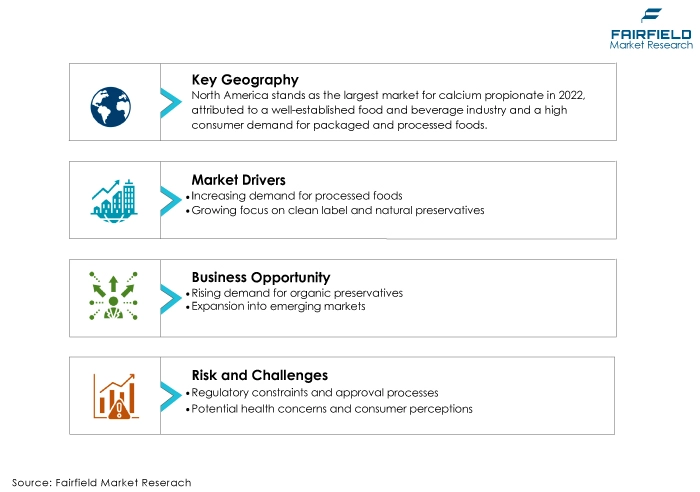
The market for calcium propionate is growing, and one of the main factors driving this expansion is the rising demand for processed foods. Processed food production and consumption have surged as a result of customers' increased preference for convenience and ready-to-eat options in today's food scene. Because of its exceptional ability to preserve food, calcium propionate is widely used in a variety of processed food categories, including dairy, packaged foods, baked goods, and meat processing.
The capacity of calcium propionate to prevent the growth of mold, prolong the shelf-life, and preserve product quality is in complete harmony with the needs of both manufacturers, and consumers. The need for processed foods is anticipated to endure as the world's population gets busier and more urbanised, which will fuel the market for calcium propionate's expansion.
- Greater Emphasis on Clean-label Products
The market for calcium propionate is being driven primarily by consumers' increasing inclination towards clean-label products. As customers' awareness of health and welbeing increases, they are actively looking for food products that have natural and transparent components. In this regard, calcium propionate has gained significance due to its ability to function as an excellent preservative while yet being perceived as a natural ingredient.
In response to the clean label movement, food producers are adjusting their recipes to include calcium propionate, meeting the changing needs of consumers who are concerned about their health. Calcium propionate's significance as a clean label option for preserving different food goods is projected to help the market as regulatory bodies stress openness in food labeling.
- Tightening Screws of Food Safety Regulations
Tight food safety laws all around the world are a major factor driving the calcium propionate industry. Governments and regulatory agencies are implementing stricter regulations to guarantee the quality and safety of food items at every stage of the supply chain. Due to its proven ability to stop microbiological deterioration and improve food safety, food makers trying to meet these criteria are using more and more calcium propionate.
By extending the shelf-life of perishable goods, preservatives help reduce food waste, which is in line with more general sustainability objectives. The need for food makers to achieve and beyond strict food safety standards is expected to fuel an increase in the demand for calcium propionate as regulatory scrutiny continues to mount.
Major Growth Barriers
- Regulatory Constraints, and Complex Approval Processes
The market for calcium propionate is severely constrained by the complex regulatory environment and licensing procedures pertaining to food additives. Manufacturers face multiple hurdles when it comes to complying with various and changing rules, which include careful documentation and adherence to standards.
Managing the complicated regulatory landscape can lead to delays and higher expenses, which can affect market dynamics and make it more difficult to introduce calcium propionate into a variety of culinary applications.
- Potential Health Concerns, and Changing Consumer Perception
A major barrier to the market is the attitudes of consumers and health issues. Preservatives are widely accepted as safe. However, some customers may have concerns about their use, which could influence their purchasing decision.
Market participants face a challenge in influencing consumer attitudes and preferences as a result of the need for effective communication and education regarding the safety and advantages of calcium propionate in order to address these concerns, and preserve a favourable consumer perception.
Key Trends and Opportunities to Look at
The market for calcium propionate has a lot of potential due to consumers' growing demand for natural and organic products. Organic preservatives are becoming more and more in demand as people become more health-conscious and look for clean-label solutions. Given its natural source, calcium propionate has a chance to benefit from this trend.
Producers might investigate ways to create and promote calcium propionate formulations organically, meeting the changing needs of consumers who are health-conscious and diversifying their product lines in response to the market for natural preservatives.
- Expansion in Emerging Markets
- Advent of Food Preservation Technologies
The calcium propionate market has a good chance to grow by entering emerging markets. The demand for processed and convenience meals is rising in tandem with the fast urbanisation and income growth of countries in places like Latin America, and the Asia Pacific area.
Given its reputation for effectively prolonging the shelf-life of those products, calcium propionate stands to gain significantly from these growing industries. Businesses can make strategic investments in these areas by leveraging the expanding customer base and forming alliances with regional food producers to satisfy the growing demand for preserved food items.
Innovation in the calcium propionate industry is possible as long as technology in the food preservation sector keeps improving. R&D initiatives aimed at improving calcium propionate's effectiveness, sustainability, and range of applications may pave the way for future market expansion.
The efficacy of calcium propionate as a preservative can be further enhanced by innovations, including controlled-release formulations, encapsulating technologies, and innovative delivery systems, which can expand its applicability and meet particular issues in other food segments. By allocating resources toward research and development, manufacturers can strategically leverage technical advancements and maintain a leading position in the dynamic food preservation industry.
How Does the Regulatory Scenario Shape this Industry?
The market for calcium propionate is governed by strict regulations that control food additives and preservatives—regulatory organisations, like the European Food Safety Authority (EFSA), and the Food and Drug Administration (US FDA) set acceptable limits and guidelines for the use of calcium propionate in different food products.
Such criteria that specify allowable levels, labeling regulations, and adherence to good manufacturing procedures, protect the safety and quality of preserved foods. Manufacturers must adhere to these regulations, which mean thorough testing, record-keeping, and open labeling in order to fulfill the requirements and guarantee the viability of calcium propionate-containing products on the market.
Fairfield’s Ranking Board
Top Segments
The dry form of calcium propionate dominates the market in 2025, which is favoured for its extensive application and numerous intrinsic benefits. Because of its longer shelf-life, affordability, and simplicity of handling, food makers favour the dry version. Dry calcium propionate's dominance in the market is mostly due to its ease of storage, transportation, and mixing into different food formulas.
Calcium propionate in liquid form is the fastest-growing type due to its simplicity of use and versatility in liquid-based food items. Liquid formulations are suitable for drinks, and other food items that are liquid-based since they have the advantage of homogenous dispersion. The liquid form of calcium propionate is expanding faster and gaining market share as consumers' need for a wider variety of preserved liquid items grows.
- Bakery Represents the Major Consumer Category, Animal Feed to Register the Fastest Uptake by 2033
The bakery sector will be the main player in the calcium propionate market in 2025. Because calcium propionate effectively inhibits the growth of mold and prolongs shelf-life, it is widely used in bakery products like bread and pastries. As people throughout the world still incorporate baked goods in their daily diets, there is a constant need for calcium propionate in this industry, which greatly contributes to its supremacy.
The animal feed sector is anticipated to experience the most rapid expansion during the forecast period as consumer consciousness regarding the criticality of animal nutrition and health grows. Calcium propionate is a useful addition to animal feed that improves feed quality by inhibiting the growth of pathogenic microorganisms. The demand for calcium propionate in animal feed applications rises significantly as the livestock industry grows and consumers place a higher value on animal welfare, making it the fastest-growing market category.
Regional Frontrunners
North America Leads as Processed and Packaged Products Remain the Mainstay of F&B
In 2025, the largest market for calcium propionate is found in North America, which owes its dominance to a thriving and highly developed food industry. Customers in the area show a clear preference for processed and packaged foods, where calcium propionate is often used as a preservative.
A strong supply chain and strict laws governing food safety are two factors in the food producers' widespread use of calcium propionate. Because of persistent consumer demand, regulatory compliance, and the region's vibrant and fiercely competitive food industry's ongoing search for food preservation solutions, North America leads the world in market size.
A Swelling Market for Processed and Preserved Foods Drives Asia Pacific’s Growth
The calcium propionate market in the Asia Pacific area is expanding quickly due to a number of factors. Increasing overall disposable cash, rapidly evolving consumer lifestyles, growing demand for convenient products, and frequently changing dietary habits collectively lead to a surge in the market for processed and preserved foods.
The use of calcium propionate is increasing as the area becomes more urbanised, and there is a noticeable move towards more shelf-stable and easy food options. Asia Pacific is the area with the greatest rate of growth in the worldwide calcium propionate market due to the rising food and beverage industry in nations like China, and India.
Fairfield’s Competitive Landscape Analysis
The market for calcium propionate is very competitive, with both long-standing competitors and recent entries. To get a competitive edge, key corporations concentrate on developing strategic alliances, increasing production capacity, and creating innovative products. Strict adherence to regulations and quality standards are important elements influencing the competitive dynamics in this market.
Who are the Leaders in Global Calcium Propionate Space?
- Niacet
- Impextraco
- ADDISON
- Kemin Industries
- Macco Organiques
- Bell Chem
- Krishna Chemicals
- AM Food Chemicals
- Associated British Foods Plc
- Fine Organics
An Expert’s Eye
Demand and Future Growth
The market for calcium propionate continues to witness strong demand due to factors including urbanisation, the growing population of the world, and consumers' growing inclination towards processed foods. The increasing need for products with a clean label underscores the importance of calcium propionate as an all-natural preservative.
The market performance is expected to be supported by the development of emerging markets, improvements in food preservation technology, and a persistent emphasis on food safety. The market's durability can be attributed to its capacity to conform to changing customer preferences and regulatory requirements, thereby establishing calcium propionate as a crucial element in the constantly growing array of food preservation solutions.
Supply Side of the Market
According to our analysis, the calcium propionate market is robust and competitive from a supply-side perspective. Manufacturers take advantage of new developments in production technologies to guarantee economical and effective procedures. Important suppliers continuously work to increase production capabilities and uphold strict quality control procedures in order to meet the growing demand for calcium propionate.
In the supply chain, strategic alliances and collaborations also support a consistent and dependable supply of calcium propionate. Suppliers who prioritise sustainable sourcing and production methods are crucial in fulfilling the varied requirements of the food sector and guaranteeing a consistent and dependable supply of this indispensable preservative.
Global Calcium Propionate Market is Segmented as Below:
By Form:
- Dry
- Liquid
By Application:
- Bakery
- Dairy
- Meat Processing
- Animal Feed
- Beverages
- Packaged Food Products
- Miscellaneous
By Geographic Coverage:
- North America
- Europe
- Asia Pacific
- Latin America
- Middle East & Africa
- Executive Summary
- Global Calcium Propionate Market Snapshot
- Future Projections
- Key Market Trends
- Regional Snapshot, by Value, 2026
- Analyst Recommendations
- Market Overview
- Market Definitions and Segmentations
- Market Dynamics
- Drivers
- Restraints
- Market Opportunities
- Value Chain Analysis
- COVID-19 Impact Analysis
- Porter's Five Forces Analysis
- Impact of Russia-Ukraine Conflict
- PESTLE Analysis
- Regulatory Analysis
- Price Trend Analysis
- Current Prices and Future Projections, 2025-2033
- Price Impact Factors
- Global Calcium Propionate Market Outlook, 2020 - 2033
- Global Calcium Propionate Market Outlook, by Form, Value (US$ Mn), 2020-2033
- Dry
- Liquid
- Global Calcium Propionate Market Outlook, by Application, Value (US$ Mn), 2020-2033
- Bakery
- Dairy
- Meat Processing
- Animal Feed
- Beverages
- Packaged Food Products
- Miscellaneous
- Global Calcium Propionate Market Outlook, by Region, Value (US$ Mn), 2020-2033
- North America
- Europe
- Asia Pacific
- Latin America
- Middle East & Africa
- Global Calcium Propionate Market Outlook, by Form, Value (US$ Mn), 2020-2033
- North America Calcium Propionate Market Outlook, 2020 - 2033
- North America Calcium Propionate Market Outlook, by Form, Value (US$ Mn), 2020-2033
- Dry
- Liquid
- North America Calcium Propionate Market Outlook, by Application, Value (US$ Mn), 2020-2033
- Bakery
- Dairy
- Meat Processing
- Animal Feed
- Beverages
- Packaged Food Products
- Miscellaneous
- North America Calcium Propionate Market Outlook, by Country, Value (US$ Mn), 2020-2033
- U.S. Calcium Propionate Market Outlook, by Form, 2020-2033
- U.S. Calcium Propionate Market Outlook, by Application, 2020-2033
- Canada Calcium Propionate Market Outlook, by Form, 2020-2033
- Canada Calcium Propionate Market Outlook, by Application, 2020-2033
- BPS Analysis/Market Attractiveness Analysis
- North America Calcium Propionate Market Outlook, by Form, Value (US$ Mn), 2020-2033
- Europe Calcium Propionate Market Outlook, 2020 - 2033
- Europe Calcium Propionate Market Outlook, by Form, Value (US$ Mn), 2020-2033
- Dry
- Liquid
- Europe Calcium Propionate Market Outlook, by Application, Value (US$ Mn), 2020-2033
- Bakery
- Dairy
- Meat Processing
- Animal Feed
- Beverages
- Packaged Food Products
- Miscellaneous
- Europe Calcium Propionate Market Outlook, by Country, Value (US$ Mn), 2020-2033
- Germany Calcium Propionate Market Outlook, by Form, 2020-2033
- Germany Calcium Propionate Market Outlook, by Application, 2020-2033
- Italy Calcium Propionate Market Outlook, by Form, 2020-2033
- Italy Calcium Propionate Market Outlook, by Application, 2020-2033
- France Calcium Propionate Market Outlook, by Form, 2020-2033
- France Calcium Propionate Market Outlook, by Application, 2020-2033
- U.K. Calcium Propionate Market Outlook, by Form, 2020-2033
- U.K. Calcium Propionate Market Outlook, by Application, 2020-2033
- Spain Calcium Propionate Market Outlook, by Form, 2020-2033
- Spain Calcium Propionate Market Outlook, by Application, 2020-2033
- Russia Calcium Propionate Market Outlook, by Form, 2020-2033
- Russia Calcium Propionate Market Outlook, by Application, 2020-2033
- Rest of Europe Calcium Propionate Market Outlook, by Form, 2020-2033
- Rest of Europe Calcium Propionate Market Outlook, by Application, 2020-2033
- BPS Analysis/Market Attractiveness Analysis
- Europe Calcium Propionate Market Outlook, by Form, Value (US$ Mn), 2020-2033
- Asia Pacific Calcium Propionate Market Outlook, 2020 - 2033
- Asia Pacific Calcium Propionate Market Outlook, by Form, Value (US$ Mn), 2020-2033
- Dry
- Liquid
- Asia Pacific Calcium Propionate Market Outlook, by Application, Value (US$ Mn), 2020-2033
- Bakery
- Dairy
- Meat Processing
- Animal Feed
- Beverages
- Packaged Food Products
- Miscellaneous
- Asia Pacific Calcium Propionate Market Outlook, by Country, Value (US$ Mn), 2020-2033
- China Calcium Propionate Market Outlook, by Form, 2020-2033
- China Calcium Propionate Market Outlook, by Application, 2020-2033
- Japan Calcium Propionate Market Outlook, by Form, 2020-2033
- Japan Calcium Propionate Market Outlook, by Application, 2020-2033
- South Korea Calcium Propionate Market Outlook, by Form, 2020-2033
- South Korea Calcium Propionate Market Outlook, by Application, 2020-2033
- India Calcium Propionate Market Outlook, by Form, 2020-2033
- India Calcium Propionate Market Outlook, by Application, 2020-2033
- Southeast Asia Calcium Propionate Market Outlook, by Form, 2020-2033
- Southeast Asia Calcium Propionate Market Outlook, by Application, 2020-2033
- Rest of SAO Calcium Propionate Market Outlook, by Form, 2020-2033
- Rest of SAO Calcium Propionate Market Outlook, by Application, 2020-2033
- BPS Analysis/Market Attractiveness Analysis
- Asia Pacific Calcium Propionate Market Outlook, by Form, Value (US$ Mn), 2020-2033
- Latin America Calcium Propionate Market Outlook, 2020 - 2033
- Latin America Calcium Propionate Market Outlook, by Form, Value (US$ Mn), 2020-2033
- Dry
- Liquid
- Latin America Calcium Propionate Market Outlook, by Application, Value (US$ Mn), 2020-2033
- Bakery
- Dairy
- Meat Processing
- Animal Feed
- Beverages
- Packaged Food Products
- Miscellaneous
- Latin America Calcium Propionate Market Outlook, by Country, Value (US$ Mn), 2020-2033
- Brazil Calcium Propionate Market Outlook, by Form, 2020-2033
- Brazil Calcium Propionate Market Outlook, by Application, 2020-2033
- Mexico Calcium Propionate Market Outlook, by Form, 2020-2033
- Mexico Calcium Propionate Market Outlook, by Application, 2020-2033
- Argentina Calcium Propionate Market Outlook, by Form, 2020-2033
- Argentina Calcium Propionate Market Outlook, by Application, 2020-2033
- Rest of LATAM Calcium Propionate Market Outlook, by Form, 2020-2033
- Rest of LATAM Calcium Propionate Market Outlook, by Application, 2020-2033
- BPS Analysis/Market Attractiveness Analysis
- Latin America Calcium Propionate Market Outlook, by Form, Value (US$ Mn), 2020-2033
- Middle East & Africa Calcium Propionate Market Outlook, 2020 - 2033
- Middle East & Africa Calcium Propionate Market Outlook, by Form, Value (US$ Mn), 2020-2033
- Dry
- Liquid
- Middle East & Africa Calcium Propionate Market Outlook, by Application, Value (US$ Mn), 2020-2033
- Bakery
- Dairy
- Meat Processing
- Animal Feed
- Beverages
- Packaged Food Products
- Miscellaneous
- Middle East & Africa Calcium Propionate Market Outlook, by Country, Value (US$ Mn), 2020-2033
- GCC Calcium Propionate Market Outlook, by Form, 2020-2033
- GCC Calcium Propionate Market Outlook, by Application, 2020-2033
- South Africa Calcium Propionate Market Outlook, by Form, 2020-2033
- South Africa Calcium Propionate Market Outlook, by Application, 2020-2033
- Egypt Calcium Propionate Market Outlook, by Form, 2020-2033
- Egypt Calcium Propionate Market Outlook, by Application, 2020-2033
- Nigeria Calcium Propionate Market Outlook, by Form, 2020-2033
- Nigeria Calcium Propionate Market Outlook, by Application, 2020-2033
- Rest of Middle East Calcium Propionate Market Outlook, by Form, 2020-2033
- Rest of Middle East Calcium Propionate Market Outlook, by Application, 2020-2033
- BPS Analysis/Market Attractiveness Analysis
- Middle East & Africa Calcium Propionate Market Outlook, by Form, Value (US$ Mn), 2020-2033
- Competitive Landscape
- Company Vs Segment Heatmap
- Company Market Share Analysis, 2025
- Competitive Dashboard
- Company Profiles
- Niacet
- Company Overview
- Product Portfolio
- Financial Overview
- Business Strategies and Developments
- Impextraco
- ADDISON
- Kemin Industries
- Macco Organiques
- Bell Chem
- Krishna Chemicals
- AM Food Chemicals
- Associated British Foods Plc
- Fine Organics
- Niacet
- Appendix
- Research Methodology
- Report Assumptions
- Acronyms and Abbreviations
|
BASE YEAR |
HISTORICAL DATA |
FORECAST PERIOD |
UNITS |
|||
 |
2025 |
 |
2019 - 2024 |
 |
2026 - 2033 |
Value: US$ Million |
|
REPORT FEATURES |
DETAILS |
|
Form Coverage |
|
|
Application Coverage |
|
|
Geographical Coverage |
|
|
Leading Companies |
|
|
Report Highlights |
Key Market Indicators, Macro-micro economic impact analysis, Technological Roadmap, Key Trends, Driver, Restraints, and Future Opportunities & Revenue Pockets, Porter’s 5 Forces Analysis, Historical Trend (2019-2021), Market Estimates and Forecast, Market Dynamics, Industry Trends, Competition Landscape, Category, Region, Country-wise Trends & Analysis, COVID-19 Impact Analysis (Demand and Supply Chain) |
Our Research Methodology
Considering the volatility of business today, traditional approaches to strategizing a game plan can be unfruitful if not detrimental. True ambiguity is no way to determine a forecast. A myriad of predetermined factors must be accounted for such as the degree of risk involved, the magnitude of circumstances, as well as conditions or consequences that are not known or unpredictable. To circumvent binary views that cast uncertainty, the application of market research intelligence to strategically posture, move, and enable actionable outcomes is necessary.
View Methodology
Quality Assured
Rigorous Validation Process

Confidentiality Assured
End-to-end Data Security

Custom Research Services
Tailored To Your Objectives
FAQs
The bakery industry, seeking extended shelf life for products, is a major driver for calcium propionate usage. Manufacturers collaborate with bakeries to tailor formulations, ensuring optimal preservation without compromising taste, texture, or overall product quality.
Growing demand for clean-label products is influencing manufacturers to explore natural preservatives like calcium propionate. Companies are investing in research and development to enhance the natural attributes of calcium propionate and address consumer concerns about artificial additives.
Manufacturers are actively communicating research on the safety of calcium propionate while exploring alternative preservatives. Ongoing research and development focus on creating calcium propionate formulations with reduced perceived health risks, ensuring transparency, and addressing consumer concerns.
The global calcium propionate market is influenced by diverse regulations and food safety standards. Manufacturers adhere to stringent quality control processes, invest in certifications, and collaborate with regulatory bodies to ensure compliance with international standards for food safety and additives.
Sustainability is gaining importance, with manufacturers investing in eco-friendly production methods and packaging. Additionally, efforts are made to optimise transportation logistics, reduce waste, and implement circular economy practices in the calcium propionate supply chain.
Related Reports
Brewery Equipment Market Insights, Competitive Landscape, and Market Forecast 2033
Brewery Equipment Market to reach US$33.61 Bn by 2033, growing at 5.9% CAGR, driven by craft brewing, automation, and sustainable production.
Macadamia Nut Market Insights, Competitive Landscape, and Market Forecast 2026–2033
Macadamia Nut Market to reach US$4.69 Bn by 2033, growing at 9.4% CAGR, driven by wellness trends, organic demand, and plant-based applications.
Dietary Supplements Market Insights, Competitive Landscape, and Market Forecast 2026–2033
Dietary Supplements Market to reach US$435.78 billion by 2033, growing at 9.6% CAGR, driven by health awareness, and personalized nutrition.
Decaffeinated Coffee Market Insights, Competitive Landscape, and Market Forecast 2033
Decaffeinated Coffee Market is projected to reach US$5.20 billion by 2033, driven by health trends, premiumization, specialty retail, and better technology.
Coffee Substitute Market Insights, Competitive Landscape, and Market Forecast 2026–2033
The coffee substitute market is expected to grow from US$18.20 billion in 2026 to US$23.95 billion by 2033 at a 4.0% CAGR, driven by beverage innovation.
Protein Crisps Market Insights, Competitive Landscape, and Market Forecast 2033
The protein crisps market will grow from US$9.0 Bn in 2026 to US$15.83 Bn by 2033 at an 8.4% CAGR, driven by sports nutrition and healthy snacking trends.