



Case Packing Machine Market
Case Packing Machine Market Insights, Competitive Landscape, and Market Forecast - 2033
Market Growth Forecast
Quick Report Digest
Major Growth Determinants
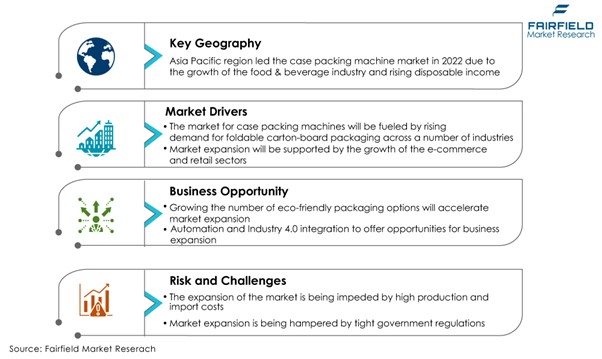
- Increased Demand for Foldable Carton-board Packaging
Cardboard-based secondary packaging is generally preferred to all other types of packaging due to its complete biodegradability. An empty carton can be folded to maximise storage space. It's not always required to use glue for sealing. The box will be effectively sealed if the flaps are tucked within. It provides a sizable, easily-printable surface for product information and brand promotion. As a result, carton-board packaging is in greater demand globally as a result of this.
However, the labour pool has shrunk since case packing machines produce more effective results than human labour. Due to an increase in carton-board packaging in most industries, a greater requirement for packaging more cartons in a shorter time is emerging. Thus, the market for case packing machines is growing due to increased demand for carton-board packing.
- E-commerce and Retail Expansion
The retail and e-commerce industries have used packaging equipment to outperform the competition. High consumer expectations and the spike in demand for quick delivery have given e-retailers the push to innovate to fulfill orders on time and stay competitive in the market. This creates a significant possibility for packing equipment to experience quick acceptance in the e-commerce sector.
For instance, Kiva Systems' packaging automation solutions may pick items off the shelf and deliver them to workers. As a result, to handle high-volume and high-value orders, e-commerce and retailing enterprises are currently investing in integrating robotics.
- Severing Skilled Labour Shortage
Many firms, including packing and manufacturing, worry about finding qualified people to do tasks requiring precision and understanding. Repeated case packing tasks include assembly, filling, and sealing packages. Additionally, inconsistencies, errors, or even a lower standard of the finished product may occur due to a lack of trained staff with the required knowledge. This consistency yields an improved product as well as a stronger brand reputation.
Furthermore, labour-intensive tasks like manual packaging may have high turnover rates because of their repetitive nature and physical demands. Frequent turnover increases the cost of training new staff, reducing productivity. Thus, this is anticipated to boost market expansion.
Major Growth Barriers
- High Production and Import Expenses
Leading market players strongly emphasize case packing machines, increasing efficiency by speeding up operations. The cost of production as a whole is raised, nevertheless. Furthermore, the export industry is badly impacted since small and medium-sized businesses find it difficult to purchase these devices. Additionally, because of the charges levied by customs duty, developing nations encounter difficulties importing machinery, which hinders the global case packing machine market.
- Government-imposed Restrictions
In the majority of manufacturing sectors, case packing machines are used. The industry that manufactures food and beverages is the largest portion of users, followed by the pharmaceutical sector. The Health and Safety Executive (HSE) has concluded from an analysis of packing machinery accidents examined in the food and beverages industry that injuries resulting from using, maintaining, or removing blockages at packaging machines can be severe or even dangerous (as with palletizers). These laws may prevent the market from expanding.
Key Trends and Opportunities to Look at
Case packing machines were increasingly incorporated into smart manufacturing settings, which was a big trend. Data analytics and other Industry 4.0 principles were used to track and improve equipment performance, preventive maintenance, and production efficiency. As a result, this is boosting the market for case packing machines.
- Boom Around Eco-friendly Packaging
- Surging Popularity of Robotics and Collaborative Robots (Cobots)
Eco-friendly packaging options are created to reduce the environmental effects of packaging components and operations during their useful lives. These solutions seek to decrease resource consumption, encourage sustainability, and reduce waste. Using packaging materials effectively and streamlining the packaging procedure to meet environmental objectives are the main concerns when discussing case packing machines.
In many areas, including manufacturing and packaging, robotics and collabourative robots, sometimes called "cobots," are game-changing technology. They significantly improve the automation, productivity, and safety of case packing machines and other systems. Increased production efficiency is also a result of robots' ability to work continuously at a fast pace without becoming weary. In some circumstances, they are faster at completing tasks than manual labour, particularly useful in high-volume production settings.
How Does the Regulatory Scenario Shape this Industry?
Over the last three years, sustainable packaging standards have mostly focused on plastic case packing. Eighty-three percent of the legal measures linked to sustainable packaging worldwide, with 147 measures found, focus on plastics. The European Union and Asia have the most plastic rules, with France and India ranking first and second, respectively. Although it has changed over the years in response to some lessons learned, the system in the United States for regulating food contact materials and food packaging is pretty well established.
All compounds that are intended to become parts of food must acquire premarket approval from the Food and Drug Administration (FDA), unless they are covered by a particular exemption, according to the Federal Food, Drug, and Cosmetic Act (the Act), which was amended to include food additives in 1958.
Furthermore, the Federal Food, Drug, and Cosmetic Act was amended in 1998 to allow food contact notifications (FCNs) to be submitted instead of food additive petitions for compounds that come into contact with food. The FDA supported this amendment.
The Top Segments on Ranking Board
The side load segment dominated the market in 2022. Food enterprises may be able to increase packaging output by utilising side load case packing machines. In contrast to other loading techniques like top or bottom loading, this case packing machine feeds goods into a packaging case from the side. Products best put into the case horizontally from one of its sides should be handled by a side load case packing machine.
Furthermore, the top load category is projected to experience the fastest market growth. Industries prioritising product security, aesthetics, and efficiency in their packaging processes can benefit from top load case packing machines. They are a significant resource for producers looking for dependable and adaptable packaging solutions due to their versatility and compatibility with numerous product types.
- Automatic Case Packers Surge Ahead
- 10 to 25 CPM Capacity Most Sought-after
- Confectionary Industry Registers Maximum Demand
In 2022, the automatic category dominated the industry. The automatic case packers are designed to process a greater volume of goods significantly faster. Larger throughput allows for a significantly faster output rate, making it more appropriate for industrial operations on a grand scale. Additionally, they use exact robotic or mechanical techniques to pack goods consistently and accurately, reducing the likelihood of errors and anomalies.
The semi-automatic category is anticipated to grow substantially throughout the projected period. Between entirely manual and fully automated packaging operations is a transitional stage represented by the semi-automatic category of case packing machines. It offers the right amount of productivity, adaptability, and human control, making it an excellent option for various sectors with varying packaging requirements and production volumes.
The 10 to 25 CPM segment dominated the market in 2022. This capacity range is suitable for businesses with a moderate volume of production which requires efficient case packing while juggling speed and accuracy. The distinct product needs and operating requirements must be considered when selecting a case packing machine within this capacity range.
The 25 to 50 CPM category is expected to experience the fastest growth within the forecast time frame. The 25 to 50 CPM capacity category of case packing machines provides a balanced packaging solution for enterprises with medium-scale production needs. These machines offer an effective packaging process without the difficulty and expense associated with high-speed machines, making them an advantageous option for various applications.
In 2022, the confectionary category led the market growth. The confectionery industry is well-represented in the market for case packing machines. These gadgets guarantee uniformity and efficiency in packing by automating the packaging of confectionery products. Along with the demand for packaged confectionery products, case packing machines that cater to this industry are predicted to see a rise in demand.
Moreover, the frozen food category is expected to grow fastest in the case packing machine market during the forecast period. The convenience and adaptability of frozen foods have helped them become more popular. The category of frozen foods is always evolving and providing new goods to satisfy consumer expectations for time-saving solutions and a larger variety of meal options.
Regional Frontrunners
Asia Pacific Remains the Largest Revenue Contributor
In the packaging industries, case packing machine adoption is anticipated to dominate in the Asia-Pacific region. The rise of the food and beverage industry, rising disposable income, and a growing population helped drive market expansion in the area. Recent shifts in developing economies like China, and India have also helped the region's business expand.
The expansion of the market in China, and India is driven by an increase in demand for medicines, food, and beverage products and by the entry of several domestic and foreign case packing machine manufacturers. Moreover, the demand for case packing machines in the Asia Pacific region is projected to increase due to a growing professional base.
North America to Witness Significant Growth in Sales
The increase in packaging applications in the food and beverage, pharmaceutical, and cosmetics industries is driving expansion in the North American case packing machine market. Consumers of packaged goods in North America primarily focused on convenience and packaging that complemented their lifestyles and provided value.
Furthermore, the adoption rate of packaging equipment in the North American region has increased due to the growth of industrial automation and technological developments in manufacturing facilities. The need for environmentally friendly packaging has significantly increased, promoting the usage and creation of green materials.
Along with rising consumer awareness and rules about food cleanliness, certain other factors driving the growth of the North American case packing machine market include rising demand for packaged foods.
Who are the Leaders in Global Case Packing Machines Space?
- BluePrint Automation
- Mpack Group
- Douglas Machine Inc.
- Delkor Systems, Inc.
- IMA Group
- FOCKE & CO
- Ishida Europe Ltd
- Somic Packaging
- Case Packing Systems BV (Xano Group)
- Brenton, LLC
- ABRIGO SPA.
- Cama Group
- Fallas Automation
- Clearpack
- Aagard Group
Fairfield’s Competitive Landscape Analysis
The global case packing machine market is a consolidated market with less major players present across the globe. The key players are introducing new products as well as working on the distriubution channels to enhance their worldwide presence. Moreover, Fairfield Market Research is expecting the market to witness more consolidation over the coming years.
An Expert’s Eye
Demand and Future Growth
As per Fairfield’s Analysis, an increase in consumer demand for food and beverages is driving the market. The rising demand for beverages may result in a growth in secondary packaging, where case packaging is favored in large quantities, increasing the need for case packing machines.
Furthermore, technological developments have greatly aided the growth and development of various case packing machines in factory automation. However, the case packing machine market is expected to face considerable challenges because of high initial expenses.
Supply Side Uncovered
According to our analysis, the manufacturers present in the case packaging machine market are focusing on enhancing the machine capacities and competences by introducing new models in the 25 to 50 CPM category which will help the end users to work more effectively and efficiently. For instance, in September 2022, in order to satisfy CPQ clients' requests for packing between 30 and 50 cases per minute, Brenton announced a new continuous motion side-load case packer.
Case packing machine makers are working on technological advanced versions which requires integrating automation, robotics, and AI in order to increase production, accuracy, and adaptability. Intelligent features, preemptive maintenance, and real-time monitoring are becoming more prevalent.
In addition, a number of firms are creating case packing equipment to assist eco-friendly packaging techniques in response to rising environmental concerns. This can mean implementing energy-saving technologies, utilising environmentally friendly materials, and optimising package designs to save waste. These might make the machine's environmental impact even smaller.
Global Case Packing Machine Market is Segmented as Below:
By Machine Type
- Top Load
- Side Load
- Wrap Around
By Automation
- Semi-automatic
- Automatic
By Capacity
- Less than 10 CPM
- 10 to 25 CPM
- 25 to 50 PM
- 50 to 100 CPM
By End Use
- Snacks
- Potato Chips
- Tortilla Chips
- Extruded Snacks
- Nuts & Seeds
- Dried Fruits
- Miscellaneous
- Frozen Food
- Potato Product IQF
- Fruit and Vegetables IQF
- Meat and Protein IQF
- Fresh & Chilled Food
- Leaf Salad
- Confectionery
- Jelly
- Wrapped Confectionery
- Miscellaneous Confectionary
- Chocolate & Bars
- Chocolate Lentils
- Wrapped Chocolate
- Cereals
- Extruded Cereals
- Flakes
- Muesli
- Bakery
- Cake
- Bread
- Frozen Bakery
- Cookies
- Biscuits
- Crackers
- Powder
- Infant Nutrition
- Instant Drinks
- Food Powder
- Coffee & Tea
- Ground Coffee
- Whole Bean Coffee
- Coffee Pods
- Pet Food
- Dry Pet Food
- Wet Pet Food
- Dairy Products
- Cheese
- Yogurt
- Puddings
- Misc. food
- Pasta
- Rice
- Beans and Lentils
- Salt
- Sugar
- Herbs & Spices
- Pharmaceuticals
- Personal Care and Cosmetics
- Household Care
By Geography
- North America
- United States
- Canada
- Europe
- Germany
- U.K.
- France
- Italy
- Netherlands
- Russia
- Rest of Europe
- Asia Pacific
- Japan
- China
- India
- South Korea
- Southeast Asia
- Rest of Asia Pacific
- Latin America
- Brazil
- Mexico
- Rest of Latin America
- Middle East & Africa
- GCC
- South Africa
- Rest of Middle East & Africa
- Executive Summary
- Global Case Packing Machine Market Snapshot
- Future Projections
- Key Market Trends
- Regional Snapshot, by Value, 2026
- Analyst Recommendations
- Market Overview
- Market Definitions and Segmentations
- Market Dynamics
- Drivers
- Restraints
- Market Opportunities
- Value Chain Analysis
- COVID-19 Impact Analysis
- Porter's Five Forces Analysis
- Impact of Russia-Ukraine Conflict
- PESTLE Analysis
- Regulatory Analysis
- Price Trend Analysis
- Current Prices and Future Projections, 2025-2033
- Price Impact Factors
- Global Case Packing Machine Market Outlook, 2020 - 2033
- Global Case Packing Machine Market Outlook, by Machine Type, Value (US$ Mn), 2020-2033
- Top Load
- Side Load
- Wrap Around
- Global Case Packing Machine Market Outlook, by Automation, Value (US$ Mn), 2020-2033
- Semi-automatic
- Automatic
- Global Case Packing Machine Market Outlook, by Capacity, Value (US$ Mn), 2020-2033
- Less than 10 CPM
- 10 to 25 CPM
- 25 to 50 PM
- 50 to 100 CPM
- Global Case Packing Machine Market Outlook, by By End Use, Value (US$ Mn), 2020-2033
- Snacks
- Frozen Food
- Confectionery
- Chocolate & Bars
- Cereals
- Bakery
- Powder
- Coffee & Tea
- Pet Food
- Dairy Products
- Global Case Packing Machine Market Outlook, by Region, Value (US$ Mn), 2020-2033
- North America
- Europe
- Asia Pacific
- Latin America
- Middle East & Africa
- Global Case Packing Machine Market Outlook, by Machine Type, Value (US$ Mn), 2020-2033
- North America Case Packing Machine Market Outlook, 2020 - 2033
- North America Case Packing Machine Market Outlook, by Machine Type, Value (US$ Mn), 2020-2033
- Top Load
- Side Load
- Wrap Around
- North America Case Packing Machine Market Outlook, by Automation, Value (US$ Mn), 2020-2033
- Semi-automatic
- Automatic
- North America Case Packing Machine Market Outlook, by Capacity, Value (US$ Mn), 2020-2033
- Less than 10 CPM
- 10 to 25 CPM
- 25 to 50 PM
- 50 to 100 CPM
- North America Case Packing Machine Market Outlook, by By End Use, Value (US$ Mn), 2020-2033
- Snacks
- Frozen Food
- Confectionery
- Chocolate & Bars
- Cereals
- Bakery
- Powder
- Coffee & Tea
- Pet Food
- Dairy Products
- North America Case Packing Machine Market Outlook, by Country, Value (US$ Mn), 2020-2033
- U.S. Case Packing Machine Market Outlook, by Machine Type, 2020-2033
- U.S. Case Packing Machine Market Outlook, by Automation, 2020-2033
- U.S. Case Packing Machine Market Outlook, by Capacity, 2020-2033
- U.S. Case Packing Machine Market Outlook, by By End Use, 2020-2033
- Canada Case Packing Machine Market Outlook, by Machine Type, 2020-2033
- Canada Case Packing Machine Market Outlook, by Automation, 2020-2033
- Canada Case Packing Machine Market Outlook, by Capacity, 2020-2033
- Canada Case Packing Machine Market Outlook, by By End Use, 2020-2033
- BPS Analysis/Market Attractiveness Analysis
- North America Case Packing Machine Market Outlook, by Machine Type, Value (US$ Mn), 2020-2033
- Europe Case Packing Machine Market Outlook, 2020 - 2033
- Europe Case Packing Machine Market Outlook, by Machine Type, Value (US$ Mn), 2020-2033
- Top Load
- Side Load
- Wrap Around
- Europe Case Packing Machine Market Outlook, by Automation, Value (US$ Mn), 2020-2033
- Semi-automatic
- Automatic
- Europe Case Packing Machine Market Outlook, by Capacity, Value (US$ Mn), 2020-2033
- Less than 10 CPM
- 10 to 25 CPM
- 25 to 50 PM
- 50 to 100 CPM
- Europe Case Packing Machine Market Outlook, by By End Use, Value (US$ Mn), 2020-2033
- Snacks
- Frozen Food
- Confectionery
- Chocolate & Bars
- Cereals
- Bakery
- Powder
- Coffee & Tea
- Pet Food
- Dairy Products
- Europe Case Packing Machine Market Outlook, by Country, Value (US$ Mn), 2020-2033
- Germany Case Packing Machine Market Outlook, by Machine Type, 2020-2033
- Germany Case Packing Machine Market Outlook, by Automation, 2020-2033
- Germany Case Packing Machine Market Outlook, by Capacity, 2020-2033
- Germany Case Packing Machine Market Outlook, by By End Use, 2020-2033
- Italy Case Packing Machine Market Outlook, by Machine Type, 2020-2033
- Italy Case Packing Machine Market Outlook, by Automation, 2020-2033
- Italy Case Packing Machine Market Outlook, by Capacity, 2020-2033
- Italy Case Packing Machine Market Outlook, by By End Use, 2020-2033
- France Case Packing Machine Market Outlook, by Machine Type, 2020-2033
- France Case Packing Machine Market Outlook, by Automation, 2020-2033
- France Case Packing Machine Market Outlook, by Capacity, 2020-2033
- France Case Packing Machine Market Outlook, by By End Use, 2020-2033
- U.K. Case Packing Machine Market Outlook, by Machine Type, 2020-2033
- U.K. Case Packing Machine Market Outlook, by Automation, 2020-2033
- U.K. Case Packing Machine Market Outlook, by Capacity, 2020-2033
- U.K. Case Packing Machine Market Outlook, by End Use, 2020-2033
- Spain Case Packing Machine Market Outlook, by Machine Type, 2020-2033
- Spain Case Packing Machine Market Outlook, by Automation, 2020-2033
- Spain Case Packing Machine Market Outlook, by Capacity, 2020-2033
- Spain Case Packing Machine Market Outlook, by End Use, 2020-2033
- Russia Case Packing Machine Market Outlook, by Machine Type, 2020-2033
- Russia Case Packing Machine Market Outlook, by Automation, 2020-2033
- Russia Case Packing Machine Market Outlook, by Capacity, 2020-2033
- Russia Case Packing Machine Market Outlook, by End Use, 2020-2033
- Rest of Europe Case Packing Machine Market Outlook, by Machine Type, 2020-2033
- Rest of Europe Case Packing Machine Market Outlook, by Automation, 2020-2033
- Rest of Europe Case Packing Machine Market Outlook, by Capacity, 2020-2033
- Rest of Europe Case Packing Machine Market Outlook, by End Use, 2020-2033
- BPS Analysis/Market Attractiveness Analysis
- Europe Case Packing Machine Market Outlook, by Machine Type, Value (US$ Mn), 2020-2033
- Asia Pacific Case Packing Machine Market Outlook, 2020 - 2033
- Asia Pacific Case Packing Machine Market Outlook, by Machine Type, Value (US$ Mn), 2020-2033
- Top Load
- Side Load
- Wrap Around
- Asia Pacific Case Packing Machine Market Outlook, by Automation, Value (US$ Mn), 2020-2033
- Semi-automatic
- Automatic
- Asia Pacific Case Packing Machine Market Outlook, by Capacity, Value (US$ Mn), 2020-2033
- Less than 10 CPM
- 10 to 25 CPM
- 25 to 50 PM
- 50 to 100 CPM
- Asia Pacific Case Packing Machine Market Outlook, by By End Use, Value (US$ Mn), 2020-2033
- Snacks
- Frozen Food
- Confectionery
- Chocolate & Bars
- Cereals
- Bakery
- Powder
- Coffee & Tea
- Pet Food
- Dairy Products
- Asia Pacific Case Packing Machine Market Outlook, by Country, Value (US$ Mn), 2020-2033
- China Case Packing Machine Market Outlook, by Machine Type, 2020-2033
- China Case Packing Machine Market Outlook, by Automation, 2020-2033
- China Case Packing Machine Market Outlook, by Capacity, 2020-2033
- China Case Packing Machine Market Outlook, by End Use, 2020-2033
- Japan Case Packing Machine Market Outlook, by Machine Type, 2020-2033
- Japan Case Packing Machine Market Outlook, by Automation, 2020-2033
- Japan Case Packing Machine Market Outlook, by Capacity, 2020-2033
- Japan Case Packing Machine Market Outlook, by End Use, 2020-2033
- South Korea Case Packing Machine Market Outlook, by Machine Type, 2020-2033
- South Korea Case Packing Machine Market Outlook, by Automation, 2020-2033
- South Korea Case Packing Machine Market Outlook, by Capacity, 2020-2033
- South Korea Case Packing Machine Market Outlook, by End Use, 2020-2033
- India Case Packing Machine Market Outlook, by Machine Type, 2020-2033
- India Case Packing Machine Market Outlook, by Automation, 2020-2033
- India Case Packing Machine Market Outlook, by Capacity, 2020-2033
- India Case Packing Machine Market Outlook, by End Use, 2020-2033
- Southeast Asia Case Packing Machine Market Outlook, by Machine Type, 2020-2033
- Southeast Asia Case Packing Machine Market Outlook, by Automation, 2020-2033
- Southeast Asia Case Packing Machine Market Outlook, by Capacity, 2020-2033
- Southeast Asia Case Packing Machine Market Outlook, by End Use, 2020-2033
- Rest of SAO Case Packing Machine Market Outlook, by Machine Type, 2020-2033
- Rest of SAO Case Packing Machine Market Outlook, by Automation, 2020-2033
- Rest of SAO Case Packing Machine Market Outlook, by Capacity, 2020-2033
- Rest of SAO Case Packing Machine Market Outlook, by End Use, 2020-2033
- BPS Analysis/Market Attractiveness Analysis
- Asia Pacific Case Packing Machine Market Outlook, by Machine Type, Value (US$ Mn), 2020-2033
- Latin America Case Packing Machine Market Outlook, 2020 - 2033
- Latin America Case Packing Machine Market Outlook, by Machine Type, Value (US$ Mn), 2020-2033
- Top Load
- Side Load
- Wrap Around
- Latin America Case Packing Machine Market Outlook, by Automation, Value (US$ Mn), 2020-2033
- Semi-automatic
- Automatic
- Latin America Case Packing Machine Market Outlook, by Capacity, Value (US$ Mn), 2020-2033
- Less than 10 CPM
- 10 to 25 CPM
- 25 to 50 PM
- 50 to 100 CPM
- Latin America Case Packing Machine Market Outlook, by End Use, Value (US$ Mn), 2020-2033
- Snacks
- Frozen Food
- Confectionery
- Chocolate & Bars
- Cereals
- Bakery
- Powder
- Coffee & Tea
- Pet Food
- Dairy Products
- Latin America Case Packing Machine Market Outlook, by Country, Value (US$ Mn), 2020-2033
- Brazil Case Packing Machine Market Outlook, by Machine Type, 2020-2033
- Brazil Case Packing Machine Market Outlook, by Automation, 2020-2033
- Brazil Case Packing Machine Market Outlook, by Capacity, 2020-2033
- Brazil Case Packing Machine Market Outlook, by End Use, 2020-2033
- Mexico Case Packing Machine Market Outlook, by Machine Type, 2020-2033
- Mexico Case Packing Machine Market Outlook, by Automation, 2020-2033
- Mexico Case Packing Machine Market Outlook, by Capacity, 2020-2033
- Mexico Case Packing Machine Market Outlook, by End Use, 2020-2033
- Argentina Case Packing Machine Market Outlook, by Machine Type, 2020-2033
- Argentina Case Packing Machine Market Outlook, by Automation, 2020-2033
- Argentina Case Packing Machine Market Outlook, by Capacity, 2020-2033
- Argentina Case Packing Machine Market Outlook, by End Use, 2020-2033
- Rest of LATAM Case Packing Machine Market Outlook, by Machine Type, 2020-2033
- Rest of LATAM Case Packing Machine Market Outlook, by Automation, 2020-2033
- Rest of LATAM Case Packing Machine Market Outlook, by Capacity, 2020-2033
- Rest of LATAM Case Packing Machine Market Outlook, by End Use, 2020-2033
- BPS Analysis/Market Attractiveness Analysis
- Latin America Case Packing Machine Market Outlook, by Machine Type, Value (US$ Mn), 2020-2033
- Middle East & Africa Case Packing Machine Market Outlook, 2020 - 2033
- Middle East & Africa Case Packing Machine Market Outlook, by Machine Type, Value (US$ Mn), 2020-2033
- Top Load
- Side Load
- Wrap Around
- Middle East & Africa Case Packing Machine Market Outlook, by Automation, Value (US$ Mn), 2020-2033
- Semi-automatic
- Automatic
- Middle East & Africa Case Packing Machine Market Outlook, by Capacity, Value (US$ Mn), 2020-2033
- Less than 10 CPM
- 10 to 25 CPM
- 25 to 50 PM
- 50 to 100 CPM
- Middle East & Africa Case Packing Machine Market Outlook, by End Use, Value (US$ Mn), 2020-2033
- Snacks
- Frozen Food
- Confectionery
- Chocolate & Bars
- Cereals
- Bakery
- Powder
- Coffee & Tea
- Pet Food
- Dairy Products
- Middle East & Africa Case Packing Machine Market Outlook, by Country, Value (US$ Mn), 2020-2033
- GCC Case Packing Machine Market Outlook, by Machine Type, 2020-2033
- GCC Case Packing Machine Market Outlook, by Automation, 2020-2033
- GCC Case Packing Machine Market Outlook, by Capacity, 2020-2033
- GCC Case Packing Machine Market Outlook, by End Use, 2020-2033
- South Africa Case Packing Machine Market Outlook, by Machine Type, 2020-2033
- South Africa Case Packing Machine Market Outlook, by Automation, 2020-2033
- South Africa Case Packing Machine Market Outlook, by Capacity, 2020-2033
- South Africa Case Packing Machine Market Outlook, by End Use, 2020-2033
- Egypt Case Packing Machine Market Outlook, by Machine Type, 2020-2033
- Egypt Case Packing Machine Market Outlook, by Automation, 2020-2033
- Egypt Case Packing Machine Market Outlook, by Capacity, 2020-2033
- Egypt Case Packing Machine Market Outlook, by End Use, 2020-2033
- Nigeria Case Packing Machine Market Outlook, by Machine Type, 2020-2033
- Nigeria Case Packing Machine Market Outlook, by Automation, 2020-2033
- Nigeria Case Packing Machine Market Outlook, by Capacity, 2020-2033
- Nigeria Case Packing Machine Market Outlook, by End Use, 2020-2033
- Rest of Middle East Case Packing Machine Market Outlook, by Machine Type, 2020-2033
- Rest of Middle East Case Packing Machine Market Outlook, by Automation, 2020-2033
- Rest of Middle East Case Packing Machine Market Outlook, by Capacity, 2020-2033
- Rest of Middle East Case Packing Machine Market Outlook, by End Use, 2020-2033
- BPS Analysis/Market Attractiveness Analysis
- Middle East & Africa Case Packing Machine Market Outlook, by Machine Type, Value (US$ Mn), 2020-2033
- Competitive Landscape
- Company Vs Segment Heatmap
- Company Market Share Analysis, 2025
- Competitive Dashboard
- Company Profiles
- BluePrint Automation
- Company Overview
- Product Portfolio
- Financial Overview
- Business Strategies and Developments
- Mpack Group
- Douglas Machine Inc.
- Delkor Systems, Inc.
- IMA Group
- FOCKE & CO
- Ishida Europe Ltd
- Somic Packaging
- Case Packing Systems BV (Xano Group)
- Brenton, LLC
- BluePrint Automation
- Appendix
- Research Methodology
- Report Assumptions
- Acronyms and Abbreviations
|
BASE YEAR |
HISTORICAL DATA |
FORECAST PERIOD |
UNITS |
|||
 |
2025 |
 |
2019 - 2024 |
 |
2026 - 2033 |
Value: US$ Million |
|
REPORT FEATURES |
DETAILS |
|
Machine Type Coverage |
|
|
Capacity Coverage |
|
|
Automation Coverage |
|
|
End Use Coverage |
|
|
Geographical Coverage |
|
|
Leading Companies |
|
|
Report Highlights |
Key Market Indicators, Macro-micro economic impact analysis, Technological Roadmap, Key Trends, Driver, Restraints, and Future Opportunities & Revenue Pockets, Porter’s 5 Forces Analysis, Historical Trend (2019-2021), Market Estimates and Forecast, Market Dynamics, Industry Trends, Competition Landscape, Category, Region, Country-wise Trends & Analysis, COVID-19 Impact Analysis (Demand and Supply Chain) |
Our Research Methodology
Considering the volatility of business today, traditional approaches to strategizing a game plan can be unfruitful if not detrimental. True ambiguity is no way to determine a forecast. A myriad of predetermined factors must be accounted for such as the degree of risk involved, the magnitude of circumstances, as well as conditions or consequences that are not known or unpredictable. To circumvent binary views that cast uncertainty, the application of market research intelligence to strategically posture, move, and enable actionable outcomes is necessary.
View Methodology
Quality Assured
Rigorous Validation Process

Confidentiality Assured
End-to-end Data Security

Custom Research Services
Tailored To Your Objectives
FAQs
The global case packing machine market recorded a valuation of around USD 789.3 Mn in 2026 .
The market for case packing machine market is expected to see a modest CAGR of 3% during the years of projection.
Asia Pacific holds the largest share of the global case packing machine market value pie.
The primary factor projected to drive the case packing machines market revenue expansion is an increase in the demand for folding carton-board packaging across multiple sectors, and manufacturer improvements.
In 2026, the side load category held a significant share in the global market for case packing machines. The trend will most likely prevail throughout the period of forecast.
Related Reports
Recyclable Polyolefin Impact Modifiers Market Insights, Competitive Landscape, and Market Forecast 2033
Recyclable Polyolefin Impact Modifiers Market to reach USD 2.81 Bn by 2033, growing at 8.4% CAGR, driven by recycling, and sustainability demand.
Zero-Waste Beauty Market Insights, Competitive Landscape, and Market Forecast 2033
Zero-Waste Beauty Market to reach USD 5.97 Bn by 2033, growing at 14.6% CAGR, driven by packaging, waterless formulations, and consumer demand.
Dispersible Bio Films Market Insights, Competitive Landscape, and Market Forecast 2033
Dispersible Bio Films Market to reach USD 829.66 Mn by 2033, growing at 16.2% CAGR, driven by pharma delivery, nutraceuticals, and convenient dosing.
Blue Light Blocking Glasses Market
The global blue light blocking glasses market will reach US$ 5.18 Bn by 2033, growing at a 9.2% CAGR, driven by rising screen exposure and eye-care awareness
Microalgae in Fertilizers Market Insights, Competitive Landscape, and Market Forecast - 2033
Microalgae in fertilizers market is valued at USD 480.00 million in 2026 and is projected to reach USD 1,171.92 million by 2033, growing at a CAGR of 13.6%.
Smart Seed Coatings Market Insights, Competitive Landscape, and Market Forecast 2033
The smart seed coatings market is valued at USD 1.50 billion in 2026 and is projected to reach USD 3.19 billion by 2033, growing at 11.4% CAGR