



Coconut Products Market
Coconut Products Market Insights, Competitive Landscape, and Market Forecast - 2033
Global Coconut Products Market Forecast
The Coconut Products Market is expected to grow from USD 8.7 Billion in 2026 to USD 13.9 Billion by 2033, reflecting strong industry expansion and registering a CAGR of 6.9% during the forecast period from 2026 to 2033.
Market Size and Trend Analysis
- The key trend anticipated to fuel the coconut products market growth is the increasing awareness of health benefits associated with coconuts. Coconut-based products are considered natural, organic, and healthy alternatives in various food and beverage applications.
- Another major market trend expected to fuel the coconut derivatives, such as coconut oil and milk, find extensive applications in cosmetics and pharmaceuticals due to their natural moisturizing and healing properties.
- In 2022, mature coconuts are widely used for producing various coconut products due to their higher oil content and richer taste compared to young coconuts.
- Coconut oil is a versatile product used not only in cooking but also in cosmetics, and pharmaceuticals. Its health benefits and diverse applications make it the dominant derivative product type in the market.
- In 2022, the food and beverages industry is the largest consumer of coconut products. Coconut derivatives like coconut water, milk, and desiccated coconut are extensively used in various cuisines, beverages, and desserts, making this sector the dominant end user.
- Supermarkets and hypermarkets have a vast consumer base and offer a wide range of coconut products under one roof. Consumers often prefer the convenience of purchasing coconut products along with their regular groceries, making this distribution channel the dominant choice.
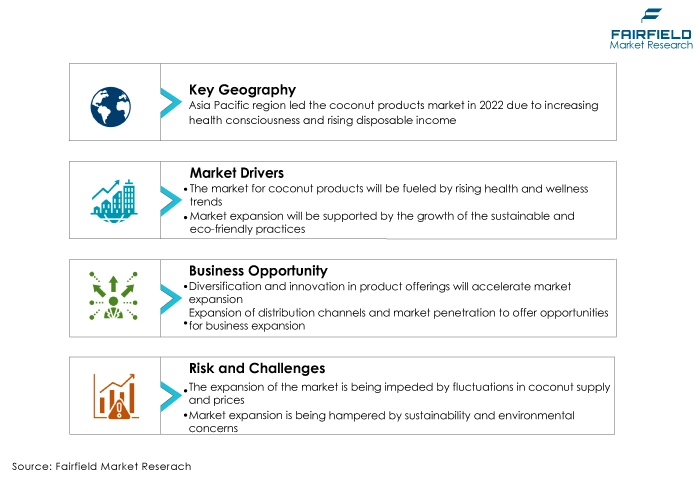
- Asia Pacific dominates the coconut products market due to the abundant availability of coconuts in countries like Indonesia, the Philippines, and India. These regions have a rich tradition of coconut-based cuisine and products, leading to a high demand and making Asia Pacific the dominant market.
- North America is witnessing a surge in demand for healthy and natural food products, including coconut-based items. North America is the area with the fastest-growing market due to a combination of creative product introductions and increased consumer knowledge of the health advantages of coconut products.
- Expanding Health-conscious Consumer Clustre
- Versatile Application Range
- Sustainability Drive
- Supply Chain Challenges
- Intense Competition, and Price Sensitivity
- Rising Demand for Healthier Dietary Alternatives
- Sustainable and Ethical Sourcing
- Innovative Product Diversification
- Young Coconut Sales Prominent over Mature Counterparts
- Coconut Oil Sales Remain Noteworthy
- F&B Leads in Uptake
- Distribution Channel Category is Expected to be the Leading in Coconut Products Market
A Look Back and a Look Forward - Comparative Analysis
The market for coconut products is currently experiencing robust growth, driven by increasing consumer awareness about the health benefits of coconut-based products. Coconut derivatives such as coconut oil, water, milk, and desiccated coconut are highly sought after due to their natural and nutritious properties.
The demand is further amplified by the growing trend towards organic and plant-based products, where coconuts find extensive applications in the food and beverage, cosmetics, and pharmaceutical industries. Key players are focusing on product diversification and expanding their distribution networks, catering to the rising demand for coconut products globally.
The market witnessed staggered growth during the historical period 2018 - 2022. The coconut products market grew steadily as customer tastes shifted in favour of healthier options. The period witnessed a surge in the use of coconut-based ingredients in various food preparations, beverages, and beauty products. Additionally, advancements in processing technologies improved the quality and shelf life of coconut products, further fueling market expansion.
Rising disposable incomes, and urbanisation played pivotal roles in driving the demand for convenient and natural products, contributing to the historical market growth. The future of the coconut products market appears promising, with sustained growth anticipated. Increasing consumer inclination towards organic, non-GMO, and plant-based products will continue to drive the market.
Moreover, ongoing research and development efforts to create innovative coconut-based products are expected to open new avenues for market players. The market will witness a surge in demand for premium coconut derivatives, catering to the evolving preferences of health-conscious consumers. Expansion in distribution channels, especially through online platforms, will enhance market accessibility, contributing to the market's exponential growth in the coming years.
Key Growth Determinants
The rising health consciousness among consumers is a significant driver propelling the
. Coconut-based products are perceived as natural, organic, and healthy alternatives, aligning with the growing demand for nutritious food choices.
Coconut oil, water, milk, and other derivatives are rich in vitamins, minerals, and antioxidants, making them popular among health-conscious individuals. As awareness about the health benefits of coconuts spreads, the market is experiencing a surge in demand, especially in regions where health and wellness are paramount consumer concerns.
The coconut products market is the versatility of coconuts in various applications. Coconut derivatives like oil, milk, water, and desiccated coconut are used not only in culinary creations but also in cosmetics, pharmaceuticals, and personal care products.
A wide array of applications enhances the market's growth potential, as coconut products find their way into diverse industries. This versatility is attracting both consumers and businesses, leading to increased investments in coconut-based products and driving the market forward.
The need for coconut goods is being driven by the increased focus on sustainability and environmentally friendly practices. The cultivation of coconut trees requires little water and chemical inputs, making them sustainable resources. As people grow more aware of environmental issues, they actively search for items that share these ideals.
Coconuts, being natural and biodegradable, are gaining popularity as sustainable alternatives in various industries. Businesses focusing on eco-friendly packaging and production processes are finding success in the market, fuelled by the environmentally aware consumer base. This trend is expected to sustain the growth of the coconut products market in the foreseeable future.
Major Growth Barriers
The coconut products industry is the complexity of the supply chain. Coconuts are primarily grown in tropical regions, which often face challenges such as weather fluctuations and natural disasters. These factors can disrupt the supply chain, leading to inconsistent product availability and price fluctuations.
Additionally, the logistics involved in transporting coconuts and their derivatives to various regions can be intricate, impacting the market's stability..
Intense competition and price sensitivity pose challenges to market players. The coconut products market is saturated with numerous producers and suppliers, leading to competitive pricing strategies. Price sensitivity among consumers, especially in price-conscious regions, affects profit margins for businesses.
Maintaining high-quality standards while managing competitive pricing is a delicate balance. Companies face the challenge of offering cost-effective products without compromising on quality, which requires strategic planning and innovative approaches to stay ahead in the market.
Key Trends and Opportunities to Look at
Consumers are increasingly seeking healthier alternatives, driving the popularity of coconut products. The trend is global, with a focus on organic and natural options.
Key players are investing in research and development to introduce innovative coconut-based products, catering to health-conscious consumers. Brands leverage this trend by emphasizing the health benefits of their coconut offerings through targeted marketing campaigns.
Sustainability has become a paramount concern in the coconut products industry. Companies are adopting eco-friendly practices and ethical sourcing methods. Popular across regions, this trend influences purchasing decisions.
Brands are investing in sustainable sourcing, emphasizing fair trade, and promoting eco-conscious packaging. Transparent communication about these practices helps build brand loyalty and trust among environmentally conscious consumers.
Diversification of coconut-based products is a significant trend. Companies are expanding their product portfolios to include items like coconut flour, coconut sugar, and coconut snacks. This trend is popular in both developed and emerging markets.
Key players are investing in research to create unique, convenient, and value-added coconut products. Brands leverage this trend by introducing novel products, emphasizing convenience, and exploring culinary applications, catering to diverse consumer preferences.
How Does the Regulatory Scenario Shape this Industry?
The coconut products market is significantly influenced by regulatory frameworks that vary across regions. Regulatory entities such as the US FDA, and the European Food Safety Authority (EFSA) set stringent guidelines on food safety and labeling, impacting product quality standards and consumer trust.
Moreover, certifications like organic and Fair Trade, regulated by organisations such as the USDA Organic and Fair Trade International, respectively, play a vital role in market access, especially in North America, and Europe. In Asia, where a significant portion of coconut products originates, adherence to local food safety regulations is crucial for exports.
Region-specific changes, such as the European Union’s ban on certain pesticide residues, have forced market players to adapt. Compliance with these regulations not only ensures market entry but also builds credibility, enabling brands to capitalise on the growing consumer demand for safe and ethically sourced coconut products.
Fairfield’s Ranking Board
Top Segments
The young coconut segment dominated the market in 2022. These products are widely popular due to their refreshing taste, natural electrolytes, and health benefits. Young coconut products have carved a significant niche in the health and wellness sector, with a strong focus on natural hydration and nutrition.
As of the latest market analysis, young coconut products hold a dominant position in the market, accounting for approximately 60% of the total market share.
Furthermore, mature coconut products are fastest growing category in the market. These products are derived from mature brown coconuts and include items like desiccated coconut, coconut flour, and coconut sugar.
Mature coconut products are favoured for their rich flavour profiles and versatile applications in various culinary dishes and baked goods. With the increasing demand for gluten-free and organic alternatives, mature coconut products have experienced a surge in popularity among health-conscious consumers.
In 2022, the coconut products market, coconut oil asserts its dominance. Coconut oil is a versatile product widely used in cooking, skincare, and haircare. Its popularity stems from its health benefits and diverse applications. As per the latest market data, coconut oil holds a substantial market share of approximately 50%.
The dominance of coconut oil can be attributed to its established usage in various industries, including food, cosmetics, and pharmaceuticals, making it a staple product for consumers globally.
Coconut water emerges as the fastest-growing category. Coconut water is renowned for its natural hydration properties and health benefits. It has gained popularity as a refreshing and healthy beverage choice, especially among health-conscious consumers. The market share of coconut water has experienced rapid growth, currently standing at around 30%.
The food and beverages sector stands out as the dominant end-user category. Coconut products are widely used in the culinary industry, including both food and beverages. The versatility of coconut-based ingredients, such as coconut oil, coconut milk, and desiccated coconut, makes them essential components in various recipes and food products. As a result, the food and beverages sector commands a significant market share of approximately 55%.
The end user segments, cosmetics emerges as the fastest-growing category in the coconut products market. Coconut-derived ingredients, especially coconut oil and coconut water, have gained immense popularity in the cosmetics industry due to their natural moisturizing and nourishing properties. These ingredients are widely used in skincare products, hair care formulations, and cosmetics. The Cosmetics sector currently holds a market share of approximately 25% and is expected to experience significant growth in the coming years.
In 2022, supermarket/hypermarket emerges as the dominant distribution channel. Supermarkets and hypermarkets serve as one-stop destinations for consumers, offering a wide range of coconut products under a single roof. These retail outlets provide convenience, variety, and competitive pricing, attracting a large customer base.
Due to the ease of access and the ability to compare products and prices, consumers prefer purchasing coconut products from supermarkets and hypermarkets. This distribution channel commands a substantial market share of approximately 50%.
Moreover, the online retail stores segment represents the fastest-growing category in the market for coconut products. With the proliferation of e-commerce platforms, consumers are increasingly shifting toward online shopping for their convenience and accessibility.
Online retail stores offer a wide array of coconut products, enabling consumers to explore various brands and product options from the comfort of their homes. The online retail stores segment currently holds a market share of approximately 30% and is expected to witness rapid growth in the coming years.
Regional Frontrunners
Asia Pacific Eats up the Largest Share of the Pie - Production, and Consumption
The Asia Pacific region continues to dominate the global market for coconut products, contributing a substantial market share of around 65%. This prominence is primarily attributed to the region's favourable climate for coconut cultivation and its rich heritage of coconut-based products.
Countries like Indonesia, the Philippines, India, and Thailand are major players in the coconut industry, boasting extensive coconut plantations and a deeply rooted tradition of utilizing coconuts in various forms.
The region's tropical climate provides an ideal environment for coconut trees to thrive, resulting in high-quality coconut produce. Moreover, the booming demand for healthy and organic products has further propelled the coconut market in Asia Pacific.
Coconut-based products, known for their nutritional benefits and versatility, have gained significant traction among health-conscious consumers.
North America Anticipates Profit Generation Through the Natural and Organic Boom
North America is poised to witness significant growth in coconut product sales during the forecast period, contributing to approximately 20% of the global market share. Several factors contribute to this surge in demand.
One of the primary drivers is the increasing awareness among North American consumers regarding the health benefits associated with coconut-based products. The rise in health-consciousness, coupled with a growing preference for natural and organic ingredients, has led to a substantial uptick in the consumption of coconut-based food, beverages, and personal care items.
Furthermore, the culinary landscape in North America has been diversifying, with coconut gaining popularity as a versatile ingredient in various cuisines. Coconut oil is increasingly used in cooking, baking, and beverages, appealing to a broad spectrum of consumers.
Prominent Players in Global Coconut Products Market
• Vita Coco
• Pepsico
• Coca-Cola (Zico)
• Eco Biscuits
• Dutch Plantin
• Coconut Dream
• Koh Coconut
• PECU
• UFC Coconut Water
• Taste Nirvana
The Global Coconut Products Market is Segmented as Below
Product Outlook
• Coconut Oil
• Coconut Water
• Coconut Milk/Cream
Application Outlook
• Cosmetics
• Food & Beverage
By Region
• North America
• Europe
• Asia Pacific
• Latin America
• Middle East & Africa
- Executive Summary
- Global Coconut Products Market Snapshot
- Future Projections
- Key Market Trends
- Regional Snapshot, by Value, 2026
- Analyst Recommendations
- Market Overview
- Market Definitions and Segmentations
- Market Dynamics
- Drivers
- Restraints
- Market Opportunities
- Value Chain Analysis
- COVID-19 Impact Analysis
- Porter's Five Forces Analysis
- Impact of Russia-Ukraine Conflict
- PESTLE Analysis
- Regulatory Analysis
- Price Trend Analysis
- Current Prices and Future Projections, 2025-2033
- Price Impact Factors
- Global Coconut Products Market Outlook, 2020 - 2033
- Global Coconut Products Market Outlook, by Product Outlook, Value (US$ Bn), 2020-2033
- Coconut Oil
- Coconut Water
- Coconut Milk/Cream
- Global Coconut Products Market Outlook, by Application Outlook , Value (US$ Bn), 2020-2033
- Cosmetics
- Food & Beverage
- Global Coconut Products Market Outlook, by Region, Value (US$ Bn), 2020-2033
- North America
- Europe
- Asia Pacific
- Latin America
- Middle East & Africa
- Global Coconut Products Market Outlook, by Product Outlook, Value (US$ Bn), 2020-2033
- North America Coconut Products Market Outlook, 2020 - 2033
- North America Coconut Products Market Outlook, by Product Outlook, Value (US$ Bn), 2020-2033
- Coconut Oil
- Coconut Water
- Coconut Milk/Cream
- North America Coconut Products Market Outlook, by Application Outlook , Value (US$ Bn), 2020-2033
- Cosmetics
- Food & Beverage
- North America Coconut Products Market Outlook, by Country, Value (US$ Bn), 2020-2033
- U.S. Coconut Products Market Outlook, by Product Outlook, 2020-2033
- U.S. Coconut Products Market Outlook, by Application Outlook , 2020-2033
- Canada Coconut Products Market Outlook, by Product Outlook, 2020-2033
- Canada Coconut Products Market Outlook, by Application Outlook , 2020-2033
- BPS Analysis/Market Attractiveness Analysis
- North America Coconut Products Market Outlook, by Product Outlook, Value (US$ Bn), 2020-2033
- Europe Coconut Products Market Outlook, 2020 - 2033
- Europe Coconut Products Market Outlook, by Product Outlook, Value (US$ Bn), 2020-2033
- Coconut Oil
- Coconut Water
- Coconut Milk/Cream
- Europe Coconut Products Market Outlook, by Application Outlook , Value (US$ Bn), 2020-2033
- Cosmetics
- Food & Beverage
- Europe Coconut Products Market Outlook, by Country, Value (US$ Bn), 2020-2033
- Germany Coconut Products Market Outlook, by Product Outlook, 2020-2033
- Germany Coconut Products Market Outlook, by Application Outlook , 2020-2033
- Italy Coconut Products Market Outlook, by Product Outlook, 2020-2033
- Italy Coconut Products Market Outlook, by Application Outlook , 2020-2033
- France Coconut Products Market Outlook, by Product Outlook, 2020-2033
- France Coconut Products Market Outlook, by Application Outlook , 2020-2033
- U.K. Coconut Products Market Outlook, by Product Outlook, 2020-2033
- U.K. Coconut Products Market Outlook, by Application Outlook , 2020-2033
- Spain Coconut Products Market Outlook, by Product Outlook, 2020-2033
- Spain Coconut Products Market Outlook, by Application Outlook , 2020-2033
- Russia Coconut Products Market Outlook, by Product Outlook, 2020-2033
- Russia Coconut Products Market Outlook, by Application Outlook , 2020-2033
- Rest of Europe Coconut Products Market Outlook, by Product Outlook, 2020-2033
- Rest of Europe Coconut Products Market Outlook, by Application Outlook , 2020-2033
- BPS Analysis/Market Attractiveness Analysis
- Europe Coconut Products Market Outlook, by Product Outlook, Value (US$ Bn), 2020-2033
- Asia Pacific Coconut Products Market Outlook, 2020 - 2033
- Asia Pacific Coconut Products Market Outlook, by Product Outlook, Value (US$ Bn), 2020-2033
- Coconut Oil
- Coconut Water
- Coconut Milk/Cream
- Asia Pacific Coconut Products Market Outlook, by Application Outlook , Value (US$ Bn), 2020-2033
- Cosmetics
- Food & Beverage
- Asia Pacific Coconut Products Market Outlook, by Country, Value (US$ Bn), 2020-2033
- China Coconut Products Market Outlook, by Product Outlook, 2020-2033
- China Coconut Products Market Outlook, by Application Outlook , 2020-2033
- Japan Coconut Products Market Outlook, by Product Outlook, 2020-2033
- Japan Coconut Products Market Outlook, by Application Outlook , 2020-2033
- South Korea Coconut Products Market Outlook, by Product Outlook, 2020-2033
- South Korea Coconut Products Market Outlook, by Application Outlook , 2020-2033
- India Coconut Products Market Outlook, by Product Outlook, 2020-2033
- India Coconut Products Market Outlook, by Application Outlook , 2020-2033
- Southeast Asia Coconut Products Market Outlook, by Product Outlook, 2020-2033
- Southeast Asia Coconut Products Market Outlook, by Application Outlook , 2020-2033
- Rest of SAO Coconut Products Market Outlook, by Product Outlook, 2020-2033
- Rest of SAO Coconut Products Market Outlook, by Application Outlook , 2020-2033
- BPS Analysis/Market Attractiveness Analysis
- Asia Pacific Coconut Products Market Outlook, by Product Outlook, Value (US$ Bn), 2020-2033
- Latin America Coconut Products Market Outlook, 2020 - 2033
- Latin America Coconut Products Market Outlook, by Product Outlook, Value (US$ Bn), 2020-2033
- Coconut Oil
- Coconut Water
- Coconut Milk/Cream
- Latin America Coconut Products Market Outlook, by Application Outlook , Value (US$ Bn), 2020-2033
- Cosmetics
- Food & Beverage
- Latin America Coconut Products Market Outlook, by Country, Value (US$ Bn), 2020-2033
- Brazil Coconut Products Market Outlook, by Product Outlook, 2020-2033
- Brazil Coconut Products Market Outlook, by Application Outlook , 2020-2033
- Mexico Coconut Products Market Outlook, by Product Outlook, 2020-2033
- Mexico Coconut Products Market Outlook, by Application Outlook , 2020-2033
- Argentina Coconut Products Market Outlook, by Product Outlook, 2020-2033
- Argentina Coconut Products Market Outlook, by Application Outlook , 2020-2033
- Rest of LATAM Coconut Products Market Outlook, by Product Outlook, 2020-2033
- Rest of LATAM Coconut Products Market Outlook, by Application Outlook , 2020-2033
- BPS Analysis/Market Attractiveness Analysis
- Latin America Coconut Products Market Outlook, by Product Outlook, Value (US$ Bn), 2020-2033
- Middle East & Africa Coconut Products Market Outlook, 2020 - 2033
- Middle East & Africa Coconut Products Market Outlook, by Product Outlook, Value (US$ Bn), 2020-2033
- Coconut Oil
- Coconut Water
- Coconut Milk/Cream
- Middle East & Africa Coconut Products Market Outlook, by Application Outlook , Value (US$ Bn), 2020-2033
- Cosmetics
- Food & Beverage
- Middle East & Africa Coconut Products Market Outlook, by Country, Value (US$ Bn), 2020-2033
- GCC Coconut Products Market Outlook, by Product Outlook, 2020-2033
- GCC Coconut Products Market Outlook, by Application Outlook , 2020-2033
- South Africa Coconut Products Market Outlook, by Product Outlook, 2020-2033
- South Africa Coconut Products Market Outlook, by Application Outlook , 2020-2033
- Egypt Coconut Products Market Outlook, by Product Outlook, 2020-2033
- Egypt Coconut Products Market Outlook, by Application Outlook , 2020-2033
- Nigeria Coconut Products Market Outlook, by Product Outlook, 2020-2033
- Nigeria Coconut Products Market Outlook, by Application Outlook , 2020-2033
- Rest of Middle East Coconut Products Market Outlook, by Product Outlook, 2020-2033
- Rest of Middle East Coconut Products Market Outlook, by Application Outlook , 2020-2033
- BPS Analysis/Market Attractiveness Analysis
- Middle East & Africa Coconut Products Market Outlook, by Product Outlook, Value (US$ Bn), 2020-2033
- Competitive Landscape
- Company Vs Segment Heatmap
- Company Market Share Analysis, 2025
- Competitive Dashboard
- Company Profiles
- Vita Coco
- Company Overview
- Product Portfolio
- Financial Overview
- Business Strategies and Developments
- Pepsico
- Coca-Cola (Zico)
- Eco Biscuits
- Dutch Plantin
- Coconut Dream
- Koh Coconut
- PECU
- UFC Coconut Water
- Taste Nirvana
- Vita Coco
- Appendix
- Research Methodology
- Report Assumptions
- Acronyms and Abbreviations
|
BASE YEAR |
HISTORICAL DATA |
FORECAST PERIOD |
UNITS |
|||
 |
2025 |
 |
2020 - 2025 |
 |
2026 - 2033 |
Value: US$ Million |
Our Research Methodology
Considering the volatility of business today, traditional approaches to strategizing a game plan can be unfruitful if not detrimental. True ambiguity is no way to determine a forecast. A myriad of predetermined factors must be accounted for such as the degree of risk involved, the magnitude of circumstances, as well as conditions or consequences that are not known or unpredictable. To circumvent binary views that cast uncertainty, the application of market research intelligence to strategically posture, move, and enable actionable outcomes is necessary.
View Methodology
Quality Assured
Rigorous Validation Process

Confidentiality Assured
End-to-end Data Security

Custom Research Services
Tailored To Your Objectives
FAQs
The Coconut Products market size is USD 8.7 billion in 2026.
The Coconut Products market is projected to register a 6.9% CAGR by 2033.
The Coconut Products market growth drivers include rising health consciousness, expanding applications across food, cosmetics and pharmaceuticals, and increasing demand for sustainable plant-based products.
Asia Pacific is the dominant region for the Coconut Products market.
Vita Coco, PepsiCo, Coca-Cola (Zico), Dutch Plantin, and Taste Nirvana are some leading industry players in the Coconut Products market.
Related Reports
Plant Based Meals Market Size, Share, Insights, Competitive Landscape, and Forecast 2026 to 2033
The plant-based meals market is valued at US$19.4 billion in 2026 and is projected to reach US$29.2 billion by 2033, growing at 6.02% CAGR
Grain Alcohol Market Size, Share, Insights, Competitive Landscape, and Forecast 2026 to 2033
The global grain alcohol market is valued at US$13.2 billion in 2026 and is projected to reach US$20.1 billion by 2033, growing at 6.2% CAGR
Nixtamalized Corn Flour Market Size, Share, Insights, Competitive Landscape, and Forecast 2026 to 2033
The nixtamalized corn flour market is projected to grow from US$6.2 billion in 2026 to US$9.1 billion by 2033, at a 5.63% CAGR
Fruit-flavour Drink Compounds Market Size, Share, Insights, Competitive Landscape, and Forecast 2026 to 2033
The fruit-flavour drink compounds market is projected to grow from US$7.4 billion in 2026 to US$11.9 billion by 2033, at a 7.0% CAGR
Protein Fat-Mimic Systems Market Size, Share, Insights, Competitive Landscape, and Forecast 2026 to 2033
The protein fat-mimic systems market, valued at US$ 2.2 billion in 2026 and projected to reach US$ 4.48 billion by 2033, growing at a 10.7% CAGR
Additive-Free Dairy Powders Market Size, Share, Insights, Competitive Landscape, and Forecast 2026 to 2033
The additive-Free Dairy Powders Market is valued at US$ 1.50 billion in 2026 and projected to reach US$ 2.83 billion by 2033, growing at a 9.5% CAGR