



Commercial Aquaculture Vaccines Market
Commercial Aquaculture Vaccines Market Insights, Competitive Landscape, and Market Forecast - 2033
Global Commercial Aquaculture Vaccines Market Forecast
- The Commercial Aquaculture Vaccines Market is valued at USD 457.4 Bn in 2026 and is projected to reach USD 751.3 Bn, growing at a CAGR of 5% by 2033.
Commercial Aquaculture Vaccines Market Insights
- Increasing aquaculture production is likely to spur growth.
- Innovations in recombinant vaccines, DNA-based solutions, and oral formulations are shaping the future of aquaculture vaccines.
- Shift towards sustainable seafood production is propelling demand for vaccines to decrease antibiotic usage in aquaculture.
- Bacterial pathogen segment is likely to dominate as it addresses diseases like vibriosis and furunculosis in aquaculture.
- Europe is likely to emerge as the region owing to advanced aquaculture infrastructure, government policies, and consumer demand for sustainable practices.
- Developments in oral and submerged vaccine delivery techniques increase scalability while minimizing fish sensitivity during vaccination administration.
- Advancements in vaccine delivery methods, like oral and immersion, improve scalability and reduce stress in fish during vaccine administration.
- Increasing Aquaculture Production Fuels Vaccine Demand
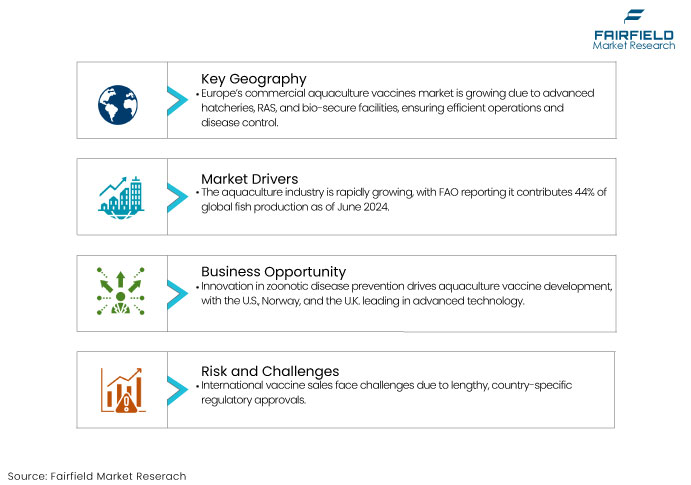
- In June 2024, The Food and Agriculture Organization (FAO) revealed that aquaculture accounts for 44% of the world's total fish production, making it one of the fastest-growing segments of agriculture.
- The FAO has projected the global aquaculture production to reach 185 Mn tonnes in 2023.
- The Global Aquaculture Alliance forecasts a 40% rise in aquaculture production by 2030 to meet seafood demand. This underscores the need for robust disease management solutions, fuelling the expansion of commercial aquaculture vaccine market.
- Rising Incidence of Aquatic Animal Diseases
- Stringent Regulations for Vaccine Approval
- A 2023 report by the Global Alliance for Vaccines in Aquaculture highlights that developing an aquaculture vaccine takes 8 to 12 years on average and costs over $30 million per vaccine.
- Developed Economies to Witness Advancements in Aquaculture Sectors
-
According to New Zealand Foreign Affairs & Trade, Norway’s aquaculture industry accounted for 73% of its seafood export value and 45% of total export volume in 2023. It benefits from advanced technologies like automated feeding systems and bio secure vaccine solutions.
- Rising Demand for Sustainable Aquaculture
- Effectiveness of Inactivated Vaccine to Foster Demand
- Prevention of Bacterial Diseases to Augment Demand
- Advanced Aquaculture Infrastructure in Europe to Propel Growth
- North America
- Per capita seafood consumption in the U.S. reached 19 pounds annually in 2023, with rising consumer preference for locally farmed and sustainably sourced fish.
- The U.S. aquaculture industry is predicted to reaching US$ 2.3 Bn by 2030.
- Merck & Co.
- Elanco Animal Health Incorporated
- Phibro Animal Health Corporation
- HIPRA
- Zoetis Animal Healthcare
- IDT Biologika
- Tecnovax S.A.
- AquaVet Health Inc/AQUAVET S.A.
- Nisseiken Co., Ltd.
- ICTYO, Virbac
- In January 2024, Moredun Research Institute received a funding of £1.5M from the Biotechnology and Biological Sciences Research Council (BBSRC) to develop an oral vaccine against salmon lice in farmed Atlantic salmon.
- In July 2024, Merck Animal Health, completed its acquisition of Elanco’s aqua business. This strengthens its position in aquaculture with solutions promoting fish health, welfare, and sustainability.
- In August 2024, Fischer Medical Ventures Ltd (Fischer MV) entered into a partnership with Bio Angle Vacs Sdn Bhd (BAV) to develop breakthrough vaccines for livestock and aquaculture into the Indian market.
- In October 2024, researchers at the University of Stirling received funding of £770,000 to aid the deployment of a new vaccine to tackle antimicrobial resistance (AMR) in Vietnamese catfish and bringing in significant advancements to the aquaculture industry.
- Experts highlight the continuous advancements in aquaculture vaccines, focusing on novel delivery systems and targeted formulations.
- Adherence to stringent regulatory standards remains a key factor influencing market dynamics.
- Collaboration with aquaculture farms and feed producers is essential for expansion.
- Growing demand for eco-friendly and sustainable aquaculture practices is shaping vaccine development.
- Attenuated
- Inactivated
- Subunit
- DNA
- Virus
- Bacteria
- Tilapia
- Salmon
- Trout
- Carp
- Sea Bass
- Bream
- Turbot
- Others
- Intramuscular
- Intraperitoneal
- Oral
- Immersion
- Fish Veterinary Clinics
- Fish Farming Companies
- Aquatic Research Institutes
- North America
- Europe
- Asia Pacific
- Latin America
- Middle East & Africa
A Look Back and a Look Forward - Comparative Analysis
The commercial aquaculture vaccines market growth was steady during the historical period owing to improvements in fish health care. Rising demand for sustainably produced seafood worldwide fostered demand.
As a preventive treatment against bacterial and viral infections in fish, the market moved away from standard antibiotics and toward vaccinations. Early vaccinations used injection and immersion as innovative methods of administration to combat common diseases like vibriosis and furunculosis.
Rising prevalence of aquaculture diseases, regulatory antibiotic restrictions, and consumer demand for safer seafood products fuelled growth. North America and Europe historically led the market owing to robust aquaculture practices and government support.
Expansion of aquaculture activities in China, India, and Vietnam, is likely o boost market expansion in Asia Pacific during the forecast period. Innovations in aquaculture vaccines is anticipated to open new growth opportunities.
Key Growth Determinants
The aquaculture industry is witnessing rapid global growth, driven by rising demand for fishery products.
As fish are a prominent source of nourishment for over a billion people in developing nations, expanding aquaculture is important to supply the food and nutritional needs of the population.
To accommodate the world's growing seafood demand while maintaining sustainability, fish vaccinations are becoming crucial. This is predicted to drive a large increase in the commercial aquaculture vaccination market.
Vaccination is a crucial strategy in the fight against zoonotic diseases that can infect humans, fish, and other species. It is also essential to protect aquaculture operations and public health.
Increasing prevalence of infectious diseases among aquatic species is a significant growth driver for the commercial aquaculture vaccines market. Diseases like bacterial septicemia, vibriosis, and viral infections can severely impact fish health, leading to mass mortality and substantial financial losses for aquaculture operations.
Expansion in global fish farming to meet rising seafood demand is likely to intensify the risk of disease outbreaks, prompting the need for effective disease prevention measures. Vaccines offer a reliable and sustainable solution by enhancing the immunity of aquatic animals without the overuse of antibiotics, contributing to antimicrobial resistance. The shift towards proactive disease management in aquaculture drives research and development efforts in innovative vaccine formulations for fish species.
Key Growth Barriers
Companies wanting to sell their vaccines internationally face considerable obstacles owing to lengthy regulatory approval procedures. Every nation has its own approval processes and regulatory bodies.
A few regulatory bodies maintain distinct clearance schedules, even though they adhere to rules established by significant regulatory agencies like the U.S. FDA. Vendors cannot release new or enhanced items until all required permits have been obtained due to this intricacy.
Lengthy timelines and substantial expenses discourage smaller companies from entering the market, stifling innovation while slowing the introduction of new and effective vaccines. Companies are required to wait for regulatory clearances before distributing their products
Fragmented nature of the approval process increases distribution costs, often compelling providers to delay launches until all approvals are obtained. Such challenges significantly impede growth of the commercial aquaculture vaccine market.
Commercial Aquaculture Vaccines Market Trends and Opportunities
Technological breakthroughs and a strong focus on innovation in the prevention and treatment of zoonotic illnesses is fostering the development of commercial aquaculture vaccines. Leading high-income nations, like the U.S., Norway, and the U.K., are using state-of-the-art technologies to aid in the creation of vaccines.
Advancements in synthetic, systems biology, and next-generation sequencing is accelerating the development of vaccines. Sustained funding for multidisciplinary vaccine research improves development effectiveness while shortening the time it takes for new vaccines to reach the market. These developments foster innovation while assisting the expansion and sustainability of the global aquaculture sector by encouraging workable and sustainable solutions to aquaculture illnesses.
With global seafood consumption projected to reach 196 million tons by 2025, there is a growing shift towards sustainable farming practices that decreases environmental impact while minimizing antibiotic use.
Rise of organic aquaculture further bolsters the demand for the vaccine. Growth in the sector is likely to create opportunities for vaccine developers to meet the rising need for high-quality and antibiotic-free fish.
Increased consumer awareness regarding sustainability and health, especially in areas with stringent regulatory norms is encouraging aquaculture farms to focus on disease control techniques. Aquaculture companies can improve product quality and satisfy consumer demand for safer, cleaner, and sustainably produced seafood by concentrating on fish health without using antibiotics. Compatibility with international sustainability objectives emphasize how important vaccinations are to determine aquaculture's future.
How is Regulatory Scenario Shaping this Industry?
Regulatory scenario is a key factor shaping the commercial aquaculture vaccines market, influencing its growth and adoption across regions. Governments and regulatory bodies are focusing on decreasing antibiotic use in aquaculture owing to rising concerns about antimicrobial resistance and environmental sustainability.
Regulations, like the European Union's ban on antibiotic growth promoters, have accelerated the shift toward preventive measures like vaccines to ensure food safety. Streamlined regulatory frameworks are also fostering innovation in vaccine development.
Governments authorities of several countries are simplifying approval processes for new vaccines, enabling faster commercialization of advanced solutions. Regulatory agencies in prominent aquaculture markets, including the U.S., Europe, and Asia-Pacific, collaborate with researchers and vaccine manufacturers to set efficacy and safety testing guidelines.
Public and private funding initiatives support vaccination programs while ensuring compliance with regulatory standards, thereby encouraging vaccine adoption. These evolving policies create a supportive growth environment while promoting sustainable aquaculture practices.
Segments Covered in the Report
Inactivated vaccine is predicted to exhibit a CAGR of 5% through 2032. Demonstrated safety and effectiveness of inactivated vaccine type augment their growth. These vaccinations provide dependable protection against common illnesses like vibriosis and furunculosis by using organisms that have been destroyed. They are routinely used because of their durability, low risk of infection, and compatibility with different fish species.
Long-lasting protection is guaranteed by improved immunogenicity owing to advancements in formulation processes. The segment's expansion is further supported by regulatory preferences for safe and efficient aquaculture disease management technologies. The category continues to be a crucial part of the global market as it successfully meets the demands of industry as well as consumers.
Bacteria is predicted to lead the pathogen category with a share of 70 % in 2025. This growth is attributed to the prevalence of bacterial diseases in aquaculture. Effective vaccinations are crucial as infectious bacteria like vibriosis and furunculosis pose serious risks to fish health and productivity.
Developments in vaccine formulations that target certain bacterial strains are enhancing the prevention and management of disease. Expanding emphasis on bacterial pathogens is supported by the aquaculture industry's growing requirement for disease management solutions, fostering dominance of the bacteria segment.
Regional Analysis
The commercial aquaculture vaccines market in Europe is witnessing significant expansion owing to the presence of modern hatcheries, recirculating aquaculture systems (RAS), and bio-secure facilities. The regions’ sophisticated infrastructure supports effective operations and robust disease control.
Europe’s capacity to address intricate aquaculture issues is further strengthened by the incorporation of cutting-edge technologies like next-generation sequencing (NGS), CRISPR-based genome editing, and creative vaccine delivery methods, like carriers based on nanotechnology.
Supportive government regulations are essential for encouraging the creation of immunoprophylactic drugs, lowering the need for antibiotics, and providing funds for studies that promote sustainable aquaculture methods. Growing demand for responsibly produced and antibiotic devoid seafood is in line with Europe's stringent regulations. This includes following EU guidelines for food safety and animal welfare.
Growing awareness of health benefits of seafood, like rich in omega-3 fatty acids, is driving demand in North America. Canada witnessed a 7% annual growth in seafood consumption, especially for aquaculture products like salmon and trout.
The region has a highly developed aquaculture sector, focusing on species like salmon, trout, tilapia, and shellfish. North America is home to some of the largest aquaculture operations, particularly in regions like British Columbia (Canada) and Maine (U.S.).
Fairfield’s Competitive Landscape Analysis
According to Fairfield’s analysis, there is fierce competition between regional and international companies in the commercial aquaculture vaccination market. Leading players are focusing on product innovation and geographic expansion, like Elanco Animal Health, HIPRA, and Merck & Co. (MSD Animal Health).
Businesses are investing in research and development to create vaccines to fight new aquatic illnesses while adhering to strict legal requirements. To increase their market presence, companies are collaborating with feed and aquaculture farms.
Regional players also play an important role as they address disease concerns while promoting competitiveness. Innovation is accelerated by the expanding use of sophisticated vaccine delivery systems, like injectable and oral vaccinations. Price sensitivity and the growing global demand for sustainable aquaculture methods influence market dynamics.
Key Market Companies
Recent Industry Developments
An Expert’s Eye
Global Commercial Aquaculture Vaccines Market is Segmented as-
By Vaccine Type
By Pathogen
By Species
By Route of Administration
By End User
By Region
- Executive Summary
- Global Commercial Aquaculture Vaccines Market Snapshot
- Future Projections
- Key Market Trends
- Regional Snapshot, by Value, 2026
- Analyst Recommendations
- Market Overview
- Market Definitions and Segmentations
- Market Dynamics
- Drivers
- Restraints
- Market Opportunities
- Value Chain Analysis
- COVID-19 Impact Analysis
- Porter's Five Forces Analysis
- Impact of Russia-Ukraine Conflict
- PESTLE Analysis
- Regulatory Analysis
- Price Trend Analysis
- Current Prices and Future Projections, 2025-2033
- Price Impact Factors
- Global Commercial Aquaculture Vaccines Market Outlook, 2020 - 2033
- Global Commercial Aquaculture Vaccines Market Outlook, by Vaccine Type, Value (US$ Mn), 2020-2033
- Attenuated
- Inactivated
- Subunit
- DNA
- Global Commercial Aquaculture Vaccines Market Outlook, by Pathogen, Value (US$ Mn), 2020-2033
- Virus
- Bacteria
- Global Commercial Aquaculture Vaccines Market Outlook, by Species, Value (US$ Mn), 2020-2033
- Tilapia
- Salmon
- Trout
- Carp
- Sea Bass
- Bream
- Turbot
- Others
- Global Commercial Aquaculture Vaccines Market Outlook, by Route of Administration, Value (US$ Mn), 2020-2033
- Intramuscular
- Intraperitoneal
- Oral
- Immersion
- Global Commercial Aquaculture Vaccines Market Outlook, by End User, Value (US$ Mn), 2020-2033
- Fish Veterinary Clinics
- Fish Farming Companies
- Aquatic Research Institutes
- Global Commercial Aquaculture Vaccines Market Outlook, by Region, Value (US$ Mn), 2020-2033
- North America
- Europe
- Asia Pacific
- Latin America
- Middle East & Africa
- Global Commercial Aquaculture Vaccines Market Outlook, by Vaccine Type, Value (US$ Mn), 2020-2033
- North America Commercial Aquaculture Vaccines Market Outlook, 2020 - 2033
- North America Commercial Aquaculture Vaccines Market Outlook, by Vaccine Type, Value (US$ Mn), 2020-2033
- Attenuated
- Inactivated
- Subunit
- DNA
- North America Commercial Aquaculture Vaccines Market Outlook, by Pathogen, Value (US$ Mn), 2020-2033
- Virus
- Bacteria
- North America Commercial Aquaculture Vaccines Market Outlook, by Species, Value (US$ Mn), 2020-2033
- Tilapia
- Salmon
- Trout
- Carp
- Sea Bass
- Bream
- Turbot
- Others
- North America Commercial Aquaculture Vaccines Market Outlook, by Route of Administration, Value (US$ Mn), 2020-2033
- Intramuscular
- Intraperitoneal
- Oral
- Immersion
- North America Commercial Aquaculture Vaccines Market Outlook, by End User, Value (US$ Mn), 2020-2033
- Fish Veterinary Clinics
- Fish Farming Companies
- Aquatic Research Institutes
- North America Commercial Aquaculture Vaccines Market Outlook, by Country, Value (US$ Mn), 2020-2033
- S. Commercial Aquaculture Vaccines Market Outlook, by Vaccine Type, 2020-2033
- S. Commercial Aquaculture Vaccines Market Outlook, by Pathogen, 2020-2033
- S. Commercial Aquaculture Vaccines Market Outlook, by Species, 2020-2033
- S. Commercial Aquaculture Vaccines Market Outlook, by Route of Administration, 2020-2033
- S. Commercial Aquaculture Vaccines Market Outlook, by End User, 2020-2033
- Canada Commercial Aquaculture Vaccines Market Outlook, by Vaccine Type, 2020-2033
- Canada Commercial Aquaculture Vaccines Market Outlook, by Pathogen, 2020-2033
- Canada Commercial Aquaculture Vaccines Market Outlook, by Species, 2020-2033
- Canada Commercial Aquaculture Vaccines Market Outlook, by Route of Administration, 2020-2033
- Canada Commercial Aquaculture Vaccines Market Outlook, by End User, 2020-2033
- BPS Analysis/Market Attractiveness Analysis
- North America Commercial Aquaculture Vaccines Market Outlook, by Vaccine Type, Value (US$ Mn), 2020-2033
- Europe Commercial Aquaculture Vaccines Market Outlook, 2020 - 2033
- Europe Commercial Aquaculture Vaccines Market Outlook, by Vaccine Type, Value (US$ Mn), 2020-2033
- Attenuated
- Inactivated
- Subunit
- DNA
- Europe Commercial Aquaculture Vaccines Market Outlook, by Pathogen, Value (US$ Mn), 2020-2033
- Virus
- Bacteria
- Europe Commercial Aquaculture Vaccines Market Outlook, by Species, Value (US$ Mn), 2020-2033
- Tilapia
- Salmon
- Trout
- Carp
- Sea Bass
- Bream
- Turbot
- Others
- Europe Commercial Aquaculture Vaccines Market Outlook, by Route of Administration, Value (US$ Mn), 2020-2033
- Intramuscular
- Intraperitoneal
- Oral
- Immersion
- Europe Commercial Aquaculture Vaccines Market Outlook, by End User, Value (US$ Mn), 2020-2033
- Fish Veterinary Clinics
- Fish Farming Companies
- Aquatic Research Institutes
- Europe Commercial Aquaculture Vaccines Market Outlook, by Country, Value (US$ Mn), 2020-2033
- Germany Commercial Aquaculture Vaccines Market Outlook, by Vaccine Type, 2020-2033
- Germany Commercial Aquaculture Vaccines Market Outlook, by Pathogen, 2020-2033
- Germany Commercial Aquaculture Vaccines Market Outlook, by Species, 2020-2033
- Germany Commercial Aquaculture Vaccines Market Outlook, by Route of Administration, 2020-2033
- Germany Commercial Aquaculture Vaccines Market Outlook, by End User, 2020-2033
- Italy Commercial Aquaculture Vaccines Market Outlook, by Vaccine Type, 2020-2033
- Italy Commercial Aquaculture Vaccines Market Outlook, by Pathogen, 2020-2033
- Italy Commercial Aquaculture Vaccines Market Outlook, by Species, 2020-2033
- Italy Commercial Aquaculture Vaccines Market Outlook, by Route of Administration, 2020-2033
- Italy Commercial Aquaculture Vaccines Market Outlook, by End User, 2020-2033
- France Commercial Aquaculture Vaccines Market Outlook, by Vaccine Type, 2020-2033
- France Commercial Aquaculture Vaccines Market Outlook, by Pathogen, 2020-2033
- France Commercial Aquaculture Vaccines Market Outlook, by Species, 2020-2033
- France Commercial Aquaculture Vaccines Market Outlook, by Route of Administration, 2020-2033
- France Commercial Aquaculture Vaccines Market Outlook, by End User, 2020-2033
- K. Commercial Aquaculture Vaccines Market Outlook, by Vaccine Type, 2020-2033
- K. Commercial Aquaculture Vaccines Market Outlook, by Pathogen, 2020-2033
- K. Commercial Aquaculture Vaccines Market Outlook, by Species, 2020-2033
- K. Commercial Aquaculture Vaccines Market Outlook, by Route of Administration, 2020-2033
- K. Commercial Aquaculture Vaccines Market Outlook, by End User, 2020-2033
- Spain Commercial Aquaculture Vaccines Market Outlook, by Vaccine Type, 2020-2033
- Spain Commercial Aquaculture Vaccines Market Outlook, by Pathogen, 2020-2033
- Spain Commercial Aquaculture Vaccines Market Outlook, by Species, 2020-2033
- Spain Commercial Aquaculture Vaccines Market Outlook, by Route of Administration, 2020-2033
- Spain Commercial Aquaculture Vaccines Market Outlook, by End User, 2020-2033
- Russia Commercial Aquaculture Vaccines Market Outlook, by Vaccine Type, 2020-2033
- Russia Commercial Aquaculture Vaccines Market Outlook, by Pathogen, 2020-2033
- Russia Commercial Aquaculture Vaccines Market Outlook, by Species, 2020-2033
- Russia Commercial Aquaculture Vaccines Market Outlook, by Route of Administration, 2020-2033
- Russia Commercial Aquaculture Vaccines Market Outlook, by End User, 2020-2033
- Rest of Europe Commercial Aquaculture Vaccines Market Outlook, by Vaccine Type, 2020-2033
- Rest of Europe Commercial Aquaculture Vaccines Market Outlook, by Pathogen, 2020-2033
- Rest of Europe Commercial Aquaculture Vaccines Market Outlook, by Species, 2020-2033
- Rest of Europe Commercial Aquaculture Vaccines Market Outlook, by Route of Administration, 2020-2033
- Rest of Europe Commercial Aquaculture Vaccines Market Outlook, by End User, 2020-2033
- BPS Analysis/Market Attractiveness Analysis
- Europe Commercial Aquaculture Vaccines Market Outlook, by Vaccine Type, Value (US$ Mn), 2020-2033
- Asia Pacific Commercial Aquaculture Vaccines Market Outlook, 2020 - 2033
- Asia Pacific Commercial Aquaculture Vaccines Market Outlook, by Vaccine Type, Value (US$ Mn), 2020-2033
- Attenuated
- Inactivated
- Subunit
- DNA
- Asia Pacific Commercial Aquaculture Vaccines Market Outlook, by Pathogen, Value (US$ Mn), 2020-2033
- Virus
- Bacteria
- Asia Pacific Commercial Aquaculture Vaccines Market Outlook, by Species, Value (US$ Mn), 2020-2033
- Tilapia
- Salmon
- Trout
- Carp
- Sea Bass
- Bream
- Turbot
- Others
- Asia Pacific Commercial Aquaculture Vaccines Market Outlook, by Route of Administration, Value (US$ Mn), 2020-2033
- Intramuscular
- Intraperitoneal
- Oral
- Immersion
- Asia Pacific Commercial Aquaculture Vaccines Market Outlook, by End User, Value (US$ Mn), 2020-2033
- Fish Veterinary Clinics
- Fish Farming Companies
- Aquatic Research Institutes
- Asia Pacific Commercial Aquaculture Vaccines Market Outlook, by Country, Value (US$ Mn), 2020-2033
- China Commercial Aquaculture Vaccines Market Outlook, by Vaccine Type, 2020-2033
- China Commercial Aquaculture Vaccines Market Outlook, by Pathogen, 2020-2033
- China Commercial Aquaculture Vaccines Market Outlook, by Species, 2020-2033
- China Commercial Aquaculture Vaccines Market Outlook, by Route of Administration, 2020-2033
- China Commercial Aquaculture Vaccines Market Outlook, by End User, 2020-2033
- Japan Commercial Aquaculture Vaccines Market Outlook, by Vaccine Type, 2020-2033
- Japan Commercial Aquaculture Vaccines Market Outlook, by Pathogen, 2020-2033
- Japan Commercial Aquaculture Vaccines Market Outlook, by Species, 2020-2033
- Japan Commercial Aquaculture Vaccines Market Outlook, by Route of Administration, 2020-2033
- Japan Commercial Aquaculture Vaccines Market Outlook, by End User, 2020-2033
- South Korea Commercial Aquaculture Vaccines Market Outlook, by Vaccine Type, 2020-2033
- South Korea Commercial Aquaculture Vaccines Market Outlook, by Pathogen, 2020-2033
- South Korea Commercial Aquaculture Vaccines Market Outlook, by Species, 2020-2033
- South Korea Commercial Aquaculture Vaccines Market Outlook, by Route of Administration, 2020-2033
- South Korea Commercial Aquaculture Vaccines Market Outlook, by End User, 2020-2033
- India Commercial Aquaculture Vaccines Market Outlook, by Vaccine Type, 2020-2033
- India Commercial Aquaculture Vaccines Market Outlook, by Pathogen, 2020-2033
- India Commercial Aquaculture Vaccines Market Outlook, by Species, 2020-2033
- India Commercial Aquaculture Vaccines Market Outlook, by Route of Administration, 2020-2033
- India Commercial Aquaculture Vaccines Market Outlook, by End User, 2020-2033
- Southeast Asia Commercial Aquaculture Vaccines Market Outlook, by Vaccine Type, 2020-2033
- Southeast Asia Commercial Aquaculture Vaccines Market Outlook, by Pathogen, 2020-2033
- Southeast Asia Commercial Aquaculture Vaccines Market Outlook, by Species, 2020-2033
- Southeast Asia Commercial Aquaculture Vaccines Market Outlook, by Route of Administration, 2020-2033
- Southeast Asia Commercial Aquaculture Vaccines Market Outlook, by End User, 2020-2033
- Rest of SAO Commercial Aquaculture Vaccines Market Outlook, by Vaccine Type, 2020-2033
- Rest of SAO Commercial Aquaculture Vaccines Market Outlook, by Pathogen, 2020-2033
- Rest of SAO Commercial Aquaculture Vaccines Market Outlook, by Species, 2020-2033
- Rest of SAO Commercial Aquaculture Vaccines Market Outlook, by Route of Administration, 2020-2033
- Rest of SAO Commercial Aquaculture Vaccines Market Outlook, by End User, 2020-2033
- BPS Analysis/Market Attractiveness Analysis
- Asia Pacific Commercial Aquaculture Vaccines Market Outlook, by Vaccine Type, Value (US$ Mn), 2020-2033
- Latin America Commercial Aquaculture Vaccines Market Outlook, 2020 - 2033
- Latin America Commercial Aquaculture Vaccines Market Outlook, by Vaccine Type, Value (US$ Mn), 2020-2033
- Attenuated
- Inactivated
- Subunit
- DNA
- Latin America Commercial Aquaculture Vaccines Market Outlook, by Pathogen, Value (US$ Mn), 2020-2033
- Virus
- Bacteria
- Latin America Commercial Aquaculture Vaccines Market Outlook, by Species, Value (US$ Mn), 2020-2033
- Tilapia
- Salmon
- Trout
- Carp
- Sea Bass
- Bream
- Turbot
- Others
- Latin America Commercial Aquaculture Vaccines Market Outlook, by Route of Administration, Value (US$ Mn), 2020-2033
- Intramuscular
- Intraperitoneal
- Oral
- Immersion
- Latin America Commercial Aquaculture Vaccines Market Outlook, by End User, Value (US$ Mn), 2020-2033
- Fish Veterinary Clinics
- Fish Farming Companies
- Aquatic Research Institutes
- Latin America Commercial Aquaculture Vaccines Market Outlook, by Country, Value (US$ Mn), 2020-2033
- Brazil Commercial Aquaculture Vaccines Market Outlook, by Vaccine Type, 2020-2033
- Brazil Commercial Aquaculture Vaccines Market Outlook, by Pathogen, 2020-2033
- Brazil Commercial Aquaculture Vaccines Market Outlook, by Species, 2020-2033
- Brazil Commercial Aquaculture Vaccines Market Outlook, by Route of Administration, 2020-2033
- Brazil Commercial Aquaculture Vaccines Market Outlook, by End User, 2020-2033
- Mexico Commercial Aquaculture Vaccines Market Outlook, by Vaccine Type, 2020-2033
- Mexico Commercial Aquaculture Vaccines Market Outlook, by Pathogen, 2020-2033
- Mexico Commercial Aquaculture Vaccines Market Outlook, by Species, 2020-2033
- Mexico Commercial Aquaculture Vaccines Market Outlook, by Route of Administration, 2020-2033
- Mexico Commercial Aquaculture Vaccines Market Outlook, by End User, 2020-2033
- Argentina Commercial Aquaculture Vaccines Market Outlook, by Vaccine Type, 2020-2033
- Argentina Commercial Aquaculture Vaccines Market Outlook, by Pathogen, 2020-2033
- Argentina Commercial Aquaculture Vaccines Market Outlook, by Species, 2020-2033
- Argentina Commercial Aquaculture Vaccines Market Outlook, by Route of Administration, 2020-2033
- Argentina Commercial Aquaculture Vaccines Market Outlook, by End User, 2020-2033
- Rest of LATAM Commercial Aquaculture Vaccines Market Outlook, by Vaccine Type, 2020-2033
- Rest of LATAM Commercial Aquaculture Vaccines Market Outlook, by Pathogen, 2020-2033
- Rest of LATAM Commercial Aquaculture Vaccines Market Outlook, by Species, 2020-2033
- Rest of LATAM Commercial Aquaculture Vaccines Market Outlook, by Route of Administration, 2020-2033
- Rest of LATAM Commercial Aquaculture Vaccines Market Outlook, by End User, 2020-2033
- BPS Analysis/Market Attractiveness Analysis
- Latin America Commercial Aquaculture Vaccines Market Outlook, by Vaccine Type, Value (US$ Mn), 2020-2033
- Middle East & Africa Commercial Aquaculture Vaccines Market Outlook, 2020 - 2033
- Middle East & Africa Commercial Aquaculture Vaccines Market Outlook, by Vaccine Type, Value (US$ Mn), 2020-2033
- Attenuated
- Inactivated
- Subunit
- DNA
- Middle East & Africa Commercial Aquaculture Vaccines Market Outlook, by Pathogen, Value (US$ Mn), 2020-2033
- Virus
- Bacteria
- Middle East & Africa Commercial Aquaculture Vaccines Market Outlook, by Species, Value (US$ Mn), 2020-2033
- Tilapia
- Salmon
- Trout
- Carp
- Sea Bass
- Bream
- Turbot
- Others
- Middle East & Africa Commercial Aquaculture Vaccines Market Outlook, by Route of Administration, Value (US$ Mn), 2020-2033
- Intramuscular
- Intraperitoneal
- Oral
- Immersion
- Middle East & Africa Commercial Aquaculture Vaccines Market Outlook, by End User, Value (US$ Mn), 2020-2033
- Fish Veterinary Clinics
- Fish Farming Companies
- Aquatic Research Institutes
- Middle East & Africa Commercial Aquaculture Vaccines Market Outlook, by Country, Value (US$ Mn), 2020-2033
- GCC Commercial Aquaculture Vaccines Market Outlook, by Vaccine Type, 2020-2033
- GCC Commercial Aquaculture Vaccines Market Outlook, by Pathogen, 2020-2033
- GCC Commercial Aquaculture Vaccines Market Outlook, by Species, 2020-2033
- GCC Commercial Aquaculture Vaccines Market Outlook, by Route of Administration, 2020-2033
- GCC Commercial Aquaculture Vaccines Market Outlook, by End User, 2020-2033
- South Africa Commercial Aquaculture Vaccines Market Outlook, by Vaccine Type, 2020-2033
- South Africa Commercial Aquaculture Vaccines Market Outlook, by Pathogen, 2020-2033
- South Africa Commercial Aquaculture Vaccines Market Outlook, by Species, 2020-2033
- South Africa Commercial Aquaculture Vaccines Market Outlook, by Route of Administration, 2020-2033
- South Africa Commercial Aquaculture Vaccines Market Outlook, by End User, 2020-2033
- Egypt Commercial Aquaculture Vaccines Market Outlook, by Vaccine Type, 2020-2033
- Egypt Commercial Aquaculture Vaccines Market Outlook, by Pathogen, 2020-2033
- Egypt Commercial Aquaculture Vaccines Market Outlook, by Species, 2020-2033
- Egypt Commercial Aquaculture Vaccines Market Outlook, by Route of Administration, 2020-2033
- Egypt Commercial Aquaculture Vaccines Market Outlook, by End User, 2020-2033
- Nigeria Commercial Aquaculture Vaccines Market Outlook, by Vaccine Type, 2020-2033
- Nigeria Commercial Aquaculture Vaccines Market Outlook, by Pathogen, 2020-2033
- Nigeria Commercial Aquaculture Vaccines Market Outlook, by Species, 2020-2033
- Nigeria Commercial Aquaculture Vaccines Market Outlook, by Route of Administration, 2020-2033
- Nigeria Commercial Aquaculture Vaccines Market Outlook, by End User, 2020-2033
- Rest of Middle East Commercial Aquaculture Vaccines Market Outlook, by Vaccine Type, 2020-2033
- Rest of Middle East Commercial Aquaculture Vaccines Market Outlook, by Pathogen, 2020-2033
- Rest of Middle East Commercial Aquaculture Vaccines Market Outlook, by Species, 2020-2033
- Rest of Middle East Commercial Aquaculture Vaccines Market Outlook, by Route of Administration, 2020-2033
- Rest of Middle East Commercial Aquaculture Vaccines Market Outlook, by End User, 2020-2033
- BPS Analysis/Market Attractiveness Analysis
- Middle East & Africa Commercial Aquaculture Vaccines Market Outlook, by Vaccine Type, Value (US$ Mn), 2020-2033
- Competitive Landscape
- Company Vs Segment Heatmap
- Company Market Share Analysis, 2025
- Competitive Dashboard
- Company Profiles
- Merck & Co.
- Company Overview
- Product Portfolio
- Financial Overview
- Business Strategies and Developments
- Elanco Animal Health Incorporated
- Phibro Animal Health Corporation
- HIPRA
- Zoetis Animal Healthcare
- IDT Biologika
- Tecnovax S.A.
- AquaVet Health Inc/AQUAVET S.A.
- Nisseiken Co., Ltd.
- ICTYO, Virbac
- Merck & Co.
- Appendix
- Research Methodology
- Report Assumptions
- Acronyms and Abbreviations
|
BASE YEAR |
HISTORICAL DATA |
FORECAST PERIOD |
UNITS |
|||
 |
2025 |
 |
2019 - 2024 |
 |
2026 - 2033 |
Value: US$ Billion |
|
REPORT FEATURES |
DETAILS |
|
Vaccine Type |
|
|
Pathogen |
|
|
Species |
|
|
Route of Administration |
|
|
End User |
|
|
Geographical Coverage |
|
|
Leading Companies |
|
|
Report Highlights |
Key Market Indicators, Macro-micro economic impact analysis, Technological Roadmap, Key Trends, Driver, Restraints, and Future Opportunities & Revenue Pockets, Porter’s 5 Forces Analysis, Historical Trend (2019-2023), Market Estimates and Forecast, Market Dynamics, Industry Trends, Competition Landscape, Category, Region, Country-wise Trends & Analysis, COVID-19 Impact Analysis (Demand and Supply Chain) |
Our Research Methodology
Considering the volatility of business today, traditional approaches to strategizing a game plan can be unfruitful if not detrimental. True ambiguity is no way to determine a forecast. A myriad of predetermined factors must be accounted for such as the degree of risk involved, the magnitude of circumstances, as well as conditions or consequences that are not known or unpredictable. To circumvent binary views that cast uncertainty, the application of market research intelligence to strategically posture, move, and enable actionable outcomes is necessary.
View Methodology
Quality Assured
Rigorous Validation Process

Confidentiality Assured
End-to-end Data Security

Custom Research Services
Tailored To Your Objectives
FAQs
The Commercial Aquaculture Vaccines market size is USD 457.4 Bn in 2026.
The Commercial Aquaculture Vaccines market is projected to grow at a CAGR of 5% by 2033.
The market growth drivers include rising aquaculture production, increasing aquatic animal diseases, and growing demand for sustainable seafood.
Europe is a dominating region for the Commercial Aquaculture Vaccines market.
Merck & Co., Elanco Animal Health Incorporated, HIPRA, Zoetis Animal Healthcare, and Phibro Animal Health Corporation are some leading industry players in the Commercial Aquaculture Vaccines market.
Related Reports
Cold and Flu Supplements Market Size, Share, Insights, Competitive Landscape, and Forecast 2026 to 2033
The global cold and flu supplements market is valued at US$24.65 billion in 2026, reaching US$54.60 billion by 2033, growing at a 12.0% CAGR
Cell Isolation Market Size, Share, Insights, Competitive Landscape, and Forecast 2026 to 2033
The global cell isolation market is valued at US$4.39 billion in 2026, reaching US$10.14 billion by 2033, growing at a 12.7% CAGR
Cell & Gene Therapy Bioanalytical Testing Services Market Size, Share, Insights, Competitive Landscape, and Forecast 2026 to 2033
The cell & gene therapy bioanalytical testing services market is valued at US$0.633 billion in 2026, reaching US$1.041 billion by 2033, at 7.4% CAGR
AI in Pharmaceutical Market Size, Share, Insights, Competitive Landscape, and Forecast 2026 to 2033
The global AI in pharmaceutical market is valued at US$1.94 billion in 2026, reaching US$13.93 billion by 2033, growing at a 32.5% CAGR
Agentic AI in Pharmaceuticals Market Size, Share, Insights, Competitive Landscape, and Forecast 2026 to 2033
The global agentic AI in pharmaceuticals market is valued at US$1.3 billion in 2026, reaching US$13.0 billion by 2033, growing at a 38.95% CAGR
Sterile Injectable Contract Manufacturing Market Size, Share, Insights, Competitive Landscape, and Forecast 2026 to 2033
The sterile injectable contract manufacturing market will grow from US$16.89 billion in 2026 to US$36.37 billion by 2033, at an 11.6% CAGR.