



Companion Animal Diagnostics Market
Companion Animal Diagnostics Market Insights, Competitive Landscape, and Market Forecast - 2033
The Companion Animal Diagnostics Market is valued at USD 3.7 Bn in 2026 and is projected to reach USD 6.7 Bn, growing at a CAGR of 9% by 2033.
Companion Animal Diagnostics Market Insights
A Look Back and a Look Forward - Comparative Analysis
The companion animal diagnostics market growth during the historical period was attributed to the increasing adoption of pets, especially in developed regions like North America and Europe. Rising disposable incomes and a growing awareness of animal health fueled the demand for advanced diagnostic tools during the period.
Technologies like point-of-care (POC) testing, real-time PCR, and immunoassays have gained traction for their accuracy and efficiency in diagnosing diseases. The COVID-19 pandemic highlighted the importance of zoonotic disease management, further boosting growth. High diagnostic procedure costs and limited infrastructure in emerging regions posed challenges during this period.
Technological advancements like AI-powered diagnostic tools and portable devices for POC testing are anticipated to drive growth during the forecast period. Increasing prevalence of chronic conditions in companion animals, such as diabetes and cancer, are further predicted to drive the demand for animal diagnostics.
Regulatory support for animal welfare along with the rising adoption of preventive healthcare practices is likely to strengthen growth. Focus on sustainability and eco-friendly diagnostic tools is projected to shape the future of the industry, as companies innovate to align with the global environmental goals.
Key Growth Determinants
- Rising Pet Ownership and Humanisation of Pets
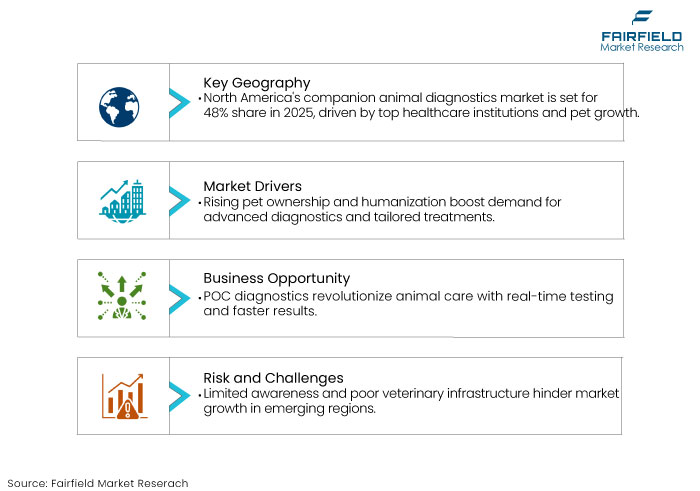
Worldwide increase in pet ownership and the escalating tendency of pet humanization have augmented the demand for companion animal diagnostics. Pets are now considered family members, thereby increasing costs linked to their care, particularly in healthcare. This emphasizes the development of precise diagnostics and tailored treatment programs for pets.
According to the American Pet Products Association (APPA), 67% of U.S. households, with around 85 million families owned a pet as of 2021. This surge in pet ownership drives the demand for veterinary care and diagnostics.
In developed regions like North America and Europe, pet owners emphasize preventive care, choosing routine health assessments and early diagnosis to safeguard their pets' health. Emerging regions such as Asia Pacific are witnessing accelerated adoption of dogs as companions owing to the evolving societal norms, increasing disposable incomes, and urbanization.
These factors play a crucial role in generating a rapidly expanding market for sophisticated diagnostic instruments, including blood assays, imaging modalities, and genetic analyses. Awareness campaigns by veterinary organizations and governments regarding disease prevention further amplify the importance of diagnostics.
- Increasing Incidence of Zoonotic Diseases and Chronic Illnesses
Rising incidence of zoonotic infections, including rabies, leptospirosis, and Lyme disease, underscores the essential function of diagnostics in companion animal healthcare. Such diseases provide considerable public health hazards, highlighting the need for precise and timely detection to avert transmission from animals to humans.
- The World Health Organization (WHO) reported that 60% of emerging infectious diseases in humans are zoonotic, with many originating from companion animals.
PCR-based tests and immunoassays are essential to identify and manage zoonotic infections. Chronic ailments like diabetes, arthritis, and cancer are increasingly prevalent in dogs, owing to their extended lifespans and altered diets.
Government actions and legislation aimed at zoonotic disease prevention and awareness campaigns are enhancing the adoption of veterinary diagnostics. Simultaneous emphasis on mitigating public health threats and addressing chronic diseases guarantees a continuous need for diagnostic solutions, establishing it as a pivotal catalyst for market expansion.
- Lyme disease has seen a significant rise, with 300,000 new cases reported annually in the U.S., often linked to pets carrying ticks.
Key Growth Barriers
- Limited Awareness and Veterinary Infrastructure in Developing Markets
In numerous emerging regions, the companion animal diagnostics market encounters obstacles from insufficient awareness of modern diagnostic alternatives and inadequate veterinary infrastructure.
Pet owners in remote or underdeveloped regions frequently depend on fundamental veterinarian services and may not emphasize routine pet health assessments. Lack of specialist veterinary clinics with advanced diagnostic equipment intensifies the problem.
Governments and commercial entities are making an effort to enhance access to veterinary care in such areas. Absence of developed infrastructure and awareness constrains the market's penetration and acceptance of advanced diagnostics, presenting a considerable impediment to the industry's growth.
Companion Animal Diagnostics Market Trends and Opportunities
- Rising Adoption of Point-of-Care (POC) Diagnostics in Veterinary Practices
Growing adoption of point-of-care (POC) diagnostics is emerging as a transformative trend in the companion animal diagnostics market. POC technologies enable real-time testing and rapid results, enhancing the efficiency of veterinary practices.
- According to a survey by VetFolio, 55% of veterinarians reported using POC diagnostic tools regularly in their practices, with portable blood analyzers and handheld imaging devices being the most commonly adopted.
Products like portable blood analysers, handheld imaging devices, and in-clinic rapid test kits are gaining popularity owing to their convenience and reliability. The shift toward POC diagnostics is driven by technological advancements, including microfluidics, biosensors, and integrated data management systems, making these devices more accurate and user-friendly.
POC tools also decrease the dependency on external laboratories, enabling veterinarians to offer comprehensive care under one roof. This trend is particularly impactful in regions having limited access to centralized labs, like rural or remote areas, as it bridges the gap in diagnostic capabilities.
Rising demand for preventive care has amplified the adoption of POC diagnostics for regular health monitoring. This trend is predicted to redefine the way veterinary diagnostics are delivered, enhancing speed and quality of care.
- Augmentation of Preventive Care Initiatives Creates Growth Opportunities
Preventive treatment is swiftly becoming profitable in the companion animal diagnostics market. As pets are perceived as family members, owners are anticipated to spend on their routine health examinations for the early identification of any health concerns.
- According to the American Pet Products Association (APPA), 55% of pet owners in the U.S. now prioritize preventive care for their pets, contributing to a steady increase in expenditure.
Preventive diagnostics, including routine blood tests, fecal examinations, and wellness panels, are experiencing increased demand. This is because they facilitate the early identification of illnesses like diabetes, heart disease, and parasitic infections before they escalate.
- The U.S. pet industry was projected to spend US$ 32.6 billion on pet healthcare in 2024, with a significant portion dedicated to routine diagnostics and wellness check-ups.
Emerging economies in the Asia-Pacific and Latin America are positioned for growth in pet care expenditure owing to the rising disposable incomes and urbanization. Innovations in diagnostic technology, including artificial intelligence (AI) and telemedicine integration, are likely to enhance the accessibility and efficiency of preventive diagnostics.
AI-driven solutions can forecast health hazards utilizing diagnostic data, whereas telemedicine platforms enable veterinarians to evaluate and oversee dogs remotely. The augmentation of preventative care programs improves pet health outcomes while creating new business opportunities for diagnostic manufacturers and veterinary clinics.
How is Regulatory Scenario Shaping this Industry?
The regulatory landscape plays a critical role in shaping the market, driving innovation, product development, and adoption while ensuring safety and efficacy. Regulatory bodies like the U.S. FDA and the European Medicines Agency (EMA) enforce strict guidelines for diagnostic products, ensuring they meet safety and accuracy standards. This drives companies to invest in advanced technologies and high-quality solutions to comply with these regulations.
- Organizations like the World Organisation for Animal Health (OIE) promote uniform diagnostic protocols, fostering growth by encouraging global trade and standardization.
Government authorities across the globe have introduced policies emphasizing animal health and welfare, like mandatory vaccination programs and disease surveillance initiatives. This further creates a demand for diagnostic tools.
- For instance, the EU Animal Health Law supports regular health checks and diagnostics for pets to control zoonotic diseases.
Segment Covered in the Report
- Increasing Incidence of Zoonotic Illnesses to drive Growth in Clinical Biochemistry
Pet owners have acknowledged the advantages of clinical biochemistry in diagnosing and monitoring diverse health issues in companion animals. These examinations yield information regarding organ functionality, metabolic conditions, and disease.
Availability of several commercial reagents and consumables for clinical biochemistry has enhanced its significance. The precision of these analysers has motivated pet owners and doctors to use them swiftly and effectively.
The urinalysis diagnosis further enables veterinarians to swiftly evaluate renal function, identify urinary tract infections, and oversee general health. Advancements in urinalysis apparatus, like automated analysers and dipstick tests, streamline the procedure and facilitate prompt diagnosis.
- As Individuals Embrace Dogs as Family Members, they are Prioritizing their Healthcare
Dogs are anticipated to constitute 45% of share in the animal type segment. Researching common dog disorders, including heart disease, cancer, diabetes, and infectious conditions, has enhanced diagnostic methods for early identification and improved treatment strategies.
Increased utilization of dog diagnostic services, encompassing normal health assessments and costly examinations for breed-specific ailments expand prospects for this application. A large number of individuals are embracing dogs as family members and therefore prioritizing their health care.
Individuals are also motivated to explore health improvements through veterinary diagnostics. Enhanced comprehension of dog health along with the rising demand for niche-specific diagnostic solutions significantly contribute to dogs becoming the largest animal type.
Regional Analysis
- Prevalence of Chronic Diseases Among the Pet Population of North America to Augment Growth
The companion animal diagnostics market in North America is anticipated to account for a share of 48% in 2025. Growth in the region is anticipated to be driven by the existence of prominent animal healthcare institutions and the rising population of companion animals.
Animal diagnostics companies are aiming to introduce technologically advanced medical equipment in the region to address the increasing need for animal disease diagnostic tools and therapies. The U.S. companion animal diagnostics sector commands a significant market share of 85% in North America. This growth is attributed to the increasing prevalence of chronic diseases, including diabetes, cancer, and skin problems among the pet population in the country.
The market has shown a rise in in-house testing practices with the commercial availability of diagnostic and therapeutic items. Increasing disposable incomes have prompted pet owners to allocate resources towards pet healthcare, elevating the need for veterinary clinics, pharmaceuticals, and therapies in the region.
- Pet Owners in Asia Pacific are Recognizing the Necessity of Proactive Health Management
The Asia Pacific companion animal diagnostics market is projected to exhibit a CAGR of 7.5% through the forecast period. Growth in the region is primarily driven by rapid urbanization and rising pet ownership rates.
As people relocate to metropolitan areas, veterinary clinics and diagnostic services are becoming more accessible, thereby facilitating a convenient healthcare-seeking experience for pet owners. Urban migration underscores the significance of pet health, as pet owners increasingly recognize the necessity of proactive health management and diagnostic opportunities.
Diagnostic testing is anticipated to witness a surge in utilization as individuals become more educated about the timing and methods for early disease detection. Pet owners are estimated to continue to spend on resources, especially in growing markets like China and India, to being enhancements in veterinarian services.
Fairfield’s Competitive Landscape Analysis
The companion animal diagnostics market is highly competitive. Global and regional players are focused on innovation and are working on expanding their reach. Leading companies in the industry include IDEXX Laboratories, Zoetis Inc., Heska Corporation, Thermo Fisher Scientific, and Virbac. These businesses dominate the market through extensive product portfolios, advanced diagnostic solutions, and strong distribution networks.
Emerging players are emphasizing on cost-effective solutions while targeting underpenetrated markets, particularly in Asia Pacific and Latin America. Technological advancements, like AI-driven diagnostic tools and real-time PCR, further intensify competition. Rising demand for personalized diagnostics and preventive care is prompting companies to invest in innovation and regional expansion.
Key Market Companies
- IDEXX Laboratories, Inc.
- Zoetis Inc.
- Heska Corporation
- Thermo Fisher Scientific Inc.
- Virbac
- Bayer Animal Health
- Neogen Corporation
- Fujifilm Holdings Corporation
- Indical Bioscience GmbH
- Idvet
- Randax Laboratories
- Bionote Inc.
- Skyla Coproration
- Urit Medical Electronic Co., Ltd.
- Nova Biomedical
- Swissavans AG
- Alvedia
- Megacor Veterinary Diagnostics
- Biopanda Reagents Ltd.
- Anipoc Ltd.
- Ring Biotechnology Co Ltd.
An Expert’s Eye
- Innovations in diagnostic tools are transforming the market by making diagnostics faster, accessible, and accurate.
- Experts note that pet owners are now more proactive about routine check-ups and early disease detection, thereby boosting the demand for diagnostic services.
- Rising disposable incomes in Asia Pacific and Latin America are anticipated to make these regions key markets, with increasing pet ownership and demand for diagnostic services.
- Veterinary clinics are predicted to remain the primary adopters of diagnostic technologies, with rising investments in new diagnostic equipment and technologies essential for maintaining competitive advantage.
Global Companion Animal Diagnostics Market is Segmented as-
By Product Type
- Consumables
- Instruments
By Technology
- Clinical Biochemistry
- Immunodiagnostics
- Hematology
- Molecular Diagnostics
- Urinalysis
- Others
By Application
- Bacteriology
- Clinical Pathology
- Virology
- Parasitology
- Others
By Animal Type
- Dogs
- Cats
- Others
By Region
- North America
- Europe
- Asia Pacific
- Latin America
- Middle East & Africa
- Executive Summary
- Global Companion Animal Diagnostics Market Snapshot
- Future Projections
- Key Market Trends
- Regional Snapshot, by Value, 2026
- Analyst Recommendations
- Market Overview
- Market Definitions and Segmentations
- Market Dynamics
- Drivers
- Restraints
- Market Opportunities
- Value Chain Analysis
- COVID-19 Impact Analysis
- Porter's Five Forces Analysis
- Impact of Russia-Ukraine Conflict
- PESTLE Analysis
- Regulatory Analysis
- Price Trend Analysis
- Current Prices and Future Projections, 2025-2033
- Price Impact Factors
- Global Companion Animal Diagnostics Market Outlook, 2020 - 2033
- Global Companion Animal Diagnostics Market Outlook, by Product Type, Value (US$ Mn), 2020-2033
- Consumables
- Instruments
- Global Companion Animal Diagnostics Market Outlook, by Technology, Value (US$ Mn), 2020-2033
- Clinical Biochemistry
- Immunodiagnostics
- Hematology
- Molecular Diagnostics
- Urinalysis
- Others
- Global Companion Animal Diagnostics Market Outlook, by Application, Value (US$ Mn), 2020-2033
- Bacteriology
- Clinical Pathology
- Virology
- Parasitology
- Others
- Global Companion Animal Diagnostics Market Outlook, by Animal Type, Value (US$ Mn), 2020-2033
- Dogs
- Cats
- Others
- Global Companion Animal Diagnostics Market Outlook, by Region, Value (US$ Mn), 2020-2033
- North America
- Europe
- Asia Pacific
- Latin America
- Middle East & Africa
- Global Companion Animal Diagnostics Market Outlook, by Product Type, Value (US$ Mn), 2020-2033
- North America Companion Animal Diagnostics Market Outlook, 2020 - 2033
- North America Companion Animal Diagnostics Market Outlook, by Product Type, Value (US$ Mn), 2020-2033
- Consumables
- Instruments
- North America Companion Animal Diagnostics Market Outlook, by Technology, Value (US$ Mn), 2020-2033
- Clinical Biochemistry
- Immunodiagnostics
- Hematology
- Molecular Diagnostics
- Urinalysis
- Others
- North America Companion Animal Diagnostics Market Outlook, by Application, Value (US$ Mn), 2020-2033
- Bacteriology
- Clinical Pathology
- Virology
- Parasitology
- Others
- North America Companion Animal Diagnostics Market Outlook, by Animal Type, Value (US$ Mn), 2020-2033
- Dogs
- Cats
- Others
- North America Companion Animal Diagnostics Market Outlook, by Country, Value (US$ Mn), 2020-2033
- U.S. Companion Animal Diagnostics Market Outlook, by Product Type, 2020-2033
- U.S. Companion Animal Diagnostics Market Outlook, by Technology, 2020-2033
- U.S. Companion Animal Diagnostics Market Outlook, by Application, 2020-2033
- U.S. Companion Animal Diagnostics Market Outlook, by Animal Type, 2020-2033
- Canada Companion Animal Diagnostics Market Outlook, by Product Type, 2020-2033
- Canada Companion Animal Diagnostics Market Outlook, by Technology, 2020-2033
- Canada Companion Animal Diagnostics Market Outlook, by Application, 2020-2033
- Canada Companion Animal Diagnostics Market Outlook, by Animal Type, 2020-2033
- BPS Analysis/Market Attractiveness Analysis
- North America Companion Animal Diagnostics Market Outlook, by Product Type, Value (US$ Mn), 2020-2033
- Europe Companion Animal Diagnostics Market Outlook, 2020 - 2033
- Europe Companion Animal Diagnostics Market Outlook, by Product Type, Value (US$ Mn), 2020-2033
- Consumables
- Instruments
- Europe Companion Animal Diagnostics Market Outlook, by Technology, Value (US$ Mn), 2020-2033
- Clinical Biochemistry
- Immunodiagnostics
- Hematology
- Molecular Diagnostics
- Urinalysis
- Others
- Europe Companion Animal Diagnostics Market Outlook, by Application, Value (US$ Mn), 2020-2033
- Bacteriology
- Clinical Pathology
- Virology
- Parasitology
- Others
- Europe Companion Animal Diagnostics Market Outlook, by Animal Type, Value (US$ Mn), 2020-2033
- Dogs
- Cats
- Others
- Europe Companion Animal Diagnostics Market Outlook, by Country, Value (US$ Mn), 2020-2033
- Germany Companion Animal Diagnostics Market Outlook, by Product Type, 2020-2033
- Germany Companion Animal Diagnostics Market Outlook, by Technology, 2020-2033
- Germany Companion Animal Diagnostics Market Outlook, by Application, 2020-2033
- Germany Companion Animal Diagnostics Market Outlook, by Animal Type, 2020-2033
- Italy Companion Animal Diagnostics Market Outlook, by Product Type, 2020-2033
- Italy Companion Animal Diagnostics Market Outlook, by Technology, 2020-2033
- Italy Companion Animal Diagnostics Market Outlook, by Application, 2020-2033
- Italy Companion Animal Diagnostics Market Outlook, by Animal Type, 2020-2033
- France Companion Animal Diagnostics Market Outlook, by Product Type, 2020-2033
- France Companion Animal Diagnostics Market Outlook, by Technology, 2020-2033
- France Companion Animal Diagnostics Market Outlook, by Application, 2020-2033
- France Companion Animal Diagnostics Market Outlook, by Animal Type, 2020-2033
- U.K. Companion Animal Diagnostics Market Outlook, by Product Type, 2020-2033
- U.K. Companion Animal Diagnostics Market Outlook, by Technology, 2020-2033
- U.K. Companion Animal Diagnostics Market Outlook, by Application, 2020-2033
- U.K. Companion Animal Diagnostics Market Outlook, by Animal Type, 2020-2033
- Spain Companion Animal Diagnostics Market Outlook, by Product Type, 2020-2033
- Spain Companion Animal Diagnostics Market Outlook, by Technology, 2020-2033
- Spain Companion Animal Diagnostics Market Outlook, by Application, 2020-2033
- Spain Companion Animal Diagnostics Market Outlook, by Animal Type, 2020-2033
- Russia Companion Animal Diagnostics Market Outlook, by Product Type, 2020-2033
- Russia Companion Animal Diagnostics Market Outlook, by Technology, 2020-2033
- Russia Companion Animal Diagnostics Market Outlook, by Application, 2020-2033
- Russia Companion Animal Diagnostics Market Outlook, by Animal Type, 2020-2033
- Rest of Europe Companion Animal Diagnostics Market Outlook, by Product Type, 2020-2033
- Rest of Europe Companion Animal Diagnostics Market Outlook, by Technology, 2020-2033
- Rest of Europe Companion Animal Diagnostics Market Outlook, by Application, 2020-2033
- Rest of Europe Companion Animal Diagnostics Market Outlook, by Animal Type, 2020-2033
- BPS Analysis/Market Attractiveness Analysis
- Europe Companion Animal Diagnostics Market Outlook, by Product Type, Value (US$ Mn), 2020-2033
- Asia Pacific Companion Animal Diagnostics Market Outlook, 2020 - 2033
- Asia Pacific Companion Animal Diagnostics Market Outlook, by Product Type, Value (US$ Mn), 2020-2033
- Consumables
- Instruments
- Asia Pacific Companion Animal Diagnostics Market Outlook, by Technology, Value (US$ Mn), 2020-2033
- Clinical Biochemistry
- Immunodiagnostics
- Hematology
- Molecular Diagnostics
- Urinalysis
- Others
- Asia Pacific Companion Animal Diagnostics Market Outlook, by Application, Value (US$ Mn), 2020-2033
- Bacteriology
- Clinical Pathology
- Virology
- Parasitology
- Others
- Asia Pacific Companion Animal Diagnostics Market Outlook, by Animal Type, Value (US$ Mn), 2020-2033
- Dogs
- Cats
- Others
- Asia Pacific Companion Animal Diagnostics Market Outlook, by Country, Value (US$ Mn), 2020-2033
- China Companion Animal Diagnostics Market Outlook, by Product Type, 2020-2033
- China Companion Animal Diagnostics Market Outlook, by Technology, 2020-2033
- China Companion Animal Diagnostics Market Outlook, by Application, 2020-2033
- China Companion Animal Diagnostics Market Outlook, by Animal Type, 2020-2033
- Japan Companion Animal Diagnostics Market Outlook, by Product Type, 2020-2033
- Japan Companion Animal Diagnostics Market Outlook, by Technology, 2020-2033
- Japan Companion Animal Diagnostics Market Outlook, by Application, 2020-2033
- Japan Companion Animal Diagnostics Market Outlook, by Animal Type, 2020-2033
- South Korea Companion Animal Diagnostics Market Outlook, by Product Type, 2020-2033
- South Korea Companion Animal Diagnostics Market Outlook, by Technology, 2020-2033
- South Korea Companion Animal Diagnostics Market Outlook, by Application, 2020-2033
- South Korea Companion Animal Diagnostics Market Outlook, by Animal Type, 2020-2033
- India Companion Animal Diagnostics Market Outlook, by Product Type, 2020-2033
- India Companion Animal Diagnostics Market Outlook, by Technology, 2020-2033
- India Companion Animal Diagnostics Market Outlook, by Application, 2020-2033
- India Companion Animal Diagnostics Market Outlook, by Animal Type, 2020-2033
- Southeast Asia Companion Animal Diagnostics Market Outlook, by Product Type, 2020-2033
- Southeast Asia Companion Animal Diagnostics Market Outlook, by Technology, 2020-2033
- Southeast Asia Companion Animal Diagnostics Market Outlook, by Application, 2020-2033
- Southeast Asia Companion Animal Diagnostics Market Outlook, by Animal Type, 2020-2033
- Rest of SAO Companion Animal Diagnostics Market Outlook, by Product Type, 2020-2033
- Rest of SAO Companion Animal Diagnostics Market Outlook, by Technology, 2020-2033
- Rest of SAO Companion Animal Diagnostics Market Outlook, by Application, 2020-2033
- Rest of SAO Companion Animal Diagnostics Market Outlook, by Animal Type, 2020-2033
- BPS Analysis/Market Attractiveness Analysis
- Asia Pacific Companion Animal Diagnostics Market Outlook, by Product Type, Value (US$ Mn), 2020-2033
- Latin America Companion Animal Diagnostics Market Outlook, 2020 - 2033
- Latin America Companion Animal Diagnostics Market Outlook, by Product Type, Value (US$ Mn), 2020-2033
- Consumables
- Instruments
- Latin America Companion Animal Diagnostics Market Outlook, by Technology, Value (US$ Mn), 2020-2033
- Clinical Biochemistry
- Immunodiagnostics
- Hematology
- Molecular Diagnostics
- Urinalysis
- Others
- Latin America Companion Animal Diagnostics Market Outlook, by Application, Value (US$ Mn), 2020-2033
- Bacteriology
- Clinical Pathology
- Virology
- Parasitology
- Others
- Latin America Companion Animal Diagnostics Market Outlook, by Animal Type, Value (US$ Mn), 2020-2033
- Dogs
- Cats
- Others
- Latin America Companion Animal Diagnostics Market Outlook, by Country, Value (US$ Mn), 2020-2033
- Brazil Companion Animal Diagnostics Market Outlook, by Product Type, 2020-2033
- Brazil Companion Animal Diagnostics Market Outlook, by Technology, 2020-2033
- Brazil Companion Animal Diagnostics Market Outlook, by Application, 2020-2033
- Brazil Companion Animal Diagnostics Market Outlook, by Animal Type, 2020-2033
- Mexico Companion Animal Diagnostics Market Outlook, by Product Type, 2020-2033
- Mexico Companion Animal Diagnostics Market Outlook, by Technology, 2020-2033
- Mexico Companion Animal Diagnostics Market Outlook, by Application, 2020-2033
- Mexico Companion Animal Diagnostics Market Outlook, by Animal Type, 2020-2033
- Argentina Companion Animal Diagnostics Market Outlook, by Product Type, 2020-2033
- Argentina Companion Animal Diagnostics Market Outlook, by Technology, 2020-2033
- Argentina Companion Animal Diagnostics Market Outlook, by Application, 2020-2033
- Argentina Companion Animal Diagnostics Market Outlook, by Animal Type, 2020-2033
- Rest of LATAM Companion Animal Diagnostics Market Outlook, by Product Type, 2020-2033
- Rest of LATAM Companion Animal Diagnostics Market Outlook, by Technology, 2020-2033
- Rest of LATAM Companion Animal Diagnostics Market Outlook, by Application, 2020-2033
- Rest of LATAM Companion Animal Diagnostics Market Outlook, by Animal Type, 2020-2033
- BPS Analysis/Market Attractiveness Analysis
- Latin America Companion Animal Diagnostics Market Outlook, by Product Type, Value (US$ Mn), 2020-2033
- Middle East & Africa Companion Animal Diagnostics Market Outlook, 2020 - 2033
- Middle East & Africa Companion Animal Diagnostics Market Outlook, by Product Type, Value (US$ Mn), 2020-2033
- Consumables
- Instruments
- Middle East & Africa Companion Animal Diagnostics Market Outlook, by Technology, Value (US$ Mn), 2020-2033
- Clinical Biochemistry
- Immunodiagnostics
- Hematology
- Molecular Diagnostics
- Urinalysis
- Others
- Middle East & Africa Companion Animal Diagnostics Market Outlook, by Application, Value (US$ Mn), 2020-2033
- Bacteriology
- Clinical Pathology
- Virology
- Parasitology
- Others
- Middle East & Africa Companion Animal Diagnostics Market Outlook, by Animal Type, Value (US$ Mn), 2020-2033
- Dogs
- Cats
- Others
- Middle East & Africa Companion Animal Diagnostics Market Outlook, by Country, Value (US$ Mn), 2020-2033
- GCC Companion Animal Diagnostics Market Outlook, by Product Type, 2020-2033
- GCC Companion Animal Diagnostics Market Outlook, by Technology, 2020-2033
- GCC Companion Animal Diagnostics Market Outlook, by Application, 2020-2033
- GCC Companion Animal Diagnostics Market Outlook, by Animal Type, 2020-2033
- South Africa Companion Animal Diagnostics Market Outlook, by Product Type, 2020-2033
- South Africa Companion Animal Diagnostics Market Outlook, by Technology, 2020-2033
- South Africa Companion Animal Diagnostics Market Outlook, by Application, 2020-2033
- South Africa Companion Animal Diagnostics Market Outlook, by Animal Type, 2020-2033
- Egypt Companion Animal Diagnostics Market Outlook, by Product Type, 2020-2033
- Egypt Companion Animal Diagnostics Market Outlook, by Technology, 2020-2033
- Egypt Companion Animal Diagnostics Market Outlook, by Application, 2020-2033
- Egypt Companion Animal Diagnostics Market Outlook, by Animal Type, 2020-2033
- Nigeria Companion Animal Diagnostics Market Outlook, by Product Type, 2020-2033
- Nigeria Companion Animal Diagnostics Market Outlook, by Technology, 2020-2033
- Nigeria Companion Animal Diagnostics Market Outlook, by Application, 2020-2033
- Nigeria Companion Animal Diagnostics Market Outlook, by Animal Type, 2020-2033
- Rest of Middle East Companion Animal Diagnostics Market Outlook, by Product Type, 2020-2033
- Rest of Middle East Companion Animal Diagnostics Market Outlook, by Technology, 2020-2033
- Rest of Middle East Companion Animal Diagnostics Market Outlook, by Application, 2020-2033
- Rest of Middle East Companion Animal Diagnostics Market Outlook, by Animal Type, 2020-2033
- BPS Analysis/Market Attractiveness Analysis
- Middle East & Africa Companion Animal Diagnostics Market Outlook, by Product Type, Value (US$ Mn), 2020-2033
- Competitive Landscape
- Company Vs Segment Heatmap
- Company Market Share Analysis, 2025
- Competitive Dashboard
- Company Profiles
- IDEXX Laboratories, Inc.
- Company Overview
- Product Portfolio
- Financial Overview
- Business Strategies and Developments
- Zoetis Inc.
- Heska Corporation
- Thermo Fisher Scientific Inc.
- Virbac
- Bayer Animal Health
- Neogen Corporation
- Fujifilm Holdings Corporation
- Indical Bioscience GmbH
- Idvet
- IDEXX Laboratories, Inc.
- Appendix
- Research Methodology
- Report Assumptions
- Acronyms and Abbreviations
|
BASE YEAR |
HISTORICAL DATA |
FORECAST PERIOD |
UNITS |
|||
 |
2025 |
 |
2019 - 2024 |
 |
2026 - 2033 |
Value: US$ Billion |
|
REPORT FEATURES |
DETAILS |
|
Product Type Coverage |
|
|
Technology Coverage |
|
|
Application Coverage |
|
|
Animal Type Coverage |
|
|
Geographical Coverage |
|
|
Leading Companies |
|
|
Report Highlights |
Key Market Indicators, Macro-micro economic impact analysis, Technological Roadmap, Key Trends, Driver, Restraints, and Future Opportunities & Revenue Pockets, Porter’s 5 Forces Analysis, Historical Trend (2019-2021), Market Estimates and Forecast, Market Dynamics, Industry Trends, Competition Landscape, Category, Region, Country-wise Trends & Analysis, COVID-19 Impact Analysis (Demand and Supply Chain) |
Our Research Methodology
Considering the volatility of business today, traditional approaches to strategizing a game plan can be unfruitful if not detrimental. True ambiguity is no way to determine a forecast. A myriad of predetermined factors must be accounted for such as the degree of risk involved, the magnitude of circumstances, as well as conditions or consequences that are not known or unpredictable. To circumvent binary views that cast uncertainty, the application of market research intelligence to strategically posture, move, and enable actionable outcomes is necessary.
View Methodology
Quality Assured
Rigorous Validation Process

Confidentiality Assured
End-to-end Data Security

Custom Research Services
Tailored To Your Objectives
FAQs
The companion diagnostics market is estimated to be valued at USD 3.7 Bn in 2026.
Veterinary hospitals and clinics are labelled as the largest companion animal industry vertical.
North America is projected to account for the largest market share in 2025.
The companion animal diagnostics market is estimated to grow at a CAGR of 9% from 2026 to 2033.
IDEXX Laboratories, Inc., Zoetis Inc., Heska Corporation, are some of the key industry players.
Related Reports
Stationary VRLA Battery Market
The Stationary VRLA Battery Market is valued at USD 5.40 Billion in 2026 and projected to reach USD 8.61 Billion by 2033, growing at a 6.9% CAGR.
Thermal Batteries for Military Market Insights, Competitive Landscape, and Market Forecast - 2033
The thermal batteries for military applications market will grow from USD 1.15 billion in 2026 to USD 1.95 billion by 2033, driven by rising defense spending.
Carbon Capture and Storage Market Insights, Competitive Landscape, and Market Forecast - 2033
The global carbon capture and storage market will reach USD 24.03 billion by 2033, growing at a 14.7% CAGR from USD 9.20 billion in 2026
Long-Duration Energy Storage Market Insights, Competitive Landscape, and Market Forecast - 2033
The global long-duration energy storage market is set to grow from USD 6.50 billion in 2026 to USD 28.97 billion by 2033, at a 23.8% CAGR.
Hydrogen Cyanide Market
Hydrogen Cyanide Market reaches USD 3.98 Billion by 2033 from USD 2.85 Billion in 2026, growing at 4.9% CAGR, with Chemicals & Plastics leading at 57%.
Seed Treatment Fungicides Market Insights, Competitive Landscape, and Market Forecast 2033
Seed Treatment Fungicides Market to reach USD 5.74 Bn by 2033, growing at 6.9% CAGR, driven by crop protection, disease control, and sustainable farming.