



Metallic Stearates Market
Metallic Stearates Market Size, Share, Insights, Competitive Landscape, and Forecast 2026 to 2033
Report Overview
Metallic Stearates Market Size and Trend Analysis
How Fast Is the Metallic Stearates Market Growing?
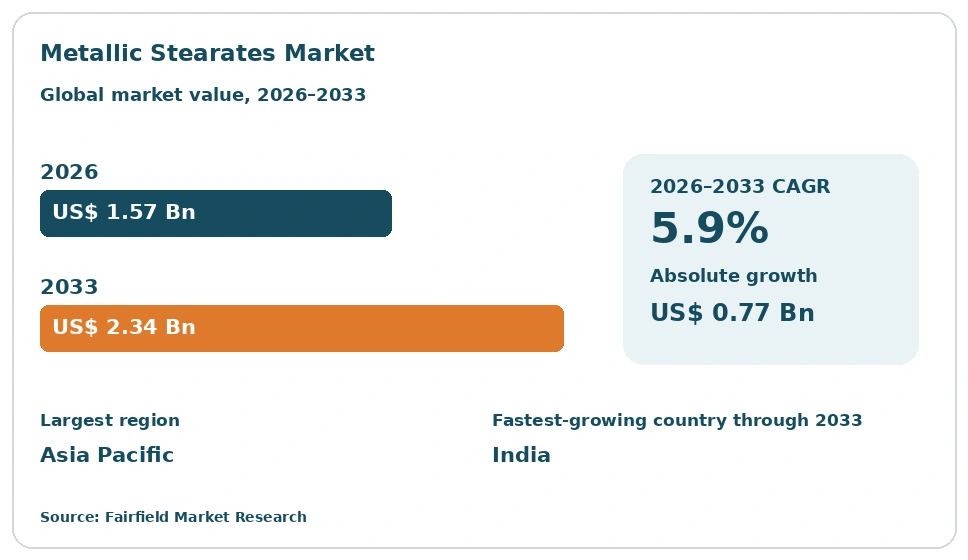
The global metallic stearates market size is expected to be valued at US$ 1.57 billion in 2026 and projected to reach US$ 2.34 billion by 2033, growing at a CAGR of 5.9% between 2026 and 2033.
Between 2020 and 2025, the market grew at a CAGR of about 5.2%, rising from roughly US$ 1.15 billion to about US$ 1.48 billion, as plastics and rubber production recovered after the pandemic slowdown, construction activity rose in Asia Pacific, and drug makers increased tablet output. The metallic stearates market covers salts of stearic acid with metals such as zinc, calcium, magnesium, aluminum, and sodium, also called metal soaps. They act as lubricants, release agents, stabilizers, acid scavengers, water repellents, anti-caking agents, and flatting agents. Major uses include PVC and polyolefin processing, rubber and tire production, pharmaceutical tablet making, cosmetics, paints and coatings, construction materials, and powder metallurgy. Most stearic acid comes from palm oil, tallow, and other vegetable fats. In June 2026, Baerlocher restructured its European additives business into a new subsidiary in Germany.
Key Report Takeaways
- By Type: Zinc Stearate held about 38% share in 2025, while Magnesium Stearate is projected to expand at a 6.6% CAGR through 2033, driven by its role as the most widely used lubricant in pharmaceutical tablets and capsules and rising generic drug output.
- By Grade: Industrial Grade held about 58.6% share in 2025, while Pharmaceutical Grade is projected to expand at a 6.5% CAGR through 2033, driven by generic drug production, nutraceutical supplements, and strict quality standards that support higher prices.
- By Application: Plastics held about 34% share in 2025, while Building and Construction is projected to expand at a 6.4% CAGR through 2033, driven by water-repellent concrete, plasters, mortars, and gypsum products.
- By Region: Asia Pacific held about 46% share in 2025, while India is projected to expand at a 7.2% CAGR through 2033, driven by polymer investment, construction growth, and a large pharmaceutical manufacturing base.
Global Metallic Stearates Market Trends and Insights
Drivers Impact Analysis
Two drivers carry the strongest influence on metallic stearates market demand during the forecast period.
| Driver | Impact on CAGR Forecast | Geographic Relevance | Impact Timeline |
| Growth of plastics and rubber processing | High | Global | Long term (≥4 years) |
| Pharmaceutical and personal care demand | Medium | Asia Pacific, North America, Europe | Medium term (2-4 years) |
Plastics Processing Is Driving the Metallic Stearates Market
Growth of plastics and rubber processing is the strongest driver of the metallic stearates market. Metallic stearates help plastics and rubber flow and release easily.
The mechanism is that plastic and rubber makers add small amounts of stearates to improve processing. Calcium and zinc stearates act as lubricants and heat stabilizers in PVC pipes, window profiles, cables, and flooring, and as acid scavengers in polyethylene and polypropylene. In rubber production, zinc stearate prevents uncured sheets from sticking together and helps vulcanization in tires, belts, and hoses. Growing construction, packaging, automotive, and electrical industries in China, India, and other emerging economies are raising plastic and rubber output. New polymer plants in India and Middle East & Africa add further demand. Because stearates are needed in nearly every batch, demand closely follows plastic and rubber production volumes. These trends support steady long-term growth.
Pharmaceuticals Are Expanding the Metallic Stearates Market
Pharmaceutical and personal care demand is expanding the metallic stearates market. Tablets and cosmetics rely on stearates.
The cause is growing global use of medicines and supplements. Magnesium stearate is the most common lubricant in tablet and capsule manufacturing, preventing powders from sticking to machines and helping tablets release cleanly. Rising generic drug production in India and China, aging populations, and growing use of vitamins and dietary supplements all increase demand. In cosmetics, zinc and magnesium stearates improve texture, adhesion, and water resistance in face powders, foundations, and eye shadows. Pharmaceutical and cosmetic grades must meet strict purity and safety standards, which supports higher prices than industrial grades. Contract manufacturers expanding in Asia Pacific add further demand. Pet food and animal supplements also use these ingredients. These trends raise both volume and value in the market.
Restraints Impact Analysis
Two restraints limit how quickly the metallic stearates market grows.
| Restraint | Impact on CAGR Forecast | Geographic Relevance | Impact Timeline |
| Raw material price volatility | High | Global | Short term (≤2 years) |
| Regulatory pressure and substitute products | Medium | Europe, North America | Long term (≥4 years) |
Raw Material Volatility Slows the Metallic Stearates Market
Raw material price volatility slows the metallic stearates market. Stearic acid and metal prices change often.
The problem is that stearic acid is made mainly from palm oil and tallow, whose prices move with weather, crop yields, biofuel demand, and export rules in Indonesia and Malaysia. Zinc, calcium, and magnesium compounds also face price swings linked to mining output and energy costs. Because stearates are low-cost additives sold in competitive markets, producers often struggle to pass higher costs to customers quickly. Rules on deforestation-free supply chains in Europe add tracing and certification costs for palm-based raw materials. Freight and energy cost changes also affect margins. Smaller producers with limited purchasing power are most affected. Long supply chains from Asia Pacific also expose buyers to shipping delays. These factors make profits volatile and slow investment in new capacity.
Regulation and Substitutes Restrict the Metallic Stearates Market
Regulatory pressure and substitute products restrict the metallic stearates market. Some customers are changing formulations.
The constraint is that tighter rules on chemicals, food contact materials, and cosmetics require more testing and documentation for stearate producers. Consumer demand for natural and clean-label products may reduce stearate use in some cosmetics and food applications. In PVC, some stabilizer systems are shifting toward organic or calcium-based alternatives, while in certain polymers, newer processing aids, waxes, and amides compete with stearates. Animal-derived stearates face concerns from vegan and halal buyers, pushing producers to use vegetable sources. Environmental rules on zinc in wastewater also add costs. Some drug makers are also testing alternative tablet lubricants. These pressures limit growth in mature markets and require producers to invest in new grades and certifications.
Market Opportunities
Bio-Based and Specialty Grades Open a Fast-Growth Revenue Pool
Bio-based and specialty grades open a fast-growth revenue pool. Customers want sustainable and high-performance additives.
The opportunity comes from rising demand for stearates made from certified sustainable palm oil, other vegetable oils, or traceable sources, as well as vegan, kosher, and halal grades. Brand owners in cosmetics, food packaging, and pharmaceuticals want ingredients that support their sustainability goals. Specialty grades with fine particle sizes, high purity, dispersions, and low dust levels serve demanding uses such as 3D printing, powder metallurgy, battery materials, and high-end coatings. Producers are also developing PFAS-free processing aids for plastic films. Close cooperation with customers on new formulations helps suppliers win long contracts. Companies that invest in certification, traceability, and custom products can earn higher margins and stronger customer loyalty than commodity producers.
Construction Applications Create a Growth Revenue Pool
Construction applications create a growth revenue pool. Builders want stronger, longer-lasting materials.
The opportunity reflects growing use of calcium and zinc stearates as water repellents in concrete, mortars, plasters, renders, and gypsum boards, which protect buildings from moisture damage and extend their life. Infrastructure spending in India, China, Indonesia, Saudi Arabia, and other emerging economies is raising demand for building materials. In Europe and North America, renovation and energy-efficient building rules support high-performance construction chemicals. Stearates also serve as flatting agents and stabilizers in paints and coatings used on buildings. Dry-mix mortar plants are expanding quickly in many emerging cities. Ready-to-use dispersions make dosing easier for these plants. Producers that work closely with construction chemical companies to develop tailored grades can capture steady growth in this segment.
Segment Analysis
By Type: Zinc Stearate Leads While Magnesium Stearate Grows Fastest
Zinc Stearate held about 38% share in 2025. It is widely used as a release agent and lubricant in rubber and plastics, a flatting agent in paints and lacquers, a water repellent in construction materials, and a texture improver in cosmetics. Its wide range of uses across many industries makes it the largest type.
Magnesium Stearate is the fastest-growing type, expanding at a 6.6% CAGR through 2033. It is the leading lubricant in pharmaceutical tablets and capsules and is also used in supplements, food, and cosmetics. Rising drug and supplement production supports demand. Calcium Stearate, Aluminum Stearate, and Sodium Stearate form other segments, with calcium stearate widely used in PVC. For the market, magnesium growth raises the share of high-value grades.
By Grade: Industrial Grade Leads While Pharmaceutical Grade Grows Fastest
Industrial Grade held about 58.6% share in 2025. It serves plastics, rubber, construction, paints and coatings, paper, and metal processing, where large volumes are needed and price matters more than extreme purity. Producers supply powders, flakes, and dispersions for automated processing lines.
Pharmaceutical Grade is the fastest-growing grade, expanding at a 6.5% CAGR through 2033. It must meet pharmacopeia standards for purity, metal content, and microbial limits and is used in tablets, capsules, and supplements. Generic drug production in India and China drives growth. Food Grade forms another segment serving food processing and packaging. Supplement makers also buy large amounts of this grade. For the market, pharmaceutical growth supports higher prices and stable contracts with drug makers.
By Application: Plastics Lead While Building and Construction Grow Fastest
Plastics held about 34% share in 2025. Stearates are used as lubricants, stabilizers, and acid scavengers in PVC, polyethylene, polypropylene, and engineering plastics for pipes, films, cables, packaging, and automotive parts. Growing plastic production in every region keeps this the largest application.
Building and Construction is the fastest-growing application, expanding at a 6.4% CAGR through 2033. Stearates make concrete, mortar, plaster, and gypsum products water repellent and more durable. Rubber, Pharmaceuticals, Cosmetics and Personal Care, Paints and Coatings, and Others form other applications. Dry-mix mortars and tile adhesives are a fast-growing use in cities across Asia Pacific and Middle East & Africa. For the market, construction growth links demand to infrastructure spending and housing.
Geography Analysis
Why Is North America Important to the Metallic Stearates Market?
North America is important to the metallic stearates market because it has large plastics, rubber, pharmaceutical, and personal care industries that demand high-quality and specialty grades. The United States is home to major producers and distributors such as Valtris Specialty Chemicals, Baerlocher USA, Norac Additives, and Dover Chemical, and strong pharmaceutical and supplement manufacturing uses magnesium stearate. Canada and Mexico add demand from plastics, automotive, and construction. Strict quality and food-contact rules favor established suppliers. Key barriers include high costs. Many supplement makers prefer plant-based magnesium stearate. One change shaping the region is demand for vegetable-based grades.
Europe Shapes the Metallic Stearates Market Through Sustainability and Quality
Europe is a major metallic stearates market. Germany, Italy, France, the United Kingdom, and Spain have strong plastics, rubber, pharmaceutical, cosmetics, and construction chemical industries. Leading producers such as Baerlocher, Peter Greven, and FACI are based in the region. Strict REACH rules, deforestation-free supply chain regulation, and PFAS restrictions push suppliers toward sustainable and certified grades. Key barriers include high energy costs. Many producers source stearic acid from Asia Pacific. Rubber and tire makers in Germany, France, and Italy remain important customers. Demand for natural cosmetics also influences product choices. One opportunity is certified sustainable and specialty stearates.
Which Region Is Leading the Metallic Stearates Market?
Asia Pacific is leading the metallic stearates market with about 46% share in 2025, and India is the fastest-growing country, expanding at a 7.2% CAGR through 2033. China is the largest producer and user, with huge plastics, rubber, tire, and construction industries. India is investing heavily in polymers and has a large generic drug industry. Malaysia and Indonesia supply stearic acid from palm oil, while Japan and South Korea have advanced specialty producers. Key barriers include price competition. Many local producers sell lower-priced grades. One change shaping the region is new polymer capacity in India.
Latin America Grows the Metallic Stearates Market Through Plastics and Construction
Latin America is a growing metallic stearates market. Brazil has large plastics, rubber, cosmetics, and construction industries, and local producers make stearic acid and stearates from vegetable oils and tallow. Mexico has strong automotive, packaging, and pharmaceutical manufacturing that serves North America. Argentina, Colombia, and Chile add demand from plastics, construction, and personal care. Key barriers include currency swings and import costs. Much of the region’s stearic acid is imported from Malaysia and Indonesia. Construction projects in large cities support demand for water-repellent mortars. Local cosmetic brands are also growing. One opportunity is local supply for plastics and pharmaceutical makers.
Middle East & Africa Builds the Metallic Stearates Market Through Polymer Investment
Middle East & Africa is an emerging metallic stearates market. Saudi Arabia and the United Arab Emirates have large petrochemical and polymer industries that use stearates in plastics processing, and major construction projects increase demand for water-repellent building materials. Egypt, South Africa, and Nigeria have growing plastics, pharmaceutical, and construction sectors. Key barriers include reliance on imports and limited local production. Paint and coatings production is growing in Saudi Arabia and Egypt. Distributors in Dubai supply many countries in the region. Pharmaceutical factories are expanding in Saudi Arabia and Egypt. One opportunity is supplying polymer producers and construction chemical makers.
Competitive Landscape
The metallic stearates market is moderately fragmented. Baerlocher, Peter Greven, Valtris Specialty Chemicals, FACI, and Sun Ace Kakoh are leading players, while Norac Additives, Dover Chemical, James M. Brown, Dainichi Chemical Industry, PMC Biogenix, Nimbasia, and Univar Solutions compete strongly. A few global producers supply multinational plastics, rubber, and pharmaceutical customers, while many regional and local manufacturers in China, India, and Malaysia serve price-sensitive buyers. Distributors play an important role in reaching smaller customers.
Companies compete on product quality, particle size, purity, consistency, certifications, technical support, and price. Pharmaceutical and cosmetic customers demand strict quality control, documentation, and traceable raw materials, which favors established producers. Industrial customers focus more on price, availability, and reliable delivery. Backward integration into stearic acid and access to sustainable palm oil give some producers a cost and sustainability advantage.
Strategic moves show how competition is changing. In February 2026, Valtris Specialty Chemicals sold its Champlor Renewables business to focus on additives. In June 2026, Baerlocher created a new European subsidiary to speed decisions and promoted PFAS-free processing aids. The same month, Peter Greven announced a project to cut carbon emissions at its main plant. These moves show producers sharpening their focus and investing in sustainability.
Three themes shape vendor strategy. First, producers are developing bio-based, certified, and specialty grades for pharmaceuticals, cosmetics, and food. Second, they are reducing the carbon footprint of their plants and supply chains. Third, they are expanding production and distribution in Asia Pacific and Middle East & Africa to serve growing plastics and construction industries.
Metallic Stearates Market Industry Leaders
- Baerlocher
- Peter Greven
- Valtris Specialty Chemicals
- FACI
- Sun Ace Kakoh
Recent Industry Developments
- June 2026: Baerlocher moved its European operations into a new subsidiary, Baerlocher Germany, managing PVC stabilizers and specialty additives, and promoted its PFAS-free Baerolub AID processing aids - strengthens its position in the metallic stearates market.
- June 2026: Peter Greven announced a government-funded project to replace a natural gas steam boiler at its Bad Münstereifel headquarters with electric heat and thermal storage, cutting CO2 emissions by up to 78% - supports lower-carbon stearate production.
- February 2026: Valtris Specialty Chemicals completed the sale of its Champlor Renewables business in France to Avril Industrie, keeping its specialty additives business at the site - sharpens its focus on additives.
Companies Covered in the Report
- Baerlocher
- Peter Greven
- Valtris Specialty Chemicals
- FACI
- Sun Ace Kakoh
- Norac Additives
- Dover Chemical
- James M. Brown
- Dainichi Chemical Industry
- PMC Biogenix
- Nimbasia
- Univar Solutions
Metallic Stearates Market Report Scope
This report covers the metallic stearates market, including zinc, calcium, magnesium, aluminum, and sodium stearates, in industrial, pharmaceutical, and food grades, used in plastics, rubber, building and construction, pharmaceuticals, cosmetics and personal care, paints and coatings, and other applications. The base year is 2025, and the forecast period runs from 2026 to 2033. All values are expressed in US$ Billion.
| Type | Zinc Stearate, Calcium Stearate, Magnesium Stearate, Aluminum Stearate, Sodium Stearate |
| Grade | Industrial Grade, Pharmaceutical Grade, Food Grade |
| Application | Plastics, Rubber, Building and Construction, Pharmaceuticals, Cosmetics and Personal Care, Paints and Coatings, Others |
| Regions | North America, Europe, Asia Pacific, Latin America, Middle East & Africa |
1. Executive Summary
1.1 Metallic Stearates Market Snapshot
1.2 Future Projections
1.3 Key Market Trends
1.4 Regional Snapshot
2. Market Overview
2.1 Market Definition and Report Scope
2.2 Historical Market Trends
2.3 Market Dynamics
2.3.1 Drivers
2.3.1.1 Plastics Processing Is Driving the Metallic Stearates Market
2.3.1.2 Pharmaceuticals Are Expanding the Metallic Stearates Market
2.3.2 Restraints
2.3.2.1 Raw Material Volatility Slows the Metallic Stearates Market
2.3.2.2 Regulation and Substitutes Restrict the Metallic Stearates Market
2.3.3 Market Opportunities
2.3.3.1 Bio-Based and Specialty Grades Open a Fast-Growth Revenue Pool
2.3.3.2 Construction Applications Create a Growth Revenue Pool
3. Global Metallic Stearates Market Outlook, 2020–2033
3.1 Global Metallic Stearates Market Outlook, by Type, Value (US$ Billion), 2020–2033
3.1.1 Zinc Stearate
3.1.2 Calcium Stearate
3.1.3 Magnesium Stearate
3.1.4 Aluminum Stearate
3.1.5 Sodium Stearate
3.2 Global Metallic Stearates Market Outlook, by Grade, Value (US$ Billion), 2020–2033
3.2.1 Industrial Grade
3.2.2 Pharmaceutical Grade
3.2.3 Food Grade
3.3 Global Metallic Stearates Market Outlook, by Application, Value (US$ Billion), 2020–2033
3.3.1 Plastics
3.3.2 Rubber
3.3.3 Building and Construction
3.3.4 Pharmaceuticals
3.3.5 Cosmetics and Personal Care
3.3.6 Paints and Coatings
3.3.7 Others
3.4 Global Metallic Stearates Market Outlook, by Region, Value (US$ Billion), 2020–2033
3.4.1 North America
3.4.2 Europe
3.4.3 Asia Pacific
3.4.4 Latin America
3.4.5 Middle East & Africa
4. North America Metallic Stearates Market Outlook, 2020–2033
4.1 North America Metallic Stearates Market Outlook, by Type, Value (US$ Billion), 2020–2033
4.1.1 Zinc Stearate
4.1.2 Calcium Stearate
4.1.3 Magnesium Stearate
4.1.4 Aluminum Stearate
4.1.5 Sodium Stearate
4.2 North America Metallic Stearates Market Outlook, by Grade, Value (US$ Billion), 2020–2033
4.2.1 Industrial Grade
4.2.2 Pharmaceutical Grade
4.2.3 Food Grade
4.3 North America Metallic Stearates Market Outlook, by Application, Value (US$ Billion), 2020–2033
4.3.1 Plastics
4.3.2 Rubber
4.3.3 Building and Construction
4.3.4 Pharmaceuticals
4.3.5 Cosmetics and Personal Care
4.3.6 Paints and Coatings
4.3.7 Others
4.4 North America Metallic Stearates Market Outlook, by Country, Value (US$ Billion), 2020–2033
4.4.1 United States Metallic Stearates Market Outlook, by Type, 2020–2033
4.4.2 United States Metallic Stearates Market Outlook, by Grade, 2020–2033
4.4.3 United States Metallic Stearates Market Outlook, by Application, 2020–2033
4.4.4 Canada Metallic Stearates Market Outlook, by Type, 2020–2033
4.4.5 Canada Metallic Stearates Market Outlook, by Grade, 2020–2033
4.4.6 Canada Metallic Stearates Market Outlook, by Application, 2020–2033
4.4.7 Mexico Metallic Stearates Market Outlook, by Type, 2020–2033
4.4.8 Mexico Metallic Stearates Market Outlook, by Grade, 2020–2033
4.4.9 Mexico Metallic Stearates Market Outlook, by Application, 2020–2033
5. Europe Metallic Stearates Market Outlook, 2020–2033
5.1 Europe Metallic Stearates Market Outlook, by Type, Value (US$ Billion), 2020–2033
5.1.1 Zinc Stearate
5.1.2 Calcium Stearate
5.1.3 Magnesium Stearate
5.1.4 Aluminum Stearate
5.1.5 Sodium Stearate
5.2 Europe Metallic Stearates Market Outlook, by Grade, Value (US$ Billion), 2020–2033
5.2.1 Industrial Grade
5.2.2 Pharmaceutical Grade
5.2.3 Food Grade
5.3 Europe Metallic Stearates Market Outlook, by Application, Value (US$ Billion), 2020–2033
5.3.1 Plastics
5.3.2 Rubber
5.3.3 Building and Construction
5.3.4 Pharmaceuticals
5.3.5 Cosmetics and Personal Care
5.3.6 Paints and Coatings
5.3.7 Others
5.4 Europe Metallic Stearates Market Outlook, by Country, Value (US$ Billion), 2020–2033
5.4.1 Germany Metallic Stearates Market Outlook, by Type, 2020–2033
5.4.2 Germany Metallic Stearates Market Outlook, by Grade, 2020–2033
5.4.3 Germany Metallic Stearates Market Outlook, by Application, 2020–2033
5.4.4 Italy Metallic Stearates Market Outlook, by Type, 2020–2033
5.4.5 Italy Metallic Stearates Market Outlook, by Grade, 2020–2033
5.4.6 Italy Metallic Stearates Market Outlook, by Application, 2020–2033
5.4.7 France Metallic Stearates Market Outlook, by Type, 2020–2033
5.4.8 France Metallic Stearates Market Outlook, by Grade, 2020–2033
5.4.9 France Metallic Stearates Market Outlook, by Application, 2020–2033
5.4.10 United Kingdom Metallic Stearates Market Outlook, by Type, 2020–2033
5.4.11 United Kingdom Metallic Stearates Market Outlook, by Grade, 2020–2033
5.4.12 United Kingdom Metallic Stearates Market Outlook, by Application, 2020–2033
5.4.13 Spain Metallic Stearates Market Outlook, by Type, 2020–2033
5.4.14 Spain Metallic Stearates Market Outlook, by Grade, 2020–2033
5.4.15 Spain Metallic Stearates Market Outlook, by Application, 2020–2033
6. Asia Pacific Metallic Stearates Market Outlook, 2020–2033
6.1 Asia Pacific Metallic Stearates Market Outlook, by Type, Value (US$ Billion), 2020–2033
6.1.1 Zinc Stearate
6.1.2 Calcium Stearate
6.1.3 Magnesium Stearate
6.1.4 Aluminum Stearate
6.1.5 Sodium Stearate
6.2 Asia Pacific Metallic Stearates Market Outlook, by Grade, Value (US$ Billion), 2020–2033
6.2.1 Industrial Grade
6.2.2 Pharmaceutical Grade
6.2.3 Food Grade
6.3 Asia Pacific Metallic Stearates Market Outlook, by Application, Value (US$ Billion), 2020–2033
6.3.1 Plastics
6.3.2 Rubber
6.3.3 Building and Construction
6.3.4 Pharmaceuticals
6.3.5 Cosmetics and Personal Care
6.3.6 Paints and Coatings
6.3.7 Others
6.4 Asia Pacific Metallic Stearates Market Outlook, by Country, Value (US$ Billion), 2020–2033
6.4.1 India Metallic Stearates Market Outlook, by Type, 2020–2033
6.4.2 India Metallic Stearates Market Outlook, by Grade, 2020–2033
6.4.3 India Metallic Stearates Market Outlook, by Application, 2020–2033
6.4.4 China Metallic Stearates Market Outlook, by Type, 2020–2033
6.4.5 China Metallic Stearates Market Outlook, by Grade, 2020–2033
6.4.6 China Metallic Stearates Market Outlook, by Application, 2020–2033
6.4.7 Malaysia Metallic Stearates Market Outlook, by Type, 2020–2033
6.4.8 Malaysia Metallic Stearates Market Outlook, by Grade, 2020–2033
6.4.9 Malaysia Metallic Stearates Market Outlook, by Application, 2020–2033
6.4.10 Indonesia Metallic Stearates Market Outlook, by Type, 2020–2033
6.4.11 Indonesia Metallic Stearates Market Outlook, by Grade, 2020–2033
6.4.12 Indonesia Metallic Stearates Market Outlook, by Application, 2020–2033
6.4.13 Japan Metallic Stearates Market Outlook, by Type, 2020–2033
6.4.14 Japan Metallic Stearates Market Outlook, by Grade, 2020–2033
6.4.15 Japan Metallic Stearates Market Outlook, by Application, 2020–2033
6.4.16 South Korea Metallic Stearates Market Outlook, by Type, 2020–2033
6.4.17 South Korea Metallic Stearates Market Outlook, by Grade, 2020–2033
6.4.18 South Korea Metallic Stearates Market Outlook, by Application, 2020–2033
7. Latin America Metallic Stearates Market Outlook, 2020–2033
7.1 Latin America Metallic Stearates Market Outlook, by Type, Value (US$ Billion), 2020–2033
7.1.1 Zinc Stearate
7.1.2 Calcium Stearate
7.1.3 Magnesium Stearate
7.1.4 Aluminum Stearate
7.1.5 Sodium Stearate
7.2 Latin America Metallic Stearates Market Outlook, by Grade, Value (US$ Billion), 2020–2033
7.2.1 Industrial Grade
7.2.2 Pharmaceutical Grade
7.2.3 Food Grade
7.3 Latin America Metallic Stearates Market Outlook, by Application, Value (US$ Billion), 2020–2033
7.3.1 Plastics
7.3.2 Rubber
7.3.3 Building and Construction
7.3.4 Pharmaceuticals
7.3.5 Cosmetics and Personal Care
7.3.6 Paints and Coatings
7.3.7 Others
7.4 Latin America Metallic Stearates Market Outlook, by Country, Value (US$ Billion), 2020–2033
7.4.1 Brazil Metallic Stearates Market Outlook, by Type, 2020–2033
7.4.2 Brazil Metallic Stearates Market Outlook, by Grade, 2020–2033
7.4.3 Brazil Metallic Stearates Market Outlook, by Application, 2020–2033
7.4.4 Mexico Metallic Stearates Market Outlook, by Type, 2020–2033
7.4.5 Mexico Metallic Stearates Market Outlook, by Grade, 2020–2033
7.4.6 Mexico Metallic Stearates Market Outlook, by Application, 2020–2033
7.4.7 Argentina Metallic Stearates Market Outlook, by Type, 2020–2033
7.4.8 Argentina Metallic Stearates Market Outlook, by Grade, 2020–2033
7.4.9 Argentina Metallic Stearates Market Outlook, by Application, 2020–2033
7.4.10 Colombia Metallic Stearates Market Outlook, by Type, 2020–2033
7.4.11 Colombia Metallic Stearates Market Outlook, by Grade, 2020–2033
7.4.12 Colombia Metallic Stearates Market Outlook, by Application, 2020–2033
7.4.13 Chile Metallic Stearates Market Outlook, by Type, 2020–2033
7.4.14 Chile Metallic Stearates Market Outlook, by Grade, 2020–2033
7.4.15 Chile Metallic Stearates Market Outlook, by Application, 2020–2033
7.4.16 Malaysia Metallic Stearates Market Outlook, by Type, 2020–2033
7.4.17 Malaysia Metallic Stearates Market Outlook, by Grade, 2020–2033
7.4.18 Malaysia Metallic Stearates Market Outlook, by Application, 2020–2033
7.4.19 Indonesia Metallic Stearates Market Outlook, by Type, 2020–2033
7.4.20 Indonesia Metallic Stearates Market Outlook, by Grade, 2020–2033
7.4.21 Indonesia Metallic Stearates Market Outlook, by Application, 2020–2033
8. Middle East & Africa Metallic Stearates Market Outlook, 2020–2033
8.1 Middle East & Africa Metallic Stearates Market Outlook, by Type, Value (US$ Billion), 2020–2033
8.1.1 Zinc Stearate
8.1.2 Calcium Stearate
8.1.3 Magnesium Stearate
8.1.4 Aluminum Stearate
8.1.5 Sodium Stearate
8.2 Middle East & Africa Metallic Stearates Market Outlook, by Grade, Value (US$ Billion), 2020–2033
8.2.1 Industrial Grade
8.2.2 Pharmaceutical Grade
8.2.3 Food Grade
8.3 Middle East & Africa Metallic Stearates Market Outlook, by Application, Value (US$ Billion), 2020–2033
8.3.1 Plastics
8.3.2 Rubber
8.3.3 Building and Construction
8.3.4 Pharmaceuticals
8.3.5 Cosmetics and Personal Care
8.3.6 Paints and Coatings
8.3.7 Others
8.4 Middle East & Africa Metallic Stearates Market Outlook, by Country, Value (US$ Billion), 2020–2033
8.4.1 Saudi Arabia Metallic Stearates Market Outlook, by Type, 2020–2033
8.4.2 Saudi Arabia Metallic Stearates Market Outlook, by Grade, 2020–2033
8.4.3 Saudi Arabia Metallic Stearates Market Outlook, by Application, 2020–2033
8.4.4 United Arab Emirates Metallic Stearates Market Outlook, by Type, 2020–2033
8.4.5 United Arab Emirates Metallic Stearates Market Outlook, by Grade, 2020–2033
8.4.6 United Arab Emirates Metallic Stearates Market Outlook, by Application, 2020–2033
8.4.7 Egypt Metallic Stearates Market Outlook, by Type, 2020–2033
8.4.8 Egypt Metallic Stearates Market Outlook, by Grade, 2020–2033
8.4.9 Egypt Metallic Stearates Market Outlook, by Application, 2020–2033
8.4.10 South Africa Metallic Stearates Market Outlook, by Type, 2020–2033
8.4.11 South Africa Metallic Stearates Market Outlook, by Grade, 2020–2033
8.4.12 South Africa Metallic Stearates Market Outlook, by Application, 2020–2033
8.4.13 Nigeria Metallic Stearates Market Outlook, by Type, 2020–2033
8.4.14 Nigeria Metallic Stearates Market Outlook, by Grade, 2020–2033
8.4.15 Nigeria Metallic Stearates Market Outlook, by Application, 2020–2033
9. Competitive Landscape
9.1 Metallic Stearates Market Industry Leaders
9.2 Recent Industry Developments
9.3 Company Profiles
9.3.1 Baerlocher
9.3.2 Peter Greven
9.3.3 Valtris Specialty Chemicals
9.3.4 FACI
9.3.5 Sun Ace Kakoh
9.3.6 Norac Additives
9.3.7 Dover Chemical
9.3.8 James M. Brown
9.3.9 Dainichi Chemical Industry
9.3.10 PMC Biogenix
9.3.11 Nimbasia
9.3.12 Univar Solutions
10. Appendix
10.1 Research Methodology
10.2 Report Assumptions
10.3 Acronyms and Abbreviations
| Type | Zinc Stearate, Calcium Stearate, Magnesium Stearate, Aluminum Stearate, Sodium Stearate |
| Grade | Industrial Grade, Pharmaceutical Grade, Food Grade |
| Application | Plastics, Rubber, Building and Construction, Pharmaceuticals, Cosmetics and Personal Care, Paints and Coatings, Others |
| Regions | North America, Europe, Asia Pacific, Latin America, Middle East & Africa |
Our Research Methodology
Considering the volatility of business today, traditional approaches to strategizing a game plan can be unfruitful if not detrimental. True ambiguity is no way to determine a forecast. A myriad of predetermined factors must be accounted for such as the degree of risk involved, the magnitude of circumstances, as well as conditions or consequences that are not known or unpredictable. To circumvent binary views that cast uncertainty, the application of market research intelligence to strategically posture, move, and enable actionable outcomes is necessary.
View Methodology
Quality Assured
Rigorous Validation Process

Confidentiality Assured
End-to-end Data Security

Custom Research Services
Tailored To Your Objectives
FAQs
The metallic stearates market is valued at US$ 1.57 billion in 2026, led by zinc stearate, plastics, and Asia Pacific.
The market is projected to reach US$ 2.34 billion by 2033, growing at a 5.9% CAGR and adding US$ 0.77 billion.
Pharmaceutical grade is growing fastest at a 6.5% CAGR through 2033, driven by generic drugs, supplements, and strict quality standards.
India is growing fastest at a 7.2% CAGR through 2033, driven by polymer investment, construction growth, and pharmaceutical manufacturing.
Asia Pacific holds the largest share at about 46% in 2025, supported by large plastics, rubber, and construction industries in China.
Related Reports
Ketones Market Size, Share, Insights, Competitive Landscape, and Forecast 2026 to 2033
Explore the ketones market, projected to reach US$34.45 billion by 2033 at 4.3% CAGR, with insights on types, applications, regions, and key companies.
Ethyl Benzene Market Size, Share, Insights, Competitive Landscape, and Forecast 2026 to 2033
Explore the Ethyl Benzene market, projected to reach US$52.6 billion by 2033 at 4.6% CAGR, with insights on applications, regions, and key companies.
Polyurethane Elastomers Market Size, Share, Insights, Competitive Landscape, and Forecast 2026 to 2033
The global polyurethane elastomers market is valued at US$9.8 billion in 2026, reaching US$14.9 billion by 2033, growing at a 6.2% CAGR
Medical Flexible Packaging Market Size, Share, Insights, Competitive Landscape, and Forecast 2026 to 2033
The global medical flexible packaging market is valued at US$33.27 billion in 2026, reaching US$47.66 billion by 2033, growing at a 5.3% CAGR
Green Composites Market Size, Share, Insights, Competitive Landscape, and Forecast 2026 to 2033
The global green composites market is valued at US$9.2 billion in 2026, reaching US$18.6 billion by 2033, growing at a 10.6% CAGR
Corrosion Protection Coatings Market Size, Share, Insights, Competitive Landscape, and Forecast 2026 to 2033
Explore the corrosion protection coatings market outlook for 2026–2033, including resin trends, application methods, regional demand, and key suppliers.