



Green Composites Market
Green Composites Market Size, Share, Insights, Competitive Landscape, and Forecast 2026 to 2033
Green Composites Market Size and Trend Analysis
How Fast Will Green Composites Demand Grow Through 2033?
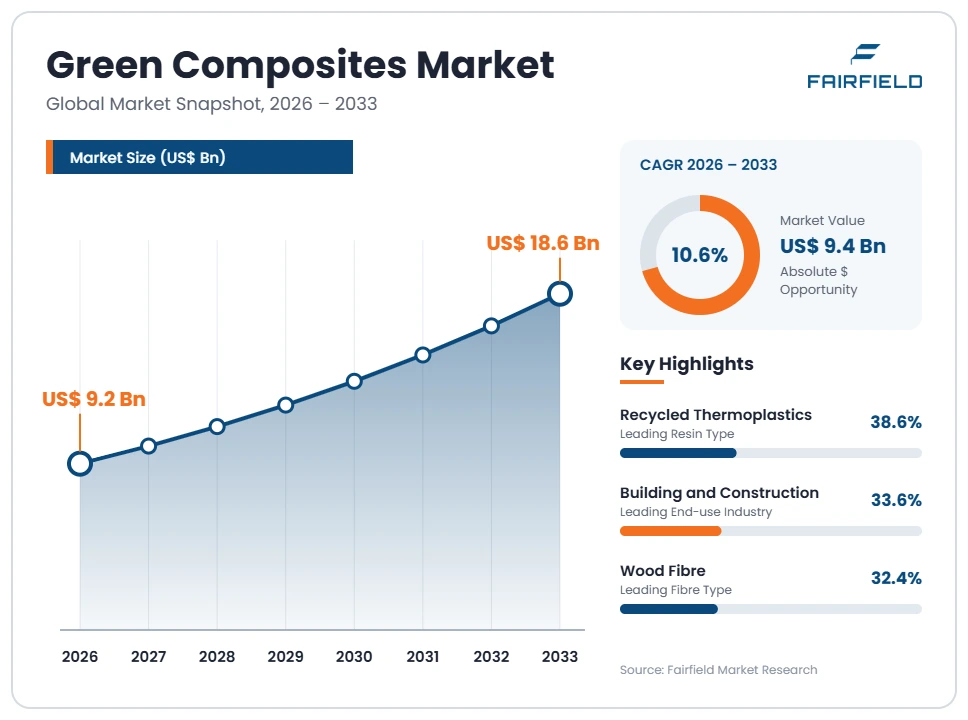
The global Green Composites market size is expected to be valued at US$ 9.2 billion in 2026 and projected to reach US$ 18.6 billion by 2033, growing at a CAGR of 10.6% between 2026 and 2033. Growth follows the steady substitution of glass fibre and virgin plastic in parts where moderate stiffness is sufficient. Automotive interior panels, exterior decking and moulded consumer housings carry most of the added volume. Between 2020 and 2025 the market expanded at an estimated 8.4% CAGR, and the absolute dollar opportunity across the forecast period reaches US$ 9.4 billion. Buyer demand for recycled and bio-based content, more than mechanical gains, sets the pace of adoption.
Key Report Takeaways
- By Fibre Type: Wood fibre led with 32.4% share in 2026, while hemp is projected to expand at a 13.1% CAGR through 2033, driven by wider decortication capacity across European and North American farming regions supplying consistent technical fibre grades.
- By Resin Type: Recycled thermoplastics led with 38.6% share in 2026, while bio-based thermosets are projected to expand at a 12.9% CAGR through 2033, driven by qualification of plant-oil and lignin-derived systems in structural panel and sporting goods tooling.
- By Manufacturing Process: Compression moulding led with 30.5% share in 2026, while injection moulding is projected to expand at a 12.4% CAGR through 2033, driven by short-fibre compound availability that lets moulders reuse existing presses without major retooling spend.
- By End-use Industry: Building and construction led with 33.6% share in 2026, while automotive and transportation is projected to expand at a 12.3% CAGR through 2033, driven by interior part weight targets and supplier commitments on recycled material content.
- By Region: Europe led with 34.8% share in 2026, ahead of Asia Pacific at 29.6%, North America at 24.2%, Latin America at 6.9% and Middle East & Africa at 4.5%, with Asia Pacific growing fastest at a 12.6% CAGR.
Global Green Composites Market Trends and Insights
Market Growth Drivers
Automotive Interior Substitution Pulls Natural Fibre Volume
Vehicle interior programmes are the single largest pull on green composite volume today. Door trim substrates, parcel shelves, headliners, pillar covers and load floors use natural fibre mats pressed into finished panels. These parts need dimensional stability and acoustic damping rather than high structural strength, which suits flax, hemp and kenaf reinforcement well. Each converted part displaces glass fibre or a filled polypropylene moulding, so adoption shows up directly in compounding and mat demand.
Tier one interior suppliers have built nonwoven mat lines and compression press capacity close to assembly plants, because bulky mats are costly to ship. Automakers also apply recycled and bio-based content targets to their interior bill of materials, which gives purchasing teams a reason to specify these panels. Electric vehicle programmes reinforce the pattern, since cabin weight savings extend driving range without touching battery cost.
Recycled and Bio-Based Content Requirements Reshape Specifications
End-of-life and recycled-content policy has moved material choice out of engineering and into procurement. Where buyers must report recycled or renewable content across a product family, composites built on recycled polypropylene or bio-based matrices become an easy way to raise that number. The effect is strongest in construction products and consumer goods, where the performance bar is set by appearance and durability rather than by load.
Public procurement rules, retailer sourcing policies and corporate reporting frameworks all push in the same direction, and compounders respond by publishing material declarations for each grade. Converters that can document fibre origin and resin composition win specification positions that pure cost competition would not deliver. Certification and traceability capability has become a commercial asset, not a compliance overhead, and it shapes which suppliers reach approved vendor lists.
Market Restraints
Moisture Uptake and Fibre Variability Limit Application Reach
Natural fibres absorb moisture, and that behaviour caps where green composites can be specified. Water uptake causes swelling, dimensional change and loss of interfacial adhesion, which engineers must design around with coatings, surface treatments or protected installation details. Agricultural fibre also varies with harvest, retting method and growing season, so batch properties move more than glass fibre properties do. Designers respond by adding safety margin, which erodes the weight and cost advantage.
Compounders counter this with fibre drying, chemical or enzymatic surface treatment and tighter incoming inspection, yet each step adds cost and process complexity. Structural, exterior and high-temperature applications remain difficult to serve, which keeps the addressable market concentrated in semi-structural and cosmetic parts. Until property data sets mature across suppliers, qualification cycles stay long and conservative engineering teams default to familiar reinforcement.
Bio-Resin Cost and Contested Life-Cycle Claims Slow Adoption
Bio-based matrices still cost more than commodity polyolefins, and that gap governs adoption in price-sensitive segments. Production volumes for bio-polyesters, plant-oil epoxies and bio-polyamides remain small relative to petrochemical equivalents, so buyers face both a price premium and supply concentration risk. Projects that cannot pass the premium through to their own customers usually revert to cheaper recycled thermoplastic matrices instead.
Environmental positioning faces its own friction. Life-cycle outcomes for natural fibre parts depend heavily on land use, fertiliser and water inputs, retting energy, transport distance and end-of-life route, so published comparisons against glass fibre reach different conclusions. Composite parts that mix bio and fossil components are also hard to separate at disposal, which complicates recyclability claims. Buyers increasingly ask for assessment detail, and vague sustainability messaging now attracts scrutiny rather than preference.
Market Opportunities
Recycled Thermoplastic Compounding Opens Cost-Competitive Volume
Pairing natural fibre with recycled polypropylene or recycled polyethylene creates the one green composite family that can undercut incumbent materials on price. Recyclate is cheaper than virgin resin, fibre acts as a stiffening filler, and the resulting compound raises recycled content without a performance penalty in non-structural parts. That combination converts sustainability specification into a cost argument, which widens the buyer set considerably.
The opening sits with compounders who can stabilise recyclate quality, since variable melt flow and contamination are the practical barriers. Investment in sorting, washing and melt filtration upstream translates directly into usable composite feedstock, and twin-screw compounding lines can be reconfigured for fibre feeding at modest cost. Decking, fencing, pallets, crates and returnable logistics components absorb very large volumes, so compounding capacity added here fills quickly against existing demand.
Consumer Electronics and Sporting Goods Reward Visible Material Identity
Premium consumer products offer margin that technical applications rarely provide, because the material itself becomes part of the product story. Flax and hemp laminates show a visible weave and a warm surface, so brands use them where carbon fibre would once have signalled performance. Speaker enclosures, laptop shells, eyewear, luggage and furniture all accept the material on appearance and feel.
Sporting goods demonstrate the same logic with a technical argument attached. Flax laminates damp vibration well, which benefits skis, snowboards, bicycle components, paddles and racket frames, and several equipment brands now build product lines around that property. These markets qualify materials faster than automotive or construction, tolerate higher prices and generate visible reference applications. Success here shortens the qualification path into adjacent industrial segments by building published property data and supplier confidence.
Segment Analysis
- Why Does Wood Fibre Still Anchor Green Composite Demand?
Wood fibre led the market with 32.4% share in 2026, because wood-plastic composite decking, cladding and profile extrusion consume very large tonnages at low unit cost. Sawmill residue and recovered wood flour are widely available, dry easily and process predictably, which suits continuous extrusion lines running long production campaigns. Established building product brands have amortised their capacity over two decades, so the cost position is hard to challenge.
Hemp is the fastest-growing fibre at a 13.1% CAGR through 2033, supported by expanded decortication and fibre processing capacity in Europe and North America that finally delivers consistent technical grades. Flax holds the premium position in laminates where surface appearance and vibration damping matter. The split matters strategically: wood fibre defends volume and price, while bast fibres carry the higher-value applications that lift average selling prices across the market.
- Recycled Matrices Hold Volume While Bio-Based Thermosets Gain Ground
Recycled thermoplastics led the resin category with 38.6% share in 2026, because recycled polypropylene and polyethylene let converters raise recycled content while lowering material cost. That dual benefit removes the usual trade-off between sustainability targets and purchasing budgets, and it fits the extrusion and injection processes already installed across the supply base.
Bio-based thermosets are the fastest-growing matrix class at a 12.9% CAGR through 2033, as plant-oil epoxies, bio-polyesters and lignin-modified systems clear qualification in panels, boards and sporting goods tooling. Bio-based thermoplastics such as polylactic acid and bio-polyamide hold a solid middle position in consumer goods. For strategy teams the implication is clear: volume growth sits with recyclate economics, while margin growth sits with bio-based chemistry. Suppliers covering both avoid being squeezed between commodity pricing and specialist performance demands.
- Compression Moulding Leads Output as Injection Moulding Scales Fastest
Compression moulding led the process category with 30.5% share in 2026, because automotive interior panels are made from nonwoven fibre mats consolidated in heated presses. The process handles long fibres without breaking them, produces large thin panels in short cycles and tolerates the bulk of natural fibre preforms. Tier one suppliers have standardised on it, and installed press capacity near vehicle assembly plants reinforces the position.
Injection moulding is the fastest-growing process at a 12.4% CAGR through 2033, as pelletised short-fibre compounds let general moulders enter the market using existing machines. Extrusion remains central to decking and profile production, while resin transfer moulding and infusion serve marine, sporting goods and panel applications. The shift towards injection moulding broadens the supplier base well beyond specialist composite converters, which should accelerate part conversion and compress the price premium green compounds currently carry.
- Construction Holds the Largest Share While Automotive Grows Quickest
Building and construction led end-use demand with 33.6% share in 2026, carried by decking, cladding, fencing, railing, window profiles and interior panels. These products need weather durability, low maintenance and an acceptable appearance rather than structural performance, which matches green composite capability closely. Renovation activity in mature housing markets sustains replacement demand independently of new construction cycles.
Automotive and transportation is the fastest-growing end use at a 12.3% CAGR through 2033, driven by interior part weight targets and supplier commitments on recycled and renewable content. Consumer goods and electronics add visible, brand-led applications, while sporting goods supply premium niches with strong technical justification. The pattern leaves the market with a stable construction base and a faster mobility layer above it, so suppliers serving both gain volume security together with exposure to higher-growth programmes.
Geography Analysis
- North America Builds Scale Through Decking and Recycled Feedstock
North America held 24.2% share in 2026 and is set to grow at a 9.7% CAGR through 2033. The United States dominates regional consumption through wood-plastic composite decking, railing and cladding, supported by a large renovation market and established brand distribution through home improvement retail. Canada contributes wood fibre and recovered wood flour supply from its forest products sector. Growth rests on recycled polyolefin availability, since regional recycling infrastructure feeds compounders with usable feedstock at competitive cost. Automotive interior adoption is advancing more slowly than in Europe, concentrated in programmes where suppliers have carried material choices across from European platforms. Hemp fibre processing capacity has expanded since agricultural hemp cultivation was legalised, giving regional converters a domestic bast fibre option.
- Which Region Is Leading the Green Composites Market?
Europe leads the green composites market with 34.8% share in 2026, growing at a 9.8% CAGR through 2033. Leadership rests on three reinforcing factors. Automotive interior programmes in Germany, France and Italy have specified natural fibre panels for two decades, so supply chains and property data are mature. France, Belgium and the Netherlands form the world’s main flax growing and scutching region, giving European converters direct access to the highest-quality bast fibre. Regional policy on end-of-life vehicles, construction product declarations and recycled content keeps material substitution commercially rewarded rather than optional. Sporting goods and marine builders across Switzerland, Austria and the Nordic countries have also built premium flax laminate product lines, reinforcing the region’s technical reputation.
- Which Region Is Growing Fastest in the Green Composites Market?
Asia Pacific is the fastest-growing region at a 12.6% CAGR through 2033, from 29.6% share in 2026. India and Bangladesh supply most of the world’s jute, and China holds extensive hemp, ramie and bamboo fibre capacity, so the region controls raw material at origin. China is also the largest producer of wood-plastic composite profiles, serving domestic construction and exporting to North America and Europe. Vehicle production growth across China, India, Japan and South Korea creates interior panel demand at scale, and domestic automakers are adopting recycled content targets. Rising construction spending and expanding furniture and consumer goods manufacturing add further volume. Local compounding investment is shifting the region from fibre exporter towards finished composite producer.
- Latin America Converts Agricultural Fibre Supply Into Local Processing
Latin America held 6.9% share in 2026 and is projected to grow at a 9.4% CAGR through 2033. Brazil anchors the region through sisal and curaua fibre production, a substantial automotive assembly base and a developed furniture industry. Vehicle manufacturers operating Brazilian plants have applied natural fibre interior panels on local programmes, often transferring specifications from European parent platforms. Mexico benefits from automotive supply integration with North America, which pulls interior component production into the country. Argentina and Colombia contribute smaller volumes through construction products and packaging. Growth depends on moving beyond raw fibre export towards domestic compounding, since limited local resin recycling capacity still constrains matrix supply and forces converters to import feedstock.
- Middle East & Africa Advances From a Small Construction-Led Base
Middle East & Africa held 4.5% share in 2026, the smallest regional position, with a 9.0% CAGR projected through 2033. Demand concentrates in construction products across the Gulf states, where large building programmes and sustainable building certification schemes create specification pull for composite decking, cladding and outdoor furniture. Hot, dry conditions suit wood-plastic composites better than untreated timber, which supports substitution. Egypt, Kenya and Tanzania produce sisal and other agricultural fibres, mostly exported rather than processed locally. South Africa has the region’s most developed automotive assembly base and the clearest route to interior panel adoption. Limited local compounding capacity and reliance on imported composite products remain the main constraints on faster regional growth.
Competitive Landscape
The green composites market is fragmented, with no supplier holding a commanding position across fibre types, matrices and end uses. Three distinct groups compete. Large forest products and pulp companies supply cellulose-based compounds at scale. Building product manufacturers dominate wood-plastic composite decking through brand strength and retail distribution. Specialist compounders and laminate producers serve automotive, sporting goods and consumer applications with technical grades. Because these groups rarely compete head on, consolidation has been limited, and regional converters retain strong local positions where freight costs protect them.
Competition runs on material consistency, documented content and processing compatibility rather than on headline mechanical properties. Suppliers differentiate through fibre treatment and sizing chemistry, melt flow control in recyclate-based compounds, odour and emission performance for interior parts, and the quality of the property data they publish. Traceability of fibre origin and resin composition has become a practical requirement for automotive and construction specification. New entrants typically arrive from bioplastics compounding or recycling rather than from traditional composites, bringing feedstock access instead of laminate expertise.
Strategic activity centres on capacity, qualification and integration. Compounders are adding fibre handling and drying capability to existing extrusion lines, which is cheaper than building dedicated plants. Fibre processors are moving downstream into compounds and preforms to capture more value than raw fibre sales allow. Partnerships between fibre suppliers, resin producers and converters shorten qualification cycles, since joint development is the only practical way to generate the property data that engineering teams require.
Competitive direction favours suppliers that can document what they sell. As buyers test sustainability claims more rigorously, assessment capability, consistent quality and reliable supply matter more than material novelty alone.
Industry Leaders
- UPM
- Stora Enso
- Trex Company, Inc.
- UFP Industries, Inc.
- Bcomp Ltd
- FlexForm Technologies
- Green Dot Bioplastics, Inc.
- TECNARO GmbH
Companies Covered in the Report
- UPM
- Stora Enso
- Trex Company, Inc.
- UFP Industries, Inc.
- Fiberon
- Bcomp Ltd
- FlexForm Technologies
- Green Dot Bioplastics, Inc.
- TECNARO GmbH
- JELU-WERK Josef Ehrler GmbH & Co. KG
- EcoTechnilin SAS
- Composites Evolution Limited
- Procotex Corporation SA
- Trifilon AB
- Amorim Cork Composites
Green Composites Market Report Scope
| Metric | Value |
| Study Period | 2020–2033 |
| Market Size 2026 | US$ 9.2 Billion |
| Market Size 2033 | US$ 18.6 Billion |
| CAGR 2026–2033 | 10.6% |
| Absolute Dollar Opportunity | US$ 9.4 Billion |
| Largest Market | Europe (34.8% share in 2026) |
| Fastest-Growing Market | Asia Pacific (12.6% CAGR 2026–2033) |
| Market Concentration | Fragmented |
| Major Players | UPM, Stora Enso, Trex Company, Inc., UFP Industries, Inc., Bcomp Ltd |
Green Composites Market Segmentation
- Executive Summary
- Green Composites Market Snapshot
- Future Projections
- Key Market Trends
- Regional Snapshot
- Market Overview
- Market Definition and Report Scope
- Historical Market Trends
- Market Dynamics
- Drivers
- Automotive Interior Substitution Pulls Natural Fibre Volume
- Recycled and Bio-Based Content Requirements Reshape Specifications
- Restraints
- Moisture Uptake and Fibre Variability Limit Application Reach
- Bio-Resin Cost and Contested Life-Cycle Claims Slow Adoption
- Market Opportunities
- Recycled Thermoplastic Compounding Opens Cost-Competitive Volume
- Consumer Electronics and Sporting Goods Reward Visible Material Identity
- Drivers
- Global Green Composites Market Outlook, 2026–2033
- Global Green Composites Market Outlook, by Fibre Type, Value (US$ Billion), 2026–2033
- Wood Fibre
- Flax
- Hemp
- Jute
- Kenaf
- Others
- Global Green Composites Market Outlook, by Resin Type, Value (US$ Billion), 2026–2033
- Recycled Thermoplastics
- Bio-based Thermoplastics
- Bio-based Thermosets
- Hybrid and Partially Bio-based Systems
- Global Green Composites Market Outlook, by Manufacturing Process, Value (US$ Billion), 2026–2033
- Compression Moulding
- Extrusion
- Injection Moulding
- Resin Transfer Moulding and Infusion
- Others
- Global Green Composites Market Outlook, by End-use Industry, Value (US$ Billion), 2026–2033
- Building and Construction
- Automotive and Transportation
- Consumer Goods and Electronics
- Sporting Goods and Leisure
- Others
- Global Green Composites Market Outlook, by Region, Value (US$ Billion), 2026–2033
- North America
- Europe
- Asia Pacific
- Latin America
- Middle East & Africa
- Global Green Composites Market Outlook, by Fibre Type, Value (US$ Billion), 2026–2033
- North America Green Composites Market Outlook, 2026–2033
- North America Green Composites Market Outlook, by Fibre Type, Value (US$ Billion), 2026–2033
- Wood Fibre
- Flax
- Hemp
- Jute
- Kenaf
- Others
- North America Green Composites Market Outlook, by Resin Type, Value (US$ Billion), 2026–2033
- Recycled Thermoplastics
- Bio-based Thermoplastics
- Bio-based Thermosets
- Hybrid and Partially Bio-based Systems
- North America Green Composites Market Outlook, by Manufacturing Process, Value (US$ Billion), 2026–2033
- Compression Moulding
- Extrusion
- Injection Moulding
- Resin Transfer Moulding and Infusion
- Others
- North America Green Composites Market Outlook, by End-use Industry, Value (US$ Billion), 2026–2033
- Building and Construction
- Automotive and Transportation
- Consumer Goods and Electronics
- Sporting Goods and Leisure
- Others
- North America Green Composites Market Outlook, by Country, Value (US$ Billion), 2026–2033
- United States Green Composites Market Outlook, by Fibre Type, 2026–2033
- United States Green Composites Market Outlook, by Resin Type, 2026–2033
- United States Green Composites Market Outlook, by Manufacturing Process, 2026–2033
- United States Green Composites Market Outlook, by End-use Industry, 2026–2033
- Canada Green Composites Market Outlook, by Fibre Type, 2026–2033
- Canada Green Composites Market Outlook, by Resin Type, 2026–2033
- Canada Green Composites Market Outlook, by Manufacturing Process, 2026–2033
- Canada Green Composites Market Outlook, by End-use Industry, 2026–2033
- North America Green Composites Market Outlook, by Fibre Type, Value (US$ Billion), 2026–2033
- Europe Green Composites Market Outlook, 2026–2033
- Europe Green Composites Market Outlook, by Fibre Type, Value (US$ Billion), 2026–2033
- Wood Fibre
- Flax
- Hemp
- Jute
- Kenaf
- Others
- Europe Green Composites Market Outlook, by Resin Type, Value (US$ Billion), 2026–2033
- Recycled Thermoplastics
- Bio-based Thermoplastics
- Bio-based Thermosets
- Hybrid and Partially Bio-based Systems
- Europe Green Composites Market Outlook, by Manufacturing Process, Value (US$ Billion), 2026–2033
- Compression Moulding
- Extrusion
- Injection Moulding
- Resin Transfer Moulding and Infusion
- Others
- Europe Green Composites Market Outlook, by End-use Industry, Value (US$ Billion), 2026–2033
- Building and Construction
- Automotive and Transportation
- Consumer Goods and Electronics
- Sporting Goods and Leisure
- Others
- Europe Green Composites Market Outlook, by Country and Subregion, Value (US$ Billion), 2026–2033
- Germany Green Composites Market Outlook, by Fibre Type, 2026–2033
- Germany Green Composites Market Outlook, by Resin Type, 2026–2033
- Germany Green Composites Market Outlook, by Manufacturing Process, 2026–2033
- Germany Green Composites Market Outlook, by End-use Industry, 2026–2033
- France Green Composites Market Outlook, by Fibre Type, 2026–2033
- France Green Composites Market Outlook, by Resin Type, 2026–2033
- France Green Composites Market Outlook, by Manufacturing Process, 2026–2033
- France Green Composites Market Outlook, by End-use Industry, 2026–2033
- Italy Green Composites Market Outlook, by Fibre Type, 2026–2033
- Italy Green Composites Market Outlook, by Resin Type, 2026–2033
- Italy Green Composites Market Outlook, by Manufacturing Process, 2026–2033
- Italy Green Composites Market Outlook, by End-use Industry, 2026–2033
- Belgium Green Composites Market Outlook, by Fibre Type, 2026–2033
- Belgium Green Composites Market Outlook, by Resin Type, 2026–2033
- Belgium Green Composites Market Outlook, by Manufacturing Process, 2026–2033
- Belgium Green Composites Market Outlook, by End-use Industry, 2026–2033
- Netherlands Green Composites Market Outlook, by Fibre Type, 2026–2033
- Netherlands Green Composites Market Outlook, by Resin Type, 2026–2033
- Netherlands Green Composites Market Outlook, by Manufacturing Process, 2026–2033
- Netherlands Green Composites Market Outlook, by End-use Industry, 2026–2033
- Switzerland Green Composites Market Outlook, by Fibre Type, 2026–2033
- Switzerland Green Composites Market Outlook, by Resin Type, 2026–2033
- Switzerland Green Composites Market Outlook, by Manufacturing Process, 2026–2033
- Switzerland Green Composites Market Outlook, by End-use Industry, 2026–2033
- Austria Green Composites Market Outlook, by Fibre Type, 2026–2033
- Austria Green Composites Market Outlook, by Resin Type, 2026–2033
- Austria Green Composites Market Outlook, by Manufacturing Process, 2026–2033
- Austria Green Composites Market Outlook, by End-use Industry, 2026–2033
- Nordic countries Green Composites Market Outlook, by Fibre Type, 2026–2033
- Nordic countries Green Composites Market Outlook, by Resin Type, 2026–2033
- Nordic countries Green Composites Market Outlook, by Manufacturing Process, 2026–2033
- Nordic countries Green Composites Market Outlook, by End-use Industry, 2026–2033
- Europe Green Composites Market Outlook, by Fibre Type, Value (US$ Billion), 2026–2033
- Asia Pacific Green Composites Market Outlook, 2026–2033
- Asia Pacific Green Composites Market Outlook, by Fibre Type, Value (US$ Billion), 2026–2033
- Wood Fibre
- Flax
- Hemp
- Jute
- Kenaf
- Others
- Asia Pacific Green Composites Market Outlook, by Resin Type, Value (US$ Billion), 2026–2033
- Recycled Thermoplastics
- Bio-based Thermoplastics
- Bio-based Thermosets
- Hybrid and Partially Bio-based Systems
- Asia Pacific Green Composites Market Outlook, by Manufacturing Process, Value (US$ Billion), 2026–2033
- Compression Moulding
- Extrusion
- Injection Moulding
- Resin Transfer Moulding and Infusion
- Others
- Asia Pacific Green Composites Market Outlook, by End-use Industry, Value (US$ Billion), 2026–2033
- Building and Construction
- Automotive and Transportation
- Consumer Goods and Electronics
- Sporting Goods and Leisure
- Others
- Asia Pacific Green Composites Market Outlook, by Country, Value (US$ Billion), 2026–2033
- India Green Composites Market Outlook, by Fibre Type, 2026–2033
- India Green Composites Market Outlook, by Resin Type, 2026–2033
- India Green Composites Market Outlook, by Manufacturing Process, 2026–2033
- India Green Composites Market Outlook, by End-use Industry, 2026–2033
- Bangladesh Green Composites Market Outlook, by Fibre Type, 2026–2033
- Bangladesh Green Composites Market Outlook, by Resin Type, 2026–2033
- Bangladesh Green Composites Market Outlook, by Manufacturing Process, 2026–2033
- Bangladesh Green Composites Market Outlook, by End-use Industry, 2026–2033
- China Green Composites Market Outlook, by Fibre Type, 2026–2033
- China Green Composites Market Outlook, by Resin Type, 2026–2033
- China Green Composites Market Outlook, by Manufacturing Process, 2026–2033
- China Green Composites Market Outlook, by End-use Industry, 2026–2033
- Japan Green Composites Market Outlook, by Fibre Type, 2026–2033
- Japan Green Composites Market Outlook, by Resin Type, 2026–2033
- Japan Green Composites Market Outlook, by Manufacturing Process, 2026–2033
- Japan Green Composites Market Outlook, by End-use Industry, 2026–2033
- South Korea Green Composites Market Outlook, by Fibre Type, 2026–2033
- South Korea Green Composites Market Outlook, by Resin Type, 2026–2033
- South Korea Green Composites Market Outlook, by Manufacturing Process, 2026–2033
- South Korea Green Composites Market Outlook, by End-use Industry, 2026–2033
- Asia Pacific Green Composites Market Outlook, by Fibre Type, Value (US$ Billion), 2026–2033
- Latin America Green Composites Market Outlook, 2026–2033
- Latin America Green Composites Market Outlook, by Fibre Type, Value (US$ Billion), 2026–2033
- Wood Fibre
- Flax
- Hemp
- Jute
- Kenaf
- Others
- Latin America Green Composites Market Outlook, by Resin Type, Value (US$ Billion), 2026–2033
- Recycled Thermoplastics
- Bio-based Thermoplastics
- Bio-based Thermosets
- Hybrid and Partially Bio-based Systems
- Latin America Green Composites Market Outlook, by Manufacturing Process, Value (US$ Billion), 2026–2033
- Compression Moulding
- Extrusion
- Injection Moulding
- Resin Transfer Moulding and Infusion
- Others
- Latin America Green Composites Market Outlook, by End-use Industry, Value (US$ Billion), 2026–2033
- Building and Construction
- Automotive and Transportation
- Consumer Goods and Electronics
- Sporting Goods and Leisure
- Others
- Latin America Green Composites Market Outlook, by Country, Value (US$ Billion), 2026–2033
- Brazil Green Composites Market Outlook, by Fibre Type, 2026–2033
- Brazil Green Composites Market Outlook, by Resin Type, 2026–2033
- Brazil Green Composites Market Outlook, by Manufacturing Process, 2026–2033
- Brazil Green Composites Market Outlook, by End-use Industry, 2026–2033
- Mexico Green Composites Market Outlook, by Fibre Type, 2026–2033
- Mexico Green Composites Market Outlook, by Resin Type, 2026–2033
- Mexico Green Composites Market Outlook, by Manufacturing Process, 2026–2033
- Mexico Green Composites Market Outlook, by End-use Industry, 2026–2033
- Argentina Green Composites Market Outlook, by Fibre Type, 2026–2033
- Argentina Green Composites Market Outlook, by Resin Type, 2026–2033
- Argentina Green Composites Market Outlook, by Manufacturing Process, 2026–2033
- Argentina Green Composites Market Outlook, by End-use Industry, 2026–2033
- Colombia Green Composites Market Outlook, by Fibre Type, 2026–2033
- Colombia Green Composites Market Outlook, by Resin Type, 2026–2033
- Colombia Green Composites Market Outlook, by Manufacturing Process, 2026–2033
- Colombia Green Composites Market Outlook, by End-use Industry, 2026–2033
- Latin America Green Composites Market Outlook, by Fibre Type, Value (US$ Billion), 2026–2033
- Middle East & Africa Green Composites Market Outlook, 2026–2033
- Middle East & Africa Green Composites Market Outlook, by Fibre Type, Value (US$ Billion), 2026–2033
- Wood Fibre
- Flax
- Hemp
- Jute
- Kenaf
- Others
- Middle East & Africa Green Composites Market Outlook, by Resin Type, Value (US$ Billion), 2026–2033
- Recycled Thermoplastics
- Bio-based Thermoplastics
- Bio-based Thermosets
- Hybrid and Partially Bio-based Systems
- Middle East & Africa Green Composites Market Outlook, by Manufacturing Process, Value (US$ Billion), 2026–2033
- Compression Moulding
- Extrusion
- Injection Moulding
- Resin Transfer Moulding and Infusion
- Others
- Middle East & Africa Green Composites Market Outlook, by End-use Industry, Value (US$ Billion), 2026–2033
- Building and Construction
- Automotive and Transportation
- Consumer Goods and Electronics
- Sporting Goods and Leisure
- Others
- Middle East & Africa Green Composites Market Outlook, by Country and Subregion, Value (US$ Billion), 2026–2033
- Gulf states Green Composites Market Outlook, by Fibre Type, 2026–2033
- Gulf states Green Composites Market Outlook, by Resin Type, 2026–2033
- Gulf states Green Composites Market Outlook, by Manufacturing Process, 2026–2033
- Gulf states Green Composites Market Outlook, by End-use Industry, 2026–2033
- Egypt Green Composites Market Outlook, by Fibre Type, 2026–2033
- Egypt Green Composites Market Outlook, by Resin Type, 2026–2033
- Egypt Green Composites Market Outlook, by Manufacturing Process, 2026–2033
- Egypt Green Composites Market Outlook, by End-use Industry, 2026–2033
- Kenya Green Composites Market Outlook, by Fibre Type, 2026–2033
- Kenya Green Composites Market Outlook, by Resin Type, 2026–2033
- Kenya Green Composites Market Outlook, by Manufacturing Process, 2026–2033
- Kenya Green Composites Market Outlook, by End-use Industry, 2026–2033
- South Africa Green Composites Market Outlook, by Fibre Type, 2026–2033
- South Africa Green Composites Market Outlook, by Resin Type, 2026–2033
- South Africa Green Composites Market Outlook, by Manufacturing Process, 2026–2033
- South Africa Green Composites Market Outlook, by End-use Industry, 2026–2033
- Middle East & Africa Green Composites Market Outlook, by Fibre Type, Value (US$ Billion), 2026–2033
- Competitive Landscape
- Industry Leaders
- Company Profiles
- UPM
- Stora Enso
- Trex Company, Inc.
- UFP Industries, Inc.
- Fiberon
- Bcomp Ltd
- FlexForm Technologies
- Green Dot Bioplastics, Inc.
- TECNARO GmbH
- JELU-WERK Josef Ehrler GmbH & Co. KG
- EcoTechnilin SAS
- Composites Evolution Limited
- Procotex Corporation SA
- Trifilon AB
- Amorim Cork Composites
- Appendix
- Research Methodology
- Report Assumptions
- Acronyms and Abbreviations
Fibre Type
- Wood Fibre
- Flax
- Hemp
- Jute
- Kenaf
- Others
Resin Type
- Recycled Thermoplastics
- Bio-based Thermoplastics
- Bio-based Thermosets
- Hybrid and Partially Bio-based Systems
Manufacturing Process
- Compression Moulding
- Extrusion
- Injection Moulding
- Resin Transfer Moulding and Infusion
- Others
End-use Industry
- Building and Construction
- Automotive and Transportation
- Consumer Goods and Electronics
- Sporting Goods and Leisure
- Others
Region
- North America
- Europe
- Asia Pacific
- Latin America
- Middle East & Africa
Our Research Methodology
Considering the volatility of business today, traditional approaches to strategizing a game plan can be unfruitful if not detrimental. True ambiguity is no way to determine a forecast. A myriad of predetermined factors must be accounted for such as the degree of risk involved, the magnitude of circumstances, as well as conditions or consequences that are not known or unpredictable. To circumvent binary views that cast uncertainty, the application of market research intelligence to strategically posture, move, and enable actionable outcomes is necessary.
View Methodology
Quality Assured
Rigorous Validation Process

Confidentiality Assured
End-to-end Data Security

Custom Research Services
Tailored To Your Objectives
FAQs
The green composites market is valued at US$ 9.2 billion in 2026 and is projected to reach US$ 18.6 billion by 2033.
The market is projected to grow at a 10.6% CAGR between 2026 and 2033, adding an absolute dollar opportunity of US$ 9.4 billion.
Wood fibre holds the largest share at 32.4% in 2026, while hemp is the fastest-growing fibre at a 13.1% CAGR through 2033.
Europe leads with 34.8% share in 2026, while Asia Pacific grows fastest at a 12.6% CAGR through 2033, supported by regional fibre supply.
Related Reports
Polyurethane Elastomers Market Size, Share, Insights, Competitive Landscape, and Forecast 2026 to 2033
The global polyurethane elastomers market is valued at US$9.8 billion in 2026, reaching US$14.9 billion by 2033, growing at a 6.2% CAGR
Medical Flexible Packaging Market Size, Share, Insights, Competitive Landscape, and Forecast 2026 to 2033
The global medical flexible packaging market is valued at US$33.27 billion in 2026, reaching US$47.66 billion by 2033, growing at a 5.3% CAGR
Corrosion Protection Coatings Market Size, Share, Insights, Competitive Landscape, and Forecast 2026 to 2033
Explore the corrosion protection coatings market outlook for 2026–2033, including resin trends, application methods, regional demand, and key suppliers.
Coated Abrasives Market Size, Share, Insights, Competitive Landscape, and Forecast 2026 to 2033
The coated abrasives market is projected to grow from US$13.4 billion in 2026 to US$19.0 billion by 2033 at a 5.1% CAGR.
Aerosol Propellants Market Size, Share, Insights, Competitive Landscape, and Forecast 2026 to 2033
The aerosol propellants market is projected to grow from US$11.90 billion in 2026 to US$16.63 billion by 2033 at a 4.9% CAGR.
Marine Oligosaccharides Market Size, Share, Insights, Competitive Landscape, and Forecast 2026 to 2033
The marine oligosaccharides market is projected to grow from US$0.3 billion in 2026 to US$0.6 billion by 2033 at a 10.4% CAGR.