



Medical Flexible Packaging Market
Medical Flexible Packaging Market Size, Share, Insights, Competitive Landscape, and Forecast 2026 to 2033
Medical Flexible Packaging Market Size and Trend Analysis
How Fast Is the Medical Flexible Packaging Market Growing?
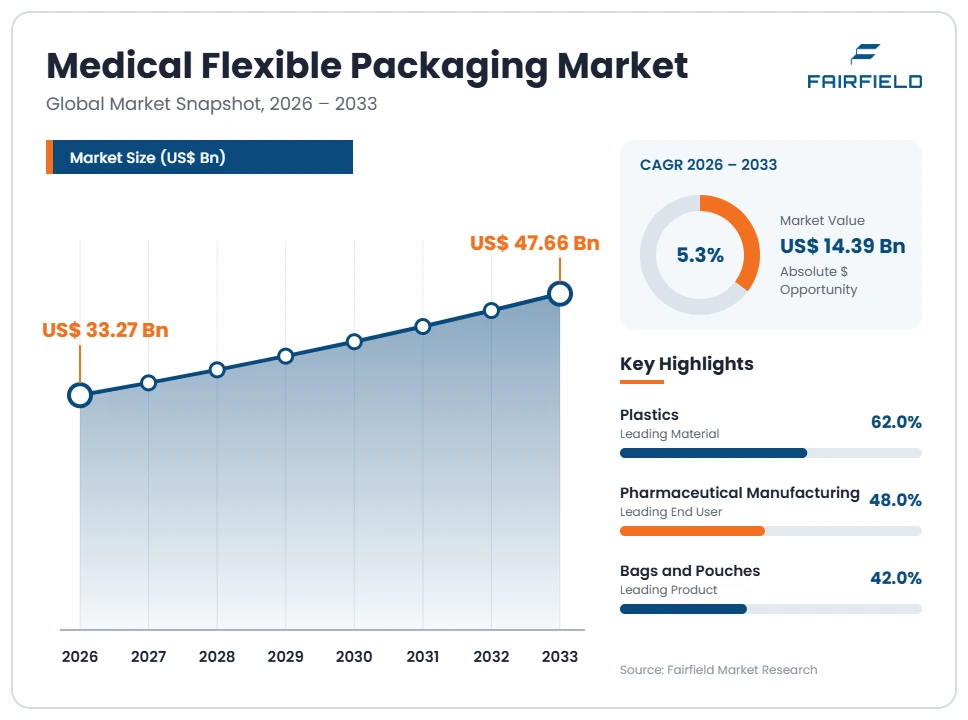
The global medical flexible packaging market size is expected to be valued at US$ 33.27 billion in 2026 and projected to reach US$ 47.66 billion by 2033, growing at a CAGR of 5.3% between 2026 and 2033.
Between 2020 and 2025, the market grew at a CAGR of about 4.8%, reaching about US$ 31.6 billion in 2025, as pandemic demand for testing kits, protective equipment, and vaccines lifted volumes in 2020 and 2021, then steady growth in pharmaceuticals and medical devices continued while resin and energy costs rose. The medical flexible packaging market covers bags, pouches, films, lidding, wraps, and laminates made from plastics, paper, aluminum foil, and Tyvek that protect medicines, medical devices, diagnostic kits, and surgical supplies. It includes sterile barrier packaging that keeps devices sterile until use, header bags, medical pouches, blister lidding, IV and blood bags, and sachets. Materials include polyethylene, polypropylene, PET, PVC, and coated papers. Growth comes from rising healthcare spending, more surgical procedures, and single-use devices. In November 2026, Nelipak acquired Technipaq to expand its sterilizable flexible packaging.
Key Report Takeaways
- By Material: Plastics held about 62% share in 2025, while Paper and Tyvek is projected to expand at a 6.4% CAGR through 2033, driven by breathable sterile barrier needs, recyclability goals, and growth in sterilizable device packaging.
- By Product: Bags and Pouches held about 42% share in 2025, while Films and Lidding is projected to expand at a 6.2% CAGR through 2033, driven by blister packs for medicines, thermoformed device trays, and automated packaging lines.
- By End User: Pharmaceutical Manufacturing held about 48% share in 2025, while Medical Device Manufacturing is projected to expand at a 6.0% CAGR through 2033, driven by more surgeries, single-use devices, and strict sterile packaging rules.
- By Region: Asia Pacific held about 38% share in 2025, while India is projected to expand at a 7.0% CAGR through 2033, driven by strong generic drug exports, new device plants, and rising hospital capacity.
Global Medical Flexible Packaging Market Trends and Insights
Drivers Impact Analysis
Two drivers carry the strongest influence on medical flexible packaging market demand during the forecast period.
| Driver | Impact on CAGR Forecast | Geographic Relevance | Impact Timeline |
| Rising pharmaceutical and medical device production | High | Global | Long term (≥4 years) |
| Growth of single-use devices and sterile packaging rules | Medium | North America, Europe, Asia Pacific | Medium term (2-4 years) |
Healthcare Production Is Driving the Medical Flexible Packaging Market
Rising pharmaceutical and medical device production is the strongest driver of the medical flexible packaging market. More medicines and devices need protection.
The mechanism is the growth of healthcare output worldwide. Aging populations, chronic diseases, and wider insurance coverage are increasing demand for medicines, injectables, diagnostic tests, and medical devices in every region. Pharmaceutical companies use flexible blister lidding, sachets, and pouches to protect tablets and powders from moisture, light, and oxygen, and biologics and vaccines need specialized packaging. Medical device makers package catheters, syringes, implants, gloves, and surgical kits in pouches and header bags. Generic drug production in India and China supplies the world, and new device plants are opening in Mexico, Ireland, Malaysia, and Costa Rica. Each new product and plant adds steady demand for packaging materials. These trends support long-term demand.
Sterile Packaging Needs Are Expanding the Medical Flexible Packaging Market
The growth of single-use devices and sterile packaging rules are expanding the medical flexible packaging market. Hospitals rely on sterile products.
The cause is infection control and regulation. Hospitals increasingly use single-use instruments, kits, and devices to cut infection risk and cleaning costs, and each item needs a sterile barrier packaging system that survives sterilization, transport, and storage. Standards such as ISO 11607 require validated packaging, and regulators in Europe and the United States have tightened rules on device labeling and traceability. Packaging failures such as seal defects can lead to recalls, so device makers want reliable suppliers. In August 2026, Amcor added automated lines with full vision inspection at its Mundelein, Illinois, healthcare plant. Unique device identification rules also require clear printed codes on many packs. These trends expand sales.
Restraints Impact Analysis
Two restraints limit how quickly the medical flexible packaging market grows.
| Restraint | Impact on CAGR Forecast | Geographic Relevance | Impact Timeline |
| Plastic waste and recyclability pressures | High | Europe, North America | Long term (≥4 years) |
| Volatile resin costs and long validation times | Medium | Global | Medium term (2-4 years) |
Sustainability Pressure Slows the Medical Flexible Packaging Market
Plastic waste and recyclability pressures slow the medical flexible packaging market. Healthcare creates large amounts of packaging waste.
The specific causes are multi-material packaging and new rules. Many medical packages combine several plastic layers, foil, and paper to achieve barrier and sterility, which makes them hard to recycle. Hospitals generate large volumes of packaging waste, and health systems in Europe and North America have set targets to cut emissions and waste. The European Union packaging rules set recyclability goals, though some medical packaging receives exemptions. Switching to mono-material or recyclable designs requires new testing and approval, which takes time and money. Some PVC and fluorinated materials face restrictions. These pressures slow growth for traditional materials and raise costs for packaging makers and their healthcare customers, who must balance patient safety with environmental goals.
Validation and Cost Challenges Restrict the Medical Flexible Packaging Market
Volatile resin costs and long validation times restrict the medical flexible packaging market. Changing packaging is slow.
The underlying causes are raw material swings and strict testing. Polyethylene, polypropylene, PET, and aluminum prices follow energy markets, and long-term contracts make it hard to pass on increases. Any change to medical packaging materials or suppliers requires validation testing and sometimes regulatory filings, which can take more than a year and cost large sums for each product line. Shortages of medical-grade resins, Tyvek, and specialty papers have caused delays in some years. Smaller converters struggle to afford the clean rooms, testing labs, and quality systems that medical customers require. Ethylene oxide sterilization limits in the United States may also force packaging redesigns for other sterilization methods. These factors restrict growth.
Market Opportunities
Recyclable and Mono-Material Packaging Opens a Fast-Growth Revenue Pool
Recyclable and mono-material packaging opens a fast-growth revenue pool in the medical flexible packaging market. Customers want greener options.
Suppliers can capture this opportunity. Pharmaceutical and device companies have set sustainability targets and are asking for packaging made from single materials, recycled content, or bio-based plastics that still meet sterility and barrier needs. Recycle-ready polyethylene and polypropylene laminates, paper-based blister packs, and lighter films are being developed and tested. Hospitals in Europe and North America want packaging that is easier to recycle, and some health systems include sustainability in tenders. Packaging made with less material also lowers shipping costs. Companies that offer validated sustainable designs and help customers with testing and regulatory documentation can win new business and premium prices, as customers prefer suppliers that reduce their validation workload.
Biologics and Home Care Create a Growth Revenue Pool
Biologics and home care create a growth revenue pool in the medical flexible packaging market. New therapies need specialized packaging.
Suppliers can capture this opportunity. Biologic drugs, cell and gene therapies, and vaccines need high-barrier bags and pouches that protect sensitive products, sometimes at very low temperatures. Home care, self-injection devices, and at-home diagnostic kits need easy-to-open, clearly labeled packs. In November 2026, Nelipak acquired Technipaq to grow its pouch and lidding capacity. Cold chain and cryogenic bags must stay strong and sealed at very low temperatures, and clinical trial kits need small batches with flexible printing. Growth in injectable weight-loss and diabetes drugs adds demand for pen and syringe packaging. Companies with specialized materials, small-batch capabilities, and strong quality records can grow.
Segment Analysis
- By Material: Plastics Lead While Paper and Tyvek Grow Fastest
Plastics held about 62% share in 2025. Polyethylene, polypropylene, PET, and PVC films provide strength, clarity, moisture barrier, and sealability, and they are used in pouches, bags, blister lidding, IV bags, and wraps. Multi-layer plastic films can be tailored for different sterilization methods and barrier needs, making them the most widely used material.
Paper and Tyvek is the fastest-growing material, expanding at a 6.4% CAGR through 2033. Medical-grade paper and DuPont’s Tyvek are breathable, allowing sterilizing gases to enter while keeping bacteria out, and they are standard in device pouches and header bags. Paper-based designs also support recycling goals. Aluminum foil and other materials form further segments, used for high-barrier medicine packs. For the market, paper and Tyvek growth supports device packaging.
- By Product: Bags and Pouches Lead While Films and Lidding Grow Fastest
Bags and Pouches held about 42% share in 2025. Medical pouches and header bags package syringes, catheters, implants, gloves, and surgical kits, while IV, blood, and drainage bags hold fluids. Pre-made pouches let device makers package products quickly, and new designs make opening easier for clinicians. Chevron and peel pouches allow aseptic presentation in operating rooms, and pouches are validated for ethylene oxide, gamma, steam, and hydrogen peroxide sterilization.
Films and Lidding is the fastest-growing product, expanding at a 6.2% CAGR through 2033. Lidding films seal thermoformed device trays and blister packs for tablets and capsules, and rollstock films run on automated form-fill-seal lines. Wraps, sachets, laminates, and other products form further segments, with sterilization wraps used for hospital instrument trays. For the market, films and lidding growth follows automated packaging.
- By End User: Pharmaceutical Manufacturing Leads While Medical Device Manufacturing Grows Fastest
Pharmaceutical Manufacturing held about 48% share in 2025. Drug makers use flexible packaging for blister packs, sachets, strip packs, and bags for active ingredients and finished medicines, and generic production in India and China uses large volumes. Biologics and vaccines add high-value demand, and child-resistant and senior-friendly blister designs are growing. Moisture-sensitive medicines need high-barrier foil packs.
Medical Device Manufacturing is the fastest-growing end user, expanding at a 6.0% CAGR through 2033. More surgeries, minimally invasive procedures, and single-use devices increase demand for sterile pouches and lidding. Contract packaging, implant manufacturing, and other end users form further segments, with contract packagers serving smaller drug and device firms. Orthopedic and cardiovascular implants need double sterile barrier packs. For the market, device growth adds sterile packaging value.
Geography Analysis
- Why Is North America Important to the Medical Flexible Packaging Market?
North America is important to the medical flexible packaging market because it has the world’s largest medical device industry and strict sterile packaging standards. The United States hosts major device makers such as Medtronic, Becton, Dickinson and Company, Johnson & Johnson, and Abbott, along with packaging suppliers Amcor, Sealed Air, Oliver Healthcare Packaging, Nelipak, and Tekni-Plex. In 2026, Amcor upgraded its Mundelein plant and Nelipak acquired Technipaq. Mexico has large device assembly plants, and Canada adds pharmaceutical demand. Key barriers include sustainability pressure and validation costs. One change shaping the region is reshoring.
- Europe Shapes the Medical Flexible Packaging Market Through Regulation and Sustainability
Europe is a major medical flexible packaging market. Germany, Ireland, Switzerland, France, and Italy have large pharmaceutical and device industries, and Ireland is a major device manufacturing hub. Constantia Flexibles, Huhtamaki, Mondi, and Amcor operate many plants in the region, serving drug and device makers across many countries. The European Union medical device regulation and packaging rules raise quality and sustainability demands. Pharmaceutical exports from Germany and Switzerland need high-barrier packs. Key barriers include high energy costs and recycling targets. One opportunity is recyclable medical packaging that meets new rules while keeping sterility.
- Which Region Is Leading the Medical Flexible Packaging Market?
Asia Pacific is leading the medical flexible packaging market with about 38% share in 2025, and India is the fastest-growing country, expanding at a 7.0% CAGR through 2033. India is the world’s largest supplier of generic medicines and is growing its device industry under government incentive programs. China has large pharmaceutical, device, and packaging industries, while Japan, South Korea, Malaysia, and Singapore host device and biologics plants. Rising hospital capacity adds demand, and local converters are investing in clean rooms. Key barriers include price competition and uneven quality standards. One change shaping the region is device manufacturing growth.
- Latin America Grows the Medical Flexible Packaging Market Through Device Exports
Latin America is a growing medical flexible packaging market. Mexico and Costa Rica host major medical device plants that export to North America, while Brazil and Argentina have large pharmaceutical industries serving domestic patients. Rising healthcare spending, public hospital programs, and hospital expansion add domestic demand. Global packaging suppliers serve the region through local plants and imports, and Brazil has a growing generic medicine industry. Key barriers include economic swings, currency changes, slow regulatory approvals, and reliance on imported films. One opportunity is supplying sterile packaging to device plants in Mexico and Costa Rica from nearby local converting sites.
- Middle East & Africa Builds the Medical Flexible Packaging Market Through Local Manufacturing
Middle East & Africa is an emerging medical flexible packaging market. Saudi Arabia, the United Arab Emirates, and Egypt are building local pharmaceutical and device manufacturing under national industrial programs, and South Africa has an established pharmaceutical industry with large generic makers. Vaccine production projects in South Africa, Egypt, and Rwanda add demand, and hospital construction in Saudi Arabia increases use of sterile supplies. Key barriers include reliance on imported films and pouches, limited local packaging capacity, and few trained quality staff. One opportunity is packaging for new local drug and vaccine plants supported by governments.
Competitive Landscape
The medical flexible packaging market is moderately consolidated. Amcor, Sealed Air, Huhtamaki, Constantia Flexibles, and Oliver Healthcare Packaging are leading players, while Nelipak, Tekni-Plex, Mondi, DuPont, Coveris, Sonoco Products Company, and Winpak compete strongly. Large global converters supply films, laminates, and pouches across many countries, while specialist medical packaging firms focus on sterile device packaging, and many regional converters serve local drug makers with blister lidding and sachets.
Companies compete on quality systems, clean room capacity, validated materials, regulatory support, reliability of supply, sustainability, and price. Medical customers rarely change suppliers because each change needs new validation testing, so long relationships and proven track records are key advantages. Global plant networks help suppliers serve multinational drug and device makers in several regions with the same approved materials.
Strategic moves show how competition is changing. In April 2025, Amcor completed its combination with Berry Global, creating a much larger packaging group. In August 2026, Amcor added automated lines with full vision inspection at its Mundelein healthcare plant. In November 2026, Nelipak acquired Technipaq to expand its sterilizable flexible packaging. These moves show competition shifting toward scale, quality control, and capacity for sterile device packaging.
Three themes shape vendor strategy. First, companies are investing in automation and inspection to prevent seal failures. Second, they are developing recyclable and mono-material medical packaging. Third, they are expanding near growing drug and device clusters in Asia Pacific and Latin America.
Medical Flexible Packaging Market Industry Leaders
- Amcor
- Sealed Air
- Huhtamaki
- Constantia Flexibles
- Oliver Healthcare Packaging
Recent Industry Developments
- November 2026: Nelipak acquired Technipaq, a maker of sterilizable flexible packaging and DuPont Tyvek authorized converter in Illinois, adding nearly 200 employees - expands medical pouches and lidding in the medical flexible packaging market.
- August 2026: Amcor added automated lines and vision systems that inspect every healthcare bag for seal defects at its Mundelein, Illinois, plant - strengthens sterile barrier packaging quality and traceability.
- April 2025: Amcor completed its combination with Berry Global, creating a larger packaging company with expanded healthcare capabilities - reshapes competition in medical packaging.
Companies Covered in the Report
- Amcor
- Sealed Air
- Huhtamaki
- Constantia Flexibles
- Oliver Healthcare Packaging
- Nelipak
- Tekni-Plex
- Mondi
- DuPont
- Coveris
- Sonoco Products Company
- Winpak
Medical Flexible Packaging Market Report Scope
| Metric | Value |
| Study Period | 2020-2033 |
| Market Size 2026 | US$ 33.27 Billion |
| Market Size 2033 | US$ 47.66 Billion |
| CAGR 2026-2033 | 5.3% |
| Absolute Dollar Opportunity | US$ 14.39 Billion |
| Largest Market | Asia Pacific |
| Fastest-Growing Market | India |
| Market Concentration | Moderately Consolidated |
| Major Players | Amcor, Sealed Air, Huhtamaki, Constantia Flexibles, Oliver Healthcare Packaging |
Medical Flexible Packaging Market Segmentation
- Executive Summary
- Medical Flexible Packaging Market Snapshot
- Future Projections
- Key Market Trends
- Regional Snapshot
- Market Overview
- Market Definition and Report Scope
- Historical Market Trends
- Market Dynamics
- Drivers
- Healthcare Production Is Driving the Medical Flexible Packaging Market
- Sterile Packaging Needs Are Expanding the Medical Flexible Packaging Market
- Restraints
- Sustainability Pressure Slows the Medical Flexible Packaging Market
- Validation and Cost Challenges Restrict the Medical Flexible Packaging Market
- Market Opportunities
- Recyclable and Mono-Material Packaging Opens a Fast-Growth Revenue Pool
- Biologics and Home Care Create a Growth Revenue Pool
- Drivers
- Global Medical Flexible Packaging Market Outlook, 2020–2033
- Global Medical Flexible Packaging Market Outlook, by Material, Value (US$ Billion), 2020–2033
- Plastics
- Paper and Tyvek
- Aluminum Foil
- Others
- Global Medical Flexible Packaging Market Outlook, by Product, Value (US$ Billion), 2020–2033
- Bags and Pouches
- Films and Lidding
- Wraps and Sachets
- Others
- Global Medical Flexible Packaging Market Outlook, by End User, Value (US$ Billion), 2020–2033
- Pharmaceutical Manufacturing
- Medical Device Manufacturing
- Implant Manufacturing
- Contract Packaging
- Others
- Global Medical Flexible Packaging Market Outlook, by Region, Value (US$ Billion), 2020–2033
- North America
- Europe
- Asia Pacific
- Latin America
- Middle East & Africa
- Global Medical Flexible Packaging Market Outlook, by Material, Value (US$ Billion), 2020–2033
- North America Medical Flexible Packaging Market Outlook, 2020–2033
- North America Medical Flexible Packaging Market Outlook, by Material, Value (US$ Billion), 2020–2033
- Plastics
- Paper and Tyvek
- Aluminum Foil
- Others
- North America Medical Flexible Packaging Market Outlook, by Product, Value (US$ Billion), 2020–2033
- Bags and Pouches
- Films and Lidding
- Wraps and Sachets
- Others
- North America Medical Flexible Packaging Market Outlook, by End User, Value (US$ Billion), 2020–2033
- Pharmaceutical Manufacturing
- Medical Device Manufacturing
- Implant Manufacturing
- Contract Packaging
- Others
- North America Medical Flexible Packaging Market Outlook, by Country, Value (US$ Billion), 2020–2033
- United States Medical Flexible Packaging Market Outlook, by Material, 2020–2033
- United States Medical Flexible Packaging Market Outlook, by Product, 2020–2033
- United States Medical Flexible Packaging Market Outlook, by End User, 2020–2033
- Mexico Medical Flexible Packaging Market Outlook, by Material, 2020–2033
- Mexico Medical Flexible Packaging Market Outlook, by Product, 2020–2033
- Mexico Medical Flexible Packaging Market Outlook, by End User, 2020–2033
- Canada Medical Flexible Packaging Market Outlook, by Material, 2020–2033
- Canada Medical Flexible Packaging Market Outlook, by Product, 2020–2033
- Canada Medical Flexible Packaging Market Outlook, by End User, 2020–2033
- North America Medical Flexible Packaging Market Outlook, by Material, Value (US$ Billion), 2020–2033
- Europe Medical Flexible Packaging Market Outlook, 2020–2033
- Europe Medical Flexible Packaging Market Outlook, by Material, Value (US$ Billion), 2020–2033
- Plastics
- Paper and Tyvek
- Aluminum Foil
- Others
- Europe Medical Flexible Packaging Market Outlook, by Product, Value (US$ Billion), 2020–2033
- Bags and Pouches
- Films and Lidding
- Wraps and Sachets
- Others
- Europe Medical Flexible Packaging Market Outlook, by End User, Value (US$ Billion), 2020–2033
- Pharmaceutical Manufacturing
- Medical Device Manufacturing
- Implant Manufacturing
- Contract Packaging
- Others
- Europe Medical Flexible Packaging Market Outlook, by Country, Value (US$ Billion), 2020–2033
- Germany Medical Flexible Packaging Market Outlook, by Material, 2020–2033
- Germany Medical Flexible Packaging Market Outlook, by Product, 2020–2033
- Germany Medical Flexible Packaging Market Outlook, by End User, 2020–2033
- Ireland Medical Flexible Packaging Market Outlook, by Material, 2020–2033
- Ireland Medical Flexible Packaging Market Outlook, by Product, 2020–2033
- Ireland Medical Flexible Packaging Market Outlook, by End User, 2020–2033
- Switzerland Medical Flexible Packaging Market Outlook, by Material, 2020–2033
- Switzerland Medical Flexible Packaging Market Outlook, by Product, 2020–2033
- Switzerland Medical Flexible Packaging Market Outlook, by End User, 2020–2033
- France Medical Flexible Packaging Market Outlook, by Material, 2020–2033
- France Medical Flexible Packaging Market Outlook, by Product, 2020–2033
- France Medical Flexible Packaging Market Outlook, by End User, 2020–2033
- Italy Medical Flexible Packaging Market Outlook, by Material, 2020–2033
- Italy Medical Flexible Packaging Market Outlook, by Product, 2020–2033
- Italy Medical Flexible Packaging Market Outlook, by End User, 2020–2033
- Europe Medical Flexible Packaging Market Outlook, by Material, Value (US$ Billion), 2020–2033
- Asia Pacific Medical Flexible Packaging Market Outlook, 2020–2033
- Asia Pacific Medical Flexible Packaging Market Outlook, by Material, Value (US$ Billion), 2020–2033
- Plastics
- Paper and Tyvek
- Aluminum Foil
- Others
- Asia Pacific Medical Flexible Packaging Market Outlook, by Product, Value (US$ Billion), 2020–2033
- Bags and Pouches
- Films and Lidding
- Wraps and Sachets
- Others
- Asia Pacific Medical Flexible Packaging Market Outlook, by End User, Value (US$ Billion), 2020–2033
- Pharmaceutical Manufacturing
- Medical Device Manufacturing
- Implant Manufacturing
- Contract Packaging
- Others
- Asia Pacific Medical Flexible Packaging Market Outlook, by Country, Value (US$ Billion), 2020–2033
- India Medical Flexible Packaging Market Outlook, by Material, 2020–2033
- India Medical Flexible Packaging Market Outlook, by Product, 2020–2033
- India Medical Flexible Packaging Market Outlook, by End User, 2020–2033
- China Medical Flexible Packaging Market Outlook, by Material, 2020–2033
- China Medical Flexible Packaging Market Outlook, by Product, 2020–2033
- China Medical Flexible Packaging Market Outlook, by End User, 2020–2033
- Japan Medical Flexible Packaging Market Outlook, by Material, 2020–2033
- Japan Medical Flexible Packaging Market Outlook, by Product, 2020–2033
- Japan Medical Flexible Packaging Market Outlook, by End User, 2020–2033
- South Korea Medical Flexible Packaging Market Outlook, by Material, 2020–2033
- South Korea Medical Flexible Packaging Market Outlook, by Product, 2020–2033
- South Korea Medical Flexible Packaging Market Outlook, by End User, 2020–2033
- Malaysia Medical Flexible Packaging Market Outlook, by Material, 2020–2033
- Malaysia Medical Flexible Packaging Market Outlook, by Product, 2020–2033
- Malaysia Medical Flexible Packaging Market Outlook, by End User, 2020–2033
- Singapore Medical Flexible Packaging Market Outlook, by Material, 2020–2033
- Singapore Medical Flexible Packaging Market Outlook, by Product, 2020–2033
- Singapore Medical Flexible Packaging Market Outlook, by End User, 2020–2033
- Asia Pacific Medical Flexible Packaging Market Outlook, by Material, Value (US$ Billion), 2020–2033
- Latin America Medical Flexible Packaging Market Outlook, 2020–2033
- Latin America Medical Flexible Packaging Market Outlook, by Material, Value (US$ Billion), 2020–2033
- Plastics
- Paper and Tyvek
- Aluminum Foil
- Others
- Latin America Medical Flexible Packaging Market Outlook, by Product, Value (US$ Billion), 2020–2033
- Bags and Pouches
- Films and Lidding
- Wraps and Sachets
- Others
- Latin America Medical Flexible Packaging Market Outlook, by End User, Value (US$ Billion), 2020–2033
- Pharmaceutical Manufacturing
- Medical Device Manufacturing
- Implant Manufacturing
- Contract Packaging
- Others
- Latin America Medical Flexible Packaging Market Outlook, by Country, Value (US$ Billion), 2020–2033
- Mexico Medical Flexible Packaging Market Outlook, by Material, 2020–2033
- Mexico Medical Flexible Packaging Market Outlook, by Product, 2020–2033
- Mexico Medical Flexible Packaging Market Outlook, by End User, 2020–2033
- Costa Rica Medical Flexible Packaging Market Outlook, by Material, 2020–2033
- Costa Rica Medical Flexible Packaging Market Outlook, by Product, 2020–2033
- Costa Rica Medical Flexible Packaging Market Outlook, by End User, 2020–2033
- Brazil Medical Flexible Packaging Market Outlook, by Material, 2020–2033
- Brazil Medical Flexible Packaging Market Outlook, by Product, 2020–2033
- Brazil Medical Flexible Packaging Market Outlook, by End User, 2020–2033
- Argentina Medical Flexible Packaging Market Outlook, by Material, 2020–2033
- Argentina Medical Flexible Packaging Market Outlook, by Product, 2020–2033
- Argentina Medical Flexible Packaging Market Outlook, by End User, 2020–2033
- Latin America Medical Flexible Packaging Market Outlook, by Material, Value (US$ Billion), 2020–2033
- Middle East & Africa Medical Flexible Packaging Market Outlook, 2020–2033
- Middle East & Africa Medical Flexible Packaging Market Outlook, by Material, Value (US$ Billion), 2020–2033
- Plastics
- Paper and Tyvek
- Aluminum Foil
- Others
- Middle East & Africa Medical Flexible Packaging Market Outlook, by Product, Value (US$ Billion), 2020–2033
- Bags and Pouches
- Films and Lidding
- Wraps and Sachets
- Others
- Middle East & Africa Medical Flexible Packaging Market Outlook, by End User, Value (US$ Billion), 2020–2033
- Pharmaceutical Manufacturing
- Medical Device Manufacturing
- Implant Manufacturing
- Contract Packaging
- Others
- Middle East & Africa Medical Flexible Packaging Market Outlook, by Country, Value (US$ Billion), 2020–2033
- Saudi Arabia Medical Flexible Packaging Market Outlook, by Material, 2020–2033
- Saudi Arabia Medical Flexible Packaging Market Outlook, by Product, 2020–2033
- Saudi Arabia Medical Flexible Packaging Market Outlook, by End User, 2020–2033
- United Arab Emirates Medical Flexible Packaging Market Outlook, by Material, 2020–2033
- United Arab Emirates Medical Flexible Packaging Market Outlook, by Product, 2020–2033
- United Arab Emirates Medical Flexible Packaging Market Outlook, by End User, 2020–2033
- Egypt Medical Flexible Packaging Market Outlook, by Material, 2020–2033
- Egypt Medical Flexible Packaging Market Outlook, by Product, 2020–2033
- Egypt Medical Flexible Packaging Market Outlook, by End User, 2020–2033
- South Africa Medical Flexible Packaging Market Outlook, by Material, 2020–2033
- South Africa Medical Flexible Packaging Market Outlook, by Product, 2020–2033
- South Africa Medical Flexible Packaging Market Outlook, by End User, 2020–2033
- Middle East & Africa Medical Flexible Packaging Market Outlook, by Material, Value (US$ Billion), 2020–2033
- Competitive Landscape
- Medical Flexible Packaging Market Industry Leaders
- Recent Industry Developments
- Company Profiles
- Amcor
- Sealed Air
- Huhtamaki
- Constantia Flexibles
- Oliver Healthcare Packaging
- Nelipak
- Tekni-Plex
- Mondi
- DuPont
- Coveris
- Sonoco Products Company
- Winpak
- Appendix
- Research Methodology
- Report Assumptions
- Acronyms and Abbreviations
Material
- Plastics
- Paper and Tyvek
- Aluminum Foil
- Others
Product
- Bags and Pouches
- Films and Lidding
- Wraps and Sachets
- Others
End User
- Pharmaceutical Manufacturing
- Medical Device Manufacturing
- Implant Manufacturing
- Contract Packaging
- Others
Regions
- North America
- Europe
- Asia Pacific
- Latin America
- Middle East & Africa
Our Research Methodology
Considering the volatility of business today, traditional approaches to strategizing a game plan can be unfruitful if not detrimental. True ambiguity is no way to determine a forecast. A myriad of predetermined factors must be accounted for such as the degree of risk involved, the magnitude of circumstances, as well as conditions or consequences that are not known or unpredictable. To circumvent binary views that cast uncertainty, the application of market research intelligence to strategically posture, move, and enable actionable outcomes is necessary.
View Methodology
Quality Assured
Rigorous Validation Process

Confidentiality Assured
End-to-end Data Security

Custom Research Services
Tailored To Your Objectives
FAQs
The medical flexible packaging market is valued at US$ 33.27 billion in 2026, led by plastics, pouches, and Asia Pacific.
The market is projected to reach US$ 47.66 billion by 2033, growing at a 5.3% CAGR and adding US$ 14.39 billion.
Medical device manufacturing is growing fastest at a 6.0% CAGR through 2033, driven by more surgeries and single-use devices.
India is growing fastest at a 7.0% CAGR through 2033, driven by generic drug exports, new device plants, and rising hospital capacity.
Asia Pacific holds the largest share at about 38% in 2025, supported by pharmaceutical and device production in India and China.
Related Reports
Polyurethane Elastomers Market Size, Share, Insights, Competitive Landscape, and Forecast 2026 to 2033
The global polyurethane elastomers market is valued at US$9.8 billion in 2026, reaching US$14.9 billion by 2033, growing at a 6.2% CAGR
Green Composites Market Size, Share, Insights, Competitive Landscape, and Forecast 2026 to 2033
The global green composites market is valued at US$9.2 billion in 2026, reaching US$18.6 billion by 2033, growing at a 10.6% CAGR
Corrosion Protection Coatings Market Size, Share, Insights, Competitive Landscape, and Forecast 2026 to 2033
Explore the corrosion protection coatings market outlook for 2026–2033, including resin trends, application methods, regional demand, and key suppliers.
Coated Abrasives Market Size, Share, Insights, Competitive Landscape, and Forecast 2026 to 2033
The coated abrasives market is projected to grow from US$13.4 billion in 2026 to US$19.0 billion by 2033 at a 5.1% CAGR.
Aerosol Propellants Market Size, Share, Insights, Competitive Landscape, and Forecast 2026 to 2033
The aerosol propellants market is projected to grow from US$11.90 billion in 2026 to US$16.63 billion by 2033 at a 4.9% CAGR.
Marine Oligosaccharides Market Size, Share, Insights, Competitive Landscape, and Forecast 2026 to 2033
The marine oligosaccharides market is projected to grow from US$0.3 billion in 2026 to US$0.6 billion by 2033 at a 10.4% CAGR.