



Corrosion Protection Coatings Market
Corrosion Protection Coatings Market Size, Share, Insights, Competitive Landscape, and Forecast 2026 to 2033
Report Overview
Corrosion Protection Coatings Market Size and Trend Analysis
How Fast Will Corrosion Protection Coatings Demand Grow?
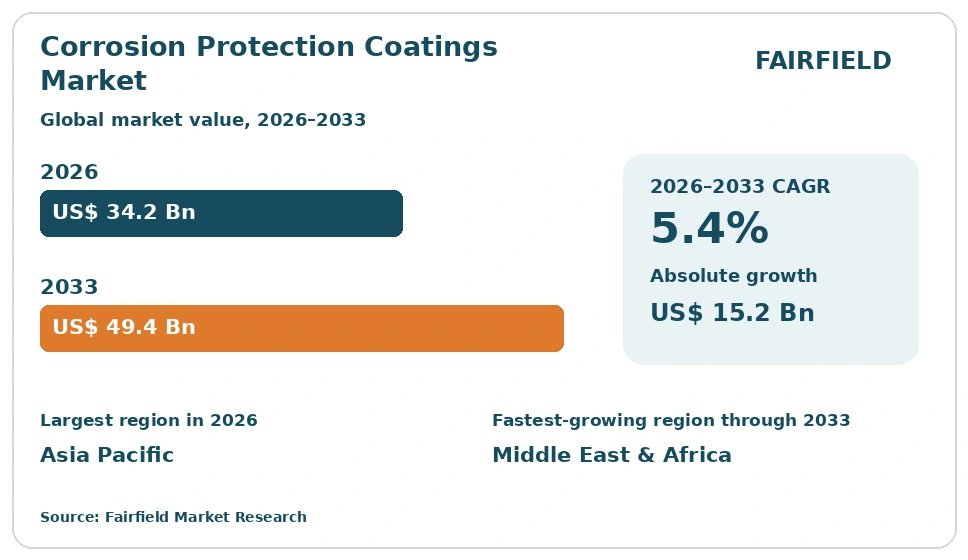
The global Corrosion Protection Coatings market size is expected to be valued at US$ 34.2 billion in 2026 and projected to reach US$ 49.4 billion by 2033, growing at a CAGR of 5.4% between 2026 and 2033. Growth rests on heavy maintenance spending across aging pipelines, bridges, storage tanks and process plants. Owners now treat coating cycles as asset-life decisions rather than cosmetic work. Demand is also shifting toward lower-solvent chemistries, as emission rules tighten across manufacturing regions. Between 2020 and 2025 the market advanced at a CAGR of 4.1%, and the forecast period adds an absolute dollar opportunity of US$ 15.2 billion.
Key Report Takeaways
- By Resin Type: Epoxy systems led with 38.6% share in 2026, while zinc-rich primers are projected to expand at a 7.2% CAGR through 2033, driven by galvanic protection needs on offshore steel exposed to constant salt spray.
- By Technology: Solventborne coatings led with 48.3% share in 2026, while waterborne systems are projected to expand at a 7.1% CAGR through 2033, driven by workplace solvent exposure limits inside shop-applied steel finishing lines.
- By Application Method: Spray application led with 52.7% share in 2026, while electrostatic and automated methods are projected to expand at a 7.3% CAGR through 2033, driven by robotic cells that hold film thickness within tight tolerances.
- By End Use: Oil and gas assets led with 26.8% share in 2026, while power generation is projected to expand at a 7.4% CAGR through 2033, driven by offshore wind tower, substation and transmission structure construction.
- By Region: Asia Pacific led with 41.8% share in 2026 across North America, Europe, Asia Pacific, Latin America and Middle East & Africa, while Middle East & Africa is projected to expand at a 7.0% CAGR through 2033, driven by Gulf refinery and desalination construction.
Market Trends and Insights
Market Growth Drivers
Aging Energy and Industrial Assets Lift Maintenance Coating Volumes
Maintenance repainting, not new construction, now anchors demand for corrosion protection coatings. Large volumes of refinery piping, storage tanks, transmission towers and highway bridges built decades ago are entering their second or third coating cycle. Owners face a direct choice between recoating on schedule and absorbing steel replacement costs that run far higher. That calculation keeps coating budgets stable even when capital projects are deferred.
Asset integrity programmes reinforce this pattern. Operators increasingly schedule inspection and recoating against condition data rather than fixed calendars, which concentrates spending on the worst-affected zones. Standards published by ISO, and the surface preparation practices maintained by AMPP, formed from NACE International and SSPC, give engineers a shared language for specifying surface cleanliness and film thickness. Shutdown windows are short, so contractors favour fast-cure epoxy and polyurethane systems that return assets to service quickly.
Offshore Wind and Marine Fleet Activity Widen Protective Coating Use
Offshore structures consume more coating per tonne of steel than almost any other application, and their growth pulls value into the market. Monopiles, transition pieces, jackets and offshore substations sit in splash zones where immersion, abrasion and salt spray act together. Specifications there call for multi-coat zinc-rich and epoxy build systems with long service intervals, since repair access at sea is costly and weather-dependent.
Commercial shipping supports the same demand base. Hull, ballast tank and deck coatings follow survey cycles set by classification societies and the International Maritime Organization, so drydock schedules convert directly into coating orders. Shipyards in Asia and repair yards in the Gulf and Mediterranean apply high volumes of anticorrosive primer under fixed turnaround times. Suppliers compete on cure speed, overcoat windows and performance in humid yard conditions.
Restraints Impact Analysis of Market
Volatile Resin and Pigment Input Costs Compress Coating Margins
Raw material volatility remains the clearest constraint on earnings in this market. Epoxy resins, isocyanates, titanium dioxide and zinc dust together account for a large share of formulation cost, and their prices move with petrochemical feedstocks, metal markets and freight rates. Contract paint supply agreements often run for a year or longer, so manufacturers absorb part of any mid-term increase before repricing becomes possible.
Zinc exposure is particularly sharp. Zinc-rich primers depend on metallic zinc loadings that cannot be reduced far without weakening galvanic protection, which limits reformulation as a defence. Producers respond by qualifying alternative suppliers, blending zinc with other inhibitive pigments where specifications allow, and shifting some volume toward higher-solids products that deliver protection in fewer coats. Buyers, meanwhile, resist price increases on commodity maintenance grades, keeping competitive pressure firmly on margins.
Tightening Solvent Emission Rules Slow Conventional System Sales
Air quality regulation steadily narrows the room for traditional solventborne anticorrosive coatings. Volatile organic compound limits in North America, Europe and parts of Asia Pacific cap solvent content by product category, and permitting for industrial finishing operations grows more demanding. Applicators that cannot meet thresholds must install abatement equipment or change products, and both routes add cost to projects that were priced on older chemistries.
Reformulation is slower here than in decorative paint. Protective coatings must hold adhesion, flexibility and barrier performance after years of immersion or weathering, so each replacement product requires extended qualification testing by asset owners. Field application adds further difficulty, since waterborne systems are sensitive to humidity and temperature during cure. The result is a transition that moves specification by specification, holding back revenue from both conventional and replacement product lines.
Market Opportunities
Waterborne and High-Solids Systems Open New Specification Wins
Compliant chemistry is becoming a route to share gain rather than a compliance cost. Asset owners rewriting specifications for emission reasons create rare openings for suppliers to displace incumbents that have held a site for years. Waterborne epoxy and acrylic primers, high-solids polyurethanes and polysiloxane topcoats all address the same constraint, and each win tends to carry multi-year maintenance volume with it.
Shop-applied work is the natural entry point. Fabricators coating structural steel, pipe spools and modular units operate in controlled conditions where humidity and temperature can be managed, which removes the main field obstacle to waterborne cure. Suppliers that pair these products with applicator training and equipment support convert trials into standing approvals. Many are also extending single-coat and two-coat systems that cut labour hours, since application cost usually exceeds material cost on large projects.
Digital Inspection and Smart Coating Systems Create Service-Led Revenue
Coating suppliers are building service businesses around data, not just drums of product. Corrosion-under-insulation surveys, drone and crawler inspection of tanks and structures, and digital film thickness records let owners target recoating where it is genuinely needed. Suppliers that provide this evidence move from transactional sales toward long-term asset care contracts, which carry steadier volumes and closer technical relationships.
Product technology is moving in the same direction. Inhibitive and self-healing pigment systems, thermal spray aluminium alternatives and colour-change indicator coatings aim to extend intervals or make damage visible before steel loss begins. Interest is strongest where access is hard and failure is expensive, including offshore platforms, bridges and buried pipeline interfaces. Adoption still depends on field evidence over several years, so suppliers run instrumented trials with owners to build qualification data.
Category-wise Insights
Why Do Epoxy Systems Still Anchor Corrosion Protection Spending?
Epoxy resins led the market with 38.6% share in 2026, because no competing chemistry matches their adhesion to blasted steel and their barrier performance under immersion. Epoxy primers and intermediate coats form the base of most multi-coat specifications for tanks, pipelines, ballast tanks and structural steel. Polyurethane holds 22.4% as the preferred topcoat for gloss and ultraviolet resistance, with acrylic at 14.2% and alkyd at 10.8% in lighter-duty service.
Growth leadership sits elsewhere. Zinc-rich primers, at 8.5% share, are projected to expand at a 7.2% CAGR through 2033, as galvanic protection becomes standard on offshore and coastal steel. Specifiers increasingly accept the higher material cost because the sacrificial mechanism keeps protecting steel after mechanical damage. For suppliers, this split means epoxy sustains volume while zinc-rich and polysiloxane products carry the higher-value positions in the specification.
Solventborne Technology Holds Volume as Waterborne Lines Scale Fastest
Solventborne technology led with 48.3% share in 2026, since field-applied maintenance work still depends on products that cure reliably across wide temperature and humidity ranges. Site conditions on bridges, tank farms and offshore structures rarely allow the control that newer chemistries prefer. Powder coatings hold 17.9% in shop-applied pipe, rebar and component work, while high-solids and other systems account for 9.2%.
Waterborne technology, at 24.6% share, is the growth leader at a 7.1% CAGR through 2033. Volatile organic compound limits, workplace exposure rules and insurer concerns about solvent storage all push fabricators toward water-based primers. Performance has improved as flash-rust inhibitors and cure modifiers matured. The practical effect is a market splitting by location of application: controlled shop environments move toward waterborne and powder, while field maintenance stays solventborne for longer.
Which Application Method Dominates Protective Coating Projects?
Spray application dominated with 52.7% share in 2026, because airless spray delivers the film builds that protective specifications demand across large steel areas at acceptable labour cost. Bridge girders, tank exteriors, offshore modules and plant structures are almost always spray-applied. Brush and roller retains 21.4%, mainly for stripe coating of welds, edges and bolts where spray alone leaves thin film. Dip and immersion covers 14.5% of fasteners and small components.
Electrostatic and automated methods hold 11.4% share and are growing fastest at a 7.3% CAGR through 2033. Fabrication shops are installing robotic and reciprocator cells to cut overspray, reduce material waste and document film thickness automatically. Skilled applicator shortages in North America and Europe add further pressure. Automation shifts value toward suppliers whose products are tuned for machine application and consistent transfer efficiency.
Oil and Gas Assets Lead Spending While Power Generation Accelerates
Oil and gas led end-use demand with 26.8% share in 2026, reflecting the sheer surface area of pipelines, storage tanks, refinery units and offshore platforms that must be protected continuously. Infrastructure and construction follows at 21.6%, supported by bridge and water asset renewal, with marine at 18.4%, industrial plant and equipment at 12.9% and transportation at 8.0%.
Power generation, at 12.3% share, is the fastest-growing end use at a 7.4% CAGR through 2033. Offshore wind foundations, transmission towers, substations and cooling water systems all require heavy-duty protective systems, and renewable build-out is adding steel faster than conventional generation retires it. Service life expectations of 25 years or more push owners toward premium multi-coat specifications. For coating suppliers, energy transition projects are becoming a second structural growth engine alongside hydrocarbons.
Geography Analysis
North America Sustains Demand Through Maintenance and Reshored Fabrication
North America held 23.1% share in 2026 and is set to grow at a 4.3% CAGR through 2033. The United States dominates regional consumption, with Canada contributing pipeline and mining demand and Mexico adding refinery and automotive supply chain volume. Spending concentrates on maintenance of an installed base built decades ago, including Gulf Coast refining and petrochemical assets, inland bridges and water infrastructure. Federal and state surface transportation funding supports steady bridge recoating programmes. Volatile organic compound rules administered at state and district level accelerate the shift toward compliant coatings, while reshored manufacturing and semiconductor plant construction add shop-applied structural steel volume.
Europe Advances on Regulation, Offshore Wind and Asset Renewal
Europe accounted for 21.4% share in 2026, growing at a 3.9% CAGR through 2033, the slowest regional pace in the market. Germany, the United Kingdom, France, Italy and the Netherlands lead consumption. Mature industrial capacity means new plant construction is limited, so demand rests on maintenance of chemical sites, ports, rail and bridge stock. Offshore wind in the North Sea and Baltic Sea is the clearest growth pocket, consuming heavy-duty systems on foundations and substations. Chemical regulation under REACH and emission limits have already removed several legacy actives, pushing early adoption of waterborne and high-solids technology and giving regional formulators a compliance advantage.
Which Region Is Leading the Corrosion Protection Coatings Market?
Asia Pacific leads the corrosion protection coatings market, with 41.8% share in 2026 and a 6.3% CAGR through 2033. China anchors the region through shipbuilding, pipeline networks, power transmission and the world’s largest steel output, while India, Japan, South Korea and Southeast Asia add refining, marine and infrastructure volume. Regional shipyards build and repair most of the global commercial fleet, which concentrates marine anticorrosive demand. Heavy spending on bridges, metros, ports and industrial parks keeps new-build consumption high rather than maintenance-led. Humid, coastal and industrially polluted conditions across much of the region shorten coating life and raise recoating frequency, reinforcing volume growth.
Latin America Builds Demand Around Mining, Energy and Port Assets
Latin America held 5.4% share in 2026 and is projected to grow at a 5.2% CAGR through 2033. Brazil leads, supported by offshore oil production, mining operations and port expansion, with Mexico, Chile, Peru and Colombia contributing refinery, copper and infrastructure demand. Deepwater production platforms and subsea-adjacent topside structures require premium protective systems with long maintenance intervals. Mining sites face aggressive chemical and abrasive exposure that shortens coating life on processing plant and conveyors. Coastal port and terminal steel in the region faces humid, chloride-rich air that shortens service life. Currency movement and import dependence for specialty resins raise delivered cost, so local blending and regional manufacturing presence strongly influence which suppliers win project work.
Which Region Is Growing Fastest in the Corrosion Protection Coatings Market?
Middle East & Africa is the fastest-growing region, expanding at a 7.0% CAGR through 2033 from 8.3% share in 2026. Saudi Arabia, the United Arab Emirates and Qatar drive most of the gain through refinery, petrochemical, desalination and gas processing construction. Economic diversification programmes are adding industrial cities, ports and tourism infrastructure, all of which require protective coatings in coastal service. Gulf conditions combine high humidity, chloride-laden air and extreme ultraviolet exposure, which forces premium multi-coat specifications and shorter recoating cycles. In Africa, mining in South Africa and gas development in Nigeria, Mozambique and Egypt supply additional demand, with port and pipeline work adding steady volume.
Competitive Landscape
The corrosion protection coatings market is moderately concentrated. A group of global coatings manufacturers holds the majority of protective and marine volume, supported by worldwide technical service networks and approvals with large asset owners. Beneath them sit strong regional formulators that compete effectively on price, delivery and local applicator relationships. Consolidation continues as larger firms acquire specialty formulators to add chemistry, regional manufacturing or access to a particular end use. Scale matters here because multinational owners increasingly award framework agreements covering many sites and countries at once.
Competition runs on technical performance rather than price alone. Vendors differentiate through salt spray and cyclic test results, surface tolerance, cure speed in cold or humid conditions, and the number of coats required to reach a specification. Compliance capability has become a competitive asset, since customers need products that meet emission limits without sacrificing service life. Suppliers also compete on application support, including applicator training, inspection services and digital records of surface preparation and film thickness. New entrants tend to arrive with narrow technology positions, such as polysiloxane topcoats, thermal spray alternatives or inhibitive pigment systems, and they matter because specification changes travel quickly once an owner validates a result.
Strategic activity centres on capacity, chemistry and services. Manufacturers add regional plants and blending capacity to shorten lead times and reduce exposure to freight and duty costs. Research investment concentrates on lower-solvent systems, single-coat and two-coat specifications, and products qualified for renewable energy structures. Partnerships with fabricators, shipyards and engineering contractors secure early specification positions before projects reach procurement.
Competitive direction is shifting toward suppliers that combine compliant chemistry with measurable asset life evidence. Firms able to prove extended maintenance intervals in field conditions gain the strongest position in long-term service agreements.
Industry Leaders
- AkzoNobel N.V.
- PPG Industries, Inc.
- The Sherwin-Williams Company
- Hempel A/S
- Jotun A/S
- Axalta Coating Systems Ltd.
Companies Covered in the Report
- AkzoNobel N.V.
- PPG Industries, Inc.
- The Sherwin-Williams Company
- Hempel A/S
- Jotun A/S
- Axalta Coating Systems Ltd.
- Nippon Paint Holdings Co., Ltd.
- Kansai Paint Co., Ltd.
- RPM International Inc.
- Sika AG
- BASF SE
- Chugoku Marine Paints, Ltd.
- Teknos Group Oy
- Berger Paints India Limited
Corrosion Protection Coatings Market Report Scope
The corrosion protection coatings market is segmented by resin type, technology, application method, end use and region.
| By Resin Type | Epoxy, Polyurethane, Acrylic, Alkyd, Zinc-Rich, Others |
| By Technology | Solventborne, Waterborne, Powder, High-Solids and Others |
| By Application Method | Spray Application, Brush and Roller, Dip and Immersion, Electrostatic and Automated |
| By End Use | Oil and Gas, Infrastructure and Construction, Marine, Industrial Plant and Equipment, Power Generation, Transportation |
| By Region | North America, Europe, Asia Pacific, Latin America, Middle East & Africa |
1. Executive Summary
1.1 Corrosion Protection Coatings Market Snapshot
1.2 Future Projections
1.3 Key Industry Highlights
1.4 Geographical Snapshot
2. Market Overview
2.1 Market Definition and Segmentation
2.2 Historical Market Trends
2.3 Market Dynamics
2.3.1 Drivers
2.3.2 Restraints
2.3.3 Market Opportunities
3. Global Corrosion Protection Coatings Market Outlook, 2026–2033
3.1 Global Corrosion Protection Coatings Market Outlook, by Resin Type, Value (US$ Billion), 2026–2033
3.1.1 Epoxy
3.1.2 Polyurethane
3.1.3 Acrylic
3.1.4 Alkyd
3.1.5 Zinc-Rich
3.1.6 Others
3.2 Global Corrosion Protection Coatings Market Outlook, by Technology, Value (US$ Billion), 2026–2033
3.2.1 Solventborne
3.2.2 Waterborne
3.2.3 Powder
3.2.4 High-Solids and Others
3.3 Global Corrosion Protection Coatings Market Outlook, by Application Method, Value (US$ Billion), 2026–2033
3.3.1 Spray Application
3.3.2 Brush and Roller
3.3.3 Dip and Immersion
3.3.4 Electrostatic and Automated
3.4 Global Corrosion Protection Coatings Market Outlook, by End Use, Value (US$ Billion), 2026–2033
3.4.1 Oil and Gas
3.4.2 Infrastructure and Construction
3.4.3 Marine
3.4.4 Industrial Plant and Equipment
3.4.5 Power Generation
3.4.6 Transportation
3.5 Global Corrosion Protection Coatings Market Outlook, by Region, Value (US$ Billion), 2026–2033
3.5.1 North America
3.5.2 Europe
3.5.3 Asia Pacific
3.5.4 Latin America
3.5.5 Middle East & Africa
4. North America Corrosion Protection Coatings Market Outlook, 2026–2033
4.1 North America Corrosion Protection Coatings Market Outlook, by Resin Type, Value (US$ Billion), 2026–2033
4.1.1 Epoxy
4.1.2 Polyurethane
4.1.3 Acrylic
4.1.4 Alkyd
4.1.5 Zinc-Rich
4.1.6 Others
4.2 North America Corrosion Protection Coatings Market Outlook, by Technology, Value (US$ Billion), 2026–2033
4.2.1 Solventborne
4.2.2 Waterborne
4.2.3 Powder
4.2.4 High-Solids and Others
4.3 North America Corrosion Protection Coatings Market Outlook, by Application Method, Value (US$ Billion), 2026–2033
4.3.1 Spray Application
4.3.2 Brush and Roller
4.3.3 Dip and Immersion
4.3.4 Electrostatic and Automated
4.4 North America Corrosion Protection Coatings Market Outlook, by End Use, Value (US$ Billion), 2026–2033
4.4.1 Oil and Gas
4.4.2 Infrastructure and Construction
4.4.3 Marine
4.4.4 Industrial Plant and Equipment
4.4.5 Power Generation
4.4.6 Transportation
4.5 North America Corrosion Protection Coatings Market Outlook, by Country, Value (US$ Billion), 2026–2033
4.5.1 United States Corrosion Protection Coatings Market Outlook, by Resin Type, 2026–2033
4.5.2 United States Corrosion Protection Coatings Market Outlook, by Technology, 2026–2033
4.5.3 United States Corrosion Protection Coatings Market Outlook, by Application Method, 2026–2033
4.5.4 United States Corrosion Protection Coatings Market Outlook, by End Use, 2026–2033
4.5.5 Canada Corrosion Protection Coatings Market Outlook, by Resin Type, 2026–2033
4.5.6 Canada Corrosion Protection Coatings Market Outlook, by Technology, 2026–2033
4.5.7 Canada Corrosion Protection Coatings Market Outlook, by Application Method, 2026–2033
4.5.8 Canada Corrosion Protection Coatings Market Outlook, by End Use, 2026–2033
4.5.9 Mexico Corrosion Protection Coatings Market Outlook, by Resin Type, 2026–2033
4.5.10 Mexico Corrosion Protection Coatings Market Outlook, by Technology, 2026–2033
4.5.11 Mexico Corrosion Protection Coatings Market Outlook, by Application Method, 2026–2033
4.5.12 Mexico Corrosion Protection Coatings Market Outlook, by End Use, 2026–2033
5. Europe Corrosion Protection Coatings Market Outlook, 2026–2033
5.1 Europe Corrosion Protection Coatings Market Outlook, by Resin Type, Value (US$ Billion), 2026–2033
5.1.1 Epoxy
5.1.2 Polyurethane
5.1.3 Acrylic
5.1.4 Alkyd
5.1.5 Zinc-Rich
5.1.6 Others
5.2 Europe Corrosion Protection Coatings Market Outlook, by Technology, Value (US$ Billion), 2026–2033
5.2.1 Solventborne
5.2.2 Waterborne
5.2.3 Powder
5.2.4 High-Solids and Others
5.3 Europe Corrosion Protection Coatings Market Outlook, by Application Method, Value (US$ Billion), 2026–2033
5.3.1 Spray Application
5.3.2 Brush and Roller
5.3.3 Dip and Immersion
5.3.4 Electrostatic and Automated
5.4 Europe Corrosion Protection Coatings Market Outlook, by End Use, Value (US$ Billion), 2026–2033
5.4.1 Oil and Gas
5.4.2 Infrastructure and Construction
5.4.3 Marine
5.4.4 Industrial Plant and Equipment
5.4.5 Power Generation
5.4.6 Transportation
5.5 Europe Corrosion Protection Coatings Market Outlook, by Country, Value (US$ Billion), 2026–2033
5.5.1 Germany Corrosion Protection Coatings Market Outlook, by Resin Type, 2026–2033
5.5.2 Germany Corrosion Protection Coatings Market Outlook, by Technology, 2026–2033
5.5.3 Germany Corrosion Protection Coatings Market Outlook, by Application Method, 2026–2033
5.5.4 Germany Corrosion Protection Coatings Market Outlook, by End Use, 2026–2033
5.5.5 United Kingdom Corrosion Protection Coatings Market Outlook, by Resin Type, 2026–2033
5.5.6 United Kingdom Corrosion Protection Coatings Market Outlook, by Technology, 2026–2033
5.5.7 United Kingdom Corrosion Protection Coatings Market Outlook, by Application Method, 2026–2033
5.5.8 United Kingdom Corrosion Protection Coatings Market Outlook, by End Use, 2026–2033
5.5.9 France Corrosion Protection Coatings Market Outlook, by Resin Type, 2026–2033
5.5.10 France Corrosion Protection Coatings Market Outlook, by Technology, 2026–2033
5.5.11 France Corrosion Protection Coatings Market Outlook, by Application Method, 2026–2033
5.5.12 France Corrosion Protection Coatings Market Outlook, by End Use, 2026–2033
5.5.13 Italy Corrosion Protection Coatings Market Outlook, by Resin Type, 2026–2033
5.5.14 Italy Corrosion Protection Coatings Market Outlook, by Technology, 2026–2033
5.5.15 Italy Corrosion Protection Coatings Market Outlook, by Application Method, 2026–2033
5.5.16 Italy Corrosion Protection Coatings Market Outlook, by End Use, 2026–2033
5.5.17 Netherlands Corrosion Protection Coatings Market Outlook, by Resin Type, 2026–2033
5.5.18 Netherlands Corrosion Protection Coatings Market Outlook, by Technology, 2026–2033
5.5.19 Netherlands Corrosion Protection Coatings Market Outlook, by Application Method, 2026–2033
5.5.20 Netherlands Corrosion Protection Coatings Market Outlook, by End Use, 2026–2033
6. Asia Pacific Corrosion Protection Coatings Market Outlook, 2026–2033
6.1 Asia Pacific Corrosion Protection Coatings Market Outlook, by Resin Type, Value (US$ Billion), 2026–2033
6.1.1 Epoxy
6.1.2 Polyurethane
6.1.3 Acrylic
6.1.4 Alkyd
6.1.5 Zinc-Rich
6.1.6 Others
6.2 Asia Pacific Corrosion Protection Coatings Market Outlook, by Technology, Value (US$ Billion), 2026–2033
6.2.1 Solventborne
6.2.2 Waterborne
6.2.3 Powder
6.2.4 High-Solids and Others
6.3 Asia Pacific Corrosion Protection Coatings Market Outlook, by Application Method, Value (US$ Billion), 2026–2033
6.3.1 Spray Application
6.3.2 Brush and Roller
6.3.3 Dip and Immersion
6.3.4 Electrostatic and Automated
6.4 Asia Pacific Corrosion Protection Coatings Market Outlook, by End Use, Value (US$ Billion), 2026–2033
6.4.1 Oil and Gas
6.4.2 Infrastructure and Construction
6.4.3 Marine
6.4.4 Industrial Plant and Equipment
6.4.5 Power Generation
6.4.6 Transportation
6.5 Asia Pacific Corrosion Protection Coatings Market Outlook, by Country, Value (US$ Billion), 2026–2033
6.5.1 China Corrosion Protection Coatings Market Outlook, by Resin Type, 2026–2033
6.5.2 China Corrosion Protection Coatings Market Outlook, by Technology, 2026–2033
6.5.3 China Corrosion Protection Coatings Market Outlook, by Application Method, 2026–2033
6.5.4 China Corrosion Protection Coatings Market Outlook, by End Use, 2026–2033
6.5.5 India Corrosion Protection Coatings Market Outlook, by Resin Type, 2026–2033
6.5.6 India Corrosion Protection Coatings Market Outlook, by Technology, 2026–2033
6.5.7 India Corrosion Protection Coatings Market Outlook, by Application Method, 2026–2033
6.5.8 India Corrosion Protection Coatings Market Outlook, by End Use, 2026–2033
6.5.9 Japan Corrosion Protection Coatings Market Outlook, by Resin Type, 2026–2033
6.5.10 Japan Corrosion Protection Coatings Market Outlook, by Technology, 2026–2033
6.5.11 Japan Corrosion Protection Coatings Market Outlook, by Application Method, 2026–2033
6.5.12 Japan Corrosion Protection Coatings Market Outlook, by End Use, 2026–2033
6.5.13 South Korea Corrosion Protection Coatings Market Outlook, by Resin Type, 2026–2033
6.5.14 South Korea Corrosion Protection Coatings Market Outlook, by Technology, 2026–2033
6.5.15 South Korea Corrosion Protection Coatings Market Outlook, by Application Method, 2026–2033
6.5.16 South Korea Corrosion Protection Coatings Market Outlook, by End Use, 2026–2033
7. Latin America Corrosion Protection Coatings Market Outlook, 2026–2033
7.1 Latin America Corrosion Protection Coatings Market Outlook, by Resin Type, Value (US$ Billion), 2026–2033
7.1.1 Epoxy
7.1.2 Polyurethane
7.1.3 Acrylic
7.1.4 Alkyd
7.1.5 Zinc-Rich
7.1.6 Others
7.2 Latin America Corrosion Protection Coatings Market Outlook, by Technology, Value (US$ Billion), 2026–2033
7.2.1 Solventborne
7.2.2 Waterborne
7.2.3 Powder
7.2.4 High-Solids and Others
7.3 Latin America Corrosion Protection Coatings Market Outlook, by Application Method, Value (US$ Billion), 2026–2033
7.3.1 Spray Application
7.3.2 Brush and Roller
7.3.3 Dip and Immersion
7.3.4 Electrostatic and Automated
7.4 Latin America Corrosion Protection Coatings Market Outlook, by End Use, Value (US$ Billion), 2026–2033
7.4.1 Oil and Gas
7.4.2 Infrastructure and Construction
7.4.3 Marine
7.4.4 Industrial Plant and Equipment
7.4.5 Power Generation
7.4.6 Transportation
7.5 Latin America Corrosion Protection Coatings Market Outlook, by Country, Value (US$ Billion), 2026–2033
7.5.1 Brazil Corrosion Protection Coatings Market Outlook, by Resin Type, 2026–2033
7.5.2 Brazil Corrosion Protection Coatings Market Outlook, by Technology, 2026–2033
7.5.3 Brazil Corrosion Protection Coatings Market Outlook, by Application Method, 2026–2033
7.5.4 Brazil Corrosion Protection Coatings Market Outlook, by End Use, 2026–2033
7.5.5 Mexico Corrosion Protection Coatings Market Outlook, by Resin Type, 2026–2033
7.5.6 Mexico Corrosion Protection Coatings Market Outlook, by Technology, 2026–2033
7.5.7 Mexico Corrosion Protection Coatings Market Outlook, by Application Method, 2026–2033
7.5.8 Mexico Corrosion Protection Coatings Market Outlook, by End Use, 2026–2033
7.5.9 Chile Corrosion Protection Coatings Market Outlook, by Resin Type, 2026–2033
7.5.10 Chile Corrosion Protection Coatings Market Outlook, by Technology, 2026–2033
7.5.11 Chile Corrosion Protection Coatings Market Outlook, by Application Method, 2026–2033
7.5.12 Chile Corrosion Protection Coatings Market Outlook, by End Use, 2026–2033
7.5.13 Peru Corrosion Protection Coatings Market Outlook, by Resin Type, 2026–2033
7.5.14 Peru Corrosion Protection Coatings Market Outlook, by Technology, 2026–2033
7.5.15 Peru Corrosion Protection Coatings Market Outlook, by Application Method, 2026–2033
7.5.16 Peru Corrosion Protection Coatings Market Outlook, by End Use, 2026–2033
7.5.17 Colombia Corrosion Protection Coatings Market Outlook, by Resin Type, 2026–2033
7.5.18 Colombia Corrosion Protection Coatings Market Outlook, by Technology, 2026–2033
7.5.19 Colombia Corrosion Protection Coatings Market Outlook, by Application Method, 2026–2033
7.5.20 Colombia Corrosion Protection Coatings Market Outlook, by End Use, 2026–2033
8. Middle East & Africa Corrosion Protection Coatings Market Outlook, 2026–2033
8.1 Middle East & Africa Corrosion Protection Coatings Market Outlook, by Resin Type, Value (US$ Billion), 2026–2033
8.1.1 Epoxy
8.1.2 Polyurethane
8.1.3 Acrylic
8.1.4 Alkyd
8.1.5 Zinc-Rich
8.1.6 Others
8.2 Middle East & Africa Corrosion Protection Coatings Market Outlook, by Technology, Value (US$ Billion), 2026–2033
8.2.1 Solventborne
8.2.2 Waterborne
8.2.3 Powder
8.2.4 High-Solids and Others
8.3 Middle East & Africa Corrosion Protection Coatings Market Outlook, by Application Method, Value (US$ Billion), 2026–2033
8.3.1 Spray Application
8.3.2 Brush and Roller
8.3.3 Dip and Immersion
8.3.4 Electrostatic and Automated
8.4 Middle East & Africa Corrosion Protection Coatings Market Outlook, by End Use, Value (US$ Billion), 2026–2033
8.4.1 Oil and Gas
8.4.2 Infrastructure and Construction
8.4.3 Marine
8.4.4 Industrial Plant and Equipment
8.4.5 Power Generation
8.4.6 Transportation
8.5 Middle East & Africa Corrosion Protection Coatings Market Outlook, by Country, Value (US$ Billion), 2026–2033
8.5.1 Saudi Arabia Corrosion Protection Coatings Market Outlook, by Resin Type, 2026–2033
8.5.2 Saudi Arabia Corrosion Protection Coatings Market Outlook, by Technology, 2026–2033
8.5.3 Saudi Arabia Corrosion Protection Coatings Market Outlook, by Application Method, 2026–2033
8.5.4 Saudi Arabia Corrosion Protection Coatings Market Outlook, by End Use, 2026–2033
8.5.5 United Arab Emirates Corrosion Protection Coatings Market Outlook, by Resin Type, 2026–2033
8.5.6 United Arab Emirates Corrosion Protection Coatings Market Outlook, by Technology, 2026–2033
8.5.7 United Arab Emirates Corrosion Protection Coatings Market Outlook, by Application Method, 2026–2033
8.5.8 United Arab Emirates Corrosion Protection Coatings Market Outlook, by End Use, 2026–2033
8.5.9 Qatar Corrosion Protection Coatings Market Outlook, by Resin Type, 2026–2033
8.5.10 Qatar Corrosion Protection Coatings Market Outlook, by Technology, 2026–2033
8.5.11 Qatar Corrosion Protection Coatings Market Outlook, by Application Method, 2026–2033
8.5.12 Qatar Corrosion Protection Coatings Market Outlook, by End Use, 2026–2033
8.5.13 South Africa Corrosion Protection Coatings Market Outlook, by Resin Type, 2026–2033
8.5.14 South Africa Corrosion Protection Coatings Market Outlook, by Technology, 2026–2033
8.5.15 South Africa Corrosion Protection Coatings Market Outlook, by Application Method, 2026–2033
8.5.16 South Africa Corrosion Protection Coatings Market Outlook, by End Use, 2026–2033
8.5.17 Nigeria Corrosion Protection Coatings Market Outlook, by Resin Type, 2026–2033
8.5.18 Nigeria Corrosion Protection Coatings Market Outlook, by Technology, 2026–2033
8.5.19 Nigeria Corrosion Protection Coatings Market Outlook, by Application Method, 2026–2033
8.5.20 Nigeria Corrosion Protection Coatings Market Outlook, by End Use, 2026–2033
8.5.21 Egypt Corrosion Protection Coatings Market Outlook, by Resin Type, 2026–2033
8.5.22 Egypt Corrosion Protection Coatings Market Outlook, by Technology, 2026–2033
8.5.23 Egypt Corrosion Protection Coatings Market Outlook, by Application Method, 2026–2033
8.5.24 Egypt Corrosion Protection Coatings Market Outlook, by End Use, 2026–2033
9. Competitive Landscape
9.1 Industry Leaders
9.2 Company Profiles
9.2.1 AkzoNobel N.V.
9.2.2 PPG Industries, Inc.
9.2.3 The Sherwin-Williams Company
9.2.4 Hempel A/S
9.2.5 Jotun A/S
9.2.6 Axalta Coating Systems Ltd.
9.2.7 Nippon Paint Holdings Co., Ltd.
9.2.8 Kansai Paint Co., Ltd.
9.2.9 RPM International Inc.
9.2.10 Sika AG
9.2.11 BASF SE
9.2.12 Chugoku Marine Paints, Ltd.
9.2.13 Teknos Group Oy
9.2.14 Berger Paints India Limited
10. Appendix
10.1 Research Methodology
10.2 Report Assumptions
10.3 Acronyms and Abbreviations
| By Resin Type | Epoxy, Polyurethane, Acrylic, Alkyd, Zinc-Rich, Others |
| By Technology | Solventborne, Waterborne, Powder, High-Solids and Others |
| By Application Method | Spray Application, Brush and Roller, Dip and Immersion, Electrostatic and Automated |
| By End Use | Oil and Gas, Infrastructure and Construction, Marine, Industrial Plant and Equipment, Power Generation, Transportation |
| By Region | North America, Europe, Asia Pacific, Latin America, Middle East & Africa |
Our Research Methodology
Considering the volatility of business today, traditional approaches to strategizing a game plan can be unfruitful if not detrimental. True ambiguity is no way to determine a forecast. A myriad of predetermined factors must be accounted for such as the degree of risk involved, the magnitude of circumstances, as well as conditions or consequences that are not known or unpredictable. To circumvent binary views that cast uncertainty, the application of market research intelligence to strategically posture, move, and enable actionable outcomes is necessary.
View Methodology
Quality Assured
Rigorous Validation Process

Confidentiality Assured
End-to-end Data Security

Custom Research Services
Tailored To Your Objectives
FAQs
The market is valued at US$ 34.2 billion in 2026, supported by maintenance recoating of aging energy, marine and infrastructure assets worldwide.
The market is projected to reach US$ 49.4 billion by 2033, growing at a 5.4% CAGR and adding US$ 15.2 billion in absolute opportunity.
Epoxy resins led with 38.6% share in 2026, and solventborne technology led technology demand with 48.3% share in the same year.
Power generation is the fastest-growing end use, at a 7.4% CAGR through 2033, driven by offshore wind, substation and transmission structure construction.
The market is moderately concentrated, with global manufacturers competing on coating performance, emission compliance, application support and regional supply capability rather than price alone.
Related Reports
Polyurethane Elastomers Market Size, Share, Insights, Competitive Landscape, and Forecast 2026 to 2033
The global polyurethane elastomers market is valued at US$9.8 billion in 2026, reaching US$14.9 billion by 2033, growing at a 6.2% CAGR
Medical Flexible Packaging Market Size, Share, Insights, Competitive Landscape, and Forecast 2026 to 2033
The global medical flexible packaging market is valued at US$33.27 billion in 2026, reaching US$47.66 billion by 2033, growing at a 5.3% CAGR
Green Composites Market Size, Share, Insights, Competitive Landscape, and Forecast 2026 to 2033
The global green composites market is valued at US$9.2 billion in 2026, reaching US$18.6 billion by 2033, growing at a 10.6% CAGR
Coated Abrasives Market Size, Share, Insights, Competitive Landscape, and Forecast 2026 to 2033
The coated abrasives market is projected to grow from US$13.4 billion in 2026 to US$19.0 billion by 2033 at a 5.1% CAGR.
Aerosol Propellants Market Size, Share, Insights, Competitive Landscape, and Forecast 2026 to 2033
The aerosol propellants market is projected to grow from US$11.90 billion in 2026 to US$16.63 billion by 2033 at a 4.9% CAGR.
Marine Oligosaccharides Market Size, Share, Insights, Competitive Landscape, and Forecast 2026 to 2033
The marine oligosaccharides market is projected to grow from US$0.3 billion in 2026 to US$0.6 billion by 2033 at a 10.4% CAGR.