



Ketones Market
Ketones Market Size, Share, Insights, Competitive Landscape, and Forecast 2026 to 2033
Report Overview
Ketones Market Size and Trend Analysis
How Fast Is the Ketones Market Growing?
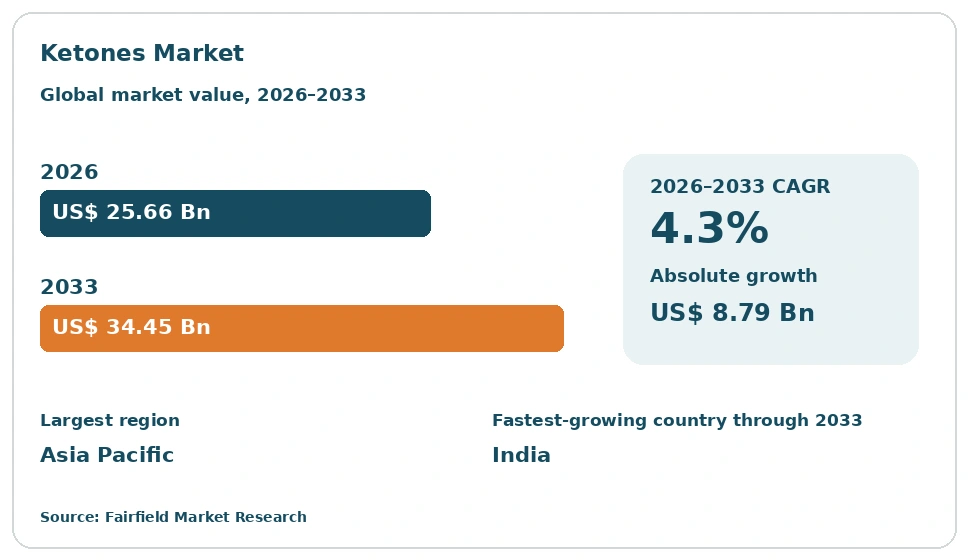
The global ketones market size is expected to be valued at US$ 25.66 billion in 2026 and projected to reach US$ 34.45 billion by 2033, growing at a CAGR of 4.3% between 2026 and 2033.
Between 2020 and 2025, the market grew at a CAGR of about 4.0%, rising from roughly US$ 20.2 billion to US$ 24.6 billion, as demand for hand sanitizers, disinfectants, and medical supplies lifted solvent use in 2020, construction and automotive coatings recovered afterward, and feedstock price swings in 2022 raised selling prices. The ketones market covers organic chemicals with a carbonyl group, mainly acetone, methyl ethyl ketone (MEK), methyl isobutyl ketone (MIBK), cyclohexanone, and specialty ketones. They are used as solvents in paints, coatings, inks, and adhesives, and as building blocks for bisphenol A, methyl methacrylate, nylon, rubber chemicals, and medicines. Most acetone is made alongside phenol from benzene and propylene. Ketones also serve pharmaceuticals, electronics, and personal care. In October 2026, Haldia Petrochemicals opened a large phenol and acetone plant in India.
Key Report Takeaways
- By Type: Acetone held about 38% share in 2025, while Methyl Isobutyl Ketone is projected to expand at a 5.0% CAGR through 2033, driven by rubber antioxidant production for tires, high-performance coatings, and extraction solvents used in mining and pharmaceuticals.
- By Function: Solvents held about 60% share in 2025, while Chemical Intermediates are projected to expand at a 4.9% CAGR through 2033, driven by demand for bisphenol A, methyl methacrylate, nylon, and specialty chemicals in Asia Pacific.
- By Application: Paints and Coatings held about 44.5% share in 2025, while Pharmaceuticals are projected to expand at a 5.6% CAGR through 2033, driven by drug production, purification, and growing generic medicine manufacturing.
- By Region: Asia Pacific held about 38% share in 2025, while India is projected to expand at a 5.6% CAGR through 2033, driven by new phenol and acetone capacity, growing paint and pharmaceutical industries, and rising chemical exports.
Global Ketones Market Trends and Insights
Drivers Impact Analysis
Two drivers carry the strongest influence on ketones market demand during the forecast period.
| Driver | Impact on CAGR Forecast | Geographic Relevance | Impact Timeline |
| Paints, coatings, and adhesives demand | High | Global | Long term (≥4 years) |
| Growth of plastics and chemical intermediates | Medium | Asia Pacific, North America | Medium term (2-4 years) |
Coatings Demand Is Driving the Ketones Market
Paints, coatings, and adhesives demand is the strongest driver of the ketones market. Ketones dissolve resins quickly and evaporate at controlled rates, which helps paints dry evenly and form smooth films.
The mechanism is steady growth in construction, cars, furniture, packaging, and industrial equipment, all of which use paints, coatings, inks, and adhesives. MEK, MIBK, acetone, and cyclohexanone dissolve resins such as acrylics, epoxies, polyurethanes, and vinyls, giving smooth finishes and fast drying. Infrastructure spending in China, India, and Middle East & Africa, along with new housing and renovation in North America and Europe, supports paint demand. Automotive refinish coatings, industrial maintenance coatings, and printing inks for flexible packaging add further use. Adhesive makers use ketones in footwear, woodworking, and pipe cements. These trends create steady, recurring solvent demand across many industries and regions.
Chemical Intermediates Are Expanding the Ketones Market
Growth of plastics and chemical intermediates is expanding the ketones market. Ketones are key raw materials for many products.
The cause is rising demand for plastics and specialty chemicals. Acetone is used to make bisphenol A, which goes into polycarbonate for electronics, cars, and building panels, and epoxy resins for wind turbines and coatings. Acetone is also used to make methyl methacrylate, the building block of acrylic sheets and paints. Cyclohexanone is the main raw material for nylon used in textiles, carpets, and engineering plastics. MIBK is converted into rubber antioxidants that protect tires. Growing car and electronics production in Asia Pacific and new chemical plants in India and China raise demand for these intermediates. Wind energy projects also use large amounts of epoxy resin. These uses link ketone demand to broad manufacturing growth.
Restraints Impact Analysis
Two restraints limit how quickly the ketones market grows.
| Restraint | Impact on CAGR Forecast | Geographic Relevance | Impact Timeline |
| Environmental and health rules on solvents | High | North America, Europe | Long term (≥4 years) |
| Feedstock price swings and overcapacity | Medium | Global | Short term (≤2 years) |
Solvent Rules Slow the Ketones Market
Environmental and health rules on solvents slow the ketones market. Governments want less air pollution from solvents.
The problem is that ketones are volatile organic compounds, which contribute to smog when they evaporate. Rules in North America and Europe limit the solvent content of paints, coatings, and adhesives, pushing manufacturers toward waterborne, powder, high-solids, and UV-curable products that use less or no solvent. Workplace exposure limits for some ketones also require ventilation and protective equipment. Some ketones face extra controls because they can be used to make illegal drugs, adding paperwork for sellers and buyers. Consumers increasingly prefer low-odor and low-emission products. Many coatings makers have already reformulated popular products. These rules reduce solvent demand in mature markets and push producers toward intermediate and specialty uses.
Feedstock Swings Restrict the Ketones Market
Feedstock price swings and overcapacity restrict the ketones market. Ketone prices follow oil and petrochemical markets.
The constraint is that acetone, MEK, and MIBK are made from benzene, propylene, butenes, and other petrochemicals, whose prices change with crude oil and natural gas. Sharp price increases, such as during periods of conflict and supply disruption, squeeze producer margins, while falling prices reduce revenue. Large new phenol and acetone plants in China have created oversupply in recent years, pushing down prices and exports. In Europe, high energy costs and weak demand have led to plant closures and insolvencies. Because acetone is a by-product of phenol, its output depends on phenol demand rather than acetone demand. Shipping costs and trade tariffs add further uncertainty for exporters. These factors make revenue and margins volatile.
Market Opportunities
Pharmaceutical and Electronics Grades Open a Fast-Growth Revenue Pool
Pharmaceutical and electronics grades open a fast-growth revenue pool. High-purity ketones sell at higher prices.
The opportunity comes from growing drug and semiconductor manufacturing. Pharmaceutical makers use acetone, MEK, and MIBK to dissolve, extract, crystallize, and purify active ingredients, and India and China are expanding generic and contract drug production. Semiconductor and display factories use ultra-pure acetone for cleaning wafers and equipment, and new chip plants in North America, Japan, South Korea, and Taiwan are raising demand. These grades require strict quality control, special packaging, and certifications that limit competition. Customers often audit suppliers before approving them. Producers that invest in purification, testing, and secure supply chains can earn premium prices and long contracts with pharmaceutical and electronics customers, reducing exposure to commodity price swings.
Bio-Based Ketones Create a Growth Revenue Pool
Bio-based and recycled ketones create a growth revenue pool. Customers increasingly want lower-carbon and more sustainable chemicals.
The opportunity reflects pressure from coatings, cosmetics, and consumer brands to cut the carbon footprint of their products. Producers can make acetone and other ketones from biomass, bio-based phenol, recycled plastics, or captured carbon, and mass-balance certification lets them sell lower-carbon grades from existing plants. Fermentation processes can produce acetone and butanol together from sugars or waste. Solvent recycling services that recover and purify used ketones from factories also reduce waste and costs. Customers in Europe and North America are willing to pay more for certified sustainable chemicals. Several European producers have already launched certified grades. Companies that develop these grades early can win new customers and meet future regulations, strengthening their market position.
Segment Analysis
By Type: Acetone Leads While Methyl Isobutyl Ketone Grows Fastest
Acetone held about 38% share in 2025. It is the most widely produced ketone and is used both as a solvent in coatings, adhesives, cleaning, nail polish removers, and pharmaceuticals, and as a raw material for bisphenol A and methyl methacrylate. Large output from phenol plants keeps it widely available.
Methyl Isobutyl Ketone is the fastest-growing type, expanding at a 5.0% CAGR through 2033. It is used to make rubber antioxidants for tires, as a solvent in high-performance coatings and inks, and to extract metals and purify medicines. Growing tire production in Asia Pacific supports demand. Methyl Ethyl Ketone, Cyclohexanone, and Specialty Ketones form other segments. For the market, MIBK growth adds higher-value sales.
By Function: Solvents Lead While Chemical Intermediates Grow Fastest
Solvents held about 60% share in 2025. Ketones dissolve many resins, oils, and plastics, which makes them important in paints, coatings, inks, adhesives, cleaning products, and laboratory work. Fast evaporation and strong dissolving power keep them in demand.
Chemical Intermediates are the fastest-growing function, expanding at a 4.9% CAGR through 2033. Ketones are converted into bisphenol A, methyl methacrylate, nylon raw materials, rubber chemicals, and pharmaceutical ingredients. New chemical plants in Asia Pacific are raising intermediate demand faster than solvent demand, which faces stricter emission rules. Extraction Agents form another function. Many producers use their own acetone to make downstream products at the same site. For the market, intermediate growth links ketones to plastics and specialty chemicals.
By Application: Paints and Coatings Lead While Pharmaceuticals Grow Fastest
Paints and Coatings held about 44.5% share in 2025. Ketones are used to dissolve resins and control drying in architectural, automotive, industrial, wood, and marine coatings, as well as printing inks. Construction, car production, and packaging growth drive steady demand across regions.
Pharmaceuticals are the fastest-growing application, expanding at a 5.6% CAGR through 2033. Drug makers use high-purity ketones to extract, crystallize, and purify active ingredients and to clean production equipment between batches. Growing generic drug production in India and China supports demand. Adhesives, Plastics, Electronics, Personal Care, and Agrochemicals form other applications. Pharmaceutical customers also need strict documentation and consistent quality from every batch. For the market, pharmaceutical growth supports premium grades and stable long-term contracts.
Geography Analysis
Why Is North America Important to the Ketones Market?
North America is important to the ketones market because it has large, low-cost petrochemical production and strong demand from coatings, adhesives, plastics, pharmaceuticals, and electronics. The United States benefits from cheap natural gas and propylene, which support competitive phenol, acetone, and MEK production by companies such as INEOS, Shell Chemicals, ExxonMobil Chemical, and Dow. New semiconductor plants are raising demand for high-purity solvents. Canada and Mexico add coatings and automotive demand. Key barriers include strict solvent emission rules. Producers there also export to Latin America and Europe. One change shaping the region is industry consolidation, including the planned Olin and Huntsman merger.
Europe Shapes the Ketones Market Through Regulation and Restructuring
Europe is a major ketones market. Germany, Belgium, the Netherlands, France, and Italy have large chemical, coatings, and automotive industries. However, high energy costs and weak demand have led to closures, including INEOS’s Gladbeck phenol plant and insolvency at Domo Chemicals’ Leuna site, tightening acetone supply. Strict REACH and solvent emission rules push the region toward low-solvent products and sustainable chemicals. Key barriers include energy costs and imports. Imports from Asia Pacific and North America are filling supply gaps. Coatings makers in the region are also leaders in low-solvent products. One opportunity is bio-based and recycled ketones.
Which Region Is Leading the Ketones Market?
Asia Pacific is leading the ketones market with about 38% share in 2025, and India is the fastest-growing country, expanding at a 5.6% CAGR through 2033. China is the world’s largest producer and user of acetone, MEK, and cyclohexanone, supported by large paint, plastics, nylon, and electronics industries. India is adding phenol and acetone capacity to cut imports and serve pharmaceuticals and paints. Japan, South Korea, and Taiwan have major producers such as Mitsui Chemicals. Key barriers include oversupply in China. One change shaping the region is new capacity in India.
Latin America Grows the Ketones Market Through Coatings and Agriculture
Latin America is a growing ketones market. Brazil and Mexico have large paint, adhesive, automotive, and packaging industries that use ketone solvents, and Brazil produces some acetone and other chemicals locally. Argentina, Colombia, Peru, and Chile use ketones in agrochemicals, coatings, and mining extraction for copper and other metals. Much of the region’s supply is imported from North America and Asia Pacific by sea. Key barriers include currency swings, import costs, and limited local production. Distributors handle most sales to smaller customers. Pharmaceutical production in Brazil and Mexico is growing. One opportunity is supplying growing coatings and pharmaceutical industries.
Middle East & Africa Builds the Ketones Market Through Petrochemical Investment
Middle East & Africa is an emerging ketones market. Saudi Arabia has large petrochemical complexes producing phenol, acetone, and other chemicals for export, with low-cost feedstock giving producers an advantage. The United Arab Emirates is a trading hub for chemicals. South Africa has local producers such as Sasol, which makes ketones from coal and gas. Egypt and Nigeria use ketones in paints and adhesives. Key barriers include limited downstream industries. Producers in Saudi Arabia export large volumes to Asia Pacific and Europe. Construction growth is raising paint demand across the region. One opportunity is export-oriented production.
Competitive Landscape
The ketones market is moderately consolidated. INEOS, Shell Chemicals, Mitsui Chemicals, Sasol, and ExxonMobil Chemical are leading players, while Dow, Eastman Chemical, LyondellBasell, BASF, Formosa Chemicals & Fibre, Kumho P&B Chemicals, and Deepak Phenolics compete strongly. Large integrated petrochemical companies dominate acetone through phenol production, while fewer producers make MEK and MIBK. Chinese producers have added large capacity in recent years, increasing competition in Asia Pacific and export markets.
Companies compete on production cost, feedstock access, plant scale, product purity, logistics, and reliability of supply. Integration with phenol, propylene, and refinery operations gives large producers a cost advantage. Specialty producers compete on high-purity pharmaceutical and electronics grades, technical service, and certifications. Distributors play an important role in reaching smaller paint, adhesive, and pharmaceutical customers.
Strategic moves show how competition is changing. In January 2026, INEOS Phenol permanently closed its Gladbeck plant as European producers cut capacity. In June 2026, Olin and Huntsman announced a merger of equals in North America. In October 2026, Haldia Petrochemicals opened a large phenol and acetone plant in India. These moves show capacity shifting from Europe toward Asia Pacific and consolidation among chemical producers.
Three themes shape vendor strategy. First, producers are restructuring or closing high-cost plants and focusing on integrated, low-cost sites. Second, they are developing high-purity, bio-based, and recycled grades to earn premium prices. Third, they are expanding in India and other growing markets to serve rising coatings, pharmaceutical, and plastics demand.
Ketones Market Industry Leaders
- INEOS
- Shell Chemicals
- Mitsui Chemicals
- Sasol
- ExxonMobil Chemical
Recent Industry Developments
- October 2026: Haldia Petrochemicals subsidiary Adperma inaugurated a phenol and acetone plant in Haldia with 215,000 tonnes a year of acetone capacity - reduces India’s import reliance in the ketones market.
- June 2026: Olin and Huntsman announced an all-stock merger of equals to form a North America chemicals company with about US$ 12.5 billion in revenue - signals consolidation among chemical producers.
- January 2026: INEOS Phenol permanently shut its Gladbeck plant in Germany, while Domo Chemicals’ Leuna site entered insolvency - tightened acetone supply and raised prices in Europe.
Companies Covered in the Report
- INEOS
- Shell Chemicals
- Mitsui Chemicals
- Sasol
- ExxonMobil Chemical
- Dow
- Eastman Chemical
- LyondellBasell
- BASF
- Formosa Chemicals & Fibre
- Kumho P&B Chemicals
- Deepak Phenolics
Ketones Market Report Scope
This report covers the ketones market, including acetone, methyl ethyl ketone, methyl isobutyl ketone, cyclohexanone, and specialty ketones, used as solvents, chemical intermediates, and extraction agents in paints and coatings, adhesives, plastics, pharmaceuticals, electronics, personal care, and agrochemicals. The base year is 2025, and the forecast period runs from 2026 to 2033. All values are expressed in US$ Billion.
| Type | Acetone, Methyl Ethyl Ketone, Methyl Isobutyl Ketone, Cyclohexanone, Specialty Ketones |
| Function | Solvents, Chemical Intermediates, Extraction Agents |
| Application | Paints and Coatings, Adhesives, Plastics, Pharmaceuticals, Electronics, Personal Care, Agrochemicals |
| Regions | North America, Europe, Asia Pacific, Latin America, Middle East & Africa |
1. Executive Summary
1.1 Ketones Market Snapshot
1.2 Future Projections
1.3 Key Market Trends
1.4 Regional Snapshot
2. Market Overview
2.1 Market Definition and Report Scope
2.2 Historical Market Trends
2.3 Market Dynamics
2.3.1 Drivers
2.3.1.1 Coatings Demand Is Driving the Ketones Market
2.3.1.2 Chemical Intermediates Are Expanding the Ketones Market
2.3.2 Restraints
2.3.2.1 Solvent Rules Slow the Ketones Market
2.3.2.2 Feedstock Swings Restrict the Ketones Market
2.3.3 Market Opportunities
2.3.3.1 Pharmaceutical and Electronics Grades Open a Fast-Growth Revenue Pool
2.3.3.2 Bio-Based Ketones Create a Growth Revenue Pool
3. Global Ketones Market Outlook, 2020–2033
3.1 Global Ketones Market Outlook, by Type, Value (US$ Billion), 2020–2033
3.1.1 Acetone
3.1.2 Methyl Ethyl Ketone
3.1.3 Methyl Isobutyl Ketone
3.1.4 Cyclohexanone
3.1.5 Specialty Ketones
3.2 Global Ketones Market Outlook, by Function, Value (US$ Billion), 2020–2033
3.2.1 Solvents
3.2.2 Chemical Intermediates
3.2.3 Extraction Agents
3.3 Global Ketones Market Outlook, by Application, Value (US$ Billion), 2020–2033
3.3.1 Paints and Coatings
3.3.2 Adhesives
3.3.3 Plastics
3.3.4 Pharmaceuticals
3.3.5 Electronics
3.3.6 Personal Care
3.3.7 Agrochemicals
3.4 Global Ketones Market Outlook, by Region, Value (US$ Billion), 2020–2033
3.4.1 North America
3.4.2 Europe
3.4.3 Asia Pacific
3.4.4 Latin America
3.4.5 Middle East & Africa
4. North America Ketones Market Outlook, 2020–2033
4.1 North America Ketones Market Outlook, by Type, Value (US$ Billion), 2020–2033
4.1.1 Acetone
4.1.2 Methyl Ethyl Ketone
4.1.3 Methyl Isobutyl Ketone
4.1.4 Cyclohexanone
4.1.5 Specialty Ketones
4.2 North America Ketones Market Outlook, by Function, Value (US$ Billion), 2020–2033
4.2.1 Solvents
4.2.2 Chemical Intermediates
4.2.3 Extraction Agents
4.3 North America Ketones Market Outlook, by Application, Value (US$ Billion), 2020–2033
4.3.1 Paints and Coatings
4.3.2 Adhesives
4.3.3 Plastics
4.3.4 Pharmaceuticals
4.3.5 Electronics
4.3.6 Personal Care
4.3.7 Agrochemicals
4.4 North America Ketones Market Outlook, by Country, Value (US$ Billion), 2020–2033
4.4.1 United States Ketones Market Outlook, by Type, 2020–2033
4.4.2 United States Ketones Market Outlook, by Function, 2020–2033
4.4.3 United States Ketones Market Outlook, by Application, 2020–2033
4.4.4 Canada Ketones Market Outlook, by Type, 2020–2033
4.4.5 Canada Ketones Market Outlook, by Function, 2020–2033
4.4.6 Canada Ketones Market Outlook, by Application, 2020–2033
4.4.7 Mexico Ketones Market Outlook, by Type, 2020–2033
4.4.8 Mexico Ketones Market Outlook, by Function, 2020–2033
4.4.9 Mexico Ketones Market Outlook, by Application, 2020–2033
5. Europe Ketones Market Outlook, 2020–2033
5.1 Europe Ketones Market Outlook, by Type, Value (US$ Billion), 2020–2033
5.1.1 Acetone
5.1.2 Methyl Ethyl Ketone
5.1.3 Methyl Isobutyl Ketone
5.1.4 Cyclohexanone
5.1.5 Specialty Ketones
5.2 Europe Ketones Market Outlook, by Function, Value (US$ Billion), 2020–2033
5.2.1 Solvents
5.2.2 Chemical Intermediates
5.2.3 Extraction Agents
5.3 Europe Ketones Market Outlook, by Application, Value (US$ Billion), 2020–2033
5.3.1 Paints and Coatings
5.3.2 Adhesives
5.3.3 Plastics
5.3.4 Pharmaceuticals
5.3.5 Electronics
5.3.6 Personal Care
5.3.7 Agrochemicals
5.4 Europe Ketones Market Outlook, by Country, Value (US$ Billion), 2020–2033
5.4.1 Germany Ketones Market Outlook, by Type, 2020–2033
5.4.2 Germany Ketones Market Outlook, by Function, 2020–2033
5.4.3 Germany Ketones Market Outlook, by Application, 2020–2033
5.4.4 Belgium Ketones Market Outlook, by Type, 2020–2033
5.4.5 Belgium Ketones Market Outlook, by Function, 2020–2033
5.4.6 Belgium Ketones Market Outlook, by Application, 2020–2033
5.4.7 Netherlands Ketones Market Outlook, by Type, 2020–2033
5.4.8 Netherlands Ketones Market Outlook, by Function, 2020–2033
5.4.9 Netherlands Ketones Market Outlook, by Application, 2020–2033
5.4.10 France Ketones Market Outlook, by Type, 2020–2033
5.4.11 France Ketones Market Outlook, by Function, 2020–2033
5.4.12 France Ketones Market Outlook, by Application, 2020–2033
5.4.13 Italy Ketones Market Outlook, by Type, 2020–2033
5.4.14 Italy Ketones Market Outlook, by Function, 2020–2033
5.4.15 Italy Ketones Market Outlook, by Application, 2020–2033
6. Asia Pacific Ketones Market Outlook, 2020–2033
6.1 Asia Pacific Ketones Market Outlook, by Type, Value (US$ Billion), 2020–2033
6.1.1 Acetone
6.1.2 Methyl Ethyl Ketone
6.1.3 Methyl Isobutyl Ketone
6.1.4 Cyclohexanone
6.1.5 Specialty Ketones
6.2 Asia Pacific Ketones Market Outlook, by Function, Value (US$ Billion), 2020–2033
6.2.1 Solvents
6.2.2 Chemical Intermediates
6.2.3 Extraction Agents
6.3 Asia Pacific Ketones Market Outlook, by Application, Value (US$ Billion), 2020–2033
6.3.1 Paints and Coatings
6.3.2 Adhesives
6.3.3 Plastics
6.3.4 Pharmaceuticals
6.3.5 Electronics
6.3.6 Personal Care
6.3.7 Agrochemicals
6.4 Asia Pacific Ketones Market Outlook, by Country, Value (US$ Billion), 2020–2033
6.4.1 India Ketones Market Outlook, by Type, 2020–2033
6.4.2 India Ketones Market Outlook, by Function, 2020–2033
6.4.3 India Ketones Market Outlook, by Application, 2020–2033
6.4.4 China Ketones Market Outlook, by Type, 2020–2033
6.4.5 China Ketones Market Outlook, by Function, 2020–2033
6.4.6 China Ketones Market Outlook, by Application, 2020–2033
6.4.7 Japan Ketones Market Outlook, by Type, 2020–2033
6.4.8 Japan Ketones Market Outlook, by Function, 2020–2033
6.4.9 Japan Ketones Market Outlook, by Application, 2020–2033
6.4.10 South Korea Ketones Market Outlook, by Type, 2020–2033
6.4.11 South Korea Ketones Market Outlook, by Function, 2020–2033
6.4.12 South Korea Ketones Market Outlook, by Application, 2020–2033
6.4.13 Taiwan Ketones Market Outlook, by Type, 2020–2033
6.4.14 Taiwan Ketones Market Outlook, by Function, 2020–2033
6.4.15 Taiwan Ketones Market Outlook, by Application, 2020–2033
7. Latin America Ketones Market Outlook, 2020–2033
7.1 Latin America Ketones Market Outlook, by Type, Value (US$ Billion), 2020–2033
7.1.1 Acetone
7.1.2 Methyl Ethyl Ketone
7.1.3 Methyl Isobutyl Ketone
7.1.4 Cyclohexanone
7.1.5 Specialty Ketones
7.2 Latin America Ketones Market Outlook, by Function, Value (US$ Billion), 2020–2033
7.2.1 Solvents
7.2.2 Chemical Intermediates
7.2.3 Extraction Agents
7.3 Latin America Ketones Market Outlook, by Application, Value (US$ Billion), 2020–2033
7.3.1 Paints and Coatings
7.3.2 Adhesives
7.3.3 Plastics
7.3.4 Pharmaceuticals
7.3.5 Electronics
7.3.6 Personal Care
7.3.7 Agrochemicals
7.4 Latin America Ketones Market Outlook, by Country, Value (US$ Billion), 2020–2033
7.4.1 Brazil Ketones Market Outlook, by Type, 2020–2033
7.4.2 Brazil Ketones Market Outlook, by Function, 2020–2033
7.4.3 Brazil Ketones Market Outlook, by Application, 2020–2033
7.4.4 Mexico Ketones Market Outlook, by Type, 2020–2033
7.4.5 Mexico Ketones Market Outlook, by Function, 2020–2033
7.4.6 Mexico Ketones Market Outlook, by Application, 2020–2033
7.4.7 Argentina Ketones Market Outlook, by Type, 2020–2033
7.4.8 Argentina Ketones Market Outlook, by Function, 2020–2033
7.4.9 Argentina Ketones Market Outlook, by Application, 2020–2033
7.4.10 Colombia Ketones Market Outlook, by Type, 2020–2033
7.4.11 Colombia Ketones Market Outlook, by Function, 2020–2033
7.4.12 Colombia Ketones Market Outlook, by Application, 2020–2033
7.4.13 Peru Ketones Market Outlook, by Type, 2020–2033
7.4.14 Peru Ketones Market Outlook, by Function, 2020–2033
7.4.15 Peru Ketones Market Outlook, by Application, 2020–2033
7.4.16 Chile Ketones Market Outlook, by Type, 2020–2033
7.4.17 Chile Ketones Market Outlook, by Function, 2020–2033
7.4.18 Chile Ketones Market Outlook, by Application, 2020–2033
8. Middle East & Africa Ketones Market Outlook, 2020–2033
8.1 Middle East & Africa Ketones Market Outlook, by Type, Value (US$ Billion), 2020–2033
8.1.1 Acetone
8.1.2 Methyl Ethyl Ketone
8.1.3 Methyl Isobutyl Ketone
8.1.4 Cyclohexanone
8.1.5 Specialty Ketones
8.2 Middle East & Africa Ketones Market Outlook, by Function, Value (US$ Billion), 2020–2033
8.2.1 Solvents
8.2.2 Chemical Intermediates
8.2.3 Extraction Agents
8.3 Middle East & Africa Ketones Market Outlook, by Application, Value (US$ Billion), 2020–2033
8.3.1 Paints and Coatings
8.3.2 Adhesives
8.3.3 Plastics
8.3.4 Pharmaceuticals
8.3.5 Electronics
8.3.6 Personal Care
8.3.7 Agrochemicals
8.4 Middle East & Africa Ketones Market Outlook, by Country, Value (US$ Billion), 2020–2033
8.4.1 Saudi Arabia Ketones Market Outlook, by Type, 2020–2033
8.4.2 Saudi Arabia Ketones Market Outlook, by Function, 2020–2033
8.4.3 Saudi Arabia Ketones Market Outlook, by Application, 2020–2033
8.4.4 United Arab Emirates Ketones Market Outlook, by Type, 2020–2033
8.4.5 United Arab Emirates Ketones Market Outlook, by Function, 2020–2033
8.4.6 United Arab Emirates Ketones Market Outlook, by Application, 2020–2033
8.4.7 South Africa Ketones Market Outlook, by Type, 2020–2033
8.4.8 South Africa Ketones Market Outlook, by Function, 2020–2033
8.4.9 South Africa Ketones Market Outlook, by Application, 2020–2033
8.4.10 Egypt Ketones Market Outlook, by Type, 2020–2033
8.4.11 Egypt Ketones Market Outlook, by Function, 2020–2033
8.4.12 Egypt Ketones Market Outlook, by Application, 2020–2033
8.4.13 Nigeria Ketones Market Outlook, by Type, 2020–2033
8.4.14 Nigeria Ketones Market Outlook, by Function, 2020–2033
8.4.15 Nigeria Ketones Market Outlook, by Application, 2020–2033
9. Competitive Landscape
9.1 Ketones Market Industry Leaders
9.2 Recent Industry Developments
9.3 Company Profiles
9.3.1 INEOS
9.3.2 Shell Chemicals
9.3.3 Mitsui Chemicals
9.3.4 Sasol
9.3.5 ExxonMobil Chemical
9.3.6 Dow
9.3.7 Eastman Chemical
9.3.8 LyondellBasell
9.3.9 BASF
9.3.10 Formosa Chemicals & Fibre
9.3.11 Kumho P&B Chemicals
9.3.12 Deepak Phenolics
10. Appendix
10.1 Research Methodology
10.2 Report Assumptions
10.3 Acronyms and Abbreviations
| Type | Acetone, Methyl Ethyl Ketone, Methyl Isobutyl Ketone, Cyclohexanone, Specialty Ketones |
| Function | Solvents, Chemical Intermediates, Extraction Agents |
| Application | Paints and Coatings, Adhesives, Plastics, Pharmaceuticals, Electronics, Personal Care, Agrochemicals |
| Regions | North America, Europe, Asia Pacific, Latin America, Middle East & Africa |
Our Research Methodology
Considering the volatility of business today, traditional approaches to strategizing a game plan can be unfruitful if not detrimental. True ambiguity is no way to determine a forecast. A myriad of predetermined factors must be accounted for such as the degree of risk involved, the magnitude of circumstances, as well as conditions or consequences that are not known or unpredictable. To circumvent binary views that cast uncertainty, the application of market research intelligence to strategically posture, move, and enable actionable outcomes is necessary.
View Methodology
Quality Assured
Rigorous Validation Process

Confidentiality Assured
End-to-end Data Security

Custom Research Services
Tailored To Your Objectives
FAQs
The ketones market is valued at US$ 25.66 billion in 2026, led by acetone, paints and coatings, and Asia Pacific.
The market is projected to reach US$ 34.45 billion by 2033, growing at a 4.3% CAGR and adding US$ 8.79 billion.
Pharmaceuticals are growing fastest at a 5.6% CAGR through 2033, driven by drug production, purification, and generic medicine manufacturing.
India is growing fastest at a 5.6% CAGR through 2033, driven by new acetone capacity and growing paint and pharmaceutical industries.
Asia Pacific holds the largest share at about 38% in 2025, supported by large chemical, paint, and plastics industries in China.
Related Reports
Metallic Stearates Market Size, Share, Insights, Competitive Landscape, and Forecast 2026 to 2033
Explore the metallic stearates market, forecast to reach US$2.34 billion by 2033 at 5.9% CAGR, with insights on types, grades, applications, and regions.
Ethyl Benzene Market Size, Share, Insights, Competitive Landscape, and Forecast 2026 to 2033
Explore the Ethyl Benzene market, projected to reach US$52.6 billion by 2033 at 4.6% CAGR, with insights on applications, regions, and key companies.
Polyurethane Elastomers Market Size, Share, Insights, Competitive Landscape, and Forecast 2026 to 2033
The global polyurethane elastomers market is valued at US$9.8 billion in 2026, reaching US$14.9 billion by 2033, growing at a 6.2% CAGR
Medical Flexible Packaging Market Size, Share, Insights, Competitive Landscape, and Forecast 2026 to 2033
The global medical flexible packaging market is valued at US$33.27 billion in 2026, reaching US$47.66 billion by 2033, growing at a 5.3% CAGR
Green Composites Market Size, Share, Insights, Competitive Landscape, and Forecast 2026 to 2033
The global green composites market is valued at US$9.2 billion in 2026, reaching US$18.6 billion by 2033, growing at a 10.6% CAGR
Corrosion Protection Coatings Market Size, Share, Insights, Competitive Landscape, and Forecast 2026 to 2033
Explore the corrosion protection coatings market outlook for 2026–2033, including resin trends, application methods, regional demand, and key suppliers.