



Bio-based Epoxy Resin Market
Bio-based Epoxy Resin Market Size, Share, Insights, Competitive Landscape, and Forecast 2026 to 2033
Bio-based Epoxy Resin Market Size and Trend Analysis
How Big Is the Bio-based Epoxy Resin Market?
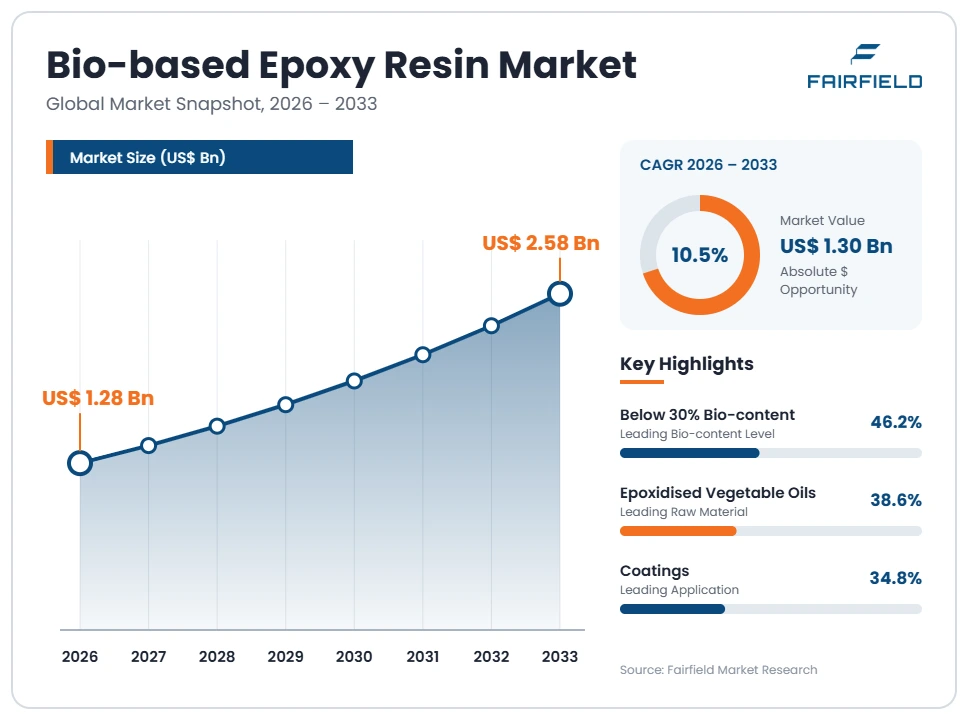
The global Bio-based Epoxy Resin market size is expected to be valued at US$ 1.28 billion in 2026 and projected to reach US$ 2.58 billion by 2033, growing at a CAGR of 10.5% between 2026 and 2033. Growth rests on three forces: substitution pressure on bisphenol-A chemistry, buyer demand for measurable bio-content, and wider use of composites in wind and transport. Between 2020 and 2025 the market expanded at a CAGR of 8.7%, and the pace now quickens as commercial grades clear qualification. The absolute dollar opportunity over the forecast period stands at US$ 1.30 billion. Coatings remain the largest application through the period.
Key Report Takeaways
- By Raw Material: Epoxidised vegetable oils led with 38.6% share in 2026, while cardanol-based resins are projected to expand at a 12.4% CAGR through 2033, driven by cashew nut shell liquid supply from established Indian processing capacity.
- By Bio-content Level: Grades below 30% bio-content held 46.2% share in 2026, while grades above 70% bio-content are set to grow at a 13.1% CAGR through 2033, driven by procurement rules that reward verified renewable carbon.
- By Application: Coatings led with 34.8% share in 2026, while composites are projected to advance at a 12.1% CAGR through 2033, driven by blade and structural part production that favours lower-viscosity infusion systems.
- By End-use Industry: Building and construction held 29.4% share in 2026, while wind energy is forecast to grow at a 12.9% CAGR through 2033, driven by turbine fleet additions and blade designs built for later material recovery.
- By Region: Europe led with 36.5% share in 2026, while Asia Pacific is projected to expand at a 12.2% CAGR through 2033, driven by feedstock access, electronics laminate output and local resin capacity in China and India.
Global Bio-based Epoxy Resin Market Trends and Insights
Market Growth Drivers
Scrutiny of Bisphenol-A Chemistry Is Opening Space for Bio-based Alternatives
Regulatory and customer scrutiny of bisphenol-A is moving specification work toward bio-derived epoxy chemistry. Authorities in several markets continue to review bisphenol compounds used in coatings that touch food, water and consumer goods. Brand owners respond by asking resin suppliers for qualified substitutes well before any rule takes effect. That anticipatory buying lifts trial volumes for cardanol, lignin and vegetable-oil based systems across coatings and adhesives.
The underlying trend is a shift from single-ingredient swaps to full formulation redesign. Cardanol-based hardeners and epoxidised vegetable oil diluents already sit in commercial coating systems, so the technical path is familiar. Suppliers such as Cardolite Corporation and SPOLCHEMIE a.s. market bio-content grades aimed at this substitution work. Bio-based carbon content can be measured by established methods such as ASTM D6866, giving buyers an objective check on supplier claims.
Composite Demand in Wind and Transport Is Pulling Bio-based Grades into Structural Use
Composite manufacturing is the strongest volume pull for bio-based epoxy resins outside coatings. Blade moulders, boat builders and automotive part makers need resins with long open times, low viscosity and stable exotherm behaviour. Bio-based infusion and laminating systems now meet those processing needs in several commercial product families. Processing parity matters more than price, because fabricators can qualify a new resin without rebuilding tooling.
Behind the shift sits a procurement trend inside the composites supply chain. Turbine owners, boatyards and vehicle programmes increasingly ask suppliers to document the renewable carbon share of each material. Producers such as Sicomin and Entropy Resins build their composite portfolios around that documentation. Life-cycle benefit still depends on the feedstock and the conversion route, so credible suppliers position these grades on verified content rather than on blanket environmental claims.
Market Restraints
Feedstock Price Swings and Cost Premiums Slow Broad Adoption
Cost remains the clearest brake on bio-based epoxy resin adoption. Bio-based grades usually carry a premium over conventional bisphenol-A resins, and price-driven segments resist that gap. Commodity construction coatings and high-volume industrial maintenance work rarely absorb a premium without a mandate. The result is adoption concentrated in specification-led niches rather than across the whole resin demand base.
The driver behind the premium is feedstock exposure. Vegetable oils, glycerol and cashew nut shell liquid trade in agricultural markets where harvest, weather and competing food or fuel uses move prices. Resin producers cannot hedge those inputs as easily as petrochemical streams. Lignin supply adds a second complication, since quality varies with the pulping process and the mill. Buyers facing uncertain input costs often delay qualification until supply contracts and volumes look dependable over several years.
Performance Qualification in Demanding Applications Remains a Long Hurdle
Qualification time limits how fast bio-based epoxy resins reach high-value structural and electrical applications. Aerospace parts, electrical laminates and heavy-duty protective coatings run approval cycles measured in years, not months. Each resin must clear thermal, mechanical, electrical and ageing tests under the customer’s protocol. Until that work finishes, bio-based grades stay limited to secondary parts, tooling and less demanding layers of a coating stack.
The technical issue is that several bio-derived building blocks behave differently from bisphenol-A chemistry. Flexible aliphatic chains from vegetable oils can lower glass transition temperature and stiffness, while lignin fractions can bring colour and batch variation. Formulators manage this by blending bio-based components with conventional resin, which caps achievable bio-content. Producers including Huntsman Corporation and Olin Corporation work on this balance, yet closing the structural performance gap remains incremental work.
Market Opportunities
Recyclable and Repairable Epoxy Systems Create a Second Value Layer
Designing bio-based epoxy systems for end-of-life recovery opens revenue beyond material substitution. Wind blade owners, boat builders and vehicle makers face growing pressure to recover composite parts instead of landfilling them. Resins built with cleavable linkages allow fibre recovery and part repair under controlled conditions. A supplier offering renewable content and a recovery route sells a service position, not a commodity.
The industry activity behind this is concentrated in resin chemistry research and pilot-scale recovery trials run with fabricators and asset owners. Chemical recycling of thermoset composites has moved from laboratory work to active development in Europe and North America. Firms such as Covestro AG and Arkema S.A. carry the polymer and formulation capability to commercialise such systems. Circularity requirements written into construction and energy procurement give the concept a dependable demand base.
Glycerol-Derived Epichlorohydrin Enables Higher Bio-content Drop-in Grades
Bio-based epichlorohydrin gives producers a route to high bio-content resins that behave like conventional ones. Epichlorohydrin is one of the two main inputs to standard epoxy resin, so replacing it with a glycerol-derived equivalent raises renewable carbon without changing the resin backbone. Customers gain a drop-in product that needs no reformulation and little requalification. That combination removes the single largest barrier to adoption in coatings, adhesives and electrical laminates.
Glycerol is a by-product of biodiesel manufacture, which gives the route a feedstock already produced at industrial scale. Chlor-alkali and epoxy producers including Olin Corporation, Westlake Corporation and SPOLCHEMIE a.s. operate across the epichlorohydrin and resin value chain, so the capability sits with established players. Mass-balance schemes such as ISCC PLUS let producers track renewable input through shared assets, supporting credible claims.
Segment Analysis
- Which Raw Material Route Leads the Bio-based Epoxy Resin Market?
Epoxidised vegetable oils lead the raw material category with 38.6% share in 2026, while cardanol-based resins grow fastest at a 12.4% CAGR through 2033. Soybean and linseed derivatives hold position because the epoxidation route is mature, feedstock is abundant and the products work as diluents and toughening agents in existing formulations. That versatility lets converters add renewable content without approving a new resin.
Cardanol takes the growth lead for a different reason. Cashew nut shell liquid is a non-food by-product whose aromatic phenolic structure resembles petrochemical phenol, so cardanol hardeners deliver chemical resistance and moisture tolerance aliphatic oils cannot match. Indian processing capacity supplies the material. Lignin and bio-based epichlorohydrin routes sit behind both, lignin held back by quality variation. The split shows volume flowing to easy substitution while performance chemistry drives growth.
- Partially Bio-based Grades Carry Volume While High-Content Grades Set the Pace
Grades below 30% bio-content hold 46.2% share in 2026, while grades above 70% bio-content expand fastest at a 13.1% CAGR through 2033. Low-content blends dominate volume because formulators claim renewable carbon while retaining conventional epoxy behaviour. Requalification effort stays small and the cost premium remains manageable for industrial coatings.
High bio-content grades grow faster as procurement rules tighten. Public construction tenders and corporate sourcing policies increasingly set renewable content thresholds that partial blends cannot satisfy. Verification through ASTM D6866 carbon testing and schemes such as USDA BioPreferred turns those thresholds into contract language. Progress depends on bio-based epichlorohydrin and phenolic routes that raise content without hurting performance. The pattern tells suppliers that mid-range blends face commoditisation while genuine high-content chemistry commands better pricing power.
- Which Application Is Growing Fastest in Bio-based Epoxy Resins?
Composites grow fastest among applications at a 12.1% CAGR through 2033, while coatings lead with 34.8% share in 2026. Coatings hold the largest position because the segment consumes resin in high volume and accepts partial substitution readily. Protective, marine, flooring and can coatings use bio-based diluents and cardanol hardeners, and bisphenol-A scrutiny in food-contact linings keeps reformulation active.
Composites take the growth lead through wind blades, marine hulls and transport structures. Infusion and prepreg systems with bio-based content now meet the processing windows fabricators need, removing the main technical objection. Adhesives and sealants follow in construction and packaging, while electrical laminates lag because thermal and dielectric qualification runs long. The contrast matters: coatings supply the revenue base that funds development, composites the growth that justifies new capacity.
- Construction Anchors Demand While Wind Energy Adds the Steepest Growth
Building and construction leads end-use industries with 29.4% share in 2026, while wind energy grows fastest at a 12.9% CAGR through 2033. Construction holds the lead through flooring systems, concrete repair mortars, protective coatings and structural adhesives. Green building certification programmes award credits for documented renewable content, giving specifiers a direct reason to choose bio-based grades.
Wind energy grows faster because blade manufacturing consumes large resin volumes and turbine owners now set material recovery targets. Bio-based infusion resins that also support fibre recovery answer both demands at once. Transportation, marine and electrical and electronics follow, with automotive interest tied to lightweight structural parts. The division shows a stable construction base and a concentrated growth engine in renewable energy, shaping where producers place capacity.
Geography Analysis
- North America Pairs Procurement Rules With Marine and Wind Composite Demand
North America holds 27.8% share in 2026 and advances at a 9.8% CAGR through 2033. The United States supplies most regional demand, with Canada adding construction and marine volume. Federal procurement preference under USDA BioPreferred gives bio-based resins a direct route into government-linked purchasing, anchoring baseline consumption. Coastal and Great Lakes boatbuilding remains an outlet for bio-based laminating systems.
Resin and chlor-alkali assets operated by Olin Corporation, Westlake Corporation and Huntsman Corporation keep supply local and shorten qualification cycles. Onshore wind blade production adds composite volume, while state restrictions on bisphenol compounds in food-contact goods push coating reformulation. Growth stays below the global average because the industrial coatings base is mature and cost scrutiny limits how far premium grades spread.
- Which Region Is Leading the Bio-based Epoxy Resin Market?
Europe leads the market with 36.5% share in 2026 and grows at a 10.2% CAGR through 2033. Germany, France, Italy, the Netherlands and the Czech Republic form the demand core. The region leads because regulation, specification practice and local manufacturing align. REACH assessment of bisphenol compounds keeps substitution on formulators’ agendas, and circular economy rules reward documented renewable content.
Supply sits close to demand. SPOLCHEMIE a.s. produces bio-content epoxy resins in central Europe, Sicomin supplies composite systems from France, and Covestro AG and Arkema S.A. add formulation depth. North Sea offshore wind construction gives blade and coating suppliers a steady outlet. Public research funding for bio-based chemistry and composite recycling keeps development pipelines active, sustaining the share lead.
- Which Region Is Growing Fastest in the Bio-based Epoxy Resin Market?
Asia Pacific grows fastest with a 12.2% CAGR through 2033 and holds 24.6% share in 2026. China, India, Japan and South Korea drive the expansion. India holds a structural advantage in cashew nut shell liquid processing, giving formulators low-cost cardanol feedstock. China combines large epoxy resin capacity with the biggest wind turbine manufacturing base.
Electronics manufacturing adds a second growth stream. Laminate and circuit board production in China, Taiwan, Japan and South Korea creates demand for resins meeting halogen-free and renewable content specifications. Producers including Kukdo Chemical Co., Ltd., Chang Chun Group, DIC Corporation and Atul Ltd operate regional capacity. Export customers pass their own content requirements back along the supply chain, accelerating local adoption.
- Latin America Builds on Agricultural Feedstock and Construction Chemistry
Latin America accounts for 6.4% share in 2026 and grows at a 9.1% CAGR through 2033. Brazil and Mexico supply most of the demand. Brazil combines large soybean and castor oil output with a biodiesel industry that generates glycerol, giving real feedstock advantages for epoxidised oils and bio-based epichlorohydrin.
Demand concentrates in construction chemicals, infrastructure coatings and industrial maintenance. Mexican automotive and appliance manufacturing adds adhesive and coating volume tied to export programmes, where customer content requirements travel with the order. Growth stays near the global average because local capacity for specialty bio-based grades is limited and much material is imported. Currency movement and import duties keep price-sensitive buyers on conventional chemistry.
- Middle East & Africa Advances From a Small Base Through Construction and Diversification
Middle East & Africa holds 4.7% share in 2026 and grows at an 8.9% CAGR through 2033. Saudi Arabia, the United Arab Emirates and South Africa lead regional consumption. Construction programmes tied to economic diversification create demand for flooring systems, protective coatings and repair mortars, and sustainability criteria in flagship projects open a route for bio-based grades.
The region hosts significant petrochemical capability, so some producers treat bio-based chemistry as a portfolio extension. African demand centres on South Africa, where mining and industrial maintenance coatings dominate. Growth sits below the global average because conventional epoxy supply is abundant and locally priced, specification practice rarely mandates renewable content, and regional feedstock processing capacity stays small.
Competitive Landscape
The bio-based epoxy resin market is fragmented, with a clear split between large integrated resin producers and focused specialty players. Integrated companies such as Olin Corporation, Westlake Corporation and Huntsman Corporation bring epichlorohydrin and resin assets, global reach and the balance sheet for long qualification cycles. Specialists including Sicomin, Cardolite Corporation, Entropy Resins and Specific Polymers compete on application knowledge and on bio-content depth rather than volume. That structure signals a market still moving from early commercialisation toward mainstream supply.
Competition centres on verified renewable content, processing behaviour and total formulation cost. Vendors differentiate by how much bio-content they deliver without sacrificing glass transition temperature, chemical resistance or cure speed. Documentation capability is a competitive asset in itself, since customers ask for measured bio-based carbon and mass-balance traceability. Entrants from lignin and furan chemistry matter because they expand aromatic building block supply beyond cashew nut shell liquid, reducing feedstock concentration risk.
Strategic activity follows three themes rather than isolated transactions. Producers extend portfolios into bio-content grades to defend existing coating and composite accounts against substitution. They form development agreements with fabricators and brand owners, because joint qualification shortens the approval cycle that otherwise blocks adoption. They also direct research toward recyclable thermoset chemistry, which converts a sustainability claim into a measurable end-of-life service.
Competitive direction points toward integration of renewable feedstock supply with formulation capability. Companies that secure feedstock, hold certification infrastructure and sit close to composite and coating customers gain the strongest position. Credible positioning rests on feedstock origin and conversion route, since life-cycle benefit varies with both.
Industry Leaders
- Olin Corporation
- Westlake Corporation
- Huntsman Corporation
- Covestro AG
- Arkema S.A.
- Cardolite Corporation
- SPOLCHEMIE a.s.
- Sicomin
Companies Covered in the Report
- Olin Corporation
- Westlake Corporation
- Huntsman Corporation
- Covestro AG
- Arkema S.A.
- Evonik Industries AG
- Cardolite Corporation
- SPOLCHEMIE a.s.
- Sicomin
- Entropy Resins
- Specific Polymers
- Kukdo Chemical Co., Ltd.
- Aditya Birla Chemicals
- Atul Ltd
- DIC Corporation
- Chang Chun Group
- Allnex GmbH
Bio-based Epoxy Resin Market Report Scope
| Metric | Value |
| Study Period | 2020–2033 |
| Market Size 2026 | US$ 1.28 Billion |
| Market Size 2033 | US$ 2.58 Billion |
| CAGR 2026–2033 | 10.5% |
| Absolute Dollar Opportunity | US$ 1.30 Billion |
| Largest Market | Europe (36.5% share in 2026) |
| Fastest-Growing Market | Asia Pacific (12.2% CAGR 2026–2033) |
| Market Concentration | Fragmented |
| Major Players | Olin Corporation, Westlake Corporation, Huntsman Corporation, Covestro AG, Arkema S.A. |
Bio-based Epoxy Resin Market Segmentation
- Executive Summary
- Bio-based Epoxy Resin Market Snapshot
- Future Projections
- Key Market Trends
- Regional Snapshot
- Market Overview
- Market Definition and Report Scope
- Historical Market Trends
- Market Dynamics
- Drivers
- Scrutiny of Bisphenol-A Chemistry Is Opening Space for Bio-based Alternatives
- Composite Demand in Wind and Transport Is Pulling Bio-based Grades into Structural Use
- Restraints
- Feedstock Price Swings and Cost Premiums Slow Broad Adoption
- Performance Qualification in Demanding Applications Remains a Long Hurdle
- Market Opportunities
- Recyclable and Repairable Epoxy Systems Create a Second Value Layer
- Glycerol-Derived Epichlorohydrin Enables Higher Bio-content Drop-in Grades
- Drivers
- Global Bio-based Epoxy Resin Market Outlook, 2026–2033
- Global Bio-based Epoxy Resin Market Outlook, by Raw Material, Value (US$ Billion), 2026–2033
- Epoxidised Vegetable Oils
- Lignin-based
- Cardanol-based
- Bio-based Epichlorohydrin Routes
- Others
- Global Bio-based Epoxy Resin Market Outlook, by Bio-content Level, Value (US$ Billion), 2026–2033
- Below 30% Bio-content
- 30% to 70% Bio-content
- Above 70% Bio-content
- Global Bio-based Epoxy Resin Market Outlook, by Application, Value (US$ Billion), 2026–2033
- Coatings
- Composites
- Adhesives & Sealants
- Electrical & Electronic Laminates
- Others
- Global Bio-based Epoxy Resin Market Outlook, by End-use Industry, Value (US$ Billion), 2026–2033
- Building & Construction
- Wind Energy
- Transportation
- Electrical & Electronics
- Marine
- Others
- Global Bio-based Epoxy Resin Market Outlook, by Region, Value (US$ Billion), 2026–2033
- North America
- Europe
- Asia Pacific
- Latin America
- Middle East & Africa
- Global Bio-based Epoxy Resin Market Outlook, by Raw Material, Value (US$ Billion), 2026–2033
- North America Bio-based Epoxy Resin Market Outlook, 2026–2033
- North America Bio-based Epoxy Resin Market Outlook, by Raw Material, Value (US$ Billion), 2026–2033
- Epoxidised Vegetable Oils
- Lignin-based
- Cardanol-based
- Bio-based Epichlorohydrin Routes
- Others
- North America Bio-based Epoxy Resin Market Outlook, by Bio-content Level, Value (US$ Billion), 2026–2033
- Below 30% Bio-content
- 30% to 70% Bio-content
- Above 70% Bio-content
- North America Bio-based Epoxy Resin Market Outlook, by Application, Value (US$ Billion), 2026–2033
- Coatings
- Composites
- Adhesives & Sealants
- Electrical & Electronic Laminates
- Others
- North America Bio-based Epoxy Resin Market Outlook, by End-use Industry, Value (US$ Billion), 2026–2033
- Building & Construction
- Wind Energy
- Transportation
- Electrical & Electronics
- Marine
- Others
- North America Bio-based Epoxy Resin Market Outlook, by Country, Value (US$ Billion), 2026–2033
- United States Bio-based Epoxy Resin Market Outlook, by Raw Material, 2026–2033
- United States Bio-based Epoxy Resin Market Outlook, by Bio-content Level, 2026–2033
- United States Bio-based Epoxy Resin Market Outlook, by Application, 2026–2033
- United States Bio-based Epoxy Resin Market Outlook, by End-use Industry, 2026–2033
- Canada Bio-based Epoxy Resin Market Outlook, by Raw Material, 2026–2033
- Canada Bio-based Epoxy Resin Market Outlook, by Bio-content Level, 2026–2033
- Canada Bio-based Epoxy Resin Market Outlook, by Application, 2026–2033
- Canada Bio-based Epoxy Resin Market Outlook, by End-use Industry, 2026–2033
- North America Bio-based Epoxy Resin Market Outlook, by Raw Material, Value (US$ Billion), 2026–2033
- Europe Bio-based Epoxy Resin Market Outlook, 2026–2033
- Europe Bio-based Epoxy Resin Market Outlook, by Raw Material, Value (US$ Billion), 2026–2033
- Epoxidised Vegetable Oils
- Lignin-based
- Cardanol-based
- Bio-based Epichlorohydrin Routes
- Others
- Europe Bio-based Epoxy Resin Market Outlook, by Bio-content Level, Value (US$ Billion), 2026–2033
- Below 30% Bio-content
- 30% to 70% Bio-content
- Above 70% Bio-content
- Europe Bio-based Epoxy Resin Market Outlook, by Application, Value (US$ Billion), 2026–2033
- Coatings
- Composites
- Adhesives & Sealants
- Electrical & Electronic Laminates
- Others
- Europe Bio-based Epoxy Resin Market Outlook, by End-use Industry, Value (US$ Billion), 2026–2033
- Building & Construction
- Wind Energy
- Transportation
- Electrical & Electronics
- Marine
- Others
- Europe Bio-based Epoxy Resin Market Outlook, by Country, Value (US$ Billion), 2026–2033
- Germany Bio-based Epoxy Resin Market Outlook, by Raw Material, 2026–2033
- Germany Bio-based Epoxy Resin Market Outlook, by Bio-content Level, 2026–2033
- Germany Bio-based Epoxy Resin Market Outlook, by Application, 2026–2033
- Germany Bio-based Epoxy Resin Market Outlook, by End-use Industry, 2026–2033
- France Bio-based Epoxy Resin Market Outlook, by Raw Material, 2026–2033
- France Bio-based Epoxy Resin Market Outlook, by Bio-content Level, 2026–2033
- France Bio-based Epoxy Resin Market Outlook, by Application, 2026–2033
- France Bio-based Epoxy Resin Market Outlook, by End-use Industry, 2026–2033
- Italy Bio-based Epoxy Resin Market Outlook, by Raw Material, 2026–2033
- Italy Bio-based Epoxy Resin Market Outlook, by Bio-content Level, 2026–2033
- Italy Bio-based Epoxy Resin Market Outlook, by Application, 2026–2033
- Italy Bio-based Epoxy Resin Market Outlook, by End-use Industry, 2026–2033
- Netherlands Bio-based Epoxy Resin Market Outlook, by Raw Material, 2026–2033
- Netherlands Bio-based Epoxy Resin Market Outlook, by Bio-content Level, 2026–2033
- Netherlands Bio-based Epoxy Resin Market Outlook, by Application, 2026–2033
- Netherlands Bio-based Epoxy Resin Market Outlook, by End-use Industry, 2026–2033
- Czech Republic Bio-based Epoxy Resin Market Outlook, by Raw Material, 2026–2033
- Czech Republic Bio-based Epoxy Resin Market Outlook, by Bio-content Level, 2026–2033
- Czech Republic Bio-based Epoxy Resin Market Outlook, by Application, 2026–2033
- Czech Republic Bio-based Epoxy Resin Market Outlook, by End-use Industry, 2026–2033
- Europe Bio-based Epoxy Resin Market Outlook, by Raw Material, Value (US$ Billion), 2026–2033
- Asia Pacific Bio-based Epoxy Resin Market Outlook, 2026–2033
- Asia Pacific Bio-based Epoxy Resin Market Outlook, by Raw Material, Value (US$ Billion), 2026–2033
- Epoxidised Vegetable Oils
- Lignin-based
- Cardanol-based
- Bio-based Epichlorohydrin Routes
- Others
- Asia Pacific Bio-based Epoxy Resin Market Outlook, by Bio-content Level, Value (US$ Billion), 2026–2033
- Below 30% Bio-content
- 30% to 70% Bio-content
- Above 70% Bio-content
- Asia Pacific Bio-based Epoxy Resin Market Outlook, by Application, Value (US$ Billion), 2026–2033
- Coatings
- Composites
- Adhesives & Sealants
- Electrical & Electronic Laminates
- Others
- Asia Pacific Bio-based Epoxy Resin Market Outlook, by End-use Industry, Value (US$ Billion), 2026–2033
- Building & Construction
- Wind Energy
- Transportation
- Electrical & Electronics
- Marine
- Others
- Asia Pacific Bio-based Epoxy Resin Market Outlook, by Country, Value (US$ Billion), 2026–2033
- China Bio-based Epoxy Resin Market Outlook, by Raw Material, 2026–2033
- China Bio-based Epoxy Resin Market Outlook, by Bio-content Level, 2026–2033
- China Bio-based Epoxy Resin Market Outlook, by Application, 2026–2033
- China Bio-based Epoxy Resin Market Outlook, by End-use Industry, 2026–2033
- India Bio-based Epoxy Resin Market Outlook, by Raw Material, 2026–2033
- India Bio-based Epoxy Resin Market Outlook, by Bio-content Level, 2026–2033
- India Bio-based Epoxy Resin Market Outlook, by Application, 2026–2033
- India Bio-based Epoxy Resin Market Outlook, by End-use Industry, 2026–2033
- Japan Bio-based Epoxy Resin Market Outlook, by Raw Material, 2026–2033
- Japan Bio-based Epoxy Resin Market Outlook, by Bio-content Level, 2026–2033
- Japan Bio-based Epoxy Resin Market Outlook, by Application, 2026–2033
- Japan Bio-based Epoxy Resin Market Outlook, by End-use Industry, 2026–2033
- South Korea Bio-based Epoxy Resin Market Outlook, by Raw Material, 2026–2033
- South Korea Bio-based Epoxy Resin Market Outlook, by Bio-content Level, 2026–2033
- South Korea Bio-based Epoxy Resin Market Outlook, by Application, 2026–2033
- South Korea Bio-based Epoxy Resin Market Outlook, by End-use Industry, 2026–2033
- Taiwan Bio-based Epoxy Resin Market Outlook, by Raw Material, 2026–2033
- Taiwan Bio-based Epoxy Resin Market Outlook, by Bio-content Level, 2026–2033
- Taiwan Bio-based Epoxy Resin Market Outlook, by Application, 2026–2033
- Taiwan Bio-based Epoxy Resin Market Outlook, by End-use Industry, 2026–2033
- Asia Pacific Bio-based Epoxy Resin Market Outlook, by Raw Material, Value (US$ Billion), 2026–2033
- Latin America Bio-based Epoxy Resin Market Outlook, 2026–2033
- Latin America Bio-based Epoxy Resin Market Outlook, by Raw Material, Value (US$ Billion), 2026–2033
- Epoxidised Vegetable Oils
- Lignin-based
- Cardanol-based
- Bio-based Epichlorohydrin Routes
- Others
- Latin America Bio-based Epoxy Resin Market Outlook, by Bio-content Level, Value (US$ Billion), 2026–2033
- Below 30% Bio-content
- 30% to 70% Bio-content
- Above 70% Bio-content
- Latin America Bio-based Epoxy Resin Market Outlook, by Application, Value (US$ Billion), 2026–2033
- Coatings
- Composites
- Adhesives & Sealants
- Electrical & Electronic Laminates
- Others
- Latin America Bio-based Epoxy Resin Market Outlook, by End-use Industry, Value (US$ Billion), 2026–2033
- Building & Construction
- Wind Energy
- Transportation
- Electrical & Electronics
- Marine
- Others
- Latin America Bio-based Epoxy Resin Market Outlook, by Country, Value (US$ Billion), 2026–2033
- Brazil Bio-based Epoxy Resin Market Outlook, by Raw Material, 2026–2033
- Brazil Bio-based Epoxy Resin Market Outlook, by Bio-content Level, 2026–2033
- Brazil Bio-based Epoxy Resin Market Outlook, by Application, 2026–2033
- Brazil Bio-based Epoxy Resin Market Outlook, by End-use Industry, 2026–2033
- Mexico Bio-based Epoxy Resin Market Outlook, by Raw Material, 2026–2033
- Mexico Bio-based Epoxy Resin Market Outlook, by Bio-content Level, 2026–2033
- Mexico Bio-based Epoxy Resin Market Outlook, by Application, 2026–2033
- Mexico Bio-based Epoxy Resin Market Outlook, by End-use Industry, 2026–2033
- Latin America Bio-based Epoxy Resin Market Outlook, by Raw Material, Value (US$ Billion), 2026–2033
- Middle East & Africa Bio-based Epoxy Resin Market Outlook, 2026–2033
- Middle East & Africa Bio-based Epoxy Resin Market Outlook, by Raw Material, Value (US$ Billion), 2026–2033
- Epoxidised Vegetable Oils
- Lignin-based
- Cardanol-based
- Bio-based Epichlorohydrin Routes
- Others
- Middle East & Africa Bio-based Epoxy Resin Market Outlook, by Bio-content Level, Value (US$ Billion), 2026–2033
- Below 30% Bio-content
- 30% to 70% Bio-content
- Above 70% Bio-content
- Middle East & Africa Bio-based Epoxy Resin Market Outlook, by Application, Value (US$ Billion), 2026–2033
- Coatings
- Composites
- Adhesives & Sealants
- Electrical & Electronic Laminates
- Others
- Middle East & Africa Bio-based Epoxy Resin Market Outlook, by End-use Industry, Value (US$ Billion), 2026–2033
- Building & Construction
- Wind Energy
- Transportation
- Electrical & Electronics
- Marine
- Others
- Middle East & Africa Bio-based Epoxy Resin Market Outlook, by Country, Value (US$ Billion), 2026–2033
- Saudi Arabia Bio-based Epoxy Resin Market Outlook, by Raw Material, 2026–2033
- Saudi Arabia Bio-based Epoxy Resin Market Outlook, by Bio-content Level, 2026–2033
- Saudi Arabia Bio-based Epoxy Resin Market Outlook, by Application, 2026–2033
- Saudi Arabia Bio-based Epoxy Resin Market Outlook, by End-use Industry, 2026–2033
- United Arab Emirates Bio-based Epoxy Resin Market Outlook, by Raw Material, 2026–2033
- United Arab Emirates Bio-based Epoxy Resin Market Outlook, by Bio-content Level, 2026–2033
- United Arab Emirates Bio-based Epoxy Resin Market Outlook, by Application, 2026–2033
- United Arab Emirates Bio-based Epoxy Resin Market Outlook, by End-use Industry, 2026–2033
- South Africa Bio-based Epoxy Resin Market Outlook, by Raw Material, 2026–2033
- South Africa Bio-based Epoxy Resin Market Outlook, by Bio-content Level, 2026–2033
- South Africa Bio-based Epoxy Resin Market Outlook, by Application, 2026–2033
- South Africa Bio-based Epoxy Resin Market Outlook, by End-use Industry, 2026–2033
- Middle East & Africa Bio-based Epoxy Resin Market Outlook, by Raw Material, Value (US$ Billion), 2026–2033
- Competitive Landscape
- Industry Leaders
- Company Profiles
- Olin Corporation
- Westlake Corporation
- Huntsman Corporation
- Covestro AG
- Arkema S.A.
- Evonik Industries AG
- Cardolite Corporation
- SPOLCHEMIE a.s.
- Sicomin
- Entropy Resins
- Specific Polymers
- Kukdo Chemical Co., Ltd.
- Aditya Birla Chemicals
- Atul Ltd
- DIC Corporation
- Chang Chun Group
- Allnex GmbH
- Appendix
- Research Methodology
- Report Assumptions
- Acronyms and Abbreviations
Raw Material
- Epoxidised Vegetable Oils
- Lignin-based
- Cardanol-based
- Bio-based Epichlorohydrin Routes
- Others
Bio-content Level
- Below 30% Bio-content
- 30% to 70% Bio-content
- Above 70% Bio-content
Application
- Coatings
- Composites
- Adhesives & Sealants
- Electrical & Electronic Laminates
- Others
End-use Industry
- Building & Construction
- Wind Energy
- Transportation
- Electrical & Electronics
- Marine
- Others
Region
- North America
- Europe
- Asia Pacific
- Latin America
- Middle East & Africa
Our Research Methodology
Considering the volatility of business today, traditional approaches to strategizing a game plan can be unfruitful if not detrimental. True ambiguity is no way to determine a forecast. A myriad of predetermined factors must be accounted for such as the degree of risk involved, the magnitude of circumstances, as well as conditions or consequences that are not known or unpredictable. To circumvent binary views that cast uncertainty, the application of market research intelligence to strategically posture, move, and enable actionable outcomes is necessary.
View Methodology
Quality Assured
Rigorous Validation Process

Confidentiality Assured
End-to-end Data Security

Custom Research Services
Tailored To Your Objectives
FAQs
The market is valued at US$ 1.28 billion in 2026 and is projected to reach US$ 2.58 billion by 2033, growing at 10.5% annually.
Epoxidised vegetable oils lead with 38.6% share in 2026, helped by mature epoxidation processes, wide feedstock availability and easy use inside existing resin formulations.
Europe holds the largest share at 36.5% in 2026, supported by REACH scrutiny of bisphenol compounds, circular economy rules and local bio-content resin manufacturing capacity.
Wind energy grows fastest at a 12.9% CAGR through 2033, driven by blade resin volumes and turbine owner requirements for renewable content and recovery.
Key companies include Olin Corporation, Westlake Corporation, Huntsman Corporation, Covestro AG, Arkema S.A., Evonik Industries AG, Cardolite Corporation, SPOLCHEMIE a.s. and Sicomin.
Related Reports
Metallic Stearates Market Size, Share, Insights, Competitive Landscape, and Forecast 2026 to 2033
Explore the metallic stearates market, forecast to reach US$2.34 billion by 2033 at 5.9% CAGR, with insights on types, grades, applications, and regions.
Ketones Market Size, Share, Insights, Competitive Landscape, and Forecast 2026 to 2033
Explore the ketones market, projected to reach US$34.45 billion by 2033 at 4.3% CAGR, with insights on types, applications, regions, and key companies.
Ethyl Benzene Market Size, Share, Insights, Competitive Landscape, and Forecast 2026 to 2033
Explore the Ethyl Benzene market, projected to reach US$52.6 billion by 2033 at 4.6% CAGR, with insights on applications, regions, and key companies.
Polyurethane Elastomers Market Size, Share, Insights, Competitive Landscape, and Forecast 2026 to 2033
The global polyurethane elastomers market is valued at US$9.8 billion in 2026, reaching US$14.9 billion by 2033, growing at a 6.2% CAGR
Medical Flexible Packaging Market Size, Share, Insights, Competitive Landscape, and Forecast 2026 to 2033
The global medical flexible packaging market is valued at US$33.27 billion in 2026, reaching US$47.66 billion by 2033, growing at a 5.3% CAGR
Green Composites Market Size, Share, Insights, Competitive Landscape, and Forecast 2026 to 2033
The global green composites market is valued at US$9.2 billion in 2026, reaching US$18.6 billion by 2033, growing at a 10.6% CAGR